

Quantum computing with neutral atoms
Open accessThe DOI matches its Crossref record; 22 of the 22 references it cites were found in a registry or an index.
Abstract
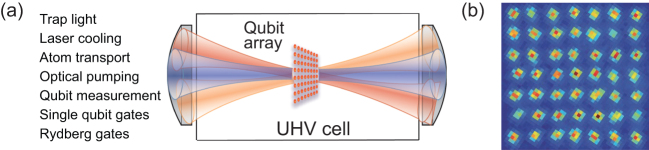
The power of quantum computation derives from algorithmic methods that exploit the availability of quantum superposition and entanglement to perform computations that are intractable with classical devices. The race is on to develop hardware that will unleash the promise of quantum algorithms. A handful of different types of hardware are currently being developed with the greatest efforts directed at superconducting, quantum-dot, trapped-ion, photonic, and neutral-atom approaches [1]. While all approaches have strengths and weaknesses, and are at different stages of development, the challenge of creating a practical design that can be scaled to a million or more qubits has not yet been met with any of the existing platforms. One may wonder if we really need a million qubits for a useful quantum computer. The answer depends on our ambition level. On the one hand it is widely believed that a quantum computer with less than 100 reliable qubits will be able to demonstrate a quantum advantage for a well defined computational problem [2]. Demonstration of a quantum computational advantage will generate great excitement in the halls of academia, but will have little broader import. A problem of great practical interest such as ab initio design of chemicals for increasing the yield of fertilizers for crop production, to name but one example, may also require just a few hundred qubits, provided computational sequences with circuit depth of 1010 or more operations can be reliably performed [3]. However, given the current performance of qubit hardware, which has demonstrated error rates not less than ∼10−3, computations with depth 1010 will only produce random outcomes of negligible value. The solution lies in the construction of error-correction circuitry operating on logical qubits, each composed of many physical qubits, which will enable logical error rates many orders of magnitude smaller than physical error rates. Although error correction is remarkably efficient for classical computing devices—Hamming codes detect and correct errors while only requiring roughly 10% overhead in the number of physical bits—quantum error correction is notoriously expensive. New approaches to error correction are the subject of intensive research with one promising direction being the development of codes that are optimized to suppress the dominant error mechanism in a particular physical platform [4,5]. Nevertheless, with physical error rates of 10−4, a plausible target for current qubit systems, the overhead required to reach logical error rates of 10−10 may be measured in thousands of physical qubits for each logical qubit. Thus a quantum computer able to perform deep calculations on a few hundred logical qubits could require a million physical qubits. A consequence of the cost of quantum error correction is that any viable approach to large-scale quantum computing needs to combine high-fidelity quantum logic operations with a capability for integrating large numbers of physical qubits. From this perspective neutral-atom qubits appear particularly promising [6] as they have already demonstrated control of more qubits than any other platform with recent experiments in 1D [7], 2D [8,9], and 3D [10] geometries showing control of up to 50 atomic qubits. Large qubit arrays can potentially be prepared in 1D, 2D, or 3D geometries. The number of proximal qubits increases with the dimensionality, which is advantageous for implementation of error correction code words, and points towards a preference for 2D or 3D arrays. On the other hand, the added overhead of compensating crosstalk incurred when targeting atoms inside a 3D volume makes parallel operations on multiple qubits challenging. A 2D geometry, as shown schematically in Fig. 1, may be an optimal choice since qubit control and measurement can be performed with lasers propagating normal to the plane of the array so that individual qubit sites can be addressed independently. With demonstrated array periods of a few micrometers we require a footprint of less than 1 mm2 for 104 qubits. Conceptual picture of a 2D neutral-atom qubit array. a) High-numerical-aperture lenses project several different wavelengths of light for control and measurement of the qubits. Specific choices of optical wavelengths depend on the atomic species. Not shown are optics for initial laser cooling, transport to the array, beam scanning, and imaging for qubit measurement. b) Averaged fluorescence image of 49 atomic qubits on a 2D grid with |$3.8 \, {\mu} \rm {m}$| spacing [8]. From a fundamental perspective the prospects for scaling neutral-atom systems are particularly promising due to the exceptionally large ratio between coherent and incoherent coupling rates. Neutral-atom qubits are encoded in hyperfine ground states for which coherence times of the order of 10 s have been demonstrated [10]. This implies a dephasing rate |$\gamma \sim 0.1 \, \rm s^{-1}$|. The coherent coupling that enables quantum logic o
Overview
The claims and statistics of this paper haven’t been checked yet.
Free: it reads the open-access text and checks the first 5 claims that cite a source we can check. Create a free account to check every claim.
Integrity signals
Registry
Cites
Statistics
Figures
Verification
Claims the paper makes
The claims and statistics of this paper haven’t been checked yet.
Free: it reads the open-access text and checks the first 5 claims that cite a source we can check. Create a free account to check every claim.
Claims other papers make about this one
Each is checked against this paper’s own text: does it say what the citing paper says it does?
The source backs part of the claim, not all of it — or backs it for a different population, condition or comparison.
In the citing paper
“Both argued that simulating quantum mechanics on classical computers requires resources growing exponentially in the problem instance size, so that certain problems will remain out of reach, regardless of the ingenuity of the algorithm designers.”
From Quantum Chemistry in the Age of Quantum Computing (2019) · cites this paper as [29]
Experimental — accuracy not yet measuredIn the citing paper
“Exact simulation of quantum chemistry systems is widely regarded as one of the problems that would benefit enormously from quantum hardware 29 .”
From Quantum Chemistry in the Age of Quantum Computing (2019) · cites this paper as [29]
Self-check
Percentages, sums and reported differences re-computed from the paper’s own numbers.
The self-check needs the paper’s full text.
Citations
Cites
Ladd, T. D., Jelezko, F., Laflamme, R., Nakamura, Y., Monroe, C., & O’Brien, J. L. (2010) · Nature · doi:10.1038/nature08812 · Cited by 3,592
Quantum information with Rydberg atoms
Saffman, M., Walker, T. G., & Mølmer, K. (2010) · Reviews of Modern Physics · doi:10.1103/revmodphys.82.2313 · Cited by 2,836
Self-citationProbing many-body dynamics on a 51-atom quantum simulator
Bernien, H., Schwartz, S., Keesling, A., Levine, H., Omran, A., Pichler, H., Choi, S., Zibrov, A. S., Endres, M., Greiner, M., et al. (2017) · Nature · doi:10.1038/nature24622 · Cited by 2,460
Fast Quantum Gates for Neutral Atoms
Jaksch, D., Cirac, J. I., Zoller, P., Rolston, S. L., Côté, R., & Lukin, M. D. (2000) · Physical Review Letters · doi:10.1103/physrevlett.85.2208 · Cited by 1,540
Cavity-based quantum networks with single atoms and optical photons
Reiserer, A., & Rempe, G. (2015) · Reviews of Modern Physics · doi:10.1103/revmodphys.87.1379 · Cited by 1,000
An atom-by-atom assembler of defect-free arbitrary two-dimensional atomic arrays
Barredo, D., de Léséleuc, S., Lienhard, V., Lahaye, T., & Browaeys, A. (2016) · Science · doi:10.1126/science.aah3778 · Cited by 860
Elucidating reaction mechanisms on quantum computers
Reiher, M., Wiebe, N., Svore, K. M., Wecker, D., & Troyer, M. (2017) · Proceedings of the National Academy of Sciences · doi:10.1073/pnas.1619152114 · Cited by 745
Quantum computational supremacy
Harrow, A. W., & Montanaro, A. (2017) · Nature · doi:10.1038/nature23458 · Cited by 702
Quantum computing with atomic qubits and Rydberg interactions: progress and challenges
Saffman, M. (2016) · Journal of Physics B: Atomic, Molecular and Optical Physics · doi:10.1088/0953-4075/49/20/202001 · Cited by 687
Self-citationHigh-Fidelity Control and Entanglement of Rydberg-Atom Qubits
Levine, H., Keesling, A., Omran, A., Bernien, H., Schwartz, S., Zibrov, A. S., Endres, M., Greiner, M., Vuletić, V., & Lukin, M. D. (2018) · Physical Review Letters · doi:10.1103/physrevlett.121.123603 · Cited by 424
Research works printed but not linked: 1
- Lienhard V, de Léséleuc S, Barredo D Phys Rev X 2018; 8: 021070.
Cited by
Quantum Chemistry in the Age of Quantum Computing
Cao, Y., Romero, J., Olson, J. P., Degroote, M., Johnson, P. D., Kieferová, M., Kivlichan, I. D., Menke, T., Peropadre, B., Sawaya, N. P. D., et al. (2019) · Chemical Reviews · doi:10.1021/acs.chemrev.8b00803 · Cited by 1,560
Quantum Chemistry in the Age of Quantum Computing
Cao, Y., Romero, J., Olson, J., Degroote, M., Johnson, P., Kieferová, M., Kivlichan, I., Menke, T., Peropadre, B., Sawaya, N., et al. (n.d.) · OPUS - Open Publications of UTS Scholars (University of Technology Sydney) · Cited by 1,265
Quantum Computer Systems for Scientific Discovery
Alexeev, Y., Bacon, D., Brown, K. R., Calderbank, R., Carr, L. D., Chong, F. T., DeMarco, B., Englund, D., Farhi, E., Fefferman, B., et al. (2021) · PRX Quantum · doi:10.1103/prxquantum.2.017001 · Cited by 248
Quantum Computer Systems for Scientific Discovery
Alexeev, Y., Bacon, D., Brown, K. R., Calderbank, R., Carr, L. D., Chong, F. T., DeMarco, B., Englund, D., Farhi, E., Fefferman, B., et al. (2021) · DSpace@MIT (Massachusetts Institute of Technology) · doi:10.6082/h7fqg-6vt65 · Cited by 240
A concise review of Rydberg atom based quantum computation and quantum simulation*
Wu, X., Liang, X., Tian, Y., Yang, F., Chen, C., Liu, Y.-C., Tey, M. K., & You, L. (2021) · Chinese Physics B · doi:10.1088/1674-1056/abd76f · Cited by 192
Metadata
- Authors
- Saffman, M.
- Affiliations
- University of Wisconsin–Madison (US)
- Corresponding author
- Saffman, Mark
- ORCID
- Saffman, Mark
- Venue
- National Science Review
- Publisher
- Oxford University Press (OUP)
- Published
- 2018-09-10
- Volume
- 6
- Issue
- 1
- Pages
- 24-25
- ISSN
- 2053-714X (ISSN-L)
- 2095-5138
- PMC
- PMC8291449
- OpenAlex
- W2891267877
- Cited by
- 69
- References
- 21
- Citations by year
- 2026: 9 · 2025: 14 · 2024: 13 · 2023: 4 · 2022: 7 · 2021: 11 · 2020: 9 · 2019: 2
- FWCI
- 3.10
- Type
- journal article
- Language
- en
- Open access
- hybrid
- doi.org
- Licence
- Locations
- National Science Review (publishedVersion, cc-by)
- PubMed Central (publishedVersion, cc-by)
- PubMed (publishedVersion)
- Funders
- National Science Foundation
- Topics
- Physical Sciences › Computer Science › Artificial Intelligence › Quantum Computing Algorithms and Architecture
- Physical Sciences › Physics and Astronomy › Atomic and Molecular Physics, and Optics › Cold Atom Physics and Bose-Einstein Condensates
- Physical Sciences › Physics and Astronomy › Atomic and Molecular Physics, and Optics › Quantum Information and Cryptography
- Keywords
- quantum computing, neutral atoms, trapped-ion quantum computing, quantum error correction, logical qubits, quantum bit error rate, scalability, quantum advantage, quantum chemistry simulation, superconducting qubits, photonic qubits, trapped-ion qubits, quantum dot qubits, quantum simulation of molecules
About these checks
Registry, retraction, Cites and statistics results are computed, not judged, with one exception: a printed reference that no index lists is read once by a model before it counts as a citation error. Claims are extracted by a model and kept only when their quote appears verbatim in the text; each cited source is then checked, with a model’s help, for whether it says what the claim relies on. Those verdicts can be wrong — read the claim’s quote and the cited source before relying on one.
Statistics and arithmetic are recomputed, not judged.
Confidence bands are shown only for fields calibrated on our annotated test set. None is calibrated yet, so no band is shown.
What counts as a claim ›How we measure confidence ›How we check this ›
Are you an author, or do you see a problem with this page? Request a review
How to cite
Cite CoChat for the checks on this page, and the paper for its own findings.
- This page
- CoChat. (2026). Citation check: Quantum computing with neutral atoms. https://app.cochat.ai/papers/10.1093/nsr/nwy088
- The paper
- Saffman, M. (2019). Quantum computing with neutral atoms. National Science Review. https://doi.org/10.1093/nsr/nwy088
Data sources
Bibliographic data: Semantic Scholar, OpenAlex, Crossref.
Contains information from the Semantic Scholar Academic Graph Datasets, made available under the ODC Attribution License (ODC-BY 1.0).
Semantic Scholar’s data is described in: Kinney, R., et al. (2023). The Semantic Scholar Open Data Platform. arXiv:2301.10140.
