

Glioblastoma modeling with 3D organoids: progress and challenges
Open accessThe DOI matches its Crossref record; 168 of the 168 references it cites were found in a registry or an index.
Abstract
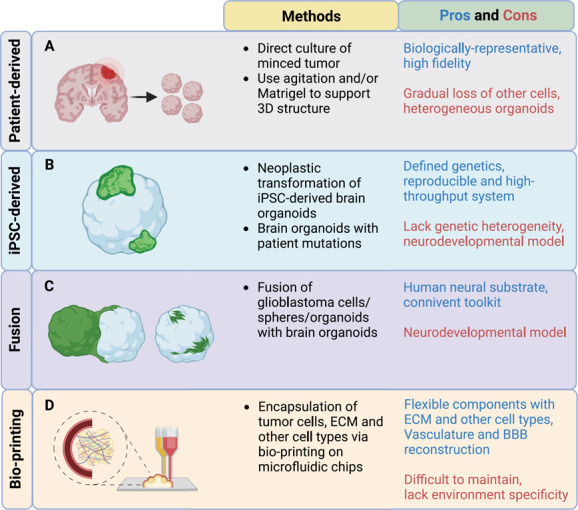
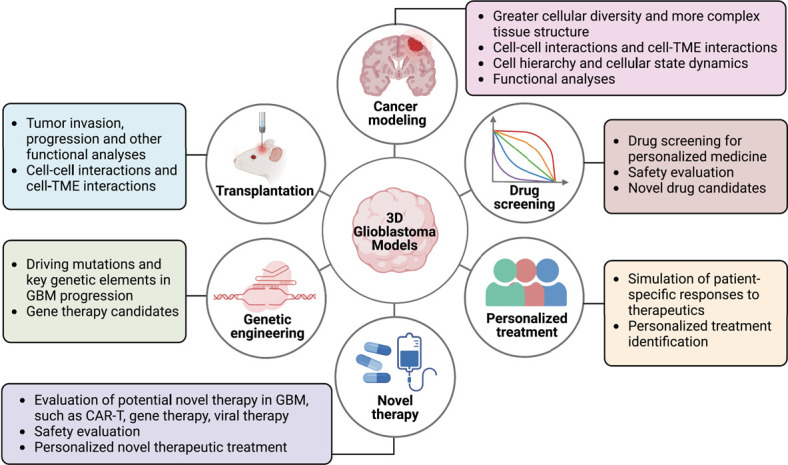
Glioblastoma (GBM) is the most aggressive adult primary brain tumor with nearly universal treatment resistance and recurrence. The mainstay of therapy remains maximal safe surgical resection followed by concurrent radiation therapy and temozolomide chemotherapy. Despite intensive investigation, alternative treatment options, such as immunotherapy or targeted molecular therapy, have yielded limited success to achieve long-term remission. This difficulty is partly due to the lack of pre-clinical models that fully recapitulate the intratumoral and intertumoral heterogeneity of GBM and the complex tumor microenvironment. Recently, GBM 3D organoids originating from resected patient tumors, genetic manipulation of induced pluripotent stem cell (iPSC)-derived brain organoids and bio-printing or fusion with non-malignant tissues have emerged as novel culture systems to portray the biology of GBM. Here, we highlight several methodologies for generating GBM organoids and discuss insights gained using such organoid models compared to classic modeling approaches using cell lines and xenografts. We also outline limitations of current GBM 3D organoids, most notably the difficulty retaining the tumor microenvironment, and discuss current efforts for improvements. Finally, we propose potential applications of organoid models for a deeper mechanistic understanding of GBM and therapeutic development.
Overview
The claims and statistics of this paper haven’t been checked yet.
Free: it reads the open-access text and checks the first 5 claims that cite a source we can check. Create a free account to check every claim.
Integrity signals
Registry
Cites
Statistics
Figures
Verification
Claims the paper makes
The claims and statistics of this paper haven’t been checked yet.
Free: it reads the open-access text and checks the first 5 claims that cite a source we can check. Create a free account to check every claim.
Claims other papers make about this one
Each is checked against this paper’s own text: does it say what the citing paper says it does?
The source backs part of the claim, not all of it — or backs it for a different population, condition or comparison.
In the citing paper
“Current methods show low maintenance of tumor stromal cells and spatial heterogeneity, and a low success rate for lower- grade gliomas (LGGs) and isocitrate dehydrogenase (IDH) mutant (IDH-mut) gliomas.13”
From Individualized patient tumor organoids faithfully preserve human brain tumor ecosystems and predict patient response to therapy (2025) · cites this paper as [13]
Experimental — accuracy not yet measuredThe cited source says what the claim attributes to it.
In the citing paper
“These models show better maintenance of GBM hetero- geneity and structure because they avoid tumor dissociation.13”
From Individualized patient tumor organoids faithfully preserve human brain tumor ecosystems and predict patient response to therapy (2025) · cites this paper as [13]
Self-check
Percentages, sums and reported differences re-computed from the paper’s own numbers.
The self-check needs the paper’s full text.
Citations
Cites
Radiotherapy Plus Concomitant and Adjuvant Temozolomide for Glioblastoma
Stupp, R., Mason, W. P., van den Bent, M. J., Weller, M., Fisher, B., Taphoorn, M. J. B., Belanger, K., Brandes, A. A., Marosi, C., Bogdahn, U., et al. (2005) · New England Journal of Medicine · doi:10.1056/nejmoa043330 · Cited by 21,807
The 2021 WHO classification of tumors of the central nervous system: a summary
Louis, D. N., Perry, A., Wesseling, P., Brat, D. J., Cree, I. A., Figarella-Branger, D., Hawkins, C., Ng, H. K., Pfister, S. M., Reifenberger, G., et al. (2021) · Neuro-Oncology · doi:10.1093/neuonc/noab106 · Cited by 12,273 · cited 3×
“IDH-wt GBM is grouped into three subtypes based on common transcriptomic and genetic signatures: classical, proneural and mesenchymal [1].”
BackgroundInfluentialComprehensive genomic characterization defines human glioblastoma genes and core pathways
The Cancer Genome Atlas Research Network (2008) · Nature · doi:10.1038/nature07385 · Cited by 7,735 · cited 2×
“…aberrations are associated with GBM onset and closely related to GBM subtypes, such as epidermal growth factor receptor (EGFR) overexpression and gain of Chr.7/loss of Chr.10 (classical GBM subtype), NF1 mutations (mesenchymal GBM subtype) and PDGFRA mutations (proneural GBM subtype) [64–67].”
BackgroundStupp, R., Hegi, M. E., Mason, W. P., van den Bent, M. J., Taphoorn, M. J., Janzer, R. C., Ludwin, S. K., Allgeier, A., Fisher, B., Belanger, K., et al. (2009) · The Lancet Oncology · doi:10.1016/s1470-2045(09)70025-7 · Cited by 7,668
Verhaak, R. G. W., Hoadley, K. A., Purdom, E., Wang, V., Qi, Y., Wilkerson, M. D., Miller, C. R., Ding, L., Golub, T., Mesirov, J. P., et al. (2010) · Cancer Cell · doi:10.1016/j.ccr.2009.12.020 · Cited by 7,575 · cited 1×
“GBM is traditionally classified into several subtypes with distinct genetic and transcriptomic features [1, 64–67, 105, 106].”
BackgroundIdentification of human brain tumour initiating cells
Singh, S. K., Hawkins, C., Clarke, I. D., Squire, J. A., Bayani, J., Hide, T., Henkelman, R. M., Cusimano, M. D., & Dirks, P. B. (2004) · Nature · doi:10.1038/nature03128 · Cited by 7,433 · cited 1×
“The first step toward 3D GBM models began from sphere cultures with growth factors in serum-free medium [34, 35], aiming to enrich and maintain the phenotypes of GBM stem cells (GSCs) [36–40].”
BackgroundAn Integrated Genomic Analysis of Human Glioblastoma Multiforme
Parsons, D. W., Jones, S., Zhang, X., Lin, J. C.-H., Leary, R. J., Angenendt, P., Mankoo, P., Carter, H., Siu, I.-M., Gallia, G. L., et al. (2008) · Science · doi:10.1126/science.1164382 · Cited by 5,857
Cerebral organoids model human brain development and microcephaly
Lancaster, M. A., Renner, M., Martin, C.-A., Wenzel, D., Bicknell, L. S., Hurles, M. E., Homfray, T., Penninger, J. M., Jackson, A. P., & Knoblich, J. A. (2013) · Nature · doi:10.1038/nature12517 · Cited by 5,372 · cited 1×
“Notably, brain organoids have been generated by various groups to mimic key features of human brain development and tissue structure, including human specific neural stem cells, cortical layer formation and generation of neuronal subtypes in both cortical and subcortical regions [49–57].”
BackgroundSingle-cell RNA-seq highlights intratumoral heterogeneity in primary glioblastoma
Patel, A. P., Tirosh, I., Trombetta, J. J., Shalek, A. K., Gillespie, S. M., Wakimoto, H., Cahill, D. P., Nahed, B. V., Curry, W. T., Martuza, R. L., et al. (2014) · Science · doi:10.1126/science.1254257 · Cited by 5,063 · cited 1×
“Recent advances in single-cell multi-omics coupled with next-generation sequencing further confirmed the existence of different GBM subtypes and suggested their roles in driving tumor progression and relapse [64, 106, 108–113].”
BackgroundThe Somatic Genomic Landscape of Glioblastoma
Brennan, C. W., Verhaak, R. G. W., McKenna, A., Campos, B., Noushmehr, H., Salama, S. R., Zheng, S., Chakravarty, D., Sanborn, J. Z., Berman, S. H., et al. (2013) · Cell · doi:10.1016/j.cell.2013.09.034 · Cited by 5,016 · cited 1×
“Interestingly, they found that Myc-overexpressing cells had a strong primitive neuroectodermal tumor-like signature with distinct cell identities compared with organoids carrying other mutation combinations (GBM-like neoCORs) [20] commonly found in GBM [65, 72, 92].”
Background
Cited by
Logun, M. T., Wang, X., Sun, Y. Y., Bagley, S. J., Li, N., Desai, A. S., Zhang, D. Y., Nasrallah, M. P., Pai, E. L.-L., Oner, B. S., et al. (2024) · Cell stem cell · doi:10.1016/j.stem.2024.11.010 · Cited by 144
Self-citationBrain-wide neuronal circuit connectome of human glioblastoma
Sun, Y. Y., Wang, X., Zhang, D. Y., Zhang, Z., Bhattarai, J. P., Wang, Y., Park, K. H., Dong, W., Hung, Y.-F., Yang, Q., et al. (2025) · Nature · doi:10.1038/s41586-025-08634-7 · Cited by 136
“Here we performed retrograde rabies virus trans-monosynaptic tracing of transplanted patient-derived GBM organoids (GBOs) 14,15 into the adult mouse brain to characterize the landscape of neuronal innervation of GBM cells in vivo and further investigated the functional effects of neuromodulatory…”
Self-citationPeng, T., Ma, X., Hua, W., Wang, C., Chu, Y., Sun, M., Fermi, V., Hamelmann, S., Lindner, K., Shao, C., et al. (2025) · Cell Stem Cell · doi:10.1016/j.stem.2025.01.002 · Cited by 86
Glioblastoma-cortical organoids recapitulate cell state heterogeneity and intercellular transfer
Mangena, V., Chanoch-Myers, R., Sartore, R., Paulsen, B., Gritsch, S., Weisman, H., Hara, T., Breakefield, X. O., Breyne, K., Regev, A., et al. (2025) · Cancer Discovery · doi:10.1158/2159-8290.cd-23-1336 · Cited by 49
“A second approach has involved grafting GBM cells into independently derived human organ-oids of neural origin (17, 18).”
Evolution of Preclinical Models for Glioblastoma Modelling and Drug Screening
Thomas, G., & Rahman, R. (2025) · Current Oncology Reports · doi:10.1007/s11912-025-01672-4 · Cited by 43
“The tissue was mechanically minced and then seeded on agar-coated flasks, facilitating self-organisation into small organoids within two weeks [62].”
Metadata
- Authors
- Wang, X., Sun, Y., Zhang, D. Y., Ming, G.-L., & Song, H.
- Affiliations
- University of Pennsylvania (US)
- Abramson Cancer Center (US)
- Corresponding author
- Song, Hongjun
- Venue
- Oxford Open Neuroscience
- Publisher
- Oxford University Press (OUP)
- Published
- 2023
- Volume
- 2
- Pages
- kvad008-kvad008
- ISSN
- 2753-149X (ISSN-L)
- PMC
- PMC10913843
- OpenAlex
- W4383314579
- Semantic Scholar
- c3b30c55134c980d41e9da0f92b30086461e9d1c
- Cited by
- 46
- References
- 167
- Citations by year
- 2026: 23 · 2025: 18 · 2024: 5
- FWCI
- 2.16
- Type
- journal article
- Language
- en
- Open access
- gold
- doi.org
- Locations
- Oxford Open Neuroscience (publishedVersion, cc-by)
- PubMed Central (publishedVersion, cc-by)
- PubMed (publishedVersion)
- Funders
- Pennsylvania Department of Health
- Dr. Miriam and Sheldon G. Adelson Medical Research Foundation
- National Institutes of Health
- National Institute of Neurological Disorders and Stroke (R35NS097370, R35NS116843)
- Topics
- Health Sciences › Medicine › Oncology › Glioma Diagnosis and Treatment
- Health Sciences › Medicine › Oncology › Cancer Cells and Metastasis
- Physical Sciences › Engineering › Biomedical Engineering › 3D Printing in Biomedical Research
- Keywords
- glioblastoma, 3D organoids, brain organoids, induced pluripotent stem cells, tumor microenvironment, intratumoral heterogeneity, treatment resistance, organoid fusion, preclinical cancer models, xenografts, cell lines, treatment development
About these checks
Registry, retraction, Cites and statistics results are computed, not judged, with one exception: a printed reference that no index lists is read once by a model before it counts as a citation error. Claims are extracted by a model and kept only when their quote appears verbatim in the text; each cited source is then checked, with a model’s help, for whether it says what the claim relies on. Those verdicts can be wrong — read the claim’s quote and the cited source before relying on one.
Statistics and arithmetic are recomputed, not judged.
Confidence bands are shown only for fields calibrated on our annotated test set. None is calibrated yet, so no band is shown.
What counts as a claim ›How we measure confidence ›How we check this ›
Are you an author, or do you see a problem with this page? Request a review
Data sources
Bibliographic data: Semantic Scholar, OpenAlex, Crossref.
Contains information from the Semantic Scholar Academic Graph Datasets, made available under the ODC Attribution License (ODC-BY 1.0).
Semantic Scholar’s data is described in: Kinney, R., et al. (2023). The Semantic Scholar Open Data Platform. arXiv:2301.10140.
