

Online Acceptance and Commitment Therapy for People with Painful Diabetic Neuropathy in the United Kingdom: A Single-Arm Feasibility Trial
Open accessThe DOI matches its Crossref record; 43 of the 43 references it cites were found in a registry or an index.
Abstract
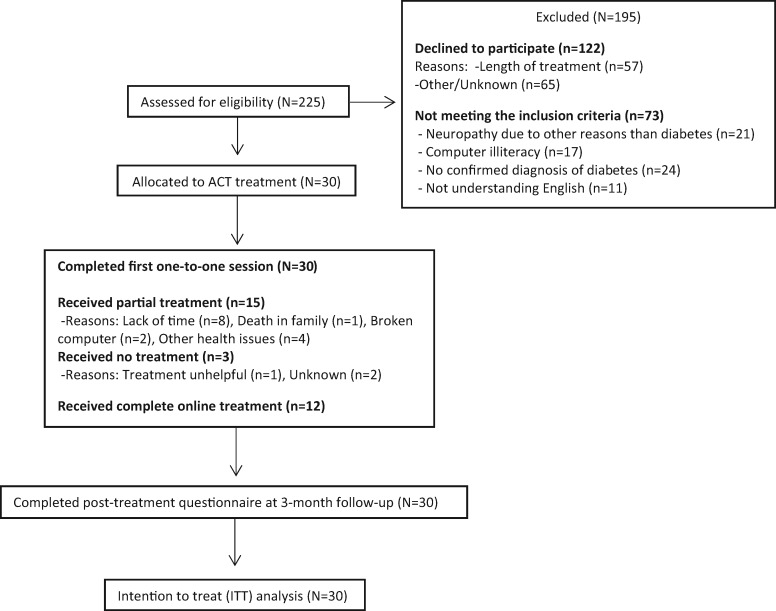
Objective: This study aimed to assess the feasibility of online Acceptance and Commitment Therapy for painful diabetic neuropathy in the United Kingdom and to determine if a larger randomized controlled trial testing treatment efficacy is justified. Methods: Participants with painful diabetic neuropathy were recruited online and from hospital services. This was a single-arm study in which all participants received online Acceptance and Commitment Therapy. Participants completed questionnaires at baseline and three months post-treatment. Primary feasibility outcomes were recruitment, retention, and treatment completion rates. Secondary outcomes were pre- to post-treatment effects on pain outcomes and psychological flexibility. Results: Of 225 potentially eligible participants, 30 took part in this study. Regarding primary feasibility outcomes, the treatment completion and follow-up questionnaire completion rates were 40% and 100%, respectively. Generally, at baseline those who completed the treatment, compared with those who did not, had better daily functioning and higher psychological flexibility. With respect to secondary outcomes, results from the completers group showed clinically meaningful effects at post-treatment for 100% of participants for pain intensity and pain distress, 66.7% for depressive symptoms, 58.3% for functional impairment, 41.7% for cognitive fusion, 66.7% for committed action, 58.3% for self-as-context, and 41.7% for pain acceptance. Conclusions: This preliminary trial suggests feasibility of recruitment and follow-up questionnaire completion rates, supporting planning for a larger randomized controlled trial. However, treatment completion rates did not achieve the prespecified feasibility target. Changes to the treatment content and delivery may enhance the feasibility of online Acceptance and Commitment Therapy for people with painful diabetic neuropathy on a larger scale.
Overview
The claims and statistics of this paper haven’t been checked yet.
Free: it reads the open-access text and checks the first 5 claims that cite a source we can check. Create a free account to check every claim.
Integrity signals
Registry
Cites
Statistics
Figures
Verification
Claims the paper makes
The claims and statistics of this paper haven’t been checked yet.
Free: it reads the open-access text and checks the first 5 claims that cite a source we can check. Create a free account to check every claim.
Claims other papers make about this one
Each is checked against this paper’s own text: does it say what the citing paper says it does?
The cited source doesn’t support the claim as written.
In the citing paper
“Studies evaluating online ACT for chronic pain speci fi cally, have shown that these treatments are feasible and acceptable [25, 26].”
From A feasibility trial of online Acceptance and Commitment Therapy for women with provoked vestibulodynia (2023) · cites this paper as [26]
Checked by a reasoning model — may be wrong.
Experimental — accuracy not yet measuredThe cited source says what the claim attributes to it.
In the citing paper
“This ACT program, ACT for PAIN, builds off previously tested versions.21–23”
From Design and implementation of online acceptance and commitment therapy with enhanced therapist support for chronic low back pain (ACT for PAIN) (2025) · cites this paper as [21]
The cited source says what the claim attributes to it.
In the citing paper
“It is based on the content and design previously studied in general chronic pain,22 painful diabetic neuropathy,21 vulvodynia,24 and HIV-related pain.23”
From Design and implementation of online acceptance and commitment therapy with enhanced therapist support for chronic low back pain (ACT for PAIN) (2025) · cites this paper as [21]
Self-check
Percentages, sums and reported differences re-computed from the paper’s own numbers.
The self-check needs the paper’s full text.
Citations
Cites
The PHQ-9: Validity of a brief depression severity measure
Kroenke, K., Spitzer, R. L., & Williams, J. B. W. (2001) · Journal of General Internal Medicine · doi:10.1046/j.1525-1497.2001.016009606.x · Cited by 44,910
(1976) · Medical Entomology and Zoology · Cited by 8,899
Acceptance and commitment therapy: model, processes and outcomes
Hayes, S. C., Luoma, J. B., Bond, F. W., Masuda, A., & Lillis, J. (2006) · Behaviour Research and Therapy · doi:10.1016/j.brat.2005.06.006 · Cited by 6,587
(1999) · Cited by 5,934
Pharmacotherapy for neuropathic pain in adults: a systematic review and meta-analysis
Finnerup, N. B., Attal, N., Haroutounian, S., McNicol, E., Baron, R., Dworkin, R. H., Gilron, I., Haanpää, M., Hansson, P., Jensen, T. S., et al. (2015) · The Lancet Neurology · doi:10.1016/s1474-4422(14)70251-0 · Cited by 3,980
The Prevalence of Comorbid Depression in Adults With Diabetes
Anderson, R. J., Freedland, K. E., Clouse, R. E., & Lustman, P. J. (2001) · Diabetes Care · doi:10.2337/diacare.24.6.1069 · Cited by 3,926
Grading the severity of chronic pain
Von Korff, M., Ormel, J., Keefe, F. J., & Dworkin, S. F. (1992) · Pain · doi:10.1016/0304-3959(92)90154-4 · Cited by 3,022
The Work and Social Adjustment Scale: a simple measure of impairment in functioning
Mundt, J. C., Marks, I. M., Shear, M. K., & Greist, J. M. (2002) · British Journal of Psychiatry · doi:10.1192/bjp.180.5.461 · Cited by 2,515
Estimating effect sizes from pretest-posttest-control group designs
Morris, S. B. (2008) · Organizational Research Methods · doi:10.1177/1094428106291059 · Cited by 2,133
Neuropathic Pain: A Maladaptive Response of the Nervous System to Damage
Costigan, M., Scholz, J., & Woolf, C. J. (2009) · Annual Review of Neuroscience · doi:10.1146/annurev.neuro.051508.135531 · Cited by 2,025
Cited by
van de Graaf, D. L., Trompetter, H. R., Smeets, T., & Mols, F. (2021) · Internet Interventions · doi:10.1016/j.invent.2021.100465 · Cited by 49
“, 2018), and one study assessed painful diabetic neuropathy (Kioskli et al., 2020).”
BackgroundMethodInfluentialCarvalho, S. A., Skvarc, D., Barbosa, R., Tavares, T., Santos, D., & Trindade, I. A. (2022) · Clinical Psychology & Psychotherapy · doi:10.1002/cpp.2643 · Cited by 40
Yu, L., Kioskli, K., & McCracken, L. M. (2021) · The Journal of Pain · doi:10.1016/j.jpain.2021.02.011 · Cited by 35
Self-citationBai, Y., Ma, J.-H., Yu, Y., & Wang, Z. (2022) · Pain Management Nursing · doi:10.1016/j.pmn.2022.05.005 · Cited by 30
Future directions in psychological therapies for pain management
Lazaridou, A., Paschali, M., & Edwards, R. R. (2020) · Pain Medicine · doi:10.1093/pm/pnaa335 · Cited by 12
Maathz, P., McCracken, L. M., Eriksson, V., Säde, F., Aneblom, G., Rikner, Å., Skalkidou, A., & Buhrman, M. (2023) · Scandinavian Journal of Pain · doi:10.1515/sjpain-2022-0146 · Cited by 10
“Studies evaluating online ACT for chronic pain specifically, have shown that these treatments are feasible and acceptable [25, 26].”
BackgroundSelf-citationMauck, M. C., Barth, K. S., Bell, K. M., Brooks, A. K., Chadwick, A. L., Gunn, C. A., Hurley, R. W., Ivanova, A., Piva, S. R., Schneider, M., et al. (2025) · Pain Medicine · doi:10.1093/pm/pnaf032 · Cited by 11
Psychologically based interventions for adults with chronic neuropathic pain: a scoping review
Oguchi, M., Nicholas, M. K., Asghari, A., Sanders, D., & Wrigley, P. J. (2024) · Pain Medicine · doi:10.1093/pm/pnae006 · Cited by 12
“%) of the studies that assessed disability, 12,32,41,44,48,51 and 3 (19”
InfluentialRoberts, M. Z., Scheiber, F. A., Moskovich, A. A., & Merwin, R. M. (2025) · Behavioral Sciences · doi:10.3390/bs15060792 · Cited by 10
“…2019; Seo, 2023a; Zandkarimi & Ghahremani, 2022), mindfulness (Alho et al., 2021; Alho et al., 2024; Berlin et al., 2020; Keenan et al., 2022; Kioskli et al., 2020; Momeniarbat et al., 2017; Ryan et al., 2020; Saito & Kumano, 2022), and values clarification, meaning in life, or committed…”
InfluentialSanduvete-Chaves, S., Chacón-Moscoso, S., & Cano-García, F. J. (2024) · Journal of Psychosomatic Research · doi:10.1016/j.jpsychores.2024.111888 · Cited by 4
Rabinowitz, E. P., Ripley, G., Levin, M. E., Allen, P. A., & Delahanty, D. L. (2024) · Journal of Contextual Behavioral Science · doi:10.1016/j.jcbs.2024.100828 · Cited by 5
Peoples’ experiences of painful diabetic neuropathy: are pain management programmes appropriate?
Davies, B. R., Cramp, F. L., Gauntlett‐Gilbert, J., & McCabe, C. (2021) · British Journal of Pain · doi:10.1177/2049463721989753 · Cited by 6
Quality of life of persons with painful diabetic neuropathy: How can we improve it?
Vileikytė, L. (2023) · Diabetes Research and Clinical Practice · doi:10.1016/j.diabres.2023.110756 · Cited by 5
Jones Berkeley, S., Wedin, S., Patidar, S. M., Margolies, S. O., Goetzinger, A. M., Mauck, M. C., Wasan, A. D., & McCracken, L. M. (2025) · Pain Medicine · doi:10.1093/pm/pnaf026 · Cited by 3
“It is based on the content and design previously studied in general chronic pain, 22 painful diabetic neuropathy, 21 vulvodynia, 24 and HIV-related pain.”
Self-citationIdentity and Sport Participation Following Limb Loss: A Qualitative Study
Havlin, H., Molyneaux, V., & Murray, C. D. (2025) · Prosthesis · doi:10.3390/prosthesis7030049 · Cited by 4
Characteristics and Treatment of Painful Diabetic Neuropathy
Gylfadottir, S. S., & Finnerup, N. B. (2023) · Contemporary diabetes · doi:10.1007/978-3-031-15613-7_25 · Cited by 2
Buren, R., Ponzano, M., Adams, N. T., Jun, J., & Ginis, K. A. M. (2026) · Epidemiologic Reviews · doi:10.1093/epirev/mxag002 · Cited by 1
Salehi, H. M., Jahangiri, A., & Bakhshipour, A. (2021) · doi:10.22123/chj.2021.246660.1573 · Cited by 2
Living with painful diabetic neuropathy: physical activity and quality of life
van Laake‐Geelen, C. C. M. (2021) · Research Publications (Maastricht University) · doi:10.26481/dis.20210923cg
Decker, V. B., King, C., Cassisi, J. E., & Tofthagen, C. S. (2023) · CIN Computers Informatics Nursing · doi:10.1097/cin.0000000000001008
Psychosocial Aspects of Diabetic Neuropathy: From Description to Interventions
Vileikytė, L., & Pouwer, F. (2023) · Contemporary diabetes · doi:10.1007/978-3-031-15613-7_13 · Cited by 1
Virtual Acceptance and Commitment Therapy (vACT) For Youth with Chronic Illnesses: A Case Report
Mahrer, N. E., Sommer, V. S., Berman, D. I., Ngo, N. H., & Gold, J. I. (2023) · Medical Research Archives · doi:10.18103/mra.v11i6.3897 · Cited by 1
Axenova, K., Malkin, A., & Thomson, K. M. (2026) · Journal of Organizational Behavior Management · doi:10.1080/01608061.2025.2609552
“Similar findings have been reported in individuals with pain-related health conditions (e.g., Kioskli et al., 2020; Zetterqvist et al., 2020), community adults (e.g., Petersen et al., 2021), caregivers for people with dementia and cerebral palsy (e.g., Kishita et al., 2022; McMillan et al., 2020),…”
Gkofa, V., Godfrey, E. L., & Scott, W. (2026) · Journal of Contextual Behavioral Science · doi:10.1016/j.jcbs.2026.100994
Self-citation
Metadata
- Authors
- Kioskli, K., Scott, W., Winkley, K., Godfrey, E., & McCracken, L. M.
- Affiliations
- King's College London (GB)
- Uppsala University (SE)
- Corresponding author
- McCracken, Lance M
- Venue
- Pain Medicine
- Publisher
- Oxford University Press (OUP)
- Published
- 2020-05-01
- Volume
- 21
- Issue
- 11
- Pages
- 2777-2788
- ISSN
- 1526-2375 (ISSN-L)
- 1526-4637
- PMC
- PMC7685693
- OpenAlex
- W3022244387
- Cited by
- 24
- References
- 43
- Citations by year
- 2026: 3 · 2025: 4 · 2024: 3 · 2023: 6 · 2022: 1 · 2021: 6 · 2020: 1
- FWCI
- 1.40
- Type
- journal article
- Language
- en
- Open access
- hybrid
- doi.org
- Licence
- Locations
- Pain Medicine (publishedVersion, cc-by)
- PubMed Central (publishedVersion, cc-by)
- PubMed (publishedVersion)
- Uppsala University Publications (Uppsala University) (submittedVersion, other-oa)
- Funders
- Diabetes UK (16/0005540)
- National Institute for Health Research (NIHR
- Whitney Scott (PDF-2015-08-059)
- Topics
- Social Sciences › Psychology › Clinical Psychology › Mindfulness and Compassion Interventions
- Social Sciences › Psychology › Applied Psychology › Digital Mental Health Interventions
- Health Sciences › Medicine › Physiology (medical) › Pain Mechanisms and Treatments
- Keywords
- acceptance and commitment therapy, diabetic neuropathic pain, online psychological intervention, feasibility, recruitment and retention, treatment completion, psychological flexibility, pain acceptance, pain intensity, pain-related distress, depressive symptoms, functional disability, cognitive fusion, self-as-context, committed action
- MeSH terms
- Diabetes Mellitus, Diabetic Neuropathies, Feasibility Studies, United Kingdom, Humans, Surveys and Questionnaires, Treatment Outcome, Acceptance and Commitment Therapy
About these checks
Registry, retraction, Cites and statistics results are computed, not judged, with one exception: a printed reference that no index lists is read once by a model before it counts as a citation error. Claims are extracted by a model and kept only when their quote appears verbatim in the text; each cited source is then checked, with a model’s help, for whether it says what the claim relies on. Those verdicts can be wrong — read the claim’s quote and the cited source before relying on one.
Statistics and arithmetic are recomputed, not judged.
Confidence bands are shown only for fields calibrated on our annotated test set. None is calibrated yet, so no band is shown.
What counts as a claim ›How we measure confidence ›How we check this ›
Are you an author, or do you see a problem with this page? Request a review
Data sources
Bibliographic data: Semantic Scholar, OpenAlex, Crossref.
Contains information from the Semantic Scholar Academic Graph Datasets, made available under the ODC Attribution License (ODC-BY 1.0).
Semantic Scholar’s data is described in: Kinney, R., et al. (2023). The Semantic Scholar Open Data Platform. arXiv:2301.10140.
