

“My Surgical Success”: Effect of a Digital Behavioral Pain Medicine Intervention on Time to Opioid Cessation After Breast Cancer Surgery—A Pilot Randomized Controlled Clinical Trial
Open accessThe DOI matches its Crossref record; 38 of the 38 references it cites were found in a registry or an index.
Abstract
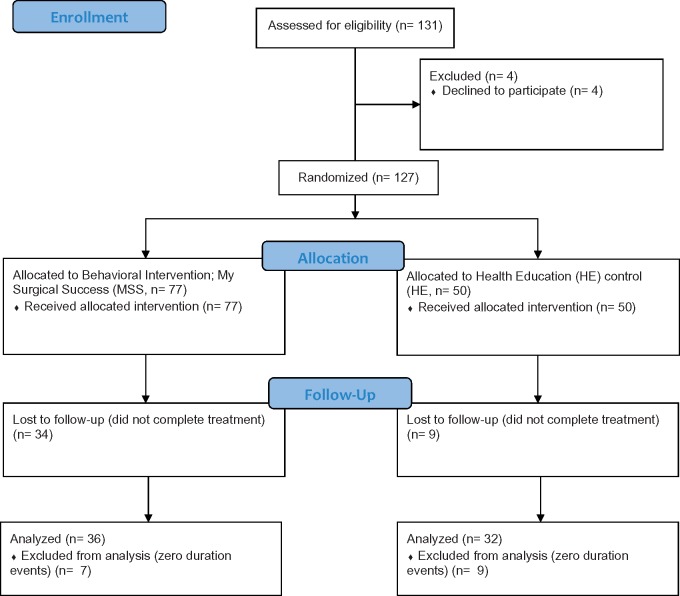
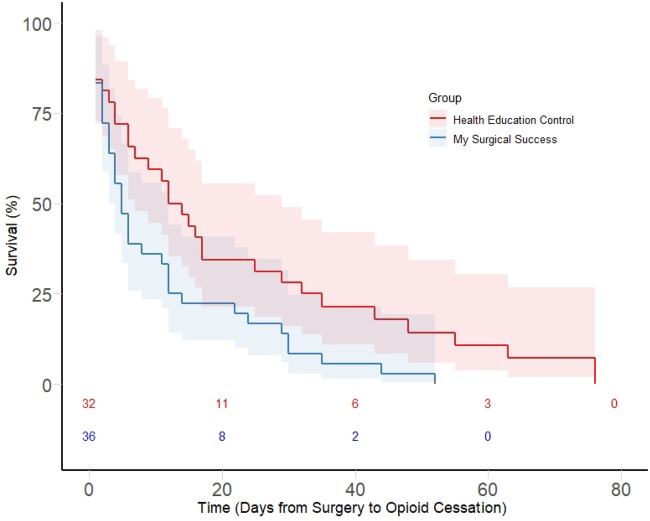
Objective: This study aims to assess the feasibility of digital perioperative behavioral pain medicine intervention in breast cancer surgery and evaluate its impact on pain catastrophizing, pain, and opioid cessation after surgery. Design and Setting: A randomized controlled clinical trial was conducted at Stanford University (Palo Alto, CA, USA) comparing a digital behavioral pain medicine intervention (“My Surgical Success” [MSS]) with digital general health education (HE). Participants: A convenience sample of 127 participants were randomized to treatment group. The analytic sample was 68 patients (N = 36 MSS, N = 32 HE). Main Outcomes: The primary outcome was feasibility and acceptability of a digital behavioral pain medicine intervention (80% threshold for acceptability items). Secondary outcomes were pain catastrophizing, past seven-day average pain intensity, and time to opioid cessation after surgery for patients who initiated opioid use. Results: The attrition rate for MSS intervention (44%) was notably higher than for HE controls (18%), but it was lower than typical attrition rates for e-health interventions (60–80%). Despite greater attrition for MSS, feasibility was demonstrated for the 56% of MSS engagers, and the 80% threshold for acceptability was met. We observed a floor effect for baseline pain catastrophizing, and no significant group differences were found for postsurgical pain catastrophizing or pain intensity. MSS was associated with 86% increased odds of opioid cessation within the 12-week study period relative to HE controls (hazard ratio = 1.86, 95% confidence interval = 1.12–3.10, P = 0.016). Conclusions: Fifty-six percent of patients assigned to MSS engaged with the online platform and reported high satisfaction. MSS was associated with significantly accelerated opioid cessation after surgery (five-day difference) with no difference in pain report relative to controls. Perioperative digital behavioral pain medicine may be a low-cost, accessible adjunct that could promote opioid cessation after breast cancer surgery.
Overview
The claims and statistics of this paper haven’t been checked yet.
Free: it reads the open-access text and checks the first 5 claims that cite a source we can check. Create a free account to check every claim.
Integrity signals
Registry
Cites
Statistics
Figures
Verification
Claims the paper makes
The claims and statistics of this paper haven’t been checked yet.
Free: it reads the open-access text and checks the first 5 claims that cite a source we can check. Create a free account to check every claim.
Claims other papers make about this one
Each is checked against this paper’s own text: does it say what the citing paper says it does?
The cited source says what the claim attributes to it.
In the citing paper
“Twelve studies evaluated (sub)acute outcomes, 2,7,11,12,18,21,29,32,39,44,45,55 and all but 2 studies 2,18 evaluated chronic outcomes.”
The cited source says what the claim attributes to it.
In the citing paper
“Relative to the adult literature, 45,66,70 there is much less pediatric research on psychological interventions during the perioperative period, 46”
From Virtual psychoeducation for improvement of pain catastrophizing in pediatric presurgical patients and caregivers: a proof-of-concept study (2023) · cites this paper as [70]
Self-check
Percentages, sums and reported differences re-computed from the paper’s own numbers.
The self-check needs the paper’s full text.
Citations
Cites
The Pain Catastrophizing Scale: Development and validation.
Sullivan, M. J. L., Bishop, S. R., & Pivik, J. (1995) · Psychological Assessment · doi:10.1037//1040-3590.7.4.524 · Cited by 8,227 · cited 5×
“The mean PCS scores were 7.33 (SEM¼ 1.3) for the MSS group and 10.06 (SEM¼ 1.4) for the HE control group, with no significant group differences.”
BackgroundMethodInfluentialFarrar, J. T., Young, J. P., LaMoreaux, L., Werth, J. L., & Poole, M. R. (2001) · Pain · doi:10.1016/s0304-3959(01)00349-9 · Cited by 5,808 · cited 1×
“Pain intensity was assessed on a numerical rating scale using an abbreviated PROMIS Pain Intensity measure [20]; respondents were asked to rate their average pain intensity over the previous seven days on a scale of 0–5.”
MethodEnhanced Recovery After Surgery: A Review
Ljungqvist, O., Scott, M., & Fearon, K. C. (2017) · JAMA Surgery · doi:10.1001/jamasurg.2016.4952 · Cited by 3,564 · cited 1×
“There is increasing interest in reducing postoperative opioid exposure by utilizing multimodal analgesia and nonpharmacological approaches to enhance recovery after surgery (ERAS) [25].”
BackgroundEysenbach, G. (2005) · Journal of Medical Internet Research · doi:10.2196/jmir.7.1.e11 · Cited by 2,524 · cited 1×
“Patients who would never otherwise receive specialized treatment are given the opportunity to do so [28], with costs being nominal to none.”
BackgroundNew Persistent Opioid Use After Minor and Major Surgical Procedures in US Adults
Brummett, C. M., Waljee, J. F., Goesling, J., Moser, S., Lin, P., Englesbe, M. J., Bohnert, A. S. B., Kheterpal, S., & Nallamothu, B. K. (2017) · JAMA Surgery · doi:10.1001/jamasurg.2017.0504 · Cited by 2,025 · cited 1×
“5% of patients prescribed opioids after surgery will transition to long-term opioid use [1,2], and up to 10% of women will continue to fill opioid prescriptions three months after breast reconstruction surgery [3].”
BackgroundSun, E. C., Darnall, B. D., Baker, L. C., & Mackey, S. (2016) · JAMA Internal Medicine · doi:10.1001/jamainternmed.2016.3298 · Cited by 1,078 · cited 1×
“5% of patients prescribed opioids after surgery will transition to long-term opioid use [1,2], and up to 10% of women will continue to fill opioid prescriptions three months after breast reconstruction surgery [3].”
BackgroundSelf-citationEhde, D. M., Dillworth, T. M., & Turner, J. A. (2014) · American Psychologist · doi:10.1037/a0035747 · Cited by 879 · cited 1×
“Cognitive-behavioral therapy for chronic pain (painCBT) is effective skills-based behavioral medicine with demonstrated efficacy for improving a wide range of pain outcomes [6] including reduced opioid use [7] and misuse [8] in outpatients.”
BackgroundPain Catastrophizing and Kinesiophobia: Predictors of Chronic Low Back Pain
Picavet, H. S. J. (2002) · American Journal of Epidemiology · doi:10.1093/aje/kwf136 · Cited by 744
Granot, M., & Ferber, S. G. (2005) · The Clinical Journal of Pain · doi:10.1097/01.ajp.0000135236.12705.2d · Cited by 426 · cited 1×
“This measure has been used in surgical research [13], specifically to examine predictors of postsurgical opioid cessation vs prolonged use (e.”
MethodPreoperative Pain Catastrophizing Predicts Pain Outcome after Knee Arthroplasty
Riddle, D. L., Wade, J. B., Jiranek, W. A., & Kong, X. (2010) · Clinical Orthopaedics & Related Research · doi:10.1007/s11999-009-0963-y · Cited by 406 · cited 1×
“However, we observed a floor effect for pain catastrophizing in the study sample; the average baseline PCS scores were well below the published ranges for clinically moderate or high levels in surgical populations [12, 34, 35] and could be best characterized as being in the “nonsymptomatic” range that does not require…”
BackgroundPowell, R., Scott, N. W., Manyande, A., Bruce, J., Vögele, C., Byrne-Davis, L. M., Unsworth, M., Osmer, C., & Johnston, M. (2016) · Cochrane Database of Systematic Reviews · doi:10.1002/14651858.cd008646.pub2 · Cited by 369 · cited 1×
“examined psychological preparation and postoperative outcomes for adults undergoing surgery under general anesthesia [37].”
Lai, J.-S., Cella, D., Choi, S., Junghaenel, D. U., Christodoulou, C., Gershon, R., & Stone, A. (2011) · Archives of Physical Medicine and Rehabilitation · doi:10.1016/j.apmr.2010.08.033 · Cited by 362
Catastrophizing: a risk factor for postsurgical pain
Pavlin, D. J., Sullivan, M. J. L., Freund, P. R., & Roesen, K. (2005) · The Clinical Journal of Pain · doi:10.1097/00002508-200501000-00010 · Cited by 326
Catastrophizing: a predictive factor for postoperative pain
Khan, R. S., Ahmed, K., Blakeway, E., Skapinakis, P., Nihoyannopoulos, L., Macleod, K., Sevdalis, N., Ashrafian, H., Platt, M., Darzi, A., et al. (2011) · The American Journal of Surgery · doi:10.1016/j.amjsurg.2010.02.007 · Cited by 289
Risk Factors for Continued Opioid Use One to Two Months After Surgery for Musculoskeletal Trauma
Helmerhorst, G. T. T., Vranceanu, A.-M., Vrahas, M., Smith, M., & Ring, D. (2014) · Journal of Bone and Joint Surgery · doi:10.2106/jbjs.l.01406 · Cited by 252 · cited 3×
“Interventions that equip patients with the skills to self-manage the pain and distress related to their surgery could be integrated into multimodal perioperative pathways designed to enhance recovery after surgery [4].”
BackgroundDevelopment and psychometric analysis of the PROMIS pain behavior item bank
Revicki, D. A., Chen, W.-H., Harnam, N., Cook, K. F., Amtmann, D., Callahan, L. F., Jensen, M. P., & Keefe, F. J. (2009) · Pain · doi:10.1016/j.pain.2009.07.029 · Cited by 237
Relative effect sizes for measures of risk
Olivier, J., May, W. L., & Bell, M. L. (2017) · Communications in Statistics - Theory and Methods · doi:10.1080/03610926.2015.1134575 · Cited by 213 · cited 1×
“9, the equivalent of a “medium” effect in terms of Cohen’s d [23, 24], for the effect of the MSS treatment vs HE control in the 12-week postsurgical follow-up after surgery using Cox proportional hazards regression (PROC POWER).”
MethodThe Role of Catastrophizing in the Prediction of Postoperative Pain
Papaioannou, M., Skapinakis, P., Damigos, D., Mavreas, V., Broumas, G., & Palgimesi, A. (2009) · Pain Medicine · doi:10.1111/j.1526-4637.2009.00730.x · Cited by 205
Hah, J., Mackey, S. C., Schmidt, P., McCue, R., Humphreys, K., Trafton, J., Efron, B., Clay, D., Sharifzadeh, Y., Ruchelli, G., et al. (2018) · JAMA Surgery · doi:10.1001/jamasurg.2017.4915 · Cited by 203
Substance misuse treatment for high-risk chronic pain patients on opioid therapy: A randomized trial
Jamison, R. N., Ross, E. L., Michna, E., Chen, L. Q., Holcomb, C., & Wasan, A. D. (2010) · Pain · doi:10.1016/j.pain.2010.02.033 · Cited by 202
Psychometric Properties of the PROMIS Physical Function Item Bank in Patients With Spinal Disorders
Hung, M., Hon, S. D., Franklin, J. D., Kendall, R. W., Lawrence, B. D., Neese, A., Cheng, C., & Brodke, D. S. (2014) · Spine · doi:10.1097/brs.0000000000000097 · Cited by 176
Darnall, B., Sturgeon, J., Kao, M.-C., Hah, J., & Mackey, S. (2014) · Journal of Pain Research · doi:10.2147/jpr.s62329 · Cited by 140 · cited 1×
“MSS extends our prior work on brief pain interventions and is modeled after a single-session chronic pain outpatient class (“Empowered Relief”) that provides pain education and self-regulation skills, including strategies to regulate cognition, emotion, and physiological responses to pain and related distress [10,11].”
BackgroundSelf-citationGeraghty, A. W. A., Torres, L. D., Leykin, Y., Perez-Stable, E. J., & Munoz, R. F. (2013) · Health Promotion International · doi:10.1093/heapro/das029 · Cited by 139
Pain Psychology: A Global Needs Assessment and National Call to Action
Darnall, B. D., Scheman, J., Davin, S., Burns, J. W., Murphy, J. L., Wilson, A. C., Kerns, R. D., & Mackey, S. C. (2016) · Pain Medicine · doi:10.1093/pm/pnv095 · Cited by 139 · cited 1×
“Multiple barriers impede patient access to behavioral pain medicine [9], including access to skilled therapists.”
BackgroundSelf-citationPrescription Opioid Use among Opioid-Naive Women Undergoing Immediate Breast Reconstruction
Marcusa, D. P., Mann, R. A., Cron, D. C., Fillinger, B., Rzepecki, A. K., Kozlow, J. H., Momoh, A. O., Englesbe, M. J., Brummett, C. M., & Waljee, J. F. (2017) · Plastic & Reconstructive Surgery · doi:10.1097/prs.0000000000003832 · Cited by 106 · cited 2×
“Time to opioid cessation after surgery is predicted by an array of psychological factors such as negative pain appraisal and catastrophizing [4], anxiety [3], and depression [4, 5].”
BackgroundCoronado, R. A., George, S. Z., Devin, C. J., Wegener, S. T., & Archer, K. R. (2015) · Archives of Physical Medicine and Rehabilitation · doi:10.1016/j.apmr.2015.06.003 · Cited by 97 · cited 1×
“Rather, presurgical and postsurgical pain intensity and pain-specific psychological experience (pain catastrophizing) were strikingly low relative to other surgeries, such as orthopedic or spine surgeries [4, 29].”
BackgroundA note on the magnitude of hazard ratios
Azuero, A. (2016) · Cancer · doi:10.1002/cncr.29924 · Cited by 95 · cited 2×
“9, the equivalent of a “medium” effect in terms of Cohen’s d [23, 24], for the effect of the MSS treatment vs HE control in the 12-week postsurgical follow-up after surgery using Cox proportional hazards regression (PROC POWER).”
BackgroundMethodMorgan, S. J., Friedly, J. L., Amtmann, D., Salem, R., & Hafner, B. J. (2016) · Archives of Physical Medicine and Rehabilitation · doi:10.1016/j.apmr.2016.09.118 · Cited by 88 · cited 1×
“The Patient-Reported Outcomes Measurement Information System (PROMIS) has been successfully applied in pain [14–17] and surgical research [18, 19].”
MethodNaylor, M. R., Naud, S., Keefe, F. J., & Helzer, J. E. (2010) · The Journal of Pain · doi:10.1016/j.jpain.2010.03.019 · Cited by 82 · cited 1×
“Cognitive-behavioral therapy for chronic pain (painCBT) is effective skills-based behavioral medicine with demonstrated efficacy for improving a wide range of pain outcomes [6] including reduced opioid use [7] and misuse [8] in outpatients.”
BackgroundReid, D. B. C., Shah, K. N., Ruddell, J. H., Shapiro, B. H., Akelman, E., Robertson, A. P., Palumbo, M. A., & Daniels, A. H. (2018) · The Spine Journal · doi:10.1016/j.spinee.2018.09.007 · Cited by 71
Exploratory and confirmatory factor analysis of the PROMIS pain quality item bank
Revicki, D. A., Cook, K. F., Amtmann, D., Harnam, N., Chen, W.-H., & Keefe, F. J. (2014) · Quality of Life Research · doi:10.1007/s11136-013-0467-9 · Cited by 62
Roh, Y. H., Lee, B. K., Noh, J. H., Oh, J. H., Gong, H. S., & Baek, G. H. (2014) · The Journal of Hand Surgery · doi:10.1016/j.jhsa.2014.08.007 · Cited by 62 · cited 1×
“However, we observed a floor effect for pain catastrophizing in the study sample; the average baseline PCS scores were well below the published ranges for clinically moderate or high levels in surgical populations [12, 34, 35] and could be best characterized as being in the “nonsymptomatic” range that does not require…”
BackgroundPsychological interventions for acute pain after open heart surgery
Ziehm, S., Rosendahl, J., Barth, J., Strauss, B. M., Mehnert, A., & Koranyi, S. (2017) · Cochrane Database of Systematic Reviews · doi:10.1002/14651858.cd009984.pub3 · Cited by 56 · cited 1×
“For instance, a Cochrane review and meta-analysis on perioperative psychological interventions in heart surgery patients revealed no impacts on postsurgical pain [36].”
BackgroundYi, J. L., Porucznik, C. A., Gren, L. H., Guan, J., Joyce, E. J., Brodke, D. S., Dailey, A. T., Mahan, M. A., Hood, R. S., Lawrence, B. D., et al. (2018) · World Neurosurgery · doi:10.1016/j.wneu.2018.09.223 · Cited by 54 · cited 1×
“cent perioperative study of a perioperative mindfulness intervention delivered in patients with lumbar spine degenerative disease before surgery is noteworthy because it assessed postsurgical opioid use [38].”
BackgroundKomatsu, R., Carvalho, B., & Flood, P. D. (2018) · British Journal of Anaesthesia · doi:10.1016/j.bja.2018.04.033 · Cited by 33 · cited 1×
“Time to opioid cessation after surgery is predicted by an array of psychological factors such as negative pain appraisal and catastrophizing [4], anxiety [3], and depression [4, 5].”
BackgroundSelf-citationPain Duration and Resolution following Surgery: An Inception Cohort Study
Carroll, I. R., Hah, J. M., Barelka, P. L., Wang, C. K. M., Wang, B. M., Gillespie, M., McCue, R., Younger, J., Trafton, J. A., Humphreys, K. N., et al. (2015) · Pain Medicine · doi:10.1111/pme.12842 · Cited by 31 · cited 1×
“Similar methods have been used in surgical research to calculate time to opioid cessation [21, 22].”
MethodHedrick, T. L., Harrigan, A. M., Thiele, R. H., Friel, C. M., Kozower, B. D., & Stukenborg, G. J. (2017) · Supportive Care in Cancer · doi:10.1007/s00520-017-3718-4 · Cited by 28 · cited 1×
“The Patient-Reported Outcomes Measurement Information System (PROMIS) has been successfully applied in pain [14–17] and surgical research [18, 19].”
MethodDarnall, B. D., Ziadni, M. S., Roy, A., Kao, M. J., Sturgeon, J. A., Cook, K. F., Lorig, K. R., Burns, J. W., & Mackey, S. (2018) · Trials · doi:10.1186/s13063-018-2537-3 · Cited by 21 · cited 1×
“MSS extends our prior work on brief pain interventions and is modeled after a single-session chronic pain outpatient class (“Empowered Relief”) that provides pain education and self-regulation skills, including strategies to regulate cognition, emotion, and physiological responses to pain and related distress [10,11].”
BackgroundSelf-citation
Cited by
Garcia, L. M., Birckhead, B. J., Krishnamurthy, P., Sackman, J., Mackey, I. G., Louis, R. G., Salmasi, V., Maddox, T., & Darnall, B. D. (2021) · Journal of Medical Internet Research · doi:10.2196/26292 · Cited by 218
Self-citationDarnall, B. D., Krishnamurthy, P., Tsuei, J., & Minor, J. D. (2020) · JMIR Formative Research · doi:10.2196/17293 · Cited by 150
“Despite these successes, any one modality will not meet the needs of everyone; indeed, even web-based pain treatments that are offered at no cost have <60% engagement rates [14], thus underscoring the need to offer a diverse range of accessible treatment options for chronic pain and, in particular, to identify treatme…”
BackgroundSelf-citationLee, K., Kim, S., Kim, S. H., Yoo, S., Sung, J. H., Oh, E. G., Kim, N. W., & Lee, J. (2023) · Journal of Medical Internet Research · doi:10.2196/38333 · Cited by 95
Schreiber, K. L., Zinboonyahgoon, N., Flowers, K. M., Hruschak, V., Fields, K. G., Patton, M. E., Schwartz, E., Azizoddin, D. R., Soens, M., King, T. A., et al. (2021) · Annals of Surgical Oncology · doi:10.1245/s10434-020-09479-2 · Cited by 77
Ziadni, M. S., Gonzalez-Castro, L., Anderson, S., Krishnamurthy, P., & Darnall, B. D. (2021) · Journal of Medical Internet Research · doi:10.2196/29672 · Cited by 59
Self-citation
Metadata
- Authors
- Darnall, B. D., Ziadni, M. S., Krishnamurthy, P., Flood, P., Heathcote, L. C., Mackey, I. G., Taub, C. J., & Wheeler, A.
- Affiliations
- Stanford Medicine (US)
- University of Houston (US)
- University of Miami (US)
- Corresponding author
- Darnall, Beth D
- ORCID
- Venue
- Pain Medicine
- Publisher
- Oxford University Press (OUP)
- Published
- 2019-05-14
- Volume
- 20
- Issue
- 11
- Pages
- 2228-2237
- ISSN
- 1526-2375 (ISSN-L)
- 1526-4637
- PMC
- PMC6830264
- OpenAlex
- W2945116544
- Cited by
- 83
- References
- 38
- Citations by year
- 2026: 12 · 2025: 15 · 2024: 11 · 2023: 14 · 2022: 13 · 2021: 9 · 2020: 8
- FWCI
- 10.66
- Type
- journal article
- Language
- en
- Open access
- hybrid
- doi.org
- Licence
- Locations
- Pain Medicine (publishedVersion, cc-by-nc)
- PubMed Central (publishedVersion, cc-by-nc)
- PubMed (publishedVersion)
- Research Portal (King's College London) (publishedVersion, other-oa)
- Funders
- National Institutes of Health
- National Center for Complementary and Integrative Health (R01 AT008561)
- National Institute on Drug Abuse (T32 035165)
- Topics
- Health Sciences › Medicine › Anesthesiology and Pain Medicine › Pain Management and Opioid Use
- Health Sciences › Health Professions › General Health Professions › Mobile Health and mHealth Applications
- Health Sciences › Medicine › Anesthesiology and Pain Medicine › Anesthesia and Pain Management
- Keywords
- breast cancer surgery, opioid cessation, pain catastrophizing, postoperative pain, digital health interventions, intervention feasibility and acceptability, attrition
- MeSH terms
- Adult, Analgesics, Analgesics, Opioid, Behavior Therapy, Breast Neoplasms, Female, Humans, Mastectomy, Middle Aged, Opioid-Related Disorders, Pain Measurement, Pain, Postoperative, Postoperative Pain
About these checks
Registry, retraction, Cites and statistics results are computed, not judged, with one exception: a printed reference that no index lists is read once by a model before it counts as a citation error. Claims are extracted by a model and kept only when their quote appears verbatim in the text; each cited source is then checked, with a model’s help, for whether it says what the claim relies on. Those verdicts can be wrong — read the claim’s quote and the cited source before relying on one.
Statistics and arithmetic are recomputed, not judged.
Confidence bands are shown only for fields calibrated on our annotated test set. None is calibrated yet, so no band is shown.
What counts as a claim ›How we measure confidence ›How we check this ›
Are you an author, or do you see a problem with this page? Request a review
Data sources
Bibliographic data: Semantic Scholar, OpenAlex, Crossref.
Contains information from the Semantic Scholar Academic Graph Datasets, made available under the ODC Attribution License (ODC-BY 1.0).
Semantic Scholar’s data is described in: Kinney, R., et al. (2023). The Semantic Scholar Open Data Platform. arXiv:2301.10140.
