

A Person-Centered Prehabilitation Program Based on Cognitive-Behavioral Physical Therapy for Patients Scheduled for Lumbar Fusion Surgery: A Randomized Controlled Trial
Open accessThe DOI matches its Crossref record; 86 of the 88 references it cites were found in a registry or an index.
Abstract
Background: Prehabilitation programs have led to improved postoperative outcomes in several surgical contexts, but there are presently no guidelines for the prehabilitation phase before lumbar fusion surgery. Objective: The objective was to investigate whether a person-centered physical therapy prehabilitation program, based on a cognitive-behavioral approach, is more effective than conventional care in reducing disability and improving functioning after lumbar fusion surgery in patients with degenerative disk disease. Design: This study was a randomized controlled trial. Setting: The study took place at 2 private spine clinics and 1 university hospital. Patients: We prospectively enrolled 118 patients scheduled for lumbar fusion surgery. Intervention: The active intervention used a person-centered perspective and focused on promoting physical activity and targeting psychological risk factors before surgery. The control group received conventional preoperative care. Measurements: The primary outcome was the Oswestry Disability Index score. Secondary outcomes were back and leg pain intensity, catastrophizing, kinesiophobia, self-efficacy, anxiety, depression, health-related quality of life, and patient-specific functioning, physical activity, and physical capacity. Data were collected on 6 occasions up to 6 months postoperatively. A linear mixed model was used to analyze the change scores of each outcome. Results: No statistically significant between-group difference was found on the primary outcome (disability) over time (baseline to 6 months). Among secondary outcome measures, a statistically significant interaction effect (“Group × Time”) was seen for the European Quality of Life 5 Dimensions Questionnaire. The largest between-group difference on the European Quality of Life 5 Dimensions Questionnaire index was seen 1 week prior to surgery and favored the active intervention. The largest between-group effect sizes at the 6-month follow-up favored the active intervention, and were seen for physical activity intensity, steps per day, and the One Leg Stand Test. Both groups reached the minimal important change for the primary outcome and, in several secondary outcomes (pain intensity, back and leg; pain catastrophizing; anxiety; health-related quality of life [EQ5D VAS]), already at 8-week follow-up. Limitations: The participants’ preoperative level of disability was lower than normative values, which suggests selection bias. Conclusions: Both interventions led to clinically important changes, but it is not clear what kind of prehabilitation program is the most effective.
Overview
The claims and statistics of this paper haven’t been checked yet.
Free: it reads the open-access text and checks the first 5 claims that cite a source we can check. Create a free account to check every claim.
Integrity signals
Registry
Cites
Statistics
Figures


Verification
Claims the paper makes
The claims and statistics of this paper haven’t been checked yet.
Free: it reads the open-access text and checks the first 5 claims that cite a source we can check. Create a free account to check every claim.
Claims other papers make about this one
Each is checked against this paper’s own text: does it say what the citing paper says it does?
The cited source says what the claim attributes to it.
In the citing paper
“Twelve studies evaluated (sub)acute outcomes, 2,7,11,12,18,21,29,32,39,44,45,55 and all but 2 studies 2,18 evaluated chronic outcomes.”
Self-check
Percentages, sums and reported differences re-computed from the paper’s own numbers.
The self-check needs the paper’s full text.
Citations
Cites
The Hospital Anxiety and Depression Scale
Zigmond, A. S., & Snaith, R. P. (1983) · Acta Psychiatrica Scandinavica · doi:10.1111/j.1600-0447.1983.tb09716.x · Cited by 47,139
Depression and quality of life in older persons: A review
Sivertsen, H., Bjørkløf, G. H., Engedal, K., Selbæk, G., & Helvik, A.-S. (2015) · Dementia and Geriatric Cognitive Disorders · doi:10.1159/000437299 · Cited by 14,152
‘Small Changes' to Diet and Physical Activity Behaviors for Weight Management
Hills, A. P., Byrne, N. M., Lindstrom, R., & Hill, J. O. (2013) · Obesity Facts · doi:10.1159/000345030 · Cited by 9,493
Moher, D., Hopewell, S., Schulz, K. F., Montori, V., Gotzsche, P. C., Devereaux, P. J., Elbourne, D., Egger, M., & Altman, D. G. (2010) · BMJ · doi:10.1136/bmj.c869 · Cited by 8,883
Cohen, J. (1992) · Psychological Bulletin · doi:10.1037//0033-2909.112.1.155 · Cited by 8,771
The Pain Catastrophizing Scale: Development and validation.
Sullivan, M. J. L., Bishop, S. R., & Pivik, J. (1995) · Psychological Assessment · doi:10.1037//1040-3590.7.4.524 · Cited by 8,227
Physical Activity in the United States Measured by Accelerometer
TROIANO, R. P., BERRIGAN, D., DODD, K. W., MÂSSE, L. C., TILERT, T., & MCDOWELL, M. (2008) · Medicine & Science in Sports & Exercise · doi:10.1249/mss.0b013e31815a51b3 · Cited by 7,638 · cited 1×
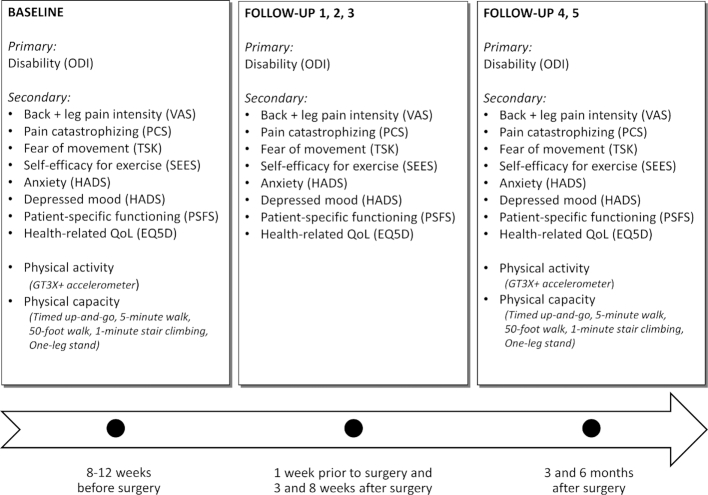
“45,46 (cid:2) Physical capacity was measured by 5-minute walking; 50-foot fast walking; Timed “Up & Go” test; 1-minute stair-climbing; and the One Leg Stand (OLS) test.”
Fairbank, J. C. T., & Pynsent, P. B. (2000) · Spine · doi:10.1097/00007632-200011150-00017 · Cited by 5,851
Statistical Methods for Meta-Analysis.
Freeman, P. R., Hedges, L. V., & Olkin, I. (1986) · Biometrics · doi:10.2307/2531069 · Cited by 4,784
Oswestry Low Back Pain Disability Questionnaire
(2007) · Encyclopedia of Pain · doi:10.1007/978-3-540-29805-2_3023 · Cited by 3,954
Research works printed but not linked: 3
- WHO, 2010, Global Recommendations on Physical Activity for Health
- Strömqvist, 2009, A deeper look at patients operated on for DDD, SWESPINE: the Swedish Spine Register, 44
- Lindbäck Y, Tropp H, Enthoven P, Abbott A, Oberg B., 2018, PREPARE: presurgery physiotherapy for patients with degenerative lumbar spine disorders: a randomized controlled trail, 1347
Cited by
Prehabilitation for Patients Undergoing Orthopedic Surgery: A Systematic Review and Meta-analysis
Punnoose, A., Claydon-Mueller, L. S., Weiss, O., Zhang, J., Rushton, A., & Khanduja, V. (2023) · JAMA Network Open · doi:10.1001/jamanetworkopen.2023.8050 · Cited by 219
Towards a common definition of surgical prehabilitation: a scoping review of randomised trials
Fleurent-Grégoire, C., Burgess, N., McIsaac, D. I., Chevalier, S., Fiore, J. F., Carli, F., Levett, D. Z. H., Moore, J., Grocott, M. P. W., Copeland, R. J., et al. (2024) · British Journal of Anaesthesia · doi:10.1016/j.bja.2024.02.035 · Cited by 154
Coronado, R. A., Brintz, C. E., McKernan, L. C., Master, H., Motzny, N., Silva, F. M., Goyal, P. M., Wegener, S. T., & Archer, K. R. (2020) · PAIN Reports · doi:10.1097/pr9.0000000000000847 · Cited by 115
Perry, R. E., Herbert, G., Atkinson, C., England, C. Y., Northstone, K., Baos, S., Brush, T., Chong, A., Ness, A., Harris, J. M., et al. (2021) · BMJ Open · doi:10.1136/bmjopen-2021-050806 · Cited by 130
Janssen, E., Punt, I. M., Clemens, M. J., Staal, J. B., Hoogeboom, T. J., & Willems, P. C. P. H. (2020) · Journal of Orthopaedic and Sports Physical Therapy · doi:10.2519/jospt.2021.9748 · Cited by 60
Metadata
- Authors
- Lotzke, H., Brisby, H., Gutke, A., Hägg, O., Jakobsson, M., Smeets, R., & Lundberg, M.
- Affiliations
- Spine Center Göteborg (SE)
- Sahlgrenska University Hospital (SE)
- University of Gothenburg (SE)
- Maastricht University (NL)
- Corresponding author
- Lundberg, Mari
- Venue
- Physical Therapy
- Publisher
- Oxford University Press (OUP)
- Published
- 2019-02-21
- Volume
- 99
- Issue
- 8
- Pages
- 1069-1088
- ISSN
- 0031-9023 (ISSN-L)
- 1538-6724
- PMC
- PMC6665875
- OpenAlex
- W2915902951
- Cited by
- 112
- References
- 88
- Citations by year
- 2026: 9 · 2025: 17 · 2024: 18 · 2023: 27 · 2022: 15 · 2021: 12 · 2020: 9 · 2019: 3
- FWCI
- 6.04
- Type
- journal article
- Language
- en
- Open access
- hybrid
- doi.org
- Licence
- Locations
- Physical Therapy (publishedVersion, cc-by-nc-nd)
- Europe PMC (PubMed Central) (publishedVersion, cc-by-nc-nd)
- PubMed Central (publishedVersion, cc-by-nc-nd)
- PubMed (publishedVersion)
- Research Publications (Maastricht University) (publishedVersion, cc-by-nc-nd)
- VUBIR (Vrije Universiteit Brussel) (submittedVersion)
- Research Publications (Maastricht University) (submittedVersion, other-oa)
- Funders
- Alzheimer's Foundation of America (120216)
- Eurospine Research (8-2014)
- Swedish Research Council (2015-02511)
- Västra Götaland Region
- Topics
- Health Sciences › Health Professions › Physical Therapy, Sports Therapy and Rehabilitation › Musculoskeletal pain and rehabilitation
- Health Sciences › Medicine › Orthopedics and Sports Medicine › Spine and Intervertebral Disc Pathology
- Health Sciences › Health Professions › Physical Therapy, Sports Therapy and Rehabilitation › Medical Practices and Rehabilitation
- Keywords
- prehabilitation, lumbar fusion, person-centred care, intervertebral disc degeneration, disability, health-related quality of life, pain catastrophizing, kinesiophobia, self-efficacy, physical activity, postoperative outcomes
- MeSH terms
- Adult, Disability Evaluation, Female, Humans, Lumbar Vertebrae, Male, Middle Aged, Preoperative Care, Surveys and Questionnaires, Spinal Fusion, Cognitive Behavioral Therapy, Low Back Pain, Patient-Centered Care, Physical Therapy Modalities
About these checks
Registry, retraction, Cites and statistics results are computed, not judged, with one exception: a printed reference that no index lists is read once by a model before it counts as a citation error. Claims are extracted by a model and kept only when their quote appears verbatim in the text; each cited source is then checked, with a model’s help, for whether it says what the claim relies on. Those verdicts can be wrong — read the claim’s quote and the cited source before relying on one.
Statistics and arithmetic are recomputed, not judged.
Confidence bands are shown only for fields calibrated on our annotated test set. None is calibrated yet, so no band is shown.
What counts as a claim ›How we measure confidence ›How we check this ›
Are you an author, or do you see a problem with this page? Request a review
How to cite
Cite CoChat for the checks on this page, and the paper for its own findings.
- This page
- CoChat. (2026). Citation check: A Person-Centered Prehabilitation Program Based on Cognitive-Behavioral Physical Therapy for Patients Scheduled for Lumbar Fusion Surgery: A Randomized Controlled Trial. https://app.cochat.ai/papers/10.1093/ptj/pzz020
- The paper
- Lotzke, H., Brisby, H., Gutke, A., Hägg, O., Jakobsson, M., Smeets, R., & Lundberg, M. (2019). A Person-Centered Prehabilitation Program Based on Cognitive-Behavioral Physical Therapy for Patients Scheduled for Lumbar Fusion Surgery: A Randomized Controlled Trial. Physical Therapy. https://doi.org/10.1093/ptj/pzz020
Data sources
Bibliographic data: Semantic Scholar, OpenAlex, Crossref.
Contains information from the Semantic Scholar Academic Graph Datasets, made available under the ODC Attribution License (ODC-BY 1.0).
Semantic Scholar’s data is described in: Kinney, R., et al. (2023). The Semantic Scholar Open Data Platform. arXiv:2301.10140.
