

The DOI matches its Crossref record; 60 of the 60 references it cites were found in a registry or an index.
Towards a Psychosis Risk Blood Diagnostic for Persons Experiencing High-Risk Symptoms: Preliminary Results From the NAPLS Project
Open accessAbstract
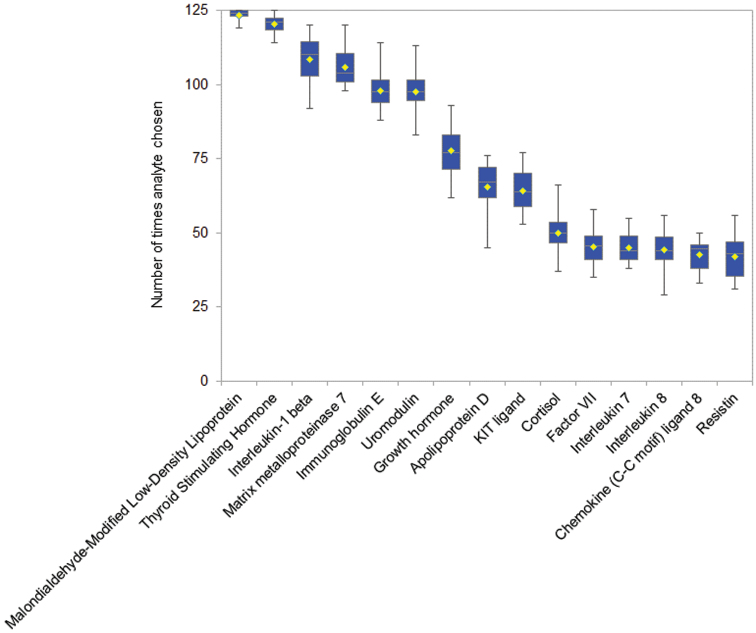
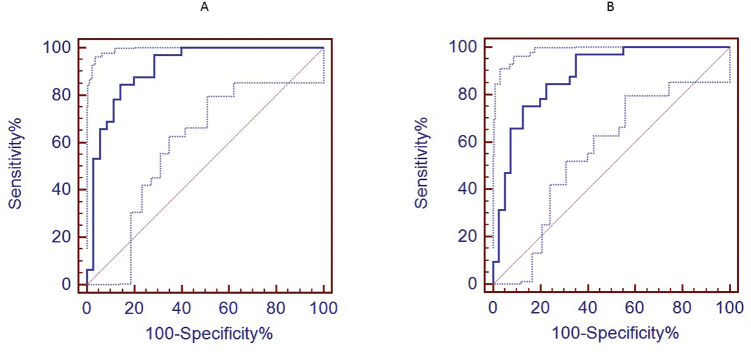
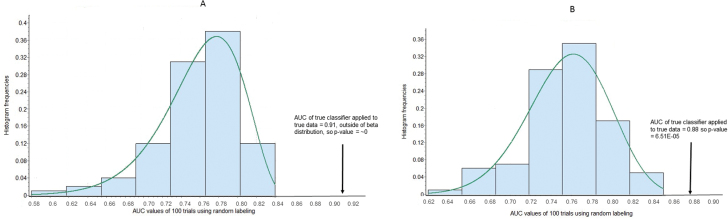
INTRODUCTION: A barrier to preventative treatments for psychosis is the absence of accurate identification of persons at highest risk. A blood test that could substantially increase diagnostic accuracy would enhance development of psychosis prevention interventions. METHODS: The North American Prodrome Longitudinal Study project is a multisite endeavor that aims to better understand predictors and mechanisms for the development of psychosis. In this study, we measured expression of plasma analytes reflecting inflammation, oxidative stress, hormones, and metabolism. A "greedy algorithm" selected analytes that best distinguished persons with clinical high-risk symptoms who developed psychosis (CHR-P; n = 32) from unaffected comparison (UC) subjects (n = 35) and from those who did not develop psychosis during a 2-year follow-up (CHR-NP; n = 40). RESULTS: The classifier included 15 analytes (selected from 117), with an area under the receiver operating curve for CHR-P vs UC of 0.91 and CHR-P vs CHR-NP of 0.88. Randomly scrambled group membership followed by reconstructions of the entire classifier method yielded consistently weak classifiers, indicating that the true classifier is highly unlikely to be a chance occurrence. Such randomization methods robustly imply the assays contain consistent information distinguishing the groups which was not obscured by the data normalization method and was revealed by classifier construction. These results support the hypothesis that inflammation, oxidative stress, and dysregulation of hypothalamic-pituitary axes may be prominent in the earliest stages of psychosis. CONCLUSION: If confirmed in other groups of persons at elevated risk of psychosis, a multiplex blood assay has the potential for high clinical utility.
Overview
The claims and statistics of this paper haven’t been checked yet.
Run the check — free, no account needed. It reads the open-access text and checks the sources it cites.
Integrity signals
Registry
Cites
Statistics
Figures
Verification
Claims the paper makes
The claims and statistics of this paper haven’t been checked yet.
Run the check — free, no account needed. It reads the open-access text and checks the sources it cites.
Claims other papers make about this one
Each is checked against this paper’s own text: does it say what the citing paper says it does?
In the citing paper
“In addition, biochemical 140,141 , imaging 52,142,143 , and electrophysiological measurements 144 may help segregating patients into higher- and lower-risk groups.”
From Developmental timing and critical windows for the treatment of psychiatric disorders (2016) · cites this paper as [141]
Self-check
Percentages, sums and reported differences re-computed from the paper’s own numbers.
The self-check needs the paper’s full text.
Citations
Cites
Diagnostic and Statistical Manual of Mental Disorders
American Psychiatric Association (2013) · doi:10.1176/appi.books.9780890425596 · Cited by 116,369
Diagnostic and Statistical Manual of Mental Disorders
Williams, J. B. W., & First, M. B. (2013) · Oxford University Press eBooks · doi:10.1093/acrefore/9780199975839.013.104 · Cited by 109,845
The meaning and use of the area under a receiver operating characteristic (ROC) curve.
Hanley, J. A., & McNeil, B. J. (1982) · Radiology · doi:10.1148/radiology.143.1.7063747 · Cited by 21,856
Diagnostic and Statistical Manual of Mental Disorders, 5th ed.
Carter, M. J. (2014) · Therapeutic Recreation Journal · Cited by 15,154
A Study of Cross-Validation and Bootstrap for Accuracy Estimation and Model Selection
Kohavi, R. (1995) · Zenodo · doi:10.5281/zenodo.19712698 · Cited by 10,909
In silico prediction of protein-protein interactions in human macrophages
Souiai, O., Guerfali, F. Z., Miled, S. B., Brun, C., & Benkahla, A. (2014) · BMC Research Notes · doi:10.1186/1756-0500-7-157 · Cited by 10,785
Significance analysis of microarrays applied to the ionizing radiation response
Tusher, V. G., Tibshirani, R., & Chu, G. (2001) · Proceedings of the National Academy of Sciences · doi:10.1073/pnas.091062498 · Cited by 10,568
Rio, D. D., Stewart, A. J., & Pellegrini, N. (2005) · Nutrition Metabolism and Cardiovascular Diseases · doi:10.1016/j.numecd.2005.05.003 · Cited by 2,789
Best Practices for QSAR Model Development, Validation, and Exploitation
Tropsha, A. (2010) · Molecular Informatics · doi:10.1002/minf.201000061 · Cited by 2,107
Meta-Analysis of Cytokine Alterations in Schizophrenia: Clinical Status and Antipsychotic Effects
Miller, B. J., Buckley, P., Seabolt, W., Mellor, A., & Kirkpatrick, B. (2011) · Biological Psychiatry · doi:10.1016/j.biopsych.2011.04.013 · Cited by 1,742
Research works printed but not linked: 3
- First, 2002, Structured Clinical Interview for DSM-IV TR Axis I Disorders, Non-patient Edition (SCID-I/NP)
- Drake, 1996, Clinician rating scale: Alcohol Use Scale (AUS), Drug Use Scale (DUS), and Substance Abuse Treatment Scale (SATS), 113
- Schwarz, 2011, Identification of a biological signature for schizophrenia in serum, Mol Psychiatry, 17, 1
Cited by
Sorted by citations
Acosta, J. N., Falcone, G. J., Rajpurkar, P., & Topol, E. J. (2022) · Nature Medicine · doi:10.1038/s41591-022-01981-2 · Cited by 1,365
Kahn, R. S., Sommer, I. E., Murray, R. M., Meyer‐Lindenberg, A., Weinberger, D. R., Cannon, T. D., O’Donovan, M. C., Correll, C. U., Kane, J. M., van Os, J., et al. (2015) · Nature Reviews Disease Primers · doi:10.1038/nrdp.2015.67 · Cited by 1,163
Self-citationCannon, T. D., Chung, Y., He, G., Sun, D., Jacobson, A., van Erp, T. G. M., McEwen, S., Addington, J., Bearden, C. E., Cadenhead, K., et al. (2015) · Biological Psychiatry · doi:10.1016/j.biopsych.2014.05.023 · Cited by 599
Self-citationAn Individualized Risk Calculator for Research in Prodromal Psychosis
Cannon, T. D., Yu, C., Addington, J., Bearden, C. E., Cadenhead, K. S., Cornblatt, B. A., Heinssen, R., Jeffries, C. D., Mathalon, D. H., McGlashan, T. H., et al. (2016) · American Journal of Psychiatry · doi:10.1176/appi.ajp.2016.15070890 · Cited by 574
“Some promising leads on the use of biological assays to predict psychosis among clinical high-risk patients have emerged using empirically based discovery approaches, including machine learning algorithms for gray matter variations in structural brain images (33) and “greedy” regression algorithms for proteomic/metabo…”
BackgroundSelf-citationAltering the course of schizophrenia: progress and perspectives
Millan, M. J., Andrieux, A., Bartzokis, G., Cadenhead, K., Dazzan, P., Fusar-Poli, P., Gallinat, J., Giedd, J., Grayson, D. R., Heinrichs, M., et al. (2016) · Nature Reviews Drug Discovery · doi:10.1038/nrd.2016.28 · Cited by 516
Self-citation
Metadata
- Authors
- Perkins, D. O., Jeffries, C. D., Addington, J., Bearden, C. E., Cadenhead, K. S., Cannon, T. D., Cornblatt, B. A., Mathalon, D. H., McGlashan, T. H., Seidman, L. J., Tsuang, M. T., Walker, E. F., Woods, S. W., & Heinssen, R.
- Affiliations
- University of North Carolina at Chapel Hill (US)
- University of Calgary (CA)
- University of California, Los Angeles (US)
- University of California San Diego (US)
- Yale University (US)
- Zucker Hillside Hospital (US)
- University of California, San Francisco (US)
- Beth Israel Deaconess Medical Center (US)
- Emory University (US)
- National Institute of Mental Health (US)
- Corresponding author
- Perkins, Diana O.
- Jeffries, Clark D.
- ORCID
- Venue
- Schizophrenia Bulletin
- Publisher
- Oxford University Press (OUP)
- Published
- 2014-08-06
- Volume
- 41
- Issue
- 2
- Pages
- 419-428
- ISSN
- 0586-7614 (ISSN-L)
- 1745-1701
- PMC
- PMC4332942
- OpenAlex
- W2144107861
- Cited by
- 238
- References
- 60
- Citations by year
- 2026: 8 · 2025: 15 · 2024: 16 · 2023: 28 · 2022: 14 · 2021: 15 · 2020: 25 · 2019: 22 · 2018: 17 · 2017: 20 · 2016: 32 · 2015: 19 · 2014: 7
- FWCI
- 19.85
- Type
- journal article
- Language
- en
- Open access
- hybrid
- doi.org
- Licence
- cc-by-nc
- Locations
- Schizophrenia Bulletin (publishedVersion, cc-by-nc)
- Europe PMC (PubMed Central) (publishedVersion, cc-by-nc)
- PubMed Central (publishedVersion, cc-by-nc)
- PubMed (publishedVersion)
- Digital Access to Scholarship at Harvard (DASH) (Harvard University) (submittedVersion, cc-by)
- Carolina Digital Repository (University of North Carolina at Chapel Hill) (submittedVersion)
- eScholarship (California Digital Library) (submittedVersion)
- eScholarship (California Digital Library) (submittedVersion, cc-by-nc)
- UNC Libraries
- Funders
- National Institute of Mental Health (U01MH081928, U01MH066160, U01MH082022, U01MH076989, U01MH081984, U01MH0818902, U01MH081857, U01MH082004, U01MH081944, P50MH066286, U01MH081988)
- Topics
- Health Sciences › Medicine › Psychiatry and Mental health › Schizophrenia research and treatment
- Life Sciences › Neuroscience › Biological Psychiatry › Tryptophan and brain disorders
- Social Sciences › Psychology › Clinical Psychology › Psychopathy, Forensic Psychiatry, Sexual Offending
- Keywords
- psychosis risk, clinical high risk for psychosis
- MeSH terms
- Adult, Female, Follow-Up Studies, Humans, Hypothalamo-Hypophyseal System, Inflammation, Male, Pituitary-Adrenal System, Psychotic Disorders, Oxidative Stress, Risk Assessment, Young Adult, Prodromal Symptoms
About these checks
Registry, retraction, Cites and statistics results are computed, not judged, with one exception: a printed reference that no index lists is read once by a model before it counts as a citation error. Claims are extracted by a model and kept only when their quote appears verbatim in the text; each cited source is then checked, with a model’s help, for whether it says what the claim relies on. Those verdicts can be wrong — read the claim’s quote and the cited source before relying on one.
Statistics and arithmetic are recomputed, not judged.
Confidence bands are shown only for fields calibrated on our annotated test set. None is calibrated yet, so no band is shown.
What counts as a claim ›How we measure confidence ›How we check this ›
Are you an author, or do you see a problem with this page? Request a review
