

Dissociable effects of self-reported daily sleep duration on high-level cognitive abilities
Open accessThe DOI matches its Crossref record; 54 of the 55 references it cites were found in a registry or an index.
Abstract
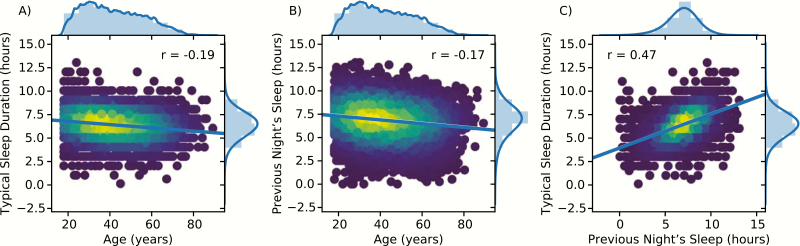
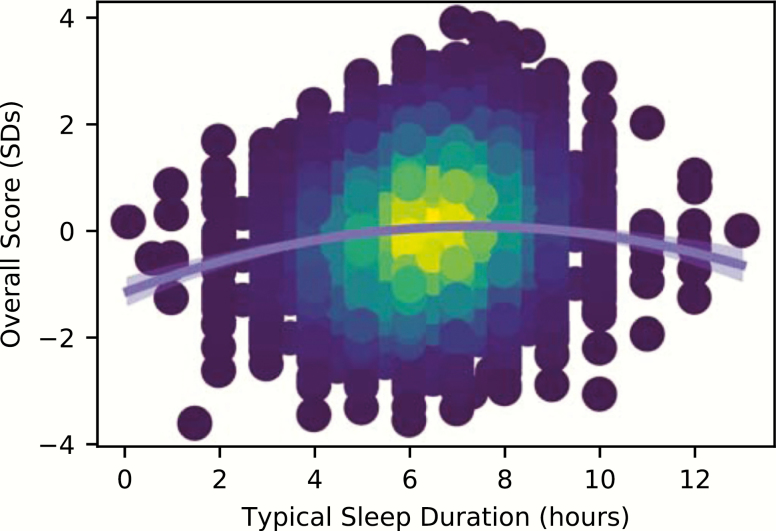
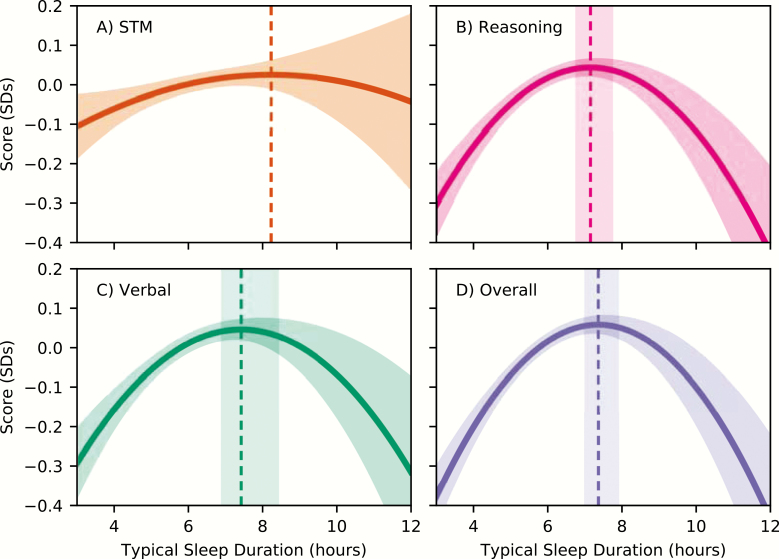
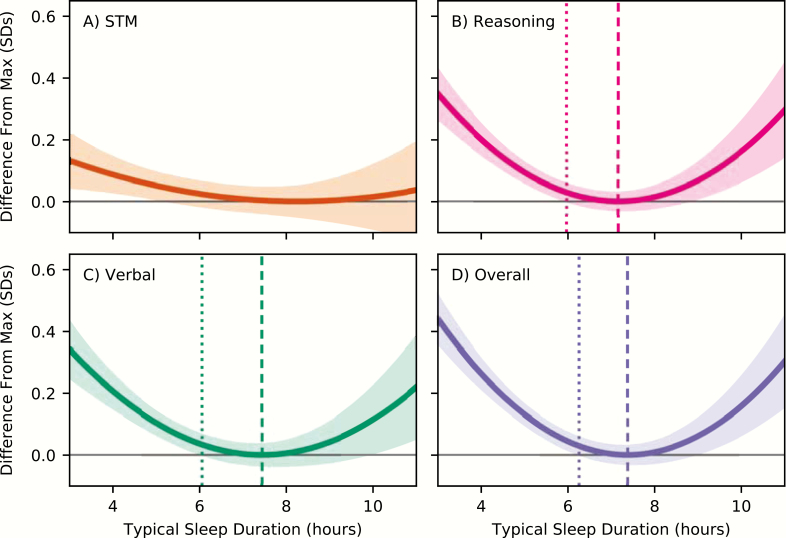
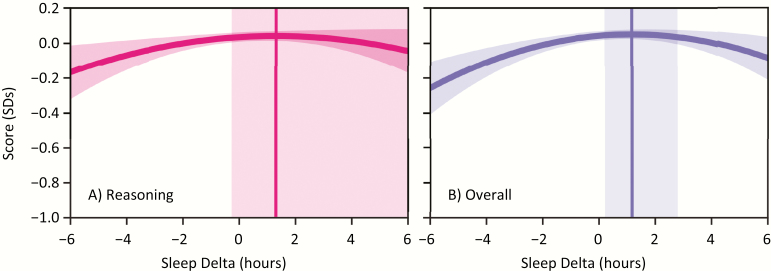
Most people will at some point experience not getting enough sleep over a period of days, weeks, or months. However, the effects of this kind of everyday sleep restriction on high-level cognitive abilities-such as the ability to store and recall information in memory, solve problems, and communicate-remain poorly understood. In a global sample of over 10000 people, we demonstrated that cognitive performance, measured using a set of 12 well-established tests, is impaired in people who reported typically sleeping less, or more, than 7-8 hours per night-which was roughly half the sample. Crucially, performance was not impaired evenly across all cognitive domains. Typical sleep duration had no bearing on short-term memory performance, unlike reasoning and verbal skills, which were impaired by too little, or too much, sleep. In terms of overall cognition, a self-reported typical sleep duration of 4 hours per night was equivalent to aging 8 years. Also, sleeping more than usual the night before testing (closer to the optimal amount) was associated with better performance, suggesting that a single night's sleep can benefit cognition. The relationship between sleep and cognition was invariant with respect to age, suggesting that the optimal amount of sleep is similar for all adult age groups, and that sleep-related impairments in cognition affect all ages equally. These findings have significant real-world implications, because many people, including those in positions of responsibility, operate on very little sleep and may suffer from impaired reasoning, problem-solving, and communications skills on a daily basis.
Overview
The claims and statistics of this paper haven’t been checked yet.
Free: it reads the open-access text and checks the first 5 claims that cite a source we can check. Create a free account to check every claim.
Integrity signals
Registry
Cites
Statistics
Figures
Verification
Claims the paper makes
The claims and statistics of this paper haven’t been checked yet.
Free: it reads the open-access text and checks the first 5 claims that cite a source we can check. Create a free account to check every claim.
Claims other papers make about this one
Each is checked against this paper’s own text: does it say what the citing paper says it does?
The source backs part of the claim, not all of it — or backs it for a different population, condition or comparison.
In the citing paper
“Previous studies in community-dwelling adults show a curvilinear relationship, such that too little sleep, as well as too much sleep, have been associated with poor cognition, mental health problems, and increased mortality risk (28, 29).”
From Nightly sleep duration predicts grade point average in the first year of college (2023) · cites this paper as [28]
Experimental — accuracy not yet measured
Self-check
Percentages, sums and reported differences re-computed from the paper’s own numbers.
The self-check needs the paper’s full text.
Citations
Cites
Ohayon, M. M., Carskadon, M. A., Guilleminault, C., & Vitiello, M. V. (2004) · Sleep · doi:10.1093/sleep/27.7.1255 · Cited by 3,349
Sleep Health: Can We Define It? Does It Matter?
Buysse, D. J. (2014) · Sleep · doi:10.5665/sleep.3298 · Cited by 2,536 · cited 1×
“between sleep duration and performance differed between reasoning and STM (F(2,32602) = 5.”
BackgroundA practical solution to the pervasive problems ofp values
Wagenmakers, E.-J. (2007) · Psychonomic Bulletin & Review · doi:10.3758/bf03194105 · Cited by 2,490
National Sleep Foundation’s updated sleep duration recommendations: final report
Hirshkowitz, M., Whiton, K., Albert, S. M., Alessi, C., Bruni, O., DonCarlos, L., Hazen, N., Herman, J., Adams Hillard, P. J., Katz, E. S., et al. (2015) · Sleep Health · doi:10.1016/j.sleh.2015.10.004 · Cited by 2,348
Neurocognitive consequences of sleep deprivation
Goel, N., Rao, H., Durmer, J., & Dinges, D. (2009) · Seminars in Neurology · doi:10.1055/s-0029-1237117 · Cited by 2,154
Vrieze, S. I. (2012) · Psychological Methods · doi:10.1037/a0027127 · Cited by 1,948 · cited 1×
“That is, it becomes more stringent as the sample size increases, and therefore tiny effect sizes are less likely to result in a rejection of the null hypothesis [34].”
BackgroundNyholt, D. R. (2004) · The American Journal of Human Genetics · doi:10.1086/383251 · Cited by 1,699 · cited 1×
“given that performance across tests was correlated (and hence the 16 measures were not completely independent), we estimated the effective number of comparisons using a method based on the variance of the eigenvalues derived from the correlation matrix of all 16 scores [31].”
MethodSelf-Reported and Measured Sleep Duration: How Similar Are They?
Lauderdale, D. S., Knutson, K. L., Yan, L. L., Liu, K., & Rathouz, P. J. (2008) · Epidemiology · doi:10.1097/ede.0b013e318187a7b0 · Cited by 1,565
Effects of Sleep Deprivation on Performance: A Meta-Analysis
Pilcher, J. J., & Huffcutt, A. I. (1996) · Sleep · doi:10.1093/sleep/19.4.318 · Cited by 1,549 · cited 1×
“On the other hand, it has been suggested that chronic partial sleep restriction has a greater impact on (broadly defined) cognitive function than total SD [36].”
BackgroundBehavioral and Physiological Consequences of Sleep Restriction
Banks, S., & Dinges, D. F. (2007) · Journal of Clinical Sleep Medicine · doi:10.5664/jcsm.26918 · Cited by 1,505 · cited 3×
“deviating from the optimal), and that cognition begins to recover as sleep duration returns to normal [4].”
Background
Cited by
Items 101–123 of 123
Reexamining the “Brain Drain” Effect: Does Ward et al. (2017) Replicate?Preprint
Pardo, A. C. R., & Minda, J. P. (2021) · doi:10.31234/osf.io/5y34g
Keep Your Brain Tissue Healthy
Alessi, C., Chambers, L. W., & Gray, M. (2021) · Oxford University Press eBooks · doi:10.1093/oso/9780198860341.003.0003
Smevik, H., Habli, S., Saksvik, S. B., Kliem, E., Evensmoen, H. R., Conde, V., Petroni, A., Asarnow, R. F., Dennis, E. L., Eikenes, L., et al. (2022) · bioRxiv (Cold Spring Harbor Laboratory) · doi:10.1101/2022.10.28.512671
Does Meditation Improve Cognition Through Sleep?Preprint
Rankaduwa, S., Owen, A. M., & Nichols, E. S. (2022) · PsyArXiv (OSF Preprints) · doi:10.31234/osf.io/d4czh
Self-citationDevelopment of the assessment of recovery activities for athletes
Wahl, C. A., Garnier‐Villarreal, M., & Meyer, B. B. (2023) · International Journal of Sport and Exercise Psychology · doi:10.1080/1612197x.2023.2168727 · Cited by 1
Kosalka, P. K., Hannan, F., Hamilton, J., Patriquin, C. J., Pavenski, K., Jurkiewicz, M. T., Tristao, L., Owen, A. M., Deoni, S., Théberge, J., et al. (2024) · Blood Vessels Thrombosis & Hemostasis · doi:10.1016/j.bvth.2024.100016
Self-citationA privação do sono e seus impactos na cognição e no humor
Garcia, M. P., Siqueira, L. B., Peres, G. F. F., Bordignon, G., Torres-da-Silva, K. R., Machado, A. R. D. S. R., Machado, A. M., & da Silva, A. V. (2024) · Brazilian Journal of Health Review · doi:10.34119/bjhrv7n3-419
Sleep and cognitive performance in athletes
Farnsworth, W., Johnson, A., Almeida, A. A., & Goldstein, C. A. (2024) · Elsevier eBooks · doi:10.1016/b978-0-12-822969-9.00004-3
Analysis of Sleep Habits: Prediction of Quality of Sleep and Reasoning Ability (Cognitive Skills)
Bhat, A., Hemachandra, C., Vidhathri, V., & Anand, M. S. (2024) · International Conference on Bioinformatics and Biomedical Science (ICBBS) · doi:10.1145/3704198.3704214
Berron, D. (2025) · Elsevier eBooks · doi:10.1016/b978-0-12-822240-9.00009-0
Torales, J. C., Canata, C. M., Morínigo, M., Falloon, K., Cantero, M., Gauto, S., López, N., Vargas, M., O’Higgins, M. G., Caycho‐Rodríguez, T., et al. (2025) · Sleep Science · doi:10.1055/s-0045-1805060 · Cited by 4
“49 Mirghani et al. and Bahamm et al. similarly reported that short nocturnal sleep adversely affects the academic performance of medical students.”
王, 秀. (2025) · Traditional Chinese Medicine · doi:10.12677/tcm.2025.146380
Hennessy, A., Nichols, E. S., Al‐Saoud, S., Roger, K., Ogilvie, J. D., Brossard‐Racine, M., & Duerden, E. G. (2026) · Research Square · doi:10.21203/rs.3.rs-9817685/v1
Self-citationGray, H. G., Kazazian, K., Kolisnyk, M., Wild, C. J., Owen, A. M., & Gofton, T. E. (2026) · Epilepsy & Behavior · doi:10.1016/j.yebeh.2026.111147
Self-citationHareket, S., Polat, K., Uçurum, S. G., Şenol, H., & Kaya, D. Ö. (2026) · Journal of Bodywork and Movement Therapies · doi:10.1016/j.jbmt.2026.07.003
A neural signature of sleep deprivation in the human brain
Wen, Z., Pace-Schott, E. F., Franzen, P. L., Cui, L., Zhang, K., Gao, S., Hong, L. E., Kochunov, P., Germain, A., & Milad, M. R. (2026) · Nature Communications · doi:10.1038/s41467-026-75661-x
“Prior studies have showed that chronic sleep restriction can accumulate and lead to cognitive impairments similar to those observed in acute sleep deprivation 67 – 69 , and natural sleep duration associates with functional connectivity 35,70 .”
Mohan, N. M., Keogh, B., Adelfio, A., Maldonado, R., Rao, A., Altini, M., Khaldi, N., & Franklyn‐Miller, A. (2026) · Sleep Medicine X · doi:10.1016/j.sleepx.2026.100198
“…can have critical impacts for health, with less than 7 h per night shown to increase the risk for coronary heart disease and diabetes [10] and self-reported sleep of 4 h per night associated with a cognitive decline equivalent to 8 years of aging across a battery of cognitive measures [11].”
Kowalski, T., Waleriańczyk, W., Mazur, W., Surała, O., Krysztofiak, H., & Gorgol, J. (2026) · International Journal of Sport and Exercise Psychology · doi:10.1080/1612197x.2026.2716007 · Cited by 1
Sleep Health and Well-being for the Neurologist
Dewey, J. J., Miller-Kuhlmann, R. K., & Molano, J. R. V. (2026) · Neurologic Clinics · doi:10.1016/j.ncl.2026.08.002
Wyss, A. B., Zhang, Y., Brown, M. R., Bressler, J., DeCarli, C. S., Fornage, M., González, H. M., Guo, X., Heckbert, S. R., Hughes, T. M., et al. (2026) · medRxiv · doi:10.64898/2026.10.19.26365906
Pitsikas, N., Nguyên, D. P., & Blokland, A. (2026) · Human Psychopharmacology Clinical and Experimental · doi:10.1002/hup.70070
“…poorer sleep quality and shorter sleep duration are generally associated with slower RTs and reduced Stroop task performance (Takeuchi et al. 2018; Wild et al. 2018), our findings suggest that poorer sleep quality, in combination with habitual coffee consumption, was associated with improved…”
Test–retest Reliability of Creyos Test Battery in Adolescents at Risk of Concussion
Shepherd, H. A., Galarneau, J.-M. F., Faris, E. K., Yeates, K. O., & Emery, C. A. (2026) · Canadian Journal of Occupational Therapy · doi:10.1177/00084174261488757
Metadata
- Authors
- Wild, C. J., Nichols, E. S., Battista, M. E., Stojanoski, B., & Owen, A. M.
- Affiliations
- Western University (CA)
- Corresponding author
- Wild, Conor J
- Venue
- Sleep
- Publisher
- Oxford University Press (OUP)
- Published
- 2018-09-13
- Volume
- 41
- Issue
- 12
- ISSN
- 0161-8105 (ISSN-L)
- 1550-9109
- PMC
- PMC6289236
- OpenAlex
- W2890391705
- Cited by
- 123
- References
- 55
- Citations by year
- 2026: 11 · 2025: 11 · 2024: 20 · 2023: 12 · 2022: 26 · 2021: 18 · 2020: 15 · 2019: 10
- FWCI
- 14.08
- Type
- journal article
- Language
- en
- Open access
- hybrid
- doi.org
- Licence
- Locations
- SLEEP (publishedVersion, cc-by-nc)
- Europe PMC (PubMed Central) (publishedVersion, cc-by-nc)
- PubMed Central (publishedVersion, cc-by-nc)
- PubMed (publishedVersion)
- Scholarship@Western (Western University) (submittedVersion, cc-by-nc)
- Scholarship@Western (Western University) (submittedVersion)
- Funders
- Canada Excellence Research Chairs, Government of Canada (#215063)
- Topics
- Social Sciences › Psychology › Experimental and Cognitive Psychology › Sleep and Work-Related Fatigue
- Social Sciences › Psychology › Experimental and Cognitive Psychology › Sleep and related disorders
- Life Sciences › Neuroscience › Cognitive Neuroscience › Sleep and Wakefulness Research
- Keywords
- sleep duration, cognitive performance, sleep restriction, short-term memory, reasoning, verbal ability, problem solving, sleep deprivation, aging, age invariance, self-reported sleep
- MeSH terms
- Adult, Cognition, Cognition Disorders, Female, Humans, Male, Memory, Problem Solving, Surveys and Questionnaires, Sleep, Sleep Deprivation, Executive Function, Self Report
About these checks
Registry, retraction, Cites and statistics results are computed, not judged, with one exception: a printed reference that no index lists is read once by a model before it counts as a citation error. Claims are extracted by a model and kept only when their quote appears verbatim in the text; each cited source is then checked, with a model’s help, for whether it says what the claim relies on. Those verdicts can be wrong — read the claim’s quote and the cited source before relying on one.
Statistics and arithmetic are recomputed, not judged.
Confidence bands are shown only for fields calibrated on our annotated test set. None is calibrated yet, so no band is shown.
What counts as a claim ›How we measure confidence ›How we check this ›
Are you an author, or do you see a problem with this page? Request a review
Data sources
Bibliographic data: Semantic Scholar, OpenAlex, Crossref.
Contains information from the Semantic Scholar Academic Graph Datasets, made available under the ODC Attribution License (ODC-BY 1.0).
Semantic Scholar’s data is described in: Kinney, R., et al. (2023). The Semantic Scholar Open Data Platform. arXiv:2301.10140.
