

The impact of enhancing self-management support for diabetes in Community Health Centers through patient engagement and relationship building: a primary care pragmatic cluster-randomized trial
Open accessThe DOI matches its Crossref record; 33 of the 33 references it cites were found in a registry or an index.
Abstract
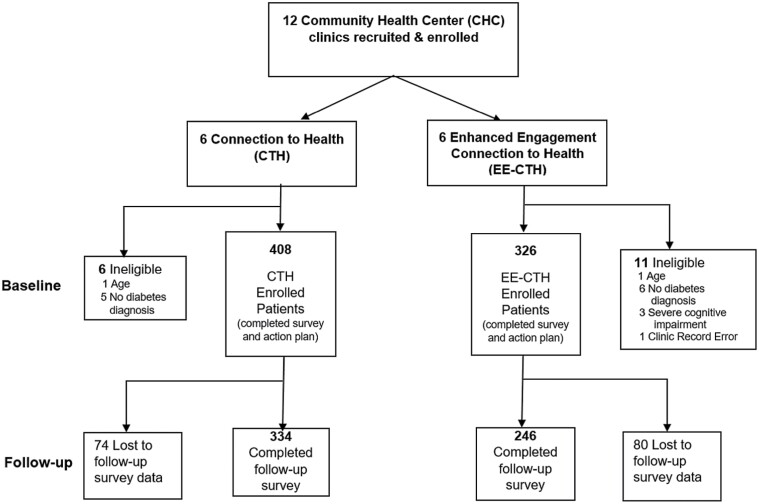
Type 2 diabetes (T2DM) self-management support (SMS) programs can yield improved clinical outcomes but may be limited in application or impact without considering individuals’ unique social and personal challenges that may impede successful diabetes outcomes. The current study compares an evidence-based SMS program with an enhanced version that adds a patient engagement protocol, to elicit and address unique patient-level challenges to support improved SMS and diabetes outcomes. Staff from 12 Community Health Center (CHC) clinical sites were trained on and delivered: Connection to Health (CTH; 6 sites), including a health survey and collaborative action planning, or Enhanced Engagement CTH (EE-CTH; 6 sites), including additional relationship building training/support. Impact of CTH and EE-CTH on behavioral self-management, psychological outcomes, and modifiable social risks was examined using general linear mixed effects. Clinics enrolled 734 individuals with T2DM (CTH = 408; EE-CTH = 326). At 6- to 12-month postenrollment, individuals in both programs reported significant improvements in self-management behaviors (sugary beverages, missed medications), psychological outcomes (stress, health-related distress), and social risks (food security, utilities; all p < .05). Compared with CTH, individuals in EE-CTH reported greater decreases in high fat foods, salt, stress and health-related distress; and depression symptoms improved within EE-CTH (all p < .05). CTH and EE-CTH demonstrated positive behavioral, psychological, and social risk impacts for T2DM in CHCs delivered within existing clinical work flows and a range of clinical roles. Given the greater improvements in psychological outcomes and behavioral self-management in EE-CTH, increased attention to relationship building strategies within SMS programs is warranted.
Overview
The claims and statistics of this paper haven’t been checked yet.
Free: it reads the open-access text and checks the first 5 claims that cite a source we can check. Create a free account to check every claim.
Integrity signals
Registry
Cites
Statistics
Figures
Verification
Claims the paper makes
The claims and statistics of this paper haven’t been checked yet.
Free: it reads the open-access text and checks the first 5 claims that cite a source we can check. Create a free account to check every claim.
Claims other papers make about this one
Each is checked against this paper’s own text: does it say what the citing paper says it does?
The source backs part of the claim, not all of it — or backs it for a different population, condition or comparison.
In the citing paper
“quantitative research has found health effects are not unambiguously mediated by social services connections or changes in social risk.”
From Revising the logic model behind health care's social care investments (2024) · cites this paper as [39]
Experimental — accuracy not yet measuredIn the citing paper
“a primary care diabetes program that aimed to link adult patients who reported social risks with social services showed a decrease in reported social risks and hemoglobin A1c, but changes in hemoglobin A1c were not mediated by the changes in social risk. 39 , 40”
From Revising the logic model behind health care's social care investments (2024) · cites this paper as [39]
Self-check
Percentages, sums and reported differences re-computed from the paper’s own numbers.
The self-check needs the paper’s full text.
Citations
Cites
International physical activity questionnaire: 12-country reliability and validity
CRAIG, C. L., MARSHALL, A. L., SJ??STR??M, M., BAUMAN, A. E., BOOTH, M. L., AINSWORTH, B. E., PRATT, M., EKELUND, U., YNGVE, A., SALLIS, J. F., et al. (2003) · Medicine & Science in Sports & Exercise · doi:10.1249/01.mss.0000078924.61453.fb · Cited by 21,619 · cited 1×
“<150 min weekly based on reported average frequency and duration of weekly moderate to strenuous physical activity) [22], missed medications in past 7 days (0–7) [23, 24], current tobacco use (no/yes), and number of alcoholic drinks in the past week [25, 26].”
BackgroundPearlin, L. I., Menaghan, E. G., Lieberman, M. A., & Mullan, J. T. (1981) · Journal of Health and Social Behavior · doi:10.2307/2136676 · Cited by 6,289 · cited 1×
“General elevated stress from a recent major life event was assessed with one item (no/yes) [28].”
BackgroundThe PHQ-8 as a measure of current depression in the general population
Kroenke, K., Strine, T. W., Spitzer, R. L., Williams, J. B. W., Berry, J. T., & Mokdad, A. H. (2009) · Journal of Affective Disorders · doi:10.1016/j.jad.2008.06.026 · Cited by 5,121
Motivational Interviewing: Helping People Change
Tober, G. (2013) · Alcohol and Alcoholism · doi:10.1093/alcalc/agt010 · Cited by 4,268 · cited 3×
“Examples of current patient engagement strategies include: Autonomy Support [12], Patient Empowerment [9, 11], and Motivational Interviewing [13].”
BackgroundThe summary of diabetes self-care activities measure: results from 7 studies and a revised scale.
Toobert, D. J., Hampson, S. E., & Glasgow, R. E. (2000) · Diabetes Care · doi:10.2337/diacare.23.7.943 · Cited by 2,561 · cited 1×
“> 2 days/ week processed/canned food and/or extra salt added to food at meals) [20, 21].”
BackgroundHorne, R., & Weinman, J. (1999) · Journal of Psychosomatic Research · doi:10.1016/s0022-3999(99)00057-4 · Cited by 2,201 · cited 1×
“<150 min weekly based on reported average frequency and duration of weekly moderate to strenuous physical activity) [22], missed medications in past 7 days (0–7) [23, 24], current tobacco use (no/yes), and number of alcoholic drinks in the past week [25, 26].”
BackgroundEffectiveness of Self-Management Training in Type 2 Diabetes
Norris, S. L., Engelgau, M. M., & Venkat Narayan, K. M. (2001) · Diabetes Care · doi:10.2337/diacare.24.3.561 · Cited by 1,846 · cited 13×
“We conducted a two-arm, pragmatic, cluster-randomized trial to evaluate the added benefit of EE-CTH relative to CTH for patients with T2DM in 12 CHCs. Outcomes (behavior self-management, psychological, social risk) were assessed as part of the program at enrollment and again at 6–12 months from baseline.”
BackgroundInfluentialSocial determinants of health and diabetes: A scientific review
Hill-Briggs, F., Adler, N. E., Berkowitz, S. A., Chin, M. H., Gary-Webb, T. L., Navas-Acien, A., Thornton, P. L., & Haire-Joshu, D. (2021) · Diabetes Care · doi:10.2337/dci20-0053 · Cited by 1,732 · cited 1×
“In this report, we focus on patient-reported outcomes that examine program impact on modifiable behavioral and environmental factors linked with diabetes clinical outcomes [16]: behavioral self-management (e.”
BackgroundSupporting Autonomy to Motivate Patients With Diabetes for Glucose Control
Williams, G. C., Freedman, Z. R., & Deci, E. L. (1998) · Diabetes Care · doi:10.2337/diacare.21.10.1644 · Cited by 1,134 · cited 2×
“Examples of current patient engagement strategies include: Autonomy Support [12], Patient Empowerment [9, 11], and Motivational Interviewing [13].”
BackgroundYoung-Hyman, D., de Groot, M., Hill-Briggs, F., Gonzalez, J. S., Hood, K., & Peyrot, M. (2016) · Diabetes Care · doi:10.2337/dc16-2053 · Cited by 1,072 · cited 1×
“, HbA1c) and has been increasingly recognized as an important stand-alone outcome [37].”
Background
Research works printed but not linked: 1
- 32. SAS Institute Inc. SAS/ACCESS® 9.4 Interface to ADABAS: Reference. Cary, NC: SAS Institute Inc., 2013.
Cited by
Revising the logic model behind health care's social care investments
GOTTLIEB, L. M., HESSLER, D., WING, H., GONZALEZ‐ROCHA, A., CARTIER, Y., & FICHTENBERG, C. (2024) · The Milbank Quarterly · doi:10.1111/1468-0009.12690 · Cited by 64
“39,40 Perhaps the most dramatic example challenging the idea that connections to social services themselves consistently lead to changes in health is the evaluation of the largest US government–funded evaluation of health care–based navigation services— the Accountable Health Communities…”
Self-citationRangachari, P., & Thapa, A. (2025) · BMC Health Services Research · doi:10.1186/s12913-025-12494-2 · Cited by 64
“For example, one RCT examined the effects of self-management support for diabetes in community health centers, showing improvements in self-management behaviors (process outcomes), mental health (clinical outcomes), and food security and access to utilities (social outcomes) [38].”
Fisher, L., Guzman, S., Polonsky, W. H., & Hessler, D. (2024) · Diabetic Medicine · doi:10.1111/dme.15446 · Cited by 35
“34–36 Fifth, we suggest that existing, evidenced-based DD intervention protocols be modified and re-structured for use in clinical care by diabetes clinicians.”
Self-citationRangachari, P., Thapa, A., Sherpa, D. L., Katukuri, K., Ramadyani, K., Jaidi, H. M., & Goodrum, L. (2024) · Frontiers in Public Health · doi:10.3389/fpubh.2024.1413205 · Cited by 24
Alcaraz, K. I., & Yanez, B. R. (2022) · Translational Behavioral Medicine · doi:10.1093/tbm/ibac062 · Cited by 17
Oh, K. M., Cieslowski, B. J., Beran, K., Elnahas, N. H., Steves, S. L., & Sutter, R. (2024) · Journal of the American Association of Nurse Practitioners · doi:10.1097/jxx.0000000000001051 · Cited by 14
“…2010; Crowley et al., 2013; Egede et al., 2024; Fischer et al., 2012; Hebert et al., 2012; Langfordetal.,2019;Welchetal.,2015;Zulligetal.,2018),16.7% offered video calls (Higa et al., 2021; Ladner et al., 2022), and 25% used texting (Hessler et al., 2022; Higa et al., 2021; Lang-ford et al., 2019).”
InfluentialResearch status and hotspots of patient engagement: A bibliometric analysis
Man, C., Liu, T., Yan, S., Xie, Q., & Liu, H. (2024) · Patient Education and Counseling · doi:10.1016/j.pec.2024.108306 · Cited by 13
Healthcare Service Quality Evaluation in a Community-Oriented Primary Care Center, Italy
Ceccarelli, A., Minotti, A., Senni, M., Pellegrini, L., Benati, G., Ceccarelli, P., Federici, A., Mazzini, S., Reali, C., Sintoni, F., et al. (2023) · Healthcare · doi:10.3390/healthcare11172396 · Cited by 11
“The incorporation of cancer screening programs [10] or chronic conditions monitoring [11,12] stands to gain from this holistic COPC approach, which fundamentally reconceptualizes the patient from a passive entity within the system to an active and invested participant in the health domain.”
BackgroundSelf-Management Support Improves Diabetes Outcomes Without Exacerbating Inequities
Krishnakumar, D., Jones, D. H., & Potter, M. B. (2024) · The Journal of the American Board of Family Medicine · doi:10.3122/jabfm.2023.230324r1 · Cited by 6
Self-citationByiringiro, S., Barsha, R. A. A., Hinneh, T. K., Uwiringiyimana, E., García, J. Y., Grant, K., Tomiwa, T., Adeleye, K. K., Owusu, B., Chen, Y., et al. (2025) · JAMA Network Open · doi:10.1001/jamanetworkopen.2025.5258 · Cited by 5
Schipper, S. B. J., Karagiannis, T., Zaccardi, F., Remmelzwaal, S., Blom, M. T., Dagan, N., Schoonmade, L. J., Langendam, M. W., Mb, J., Jensen, W., et al. (2026) · Diabetologia · doi:10.1007/s00125-026-06789-0 · Cited by 4
Tucher, E. L., Steele, A. L., Uratsu, C. S., Hamilton, L., Brown, M. C., Nugent, J. R., Jones, D. H., Gottlieb, L. M., & GRANT, R. W. (2025) · Contemporary Clinical Trials · doi:10.1016/j.cct.2025.108210 · Cited by 3
Addressing Health-Related Social Needs in Diabetes Care: Increasing Our Stride Toward Health Equity?
O’Brien, M. J., & Formagini, T. D. B. (2026) · Diabetes Care · doi:10.2337/dci25-0090 · Cited by 2
Sites, K. E. W., & Zhang, L. (2026) · Nutrition Reviews · doi:10.1093/nutrit/nuag002 · Cited by 1
Behavior Change in the Diabetic Foot
Dimitriadou, A., Brooks, B. M., & Armstrong, D. G. (2026) · Clinics in Podiatric Medicine and Surgery · doi:10.1016/j.cpm.2025.12.016
Brown, A. D., FRONGILLO, E. A., Flory, K., Lohman, M. C., Krobath, D. M., Julceus, E. F., Wei, J., Reboussin, B. A., Mendoza, J. A., Bellatorre, A., et al. (2026) · Canadian Journal of Diabetes · doi:10.1016/j.jcjd.2026.09.006
Chudi-Agbaku, D. (2026) · ScholarWorks (Walden University)
Barsha, R. A. A., Byiringiro, S., Hinneh, T. K., Uwiringiyimana, E., Garcia, J. K., Grant, K., Tomiwa, O., Adeleye, K. K., Owusu, B., Chen, Y., et al. (2026) · Journal of Clinical and Translational Science · doi:10.1017/cts.2026.10759
Göncüoğlu, C., Ozen, P. A., Kaşıkçı, M., Tuncer, A., & Bayraktar‐Ekincioglu, A. (2024) · Canadian Journal of Neurological Sciences / Journal Canadien des Sciences Neurologiques · doi:10.1017/cjn.2024.345
Enhancing Patient Engagement in Managing Diabetic Foot – A Crucial Step in Diabetes Care
Firdaus, M. K. Z. H., Hatta, N. N. K. N. M., & Hasan, M. K. C. (2024) · INTERNATIONAL JOURNAL OF CARE SCHOLARS · doi:10.31436/ijcs.v7i2.384
Toker, S., Uzun, S., & RAMAZANOĞLU, S. (2024) · Turkiye Klinikleri Journal of Nursing Sciences · doi:10.5336/nurses.2024-102400
Nurses' experiences of self-care support for patients with diabetes mellitus type II
Al Harstani, S., & Mohamed, A. (2025) · University Library of Skövde (University of Skövde)
Seesawang, J., Thongtaeng, P., & Rungnoei, N. (2026) · Nursing Science Journal of Thailand
Metadata
- Authors
- Hessler, D., Fisher, L., Dickinson, M., Dickinson, P., Parra, J., & Potter, M. B.
- Affiliations
- University of California, San Francisco (US)
- Department of Family & Community Medicine, University of Colorado—Denver , Denver, CO , USA
- Corresponding author
- Hessler, Danielle
- Venue
- Translational Behavioral Medicine
- Publisher
- Oxford University Press (OUP)
- Published
- 2022-09-01
- Volume
- 12
- Issue
- 9
- Pages
- 909-918
- ISSN
- 1613-9860 (ISSN-L)
- 1869-6716
- PMC
- PMC9540970
- OpenAlex
- W4303418591
- Cited by
- 15
- References
- 33
- Citations by year
- 2026: 3 · 2025: 3 · 2024: 7 · 2023: 1 · 2022: 1
- FWCI
- 2.22
- Type
- journal article
- Language
- en
- Open access
- hybrid
- doi.org
- Licence
- Locations
- Translational Behavioral Medicine (publishedVersion, cc-by-nc)
- PubMed Central (publishedVersion, cc-by-nc)
- PubMed (publishedVersion)
- eScholarship (California Digital Library) (submittedVersion)
- Funders
- National Institute of Diabetes and Digestive and Kidney Diseases (DK108039)
- Topics
- Health Sciences › Medicine › Endocrinology, Diabetes and Metabolism › Diabetes Management and Education
- Health Sciences › Medicine › Epidemiology › Chronic Disease Management Strategies
- Health Sciences › Health Professions › General Health Professions › Patient-Provider Communication in Healthcare
- Keywords
- type 2 diabetes, self-management support, patient engagement, relationship building, community health centers, social determinants of health, food security, depression, stress, medication adherence, primary care
- MeSH terms
- Self-Management, Community Health Centers, Diabetes Mellitus, Type 2, Humans, Patient Participation, Primary Health Care
About these checks
Registry, retraction, Cites and statistics results are computed, not judged, with one exception: a printed reference that no index lists is read once by a model before it counts as a citation error. Claims are extracted by a model and kept only when their quote appears verbatim in the text; each cited source is then checked, with a model’s help, for whether it says what the claim relies on. Those verdicts can be wrong — read the claim’s quote and the cited source before relying on one.
Statistics and arithmetic are recomputed, not judged.
Confidence bands are shown only for fields calibrated on our annotated test set. None is calibrated yet, so no band is shown.
What counts as a claim ›How we measure confidence ›How we check this ›
Are you an author, or do you see a problem with this page? Request a review
Data sources
Bibliographic data: Semantic Scholar, OpenAlex, Crossref.
Contains information from the Semantic Scholar Academic Graph Datasets, made available under the ODC Attribution License (ODC-BY 1.0).
Semantic Scholar’s data is described in: Kinney, R., et al. (2023). The Semantic Scholar Open Data Platform. arXiv:2301.10140.
