

The DOI matches its Crossref record, with a small difference in title or year; 49 of the 50 references it cites were found in a registry or an index.
When less is more: primary immunodeficiency with an autoinflammatory kick
Open accessAbstract
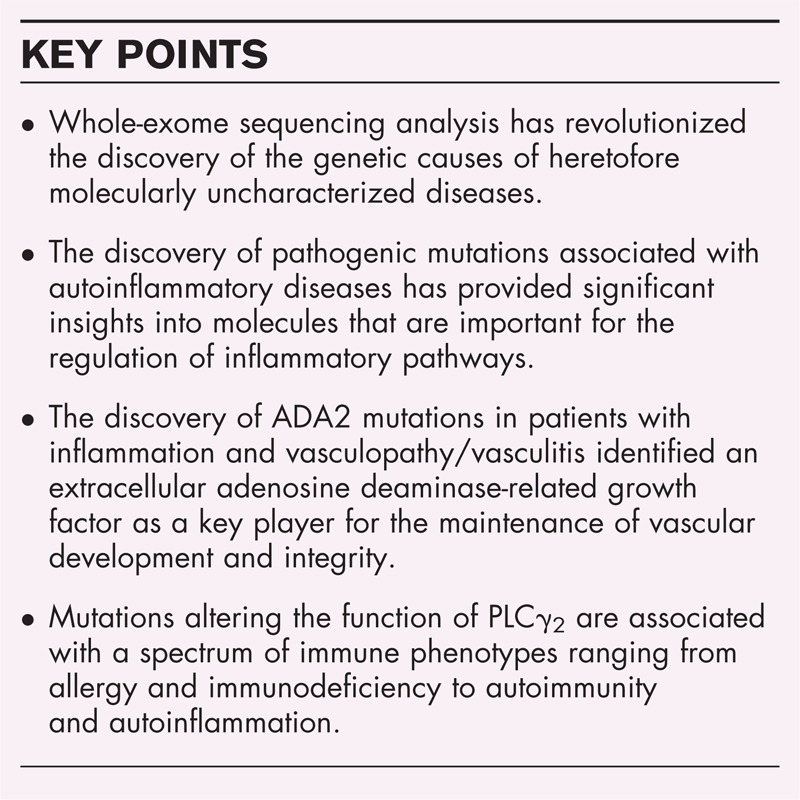
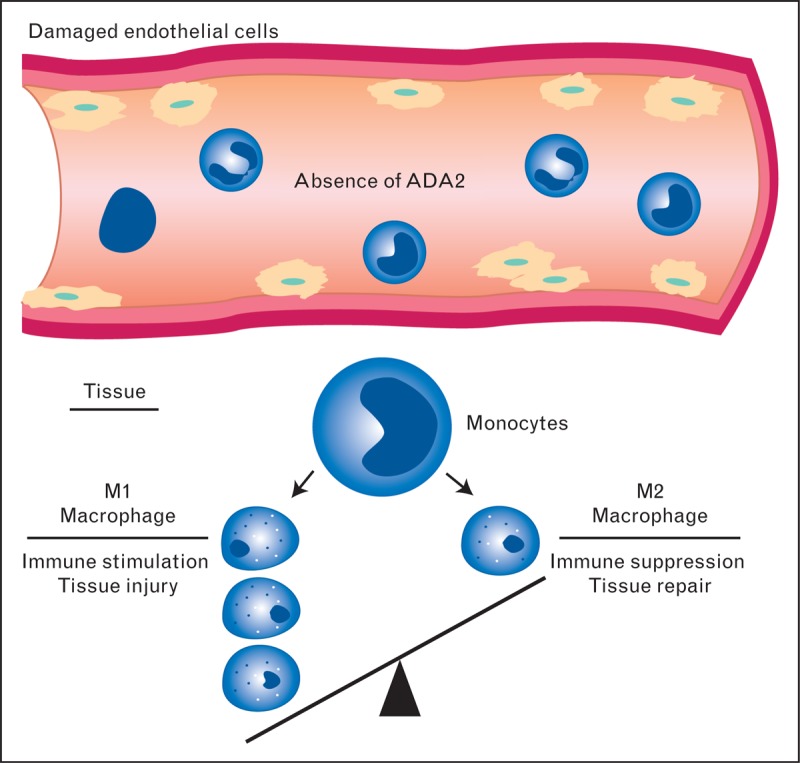
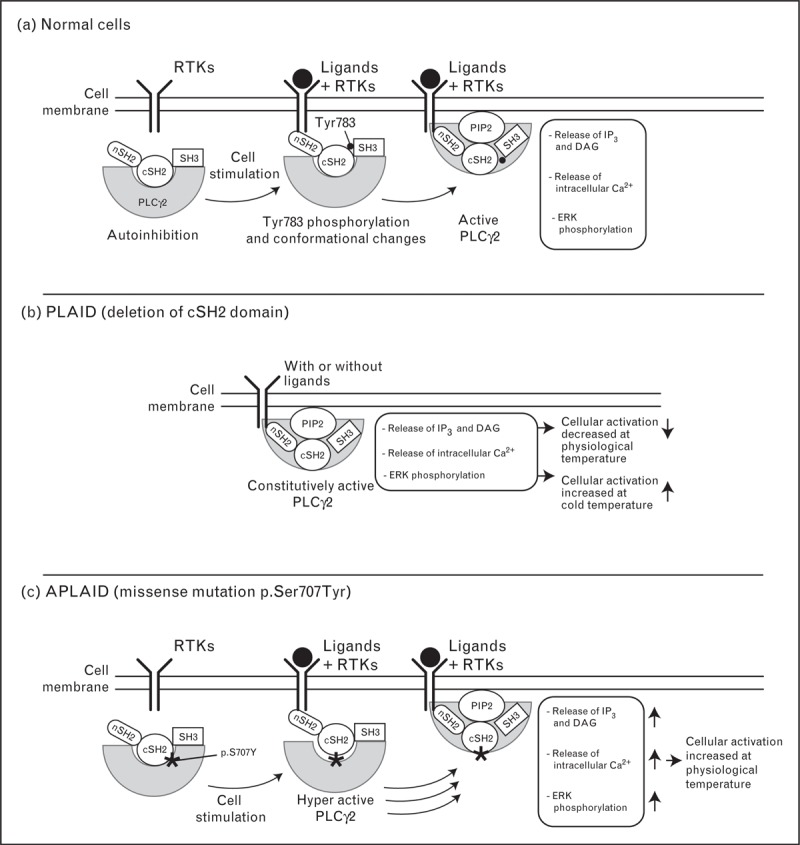
PURPOSE OF REVIEW: Next-generation sequencing is revolutionizing the molecular taxonomy of human disease. Recent studies of patients with unexplained autoinflammatory disorders reveal germline genetic mutations that target important regulators of innate immunity. RECENT FINDINGS: Whole-exome analyses of previously undiagnosed patients have catalyzed the recognition of two new disease genes. First, a phenotypic spectrum, including livedo racemosa, fever with early-onset stroke, polyarteritis nodosa, and Sneddon syndrome, is caused by loss-of-function mutations in cat eye syndrome chromosome region, candidate 1 (CECR1), encoding adenosine deaminase 2. Adenosine deaminase 2 is a secreted protein expressed primarily in myeloid cells, and a regulator of macrophage differentiation and endothelial development. Disease-associated mutations impair anti-inflammatory M2 macrophage differentiation. Second, patients presenting with cold-induced urticaria, granulomatous rash, autoantibodies, and common variable immunodeficiency, or with blistering skin lesions, bronchiolitis, enterocolitis, ocular inflammation, and mild immunodeficiency harbor distinct mutations in phospholipase Cγ₂, encoding a signaling molecule expressed in natural killer cells, mast cells, and B lymphocytes. These mutations inhibit the function of a phospholipase Cγ₂ autoinhibitory domain, causing increased or constitutive signaling. SUMMARY: These findings underscore the power of next-generation sequencing, demonstrating how the primary deficiency of key molecular regulators or even regulatory motifs may lead to autoinflammation, and suggesting a possible role for cat eye syndrome chromosome region, candidate 1 and phospholipase Cγ₂ in common diseases.
Overview
The claims and statistics of this paper haven’t been checked yet.
Run the check — free, no account needed. It reads the open-access text and checks the sources it cites.
Integrity signals
Registry
Cites
Statistics
Figures
Verification
Claims the paper makes
The claims and statistics of this paper haven’t been checked yet.
Run the check — free, no account needed. It reads the open-access text and checks the sources it cites.
Claims other papers make about this one
Each is checked against this paper’s own text: does it say what the citing paper says it does?
The source backs part of the claim, not all of it — or backs it for a different population, condition or comparison.
In the citing paper
“Patients with PLAID typically exhibit symptoms of cold urticaria, a form of cold temperature-induced hives, beginning in infancy, but otherwise shares many of the common clinical manifestations of CVID such as granulomatous disease, allergy, autoimmune disease, and an abnormally low concentration of serum IgG with recurrent infections (63, 66).”
From The role of PLCγ2 in immunological disorders, cancer, and neurodegeneration (2021) · cites this paper as [66]
Experimental — accuracy not yet measured
Self-check
Percentages, sums and reported differences re-computed from the paper’s own numbers.
The self-check needs the paper’s full text.
Citations
Cites
The Inflammasomes: Guardians of the Body
Martinon, F., Mayor, A., & Tschopp, J. (2009) · Annual Review of Immunology · doi:10.1146/annurev.immunol.021908.132715 · Cited by 2,436
Hoffman, H. M., Mueller, J. L., Broide, D. H., Wanderer, A. A., & Kolodner, R. D. (2001) · Nature Genetics · doi:10.1038/ng756 · Cited by 1,679
The International FMF Consortium (1997) · Cell · doi:10.1016/s0092-8674(00)80539-5 · Cited by 1,550
A candidate gene for familial Mediterranean fever
Bernot, A., Clépet, C., Silva, C. D., Devaud, C., Petit, J., Caloustian, C., Cruaud, C., Samson, D. S., Pulcini, F., Weissenbach, J., et al. (1997) · Nature Genetics · doi:10.1038/ng0997-25 · Cited by 1,547
Inflammatory Bowel Disease and Mutations Affecting the Interleukin-10 Receptor
Glocker, E., Kotlarz, D., Boztuǧ, K., Gertz, E. M., Schäffer, A. A., Noyan, F., Perro, M., Diestelhorst, J., Saborowski, A. L., Murugan, D., et al. (2009) · New England Journal of Medicine · doi:10.1056/nejmoa0907206 · Cited by 1,452
Activated STING in a Vascular and Pulmonary Syndrome
Liu, Y., de Jesus, A. A., Marrero, B., Yang, D., RAMSEY, S. E., Sanchez, G. A. M., Tenbrock, K., Wittkowski, H., Jones, O. Y., Kuehn, H. S., et al. (2014) · New England Journal of Medicine · doi:10.1056/nejmoa1312625 · Cited by 1,415
Self-citationMcDermott, M., Aksentijevich, I. A., Galon, J., McDermott, E. M., Ogunkolade, B.-W., Centola, M. B., Mansfield, E. A., Gadina, M., Karenko, L., Pettersson, T., et al. (1999) · Cell · doi:10.1016/s0092-8674(00)80721-7 · Cited by 1,404
Self-citationHorror Autoinflammaticus: The Molecular Pathophysiology of Autoinflammatory Disease
Masters, S. L., Simon, A., Aksentijevich, I. A., & Kastner, D. L. (2009) · Annual Review of Immunology · doi:10.1146/annurev.immunol.25.022106.141627 · Cited by 1,083
Self-citationThe calcium-sensing receptor regulates the NLRP3 inflammasome through Ca2+ and cAMP
Lee, G., Subramanian, N., Kim, A. I., Aksentijevich, I. A., Goldbach‐Mansky, R. T., Sacks, D. B., Germain, R. N., Kastner, D. L., & Chae, J. J. (2012) · Nature · doi:10.1038/nature11588 · Cited by 1,077
Self-citationInterleukin-36–Receptor Antagonist Deficiency and Generalized Pustular Psoriasis
Marrakchi, S., Guigue, P., Renshaw, B. R., Puel, A., Pei, X.-Y., Fraitag, S., Zribi, J., Bal, É., Cluzeau, C. V. M., Chrabieh, M., et al. (2011) · New England Journal of Medicine · doi:10.1056/nejmoa1013068 · Cited by 996
Research works printed but not linked: 3
- Van Eyck, 2014, Mutant ADA2 in vasculopathies., N Engl J Med, 371, 478, 10.1056/NEJMc1405506 · DOI
- Bras, 2014, Mutant ADA2 in vasculopathies., N Engl J Med, 371, 479
- Van Eyck, 2014, Mutant ADA2 in vasculopathies., N Engl J Med, 371, 480
Cited by
Sorted by citations
Hashem, H., Kumar, A. R., Müller, I., Babor, F., Bredius, R. G. M., Dalal, J. D., Hsu, A. P., Holland, S. M., Hickstein, D. D., Jolles, S. R. A., et al. (2017) · Blood · doi:10.1182/blood-2017-07-798660 · Cited by 188
Monogenic polyarteritis: the lesson of ADA2 deficiency
Caorsi, R., Penco, F., Schena, F., & Gattorno, M. (2016) · Pediatric Rheumatology · doi:10.1186/s12969-016-0111-7 · Cited by 127
Human adenosine deaminases ADA1 and ADA2 bind to different subsets of immune cells
Kaljas, Y., Liu, C., Skaldin, M., Wu, C., Zhou, Q., Lu, Y., Aksentijevich, I. A., & Zavialov, A. V. (2016) · Cellular and Molecular Life Sciences · doi:10.1007/s00018-016-2357-0 · Cited by 127
Self-citationExtending the Clinical Phenotype of Adenosine Deaminase 2 Deficiency
Ben‐Ami, T., Revel‐Vilk, S., Brooks, R. A., Shaag, A., Hershfield, M. S., Kelly, S. J., Ganson, N. J., Kfir‐Erenfeld, S., Weintraub, M., Elpeleg, O. N., et al. (2016) · The Journal of Pediatrics · doi:10.1016/j.jpeds.2016.06.058 · Cited by 114
Tervaert, J. W. C. (2018) · Autoimmunity Reviews · doi:10.1016/j.autrev.2018.07.003 · Cited by 113
The role of PLCγ2 in immunological disorders, cancer, and neurodegeneration
Jackson, J. T., Mulazzani, E., Nutt, S. L., & Masters, S. L. (2021) · Journal of Biological Chemistry · doi:10.1016/j.jbc.2021.100905 · Cited by 113
“Patients with PLAID typically exhibit symptoms of cold urticaria, a form of cold temperature-induced hives, beginning in infancy, but otherwise shares many of the common clinical manifestations of CVID such as granulomatous disease, allergy, autoimmune disease, and an abnormally low concentration of serum IgG with rec…”
BackgroundConway, O. J., Carrasquillo, M. M., Wang, X., Bredenberg, J. M., Reddy, J. S., Strickland, S. L., Younkin, C. S., Burgess, J. D., Allen, M., Lincoln, S. J., et al. (2018) · Molecular Neurodegeneration · doi:10.1186/s13024-018-0289-x · Cited by 112
Dermatologic Features of ADA2 Deficiency in Cutaneous Polyarteritis Nodosa
Santiago, T. M. G., Zavialov, A. V., Saarela, J., Seppänen, M. R. J., Reed, A. M., Abraham, R. S., & Gibson, L. E. (2015) · JAMA Dermatology · doi:10.1001/jamadermatol.2015.1635 · Cited by 89
Harrison, S. R., McGonagle, D., Nizam, S., Jarrett, S. J., van der Hilst, J. C. H., McDermott, M., & Savic, S. (2016) · JCI Insight · doi:10.1172/jci.insight.86336 · Cited by 73
Tervaert, J. W. C. (2018) · Best Practice & Research Clinical Rheumatology · doi:10.1016/j.berh.2019.01.003 · Cited by 61
Labrousse, M., Kevorkian‐Verguet, C., Boursier, G., Rowczenio, D. M., Maurier, F., Lazaro, E., Aggarwal, M., Lemelle, I., Mura, T., Bélot, A., et al. (2018) · Critical Reviews in Clinical Laboratory Sciences · doi:10.1080/10408363.2018.1488805 · Cited by 56
Contreras-Aguilar, M. D., Tvarijonaviciute, A., Monkevičienė, I., Cuervo, M. M., González-Aróstegui, L. G., Franco‐Martínez, L., Cerón, J. M. C., Tecles, F., & Escribano, D. (2020) · BMC Veterinary Research · doi:10.1186/s12917-020-02574-2 · Cited by 52
Monogenic autoinflammatory diseases: Cytokinopathies
Moghaddas, F., & Masters, S. L. (2015) · Cytokine · doi:10.1016/j.cyto.2015.02.012 · Cited by 39
Pei, W., Xu, L., Varshney, G. K., Carrington, B., Bishop, K. S., Jones, M., Huang, S. C., Idol, J., Pretorius, P. R., Beirl, A. J., et al. (2016) · Scientific Reports · doi:10.1038/srep29946 · Cited by 36
Diagnosis and management of ADA 2 deficient polyarteritis nodosa
Human, A., & Pagnoux, C. (2018) · International Journal of Rheumatic Diseases · doi:10.1111/1756-185x.13283 · Cited by 34
Caldirola, M. S., Martínez, M. P., Bezrodnik, L., Zwirner, N. W., & Gaillard, M. I. (2020) · Frontiers in Immunology · doi:10.3389/fimmu.2020.576724 · Cited by 21
Ratzinger, G., Zelger, B. G., & Zelger, B. W. H. (2019) · JDDG Journal der Deutschen Dermatologischen Gesellschaft · doi:10.1111/ddg.13930 · Cited by 18
Walliser, C., Wist, M., Hermkes, E., Zhou, Y., Schade, A., Haas, J., Deinzer, J., Désiré, L., Li, S. S. C., Stilgenbauer, S., et al. (2018) · Oncotarget · doi:10.18632/oncotarget.26173 · Cited by 17
Welzel, T., Oefelein, L., Holzer, U., Müller, A. J., Menden, B., Haack, T. B., Groβ, M., & Kuemmerle-Deschner, J. B. (2022) · Journal of Clinical Medicine · doi:10.3390/jcm11154369 · Cited by 13
Development of the doctrine of auto-inflammatory diseases in the XXI century
Федоров, Е. С., Salugina, S. O., & Kuzmina, N. N. (2019) · Rheumatology Science and Practice · doi:10.14412/1995-4484-2018-5-18 · Cited by 11
Ratzinger, G., Zelger, B. G., & Zelger, B. W. H. (2019) · JDDG Journal der Deutschen Dermatologischen Gesellschaft · doi:10.1111/ddg.13973 · Cited by 10
Autoinflammatory diseases: An immunologist’s view
Shcherbina, A. Y. (2015) · Modern Rheumatology Journal · doi:10.14412/1996-7012-2015-1-48-54 · Cited by 9
Overexpression of PLCG2 and TMEM38A inhibit tumor progression in clear cell renal cell carcinoma
Zhao, Y., Yang, L., Bai, X., Du, L., Lai, H., Liu, Y., Chen, P., DiSanto, M. E., & Zhang, X. (2025) · Scientific Reports · doi:10.1038/s41598-025-86644-1 · Cited by 8
Ratzinger, G., Zelger, B. G., & Zelger, B. W. H. (2019) · JDDG Journal der Deutschen Dermatologischen Gesellschaft · doi:10.1111/ddg.13973_g · Cited by 5
Defects in B Cell Survival and Activation
Yong, P. F. K., Dziadzio, M., & Grimbacher, B. (2016) · Elsevier eBooks · doi:10.1016/b978-0-12-374279-7.18014-2 · Cited by 4
Cheng-zhi, G., Li, J., Zhu, L., Lu, Z., & Huaiyu, H. (2015) · Neurological Sciences · doi:10.1007/s10072-015-2432-6 · Cited by 2
Veryser, E., Meyts, I., Casteels, I., Demaerel, P., Somer, L. D., & Cassiman, C. (2021) · Journal of Pediatric Ophthalmology & Strabismus · doi:10.3928/01913913-20210416-02 · Cited by 2
Wu, N. Q., Wu, D., & Shen, M. (2023) · Rheumatology · doi:10.1093/rheumatology/kead085 · Cited by 2
Toz, B., & Erer, B. (2016) · Clinical Rheumatology · doi:10.1007/s10067-016-3293-y
Deficiency of Adenosine Deaminase 2 (DADA2)
Reiff, A. O. (2019) · Springer eBooks · doi:10.1007/978-3-319-96929-9_11
Defects in B Cell Survival and Activation
Akhoon, C., & Yong, P. F. K. (2025) · Elsevier eBooks · doi:10.1016/b978-0-12-824465-4.00196-4
Comprehensive review on Sneddon’s syndrome
Alzo’ubi, M. A. (2025) · Arab Journal of Rheumatology · doi:10.4103/ajr.ajr_2_25
Li, P., Ma, C., Chen, L., Chen, Z., You, S., Li, J., & ShiSheng, S. U. N. (2026) · Chemical Communications · doi:10.1039/d5cc06865g
Metadata
- Authors
- Giannelou, A., Zhou, Q., & Kastner, D. L.
- Affiliations
- National Institutes of Health (US)
- Corresponding author
- Giannelou, Angeliki
- Venue
- Current Opinion in Allergy & Clinical Immunology
- Published
- 2014-12
- Volume
- 14
- Issue
- 6
- Pages
- 491-500
- ISSN
- 1473-6322 (ISSN-L)
- 1528-4050
- PMC
- PMC4212813
- OpenAlex
- W2023021099
- Cited by
- 34
- References
- 50
- Citations by year
- 2026: 1 · 2025: 3 · 2023: 1 · 2022: 1 · 2021: 2 · 2020: 2 · 2019: 6 · 2018: 6 · 2017: 1 · 2016: 7 · 2015: 4
- FWCI
- 0.39
- Type
- journal article
- Language
- en
- Open access
- green
- www.ncbi.nlm.nih.gov
- Licence
- cc-by-nc-nd
- Locations
- Current Opinion in Allergy and Clinical Immunology (publishedVersion)
- PubMed Central (publishedVersion, cc-by-nc-nd)
- PubMed (publishedVersion)
- Funders
- National Institutes of Health
- National Human Genome Research Institute
- Topics
- Life Sciences › Immunology and Microbiology › Immunology › Immunodeficiency and Autoimmune Disorders
- Life Sciences › Biochemistry, Genetics and Molecular Biology › Molecular Biology › Inflammasome and immune disorders
- Life Sciences › Biochemistry, Genetics and Molecular Biology › Genetics › Genomics and Rare Diseases
- Keywords
- autoinflammatory disease, CECR1, ADA2, PLCγ2, germline mutations, innate immunity, M2 macrophage differentiation, cold-induced urticaria, common variable immunodeficiency, Sneddon syndrome, polyarteritis nodosa, livedo racemosa, autoinhibitory domain
- MeSH terms
- Adenosine Deaminase, Autoimmune Diseases, Humans, Mutation, Common Variable Immunodeficiency, Intercellular Signaling Peptides and Proteins, Phospholipase C gamma, Genome-Wide Association Study
About these checks
Registry, retraction, Cites and statistics results are computed, not judged, with one exception: a printed reference that no index lists is read once by a model before it counts as a citation error. Claims are extracted by a model and kept only when their quote appears verbatim in the text; each cited source is then checked, with a model’s help, for whether it says what the claim relies on. Those verdicts can be wrong — read the claim’s quote and the cited source before relying on one.
Statistics and arithmetic are recomputed, not judged.
Confidence bands are shown only for fields calibrated on our annotated test set. None is calibrated yet, so no band is shown.
What counts as a claim ›How we measure confidence ›How we check this ›
Are you an author, or do you see a problem with this page? Request a review
