

The DOI matches its Crossref record.
Trends in Hospitalizations for Serious Infections Among People With Opioid Use Disorder in Ontario, Canada
Abstract
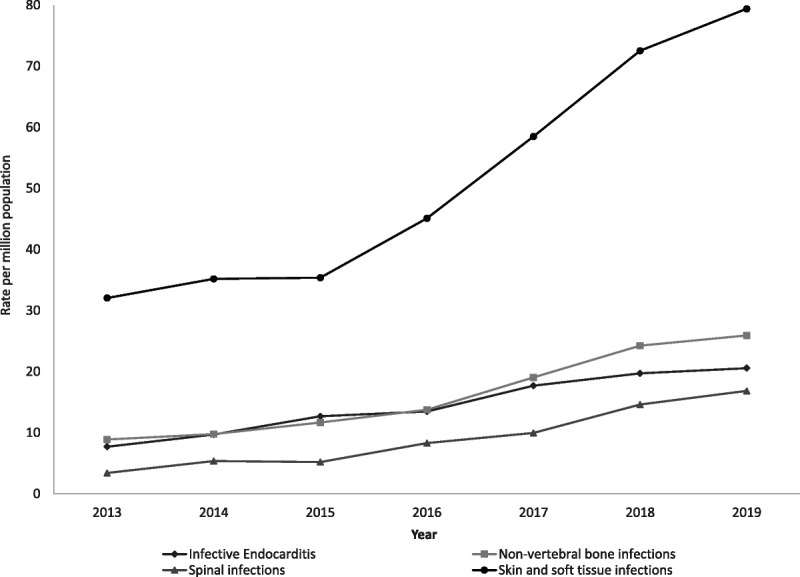
Objectives: Opioid use among people who inject drugs can lead to serious complications, including infections. We sought to study trends in rates of these complications among people with an opioid use disorder (OUD) and the sequelae of those hospitalizations. Methods: We analyzed all inpatient hospitalizations for serious infections (infective endocarditis [IE], spinal infections, nonvertebral bone infections, and skin or soft tissue infections) among people with OUD in Ontario between 2013 and 2019. We reported the population adjusted rate of hospitalizations for serious infections annually, stratified by type of infection and prevalence of prior opioid agonist therapy and hydromorphone prescribing. We reported characteristics of hospitalizations and 30–day mortality in the most recent 2 years. Results: Among people with OUD there was a 167% increase in rates of IE (7.7-20.6 per million residents; P < 0.01), a 394% increase in rates of spinal infections (3.4–16.8 per million residents; P < 0.01), a 191% increase in rates of nonvertebral bone infections (8.9 to 25.9 per million residents; P < 0.01), and a 147% increase in infections of the skin or soft tissue (32.1–79.4 per million residents; P < 0.01) over 7 years in Ontario. Death in-hospital and within 30 days of discharge was highest among those with IE (11.5% and 15.9%, respectively), and lower among those with other infections (<5%). Conclusions: Rates of serious infections among people with OUD are rising, placing a significant burden on patients. These findings suggest that early intervention and treatment of infections in this population are needed to prevent downstream harm.
Overview
The claims and statistics of this paper haven’t been checked yet.
Run the check — free, no account needed. It reads the open-access text and checks the sources it cites.
Integrity signals
Registry
Cites
Statistics
Figures
Verification
Claims the paper makes
The claims and statistics of this paper haven’t been checked yet.
Run the check — free, no account needed. It reads the open-access text and checks the sources it cites.
Claims other papers make about this one
Each is checked against this paper’s own text: does it say what the citing paper says it does?
In the citing paper
“Injection drug use–associated bacterial and fungal infections (e.g., skin and soft-tissue infections, endocarditis, osteomyelitis, septic arthritis, and epidural abscess) are associated with significant morbidity and mortality among people who inject drugs (PWID) and are costly for healthcare systems [1–6].”
In the citing paper
“The incidence of hospitalization for injecting-related infections is increasing in many parts of the world, including Australia [7], Canada [2,8,9], South Africa [10], the United Kingdom [11], the United States of America [12–16], and India [17].”
Self-check
Percentages, sums and reported differences re-computed from the paper’s own numbers.
The self-check needs the paper’s full text.
Citations
Cites
No references could be resolved yet.
Research works printed but not linked: 27
- 2018, The opioid crisis in Canada: a national perspective, Health Promot Chronic Dis Prev Can, 38, 224, 10.24095/hpcdp.38.6.02 · DOI
- 2020, Population-based trends in hospitalizations due to injection drug use-related serious bacterial infections, Oregon, 2008 to 2018, PLoS One, 15, e0242165, 10.1371/journal.pone.0242165 · DOI
- 2007, Nationwide increase in the number of hospitalizations for illicit injection drug use-related infective endocarditis, Clin Infect Dis, 45, 1200, 10.1086/522176 · DOI
- 2020, Trends in morbidity, mortality, and cost of hospitalizations associated with infectious disease sequelae of the opioid epidemic, J Infect Dis, 222, S451
- 2018, Rising rates of injection drug use associated infective endocarditis in Virginia with missed opportunities for addiction treatment referral: a retrospective cohort study, BMC Infect Dis, 18, 532, 10.1186/s12879-018-3408-y · DOI
- 2019, A controlled-release oral opioid supports S. aureus survival in injection drug preparation equipment and may increase bacteremia and endocarditis risk, PLoS One, 14, e0219777, 10.1371/journal.pone.0219777 · DOI
- 2020, A retrospective cohort study evaluating correlates of deep tissue infections among patients enrolled in opioid agonist treatment using administrative data in Ontario, Canada, PLoS One, 15, e0232191, 10.1371/journal.pone.0232191 · DOI · Paper page
- 2019, Recurrent endocarditis in persons who inject drugs, Open Forum Infect Dis, 6, ofz396, 10.1093/ofid/ofz396 · DOI
- 2020, Risk factors of infective endocarditis in persons who inject drugs, Harm Reduct J, 17, 35, 10.1186/s12954-020-00378-z · DOI
- 2020, Hydromorphone and the risk of infective endocarditis among people who inject drugs: a population-based, retrospective cohort study, Lancet Infect Dis, 20, 487, 10.1016/S1473-3099(19)30705-4 · DOI
- 2019, The risk of infective endocarditis among people who inject drugs: a retrospective, population-based time series analysis, CMAJ, 191, E93, 10.1503/cmaj.180694 · DOI
- 2020, Not just endocarditis: hospitalizations for selected invasive infections among persons with opioid and stimulant use diagnoses-North Carolina, 2010-2018, J Infect Dis, 222, S458
- 2020, Bacterial infections associated with substance use disorders, large cohort of United States Hospitals, Clin Infect Dis, 71, e37, 10.1093/cid/ciaa008 · DOI
- 2020, Tackling the overdose crisis: the role of safe supply, Int J Drug Policy, 80, 102769, 10.1016/j.drugpo.2020.102769 · DOI
- 2020, Barriers and facilitators to a novel low-barrier hydromorphone distribution program in Vancouver, Canada: a qualitative study, Drug Alcohol Depend, 216, 108202, 10.1016/j.drugalcdep.2020.108202 · DOI
- 2019, Understanding the implications of a shifting opioid landscape in Ontario, Healthc Q, 22, 6, 10.12927/hcq.2019.26025 · DOI
- 2012, Implementation of ICD-10 in Canada: how has it impacted coded hospital discharge data?, BMC Health Serv Res, 12, 149, 10.1186/1472-6963-12-149 · DOI
- 2018, Validation of an algorithm to identify infective endocarditis in people who inject drugs, Med Care, 56, e70, 10.1097/MLR.0000000000000838 · DOI
- 2017, Opiate injection-associated skin, soft tissue, and vascular infections, England, U.K., 1997-2016, Emerg Infect Dis, 23, 1400, 10.3201/eid2308.170439 · DOI · Paper page
- 2019, Recent Increase in the rate of spinal infections may be related to growing substance-use disorder in the State of Washington: wide population-based analysis of the comprehensive hospital abstract reporting system (CHARS) database, Spine (Phila Pa 1976), 44, 291, 10.1097/BRS.0000000000002819 · DOI
- 2007, Reduction in injection-related HIV risk after 6 months in a low-threshold methadone treatment program, AIDS Educ Prev, 19, 124, 10.1521/aeap.2007.19.2.124 · DOI
- 2020, Clinical and economic burden of hospitalizations for infective endocarditis in the United States, Mayo Clin Proc, 95, 858, 10.1016/j.mayocp.2019.08.023 · DOI
- 2015, Trends in infective endocarditis incidence, microbiology, and valve replacement in the United States from 2000 to 2011, J Am Coll Cardiol, 65, 2070, 10.1016/j.jacc.2015.03.518 · DOI
- 2018, Intravenous fentanyl use among people who inject drugs in Australia, Drug Alcohol Rev, 37, S314
- 2019, Associations between perceived illicit fentanyl use and infectious disease risks among people who inject drugs, Int J Drug Policy, 74, 299, 10.1016/j.drugpo.2019.10.004 · DOI
- 2010, HIV infection and risk behaviour of primary fentanyl and amphetamine injectors in Tallinn, Estonia: implications for intervention, Int J Drug Policy, 21, 56, 10.1016/j.drugpo.2009.02.007 · DOI
- 2020, Use of ICD-10 codes for identification of injection drug use-associated infective endocarditis is nonspecific and obscures critical findings on impact of medications for opioid use disorder, Open Forum Infect Dis, 7, ofaa414, 10.1093/ofid/ofaa414 · DOI
Cited by
Sorted by citations
Brothers, T. D., Lewer, D., Jones, N., Colledge-Frisby, S., Farrell, M., Hickman, M., Webster, D., Hayward, A., & Degenhardt, L. (2022) · PLOS Medicine · doi:10.1371/journal.pmed.1004049 · Cited by 25
Lim, J., Russell, W. A., El-Sheikh, M., Buckeridge, D. L., & Panagiotoglou, D. (2024) · Harm Reduction Journal · doi:10.1186/s12954-024-01037-3 · Cited by 3
Metadata
- Authors
- Gomes, T., Kitchen, S. A., Tailor, L., Men, S., Murray, R., Bayoumi, A. M., Campbell, T., Young, S., & Kolla, G.
- Venue
- Journal of Addiction Medicine
- Published
- 2021-10-28
- Volume
- 16
- Issue
- 4
- Pages
- 433-439
- ISSN
- 1932-0620
- PMC
- PMC9365258
- Cited by
- 36
- References
- 0
- Language
- en
About these checks
Registry, retraction, Cites and statistics results are computed, not judged, with one exception: a printed reference that no index lists is read once by a model before it counts as a citation error. Claims are extracted by a model and kept only when their quote appears verbatim in the text; each cited source is then checked, with a model’s help, for whether it says what the claim relies on. Those verdicts can be wrong — read the claim’s quote and the cited source before relying on one.
Statistics and arithmetic are recomputed, not judged.
Confidence bands are shown only for fields calibrated on our annotated test set. None is calibrated yet, so no band is shown.
What counts as a claim ›How we measure confidence ›How we check this ›
Are you an author, or do you see a problem with this page? Request a review
How to cite
Cite CoChat for the checks on this page, and the paper for its own findings.
- This page
- CoChat. (2026). Citation check: Trends in Hospitalizations for Serious Infections Among People With Opioid Use Disorder in Ontario, Canada. https://app.cochat.ai/papers/10.1097/adm.0000000000000928
- The paper
- Gomes, T., Kitchen, S. A., Tailor, L., Men, S., Murray, R., Bayoumi, A. M., Campbell, T., Young, S., & Kolla, G. (2022). Trends in Hospitalizations for Serious Infections Among People With Opioid Use Disorder in Ontario, Canada. Journal of Addiction Medicine. https://doi.org/10.1097/adm.0000000000000928
