

The DOI matches its Crossref record; 64 of the 64 references it cites were found in a registry or an index; 1 of the 59 sources its claims cite were checked for support.
Economic evaluation of the effect of needle and syringe programs on skin, soft tissue, and vascular infections in people who inject drugs: a microsimulation modelling approach
Open accessAbstract
Background: Needle and syringe programs (NSP) are effective harm-reduction strategies against HIV and hepatitis C. Although skin, soft tissue, and vascular infections (SSTVI) are the most common morbidities in people who inject drugs (PWID), the extent to which NSP are clinically and cost-effective in relation to SSTVI in PWID remains unclear. The objective of this study was to model the clinical- and cost-effectiveness of NSP with respect to treatment of SSTVI in PWID. Methods: We performed a model-based, economic evaluation comparing a scenario with NSP to a scenario without NSP. We developed a microsimulation model to generate two cohorts of 100,000 individuals corresponding to each NSP scenario and estimated quality-adjusted life-years (QALY) and cost (in 2022 Canadian dollars) over a 5-year time horizon (1.5% per annum for costs and outcomes). To assess the clinical effectiveness of NSP, we conducted survival analysis that accounted for the recurrent use of health care services for treating SSTVI and SSTVI mortality in the presence of competing risks. Results: The incremental cost-effectiveness ratio associated with NSP was $70,278 per QALY, with incremental cost and QALY gains corresponding to $1207 and 0.017 QALY, respectively. Under the scenario with NSP, there were 788 fewer SSTVI deaths per 100,000 PWID, corresponding to 24% lower relative hazard of mortality from SSTVI (hazard ratio [HR] = 0.76; 95% confidence interval [CI] = 0.72–0.80). Health service utilization over the 5-year period remained lower under the scenario with NSP (outpatient: 66,511 vs. 86,879; emergency department: 9920 vs. 12,922; inpatient: 4282 vs. 5596). Relatedly, having NSP was associated with a modest reduction in the relative hazard of recurrent outpatient visits (HR = 0.96; 95% CI = 0.95–0.97) for purulent SSTVI as well as outpatient (HR = 0.88; 95% CI = 0.87–0.88) and emergency department visits (HR = 0.98; 95% CI = 0.97–0.99) for non-purulent SSTVI. Conclusions: Both the individuals and the healthcare system benefit from NSP through lower risk of SSTVI mortality and prevention of recurrent outpatient and emergency department visits to treat SSTVI. The microsimulation framework provides insights into clinical and economic implications of NSP, which can serve as valuable evidence that can aid decision-making in expansion of NSP services.
Overview
AI snapshot
Written from the paper’s full text.
TL;DR
This microsimulation economic evaluation found that needle and syringe programs (NSP) reduced skin, soft tissue, and vascular infection (SSTVI) mortality and recurrent health service use among people who inject drugs in Quebec, but at an incremental cost-effectiveness ratio of $70,278 per QALY. The authors conclude NSP provide clinical and economic benefits for SSTVI beyond HIV/HCV prevention.
Key findings
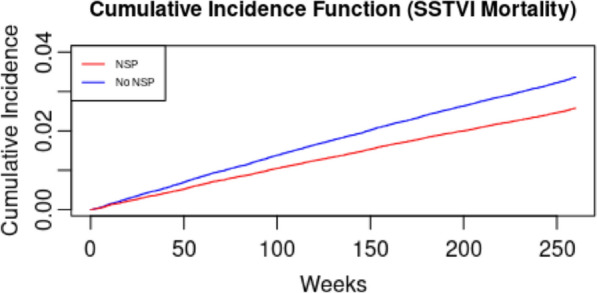
- NSP was associated with 788 fewer SSTVI deaths per 100,000 PWID over 5 years (2,572 with NSP vs. 3,360 without NSP), corresponding to a hazard ratio of 0.76 (95% CI 0.72–0.80).
- Health service utilization was lower with NSP: outpatient visits 66,511 vs. 86,879; emergency department visits 9,920 vs. 12,922; inpatient visits 4,282 vs. 5,596.
- Recurrent-event analysis showed modest reductions in outpatient visits for purulent SSTVI (HR 0.96; 95% CI 0.95–0.97) and outpatient (HR 0.88; 95% CI 0.87–0.88) and ED visits (HR 0.98; 95% CI 0.97–0.99) for non-purulent SSTVI; inpatient recurrent hazards were similar.
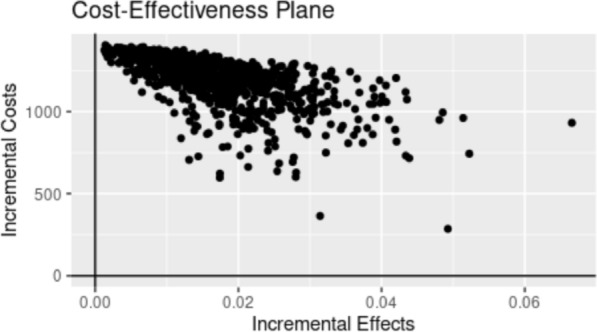
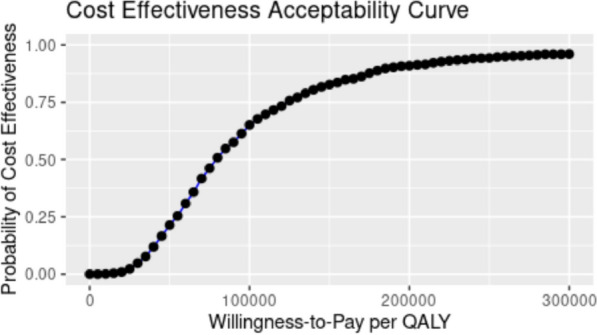
- Base-case cost-utility analysis gave an incremental cost of $1,207 and 0.017 QALY gain, yielding an ICER of $70,278 per QALY; at willingness-to-pay thresholds of $100,000 and $200,000 per QALY, the probability NSP was cost-effective was 65.1% and 90.9%, respectively.
Methods
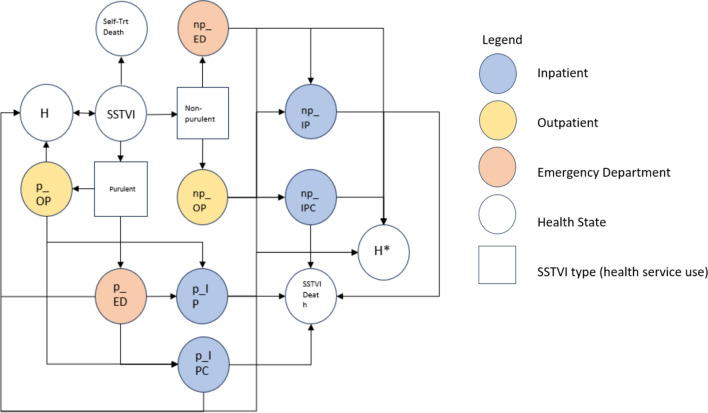
- Model-based economic evaluation comparing NSP versus no NSP using a 13-state transition microsimulation model, with two synthetic cohorts of 100,000 Quebec adults aged 18–65, a 5-year time horizon, and 1-week cycles.
- Parameters were derived from six Quebec administrative health databases (2009–2019), INSPQ surveillance of PWID, and published literature; costs were in 2022 Canadian dollars, discounted at 1.5% per annum.
- Analyses included cost-utility analysis with ICER, recurrent-event survival analysis using marginal means models, competing-risk survival analysis using Fine-Gray models, and probabilistic sensitivity analysis with 1,000 model runs.
Limitations
- The paper states that the model may not adequately capture real-world clinical variability because it assumed quality of care and health system performance remained the same for both cohorts over follow-up.
- The paper states that NSP costs were unavailable for Quebec and were taken from Ontario; fixed and variable NSP cost components could not be separated, and NSP effectiveness estimates came from studies outside Quebec.
- The paper states uncertainty around interactions among multiple injection risk behaviours, addressed through Bayesian model calibration; the text also makes evident that recurrent-event findings came from a simulated cohort with simplified assumptions, so real-world data may be needed to strengthen the findings.
Model-written summary. Check it against the paper before relying on it.
Integrity signals
Registry
Cites
Statistics
Figures
Verification
Claims the paper makes
26 Own result · 17 Own method · 13 Own interpretation · 12 Check pending · 6 No basis given · 3 No full text of the sources · 3 Not checked yet · 2 Sources not found · 1 Partly supported · accuracy not yet measured
A result the paper reports from its own data — it cites no other source for it, so there is none to check. The quote shows it is in the paper.
In the paper
“| Discount Rate 0% | NSP | $2187 | 13 | 4.07 | 0.003 | $1241 | 7 | 0.018 | 0.001 | $69,455/QALY |”
§ Economic evaluation of the effect of needle and syringe programs on skin, soft tissue, and vascular infections in people who inject drugs: a microsimulation modelling approach > Results
plaindirect- Asserted: passes — The authors put it forward as true.
- Checkable: passes — It can be checked against evidence.
- Load-bearing: unclear — It is unclear whether the paper’s conclusions depend on it.
- Based: passes — The paper gives a reason why it holds.
A result the paper reports from its own data — it cites no other source for it, so there is none to check. The quote shows it is in the paper.
In the paper
“| Annual NSP Costa ($350) | NSP | $2262 | 12 | 3.956 | 0.003 | $1343 | 7 | 0.017 | 0.001 | $78,218/QALY |”
§ Economic evaluation of the effect of needle and syringe programs on skin, soft tissue, and vascular infections in people who inject drugs: a microsimulation modelling approach > Results
plaindirect- Asserted: passes — The authors put it forward as true.
- Checkable: passes — It can be checked against evidence.
- Load-bearing: unclear — It is unclear whether the paper’s conclusions depend on it.
- Based: passes — The paper gives a reason why it holds.
A result the paper reports from its own data — it cites no other source for it, so there is none to check. The quote shows it is in the paper.
In the paper
“corresponding to 24% lower relative hazard of mortality from SSTVI (hazard ratio [HR] = 0.76; 95% confidence interval [CI] = 0.72–0.80).”
- Also stated in: § Results · plain
“This corresponded to hazard ratio of 0.76 (95% CI = 0.72–0.80; Fig. 2).”
§ Economic evaluation of the effect of needle and syringe programs on skin, soft tissue, and vascular infections in people who inject drugs: a microsimulation modelling approach > Abstract > Results
plaincorrelational- Asserted: passes — The authors put it forward as true.
- Checkable: passes — It can be checked against evidence.
- Load-bearing: passes — The paper’s conclusions depend on it.
- Based: passes — The paper gives a reason why it holds.
- The authors state this as an assumption: Each year had 52 weeks.
- Also stated in: § Results · plain
A result the paper reports from its own data — it cites no other source for it, so there is none to check. The quote shows it is in the paper.
In the paper
“| Discount Rate 3% | NSP | $2068 | 12 | 3.849 | 0.003 | $1174 | 7 | 0.017 | 0.001 | $71,108/QALY |”
§ Economic evaluation of the effect of needle and syringe programs on skin, soft tissue, and vascular infections in people who inject drugs: a microsimulation modelling approach > Results
plaindirect- Asserted: passes — The authors put it forward as true.
- Checkable: passes — It can be checked against evidence.
- Load-bearing: passes — The paper’s conclusions depend on it.
- Based: passes — The paper gives a reason why it holds.
A result the paper reports from its own data — it cites no other source for it, so there is none to check. The quote shows it is in the paper.
In the paper
“having NSP was associated with a modest reduction in the relative hazard of recurrent outpatient visits (HR = 0.96; 95% CI = 0.95–0.97) for purulent SSTVI”
- Also stated in: § Results · plain
“NSP was associated with modest reduction in the relative hazard of recurrent outpatient visits (HR = 0.96; 95% CI = 0.95–0.97) for purulent SSTVI”
§ Economic evaluation of the effect of needle and syringe programs on skin, soft tissue, and vascular infections in people who inject drugs: a microsimulation modelling approach > Abstract > Results
plaincorrelational- Asserted: passes — The authors put it forward as true.
- Checkable: passes — It can be checked against evidence.
- Load-bearing: unclear — It is unclear whether the paper’s conclusions depend on it.
- Based: passes — The paper gives a reason why it holds.
- The authors state this as an assumption: Each year had 52 weeks.
- Also stated in: § Results · plain
A result the paper reports from its own data — it cites no other source for it, so there is none to check. The quote shows it is in the paper.
In the paper
“under the scenario with NSP, there were fewer contacts with the healthcare system as well as lower hazards of recurrent outpatient visits and ED visits to treat SSTVI.”
§ Economic evaluation of the effect of needle and syringe programs on skin, soft tissue, and vascular infections in people who inject drugs: a microsimulation modelling approach > Discussion
plaindirect- Asserted: passes — The authors put it forward as true.
- Checkable: passes — It can be checked against evidence.
- Load-bearing: passes — The paper’s conclusions depend on it.
- Based: passes — The paper gives a reason why it holds.
- The authors state this as an assumption: Quality of care delivered and health system performance remained the same over the course of follow-up for both cohorts.
A result the paper reports from its own data — it cites no other source for it, so there is none to check. The quote shows it is in the paper.
In the paper
“under the scenario with NSP, there were fewer contacts with the healthcare system as well as lower hazards of recurrent outpatient visits and ED visits to treat SSTVI.”
§ Economic evaluation of the effect of needle and syringe programs on skin, soft tissue, and vascular infections in people who inject drugs: a microsimulation modelling approach > Discussion
plaindirect- Asserted: passes — The authors put it forward as true.
- Checkable: passes — It can be checked against evidence.
- Load-bearing: passes — The paper’s conclusions depend on it.
- Based: passes — The paper gives a reason why it holds.
- The authors state this as an assumption: Quality of care delivered and health system performance remained the same over the course of follow-up for both cohorts.
A result the paper reports from its own data — it cites no other source for it, so there is none to check. The quote shows it is in the paper.
In the paper
“Owing to a small number of early departures from medical institutions observed in our simulation (i.e., rare outcome), we were only able to see a modest reduction in the number of patient-directed discharges.”
§ Economic evaluation of the effect of needle and syringe programs on skin, soft tissue, and vascular infections in people who inject drugs: a microsimulation modelling approach > Discussion
plaindirect- Asserted: passes — The authors put it forward as true.
- Checkable: passes — It can be checked against evidence.
- Load-bearing: unclear — It is unclear whether the paper’s conclusions depend on it.
- Based: passes — The paper gives a reason why it holds.
A result the paper reports from its own data — it cites no other source for it, so there is none to check. The quote shows it is in the paper.
In the paper
“| Base Case | NSP | $2125 | 12 | 3.956 | 0.003 | $1207 | 7 | 0.017 | 0.001 | $70,278/QALY |”
§ Economic evaluation of the effect of needle and syringe programs on skin, soft tissue, and vascular infections in people who inject drugs: a microsimulation modelling approach > Results
plaindirect- Asserted: passes — The authors put it forward as true.
- Checkable: passes — It can be checked against evidence.
- Load-bearing: passes — The paper’s conclusions depend on it.
- Based: passes — The paper gives a reason why it holds.
- The authors state this as an assumption: Quality of care delivered and health system performance remained the same over the course of follow-up for both cohorts.
A result the paper reports from its own data — it cites no other source for it, so there is none to check. The quote shows it is in the paper.
In the paper
“When we assumed different scenarios for the annual cost of NSP per PWID ($300–$400 per person), the ICER ranged from $64,103 per QALY to $92,333 per QALY.”
§ Economic evaluation of the effect of needle and syringe programs on skin, soft tissue, and vascular infections in people who inject drugs: a microsimulation modelling approach > Results
plaincorrelational- Asserted: passes — The authors put it forward as true.
- Checkable: passes — It can be checked against evidence.
- Load-bearing: unclear — It is unclear whether the paper’s conclusions depend on it.
- Based: passes — The paper gives a reason why it holds.
- The authors state this as an assumption: Hospitalization longer than 7 days with a record of surgical procedures constituted a complication in inpatient settings.
- The authors state this as an assumption: Each year had 52 weeks.
- Probably not a substantial claim. 13
- It may state two separate claims as one. 20
The cited sources support only part of this claim — read each source’s verdict below.
In the paper
“Among people who inject drugs (PWID), skin, soft tissue, and vascular infections (SSTVI) at drug injection sites are the leading cause of emergency department (ED) visits and hospitalizations, globally [5–12].”
§ Economic evaluation of the effect of needle and syringe programs on skin, soft tissue, and vascular infections in people who inject drugs: a microsimulation modelling approach > Introduction
What the sources say
- Check pendingcites [5] Tookes H, et al. A cost analysis of hospitalizations for infections related to injection drug use at a County Safety-Net Hospital in Miami, Florida. PLoS ONE. 2015;10(6):e0129360. source
- Check pendingcites [6] Kendall CE, et al. A cohort study examining emergency department visits and hospital admissions among people who use drugs in Ottawa, Canada. Harm Reduct J. 2017;14(1):16. source
- Not checked — no full text of the sourcecites [7] Marks M, et al. Needles and the damage done: reasons for admission and financial costs associated with injecting drug use in a Central London Teaching Hospital. J Infect. 2013;66(1):95–102. source
- Partly supportedcites [8] Takahashi TA, et al. Predictors of hospitalization for injection drug users seeking care for soft tissue infections. J Gen Intern Med. 2007;22(3):382–8. sourceExperimental — accuracy not yet measured
The Background (page not provided) reports that soft tissue infection was the most common ED and admission diagnosis in a Vancouver cohort of people who inject drugs; it also describes a substantial burden at a San Francisco hospital. These local findings support the importance of such infections but not the claim that skin, soft tissue, and vascular infections are the leading cause of ED visits and hospitalizations globally. (LLM, conf=0.88)
- Check pendingcites [9] Lewer D, Harris M, Hope V. Opiate injection-associated skin, soft tissue, and vascular infections, England, UK, 1997–2016. Emerg Infect Dis. 2017;23(8):1400–3. source
- Not checked — no full text of the sourcecites [10] Dwyer R, et al. Prevalences and correlates of non-viral injecting-related injuries and diseases in a convenience sample of Australian injecting drug users. Drug Alcohol Depend. 2009;100(1–2):9–16. source
- Not checked — no full text of the sourcecites [11] Topp L, et al. Prevalence and predictors of injecting-related injury and disease among clients of Australia’s needle and syringe programs. Aust N Z J Public Health. 2008;32(1):34–7. source
- Not checked — no full text of the sourcecites [12] Blome A, et al. Emergency department medication dispensing reduces return visits and admissions. Am J Emerg Med. 2020;38(11):2387–90. source
plain- Asserted: passes — The authors put it forward as true.
- Checkable: passes — It can be checked against evidence.
- Load-bearing: fails — The paper’s conclusions may not depend on it.
- Based: passes — The paper gives a reason why it holds.
Probably not a substantial claim. The paper’s conclusions may not depend on it.
A result the paper reports from its own data — it cites no other source for it, so there is none to check. The quote shows it is in the paper.
In the paper
“In addition, the incremental QALY gains from having NSP remained very small, which then resulted in higher incremental cost per incremental QALY (i.e., ICER).”
§ Economic evaluation of the effect of needle and syringe programs on skin, soft tissue, and vascular infections in people who inject drugs: a microsimulation modelling approach > Discussion
plaindirect- Asserted: passes — The authors put it forward as true.
- Checkable: passes — It can be checked against evidence.
- Load-bearing: passes — The paper’s conclusions depend on it.
- Based: passes — The paper gives a reason why it holds.
It may state two separate claims as one.
A result the paper reports from its own data — it cites no other source for it, so there is none to check. The quote shows it is in the paper.
In the paper
“The incremental cost-effectiveness ratio associated with NSP was $70,278 per QALY, with incremental cost and QALY gains corresponding to $1207 and 0.017 QALY, respectively.”
- Also stated in: § Results · plain
“When 1.5% discount rate was assumed, the incremental cost under the NSP scenario compared to the no NSP scenario was $1,207 with 0.017 QALY gains, which correspond to an ICER of $70,278 per QALY.”
§ Economic evaluation of the effect of needle and syringe programs on skin, soft tissue, and vascular infections in people who inject drugs: a microsimulation modelling approach > Abstract > Results
plaindirect- Asserted: passes — The authors put it forward as true.
- Checkable: passes — It can be checked against evidence.
- Load-bearing: passes — The paper’s conclusions depend on it.
- Based: passes — The paper gives a reason why it holds.
It may state two separate claims as one.
- The authors state this as an assumption: Hospitalization longer than 7 days with a record of surgical procedures constituted a complication in inpatient settings.
- The authors state this as an assumption: Each year had 52 weeks.
- Also stated in: § Results · plain
A result the paper reports from its own data — it cites no other source for it, so there is none to check. The quote shows it is in the paper.
In the paper
“We estimated that having NSP led to fewer SSTVI deaths over the five-year period compared to not having NSP, with lower relative hazard of SSTVI mortality.”
§ Economic evaluation of the effect of needle and syringe programs on skin, soft tissue, and vascular infections in people who inject drugs: a microsimulation modelling approach > Discussion
hedgeddirect- Asserted: passes — The authors put it forward as true.
- Checkable: passes — It can be checked against evidence.
- Load-bearing: passes — The paper’s conclusions depend on it.
- Based: passes — The paper gives a reason why it holds.
It may state two separate claims as one.
- The authors state this as an assumption: Quality of care delivered and health system performance remained the same over the course of follow-up for both cohorts.
A result the paper reports from its own data — it cites no other source for it, so there is none to check. The quote shows it is in the paper.
In the paper
“At 0% and 3% discount rates, we also observed similar increase in costs and QALYs with an ICER of $69,455 per QALY and $71,108 per QALY, respectively.”
§ Economic evaluation of the effect of needle and syringe programs on skin, soft tissue, and vascular infections in people who inject drugs: a microsimulation modelling approach > Results
plaincorrelational- Asserted: passes — The authors put it forward as true.
- Checkable: passes — It can be checked against evidence.
- Load-bearing: passes — The paper’s conclusions depend on it.
- Based: passes — The paper gives a reason why it holds.
It may state two separate claims as one.
- The authors state this as an assumption: Hospitalization longer than 7 days with a record of surgical procedures constituted a complication in inpatient settings.
- The authors state this as an assumption: Each year had 52 weeks.
In the paper
“Many NSP in Quebec operate at the community level outside the healthcare system [64]”
§ Economic evaluation of the effect of needle and syringe programs on skin, soft tissue, and vascular infections in people who inject drugs: a microsimulation modelling approach > Discussion
What the sources say
- Not matchedcites [64] A week after opening, Montreal's safe injections sites report success, in CBC News. 2017.
Couldn’t be matched to a paper in Crossref, so it can’t be checked.
plain- Asserted: passes — The authors put it forward as true.
- Checkable: passes — It can be checked against evidence.
- Load-bearing: fails — The paper’s conclusions may not depend on it.
- Based: passes — The paper gives a reason why it holds.
Probably not a substantial claim. The paper’s conclusions may not depend on it.
- Not matched
In the paper
“With high level of trust between clients and NSP staff [66], PWID may utilize NSP as an alternative to physician visits when seeking medical care for SSTVI, and NSP may bridge the gap between medical care and PWID.”
§ Economic evaluation of the effect of needle and syringe programs on skin, soft tissue, and vascular infections in people who inject drugs: a microsimulation modelling approach > Discussion
What the sources say
- Not checked — no full text of the sourcecites [66] Treloar C, et al. Trust and people who inject drugs: the perspectives of clients and staff of Needle Syringe Programs. Int J Drug Policy. 2016;27:138–45. source
hedgedconditional- Asserted: passes — The authors put it forward as true.
- Checkable: passes — It can be checked against evidence.
- Load-bearing: unclear — It is unclear whether the paper’s conclusions depend on it.
- Based: passes — The paper gives a reason why it holds.
It may state two separate claims as one.
The paper states this without a source or data behind it here, so there is nothing to check it against. The quote shows it is in the paper.
In the paper
“Additionally, the impact of NSP on the public health burden of SSTVI and the health service utilization patterns for treating SSTVI among PWID is unclear.”
§ Economic evaluation of the effect of needle and syringe programs on skin, soft tissue, and vascular infections in people who inject drugs: a microsimulation modelling approach > Introduction
plain- Asserted: passes — The authors put it forward as true.
- Checkable: passes — It can be checked against evidence.
- Load-bearing: passes — The paper’s conclusions depend on it.
- Based: passes — The paper gives a reason why it holds.
Probably not a substantial claim. It may state two separate claims as one.
What the paper did — it cites no source for this, so there is none to check. The quote shows it is in the paper.
In the paper
“To mitigate this concern, we varied the risk ratios corresponding to injection risk behaviours as well as the cost and utility parameters in our PSA, where the intervention and the control cohorts had different values for these parameters at each iteration of the PSA.”
§ Economic evaluation of the effect of needle and syringe programs on skin, soft tissue, and vascular infections in people who inject drugs: a microsimulation modelling approach > Discussion > Limitations
plaindirect- Asserted: passes — The authors put it forward as true.
- Checkable: passes — It can be checked against evidence.
- Load-bearing: passes — The paper’s conclusions depend on it.
- Based: passes — The paper gives a reason why it holds.
Probably not a substantial claim.
- The authors state this as an assumption: Quality of care delivered and health system performance remained the same over the course of follow-up for both cohorts.
What the paper did — it cites no source for this, so there is none to check. The quote shows it is in the paper.
In the paper
“The model relied on simplified assumptions of the cohort of PWID, and the model assumptions may not have accurately reflected the complexities of the real-world patterns of SSTVI incidence and recurrence.”
§ Economic evaluation of the effect of needle and syringe programs on skin, soft tissue, and vascular infections in people who inject drugs: a microsimulation modelling approach > Discussion
hedged- Asserted: passes — The authors put it forward as true.
- Checkable: passes — It can be checked against evidence.
- Load-bearing: passes — The paper’s conclusions depend on it.
- Based: passes — The paper gives a reason why it holds.
It may state two separate claims as one.
In the paper
“In addition, NSP may help mitigate SSTVI, as they reduce needle sharing and reuse of injection equipment while contributing to injection cessation [33–38].”
§ Economic evaluation of the effect of needle and syringe programs on skin, soft tissue, and vascular infections in people who inject drugs: a microsimulation modelling approach > Introduction
What the sources say
- Check pendingcites [33] Werb D, et al. Patterns of injection drug use cessation during an expansion of syringe exchange services in a Canadian setting. Drug Alcohol Depend. 2013;132(3):535–40. source
- Check pendingcites [34] Bartholomew TS, et al. Reduction in injection risk behaviors after implementation of a syringe services program, Miami, Florida. J Subst Abuse Treat. 2021;127:108344. source
- Check pendingcites [35] Marotta PL, et al. Assessing the relationship between syringe exchange, pharmacy, and street sources of accessing syringes and injection drug use behavior in a pooled nationally representative sample of people who inject drugs in the United States from 2002 to 2019. Harm Reduct J. 2021;18(1):115. source
- Check pendingcites [36] Fernandes RM, et al. Effectiveness of needle and syringe Programmes in people who inject drugs—an overview of systematic reviews. BMC Public Health. 2017;17(1):309. source
- Check pendingcites [37] Sanchez DP, et al. Wounds and skin and soft tissue infections in people who inject drugs and the utility of syringe service programs in their management. Adv Wound Care (New Rochelle). 2021;10(10):571–82. source
- Check pendingcites [38] Thakarar K, et al. Injections and infections: understanding syringe service program utilization in a rural state. Harm Reduct J. 2021;18(1):74. source
hedgeddirect- Asserted: passes — The authors put it forward as true.
- Checkable: passes — It can be checked against evidence.
- Load-bearing: passes — The paper’s conclusions depend on it.
- Based: passes — The paper gives a reason why it holds.
It may state two separate claims as one.
What the paper did — it cites no source for this, so there is none to check. The quote shows it is in the paper.
In the paper
“Fourth, there was uncertainty around the extent to which multiple injection risk behaviours interact and elevate the risk of SSTVI.”
§ Economic evaluation of the effect of needle and syringe programs on skin, soft tissue, and vascular infections in people who inject drugs: a microsimulation modelling approach > Discussion > Limitations
plain- Asserted: passes — The authors put it forward as true.
- Checkable: passes — It can be checked against evidence.
- Load-bearing: fails — The paper’s conclusions may not depend on it.
- Based: passes — The paper gives a reason why it holds.
Probably not a substantial claim. The paper’s conclusions may not depend on it.
A conclusion the paper draws from its own results — it cites no other source for it, so there is none to check. The quote shows it is in the paper.
In the paper
“Consequently, the proportion of PWID who shared and reused needles was higher without NSP, leading to a higher probability of acquiring SSTVI in the cohort without NSP compared to the cohort with NSP.”
§ Economic evaluation of the effect of needle and syringe programs on skin, soft tissue, and vascular infections in people who inject drugs: a microsimulation modelling approach > Methods > Epidemiologic features of simulated cohort
plaindirect- Asserted: passes — The authors put it forward as true.
- Checkable: passes — It can be checked against evidence.
- Load-bearing: passes — The paper’s conclusions depend on it.
- Based: passes — The paper gives a reason why it holds.
It may state two separate claims as one.
- The authors state this as an assumption: PWID identified in administrative databases had initiated injection drug use 6 months before being captured in the data.
A conclusion the paper draws from its own results — it cites no other source for it, so there is none to check. The quote shows it is in the paper.
In the paper
“The observed differences in health service utilization patterns could be due to how NSP operate in Quebec.”
§ Economic evaluation of the effect of needle and syringe programs on skin, soft tissue, and vascular infections in people who inject drugs: a microsimulation modelling approach > Discussion
hedgedconditional- Asserted: passes — The authors put it forward as true.
- Checkable: passes — It can be checked against evidence.
- Load-bearing: fails — The paper’s conclusions may not depend on it.
- Based: passes — The paper gives a reason why it holds.
Probably not a substantial claim. The paper’s conclusions may not depend on it.
What the paper did — it cites no source for this, so there is none to check. The quote shows it is in the paper.
In the paper
“Second, due to the lack of availability of NSP costs in Quebec, we used the NSP cost estimates from Ontario.”
§ Economic evaluation of the effect of needle and syringe programs on skin, soft tissue, and vascular infections in people who inject drugs: a microsimulation modelling approach > Discussion > Limitations
plaindirect- Asserted: passes — The authors put it forward as true.
- Checkable: passes — It can be checked against evidence.
- Load-bearing: passes — The paper’s conclusions depend on it.
- Based: passes — The paper gives a reason why it holds.
Probably not a substantial claim.
The paper states this without a source or data behind it here, so there is nothing to check it against. The quote shows it is in the paper.
In the paper
“but the cost-effectiveness of NSP relative to SSTVI remains uncertain.”
§ Economic evaluation of the effect of needle and syringe programs on skin, soft tissue, and vascular infections in people who inject drugs: a microsimulation modelling approach > Introduction
plain- Asserted: passes — The authors put it forward as true.
- Checkable: passes — It can be checked against evidence.
- Load-bearing: passes — The paper’s conclusions depend on it.
- Based: passes — The paper gives a reason why it holds.
Probably not a substantial claim.
What the paper did — it cites no source for this, so there is none to check. The quote shows it is in the paper.
In the paper
“To account for this uncertainty, we conducted Bayesian model calibration using the sample importance resampling approach, which generated a posterior set of risk ratio estimates based on 659 unique sets of risk ratios (details of model calibration in Supplementary Materials).”
§ Economic evaluation of the effect of needle and syringe programs on skin, soft tissue, and vascular infections in people who inject drugs: a microsimulation modelling approach > Discussion > Limitations
plain- Asserted: passes — The authors put it forward as true.
- Checkable: passes — It can be checked against evidence.
- Load-bearing: passes — The paper’s conclusions depend on it.
- Based: passes — The paper gives a reason why it holds.
It may state two separate claims as one.
What the paper did — it cites no source for this, so there is none to check. The quote shows it is in the paper.
In the paper
“Third, in addition to the economic evaluation, we conducted survival analysis that accounts for recurrent events and competing risks, enabling the assessment of both cost-effectiveness and clinical effectiveness of NSP.”
§ Economic evaluation of the effect of needle and syringe programs on skin, soft tissue, and vascular infections in people who inject drugs: a microsimulation modelling approach > Discussion > Strengths
plain- Asserted: passes — The authors put it forward as true.
- Checkable: passes — It can be checked against evidence.
- Load-bearing: passes — The paper’s conclusions depend on it.
- Based: passes — The paper gives a reason why it holds.
It may state two separate claims as one.
What the paper did — it cites no source for this, so there is none to check. The quote shows it is in the paper.
In the paper
“The findings of recurrent-event analysis were from a simulated cohort (i.e., synthetic data).”
§ Economic evaluation of the effect of needle and syringe programs on skin, soft tissue, and vascular infections in people who inject drugs: a microsimulation modelling approach > Discussion
plain- Asserted: passes — The authors put it forward as true.
- Checkable: passes — It can be checked against evidence.
- Load-bearing: passes — The paper’s conclusions depend on it.
- Based: passes — The paper gives a reason why it holds.
Probably not a substantial claim.
A conclusion the paper draws from its own results — it cites no other source for it, so there is none to check. The quote shows it is in the paper.
In the paper
“In other words, by virtue of saving lives, having the NSP resulted in higher direct healthcare costs among those alive, which in turn increased the incremental costs for the healthcare system.”
§ Economic evaluation of the effect of needle and syringe programs on skin, soft tissue, and vascular infections in people who inject drugs: a microsimulation modelling approach > Discussion
plaindirect- Asserted: passes — The authors put it forward as true.
- Checkable: passes — It can be checked against evidence.
- Load-bearing: passes — The paper’s conclusions depend on it.
- Based: passes — The paper gives a reason why it holds.
It may state two separate claims as one.
A conclusion the paper draws from its own results — it cites no other source for it, so there is none to check. The quote shows it is in the paper.
In the paper
“Our findings remain significant because we observed that NSP reduce the epidemiological and economic burdens of SSTVI.”
§ Economic evaluation of the effect of needle and syringe programs on skin, soft tissue, and vascular infections in people who inject drugs: a microsimulation modelling approach > Discussion
plaindirect- Asserted: passes — The authors put it forward as true.
- Checkable: passes — It can be checked against evidence.
- Load-bearing: passes — The paper’s conclusions depend on it.
- Based: passes — The paper gives a reason why it holds.
It may state two separate claims as one.
What the paper did — it cites no source for this, so there is none to check. The quote shows it is in the paper.
In the paper
“While we were unable to model the effect of NSP on specific cost components, we conducted deterministic sensitivity analyses to mitigate concerns surrounding the NSP costs per PWID in Quebec by re-running the model with five different estimates of NSP cost per PWID per year.”
§ Economic evaluation of the effect of needle and syringe programs on skin, soft tissue, and vascular infections in people who inject drugs: a microsimulation modelling approach > Discussion > Limitations
plain- Asserted: passes — The authors put it forward as true.
- Checkable: passes — It can be checked against evidence.
- Load-bearing: fails — The paper’s conclusions may not depend on it.
- Based: passes — The paper gives a reason why it holds.
Probably not a substantial claim. The paper’s conclusions may not depend on it.
What the paper did — it cites no source for this, so there is none to check. The quote shows it is in the paper.
In the paper
“Relatedly, the INSPQ surveillance data captured the most up-to-date population characteristics of PWID, which are not readily available in traditional administrative databases.”
§ Economic evaluation of the effect of needle and syringe programs on skin, soft tissue, and vascular infections in people who inject drugs: a microsimulation modelling approach > Discussion > Strengths
plain- Asserted: passes — The authors put it forward as true.
- Checkable: passes — It can be checked against evidence.
- Load-bearing: fails — The paper’s conclusions may not depend on it.
- Based: passes — The paper gives a reason why it holds.
Probably not a substantial claim. The paper’s conclusions may not depend on it.
In the paper
“The health states were based on disease progression, treatment guidelines, and health service utilization patterns for treating SSTVI (see Supplementary Materials for the list of health states) [14, 47].”
- Also stated in: § Model structure · plain
“The model schematic and health states informing the model were adopted from the Infectious Disease Society of America’s (IDSA) “Practice Guidelines for the Diagnosis and Management of Skin and Soft Tissue Infections” [14] and the University of California San Francisco (UCSF) Infectious Disease Management Program’s “Guideline for the Management of Suspected Skin and Soft Tissue Infections in Adults”
§ Economic evaluation of the effect of needle and syringe programs on skin, soft tissue, and vascular infections in people who inject drugs: a microsimulation modelling approach > Methods > Model type and health states
What the sources say
- Check pendingcites [14] Stevens DL, et al. Practice guidelines for the diagnosis and management of skin and soft tissue infections: 2014 update by the infectious diseases society of America. Clin Infect Dis. 2014;59(2):147–59. source
- Not checked yetcites [47] Mulliken JS, Doernberg SM. UCSF Medical Center Guideline for the Management of Suspected Skin and Soft Tissue Infections in Adults. 2019 [cited 2023 October 10, 2023]; Available from: https://idmp.ucsf.edu/sites/g/files/tkssra4251/f/UCSF%20SSTI%20Guideline%20FINAL_0.pdf.
plain- Asserted: passes — The authors put it forward as true.
- Checkable: passes — It can be checked against evidence.
- Load-bearing: passes — The paper’s conclusions depend on it.
- Based: passes — The paper gives a reason why it holds.
It may state two separate claims as one.
- Also stated in: § Model structure · plain
In the paper
“NSP mitigate needle sharing and reuse of injection equipment [34–38]”
§ Economic evaluation of the effect of needle and syringe programs on skin, soft tissue, and vascular infections in people who inject drugs: a microsimulation modelling approach > Discussion
What the sources say
- Check pendingcites [34] Bartholomew TS, et al. Reduction in injection risk behaviors after implementation of a syringe services program, Miami, Florida. J Subst Abuse Treat. 2021;127:108344. source
- Check pendingcites [35] Marotta PL, et al. Assessing the relationship between syringe exchange, pharmacy, and street sources of accessing syringes and injection drug use behavior in a pooled nationally representative sample of people who inject drugs in the United States from 2002 to 2019. Harm Reduct J. 2021;18(1):115. source
- Check pendingcites [36] Fernandes RM, et al. Effectiveness of needle and syringe Programmes in people who inject drugs—an overview of systematic reviews. BMC Public Health. 2017;17(1):309. source
- Check pendingcites [37] Sanchez DP, et al. Wounds and skin and soft tissue infections in people who inject drugs and the utility of syringe service programs in their management. Adv Wound Care (New Rochelle). 2021;10(10):571–82. source
- Check pendingcites [38] Thakarar K, et al. Injections and infections: understanding syringe service program utilization in a rural state. Harm Reduct J. 2021;18(1):74. source
plaindirect- Asserted: passes — The authors put it forward as true.
- Checkable: passes — It can be checked against evidence.
- Load-bearing: passes — The paper’s conclusions depend on it.
- Based: passes — The paper gives a reason why it holds.
It may state two separate claims as one.
A conclusion the paper draws from its own results — it cites no other source for it, so there is none to check. The quote shows it is in the paper.
In the paper
“our study highlights complementing benefits of NSP by demonstrating their clinical and cost-effectiveness in addressing bacterial infections.”
§ Economic evaluation of the effect of needle and syringe programs on skin, soft tissue, and vascular infections in people who inject drugs: a microsimulation modelling approach > Discussion
boosteddirect- Asserted: passes — The authors put it forward as true.
- Checkable: passes — It can be checked against evidence.
- Load-bearing: passes — The paper’s conclusions depend on it.
- Based: passes — The paper gives a reason why it holds.
It may state two separate claims as one.
What the paper did — it cites no source for this, so there is none to check. The quote shows it is in the paper.
In the paper
“First, our model framework captured the real-world complexities surrounding individuals’ unique clinical pathways for the treatment of SSTVI.”
§ Economic evaluation of the effect of needle and syringe programs on skin, soft tissue, and vascular infections in people who inject drugs: a microsimulation modelling approach > Discussion > Strengths
plain- Asserted: passes — The authors put it forward as true.
- Checkable: fails — It may be too vague to check against evidence.
- Load-bearing: passes — The paper’s conclusions depend on it.
- Based: passes — The paper gives a reason why it holds.
Probably not a substantial claim. It may be too vague to check against evidence.
A conclusion the paper draws from its own results — it cites no other source for it, so there is none to check. The quote shows it is in the paper.
In the paper
“Both the individuals and the healthcare system benefit from NSP through lower risk of SSTVI mortality and prevention of recurrent outpatient and emergency department visits to treat SSTVI.”
§ Economic evaluation of the effect of needle and syringe programs on skin, soft tissue, and vascular infections in people who inject drugs: a microsimulation modelling approach > Abstract > Conclusions
plaindirect- Asserted: passes — The authors put it forward as true.
- Checkable: passes — It can be checked against evidence.
- Load-bearing: passes — The paper’s conclusions depend on it.
- Based: passes — The paper gives a reason why it holds.
It may state two separate claims as one.
A conclusion the paper draws from its own results — it cites no other source for it, so there is none to check. The quote shows it is in the paper.
In the paper
“Thus, our study provides a more comprehensive overview of the comparative effectiveness between the ‘NSP’ and the ‘No NSP’ scenarios.”
§ Economic evaluation of the effect of needle and syringe programs on skin, soft tissue, and vascular infections in people who inject drugs: a microsimulation modelling approach > Discussion > Strengths
plain- Asserted: passes — The authors put it forward as true.
- Checkable: fails — It may be too vague to check against evidence.
- Load-bearing: passes — The paper’s conclusions depend on it.
- Based: passes — The paper gives a reason why it holds.
Probably not a substantial claim. It may be too vague to check against evidence.
A conclusion the paper draws from its own results — it cites no other source for it, so there is none to check. The quote shows it is in the paper.
In the paper
“The lower hazard ratios associated with NSP suggest that they may not only operate as a lower cost alternative to formal medical service but also as a preventive strategy against SSTVI for PWID.”
§ Economic evaluation of the effect of needle and syringe programs on skin, soft tissue, and vascular infections in people who inject drugs: a microsimulation modelling approach > Discussion
hedgedconditional- Asserted: passes — The authors put it forward as true.
- Checkable: passes — It can be checked against evidence.
- Load-bearing: passes — The paper’s conclusions depend on it.
- Based: passes — The paper gives a reason why it holds.
It may state two separate claims as one.
A conclusion the paper draws from its own results — it cites no other source for it, so there is none to check. The quote shows it is in the paper.
In the paper
“This meant that there were a greater number of individuals who were at risk of health service use as well as those who incurred the NSP costs (i.e., fixed costs needed to operate the programs) at each cycle under the ‘With NSP’ scenario.”
§ Economic evaluation of the effect of needle and syringe programs on skin, soft tissue, and vascular infections in people who inject drugs: a microsimulation modelling approach > Discussion
plaindirect- Asserted: passes — The authors put it forward as true.
- Checkable: passes — It can be checked against evidence.
- Load-bearing: passes — The paper’s conclusions depend on it.
- Based: passes — The paper gives a reason why it holds.
It may state two separate claims as one.
A conclusion the paper draws from its own results — it cites no other source for it, so there is none to check. The quote shows it is in the paper.
In the paper
“Despite the relatively high ICER, other important benefits of the NSP include lower recurrent health service use under the ‘With NSP’ scenario.”
§ Economic evaluation of the effect of needle and syringe programs on skin, soft tissue, and vascular infections in people who inject drugs: a microsimulation modelling approach > Discussion
plaindirect- Asserted: passes — The authors put it forward as true.
- Checkable: passes — It can be checked against evidence.
- Load-bearing: passes — The paper’s conclusions depend on it.
- Based: passes — The paper gives a reason why it holds.
It may state two separate claims as one.
The authors state this as an assumption.
Hospitalization longer than 7 days with a record of surgical procedures constituted a complication in inpatient settings.
“We assumed that hospitalization longer than 7 days with a record of surgical procedures constituted complication in inpatient settings, which we designated as the ‘inpatient complication’ health state.”
The authors state this as an assumption.
PWID identified in administrative databases had initiated injection drug use 6 months before being captured in the data.
“We assumed that PWID identified in the administrative databases had initiated injection drug use 6 months before being captured in the data.”
The authors state this as an assumption.
Each year had 52 weeks.
“The time horizon for this study was 5 years, and we assumed that each year had 52 weeks”
The authors state this as an assumption.
Quality of care delivered and health system performance remained the same over the course of follow-up for both cohorts.
“we assumed that the quality of care delivered, and health system performance remained the same over the course of follow-up for both cohorts.”
The paper relies on this without support.
No prior study had evaluated the cost-effectiveness of needle and syringe programs in relation to skin, soft tissue, and vascular infections for people who inject drugs.
“To our knowledge, this is the first study to evaluate cost-effectiveness of needle and syringe programs in relation to skin, soft tissue, and vascular infections for people who inject drugs.”
Self-check
Percentages, sums and reported differences re-computed from the paper’s own numbers.
Each contradiction between two passages listed here was confirmed by an independent check.
Rated major: it would touch a result — a value a result rests on, reported and recomputed p-values on opposite sides of the significance level, two passages that conflict with no sign which is right, or a cited work retracted before this paper was published.
In the paper
“| SSTVI Mortality | 2572(2475–2672) | 3360(3250–3474) | 5.57(5.36–5.79) | 7.31(7.06–7.56) |”
§ Economic evaluation of the effect of needle and syringe programs on skin, soft tissue, and vascular infections in people who inject drugs: a microsimulation modelling approach > Results
Reported 5.57 · recomputed 25.72
Rated minor: it would not touch a result — a value no result rests on, a p-value that stays on the same side of the significance level, or a conflict that is clerical, resolved elsewhere in the paper, or outside its own findings.
In the paper
§ Economic evaluation of the effect of needle and syringe programs on skin, soft tissue, and vascular infections in people who inject drugs: a microsimulation modelling approach > Methods > Epidemiologic features of simulated cohort
“we based the proportion of PWID who share and reuse needles on the probabilities of needle sharing and reusing captured in INSPQ surveillance data [46].”
§ Economic evaluation of the effect of needle and syringe programs on skin, soft tissue, and vascular infections in people who inject drugs: a microsimulation modelling approach > Methods > Epidemiologic features of simulated cohort
“| % PWID reusing their own needles | 29.7 | Beta (77, 182) | [72] |”
Citations
Cites
A Proportional Hazards Model for the Subdistribution of a Competing Risk
Fine, J. P., & Gray, R. J. (1999) · Journal of the American Statistical Association · doi:10.1080/01621459.1999.10474144 · Cited by 14,290
Stevens, D. L., Bisno, A. L., Chambers, H. F. “., Dellinger, E. P., Goldstein, E. J. C., Gorbach, S. L., Hirschmann, J. V., Kaplan, S. L., Montoya, J. G., & Wade, J. C. (2014) · Clinical Infectious Diseases · doi:10.1093/cid/ciu296 · Cited by 2,870
Regression analysis of multivariate incomplete failure time data by modeling marginal distributions
Wei, L. J., Lin, D. Y., & Weissfeld, L. (1989) · Journal of the American Statistical Association · doi:10.1080/01621459.1989.10478873 · Cited by 1,868
Degenhardt, L. J., Peacock, A., Colledge‐Frisby, S., Leung, J., Grebely, J., Vickerman, P. T., Stone, J., Cunningham, E. B., Trickey, A., Dumchev, K. V., et al. (2017) · The Lancet Global Health · doi:10.1016/s2214-109x(17)30375-3 · Cited by 1,435
Global epidemiology of injecting drug use and HIV among people who inject drugs: a systematic review
Mathers, B. M., Degenhardt, L. J., Phillips, B. W., Wiessing, L. G., Hickman, M., Strathdee, S. A., WODAK, A. D., Panda, S., TYNDALL, M. W., Toufik, A., et al. (2008) · The Lancet · doi:10.1016/s0140-6736(08)61311-2 · Cited by 1,283
Caro, J., Briggs, A., Siebert, U., & Kuntz, K. M. (2012) · Value in Health · doi:10.1016/j.jval.2012.06.012 · Cited by 1,006
Stevens, D. L., Bisno, A. L., Chambers, H. F., Dellinger, E. P., Goldstein, E. J. C., Gorbach, S. L., Hirschmann, J. V., Kaplan, S. L., Montoya, J. G., & Wade, J. C. (2014) · Clinical Infectious Diseases · doi:10.1093/cid/ciu444 · Cited by 988
Modelling recurrent events: a tutorial for analysis in epidemiology
Amorim, L. D., & Cai, J. (2015) · International Journal of Epidemiology · doi:10.1093/ije/dyu222 · Cited by 564
Strategies used by people who inject drugs to avoid stigma in healthcare settings
Biancarelli, D. L., Biello, K. B., Childs, E., Drainoni, M., Salhaney, P., Edeza, A., Mimiaga, M. J., Saitz, R., & Bazzi, A. R. (2019) · Drug and Alcohol Dependence · doi:10.1016/j.drugalcdep.2019.01.037 · Cited by 524 · cited 1×
“Meanwhile, because PWID limit their use of health services owing to past experiences of mistreatment and/or stigma [25], treatment for SSTVI is often delayed [26], leading to more serious morbidity and costly hospitalizations [27].”
BackgroundKi, V., & Rotstein, C. (2007) · Canadian Journal of Infectious Diseases and Medical Microbiology · doi:10.1155/2008/846453 · Cited by 506
Research works printed but not linked: 1
- Hankins CA, et al. Le programme d’échange de seringues de CACTUS-Montréal: Description du service et profil comportemental de la clientèle. Revue sexologique. 1993;1:57–75.
Cited by
Sorted by citations
Impact of lab-based drug checking services on syringe service program engagement in Maryland, USA
Berry, C. M., Newton, D., Rybak, M. M., Burnett, G. M., Najarro, M., Sisco, E., Lopes, J., & Leber, D. D. (2026) · Harm Reduction Journal · doi:10.1186/s12954-025-01380-z · Cited by 1
Lim, J., Russell, W. A., Sheikh, M. Z. E., Buckeridge, D. L., & Panagiotoglou, D. (2024) · Harm Reduction Journal · doi:10.1186/s12954-024-01083-x · Cited by 1
Self-citationLim, J., & Panagiotoglou, D. (2026) · Substance Abuse Treatment Prevention and Policy · doi:10.1186/s13011-025-00687-1
Self-citation
Metadata
- Authors
- Lim, J., Russell, W. A., El-Sheikh, M., Buckeridge, D. L., & Panagiotoglou, D.
- Affiliations
- McGill University (CA)
- Corresponding author
- Panagiotoglou, Dimitra
- Venue
- Harm Reduction Journal
- Published
- 2024-06-28
- Volume
- 21
- Issue
- 1
- Pages
- 126-126
- ISSN
- 1477-7517 (ISSN-L)
- PMC
- PMC11212409
- OpenAlex
- W4400126400
- Cited by
- 3
- References
- 64
- Citations by year
- 2026: 2 · 2024: 1
- FWCI
- 0.82
- Type
- journal article
- Language
- en
- Update notices
- correction (2024-09-09)
- Open access
- gold
- dx.doi.org
- Locations
- Harm Reduction Journal (publishedVersion, cc-by)
- PubMed Central (publishedVersion, cc-by)
- PubMed (publishedVersion)
- DOAJ (DOAJ: Directory of Open Access Journals) (submittedVersion, cc-by-sa)
- Funders
- Canadian Institutes of Health Research (436351)
- Topics
- Health Sciences › Medicine › Epidemiology › HIV, Drug Use, Sexual Risk
- Social Sciences › Economics, Econometrics and Finance › Economics and Econometrics › Health Systems, Economic Evaluations, Quality of Life
- Health Sciences › Medicine › Infectious Diseases › HIV/AIDS Research and Interventions
- Keywords
- needle exchange programs, people who inject drugs, harm reduction, cost-effectiveness, microsimulation model, quality-adjusted life years, emergency department visits, health care utilization, syringe exchange, hepatitis C, Canada, Quebec, British Columbia
- MeSH terms
- Adult, Canada, Computer Simulation, Cost-Benefit Analysis, Female, Humans, Male, Skin Diseases, Infectious, Vascular Diseases, Substance Abuse, Intravenous, Soft Tissue Infections, Needle-Exchange Programs, Models, Economic, Quality-Adjusted Life Years, Harm Reduction
About these checks
Registry, retraction, Cites and statistics results are computed, not judged, with one exception: a printed reference that no index lists is read once by a model before it counts as a citation error. Claims are extracted by a model and kept only when their quote appears verbatim in the text; each cited source is then checked, with a model’s help, for whether it says what the claim relies on. Those verdicts can be wrong — read the claim’s quote and the cited source before relying on one.
A language model drew the claims from the paper on 2026-11-11, under version 3 of the claim definition (model deepseek-v4.1-flash, prompt extract-v3).
A second model labelled each claim on 2026-11-11 (model jev-1.13-20260917, definition revision gold-guideline-v0.2).
Cited sources are checked with a language model’s help (gpt-6-sol).
Statistics and arithmetic are recomputed, not judged.
Confidence bands are shown only for fields calibrated on our annotated test set. None is calibrated yet, so no band is shown.
What counts as a claim ›How we measure confidence ›How we check this ›
Are you an author, or do you see a problem with this page? Request a review
How to cite
Cite CoChat for the checks on this page, and the paper for its own findings.
- This page
- CoChat. (2026). Citation check: Economic evaluation of the effect of needle and syringe programs on skin, soft tissue, and vascular infections in people who inject drugs: a microsimulation modelling approach. https://app.cochat.ai/papers/10.1186/s12954-024-01037-3
- The paper
- Lim, J., Russell, W. A., El-Sheikh, M., Buckeridge, D. L., & Panagiotoglou, D. (2024). Economic evaluation of the effect of needle and syringe programs on skin, soft tissue, and vascular infections in people who inject drugs: a microsimulation modelling approach. Harm Reduction Journal. https://doi.org/10.1186/s12954-024-01037-3
