

The DOI matches its Crossref record; 34 of the 34 references it cites were found in a registry or an index; none of the 40 sources its claims cite is checked for support yet.
Five-Year Follow-Up of a Slowly Resorbable Biosynthetic P4HB Mesh (Phasix) in VHWG Grade 3 Incisional Hernia Repair
Open accessAbstract
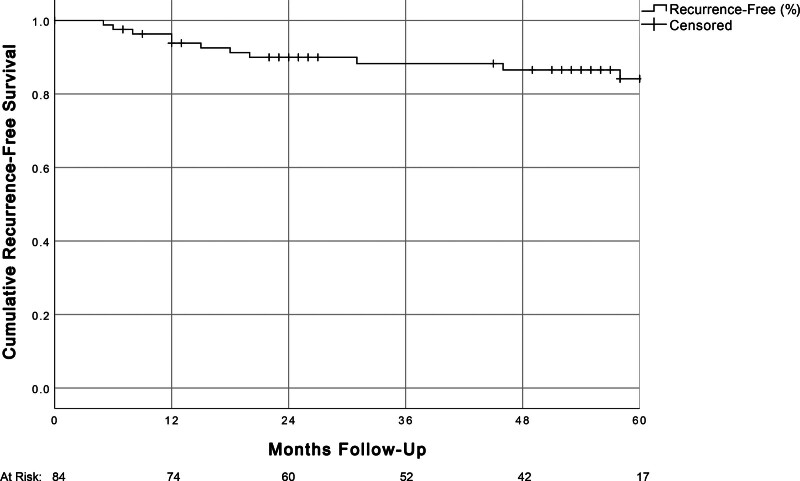
Objective: To assess the 5-year recurrence rate of incisional hernia repair in Ventral Hernia Working Group (VHWG) 3 hernia with a slowly resorbable mesh. Summary Background Data: Incisional hernia recurs frequently after initial repair. In potentially contaminated hernia, recurrences rise to 40%. Recently, the biosynthetic Phasix mesh has been developed that is resorbed in 12–18 months. Resorbable meshes might be a solution for incisional hernia repair to decrease short- and long-term (mesh) complications. However, long-term outcomes after resorption are scarce. Methods: Patients with VHWG grade 3 incisional midline hernia, who participated in the Phasix trial (Clinilcaltrials.gov: NCT02720042) were included by means of physical examination and computed tomography (CT). Primary outcome was hernia recurrence; secondary outcomes comprised of long-term mesh complications, reoperations, and abdominal wall pain [visual analogue score (VAS): 0–10]. Results: In total, 61/84 (72.6%) patients were seen. Median follow-up time was 60.0 [interquartile range (IQR): 55–64] months. CT scan was made in 39 patients (68.4%). A recurrence rate of 15.9% (95% confidence interval: 6.9–24.8) was calculated after 5 years. Four new recurrences (6.6%) were found between 2 and 5 years. Two were asymptomatic. In total, 13/84 recurrences were found. No long-term mesh complications and/or interventions occurred. VAS scores were 0 (IQR: 0–2). Conclusions: Hernia repair with Phasix mesh in high-risk patients (VHWG 3, body mass index >28) demonstrated a recurrence rate of 15.9%, low pain scores, no mesh-related complications or reoperations for chronic pain between the 2- and 5-year follow-up. Four new recurrences occurred, 2 were asymptomatic. The poly-4-hydroxybutyrate mesh is a safe mesh for hernia repair in VHWG 3 patients, which avoids long-term mesh complications like pain and mesh infection.
Overview
CoChat Summary
TL;DR
In this 5-year follow-up of a single-arm Phasix P4HB mesh trial in VHWG grade 3 incisional hernia, the Kaplan–Meier recurrence rate was 15.9% (95% CI 6.9–24.8), with four new recurrences between 2 and 5 years. No long-term mesh complications or reoperations for chronic pain occurred, and median pain VAS was 0 (IQR 0–2).
Key findings
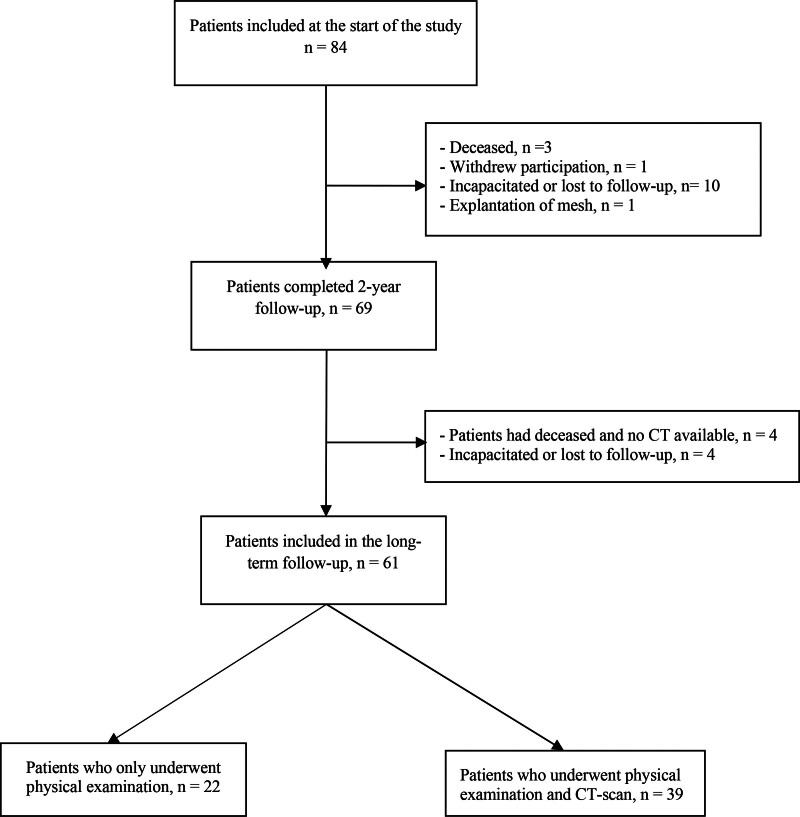
- At median 60.0 months (IQR 55–64), 61/84 (72.6%) patients were assessed; CT was performed in 39 patients (68.4%). The 5-year recurrence rate was 15.9% (95% CI 6.9–24.8) by Kaplan–Meier intention-to-treat analysis.
- Four new recurrences (6.6%) occurred between 2 and 5 years; 2 were asymptomatic, 3 were found by CT, and 1 by physical examination. Mean recurrence size was 11.8 cm² (SD 15.8 cm²).
- No long-term mesh complications, incarcerations, reinterventions for mesh complications, or mesh explantation for chronic pain occurred after the initial 2 years. Median abdominal wall pain VAS was 0 (IQR 0–2).
- Cox regression showed no significant association of recurrence with baseline BMI (HR 1.086 per kg/m²; 95% CI 0.908–1.298) or incisional hernia width (HR 0.991 per cm; 95% CI 0.977–1.005). Curvilinear distortion due to scar tissue was seen in 19/39 CT patients (48.7%).
Methods
- Long-term follow-up of a prospective, multicenter, single-arm interventional trial (NCT02720042) of patients with VHWG grade 3 midline incisional hernia from 15 European institutions, enrolled in 2016–2017 and treated with open repair using P4HB Phasix mesh in the retro-rectus (sublay) position with 5 cm overlap.
- Patients were invited from April 2021 to July 2022 for physical examination and nonenhanced abdominal CT; baseline characteristics were collected from the 2-year follow-up. Primary outcome was incisional hernia recurrence by Kaplan–Meier intention-to-treat analysis; secondary outcomes included VAS pain, long-term mesh complications, reoperations, and CT findings.
- Cox regression per-protocol analysis assessed BMI, reasons for VHWG 3, and incisional hernia width as risk factors for recurrence using SPSS version 26.
Limitations
- Stated: not all 69 eligible patients were assessable, risking survivor bias; not every patient received a CT scan, so the asymptomatic hernia recurrence rate might be underestimated; included index incisional hernias were only midsized with an average defect size of 60 cm².
- Evident: the study is single-arm without a comparator, and long-term estimates rest on 61/84 original patients assessed and CT in 39 patients.
- Evident: the abstract reports 13/84 recurrences in total, while Table 3 reports 9 (14.8%) total recurrences after 5 years, indicating an internal reporting inconsistency.
Model-written summary. Check it against the paper before relying on it.
Integrity signals
Registry
Cites
Statistics
Figures
Verification
Claims the paper makes
0 Valid · 0 Not valid · 31 Not checked · 32 Own results and interpretations
A result the paper reports from its own data — it cites no other source for it, so there is none to check. The quote shows it is in the paper.
In the paper
“Mean recurrence size was 11.8 cm2 (SD 15.8 cm2).”
§ Five-Year Follow-Up of a Slowly Resorbable Biosynthetic P4HB Mesh (Phasix) in VHWG Grade 3 Incisional Hernia Repair > RESULTS > Primary and Secondary Outcomes
plainn = 4- Asserted: passes — The authors put it forward as true.
- Checkable: passes — It can be checked against evidence.
- Load-bearing: unclear — It is unclear whether the paper’s conclusions depend on it.
- Based: passes — The paper gives a reason why it holds.
A result the paper reports from its own data — it cites no other source for it, so there is none to check. The quote shows it is in the paper.
In the paper
“Cox regression for prediction of hernia recurrence showed no statistical significance with respect to baseline BMI (HR: 1.086 per kg/m2; 95% CI: 0.908–1.298) or incisional hernia width (HR: 0.991 per cm; 95% CI: 0.977–1.005).”
§ Five-Year Follow-Up of a Slowly Resorbable Biosynthetic P4HB Mesh (Phasix) in VHWG Grade 3 Incisional Hernia Repair > RESULTS > Primary and Secondary Outcomes
plainn = 84- Asserted: passes — The authors put it forward as true.
- Checkable: passes — It can be checked against evidence.
- Load-bearing: unclear — It is unclear whether the paper’s conclusions depend on it.
- Based: passes — The paper gives a reason why it holds.
A result the paper reports from its own data — it cites no other source for it, so there is none to check. The quote shows it is in the paper.
In the paper
“In 19/39 patients (48.7%) who underwent CT, curvilinear distortion due to scar tissue was seen.”
§ Five-Year Follow-Up of a Slowly Resorbable Biosynthetic P4HB Mesh (Phasix) in VHWG Grade 3 Incisional Hernia Repair > RESULTS > Primary and Secondary Outcomes
plainn = 39- Asserted: passes — The authors put it forward as true.
- Checkable: passes — It can be checked against evidence.
- Load-bearing: unclear — It is unclear whether the paper’s conclusions depend on it.
- Based: passes — The paper gives a reason why it holds.
A result the paper reports from its own data — it cites no other source for it, so there is none to check. The quote shows it is in the paper.
In the paper
“Cox regression for prediction of hernia recurrence showed no statistical significance with respect to baseline BMI (HR: 1.086 per kg/m2; 95% CI: 0.908–1.298) or incisional hernia width (HR: 0.991 per cm; 95% CI: 0.977–1.005).”
§ Five-Year Follow-Up of a Slowly Resorbable Biosynthetic P4HB Mesh (Phasix) in VHWG Grade 3 Incisional Hernia Repair > RESULTS > Primary and Secondary Outcomes
plainn = 84- Asserted: passes — The authors put it forward as true.
- Checkable: passes — It can be checked against evidence.
- Load-bearing: unclear — It is unclear whether the paper’s conclusions depend on it.
- Based: passes — The paper gives a reason why it holds.
A result the paper reports from its own data — it cites no other source for it, so there is none to check. The quote shows it is in the paper.
In the paper
“Two were asymptomatic.”
- Also stated in: § Primary and Secondary Outcomes · plain
“Two of the patients were asymptomatic.”
- Also stated in: § DISCUSSION · plain
“with 2 of these hernias being asymptomatic.”
§ Five-Year Follow-Up of a Slowly Resorbable Biosynthetic P4HB Mesh (Phasix) in VHWG Grade 3 Incisional Hernia Repair > Abstract > Results:
plainn = 2- Asserted: passes — The authors put it forward as true.
- Checkable: passes — It can be checked against evidence.
- Load-bearing: unclear — It is unclear whether the paper’s conclusions depend on it.
- Based: passes — The paper gives a reason why it holds.
- Also stated in: § Primary and Secondary Outcomes · plain
24 more claims
Create a free account to see all 63 claims and to verify the 40 references still open.
- It may state two separate claims as one. 19
- Probably not a substantial claim. 21
Claims other papers make about this one
Each is checked against this paper’s own text: does it say what the citing paper says it does?
In the citing paper
“Long‐term recurrence rates appear to be comparable to those of non‐resorbable synthetic meshes [1, 6, 8].”
From Long‐Term Outcomes After Slowly Resorbable P4HB Mesh Implantation: A Multicenter Analysis From European Registry (2026) · cites this paper as [8]
In the citing paper
“Notably, the cumulative incidence curve indicated a peak in recurrence following the expected resorption period of the P4HB mesh, after which recurrence rates plateaued [4, 8].”
From Long‐Term Outcomes After Slowly Resorbable P4HB Mesh Implantation: A Multicenter Analysis From European Registry (2026) · cites this paper as [8]
Self-check
Percentages, sums and reported differences re-computed from the paper’s own numbers.
Each contradiction between two passages listed here was confirmed by an independent check.
Rated minor: it would not touch a result — a value no result rests on, a p-value that stays on the same side of the significance level, or a conflict that is clerical, resolved elsewhere in the paper, or outside its own findings.
In the paper
§ Five-Year Follow-Up of a Slowly Resorbable Biosynthetic P4HB Mesh (Phasix) in VHWG Grade 3 Incisional Hernia Repair > RESULTS > Baseline Characteristics
“mean BMI of 28.1 (SD: 3.9)”
§ Five-Year Follow-Up of a Slowly Resorbable Biosynthetic P4HB Mesh (Phasix) in VHWG Grade 3 Incisional Hernia Repair > RESULTS > Baseline Characteristics
“| Body mass index, mean (SD) (kg/m2) | 28.1 (4.0) |”
Citations
Cites
A comparison of suture repair with mesh repair for incisional hernia.
Luijendijk, R. W., Hop, W. C. J., van den Tol, M. P., de Lange, D. C. D., Braaksma, M. M. J., IJzermans, J. N. M., Boelhouwer, R. U., de Vries, B. C., Salu, M. K. M., Wereldsma, J. C. J., et al. (2000) · New England Journal of Medicine · doi:10.1056/nejm200008103430603 · Cited by 1,508
Self-citationClassification of primary and incisional abdominal wall hernias
Muysoms, F. E., Miserez, M., Berrevoet, F. C., Campanelli, G., Champault, G., Chelala, E., Dietz, U. A., Eker, H. H., Nakadi, I. E., Hauters, P., et al. (2009) · Hernia · doi:10.1007/s10029-009-0518-x · Cited by 1,503
Self-citationBurger, J. W. A., Luijendijk, R. W., Hop, W. C. J., Halm, J. A., Verdaasdonk, E. G. G., & Jeekel, J. (2004) · Annals of Surgery · doi:10.1097/01.sla.0000141193.08524.e7 · Cited by 1,340
Self-citationBreuing, K. H., Butler, C. E., Ferzoco, S. J., Franz, M., Hultman, C. S., Kilbridge, J. F., Rosen, M. J., Silverman, R. P., & Vargo, D. J. (2010) · Surgery · doi:10.1016/j.surg.2010.01.008 · Cited by 1,042
Long-term complications associated with prosthetic repair of incisional hernias
Leber, G. E. (1998) · Archives of Surgery · doi:10.1001/archsurg.133.4.378 · Cited by 714
Long-term recurrence and complications associated with elective incisional hernia repair.
Kokotovic, D., Bisgaard, T., & Helgstrand, F. (2016) · JAMA · doi:10.1001/jama.2016.15217 · Cited by 391
Jairam, A. P., Timmermans, L., Eker, H. H., Pierik, R. E. G. J. M., Klaveren, D. V., Steyerberg, E. W., Timman, R., van der Ham, A. C., Dawson, I., Charbon, J. A., et al. (2017) · The Lancet · doi:10.1016/s0140-6736(17)31332-6 · Cited by 330
Self-citationChelala, E., Baraké, H., Estievenart, J., Dessily, M., Charara, F., & Allé, J.-L. (2015) · Hernia · doi:10.1007/s10029-015-1397-y · Cited by 143
Mathes, T., Walgenbach, M., & Siegel, R. (2015) · World Journal of Surgery · doi:10.1007/s00268-015-3311-2 · Cited by 113
The Importance of Registries in the Postmarketing Surveillance of Surgical Meshes
Köckerling, F., Simon, T. J., Hukauf, M., Hellinger, A., Fortelny, R. H., Reinpold, W. M. J., & Bittner, R. (2017) · Annals of Surgery · doi:10.1097/sla.0000000000002326 · Cited by 98
Self-citation
Cited by
Emerging materials and technologies for advancing bioresorbable surgical meshes
Heidari, B. S., Dodda, J. M., El-Khordagui, L. K., Focarete, M. L., Maróti, P., Tóth, L., Pacilio, S., El-Habashy, S. E., Boateng, J. S., Catanzano, O., et al. (2024) · Acta Biomaterialia · doi:10.1016/j.actbio.2024.06.012 · Cited by 60
Bracale, U. M., Stabilini, C., Cavallaro, G., Pecchini, F., Sarno, G., Agresta, F., Carlucci, M., Rocchetti, S., Sartori, A., Leo, A. D., et al. (2025) · Hernia · doi:10.1007/s10029-025-03403-x · Cited by 12
Abdelsamad, A., Khalil, I., Mohammed, M. K., Serour, A. S., Wesh, Z. M., Zaree, O. A., Bedewi, M. A., Hussein, Z. A., Herzog, T., Mohamed, K. A., et al. (2025) · Hernia · doi:10.1007/s10029-025-03308-9 · Cited by 11
Multimodal management of a giant inguinoscrotal hernia with loss of domain
Natasha, N., Abbas, A., Chintapatla, S., & MacLeod, T. (2025) · BMJ Case Reports · doi:10.1136/bcr-2025-266990 · Cited by 4
Staged approach to chronic mesh infection following hernia repair: a single-center experience
Ambrose, N. P., Trinity, P., Koil, T. D., Beulah Roopavathana, S., Rebekah, G. J., & Chase, D. (2026) · Hernia · doi:10.1007/s10029-025-03433-5 · Cited by 3
Yan, H., Zhang, L., Lv, X., Guo, T., Wang, Q., & Zhang, J. (2026) · Frontiers in Immunology · doi:10.3389/fimmu.2026.1793559 · Cited by 3
Roth, J. S., Ramshaw, B., Renard, Y., Passot, G., Berrevoet, F. C., Bayliss, K., Blanc, M., Cain, C., & Goldblatt, M. I. (2025) · BMJ Open · doi:10.1136/bmjopen-2025-100294 · Cited by 3
Self-citationvan den Berg, R., Wieser, M., Jeekel, J., Stabilini, C., Bueno-Lledó, J., Köckerling, F., Chatzimavroudis, G., Jørgensen, L. N., & Romain, B. (2025) · BMJ Open · doi:10.1136/bmjopen-2024-098099 · Cited by 1
Self-citationvan den Berg, R., Wieser, M., López‐Cano, M., Bueno‐Lledó, J., Köckerling, F., Chatzimavroudis, G., Gonella‐Pacchiotti, C., Stabilini, C., Ortega‐Deballon, P., Romain, B., et al. (2026) · World Journal of Surgery · doi:10.1002/wjs.70331 · Cited by 1
Self-citationKourtidis, L., Neokleous, K., Spyridaki, K., Ntrikou, D., Lazaris, M., Choratta, T., Papalexandraki, M., Markaki, E., Tsivgouli, M., Kalligas, A., et al. (2025) · Journal of Clinical Medicine · doi:10.3390/jcm14238316 · Cited by 1
Weiss, M., Gürcan, H. M., Aronitz, E., Gareer, H., & Fischer, J. P. (2026) · Journal of Abdominal Wall Surgery · doi:10.3389/jaws.2026.16382 · Cited by 1
Contemporary approaches to complex and contaminated hernias: innovations in mesh technology
Fung, B. S. C., & Pauli, E. M. (2025) · Mini-invasive Surgery · doi:10.20517/2574-1225.2025.75
Simultaneous Management of May-Thurner Syndrome and Spigelian Hernia: A Case Report
French, J., Meshram, P. D., Naaz, R., Rizwan, M., Nguyen, S. H.-T., Knutson, A., Golzarian, J., & Harmon, J. V. (2026) · American Journal of Case Reports · doi:10.12659/ajcr.949258
Why Are We Still Implanting Permanent Synthetic Mesh for Hernia Repair Into Young Patients?
Parker, S. G., Halligan, S., Windsor, A. C. J., Zhao, S., Nip, L., & Boermeester, M. A. (2026) · Journal of Abdominal Wall Surgery · doi:10.3389/jaws.2026.16654
Incisional hernia repair with mesh: How I choose it?
Govillot, L., Bellemin, A., Baratte, C., Giovinazzo, D., & Moszkowicz, D. (2026) · Journal of Visceral Surgery · doi:10.1016/j.jviscsurg.2026.06.007
Comment choisir la prothèse pariétale pour une cure d’éventration ?
Govillot, L., Bellemin, A., Baratte, C., Giovinazzo, D., & Moszkowicz, D. (2026) · Journal de Chirurgie Viscérale · doi:10.1016/j.jchirv.2026.02.006
Patient-engaged preoperative optimization for a complex incisional hernia: a case report
Laskou, S., Gkeka, T., Roulia, P., Astreinidis, A., Kougias, L., Geropoulos, G., Psarras, K., & Sapalidis, K. (2026) · Frontiers in Surgery · doi:10.3389/fsurg.2026.1871565
Woo, S. I., & Wee, J.-W. (2026) · Polymer Degradation and Stability · doi:10.1016/j.polymdegradstab.2026.112487
Bakula, B., Sever, M., Ivkošić, A., Zadro, Z., Bakula, M., Romić, I., & Mijatović, D. (2026) · Frontiers in Surgery · doi:10.3389/fsurg.2026.1892681
Lovén, H., Helgstrand, F., Friis-Andersen, H., Ballecer, C. D., Berrevoet, F. C., Boermeester, M. A., de la Croix, H., Gaarder, C., Gögenür, I., Henriksen, N. A., et al. (2026) · BJS Open · doi:10.1093/bjsopen/zrag172
Self-citationShi, J., & Yin, C. (2026) · Journal of Biosciences and Medicines · doi:10.4236/jbm.2026.1411004
Metadata
- Authors
- Van den Dop, L. M., Van Rooijen, M. M. J., Tollens, T., Jørgensen, L. N., De Vries-Reilingh, T. S., Piessen, G., Köckerling, F., Miserez, M., Dean, M., Berrevoet, F., Dousset, B., Van Westreenen, H. L., Gossetti, F., Tetteroo, G. W. M., Koch, A., Boomsma, M. F., Lange, J. F., & Jeekel, J.
- Affiliations
- Department of Surgery, Erasmus University Medical Centre, Rotterdam, the Netherlands
- Erasmus MC (NL)
- Imelda Hospital (BE)
- Bispebjerg Hospital (DK)
- Department of Surgery, Elkerliek Hospital, Helmond, the Netherlands
- Centre Hospitalier Universitaire de Lille (FR)
- Vivantes Klinikum (DE)
- Universitair Ziekenhuis Leuven (BE)
- University College Hospital (GB)
- Ghent University Hospital (BE)
- Elkerliek Ziekenhuis (NL)
- Sapienza University of Rome (IT)
- IJsselland Ziekenhuis (NL)
- Corresponding author
- Van Rooijen, M. M. J.
- Dean, M.
- Boomsma, M. F.
- Lange, J. F.
- Jeekel, J.
- ORCID
- Venue
- Annals of Surgery Open
- Published
- 2023-11-28
- Volume
- 4
- Issue
- 4
- Pages
- e366
- ISSN
- 2691-3593 (ISSN-L)
- PMC
- PMC10735126
- OpenAlex
- W4389085285
- Semantic Scholar
- 1b67bb30735fbd7b5f2158a1ab1765de16458aba
- Cited by
- 21
- References
- 34
- Citations by year
- 2026: 13 · 2025: 7 · 2024: 1
- FWCI
- 4.49
- Type
- journal article
- Language
- en
- Open access
- gold
- doi.org
- Licence
- Locations
- Annals of Surgery Open (publishedVersion, cc-by-nc-nd)
- PubMed Central (publishedVersion, cc-by-nc-nd)
- PubMed (publishedVersion)
- EUR Research Repository (Erasmus University Rotterdam) (publishedVersion, cc-by-nc-nd)
- Ghent University Academic Bibliography (Ghent University) (submittedVersion, cc-by-nc-nd)
- Lirias (submittedVersion, cc-by-nc-nd)
- DOAJ (DOAJ: Directory of Open Access Journals) (submittedVersion, cc-by-sa)
- Topics
- Health Sciences › Medicine › Surgery › Hernia repair and management
- Health Sciences › Medicine › Surgery › Stoma care and complications
- Health Sciences › Medicine › Surgery › Surgical Sutures and Adhesives
- Keywords
- incisional hernia repair, resorbable mesh, hernia recurrence, abdominal wall reconstruction, long-term outcomes, abdominal wall pain, mesh complications, reoperation
About these checks
Registry, retraction, Cites and statistics results are computed, not judged, with one exception: a printed reference that no index lists is read once by a model before it counts as a citation error. Claims are extracted by a model and kept only when their quote appears verbatim in the text; each cited source is then checked, with a model’s help, for whether it says what the claim relies on. Those verdicts can be wrong — read the claim’s quote and the cited source before relying on one.
A language model drew the claims from the paper on 2026-11-13, under version 3 of the claim definition (model deepseek-v4.1-flash, prompt extract-v3).
A second model labelled each claim on 2026-11-13 (model jev-1.13-20260917, definition revision gold-guideline-v0.2).
Statistics and arithmetic are recomputed, not judged.
Confidence bands are shown only for fields calibrated on our annotated test set. None is calibrated yet, so no band is shown.
What counts as a claim ›How we measure confidence ›How we check this ›
Are you an author, or do you see a problem with this page? Request a review
Data sources
Bibliographic data: Semantic Scholar, OpenAlex, Crossref.
Contains information from the Semantic Scholar Academic Graph Datasets, made available under the ODC Attribution License (ODC-BY 1.0).
Semantic Scholar’s data is described in: Kinney, R., et al. (2023). The Semantic Scholar Open Data Platform. arXiv:2301.10140.
