

Spinal Cord Injury: The Global Incidence, Prevalence, and Disability From the Global Burden of Disease Study 2019
Open accessThe DOI matches its Crossref record; 19 of the 19 references it cites were found in a registry or an index.
Abstract
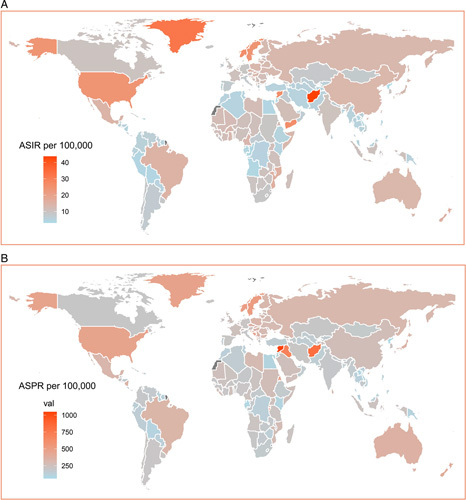
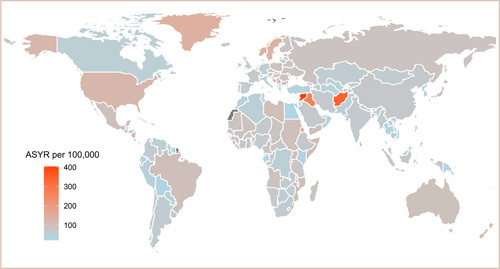
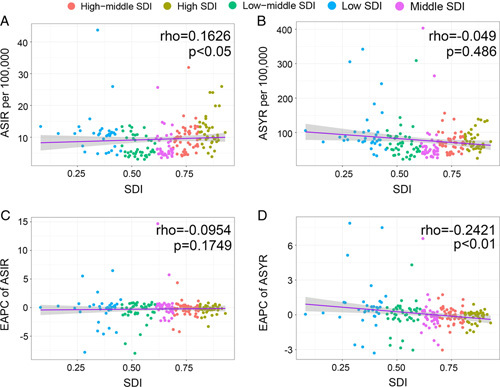
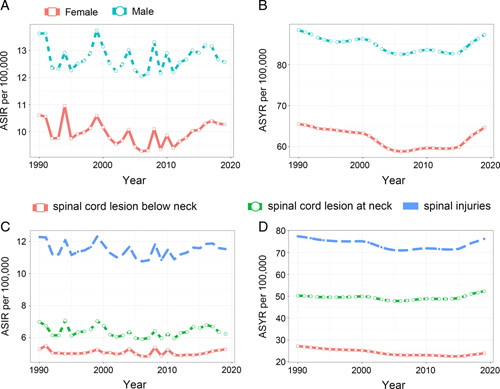
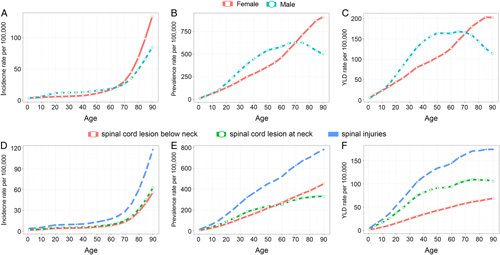
Study Design.: A retrospective cohort study. Objective.: The authors aimed to estimate the incidence, prevalence and years lived with disability (YLDs) of spinal cord injury (SCI) by location, sex, age, injury site and socio-demographic index (SDI) based on the data of the Global Burden of Disease Study (GBD) 2019. Summary of Background Data.: GBD 2019 estimates the burden of 369 diseases and injuries worldwide in 2019 and the temporal trends in the past 30 years. SCI is estimated as a result of injury from various causes. Methods.: A Bayesian meta-regression tool, DisMod-MR2.1, was used to produce the estimates. Estimated annual percentage change (EAPC) was calculated based on a linear regression mode of the age standardized rates and the calendar year to represent the temporal trends of the age standardized rates. Spearman rank order correlation was used to determine the correlation between SDI and the incidence and burden of SCI. Results.: Globally, there were 0.9 [95% uncertainty interval (UI), 0.7 to 1.2] million incident cases, 20.6 (95% UI, 18.9–23.6) million prevalent cases and 6.2 (95% UI, 4.5–8.2) million YLDs of total SCI in 2019. The ASPR increased (EAPC, 0.1; 95% confidence interval, −0.01 to 0.2), while the age standardized incidence rate (ASIR) (EAPC, −0.08; 95% UI, −0.24 to 0.09) and age standardized YLD rate (ASYR) (EAPC, −0.08; 95% confidence interval, −0.24 to 0.09) decreased. Males had higher ASIR and ASYR, and the rate of incidence, prevalence and YLD increased with age. Spinal injuries at neck level caused higher ASYR than injuries below neck level. A positive correlation existed between SDI and ASIR (ρ=0.1626, P <0.05), while a negative correlation was observed between SDI and EAPC of ASYR (ρ=−0.2421, P <0.01). Conclusion.: Conclusively, the incidence and burden of SCI has increased over the last 30 years. Males and the elderly were affected to a greater degree than females and younger individuals. Level of Evidence.: Level III.
Overview
The claims and statistics of this paper haven’t been checked yet.
Free: it reads the open-access text and checks the first 5 claims that cite a source we can check. Create a free account to check every claim.
Integrity signals
Registry
Cites
Statistics
Figures
Verification
Claims the paper makes
The claims and statistics of this paper haven’t been checked yet.
Free: it reads the open-access text and checks the first 5 claims that cite a source we can check. Create a free account to check every claim.
Self-check
Percentages, sums and reported differences re-computed from the paper’s own numbers.
The self-check needs the paper’s full text.
Citations
Cites
James, S. L., Abate, D., Abate, K. H., Abay, S. M., Abbafati, C., Abbasi, N., Abbastabar, H., Abd-Allah, F., Abdela, J., Abdelalim, A., et al. (2018) · The Lancet · doi:10.1016/s0140-6736(18)32279-7 · Cited by 13,867
James, S. L., Theadom, A., Ellenbogen, R. G., Bannick, M. S., Montjoy-Venning, W., Lucchesi, L. R., Abbasi, N., Abdulkader, R., Abraha, H. N., Adsuar, J. C., et al. (2019) · The Lancet Neurology · doi:10.1016/s1474-4422(18)30415-0 · Cited by 2,001
Wang, H., Abbas, K. M., Abbasifard, M., Abbasi-Kangevari, M., Abbastabar, H., Abd-Allah, F., Abdelalim, A., Abolhassani, H., Abreu, L. G., Abrigo, M. R. M., et al. (2020) · The Lancet · doi:10.1016/s0140-6736(20)30977-6 · Cited by 1,971
Epidemiology, Demographics, and Pathophysiology of Acute Spinal Cord Injury
Sekhon, L. H. S., & Fehlings, M. G. (2001) · Spine · doi:10.1097/00007632-200112151-00002 · Cited by 1,434
Prevention of falls and consequent injuries in elderly people
Kannus, P., Sievänen, H., Palvanen, M., Järvinen, T., & Parkkari, J. (2005) · The Lancet · doi:10.1016/s0140-6736(05)67604-0 · Cited by 1,129
Murray, C. J. L., Callender, C. S. K. H., Kulikoff, X. R., Srinivasan, V., Abate, D., Abate, K. H., Abay, S. M., Abbasi, N., Abbastabar, H., Abdela, J., et al. (2018) · The Lancet · doi:10.1016/s0140-6736(18)32278-5 · Cited by 484
Epidemiology and pathophysiology of neurogenic bladder after spinal cord injury
Hamid, R., Averbeck, M. A., Chiang, H., Garcia, A., Al Mousa, R. T., Oh, S.-J., Patel, A., Plata, M., & Del Popolo, G. (2018) · World Journal of Urology · doi:10.1007/s00345-018-2301-z · Cited by 239
Cognitive function after spinal cord injury: A systematic review
Sachdeva, R., Gao, F., Chan, C. C. H., & Krassioukov, A. V. (2018) · Neurology · doi:10.1212/wnl.0000000000006244 · Cited by 168
Dong, Y., Peng, R., Kang, H., Song, K., Guo, Q., Zhao, H., Zhu, M., Zhang, Y., Guan, H., & Li, F. (2021) · The Spine Journal · doi:10.1016/j.spinee.2021.12.007 · Cited by 160
Self-citationSpinal-cord injury: spurring regrowth
Holmes, D. I. R. (2017) · Nature · doi:10.1038/d41586-017-07550-9 · Cited by 80
Cited by
Items 501–522 of 522
de Oliveira, R. F., Rêgo, M. M. D., & Palmeira, C. S. (2026) · Revista Estima · doi:10.30886/estima.v24.1936_pt
de Oliveira, R. F., Rêgo, M. M. D., & Palmeira, C. S. (2026) · Revista Estima · doi:10.30886/estima.v24.1936_es
Sabharwal, S. (2026) · Elsevier eBooks · doi:10.1016/b978-0-443-23516-0.00154-9
WANG, Y., Jin, B., Li, S., Ouyang, Q., Xiao, Y., Wen, J., Lai, Y., Wang, P., Wang, Y., Cui, X., et al. (2026) · Advanced Science · doi:10.1002/advs.77460
Self-citationModulating Secondary Inflammation After Spinal Cord Injury Affects Pathological Bladder Remodeling
Kleindorfer, M., Roider, K., Monastyrskaya, K., Akshay, A., Heimel, P., Hercher, D., Beyerer, E., Bauer, S., Brandtner, M. G., Lusuardi, L., et al. (2026) · International Neurourology Journal · doi:10.5213/inj.2652074.037
Teti Faozo Stephane Landry, M. D., Dongo, S., Bernard, F. Y., Serge, Y. K., Jean-Baptiste, K. K., Jean-Jacques, K. K., Adama, K., Djoko, T., & Haïdara, A. (2026) · HEALTH SCIENCES AND DISEASE · doi:10.67260/hsd.v27i10.7924
Kırtaş, O., Veltink, P. H., Kæseler, R. L., Ammitzbøll, A. L., Hagen, E. M., Mohammadi, M., & Struijk, L. N. S. A. (2026) · npj Robotics · doi:10.1038/s44182-026-00117-9
Fortunato, A., Rumi, F., Antonini, D., Basile, M., Calosci, E. M., D’Ambrosio, F., Brino, E. D., Fiore, A., Pappalardo, C., Ricciardi, R., et al. (2026) · Global & Regional Health Technology Assessment · doi:10.33393/grhta.2026.3943
Sakthiyendran, N. A., Cushman, C. J., Hernandez, E. J., & MacKay, B. J. (2026) · Journal of Clinical Medicine · doi:10.3390/jcm15207849
“Due to CSCI incurring significant disability and associated direct and indirect lifetime costs, estimated at $2.3–$5.1 million per patient for a cervical-level injury, the restoration of physical function remains a high priority for this population [2].”
InfluentialBoissaud-Cooke, M. A., O’Hagan, C., Manning, A., & Waddy, S. (2026) · Journal of the Intensive Care Society · doi:10.1177/17511437261464341
Sarasombath, P., Bovonratwet, P., Chaichankul, C., Chitragran, R., Gajaseni, P., Pundee, C., Liawrungrueang, W., Owodunni, O. P., Chongsathidkiet, P., & Bunmaprasert, T. (2026) · Journal of Clinical Medicine · doi:10.3390/jcm15207923
Satria, I. P. W. A., Bisri, D. Y., & Rachman, I. A. (2026) · Indian Journal of Clinical Anaesthesia · doi:10.18231/j.ijca.16829.1788769258
Xiang, S., Teramoto, M., & Terrill, A. L. (2026) · American Journal of Occupational Therapy · doi:10.1177/19437676261500027
Mukhtar, M., Supu, N. M., & Rauf, S. (2025) · Alauddin Scientific Journal of Nursing · doi:10.24252/asjn.v5i2.40848 · Cited by 4
Wei, J., Qiu, W., Li, X., Sun, K., Li, P., Yang, K., & Yin, X. (2026) · Sage Open Chronic Disease · doi:10.1177/27558428261501003
Teti, L. S. F., Fionko, Y. B., Yao, K. S., Kouadio, A., Simaga, A., & Haïdara, A. (2026) · International Journal of Scientific Research and Modern Technology. · doi:10.38124/ijsrmt.v5i10.1714
Alvim, F., Pinho, A. R., Pereira, P. A., & Silva, M. R. (2026) · The International Journal of Spine Surgery · doi:10.14444/8976
Mobadersani, M., Motamedi, A., Meshkini, A., & Sadeghi‐Bazargani, H. (2026) · Journal of Clinical Medicine · doi:10.3390/jcm15228869
Kaiser, A. (2024) · TSpace (University of Toronto)
Xue, H., Ran, B., Li, J., Wang, G., Chen, B., & Mao, H. (2023) · doi:10.3389/fcell.2023.1227440.s001
Liu, Y., Yang, X., He, Z., Li, J., Li, Y., Wu, Y., Manyande, A., Feng, M., & Xiang, H. (2023) · doi:10.3389/fneur.2023.1304153.s005
Metadata
- Authors
- Ding, W., Hu, S., Wang, P., Kang, H., Peng, R., Dong, Y., & Li, F.
- Affiliations
- Tongji Hospital (CN)
- Corresponding author
- Hu, Shian
- Li, Feng
- Venue
- Spine
- Published
- 2022-06-30
- Volume
- 47
- Issue
- 21
- Pages
- 1532-1540
- ISSN
- 0362-2436 (ISSN-L)
- PMC
- PMC9554757
- OpenAlex
- W4286008396
- Semantic Scholar
- 6131bfdd590aeb0aa66c1d5f300a917e575e1fbb
- Cited by
- 459
- References
- 19
- Citations by year
- 2026: 94 · 2025: 163 · 2024: 145 · 2023: 56 · 2022: 1
- FWCI
- 62.66
- Type
- journal article
- Language
- en
- Open access
- hybrid
- doi.org
- Licence
- Locations
- Spine (publishedVersion, cc-by-nc-nd)
- PubMed Central (publishedVersion, cc-by-nc-nd)
- PubMed (publishedVersion)
- Topics
- Health Sciences › Medicine › Clinical Neurology › Spinal Cord Injury Research
- Health Sciences › Health Professions › Physical Therapy, Sports Therapy and Rehabilitation › Musculoskeletal pain and rehabilitation
- Health Sciences › Medicine › Emergency Medicine › Trauma and Emergency Care Studies
- Keywords
- spinal cord injury, incidence, prevalence, years lived with disability, global burden of disease, socioeconomic status, injury location, sex differences, age differences, temporal trends, cervical spine injury, disability burden, injury epidemiology, health equity, health insurance coverage, health care costs, health care utilization, quality of care, health care outcomes
- MeSH terms
- Global Burden of Disease, Aged, Bayes Theorem, Female, Humans, Male, Retrospective Studies, Spinal Cord Injuries, Global Health, Incidence, Prevalence, Quality-Adjusted Life Years
About these checks
Registry, retraction, Cites and statistics results are computed, not judged, with one exception: a printed reference that no index lists is read once by a model before it counts as a citation error. Claims are extracted by a model and kept only when their quote appears verbatim in the text; each cited source is then checked, with a model’s help, for whether it says what the claim relies on. Those verdicts can be wrong — read the claim’s quote and the cited source before relying on one.
Statistics and arithmetic are recomputed, not judged.
Confidence bands are shown only for fields calibrated on our annotated test set. None is calibrated yet, so no band is shown.
What counts as a claim ›How we measure confidence ›How we check this ›
Are you an author, or do you see a problem with this page? Request a review
Data sources
Bibliographic data: Semantic Scholar, OpenAlex, Crossref.
Contains information from the Semantic Scholar Academic Graph Datasets, made available under the ODC Attribution License (ODC-BY 1.0).
Semantic Scholar’s data is described in: Kinney, R., et al. (2023). The Semantic Scholar Open Data Platform. arXiv:2301.10140.
