

Emergency department to ICU time is associated with hospital mortality: A registry analysis of 14,788 patients from Six University Hospitals in The Netherlands.
Open accessThe DOI matches its Crossref record; 26 of the 26 references it cites were found in a registry or an index.
Abstract
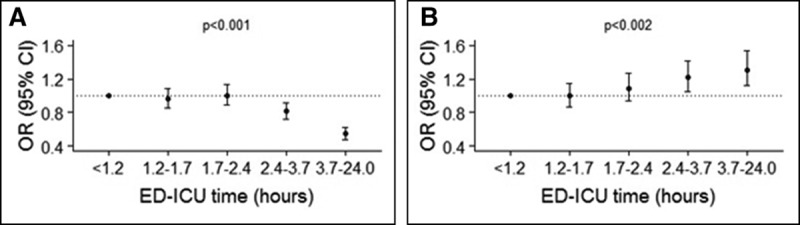
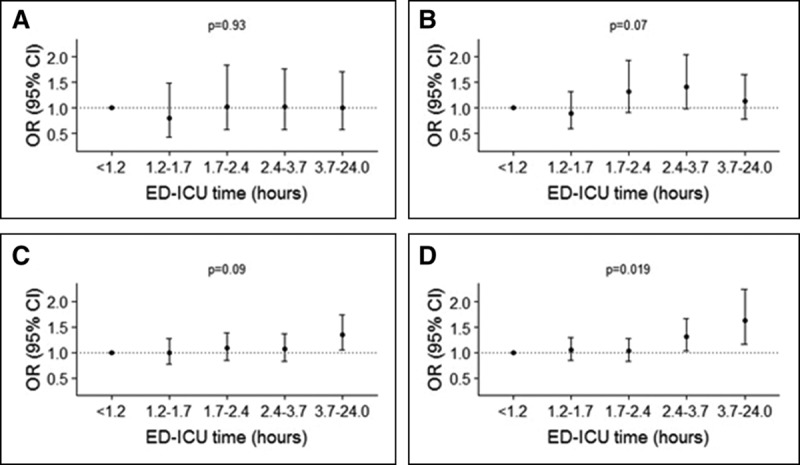
Objectives: Prolonged emergency department to ICU waiting time may delay intensive care treatment, which could negatively affect patient outcomes. The aim of this study was to investigate whether emergency department to ICU time is associated with hospital mortality. Design, Setting, and Patients: We conducted a retrospective observational cohort study using data from the Dutch quality registry National Intensive Care Evaluation. Adult patients admitted to the ICU directly from the emergency department in six university hospitals, between 2009 and 2016, were included. Using a logistic regression model, we investigated the crude and adjusted (for disease severity; Acute Physiology and Chronic Health Evaluation IV probability) odds ratios of emergency department to ICU time on mortality. In addition, we assessed whether the Acute Physiology and Chronic Health Evaluation IV probability modified the effect of emergency department to ICU time on mortality. Secondary outcomes were ICU, 30-day, and 90-day mortality. Interventions: None. Measurements and Main Results: A total of 14,788 patients were included. The median emergency department to ICU time was 2.0 hours (interquartile range, 1.3–3.3 hr). Emergency department to ICU time was correlated to adjusted hospital mortality (p< 0.002), in particular in patients with the highest Acute Physiology and Chronic Health Evaluation IV probability and long emergency department to ICU time quintiles: odds ratio, 1.29; 95% CI, 1.02–1.64 (2.4–3.7 hr) and odds ratio, 1.54; 95% CI, 1.11–2.14 (> 3.7 hr), both compared with the reference category (< 1.2 hr). For 30-day and 90-day mortality, we found similar results. However, emergency department to ICU time was not correlated to adjusted ICU mortality (p= 0.20). Conclusions: Prolonged emergency department to ICU time (> 2.4 hr) is associated with increased hospital mortality after ICU admission, mainly driven by patients who had a higher Acute Physiology and Chronic Health Evaluation IV probability. We hereby provide evidence that rapid admission of the most critically ill patients to the ICU might reduce hospital mortality.
Overview
The claims and statistics of this paper haven’t been checked yet.
Free: it reads the open-access text and checks the first 5 claims that cite a source we can check. Create a free account to check every claim.
Integrity signals
Registry
Cites
Statistics
Figures
Verification
Claims the paper makes
The claims and statistics of this paper haven’t been checked yet.
Free: it reads the open-access text and checks the first 5 claims that cite a source we can check. Create a free account to check every claim.
Claims other papers make about this one
Each is checked against this paper’s own text: does it say what the citing paper says it does?
In the citing paper
“A retrospective observational study of 14,788 critically ill patients in the Netherlands showed a higher hospital mortality for the higher ED to ICU time quintiles (2.4–3.7 h and > 3.7 h) compared with the lowest ED to ICU time quintile (< 1.2 h) [86].”
From Surviving sepsis campaign: international guidelines for management of sepsis and septic shock 2021 (2021) · cites this paper as [86]
In the citing paper
“When adjusted for severity of illness, an ED to ICU time > 2.4 h was associated with increased hospital mortality in patients with higher illness severity (ORs of 1.20 (95% CI 1.03–1.39).”
From Surviving sepsis campaign: international guidelines for management of sepsis and septic shock 2021 (2021) · cites this paper as [86]
Self-check
Percentages, sums and reported differences re-computed from the paper’s own numbers.
The self-check needs the paper’s full text.
Citations
Cites
Zimmerman, J. E., Kramer, A. A., McNair, D. S., & Malila, F. M. (2006) · Critical Care Medicine · doi:10.1097/01.ccm.0000215112.84523.f0 · Cited by 1,764 · cited 1×
“The APACHE IV model consists of the following components: the APACHE III score (consisting of the acute physiology score in the first 24 hr, comorbidities, and age), admission diagnosis (445 different diagnoses), and reason for ICU admission (medical, urgent, or elective) (13).”
MethodValidation of a modified Early Warning Score in medical admissions
Subbe, C. P. (2001) · QJM · doi:10.1093/qjmed/94.10.521 · Cited by 1,762 · cited 1×
“The NEWS, comparable to the Modified Early Warning Score (23), which is currently used in hospital wards to detect patients with increased risk of death or unplanned ICU admission, showed comparable predictive effects in ED patients as in ward patients.”
ResultChalfin, D. B., Trzeciak, S., Likourezos, A., Baumann, B. M., & Dellinger, R. P. (2007) · Critical Care Medicine · doi:10.1097/01.ccm.0000266585.74905.5a · Cited by 1,022
Trzeciak, S., & Rivers, E. P. (2003) · Emergency Medicine Journal · doi:10.1136/emj.20.5.402 · Cited by 834 · cited 1×
“In some cases, the ED staff may not have enough time to provide the required attention and medical care for those requiring intensive care (18).”
BackgroundModern Triage in the Emergency Department
Christ, M., Grossmann, F., Winter, D., Bingisser, R., & Platz, E. (2010) · Deutsches Ärzteblatt international · doi:10.3238/arztebl.2010.0892 · Cited by 493
Cardoso, L. T., Grion, C. M., Matsuo, T., Anami, E. H., Kauss, I. A., Seko, L., & Bonametti, A. M. (2011) · Critical Care · doi:10.1186/cc9975 · Cited by 461
Quality measurement at intensive care units: which indicators should we use?
de Vos, M., Graafmans, W., Keesman, E., Westert, G., & van der Voort, P. H. J. (2007) · Journal of Critical Care · doi:10.1016/j.jcrc.2007.01.002 · Cited by 158 · cited 1×
“Nowadays, a coherent view on patient care and outcomes becomes increasingly significant in ICU research (28, 29).”
BackgroundA review of triage accuracy and future direction
Tam, H. L., Chung, S. F., & Lou, C. K. (2018) · BMC Emergency Medicine · doi:10.1186/s12873-018-0215-0 · Cited by 141
Garrouste-Orgeas, M., Montuclard, L., Timsit, J., Misset, B., Christias, M., & Carlet, J. M. (2003) · Intensive Care Medicine · doi:10.1007/s00134-003-1709-z · Cited by 131
Bilben, B., Grandal, L., & Søvik, S. (2016) · Scandinavian Journal of Trauma Resuscitation and Emergency Medicine · doi:10.1186/s13049-016-0273-9 · Cited by 127 · cited 1×
“More importantly, Bilben et al (21) added the National Early Warning Score (NEWS) as triage system next to the Manchester Triage Scale; the most commonly used triage system in Europe (22).”
MethodMathews, K. S., Durst, M. S., Vargas-Torres, C., Olson, A. D., Mazumdar, M., & Richardson, L. D. (2018) · Critical Care Medicine · doi:10.1097/ccm.0000000000002993 · Cited by 126
Triage of intensive care patients: identifying agreement and controversy
Sprung, C. L., Danis, M., Iapichino, G., Artigas, A., Kesecioglu, J., Moreno, R., Lippert, A., Curtis, J. R., Meale, P., Cohen, S. L., et al. (2013) · Intensive Care Medicine · doi:10.1007/s00134-013-3033-6 · Cited by 125
The longer patients are in hospital before Intensive Care admission the higher their mortality
Goldhill, D. R., McNarry, A. F., Hadjianastassiou, V. G., & Tekkis, P. P. (2004) · Intensive Care Medicine · doi:10.1007/s00134-004-2386-2 · Cited by 123 · cited 1×
“In patients admitted from hospital wards, it was shown that an increased hospital length of stay (LOS) before ICU admission was correlated with mortality (5).”
BackgroundAl-Qahtani, S., Alsultan, A., Haddad, S., Alsaawi, A., Alshehri, M., Alsolamy, S., Felebaman, A., Tamim, H. M., Aljerian, N., Al-Dawood, A., et al. (2017) · BMC Emergency Medicine · doi:10.1186/s12873-017-0143-4 · Cited by 101
A framework for classifying factors that contribute to error in the emergency department
Cosby, K. S. (2003) · Annals of Emergency Medicine · doi:10.1016/s0196-0644(03)00635-8 · Cited by 91
Bagshaw, S. M., Wang, X., Zygun, D. A., Zuege, D. J., Dodek, P., Garland, A., Scales, D. C., Berthiaume, L. R., Faris, P., Chen, G., et al. (2017) · Journal of Critical Care · doi:10.1016/j.jcrc.2017.08.032 · Cited by 81 · cited 1×
“Besides triage and the care provided in the ED, the capacity strain on ICU beds is also a factor which can influence ED to ICU time and worsen patient outcomes (26).”
BackgroundHarris, S., Singer, M., Sanderson, C., Grieve, R., Harrison, D., & Rowan, K. (2018) · Intensive Care Medicine · doi:10.1007/s00134-018-5148-2 · Cited by 79 · cited 1×
“Harris et al (27) showed that prompt admissions to the ICU showed lower 90-day mortality compared with the controls (median delay of 11 hr; IQR, 6–26) in hospital ward patients.”
BackgroundHospital mortality is associated with ICU admission time
Kuijsten, H. A. J. M., Brinkman, S., Meynaar, I. A., Spronk, P. E., van der Spoel, J. I., Bosman, R. J., de Keizer, N. F., Abu–Hanna, A., & de Lange, D. W. (2010) · Intensive Care Medicine · doi:10.1007/s00134-010-1918-1 · Cited by 76 · cited 2×
“Other investigators have studied the correlation of admission day and time with hospital mortality (17).”
BackgroundSaukkonen, K., Varpula, M., Räsänen, P., Roine, R. P., Voipio-Pulkki, L. M., & Pettilä, V. (2006) · Journal of Internal Medicine · doi:10.1111/j.1365-2796.2006.01716.x · Cited by 63 · cited 1×
“Saukkonen et al (6) reported that crude hospital mortality was lowest in the quartile of patients with the shortest LOS in the ED.”
BackgroundCritical care and emergency medicine
Rivers, E. P., Nguyen, H. B., Huang, D. T., & Donnino, M. W. (2002) · Current Opinion in Critical Care · doi:10.1097/00075198-200212000-00020 · Cited by 58
A clinical prediction model to identify patients at high risk of death in the emergency department
Coslovsky, M., Takala, J. A., Exadaktylos, A. K., Martinolli, L., & Merz, T. M. (2015) · Intensive Care Medicine · doi:10.1007/s00134-015-3737-x · Cited by 54 · cited 1×
“Furthermore, prediction models, who can identify patients at high risk of death in the ED, and benchmarking tools, who enable hospitals to identify factors causing delays in emergency transfers, can be promising to help the most severely ill patients in time and improve the adequacy of rapid response teams in the hosp…”
BackgroundOglesby, K. J., Durham, L., Welch, J., & Subbe, C. P. (2011) · Critical Care · doi:10.1186/cc10329 · Cited by 48 · cited 1×
“Furthermore, prediction models, who can identify patients at high risk of death in the ED, and benchmarking tools, who enable hospitals to identify factors causing delays in emergency transfers, can be promising to help the most severely ill patients in time and improve the adequacy of rapid response teams in the hosp…”
BackgroundThijssen, W. A. M. H., Kraaijvanger, N., Barten, D. G., Boerma, M. L. M., Giesen, P. H. J., & Wensing, M. (2016) · BMC Health Services Research · doi:10.1186/s12913-016-1400-z · Cited by 47 · cited 1×
“2 hours (9), and this may modify the effect on mortality.”
BackgroundIs ED length of stay before ICU admission related to patient mortality?
Carter, A., Pilcher, D. V., Bailey, M., Cameron, P. A., Duke, G. J., & Cooper, D. J. (2010) · Emergency Medicine Australasia · doi:10.1111/j.1742-6723.2010.01272.x · Cited by 43 · cited 1×
“However, using Australian and New Zealand Intensive Care Society registry data, Carter et al (8) were unable to demonstrate an adjusted correlation between time in the ED and hospital mortality.”
Methodvan Beusekom, I., Bakhshi‐Raiez, F., de Keizer, N. F., van der Schaaf, M., Busschers, W. B., & Dongelmans, D. A. (2017) · Journal of Critical Care · doi:10.1016/j.jcrc.2017.12.005 · Cited by 40 · cited 1×
“As most of the Dutch inhabitants do have health insurance and their date of decease is included in the insurance claims database, we were able to assess 30-day mortality and 90-day mortality endpoints (12).”
BackgroundSelf-citationMeasuring quality indicators to improve pain management in critically ill patients
Roos-Blom, M.-J., Gude, W. T., Spijkstra, J. J., de Jonge, E., Dongelmans, D. A., & de Keizer, N. F. (2018) · Journal of Critical Care · doi:10.1016/j.jcrc.2018.10.027 · Cited by 14 · cited 1×
“Nowadays, a coherent view on patient care and outcomes becomes increasingly significant in ICU research (28, 29).”
BackgroundSelf-citation
Research works printed but not linked: 1
- Mackway-Jones KMJ Windle J Emergency Triage. 2014 Hoboken, NJ, John Wiley & Sons.
Cited by
Surviving sepsis campaign: international guidelines for management of sepsis and septic shock 2021
Evans, L., Rhodes, A., Alhazzani, W., Antonelli, M., Coopersmith, C. M., French, C., Machado, F. R., Mcintyre, L., Ostermann, M., Prescott, H. C., et al. (2021) · Intensive Care Medicine · doi:10.1007/s00134-021-06506-y · Cited by 5,082
Surviving Sepsis Campaign: International Guidelines for Management of Sepsis and Septic Shock 2021.
Evans, L., Rhodes, A., Alhazzani, W., Antonelli, M., Coopersmith, C. M., French, C., Machado, F. R., Mcintyre, L., Ostermann, M., Prescott, H. C., et al. (2021) · Critical Care Medicine · doi:10.1097/ccm.0000000000005337 · Cited by 2,935
De Hond, A., Raven, W., Schinkelshoek, L., Gaakeer, M., Ter Avest, E., Sir, O., Lameijer, H., Hessels, R. A., Reijnen, R., De Jonge, E., et al. (2021) · International Journal of Medical Informatics · doi:10.1016/j.ijmedinf.2021.104496 · Cited by 66
The role of AI in emergency department triage: An integrative systematic review
El Arab, R. A., & Al Moosa, O. A. (2025) · Intensive and Critical Care Nursing · doi:10.1016/j.iccn.2025.104058 · Cited by 75
Lauque, D., Khalemsky, A., Boudi, Z., Östlundh, L., Xu, C., Alsabri, M., Onyeji, C., Cellini, J., Intas, G., Soni, K. D., et al. (2022) · Journal of Clinical Medicine · doi:10.3390/jcm12010032 · Cited by 92
“26 Groenland CN [50] 2019 Crit Care Med 6 university hospitals in The Netherlands 1.”
Influential
Metadata
- Authors
- Groenland, C. N. L., Termorshuizen, F., Rietdijk, W. J. R., van den Brule, J., Dongelmans, D. A., de Jonge, E., de Lange, D. W., de Smet, A. M. G. A., de Keizer, N. F., Weigel, J. D., Jewbali, L. S. D., Boersma, E., & den Uil, C. A.
- Affiliations
- Erasmus MC (NL)
- Amsterdam UMC Location University of Amsterdam (NL)
- Department of Intensive Care Medicine, Radboud University Medical Center, Nijmegen, The Netherlands.
- Amsterdam University Medical Centers (NL)
- Department of Intensive Care Medicine, University Medical Center Leiden, Leiden, The Netherlands.
- Department of Intensive Care Medicine, University Medical Center Utrecht, Utrecht, The Netherlands.
- Department of Intensive Care Medicine, University Medical Center Groningen, Groningen, The Netherlands.
- Department of Medical Informatics, Amsterdam University Medical Center, Amsterdam, The Netherlands.
- Department of Intensive Care Medicine, Erasmus MC, University Medical Center, Rotterdam, The Netherlands.
- Corresponding author
- Groenland, Carline N. L.
- ORCID
- Venue
- Critical Care Medicine
- Published
- 2019-11
- Volume
- 47
- Issue
- 11
- Pages
- 1564-1571
- ISSN
- 0090-3493 (ISSN-L)
- PMC
- PMC6798749
- OpenAlex
- W2967527181
- Semantic Scholar
- 528211280874faa25d5f8766d71db6a1210ceaeb
- Cited by
- 104
- References
- 26
- Citations by year
- 2026: 10 · 2025: 18 · 2024: 18 · 2023: 13 · 2022: 16 · 2021: 16 · 2020: 12 · 2019: 1
- FWCI
- 13.05
- Type
- journal article
- Language
- en
- Open access
- hybrid
- doi.org
- Licence
- Locations
- Critical Care Medicine (publishedVersion, cc-by-nc-nd)
- Europe PMC (PubMed Central) (publishedVersion, cc-by-nc-nd)
- PubMed Central (publishedVersion, cc-by-nc-nd)
- PubMed (publishedVersion)
- EUR Research Repository (Erasmus University Rotterdam) (publishedVersion, other-oa)
- University of Groningen research database (University of Groningen / Centre for Information Technology) (publishedVersion, cc-by-nc-nd)
- Data Archiving and Networked Services (DANS) (submittedVersion)
- EUR Research Repository (Erasmus University Rotterdam) (submittedVersion, other-oa)
- RePub (Erasmus University Rotterdam) (submittedVersion, other-oa)
- Leiden Repository (Leiden University) (submittedVersion)
- Utrecht University Repository (Utrecht University) (submittedVersion, other-oa)
- Pure Amsterdam UMC (submittedVersion, other-oa)
- Radboud Repository (Radboud University) (submittedVersion)
- RePub (Erasmus University Rotterdam) (submittedVersion)
- Radboud Repository (Radboud University) (submittedVersion, other-oa)
- University of Groningen research database (University of Groningen / Centre for Information Technology) (submittedVersion, cc-by-nc-nd)
- Utrecht University Repository (Utrecht University) (submittedVersion, cc-by-nc-nd)
- Funders
- Amsterdam University Medical Centers
- Universiteit Utrecht
- Rivierduinen
- Topics
- Health Sciences › Medicine › Emergency Medicine › Emergency and Acute Care Studies
- Health Sciences › Medicine › Emergency Medicine › Trauma and Emergency Care Studies
- Health Sciences › Medicine › Critical Care and Intensive Care Medicine › Sepsis Diagnosis and Treatment
- Keywords
- in-hospital mortality, intensive care unit admission, disease severity, 30-day mortality, 90-day mortality, critically ill patients
- MeSH terms
- Adult, Aged, Emergency Service, Hospital, Female, Heart Arrest, Hematoma, Subdural, Hospitals, University, Humans, Intensive Care Units, Male, Middle Aged, Netherlands, Patient Admission, Registries, Respiratory Insufficiency, Retrospective Studies, Time Factors, Wounds and Injuries, Cohort Studies, Hospital Mortality, APACHE, Intracranial Hemorrhages
About these checks
Registry, retraction, Cites and statistics results are computed, not judged, with one exception: a printed reference that no index lists is read once by a model before it counts as a citation error. Claims are extracted by a model and kept only when their quote appears verbatim in the text; each cited source is then checked, with a model’s help, for whether it says what the claim relies on. Those verdicts can be wrong — read the claim’s quote and the cited source before relying on one.
Statistics and arithmetic are recomputed, not judged.
Confidence bands are shown only for fields calibrated on our annotated test set. None is calibrated yet, so no band is shown.
What counts as a claim ›How we measure confidence ›How we check this ›
Are you an author, or do you see a problem with this page? Request a review
Data sources
Bibliographic data: Semantic Scholar, OpenAlex, Crossref.
Contains information from the Semantic Scholar Academic Graph Datasets, made available under the ODC Attribution License (ODC-BY 1.0).
Semantic Scholar’s data is described in: Kinney, R., et al. (2023). The Semantic Scholar Open Data Platform. arXiv:2301.10140.
