

Advances in Difference-in-differences Methods for Policy Evaluation Research
Open accessThe DOI matches its Crossref record; 33 of the 34 references it cites were found in a registry or an index; 9 of the 27 sources its claims cite were checked for support.
Abstract
Difference-in-differences (DiD) is a powerful, quasi-experimental research design widely used in longitudinal policy evaluations with health outcomes. However, DiD designs face several challenges to ensuring reliable causal inference, such as when policy settings are more complex. Recent economics literature has revealed that DiD estimators may exhibit bias when heterogeneous treatment effects, a common consequence of staggered policy implementation, are present. To deepen our understanding of these advancements in epidemiology, in this methodologic primer, we start by presenting an overview of DiD methods. We then summarize fundamental problems associated with DiD designs with heterogeneous treatment effects and provide guidance on recently proposed heterogeneity-robust DiD estimators, which are increasingly being implemented by epidemiologists. We also extend the discussion to violations of the parallel trends assumption, which has received less attention. Last, we present results from a simulation study that compares the performance of several DiD estimators under different scenarios to enhance understanding and application of these methods.
Overview
CoChat Summary
## TL;DR
This paper is a methodologic primer on difference-in-differences (DiD) for health policy evaluation, focusing on why two-way fixed effects can be biased under heterogeneous treatment effects and on newer heterogeneity-robust alternatives. It also discusses violations of the parallel trends assumption and reports a Monte Carlo simulation comparing estimator performance across several scenarios.
## Key findings
- Two-way fixed effects DiD can produce biased estimates when treatment effects are heterogeneous across groups or over time; the paper explains this via “negative weights” and “forbidden comparisons.”
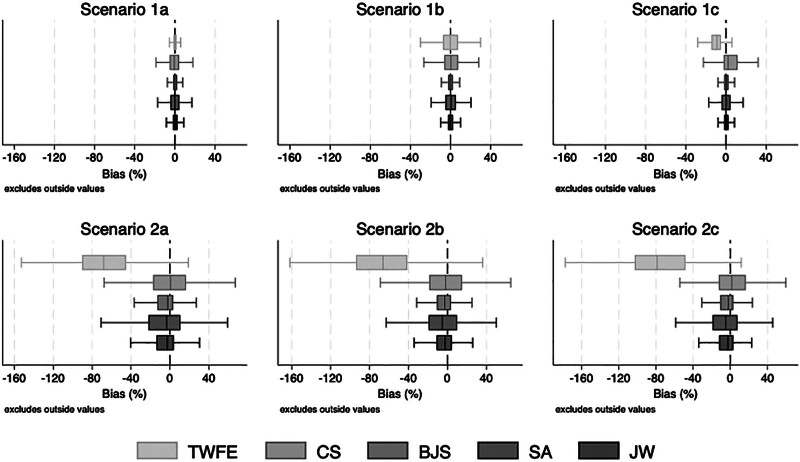
- In the simulation study, with constant and homogeneous effects, two-way fixed effects had the lowest bias (−0.01%) and RMSE (0.12).
- With dynamic treatment effects, two-way fixed effects had much larger bias (−66.40% to −78.62%), while Callaway and Sant’Anna had the lowest bias (0.64%–4.14%); Borusyak et al., Sun and Abraham, and Wooldridge were around −6% bias.
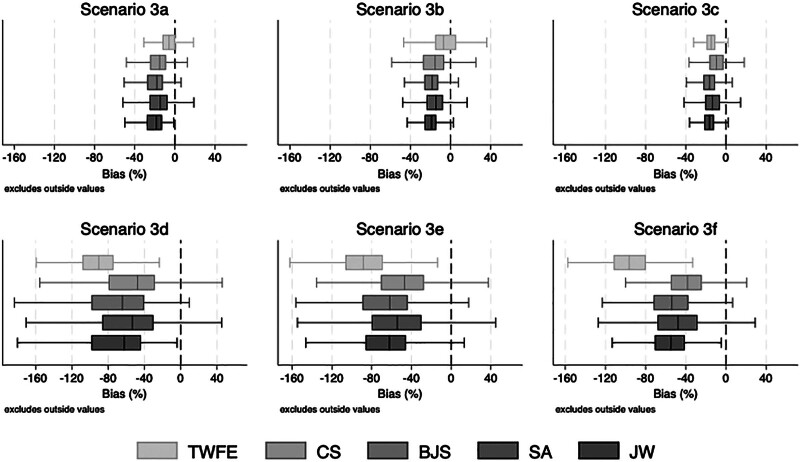
- Under parallel trends violations, bias and RMSE increased across all estimators; among heterogeneity-robust methods, Callaway and Sant’Anna and Sun and Abraham outperformed Borusyak et al. and Wooldridge.
## Methods
- Methodologic primer/review of DiD designs, including the basic 2 × 2 setup, generalized/two-way fixed effects DiD for staggered adoption, heterogeneity-robust estimators, and approaches to parallel trends violations.
- Monte Carlo simulation study comparing two-way fixed effects with four heterogeneity-robust estimators across 500 runs per estimator in each scenario.
- Simulation scenarios varied along three dimensions: constant vs dynamic treatment effects, homogeneous vs heterogeneous treatment effects, and presence vs absence of parallel trends violations; performance was assessed by percent bias and RMSE.
## Limitations
- The paper notes that traditional pretrend testing has low power and is not a reliable indicator of parallel trends violations.
- The paper states that some covariate-adjustment solutions are still under development; for example, code for conditioning on the untreated potential value of covariates is “still under development.”
- Evidence evident from the text: the simulation results are based on specified scenarios and a data-generating process described in the supplement, so their applicability depends on those assumptions and may not generalize to all empirical settings.
Model-written summary. Check it against the paper before relying on it.
Integrity signals
Registry
Cites
Statistics
Figures
Verification
Claims the paper makes
4 Valid · 4 Not valid · 9 Not checked · 31 Own results and interpretations
The cited sources support only part of this claim — read each source’s verdict below.
In the paper
“Under the parallel trends assumption, de Chaisemartin and D’Haultfœuille25 show that the two-way fixed effects DiD estimator δ in Eq. (2) can be written as the weighted average of treatment effects from multiple 2 × 2 DiDs:14,25”
§ Advances in Difference-in-differences Methods for Policy Evaluation Research > KEY LIMITATIONS OF TWO-WAY FIXED EFFECTS DiD > “Negative Weights” and “Forbidden Comparisons”
What the sources say
- Could not verifycites [14] De Chaisemartin C D’Haultfœuille X. Two-way fixed effects and differences-in-differences with heterogeneous treatment effects: a survey. The Econom J. 2023; 26: C1– C30. sourceExperimental — accuracy not yet measured
The Methods sections on Primary Analysis and DiD Assumptions describe this paper’s DiD model and its parallel-trends assumption. Neither states that a two-way fixed effects estimator is a weighted average of effects from multiple 2 × 2 DiDs; searches for that decomposition found no passage in our copy. The supplied passages have no page numbers. (LLM, conf=0.74)
- Partly supportedcites [25] De Chaisemartin C D’Haultfoeuille X. Two-way fixed effects estimators with heterogeneous treatment effects. Amer Econ Rev. 2020; 110: 2964– 2996. sourceExperimental — accuracy not yet measured
The Introduction reports that the two-way fixed-effects DiD estimate is a weighted average of two-group, two-period DiD comparisons. It also cautions that, under parallel trends, those comparisons can reflect changes over time in treatment effects—not just a weighted average of treatment effects. The paper credits the 2 × 2 decomposition to Goodman-Bacon, while describing de Chaisemartin and D’Haultfœuille’s result as a weighting of group- and period-specific effects. (LLM, conf=0.86)
plain- Asserted: passes — The authors put it forward as true.
- Checkable: passes — It can be checked against evidence.
- Load-bearing: passes — The paper’s conclusions depend on it.
- Based: passes — The paper gives a reason why it holds.
- Rests on an assumption not shown here.
- Could not verify
The cited sources that could be checked couldn’t confirm or dispute this claim.
In the paper
“However, recent literature argues that the traditional parallel trends test often has low power, causing under-rejection of the null hypothesis that there are no differences between trends in treated and comparison groups (i.e., type II error).24,34”
§ Advances in Difference-in-differences Methods for Policy Evaluation Research > VIOLATIONS OF THE PARALLEL TRENDS ASSUMPTION
What the sources say
- Could not verifycites [24] Roth J. Pretest with caution: event-study estimates after testing for parallel trends. American Economic Review: Insights. 2022; 4: 305– 322. sourceExperimental — accuracy not yet measured
The ‘To the Editor’ section discusses violations of the parallel trends assumption and bias in two-way fixed effects estimates, but not the power of a test for parallel trends. Searches for low power, pre-trends tests, and type II error found no passage addressing under-rejection of the null hypothesis. Page numbers were not available in our copy. (LLM, conf=0.76)
- Not matchedcites [34] Bilinski A Hatfield LA. Nothing to see here? non-inferiority approaches to parallel trends and other model assumptions. arXiv preprint arXiv: 180503273; 2019.
We don’t have this paper’s reference list.
plainstates a cause- Asserted: passes — The authors put it forward as true.
- Checkable: passes — It can be checked against evidence.
- Load-bearing: passes — The paper’s conclusions depend on it.
- Based: passes — The paper gives a reason why it holds.
- Rests on an assumption not shown here.
- Could not verify
The cited sources support only part of this claim — read each source’s verdict below.
In the paper
“Recent work has shown that the two-way fixed effects design requires an additional assumption to generate unbiased DiD estimates. Specifically, it requires that treatment effects are constant across treated groups and over time.”
§ Advances in Difference-in-differences Methods for Policy Evaluation Research > INTRODUCTION
What the sources say
- Not checked — no full text of the sourcecites [12] Goodman-Bacon A. Difference-in-differences with variation in treatment timing. J Econometrics. 2021; 225: 254– 277. source
- Partly supportedcites [13] Callaway B Sant’Anna PH. Difference-in-differences with multiple time periods. J Econometrics. 2021; 225: 200– 230. sourceExperimental — accuracy not yet measured
Section 3.2 says constant treatment effects across units and time make the static TWFE coefficient equal to the treatment effect under parallel trends and no anticipation. But it does not say this assumption is required for every TWFE design: Section 2.4 states that canonical two-period TWFE estimates the treatment effect on the treated without assuming constant effects. The claim overgeneralizes a condition discussed for the staggered static specification. (LLM, conf=0.89)
plainstates a cause- Asserted: passes — The authors put it forward as true.
- Checkable: passes — It can be checked against evidence.
- Load-bearing: passes — The paper’s conclusions depend on it.
- Based: passes — The paper gives a reason why it holds.
The cited sources that could be checked couldn’t confirm or dispute this claim.
In the paper
“Several articles have proposed alternative approaches to detect pretreatment violations of parallel trends, including tools to conduct power analyses and “noninferiority” approaches testing the likelihood of rejecting the null hypothesis of a large pretrend.15,24,34”
§ Advances in Difference-in-differences Methods for Policy Evaluation Research > VIOLATIONS OF THE PARALLEL TRENDS ASSUMPTION
What the sources say
- Not checked — no full text of the sourcecites [15] Roth J Sant’Anna PH Bilinski A Poe J. What’s trending in difference-in-differences? A synthesis of the recent econometrics literature. J Econometrics. 2023; 235: 2218– 2244. source
- Could not verifycites [24] Roth J. Pretest with caution: event-study estimates after testing for parallel trends. American Economic Review: Insights. 2022; 4: 305– 322. sourceExperimental — accuracy not yet measured
The 'To the Editor' section discusses parallel-trends violations caused by dynamic treatment effects and describes estimators for addressing bias; no page number is available in our copy. Searches for pretreatment power analyses and noninferiority tests found no passage describing either approach to detecting pretrend violations. (LLM, conf=0.76)
- Not matchedcites [34] Bilinski A Hatfield LA. Nothing to see here? non-inferiority approaches to parallel trends and other model assumptions. arXiv preprint arXiv: 180503273; 2019.
We don’t have this paper’s reference list.
plain- Asserted: passes — The authors put it forward as true.
- Checkable: passes — It can be checked against evidence.
- Load-bearing: passes — The paper’s conclusions depend on it.
- Based: passes — The paper gives a reason why it holds.
- Rests on an assumption not shown here.
The cited sources support only part of this claim — read each source’s verdict below.
In the paper
“Callaway and Sant’Anna13 and Sun and Abraham27 estimators impose a weaker parallel trends assumption, which only requires parallel trends from the last pretreated period until the last time period.”
§ Advances in Difference-in-differences Methods for Policy Evaluation Research > ALTERNATIVE HETEROGENEOUS TREATMENT EFFECTS-ROBUST DiD ESTIMATORS > Differences in the Parallel Trends Assumption and Covariate Adjustment
What the sources say
- Partly supportedcites [13] Callaway B Sant’Anna PH. Difference-in-differences with multiple time periods. J Econometrics. 2021; 225: 200– 230. sourceExperimental — accuracy not yet measured
Section 3.3 says the Callaway–Sant’Anna estimator relies on post-treatment parallel trends and, in its example, only on trends between the last pre-treatment period and the next period. Section 3.1 describes a weaker parallel-trends variant associated with both Callaway–Sant’Anna and Sun–Abraham, but our copy does not establish that the Sun–Abraham estimator requires parallel trends only from the last pre-treatment period through the final period. (LLM, conf=0.82)
- Could not verifycites [27] Sun L Abraham S. Estimating dynamic treatment effects in event studies with heterogeneous treatment effects. J Econometrics. 2021; 225: 175– 199. sourceExperimental — accuracy not yet measured
The Introduction’s “Parallel trends” section describes a strict assumption across every pair of time points and says it can be relaxed. It does not discuss the Callaway–Sant’Anna or Sun–Abraham estimators, or state that their assumption runs from the last pretreatment period to the last time period; searches for those terms found no such passage. (LLM, conf=0.75)
plain- Asserted: passes — The authors put it forward as true.
- Checkable: passes — It can be checked against evidence.
- Load-bearing: passes — The paper’s conclusions depend on it.
- Based: passes — The paper gives a reason why it holds.
- Partly supported
30 more claims · 1 with their cited sources checked
Create a free account to see all 48 claims and to verify the 1 reference still open.
- It may state two separate claims as one. 10
- Probably not a substantial claim. 3
Citations
Cites
Difference-in-Differences with multiple time periods
Callaway, B., & Sant’Anna, P. H. C. (2021) · Journal of Econometrics · doi:10.1016/j.jeconom.2020.12.001 · Cited by 9,126
Difference-in-differences with variation in treatment timing
Goodman-Bacon, A. (2021) · Journal of Econometrics · doi:10.1016/j.jeconom.2021.03.014 · Cited by 8,046 · cited 1×
“12,13 Heterogeneous treatment effects threaten the validity of many research designs, potentially biasing two-way fixed effects estimates.”
Estimating dynamic treatment effects in event studies with heterogeneous treatment effects
Sun, L., & Abraham, S. (2021) · Journal of Econometrics · doi:10.1016/j.jeconom.2020.09.006 · Cited by 5,518
Two-Way Fixed Effects Estimators with Heterogeneous Treatment Effects
de Chaisemartin, C., & D’Haultfœuille, X. (2020) · American Economic Review · doi:10.1257/aer.20181169 · Cited by 5,031 · cited 8×
“(2) can be written as the weighted average of treatment effects from multiple 2 × 2 DiDs: 14,25 where τ g , t represents the estimated ATT of group g at period t .”
InfluentialHow Much Should We Trust Staggered Difference-in-Differences Estimates?
Baker, A. C., Larcker, D. F., & Wang, C. C. Y. (2022) · Journal of Financial Economics · doi:10.1016/j.jfineco.2022.01.004 · Cited by 3,149
The Effect of Minimum Wages on Low-Wage Jobs*
Cengiz, D., Dube, A., Lindner, A., & Zipperer, B. (2019) · The Quarterly Journal of Economics · doi:10.1093/qje/qjz014 · Cited by 2,688
Revisiting Event-Study Designs: Robust and Efficient Estimation
Borusyak, K., Jaravel, X., & Spiess, J. (2024) · Review of Economic Studies · doi:10.1093/restud/rdae007 · Cited by 2,280
What's trending in difference-in-differences? A synthesis of the recent econometrics literature
Roth, J., Sant’Anna, P. H. C., Bilinski, A., & Poe, J. (2023) · Journal of Econometrics · doi:10.1016/j.jeconom.2023.03.008 · Cited by 2,027 · cited 3×
“14,15 Nonetheless, we recommend researchers to carefully evaluate which method to employ based on the specific context of their study, including factors discussed below.”
A More Credible Approach to Parallel Trends
Rambachan, A., & Roth, J. (2023) · Review of Economic Studies · doi:10.1093/restud/rdad018 · Cited by 1,559
Designing Difference in Difference Studies: Best Practices for Public Health Policy Research
Wing, C., Simon, K., & Bello-Gomez, R. A. (2018) · Annual Review of Public Health · doi:10.1146/annurev-publhealth-040617-013507 · Cited by 1,470
Research works printed but not linked: 5
- Coleman T. Causality in the time of cholera: John Snow as a prototype for causal inference. Available at SSRN 3262234; 2019;
- Caetano C Callaway B Payne S Rodrigues HSA. Difference in differences with time-varying covariates. arXiv preprint arXiv: 220202903; 2022.
- Wooldridge JM. Two-way fixed effects, the two-way mundlak regression, and difference-in-differences estimators. Available at SSRN 3906345; 2021;
- Bilinski A Hatfield LA. Nothing to see here? non-inferiority approaches to parallel trends and other model assumptions. arXiv preprint arXiv: 180503273; 2019.
- Callaway B Goodman-Bacon A Sant’Anna PH. Difference-in-differences with a continuous treatment. arXiv preprint arXiv: 210702637; 2021;
Cited by
Liu, K., Huang, T., Xia, Z., et al. (2024) · Applied Energy · doi:10.1016/j.apenergy.2024.124489 · Cited by 45
Luo, M., Li, H., Li, R., Wu, Y., Lan, Y., & Xie, S. (2025) · Frontiers in Public Health · doi:10.3389/fpubh.2025.1563204 · Cited by 29
Poverty and Childhood Obesity: Current Evidence and Methodologies for Future Research
Liang, R., Goto, R., Okubo, Y., Rehkopf, D. H., & Inoue, K. (2025) · Current Obesity Reports · doi:10.1007/s13679-025-00627-x · Cited by 21
“A DiD analysis takes advantage of the time before and after a treat-ment (intervention or policy) is implemented to compare outcomes between the treated and untreated groups [84].”
Zhu, R., Dong, Y., Guo, J., He, J., Chen, H., Wang, R., Ren, F., Raben, A., & Martínez, J. A. (2025) · Clinical Nutrition · doi:10.1016/j.clnu.2025.10.009 · Cited by 17
Turner, P., Rushby, T., Manfren, M., James, P. A. B., Gauthier, S., Bahaj, A. S., Sweetnam, T., Kim, S., & Ridett, E. M. (2025) · Applied Energy · doi:10.1016/j.apenergy.2025.125705 · Cited by 21
“…comparison group approach is used by Glass et al. [72] for Demand Response (DR) performance evaluation at scale, where the underlying methodology is based on Difference in Differences (DID) technique; DID is used also with time series in the context of policy evaluation [73] and econometrics [74].”
The Real-World Impact of Vitamin D Supplementation on Inflammatory Bowel Disease Clinical Outcomes
Sninsky, J. A., Sansgiry, S., Taylor, T. J., et al. (2025) · Clinical Gastroenterology and Hepatology · doi:10.1016/j.cgh.2025.07.013 · Cited by 10
US State Policies and Mental Health Symptoms Among Sexual and Gender Minority Adults
Last, B. S., Tran, N. K., Lubensky, M. E., Obedin‐Maliver, J., Lunn, M. R., & Flentje, A. (2025) · JAMA Network Open · doi:10.1001/jamanetworkopen.2025.12189 · Cited by 20
Wang, J.-Y., Chen, M., Wei, X.-X., Lu, X.-Z., Zhu, Y.-R., & Yang, J.-Y. (2025) · Frontiers in Public Health · doi:10.3389/fpubh.2025.1550480 · Cited by 12
Wells, W. M., White, J. S., Collin, D. F., Wang, G., Modrek, S., & Hamad, R. (2025) · American Journal of Epidemiology · doi:10.1093/aje/kwaf010 · Cited by 13
Self-citationNgepah, N. N., Saba, C. S., Mouteyica, A. E. N., & Ohonba, A. (2025) · Globalization and Health · doi:10.1186/s12992-025-01135-2 · Cited by 10
“It allows us to compare changes over time between treatment and control groups [18, 19].”
Employment Nondiscrimination Protection and Mental Health Among Sexual Minority Adults
Liu, M., Patel, V. R., Sandhu, S., Wadhera, R. K., & Keuroghlian, A. S. (2025) · JAMA Psychiatry · doi:10.1001/jamapsychiatry.2024.4318 · Cited by 7
Lyu, H., Xing, H., & Duan, T. (2024) · Sustainability · doi:10.3390/su162310443 · Cited by 6
Yu, Y., & Zhang, N. (2025) · Research in International Business and Finance · doi:10.1016/j.ribaf.2025.103150 · Cited by 7
Chu, X., & Hou, Y. (2026) · Frontiers in Public Health · doi:10.3389/fpubh.2025.1725444 · Cited by 7
Do laws protecting tenants’ health work?: implied warranties of habitability and respiratory health
Schwartz, G. L., & Chu, L. (2025) · American Journal of Epidemiology · doi:10.1093/aje/kwaf111 · Cited by 8
Semprini, J., Devine, J. W., & Reimer, R. A. (2025) · JNCI Cancer Spectrum · doi:10.1093/jncics/pkaf059 · Cited by 5
“13 We also tested for the presence of differential incidence trends with the 2000-2019 baseline data.”
Jin, C., Yazdi, M. D., He, H., Castro, E., Schwartz, J. D., Wright, R. O., & Wei, Y. (2025) · Environmental Research · doi:10.1016/j.envres.2025.122520 · Cited by 9
Title: Methods Used to Evaluate the Health Effects of Social Policies: A Systematic Review
Dore, E. C., Wright, E., White, J. S., & Hamad, R. (2024) · Current Epidemiology Reports · doi:10.1007/s40471-024-00356-0 · Cited by 8
“Yet others have provided methodological overviews of recent advances in quasi-experimental methods [27–29].”
Self-citationState Earned Income Tax Credits and Firearm Suicides
Asa, N., Ellyson, A. M., & Rowhani‐Rahbar, A. (2025) · JAMA Network Open · doi:10.1001/jamanetworkopen.2025.1398 · Cited by 5
ArfaeiYazdiPour, M., Zargari, F., Samimi, A., & Sahebi, S. (2026) · Transportation Research Interdisciplinary Perspectives · doi:10.1016/j.trip.2025.101829 · Cited by 9
Leite, A., Kislaya, I., Machado, A., Aguiar, P. M. V., Nunes, B., & Dias, C. A. G. D. M. (2025) · BMC Medical Research Methodology · doi:10.1186/s12874-025-02701-3 · Cited by 7
“As quasi-experimental study designs continue to evolve [46, 50] it is of utmost importance to ensure that those employing these methods are familiar with current state of art.”
Tan, M. J. T., & Maravilla, N. M. A. T. (2025) · Frontiers in Psychology · doi:10.3389/fpsyg.2025.1513775 · Cited by 3
The end of court-ordered desegregation and US children’s health: quasi-experimental evidence
Wang, G., White, J. S., & Hamad, R. (2024) · American Journal of Epidemiology · doi:10.1093/aje/kwae082 · Cited by 3
Self-citationMission vs. Margin: The Effects of Catholic Health System Ownership on Hospital Operations
Schulte, A., Staiger, B., Rodriguez, H. P., & Brewster, A. L. (2025) · Medical Care Research and Review · doi:10.1177/10775587251355541 · Cited by 2
“We chose not to include entity type as a covariate in our main DID model because this variable is most likely to change after hospital acquisition, so including it as a covariate risks biasing the acquisition treatment effect (Horwitz, 2005; Wang et al., 2024).”
Visser, E., Voshaar, M. A. H. O., van Linschoten, R. C. A., Bodelier, A. G. L., Fitzpatrick, C., de Jonge, V., Vermeulen, H. G., Verweij, K. E., van der Wiel, S. K., van der Horst, D., et al. (2026) · Alimentary Pharmacology & Therapeutics · doi:10.1111/apt.70690 · Cited by 2
“The DiD approach is commonly used to analyse the effects of an intervention using longitudinal data [30].”
Saeed, A., Jiang, M., Yasin, N. A., et al. (2026) · PLoS ONE · doi:10.1371/journal.pone.0337151 · Cited by 2
Zhang, L., & Zhang, H. (2026) · Scientific Reports · doi:10.1038/s41598-026-40954-0 · Cited by 3
“When elements such as the timing of the policy shock, treatment groups, and control groups form a quasi-natural experiment, the DID model can estimate the net effect of policy changes by measuring temporal effects before and after implementation and differences between groups 59 .”
Brintseva, O. (2026) · Higher Education Quarterly · doi:10.1111/hequ.70113 · Cited by 17
Wang, Y., Li, W., Wang, L., Wei, Y., Zhao, Y., Feng, G., & Huang, L. (2026) · The Innovation Medicine · doi:10.59717/j.xinn-med.2026.100187 · Cited by 6
Black‐Ingersoll, F., Willis, M. D., White, J. S., Grady, S. T., Vrkljan, K. A., Duncan, A. M., Burrows, K., Oblath, R., & Nori‐Sarma, A. (2025) · Environment International · doi:10.1016/j.envint.2025.110007 · Cited by 2
Self-citationChoosing an analytic approach: key study design considerations in state policy evaluation
Stone, E. M., Schuler, M. S., Stuart, E. A., Rubinstein, M., Griswold, M., Stein, B. D., & Griffin, B. A. (2025) · Health Services and Outcomes Research Methodology · doi:10.1007/s10742-025-00369-2 · Cited by 2
Xie, M., Liao, X., & YAGUCHI, T. (2025) · Land · doi:10.3390/land14112240 · Cited by 5
Asa, N., Zewdie, H. Y., Rowhani‐Rahbar, A., Wagenaar, B. H., & Mooney, S. J. (2025) · American Journal of Public Health · doi:10.2105/ajph.2025.308269 · Cited by 2
Wang, S., Wang, Y., Wang, C., Dai, L., & Li, Y. (2025) · International Regional Science Review · doi:10.1177/01600176251377371 · Cited by 6
Batra, A., Torres, J. M., Jackson, K. E., & Hamad, R. (2025) · American Journal of Preventive Medicine · doi:10.1016/j.amepre.2025.108077 · Cited by 2
Self-citationEasing Cash Assistance Rules and Breastfeeding
Dore, E. C., Collin, D. F., Rothwell, D. W., & Hamad, R. (2025) · JAMA Health Forum · doi:10.1001/jamahealthforum.2025.2999 · Cited by 3
Self-citationRe-evaluating national suicide prevention month: strategic timing and enhanced impact
Ward, J. M., Yang, A., Shi, Y., Haydinger, A. M., & Blosnich, J. R. (2025) · Critical Public Health · doi:10.1080/09581596.2025.2522328 · Cited by 1
“In addition to advances in theoretical conceptualizations of campaigns, causal inference statistical techniques have also progressed in complexity and popularity, include difference-in-differences modeling (Wang et al., 2024) and propensity score methods (Thoemmes & Kim, 2011).”
Malya, R. M., Urstad, K. H., Bø, B., Mahande, M. J., & Rogathi, J. J. (2025) · International Journal of Africa Nursing Sciences · doi:10.1016/j.ijans.2025.100847 · Cited by 9
Petersen, J., Bryant, M., Concha, N., Firman, N., Hawking, M. K. D., Jama, S., Mansukoski, L., Oyebode, O. O., Robert, A., Scammell, K., et al. (2025) · International Journal of Educational Research · doi:10.1016/j.ijer.2025.102713 · Cited by 6
Guide to recent advances in difference-in-differences methodology for population health studies
Sutton, M., Francetic, I. N. ;., O’Neill, S., Hugh-Jones, S., & Munford, L. A. (2026) · Journal of Epidemiology & Community Health · doi:10.1136/jech-2025-225449 · Cited by 5
“6 7 Our aim in this paper is to explain the limitations of simple difference- in-differences intuitively in applied population health settings and provide guidance on how to navigate the multitude of new estimators and approaches that are now available in the literature and in standard analysis…”
Liu, T., & Cheng, Q. (2026) · Economic Analysis and Policy · doi:10.1016/j.eap.2026.07.049 · Cited by 1
Fitzgerald, N. D., Palamar, J. J., Cadet, K., Rowan, E., Bruzelius, E., & Martins, S. S. (2026) · International Journal of Drug Policy · doi:10.1016/j.drugpo.2026.105217 · Cited by 1
Katz, A., Aubrey-Bassler, K., Aghajafari, F., Fransoo, G., Ivers, N. M., Kwong, J. C., Moineddin, R., Nguyen, L., Saj, D., Taylor, C. R., et al. (2026) · BMC Public Health · doi:10.1186/s12889-025-24824-4 · Cited by 1
“A basic difference-in-differences analysis is a quasi-experimental design that is used in observational settings to compare changes in outcomes over time between two populations adopting three key assumptions: (i) consistency, (ii) parallel trends, and (iii) no-anticipation assumptions [77].”
The impact of minimum energy efficiency standards on the private rental market
Fuerst, F., Huang, X., & Sheppard, M. (2025) · Energy Policy · doi:10.1016/j.enpol.2025.115039 · Cited by 2
Remote follow-up for pediatric epilepsy: effective care with equity-focused oversight
Zhong, T., & Lei, J. (2025) · Frontiers in Public Health · doi:10.3389/fpubh.2025.1727725 · Cited by 2
Medicaid Expansion and Patient Safety Culture in USA Hospitals
Forbes, J., & Arrieta, A. (2025) · International Journal of Environmental Research and Public Health · doi:10.3390/ijerph22121795 · Cited by 1
“This approach follows the standard econometric framework for staggered adoption policies [21–23].”
Necessary conditions for valid causal inference from observational data
Cox, L. A. (2025) · Critical Reviews in Toxicology · doi:10.1080/10408444.2025.2611827 · Cited by 5
Biswas, S., Mehta, S., Swaroop, S., et al. (2025) · Digestive Diseases and Sciences · doi:10.1007/s10620-025-09485-y · Cited by 1
Novick, N. P. G., Veazie, P. J., Hill, E., Pressman, E. K., Szilagyi, P. G., Nelin, T. D., & Lorch, S. A. (2025) · Health Services Research · doi:10.1111/1475-6773.70037 · Cited by 3
U.S. states opting out of expanded methadone take-home policies and associated mortality
Roy, V., Buonora, M. J., Murray-Krezan, C. M., et al. (2025) · Journal of Substance Use and Addiction Treatment · doi:10.1016/j.josat.2025.209800 · Cited by 1
“DID analyses offer robustness in detecting treatment effects despite time-invariant differences between groups and common trends affecting groups over time (Callaway & Sant’Anna, 2021; Wang et al., 2024).”
Hurricane Exposure and Risk of Long-Term Cardiovascular Disease Outcomes
Ghosh, A. K., Soroka, O., Safford, M. M., Shapiro, M. F., Wang, F., Johnson, G. D., Civelek, Y., DiMaggio, C. J., & Abramson, D. M. (2025) · JAMA Network Open · doi:10.1001/jamanetworkopen.2025.30335 · Cited by 2
State-level Payday Loan Bans and Preterm Births in the US, 2000–2019
Gailey, S., Bruckner, T. A., Badran, R., & Singh, P. (2025) · Epidemiology · doi:10.1097/ede.0000000000001865 · Cited by 1
“68 In alignment with other health policy evaluations that use the Callaway Sant’Anna-staggered DID approach, we restricted the posttreatment period to 3 years postpayday lending restrictions.”
Bruzelius, E., Gutkind, S., Philbin, M. M., et al. (2026) · International Journal of Drug Policy · doi:10.1016/j.drugpo.2026.105498
(2026) · doi:10.1016/s2468-2667(26)00169-6
Self-citationExposome for ocular diseases: From exposure evidence to causality and actionable prevention
Sun, X., Zhang, G., Feng, X., Hong, Z., Qu, Y., Li, M., Xia, Z., Xu, J., Bachwenkizi, J., Lam, H., et al. (2026) · Progress in Retinal and Eye Research · doi:10.1016/j.preteyeres.2026.101524
The impact of continuing medical education on opioid prescribing practices
Weimer, M. B., Wang, K., Fiellin, D. A., & Warner, M. (2026) · Journal of Opioid Management · doi:10.5055/jom.0997
Stuart, F. D., Moore, C. L., & Janulis, P. F. (2026) · PNAS Nexus · doi:10.1093/pnasnexus/pgag275
“The study analyzes the impact of the safety practitioner program on focal and nonfocal offenses using a generalized synthetic con-trol method with a staggered treatment adoption structure (55, 56).”
Heterogeneous Population-level Cervical Cancer Reductions Following Introduction of HPV VaccinePreprint
Feldman, C., & Semprini, J. (2026) · Research Square · doi:10.21203/rs.3.rs-10766875/v1
Postpartum contraceptive use among Medicaid beneficiaries following Idaho’s abortion ban
Rodriguez, M. I., Clark, A., Acevedo, A. M., et al. (2026) · Contraception · doi:10.1016/j.contraception.2026.111572
The Effect of Government Green Procurement on Green Exports: Evidence From China
Jiang, L., Liu, J., & Zhang, G. (2026) · Review of International Economics · doi:10.1111/roie.70079
Health care access, affordability, and satisfaction following enrollment in Medicare Advantage
Oseran, A. S., Shanab, B. M., Tale, A., et al. (2026) · Health Affairs Scholar · doi:10.1093/haschl/qxag202
Kim, H., Chen, R., & Kim, M. H. (2026) · The Gerontologist · doi:10.1093/geront/gnag160
Lee, S.-J., Kim, J., Heo, I.-S., et al. (2026) · Systems · doi:10.3390/systems14070870
Feldman, C., & Semprini, J. (2026) · Journal of Cancer Policy · doi:10.1016/j.jcpo.2026.100777
Impacts of Paid Family Leave on Perinatal Health: A Nationwide Quasi-Experimental Study
Lee, M. M., Collin, D. F., Jackson, K. E., Wells, W., & Hamad, R. (2026) · PEDIATRICS · doi:10.1542/peds.2025-074791
Self-citationLiauw, J., Campbell, K. S. J., Ennis, M., Cordingley, C., Burrows, J., Jain, V., Soliman, N., Coll-Black, M., Cohen, M., Skoll, A., et al. (2026) · Journal of Obstetrics and Gynaecology Canada · doi:10.1016/j.jogc.2026.103448
Truwit, M., & Ronfeldt, M. (2026) · Educational Evaluation and Policy Analysis · doi:10.3102/01623737261453349 · Cited by 1
Does the Double Reduction Policy Mitigate the Academic Gaps Caused by SES and Urban-Rural Settings?
Gui, P., & Alam, G. M. (2026) · Education and Urban Society · doi:10.1177/00131245261464054
“However, it requires a treated group and an unaffected control group that satisfies the parallel trends assumption (G. Wang et al., 2024).”
Wang, C., xue, J., Xie, H., Phillips, F. Y., Liu, G., & Zhang, F. (2026) · Transportation Research Part D Transport and Environment · doi:10.1016/j.trd.2026.105454
Gong, J., Collin, D. F., & Hamad, R. (2026) · Academic Pediatrics · doi:10.1016/j.acap.2026.103349
Self-citationPark, H., Woo, M., & Lee, W. (2026) · American Journal of Industrial Medicine · doi:10.1002/ajim.70099
Grant Funding Program Supports Increasing School Meals
Knight, E., Harcourt, E., Mayfield, W. A., Shupert, H., & Greever-Rice, T. (2026) · Journal of Nutrition Education and Behavior · doi:10.1016/j.jneb.2026.05.007
An, C., & Zhou, P. (2026) · ENGINEERING Management · doi:10.1007/s42524-026-6050-1 · Cited by 2
“These features limit the applicability of guides from other fields, e.g., agricultural economics (Henningsen et al., 2025), medical and health economics (Feng et al., 2025; Wang et al., 2024; Wing et al., 2024), and strategic management research (Frake et al., 2025).”
McCullough, M. (2026) · Economic Development Quarterly · doi:10.1177/08912424261454597
“Alternative estimators, such as the Callaway and Sant ’ Anna approach, generally assume that once a unit is treated, it remains treated (Wang et al., 2024; Wooldridge, 2025).”
Grory, B. M., Yeh, R. W., Beckman, J. A., Kamel, H., Lusk, J. B., Otto, C. M., Shi, J., Smith, E. E., Xian, Y., & Zachrison, K. S. (2026) · Circulation · doi:10.1161/cir.0000000000001440 · Cited by 3
Małyszko, K., Pędziński, B., Warpechowski, M., et al. (2026) · Research Square · doi:10.21203/rs.3.rs-9331640/v1
Mu, Y., & Cheng, L. (2026) · Journal of Asian Public Policy · doi:10.1080/17516234.2026.2667318
Zou, H., Wang, H., Jing, T., Huang, Y., Lin, C., Wu, H., & Yang, Y. (2026) · Applied Energy · doi:10.1016/j.apenergy.2026.127942
Azan, A., Ghassabian, A., Conderino, S. E., Thorpe, L., Weinberger, R. R., & Titus, A. R. (2026) · Journal of Transport & Health · doi:10.1016/j.jth.2026.102331
Rojas, C. L. G., Perdomo, A. K. F., Martínez, J. O., Losada-Farfán, W., Llanos, A. B., Mendez, Y. A. L., Robledo, M. C. G., Martinez-Mier, E. A., & González‐Colmenares, G. (2026) · Contemporary Clinical Trials · doi:10.1016/j.cct.2026.108328
Rousseau, D., Cronin, S. W., Trask, J., & Simon, K. (2026) · Journal of Aggression Maltreatment & Trauma · doi:10.1080/10926771.2026.2653980
Decoding of Typhoon Emergency Policy in Coastal Cities: Policy Text Mining From China
Zhongyou, W. (2026) · Risk Analysis · doi:10.1111/risa.70241
Towne, S. D. C., Jr., Zhu, X., Ory, M. G., Xu, M., Lu, Z., Lee, S. J., & Lee, C. E. (2026) · INQUIRY The Journal of Health Care Organization Provision and Financing · doi:10.1177/00469580261443122
“While the design of this study did examine self-reported change over time, the results may not represent causal inference, given, among other things, we were unable to assess longer term prior trends 41 over time leading up to the study timeline.”
Sebag, J., Nguyen, J. H., Yee, K. M. P., Burchfield, A., Yu, F., & Sadun, A. A. (2026) · American Journal of Ophthalmology · doi:10.1016/j.ajo.2026.02.027 · Cited by 2
Tracking the perinatal health benefits of cleaner transportation
Ukah, U. V., & Baumgartner, J. (2026) · International Journal of Epidemiology · doi:10.1093/ije/dyag033
Karasek, D. A., Collin, D. F., Turner, C., Hubbard, E. M., Batra, A., & Hamad, R. (2026) · American Journal of Preventive Medicine · doi:10.1016/j.amepre.2026.108319
Self-citationVélez, A. L. M., Tomala, E. K. J., Moncada, V. K. V., León, M. C. V., & Cedeño, Á. L. A. (2026) · Revista Científica Multidisciplinar G-nerando · doi:10.66473/rcmg.v7i1.976 · Cited by 4
Zhang, F., Wang, C., xue, J., et al. (2026) · SSRN Electronic Journal · doi:10.2139/ssrn.6210629
Uemura, H., Parady, G., Luo, L., & Takami, K. (2026) · SSRN Electronic Journal · doi:10.2139/ssrn.6554098
Vibe Econometrics and the Analysis ContractPreprint
Ashton, L. (2026) · SSRN Electronic Journal · doi:10.2139/ssrn.6699999 · Cited by 2
Variable Short-Term Air Quality Impacts of New York City’s Congestion Pricing PolicyPreprint
Goldberg, P. M., Anand, A., & Westervelt, D. M. (2025) · Research Square · doi:10.21203/rs.3.rs-8158429/v1
Liu, Y., Suleiman, A. O., Iverson, M. G., Wiser, A., Cunningham, S. D., & O’Grady, M. A. (2025) · BMC Public Health · doi:10.1186/s12889-025-25720-7 · Cited by 1
“Social equity has become a central focus for many states undergoing adult-use cannabis legalization [136].”
Health Effects of the 2021 Earned Income Tax Credit Expansion on Young Adults Without Children
Ali, A. K., Dore, E. C., & Hamad, R. (2025) · Milbank Quarterly · doi:10.1111/1468-0009.70060 · Cited by 2
Self-citationBanerjee, J., Gordon, H., Walsh, V. E., et al. (2025) · JAMA Network Open · doi:10.1001/jamanetworkopen.2025.44295
Wright, E. M., González, P. L., Nuñez, L., & Gannon, K. (2025) · NEW SOLUTIONS A Journal of Environmental and Occupational Health Policy · doi:10.1177/10482911251394344
“16 For example, there may be null or weak effects immediately after enactment (eg, before employers and workers were broadly made aware of their new responsibilities, rights, and enforcement options), stronger effects in subsequent years, and potential drops in effectiveness if initial fi nancial…”
Cressman, S., Stewart, K., Scheuermeyer, F. X., Hedden, L., Duncan, R., Riches, L., Abu‐Laban, R. B., Raff, D., Assali, J., Lauscher, H. N., et al. (2025) · npj Digital Medicine · doi:10.1038/s41746-025-02060-9
“The DID method observes changes in outcomes that may be attributable to HEiDi by comparing outcomes from control groups to estimate the unobservable counterfactual that would be expected in the absence of the HEiDi intervention 21 .”
López, R. F., Cristián Mardones, P., Sosa-Gómez, G., & Navarrete, J. P. (2025) · Annals of Operations Research · doi:10.1007/s10479-025-06911-2
Huang, H., Zhu, X., & Wehby, G. L. (2025) · Journal of Applied Gerontology · doi:10.1177/07334648251392996
Medicaid Expansion and Inpatient Hospital Charges Among Women with Major Depressive DisorderPreprint
Akinyemi, O. A., Fasokun, M., Ogunyankin, F., et al. (2025) · medRxiv · doi:10.1101/2025.10.07.25337532
Metadata
- Authors
- Wang, G., Hamad, R., & White, J. S.
- Affiliations
- Harvard University (US)
- Boston University (US)
- Corresponding author
- White, Justin S.
- Venue
- Epidemiology
- Published
- 2024-07-05
- Volume
- 35
- Issue
- 5
- Pages
- 628-637
- ISSN
- 1044-3983 (ISSN-L)
- 1531-5487
- PMC
- PMC11305929
- OpenAlex
- W4400349012
- Cited by
- 117
- References
- 34
- Citations by year
- 2026: 57 · 2025: 56 · 2024: 4
- FWCI
- 40.15
- Type
- journal article
- Language
- en
- Open access
- hybrid
- doi.org
- Licence
- Locations
- Epidemiology (publishedVersion, cc-by-nc-nd)
- PubMed Central (publishedVersion, cc-by-nc-nd)
- PubMed (publishedVersion)
- eScholarship (California Digital Library) (submittedVersion, cc-by-nc-nd)
- Funders
- National Institutes of Health
- National Heart, Lung, and Blood Institute (R01HL151638)
- Topics
- Physical Sciences › Mathematics › Statistics and Probability › Advanced Causal Inference Techniques
- Social Sciences › Public Administration › Evaluation and Performance Assessment
- Physical Sciences › Mathematics › Statistics and Probability › Statistical Methods in Clinical Trials
- Keywords
- difference-in-differences, policy evaluation, staggered treatment effects, treatment effect heterogeneity, parallel trends assumption, causal inference, health outcomes, simulation study
- MeSH terms
- Computer Simulation, Health Policy, Humans, Research Design, Models, Statistical, Bias
About these checks
Registry, retraction, Cites and statistics results are computed, not judged, with one exception: a printed reference that no index lists is read once by a model before it counts as a citation error. Claims are extracted by a model and kept only when their quote appears verbatim in the text; each cited source is then checked, with a model’s help, for whether it says what the claim relies on. Those verdicts can be wrong — read the claim’s quote and the cited source before relying on one.
The claim verdicts this report counts are experimental: their accuracy is not yet measured.
A language model drew the claims from the paper on 2026-09-30, under version 3 of the claim definition (model deepseek-v4.1-flash, prompt extract-v3).
A second model labelled each claim on 2026-09-30 (model jev-1.13-20260917, definition revision gold-guideline-v0.2).
Cited sources are checked with a language model’s help (gpt-6-sol).
Statistics and arithmetic are recomputed, not judged.
Confidence bands are shown only for fields calibrated on our annotated test set. None is calibrated yet, so no band is shown.
What counts as a claim ›How we measure confidence ›How we check this ›
Are you an author, or do you see a problem with this page? Request a review
Data sources
Bibliographic data: Semantic Scholar, OpenAlex, Crossref.
Contains information from the Semantic Scholar Academic Graph Datasets, made available under the ODC Attribution License (ODC-BY 1.0).
Semantic Scholar’s data is described in: Kinney, R., et al. (2023). The Semantic Scholar Open Data Platform. arXiv:2301.10140.
