

Postoperative Cutaneous Sensory Recovery After Different Surgical Approaches for Microtia and Ear Reconstruction
Open accessThe DOI matches its Crossref record; 19 of the 19 references it cites were found in a registry or an index; 1 of the 9 sources its claims cite were checked for support.
Abstract
Background: The most common means of ear reconstruction include a cutaneous flap (CF) or a fascial flap with skin graft (FSG). Each approach has advantages and disadvantages; however, sensory outcomes have yet to be compared. This study aimed to compare sensory outcomes between these 2 ear reconstruction approaches. Methods: Pediatric and adult patients with microtia or who underwent ear reconstruction were included. Sensory recovery was assessed using a 5-filament Semmes-Weinstein monofilament test sensory score before reconstruction, when available, and after single- or 2-stage reconstruction. When available, the ear remnant and the contralateral ear were used as controls. Results: Sensory data were collected from 2022 to 2024. Twenty-eight patients (32 reconstructed ears) were analyzed. Eighteen patients (20 ears) underwent autologous single- or 2-stage CF reconstruction using the Nagata technique (or a modification). Ten patients (12 ears) underwent FSG reconstruction with either porous polyethylene or cartilage constructs. Intragroup comparison of CF patients demonstrated clinically comparable sensation between pre- (ear remnant) and postoperative measurements of the reconstructed ear (as well as when compared with the contralateral ear). Intragroup comparison of FSG patients demonstrated significantly reduced sensation postoperatively when compared with the contralateral ear. The least sensitive regions after surgery included the helix/antihelix and conchal bowl. Intergroup comparison between CF and FSG patients revealed significantly improved sensation in the CF group. Conclusions: CF-based reconstruction demonstrates improved sensation over FSG-based reconstruction. These results add to the list of advantages and disadvantages of each approach and should be considered when treating patients with ear differences.
Overview
CoChat Summary
TL;DR
In a cohort of 28 patients (32 reconstructed ears), cutaneous flap (CF)–based ear reconstruction showed significantly better postoperative cutaneous sensation than fascial flap with skin graft (FSG)–based reconstruction. Soft tissue coverage, rather than construct type, appeared to be the key determinant of sensory recovery.
Key findings
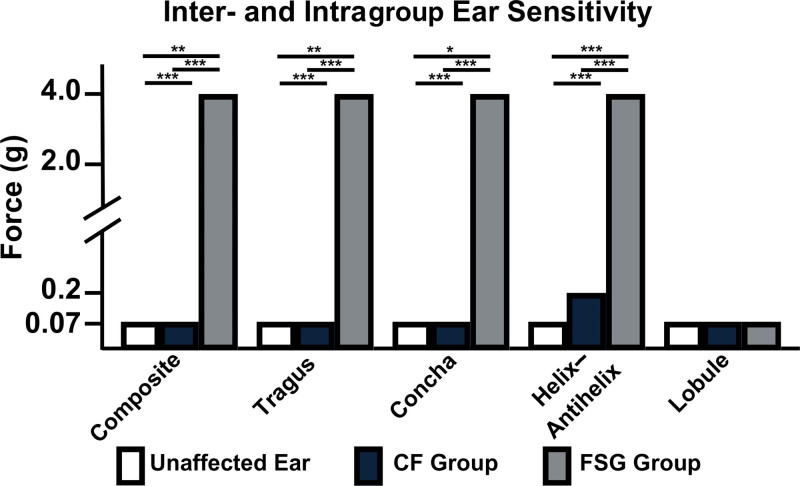
- CF reconstruction had significantly higher sensation than FSG in the reconstructed ear overall (Z = 4.75, P < 0.001) and in the tragus (Z = 4.77, P < 0.001), bowl (Z = 4.30, P < 0.001), and helix/antihelix (Z = 4.87, P < 0.001); lobule sensitivity did not differ (Z = 0.63, P = 0.862).
- Median composite SWMT score was 0.07 g for both CF-reconstructed and contralateral ears, but the contralateral ear was still statistically more sensitive (Z = 2.99; P = 0.003); FSG-reconstructed ears had a median composite score of 4.00 g versus 0.07 g contralaterally (Z = 2.57, P = 0.010).
- The least sensitive regions after surgery included the helix/antihelix and conchal bowl; in the CF group, the helix/antihelix was the least sensitive region.
- In microtia-only subanalysis (29 ears), CF reconstruction again yielded superior whole-ear sensation versus FSG (Z = 4.49, P < 0.001).
Methods
- Retrospective and prospectively followed cohort from 2022 to 2024; 28 patients (32 ears) with microtia or ear reconstruction after trauma/cancer were included, excluding those without documented sensory examinations or with cognitive impairment precluding reliable reporting.
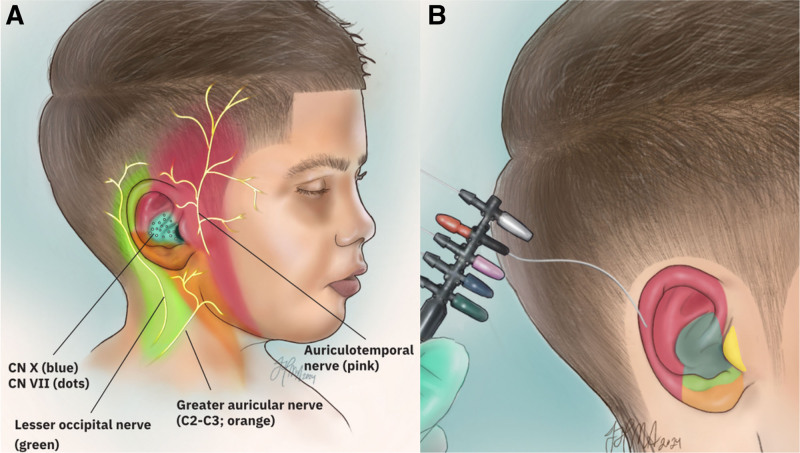
- Sensory recovery was assessed with the Semmes-Weinstein monofilament test (0.07–4 g) in four external ear regions—helix/antihelix, tragus, bowl, and lobule—before reconstruction when available and postoperatively; the contralateral ear served as a control in unilateral cases.
- Groups were CF-based reconstruction with costal cartilage (18 patients, 20 ears) versus FSG reconstruction with MEDPOR or allogenic costal cartilage (10 patients, 12 ears); analyses used Mann-Whitney U, Friedman, Dunn–Bonferroni post hoc, and Wilcoxon signed-rank tests.
Limitations
- The paper states that SWMT is inherently subjective and may vary with attention levels; underlying etiology (congenital, traumatic, neoplastic) may produce variable auricular innervation; FSG patients mostly presented from outside hospitals without preoperative baseline sensory recordings or complication rates; sensory testing occurred later in the FSG cohort; flap/graft design was individualized; and cold and thermal sensitivities were not assessed.
- The text also makes evident that the sample was small and groups were unequal, and the paper notes that intragroup comparison within the FSG group could not be reliably performed because of insufficient numbers.
Model-written summary. Check it against the paper before relying on it.
Integrity signals
Registry
Cites
Statistics
Figures
Verification
Claims the paper makes
1 Valid · 0 Not valid · 5 Not checked · 37 Own results and interpretations
A result the paper reports from its own data — it cites no other source for it, so there is none to check. The quote shows it is in the paper.
In the paper
“The Spearman correlation test did not reveal a significant correlation between time from the index procedure and sensory outcomes.”
§ Postoperative Cutaneous Sensory Recovery After Different Surgical Approaches for Microtia and Ear Reconstruction > RESULTS
plain- Asserted: passes — The authors put it forward as true.
- Checkable: passes — It can be checked against evidence.
- Load-bearing: unclear — It is unclear whether the paper’s conclusions depend on it.
- Based: passes — The paper gives a reason why it holds.
A result the paper states — it cites no source for it, so there is none to check. The quote shows it is in the paper.
In the paper
“Within the CF group, the helix/antihelix was the least sensitive region.”
§ Postoperative Cutaneous Sensory Recovery After Different Surgical Approaches for Microtia and Ear Reconstruction > RESULTS > Intragroup Comparison: FSG Group
plain- Asserted: passes — The authors put it forward as true.
- Checkable: passes — It can be checked against evidence.
- Load-bearing: unclear — It is unclear whether the paper’s conclusions depend on it.
- Based: passes — The paper gives a reason why it holds.
A result the paper reports from its own data — it cites no other source for it, so there is none to check. The quote shows it is in the paper.
In the paper
“There were no significant differences between the lobules.”
§ Postoperative Cutaneous Sensory Recovery After Different Surgical Approaches for Microtia and Ear Reconstruction > RESULTS > Intragroup Comparison: CF Group
plain- Asserted: passes — The authors put it forward as true.
- Checkable: passes — It can be checked against evidence.
- Load-bearing: unclear — It is unclear whether the paper’s conclusions depend on it.
- Based: passes — The paper gives a reason why it holds.
A result the paper reports from its own data — it cites no other source for it, so there is none to check. The quote shows it is in the paper.
In the paper
“Further investigation of these differences revealed that the composite contralateral ear was statistically more sensitive than the summative total score for the CF-reconstructed ear (Z = 2.99; P = 0.003).”
§ Postoperative Cutaneous Sensory Recovery After Different Surgical Approaches for Microtia and Ear Reconstruction > RESULTS > Intragroup Comparison: CF Group
plain- Asserted: passes — The authors put it forward as true.
- Checkable: passes — It can be checked against evidence.
- Load-bearing: unclear — It is unclear whether the paper’s conclusions depend on it.
- Based: passes — The paper gives a reason why it holds.
A result the paper reports from its own data — it cites no other source for it, so there is none to check. The quote shows it is in the paper.
In the paper
“fascial flap with skin graft cases demonstrated diminished sensitivity, particularly in the helix, conchal bowl, and tragus.”
§ Postoperative Cutaneous Sensory Recovery After Different Surgical Approaches for Microtia and Ear Reconstruction > Takeaways
boostedstates an association- Asserted: passes — The authors put it forward as true.
- Checkable: passes — It can be checked against evidence.
- Load-bearing: passes — The paper’s conclusions depend on it.
- Based: passes — The paper gives a reason why it holds.
21 more claims
Create a free account to see all 43 claims and every source verdict.
- It may state two separate claims as one. 11
- Probably not a substantial claim. 7
Statistics recomputed
Every reported test result, recomputed from its test statistic and degrees of freedom. A result shows as not adding up only once an independent check has confirmed it.
- Consistentz = 2.99reported p = .003 · recomputed p = .003
“(Z = 2.99, p = .003”
- Consistentz = 2.65reported p = .008 · recomputed p = .008
“(Z = 2.65, p = .008”
- Consistentz = 2.71reported p = .007 · recomputed p = .007
“(Z = 2.71, p = .007”
- Consistentz = 3.13reported p = .002 · recomputed p = .002
“(Z = 3.13, p = .002”
- Consistentz = 2.83reported p = .005 · recomputed p = .005
“(Z = 2.83, p = .005”
14 more recomputed tests
Create a free account to see every test the Stats check recomputed.
Self-check
Percentages, sums and reported differences re-computed from the paper’s own numbers.
Each contradiction between two passages listed here was confirmed by an independent check.
Rated major: it would touch a result — a value a result rests on, reported and recomputed p-values on opposite sides of the significance level, two passages that conflict with no sign which is right, or a cited work retracted before this paper was published.
In the paper
§ Postoperative Cutaneous Sensory Recovery After Different Surgical Approaches for Microtia and Ear Reconstruction > DISCUSSION
“The results of our sensory study demonstrate that those within the CF group exhibited significant improvements in sensitivity scores postoperatively, with sensory values closely approaching those of the contralateral, unaffected ear.”
§ Postoperative Cutaneous Sensory Recovery After Different Surgical Approaches for Microtia and Ear Reconstruction > RESULTS > Intragroup Comparison: CF Group
“Wilcoxon signed-rank tests showed that the remnant (preoperatively) was more sensitive on the tragus (Z = 2.83, P = 0.005), the bowl (Z = 2.89, P = 0.004), and the helix/antihelix (Z = 3.42, P < 0.001).”
Rated minor: it would not touch a result — a value no result rests on, a p-value that stays on the same side of the significance level, or a conflict that is clerical, resolved elsewhere in the paper, or outside its own findings.
In the paper
§ Postoperative Cutaneous Sensory Recovery After Different Surgical Approaches for Microtia and Ear Reconstruction > DISCUSSION
“The FSG group in this study consisted of 12 MEDPOR and 2 donor costal cartilage patients.”
§ Postoperative Cutaneous Sensory Recovery After Different Surgical Approaches for Microtia and Ear Reconstruction > RESULTS
“Ten patients (12 ears) underwent FSG reconstruction—10 ears were reconstructed with MEDPOR, and 2 were reconstructed with allogenic costal cartilage.”
Rated minor: it would not touch a result — a value no result rests on, a p-value that stays on the same side of the significance level, or a conflict that is clerical, resolved elsewhere in the paper, or outside its own findings.
In the paper
§ Postoperative Cutaneous Sensory Recovery After Different Surgical Approaches for Microtia and Ear Reconstruction > RESULTS
“FSG group, middle row: 55-y-old with right ear defect after melanoma excision and reconstruction with Extearna allogeneic costal cartilage 6 mo postoperatively;”
§ Postoperative Cutaneous Sensory Recovery After Different Surgical Approaches for Microtia and Ear Reconstruction > RESULTS
“| Age at sensory examination, mean (range, SD), y | 13.9 (9–20, 3.9) | 18.8 (9–53, 12.4) |”
Rated minor: it would not touch a result — a value no result rests on, a p-value that stays on the same side of the significance level, or a conflict that is clerical, resolved elsewhere in the paper, or outside its own findings.
In the paper
§ Postoperative Cutaneous Sensory Recovery After Different Surgical Approaches for Microtia and Ear Reconstruction > RESULTS
“| Ethnicity distribution, n (%) | | | | Hispanic | 17 (85) | 5 (42) | | Not Hispanic | 3 (15) | 7 (58) |”
§ Postoperative Cutaneous Sensory Recovery After Different Surgical Approaches for Microtia and Ear Reconstruction > RESULTS
“| Total patients | 28 | 18 | 10 | |”
Citations
Cites
A new method of total reconstruction of the auricle for microtia
Nagata, S. (1993) · Plastic and Reconstructive Surgery · doi:10.1097/00006534-199308000-00001 · Cited by 640
Nagata, S. (1994) · Plastic and Reconstructive Surgery · doi:10.1097/00006534-199402000-00001 · Cited by 361
Firmin, F. (1998) · Scandinavian Journal of Plastic and Reconstructive Surgery and Hand Surgery · doi:10.1080/02844319850158930 · Cited by 258
Nagata, S. (1994) · Plastic and Reconstructive Surgery · doi:10.1097/00006534-199402000-00002 · Cited by 240
Microtia‐anotia: A global review of prevalence rates
Luquetti, D. V., Leoncini, E., & Mastroiacovo, P. (2011) · Birth Defects Research Part A: Clinical and Molecular Teratology · doi:10.1002/bdra.20836 · Cited by 219
Ear reconstruction using a porous polyethylene framework and temporoparietal fascia flap
Reinisch, J., & Lewin, S. (2009) · Facial Plastic Surgery · doi:10.1055/s-0029-1239448 · Cited by 203 · cited 1×
“8 Relatively few studies have directly compared these types of reconstructions, and of those, the focus has primarily been on aesthetic outcomes or complication rates.”
Nagata, S. (1994) · Plastic and Reconstructive Surgery · doi:10.1097/00006534-199402000-00003 · Cited by 199
Nagata, S. (1994) · PubMed · Cited by 158
Nagata, S. (1994) · Plastic and Reconstructive Surgery · doi:10.1097/00006534-199402000-00004 · Cited by 156
Craniofacial reconstruction with high-density porous polyethylene implants.
Menderes, A., Baytekin, C., Topcu, A., Yilmaz, M., & Barutcu, A. (2004) · Journal of Craniofacial Surgery · doi:10.1097/00001665-200409000-00004 · Cited by 90
Cited by
Antongiovanni, J. T., Mosieri, C. N., Waites, J., Hewett, S., Shah, N. D., Alaniz, L., Morphew, T., Blaine, K., Vyas, R. M., & Pfaff, M. J. (2026) · FACE · doi:10.1177/27325016261459571
“32-34 While this approach cannot be reliably distinguished within PHIS due to coding limitations, it may further influence reconstructive decision-making and access patterns in the future.”
Self-citation
Metadata
- Authors
- Willens, S. H., Alaniz, L., Humphrey, J., Shah, N., Antongiovanni, J., Mosieri, C. A., Jaffurs, D. C., Vyas, R. M., & Pfaff, M. J.
- Affiliations
- Stanford University School of Medicine, Stanford, CA
- University of California, Irvine Medical Center (US)
- Loma Linda University (US)
- Washington State University Spokane (US)
- Louisiana State University (US)
- Children's Hospital of Orange County (US)
- Corresponding author
- Jaffurs, Daniel C.
- Vyas, Raj M.
- Pfaff, Miles J.
- Venue
- Plastic and Reconstructive Surgery, Global Open
- Published
- 2025-12
- Volume
- 13
- Issue
- 12
- Pages
- e7355
- ISSN
- 2169-7574 (ISSN-L)
- PMC
- PMC12714146
- OpenAlex
- W7115913096
- Cited by
- 1
- References
- 18
- Citations by year
- 2026: 1
- FWCI
- 0.94
- Type
- journal article
- Language
- en
- Open access
- gold
- doi.org
- Licence
- Locations
- Plastic & Reconstructive Surgery Global Open (publishedVersion, cc-by-nc-nd)
- PubMed (publishedVersion)
- PubMed Central (publishedVersion, cc-by-nc-nd)
- Topics
- Health Sciences › Medicine › Surgery › Reconstructive Facial Surgery Techniques
- Health Sciences › Medicine › Genetics (clinical) › Congenital Ear and Nasal Anomalies
- Health Sciences › Medicine › Surgery › Nasal Surgery and Airway Studies
- Keywords
- microtia, ear reconstruction, skin flaps, tactile perception, Semmes-Weinstein monofilament, porous polyethylene, pediatric patients
About these checks
Registry, retraction, Cites and statistics results are computed, not judged, with one exception: a printed reference that no index lists is read once by a model before it counts as a citation error. Claims are extracted by a model and kept only when their quote appears verbatim in the text; each cited source is then checked, with a model’s help, for whether it says what the claim relies on. Those verdicts can be wrong — read the claim’s quote and the cited source before relying on one.
A language model drew the claims from the paper on 2026-10-10, under version 3 of the claim definition (model deepseek-v4.1-flash, prompt extract-v3).
A second model labelled each claim on 2026-10-10 (model jev-1.13-20260917, definition revision gold-guideline-v0.2).
Statistics and arithmetic are recomputed, not judged.
Confidence bands are shown only for fields calibrated on our annotated test set. None is calibrated yet, so no band is shown.
What counts as a claim ›How we measure confidence ›How we check this ›
Are you an author, or do you see a problem with this page? Request a review
How to cite
Cite CoChat for the checks on this page, and the paper for its own findings.
- This page
- CoChat. (2026). Citation check: Postoperative Cutaneous Sensory Recovery After Different Surgical Approaches for Microtia and Ear Reconstruction. https://app.cochat.ai/papers/10.1097/gox.0000000000007355
- The paper
- Willens, S. H., Alaniz, L., Humphrey, J., Shah, N., Antongiovanni, J., Mosieri, C. A., Jaffurs, D. C., Vyas, R. M., & Pfaff, M. J. (2025). Postoperative Cutaneous Sensory Recovery After Different Surgical Approaches for Microtia and Ear Reconstruction. Plastic and Reconstructive Surgery, Global Open. https://doi.org/10.1097/gox.0000000000007355
Data sources
Bibliographic data: Semantic Scholar, OpenAlex, Crossref.
Contains information from the Semantic Scholar Academic Graph Datasets, made available under the ODC Attribution License (ODC-BY 1.0).
Semantic Scholar’s data is described in: Kinney, R., et al. (2023). The Semantic Scholar Open Data Platform. arXiv:2301.10140.
