

Altered connectivity of the right anterior insula drives the pain connectome changes in chronic knee osteoarthritis
Open accessThe DOI matches its Crossref record; 56 of the 56 references it cites were found in a registry or an index.
Abstract
Resting-state functional connectivity (FC) has proven a powerful approach to understand the neural underpinnings of chronic pain, reporting altered connectivity in 3 main networks: the default mode network (DMN), central executive network, and the salience network (SN). The interrelation and possible mechanisms of these changes are less well understood in chronic pain. Based on emerging evidence of its role to drive switches between network states, the right anterior insula (rAI, an SN hub) may play a dominant role in network connectivity changes underpinning chronic pain. To test this hypothesis, we used seed-based resting-state FC analysis including dynamic and effective connectivity metrics in 25 people with chronic osteoarthritis (OA) pain and 19 matched healthy volunteers. Compared with controls, participants with painful knee OA presented with increased anticorrelation between the rAI (SN) and DMN regions. Also, the left dorsal prefrontal cortex (central executive network hub) showed more negative FC with the right temporal gyrus. Granger causality analysis revealed increased negative influence of the rAI on the posterior cingulate (DMN) in patients with OA in line with the observed enhanced anticorrelation. Moreover, dynamic FC was lower in the DMN of patients and thus more similar to temporal dynamics of the SN. Together, these findings evidence a widespread network disruption in patients with persistent OA pain and point toward a driving role of the rAI.
Overview
The claims and statistics of this paper haven’t been checked yet.
Free: it reads the open-access text and checks the first 5 claims that cite a source we can check. Create a free account to check every claim.
Integrity signals
Registry
Cites
Statistics
Figures
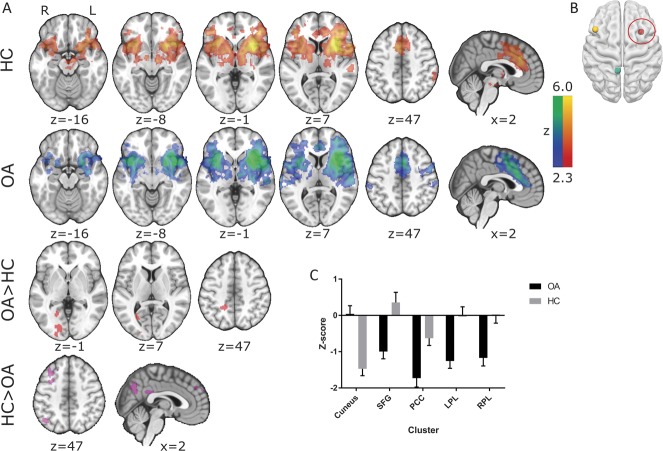
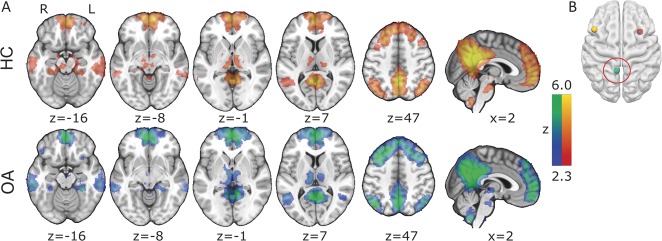
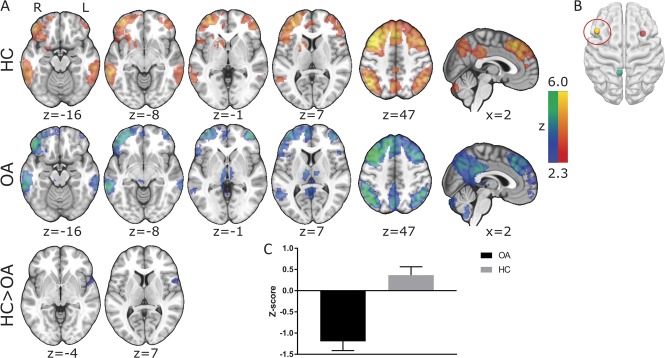
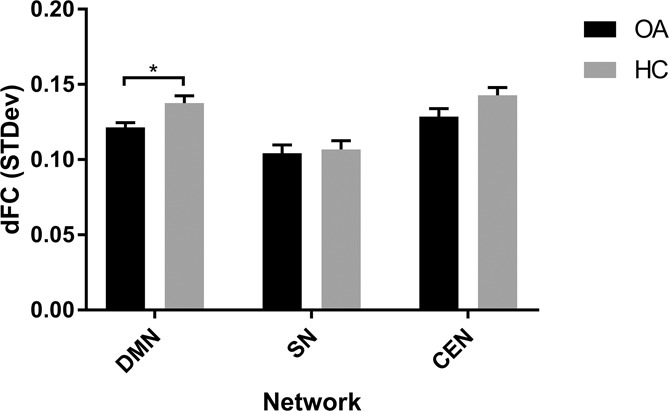
Verification
Claims the paper makes
The claims and statistics of this paper haven’t been checked yet.
Free: it reads the open-access text and checks the first 5 claims that cite a source we can check. Create a free account to check every claim.
Claims other papers make about this one
Each is checked against this paper’s own text: does it say what the citing paper says it does?
The cited source doesn’t support the claim as written.
In the citing paper
“Not only does each network independently demonstrate changes in functional connectivity in response to different types of chronic pain stimuli, it has been demonstrated that there is elevated functional connectivity among the DMN, FPN, and SN in individuals suffering from CMP [12,13,14,15,16,17,18].”
From Graph theory analysis of induced neural plasticity post-Acceptance and Commitment Therapy for chronic pain (2020) · cites this paper as [14]
Checked by a reasoning model — may be wrong.
Experimental — accuracy not yet measured
Self-check
Percentages, sums and reported differences re-computed from the paper’s own numbers.
The self-check needs the paper’s full text.
Citations
Cites
Jenkinson, M., Bannister, P., Brady, M., & Smith, S. (2002) · NeuroImage · doi:10.1006/nimg.2002.1132 · Cited by 11,888
The Pain Catastrophizing Scale: Development and validation.
Sullivan, M. J. L., Bishop, S. R., & Pivik, J. (1995) · Psychological Assessment · doi:10.1037//1040-3590.7.4.524 · Cited by 8,227 · cited 1×
“Directly before the scan session, all subjects undertook a battery of psychometric questionnaires including measures of educational level, low mood (Beck’s Depression Index), anxiety (StateTrait Anxiety Index), pain state (McGill Pain Questionnaire), and pain catastrophizing (Pain Catastrophizing Scale).(8,18,38,52,54…”
MethodPower, J. D., Barnes, K. A., Snyder, A. Z., Schlaggar, B. L., & Petersen, S. E. (2012) · NeuroImage · doi:10.1016/j.neuroimage.2011.10.018 · Cited by 7,429
Dissociable intrinsic connectivity networks for salience processing and executive control
Seeley, W. W., Menon, V., Schatzberg, A. F., Keller, J., Glover, G. H., Kenna, H., Reiss, A. L., & Greicius, M. D. (2007) · The Journal of Neuroscience · doi:10.1523/jneurosci.5587-06.2007 · Cited by 7,426 · cited 2×
“A brain network implicated in this process is the “salience network” (SN).(50) The core SN is formed by the bilateral anterior insula and the anterior middle cingulate cortex supporting the integration of external information, previous experience, and concurrent homeostatic state, to orient attention.”
BackgroundA global optimisation method for robust affine registration of brain images
Jenkinson, M., & Smith, S. (2001) · Medical Image Analysis · doi:10.1016/s1361-8415(01)00036-6 · Cited by 6,872 · cited 1×
“Linear registration (FLIRT) to the T1-weighted image (BBR) and Montreal Neurological Institute standard space (12 ̊ of freedom) was performed.(30,31) All data sets were denoised using ICA1 FIX (independent component analysis followed by FMRIB’s ICA-based noise reduction.”
MethodThe McGill Pain Questionnaire: Major properties and scoring methods
Melzack, R. (1975) · Pain · doi:10.1016/0304-3959(75)90044-5 · Cited by 6,845
Saliency, switching, attention and control: a network model of insula function
Menon, V., & Uddin, L. Q. (2010) · Brain Structure and Function · doi:10.1007/s00429-010-0262-0 · Cited by 5,592 · cited 2×
“The core SN is formed by the bilateral anterior insula and the anterior middle cingulate cortex supporting the integration of external information, previous experience, and concurrent homeostatic state, to orient attention.(39) Therefore, the SN is expected to play a dominant role in chronic pain, a condition believed…”
BackgroundDynamic functional connectivity: Promise, issues, and interpretations
Hutchison, R. M., Womelsdorf, T., Allen, E. A., Bandettini, P. A., Calhoun, V. D., Corbetta, M., Della Penna, S., Duyn, J. H., Glover, G. H., Gonzalez-Castillo, J., et al. (2013) · NeuroImage · doi:10.1016/j.neuroimage.2013.05.079 · Cited by 2,962
Sridharan, D., Levitin, D. J., & Menon, V. (2008) · Proceedings of the National Academy of Sciences · doi:10.1073/pnas.0800005105 · Cited by 2,892 · cited 2×
“Previous work in healthy volunteers has demonstrated the right anterior insula (rAI) as the main causal output within the SN, projecting to and influencing the central executive network (CEN) and DMN acting as a key switch between these networks.(22,39,53) There are, however, surprisingly few studies reporting SN chan…”
ResultREST: A Toolkit for Resting-State Functional Magnetic Resonance Imaging Data Processing
Song, X.-W., Dong, Z.-Y., Long, X.-Y., Li, S.-F., Zuo, X.-N., Zhu, C.-Z., He, Y., Yan, C.-G., & Zang, Y.-F. (2011) · PLoS ONE · doi:10.1371/journal.pone.0025031 · Cited by 1,872 · cited 1×
“Bivariate first-order coefficient-based voxel-wise Granger causality analysis (GCA) was calculated using the REST fMRI toolbox.(51) Granger causality analysis calculates an estimate of the causal effect of a region of interest on each voxel in the brain (X-Y effect) and the reverse (Y-X effect).”
Method
Research works printed but not linked: 2
- 17. Drabek MM Reckziegel D Cottam WJ Li X Frowd N Alshuft H Scammell B Kurien T Auer DP Chronic pain-related sexual dimorphism in gray matter density: a whole-brain voxel-based morphometric study on osteoarthritis patients, Proceedings of the ISMRM-ESMRMB. 2017.
- 52. Spielberger C Gorsuch R Lushene R Vagg PR Jacobs GA Manual for the state-trait anxiety inventory. Palo Alto: Consulting Psychologists Press, 1983.
Cited by
Items 101–122 of 122
Linking fMRI, Pain, and Addictions
Aytur, S., Roy, G., Doyle, M., Ray, K. L., Meier, S. K., & Robin, D. A. (2022) · Springer eBooks · doi:10.1007/978-3-030-67928-6_33-1
Linking fMRI, Pain, and Addictions
Aytur, S., Roy, G., Doyle, M., Ray, K. L., Meier, S. K., & Robin, D. A. (2022) · Springer eBooks · doi:10.1007/978-3-030-92392-1_33
Neurobiological Impact of HIV Infection and Chronic Cannabis Use
Flannery, J. S. (2021) · FIU - Digital Commons (Florida International University) · doi:10.25148/etd.fidc010223
Stauber, W. T., McGaughey, T. A., Evans, N., Chaffin, A., Snyder, S. B., Webster, P. J., Sizemore, G., Brefczynski‐Lewis, J. A., & Lewis, J. W. (2024) · Research Square · doi:10.21203/rs.3.rs-4548047/v1
Sagnier, S., & Linden, D. E. J. (2024) · Elsevier eBooks · doi:10.1016/b978-0-12-820480-1.00174-1
Hinkle, C. E. (2021) · Maryland Shared Open Access Repository (USMAI Consortium) · doi:10.13016/m2qqwk-wxgv
Baumbach, P. (2021) · Common Library Network (Der Gemeinsame Bibliotheksverbund) · doi:10.22032/dbt.50139
B. Tremblay, M.-P. (2021) · Corpus Université Laval (Université Laval)
Oh, H. (2024) · Nottingham ePrints (University of Nottingham)
Goncalves, S. V. (2021) · Nottingham ePrints (University of Nottingham)
Wang, M. C. (2025) · Nottingham ePrints (University of Nottingham)
Physiological underpinnings of healthy brain ageing
Watt, J. K. (2022) · Nottingham ePrints (University of Nottingham)
Brain Mechanisms of Osteoarthritis Pain
Monteiro, J. D. B. B. (2021) · Portuguese National Funding Agency for Science, Research and Technology (RCAAP Project by FCT) · doi:10.34626/1qfs-f830
Li, Y., Liu, C., Diao, Z., Liu, Y., Lu, J., Li, H., Zheng, Y., Wei, Z., Qiao, H., & Liu, P. (2026) · Musculoskeletal Science and Practice · doi:10.1016/j.msksp.2026.103566
Transcriptomic decoding of dynamic brain activity alterations in chronic non-specific low back pain
Liu, J.-L., Lai, P., Chen, X., Jia, C., Zhao, Y., Patchaivuttikul, N., Xin, M., Zhu, D., Xia, J., Zeng, F., et al. (2026) · Regional Anesthesia & Pain Medicine · doi:10.1136/rapm-2026-107857
“39 40 Compared with HCs, patients with CNLBP exhibited significantly higher MDT in state 6, suggesting the presence of a persistent hyperarousal state in CNLBP. Elevated activity of the LN and SN in state 6 may contribute to chronic pain and its pain-related emotional comorbidities.”
Miao, Z., Zhang, X., Zhao, G., Li, S., Wang, F., Lu, Q., Liu, X., & Liu, P. (2026) · Pain · doi:10.1097/j.pain.0000000000004033
Liu, H., Su, X., Chen, Y., Gan, H., Shang, M., Chi, X., Li, Y., Lu, T., Zhang, M., Dun, W., et al. (2026) · iScience · doi:10.1016/j.isci.2026.116525
The hijacked insula: A stratified model of affective touch modulation in chronic pain
Palamoutsi, E. M., & Liberati, G. (2026) · Journal of Neuropsychology · doi:10.1111/jnp.70062
Moutayb, O., Noël, J., Anouar, Y., Bennis, M., Ba-M’hamed, S., & Fatima-Zahra, L. M. (2026) · Brain Research · doi:10.1016/j.brainres.2026.150478
Luo, W., Zhou, J., Cheng, S., Dong, X., Chen, Y., Tang, C., He, W., Wang, Z., Zeng, F., Li, Z., et al. (2026) · The Korean journal of pain · doi:10.3344/kjp.26221
“Consistent with this account, KOA and other chronic pain conditions show altered DMN organization and abnormal coupling among the DMN, sensorimotor, salience/ventral-attention, and cognitive-control networks [11–13].”
A brain network framework for cognitive dysfunction in chronic pain
Čeko, M., & D’Mello, S. K. (2026) · Pain · doi:10.1097/j.pain.0000000000004140
Metadata
- Authors
- Cottam, W. J., Iwabuchi, S. J., Drabek, M. M., Reckziegel, D., & Auer, D. P.
- Affiliations
- University of Nottingham (GB)
- Corresponding author
- Auer, Dorothee P.
- Venue
- Pain
- Published
- 2018-03-16
- Volume
- 159
- Issue
- 5
- Pages
- 929-938
- ISSN
- 0304-3959 (ISSN-L)
- 1872-6623
- PMC
- PMC5916486
- OpenAlex
- W2782813784
- Semantic Scholar
- 79a03d0cc7741800c790d995014f04ffb4e2e64b
- Cited by
- 110
- References
- 56
- Citations by year
- 2026: 9 · 2025: 9 · 2024: 16 · 2023: 18 · 2022: 21 · 2021: 16 · 2020: 9 · 2019: 11 · 2018: 1
- FWCI
- 5.50
- Type
- journal article
- Language
- en
- Open access
- hybrid
- doi.org
- Locations
- Pain (publishedVersion, cc-by)
- Europe PMC (PubMed Central) (publishedVersion, cc-by)
- PubMed Central (publishedVersion, cc-by)
- PubMed (publishedVersion)
- Repository@Nottingham (University of Nottingham) (submittedVersion, cc-by)
- Nottingham ePrints (University of Nottingham) (submittedVersion, cc-by)
- Topics
- Life Sciences › Neuroscience › Cognitive Neuroscience › Functional Brain Connectivity Studies
- Health Sciences › Medicine › Physiology (medical) › Pain Mechanisms and Treatments
- Life Sciences › Neuroscience › Cognitive Neuroscience › Pain Management and Placebo Effect
- Keywords
- chronic knee osteoarthritis, chronic pain, anterior insula, salience network, default mode network, resting-state functional connectivity, dynamic functional connectivity, effective connectivity, Granger causality, dorsal prefrontal cortex, posterior cingulate cortex
- MeSH terms
- Afferent Pathways, Aged, Aged, 80 and over, Anxiety, Cerebral Cortex, Chronic Disease, Female, Humans, Image Processing, Computer-Assisted, Functional Laterality, Magnetic Resonance Imaging, Male, Middle Aged, Models, Neurological, Oxygen, Surveys and Questionnaires, Case-Control Studies, Nonlinear Dynamics, Osteoarthritis, Knee
About these checks
Registry, retraction, Cites and statistics results are computed, not judged, with one exception: a printed reference that no index lists is read once by a model before it counts as a citation error. Claims are extracted by a model and kept only when their quote appears verbatim in the text; each cited source is then checked, with a model’s help, for whether it says what the claim relies on. Those verdicts can be wrong — read the claim’s quote and the cited source before relying on one.
Statistics and arithmetic are recomputed, not judged.
Confidence bands are shown only for fields calibrated on our annotated test set. None is calibrated yet, so no band is shown.
What counts as a claim ›How we measure confidence ›How we check this ›
Are you an author, or do you see a problem with this page? Request a review
Data sources
Bibliographic data: Semantic Scholar, OpenAlex, Crossref.
Contains information from the Semantic Scholar Academic Graph Datasets, made available under the ODC Attribution License (ODC-BY 1.0).
Semantic Scholar’s data is described in: Kinney, R., et al. (2023). The Semantic Scholar Open Data Platform. arXiv:2301.10140.
