

The DOI matches its Crossref record; 86 of the 89 references it cites were found in a registry or an index.
The social threats of COVID-19 for people with chronic pain
Open accessAbstract
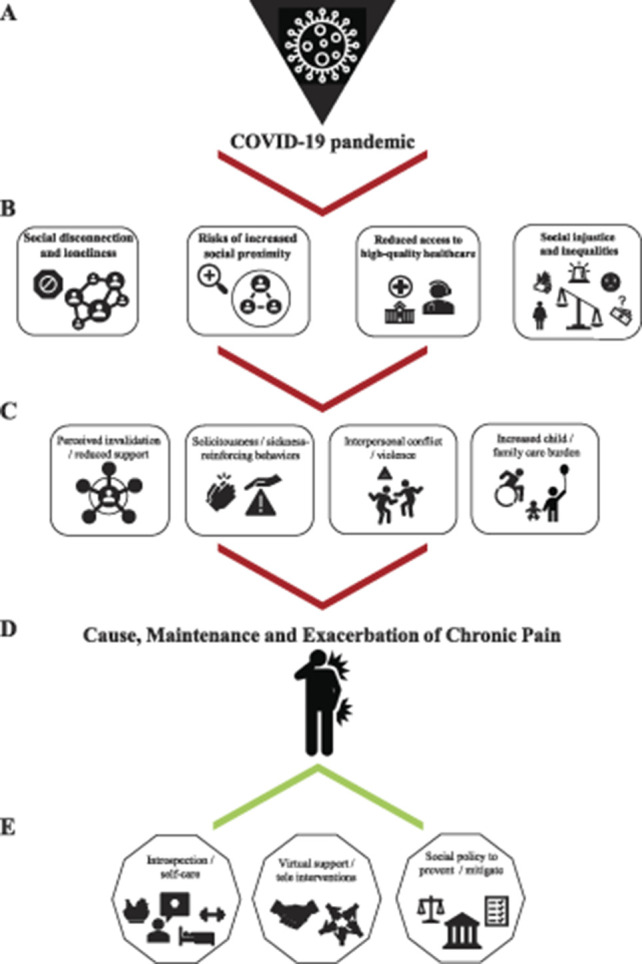
1. Introduction The COVID-19 (SARS-CoV-2) pandemic has changed the social environment in which people live and work, as well as the social systems they rely on.39,88 To contain the spread of coronavirus and to prepare for a dramatic increase in demand for limited hospital/medical facilities and resources, societies have enforced physical distancing measures. Consequently, there have been limitations on the use of public transportation, public spaces, and work, education, and recreational facilities. Furthermore, access to vital, but nonurgent, healthcare services (including pain management services) has been restricted. These changes have affected the way people connect with each other, manage their health and wellbeing, and fulfil their social roles. For some, these changes may present opportunities (eg, increased time with family, normalisation of flexible working, and reduced demand for travel). For others, however, these social changes can also represent significant threats to health and wellbeing. The negative impact of social changes prompted by the COVID-19 crisis may disproportionately affect individuals living with long-term painful conditions. Living with chronic pain can threaten an individuals' fundamental social needs for autonomy (agency or independence), belonging (social connection), and justice (fairness). In turn, for some, experiencing heightened social threat can maintain and exacerbate chronic pain.48 In this review, we draw attention to the potential for social and systemic changes associated with attempts to contain the spread of COVID-19 to precipitate, maintain, and exacerbate pain by increasing the social threats faced by individuals with chronic pain (Fig. 1). We also suggest strategies for mitigating the social impact of COVID-19 on those living with chronic pain, for instance by learning from the resilience demonstrated by people in pain who have found ways to deal with social threat. Finally, we suggest several time-critical, high-impact research questions for further investigation (Fig. 1).Figure 1.: Schematic representation of how the COVID 19 pandemic (A) exacerbates existing levels of social threat (B), thereby inducing several social challenges (C) for people with chronic pain, and ultimately increasing the risk for the development, maintenance, and exacerbation of chronic pain complaints (D). Possible protecting processes and interventions countering the effects of the pandemic are portrayed as well (E).2. Social threats posed by the COVID-19 pandemic 1.1. Social disconnection and loneliness One of the most immediate effects of the pandemic on our social lives is the introduction of physical distancing measures and restriction of travel. It is well known that spontaneous social interactions with others and participation in social roles can build and maintain a generalised sense of trust in others (social capital), promote feelings of wellbeing,76 provide protection from the harmful effects of stress,95 promote social connectedness, and reduce pain sensitivity.91 Conversely, social isolation is associated with loneliness, higher levels of depression and anxiety, poorer health behaviours, poorer sleep, higher blood pressure, poorer immune function, and pain.40,42 Chronic pain conditions place individuals at an increased risk of social isolation, smaller social network size, and reduced social role functioning,37,38,78 all of which have negative implications for pain interference and pain intensity over time.7,31,47 Indeed, disruption to social roles and relationships is one of the most distressing aspects of living with chronic pain.81 Physical distance from others and reduced participation in work and social activities can cause people to feel lonely or socially distanced from others,73 and there are concerns that the COVID-19 pandemic will lead to a steep rise in the prevalence of loneliness.5,22,35,39 People living with chronic pain, who may have entered the pandemic with fewer social resources than others, may be particularly vulnerable to feelings of loneliness and social disconnection at this time. Unless individuals have the ability and means to maintain meaningful connections with others despite physical distancing measures, being physically isolated from others threatens to exacerbate pain and associated disability. 1.2. Risk of increased social proximity The paradox of COVID-19 is that being physically isolated from one's community can mean living in closer proximity to one's household members. People living with chronic pain conditions may benefit from more frequent contact with family members because closer proximity offers more opportunity to improve social bonds. However, enforced close-proximity living could also bring challenges to autonomy and independence. Although social support can help buffer against pain,14,15,18,56 an increase in solicitous behaviours in such close proximity might unintentionally contribute to the chronicity of pain.34,43,72 For examp
Overview
The claims and statistics of this paper haven’t been checked yet.
Run the check — free, no account needed. It reads the open-access text and checks the sources it cites.
Integrity signals
Registry
Cites
Statistics
Figures
Verification
Claims the paper makes
The claims and statistics of this paper haven’t been checked yet.
Run the check — free, no account needed. It reads the open-access text and checks the sources it cites.
Claims other papers make about this one
Each is checked against this paper’s own text: does it say what the citing paper says it does?
The source backs part of the claim, not all of it — or backs it for a different population, condition or comparison.
In the citing paper
“In this context, telerehabilitation appears as a key solution to counteract the burden of the COVID-19 pandemic on patients with persistent musculoskeletal pain [1,4].”
From Behavior Modification Techniques on Patients with Chronic Pain in the Context of COVID-19 Telerehabilitation: An Umbrella Review (2022) · cites this paper as [4]
Experimental — accuracy not yet measuredThe source backs part of the claim, not all of it — or backs it for a different population, condition or comparison.
In the citing paper
“Our PAR framework provides a model for future studies codeveloping online solutions that can be scalable and potentially address the needs of high-risk populations, such as Indigenous and culturally and linguistically diverse communities.29”
From Clinical and cost-effectiveness of an online-delivered group-based pain management programme in improving pain-related disability for people with persistent pain - Protocol for a non-inferiority randomised controlled trial (iSelf-help trial) (2021) · cites this paper as [29]
Experimental — accuracy not yet measuredThe check wasn’t confident either way, so it gives no verdict — never disputed.
In the citing paper
“Lack of person-centred collaboration can minimise the importance of values,29 such as those arising from culture and health beliefs, which form the basis of understanding the needs of individuals and families.30–32”
From Clinical and cost-effectiveness of an online-delivered group-based pain management programme in improving pain-related disability for people with persistent pain - Protocol for a non-inferiority randomised controlled trial (iSelf-help trial) (2021) · cites this paper as [29]
Experimental — accuracy not yet measured
Self-check
Percentages, sums and reported differences re-computed from the paper’s own numbers.
The self-check needs the paper’s full text.
Citations
Cites
Loneliness and Social Isolation as Risk Factors for Mortality: A Meta-Analytic Review
Holt-Lunstad, J., Smith, T. B., Baker, M., Harris, T., & Stephenson, D. (2015) · Perspectives on Psychological Science · doi:10.1177/1745691614568352 · Cited by 6,043
Social conditions as fundamental causes of disease.
Link, B. G., & Phelan, J. (1995) · Journal of Health and Social Behavior · doi:10.2307/2626958 · Cited by 5,722
Holmes, E. A., O'Connor, R. C., Perry, V. H., Tracey, I., Wessely, S., Arseneault, L., Ballard, C., Christensen, H., Cohen Silver, R., Everall, I., et al. (2020) · The Lancet Psychiatry · doi:10.1016/s2215-0366(20)30168-1 · Cited by 5,715
Using social and behavioural science to support COVID-19 pandemic response
Bavel, J. J. V., Baicker, K., Boggio, P. S., Capraro, V., Cichocka, A., Cikara, M., Crockett, M. J., Crum, A. J., Douglas, K. M., Druckman, J. N., et al. (2020) · Nature Human Behaviour · doi:10.1038/s41562-020-0884-z · Cited by 4,964 · cited 3×
“Introduction 1 The COVID-19 (SARS-CoV-2) pandemic has changed the social environment in 2 which people live and work, as well as the social systems they rely on [39; 88].”
BackgroundSocial Conditions as Fundamental Causes of Disease
Link, B. G., & Phelan, J. C. (1995) · PubMed · doi:10.13016/rpln-eiwa · Cited by 2,684
Socioeconomic Disparities in Health Behaviors
Pampel, F. C., Krueger, P. M., & Denney, J. T. (2010) · Annual Review of Sociology · doi:10.1146/annurev.soc.012809.102529 · Cited by 1,944
Chronic pain: a review of its epidemiology and associated factors in population-based studies
Mills, S. E. E., Nicolson, K. P., & Smith, B. H. (2019) · British Journal of Anaesthesia · doi:10.1016/j.bja.2019.03.023 · Cited by 1,728
COVID-19: the gendered impacts of the outbreak
Wenham, C., Smith, J., & Morgan, R. (2020) · The Lancet · doi:10.1016/s0140-6736(20)30526-2 · Cited by 1,701
Just world research and the attribution process: Looking back and ahead.
Lerner, M. J., & Miller, D. T. (1978) · Psychological Bulletin · doi:10.1037/0033-2909.85.5.1030 · Cited by 1,687
The pandemic paradox: The consequences of COVID-19 on domestic violence
Bradbury‐Jones, C., & Isham, L. (2020) · Journal of Clinical Nursing · doi:10.1111/jocn.15296 · Cited by 1,165
Cited by
Sorted by citations
Items 101–148 of 148
Vaillant, J., Gairola, R., Merlin, J. S., Trivedi, A. N., Shireman, T. I., & Dow, P. M. (2025) · Medical Care Research and Review · doi:10.1177/10775587251339917 · Cited by 2
Reducing the Negative Impact of Social Distancing Through Intentional Connectedness
Akers, S. W., & Joseph, R. A. (2021) · Journal of Christian Nursing · doi:10.1097/cnj.0000000000000882 · Cited by 2
Yessick, L. R., Jackowich, R. A., Coyle, S. M., Salomons, T. V., & Pukall, C. F. (2022) · Journal of Sex & Marital Therapy · doi:10.1080/0092623x.2022.2060887 · Cited by 2
Günaydın, E. B., Öcalan, M. Ç., Uzunkulaoğlu, A., & Ay, S. (2022) · Gulhane Medical Journal · doi:10.4274/gulhane.galenos.2021.07379 · Cited by 2
Potential impact of COVID-19 pandemic on endometriosis
Huang, C., Sun, H., & Mei, J. (2022) · Reproductive and Developmental Medicine · doi:10.1097/rd9.0000000000000015 · Cited by 2
Scherrer, J. F., Miller-Matero, L. R., Sullivan, M. D., Chrusciel, T., Salas, J., Davidson, W., Zabel, C., Wilson, L., Lustman, P. J., & Ahmedani, B. K. (2022) · Journal of General Internal Medicine · doi:10.1007/s11606-022-07940-4 · Cited by 2
Possible repercussions of the COVID-19 pandemic on women with fibromyalgia: longitudinal study
de Melo, G. A., Madruga, M. L. L. H., de Oliveira, M. B. R., & Alves, N. T. (2022) · Brazilian Journal Of Pain · doi:10.5935/2595-0118.20220043-en · Cited by 2
Older Adult Perspectives on Integrative Pain Management, Analgesics and Educational Preferences
Sheikh, S., Munson, T., Brailsford, J., Patel, M., Beneciuk, J. M., Li, R. M., Henson, M., Spindle, N., Curtis, M. E., & Hendry, P. L. (2025) · Cureus · doi:10.7759/cureus.80432 · Cited by 1
Amorim, A. B., Rebbeck, T. J., Dam, N. T. V., Johnstone, C. S. H., Ashton-James, C. E., Costa, N., Barnet-Hepples, T., Jennings, M., Refshauge, K. M., & Pappas, E. (2025) · Pilot and Feasibility Studies · doi:10.1186/s40814-025-01612-w · Cited by 1
Self-citationUpadhyay, R. K., Barman, D., & Bhardwaj, K. (2026) · Nonlinear Dynamics · doi:10.1007/s11071-026-12223-2 · Cited by 2
Evaluation of a Virtual Compassionate Living Group for Patients with Chronic Pain
Brown, A., Woodcock, C., Cocallis, K., & Bowman, A. R. (2022) · OBM Integrative and Complementary Medicine · doi:10.21926/obm.icm.2204050 · Cited by 1
Sola, H. D., Salazar, A., Palomo‐Osuna, J., Dueñas, M., Failde, I., & Moral-Muñoz, J. A. (2022) · Heliyon · doi:10.1016/j.heliyon.2022.e12483 · Cited by 2
Vulnerabilidade social no contexto da pandemia de COVID-19: uma discussão bioética
Alves, P. D., & Seidl, E. M. F. (2024) · CADERNOS IBERO-AMERICANOS DE DIREITO SANITÁRIO · doi:10.17566/ciads.v12i3.1205 · Cited by 1
Impact of the COVID-19 pandemic on the non-cancer chronic pain and its management in the elderly
Pereira, J. I. A., Afonso, R. M., & Reis-Pina, P. (2022) · Brazilian Journal Of Pain · doi:10.5935/2595-0118.20220039-en · Cited by 1
Understanding and Managing the Impact of COVID-19 on Patients With Chronic Pain
Frost, E. A. M. (2020) · Topics in Pain Management · doi:10.1097/01.tpm.0000721256.41539.19 · Cited by 1
Understanding chronic pain on the gender spectrum: gender role expectations and the pandemic
Côté, C., Develay, É., Roy, M., Vachon‐Presseau, É., LUPIEN, S. J., Rainville, P., & Pagé, M. G. (2022) · Journal of Interpersonal Relations Intergroup Relations and Identity · doi:10.33921/nbqy3408 · Cited by 1
Editorial: “Novel Pain Therapeutics: From Basic Research to Clinical Translation and Rehabilitation”
Scuteri, D., Sakurada, T., Tonin, P., Corasaniti, M. T., & Bagetta, G. (2021) · Frontiers in Pharmacology · doi:10.3389/fphar.2021.681422 · Cited by 1
Schmidt, G. J., van Duinkerken, E., Mello, C. R., Fukusawa, P. R. Y., Nicaretta, D. H., & Schmidt, S. L. (2020) · CBM. Cadernos brasileiros de medicina · doi:10.29327/230921.1.20201-1
Covid-19 Causa Alterações Atencionais a Longo Prazo
do Carmo, A., van Duinkerken, E., & Schmidt, S. L. (2020) · CBM. Cadernos brasileiros de medicina · doi:10.29327/230921.1.20201-5
Manifestações Otorrinolaringológicas na COVID-19
da Silva, A. D. C. F., FARIAS, M. D. S. N. D., Pena, A. Z. A. D. O., Silva, J. V. C. D. A., Alves, M. C. D. F., Rodrigues, A. D. A. R., & Leite, J. D. C. B. (2020) · CBM. Cadernos brasileiros de medicina · doi:10.29327/230921.1.20201-6
Marques, A. C., Tolentino, J. C., & Schmidt, S. L. (2020) · CBM. Cadernos brasileiros de medicina · doi:10.29327/230921.1.20201-3
Há um Aumento na Prevalência da Dor Crônica Durante a Pandemia da COVID-19?
Neves, V. V., Tolentino, J. C., & Schmidt, S. L. (2020) · CBM. Cadernos brasileiros de medicina · doi:10.29327/230921.1.20201-4 · Cited by 1
Hruschak, V., Flowers, K. M., Azizoddin, D. R., Jamison, R. N., Edwards, R. R., & Schreiber, K. L. (2021) · Ból · doi:10.5604/01.3001.0014.8194
Lee, Y., & Auh, Q. (2022) · SSRN Electronic Journal · doi:10.2139/ssrn.4046677
(2020) · The Back Letter · doi:10.1097/01.back.0000725752.34591.23
Gjorup, A. L. T., Tolentino, J. C., & Schmidt, S. L. (2020) · CBM. Cadernos brasileiros de medicina · doi:10.29327/230921.1.20201-2
Kersebaum, D., Sendel, M., Fabig, S., Sachau, J., Lassen, J., Rehm, S., Forstenpointner, J., Rümenapp, J., Vollert, J., Hüllemann, P., et al. (2022) · Medicine · doi:10.1097/md.0000000000032054
Nimmaanrat, S., Maneewat, K., & Siripituphum, D. (2023) · PSU Medical Journal · doi:10.31584/psumj.2023258241
Hapidou, E. G., Debono, V. B., Schwarz, S., & Anthonypillai, J. (2023) · Journal of Patient Experience · doi:10.1177/23743735231199673
Artificial Intelligence Interventions in Chronic Pain Management: A Scoping Review (Preprint)Preprint
Abiodun, A. O., Das, S., & Taylor, A. (2024) · doi:10.2196/preprints.57883
“Resilience?” perspectives from adults living with sickle cell disease
Conn, C. A. I., Creary, M., Desine, S., & Bonham, V. L. (2024) · Journal of the National Medical Association · doi:10.1016/j.jnma.2024.01.002
COVID-19: sus implicaciones para la práctica de la medicina del dolor
Covarrubias‐Gómez, A., Vargas-Bermúdez, A., Perez-Franco, E., López-Collada-Estrada, M., Carrillo-Torres, O., Salazar-Trujillo, N. V., Báez-Báez, J. U., Arboleda-Castro, M. F., Gutiérrez-Salmerón, C., & Esquer-Guzmán, H. M. (2024) · Revista Mexicana de Anestesiología · doi:10.35366/115318
Han, A., Jolly, T. S., & Cohen, S. P. (2024) · Oxford University Press eBooks · doi:10.1093/med/9780197649176.003.0029
Vulnerabilidade social no contexto da pandemia de COVID-19: uma discussão bioética
Alves, P. D., & Seidl, E. M. F. (2024) · CADERNOS IBERO-AMERICANOS DE DIREITO SANITÁRIO · doi:10.17566/ciads.v13i1.1205
Frohe, T. M., Janssen, T., Garner, B. R., & Becker, S. J. (2024) · BMC Public Health · doi:10.1186/s12889-024-20077-9
Ohana, N., Baruch, Y., Tavdi, A., Palmanovich, E., Benharroch, D., Engel, I., & Yaacobi, E. (2024) · Journal of International Medical Research · doi:10.1177/03000605241302010 · Cited by 1
Use of Artificial Intelligence Interventions in Chronic Pain Management: A Scoping Review (Preprint)
Abiodun, A. O., Das, S., & Taylor, A. (2024) · Journal of Medical Internet Research · doi:10.2196/57883
LA-FALCE, T. S., Castilho, K. S., Ganança, H. S. P., da Silva, I. F., Nehmi, B. R. S., Grespan, R. M. Z., & de Moraes, J. (2025) · RECIMA21 - Revista Científica Multidisciplinar · doi:10.47820/recima21.v6i7.6582
Bai, W., Ho, H. C., & Cheung, C. W. (2025) · Pain Management · doi:10.1080/17581869.2025.2577086
Social chronic pain: the affective response to social exclusion
Telesca, A., Consonni, M., Soldini, E., Ferrario, A., Faltracco, V., Grazzi, L., Bella, E. D., Usai, S., Lauro, L. J. R., & Lauria, G. (2025) · The Journal of Headache and Pain · doi:10.1186/s10194-025-02238-2
Lazaridou, A., Paschali, M., Vilsmark, E. S., Wilkins, T., Napadow, V., & Edwards, R. (2022) · Figshare · doi:10.6084/m9.figshare.20208460
Briggs, A. M., Jordan, J., Kopansky-Giles, D. R., Sharma, S., March, L., Schneider, C. H., Mishrra, S., Young, J. J., & Slater, H. (2021) · Figshare · doi:10.6084/m9.figshare.14978449
Briggs, A. M., Jordan, J., Kopansky-Giles, D. R., Sharma, S., March, L., Schneider, C. H., Mishrra, S., Young, J. J., & Slater, H. (2021) · Figshare · doi:10.6084/m9.figshare.14978446
Briggs, A. M., Jordan, J., Kopansky-Giles, D. R., Sharma, S., March, L., Schneider, C. H., Mishrra, S., Young, J. J., & Slater, H. (2021) · Figshare · doi:10.6084/m9.figshare.14978443
Connoy, L., Rice, K., Dale, C., Sud, A., Upshur, R. E. G., Katz, J., Pinto, A. D., & Webster, F. (2026) · Qualitative Health Research · doi:10.1177/10497323261427570
Pain Retrained: Outcomes Analysis of an Online, Interdisciplinary Chronic Pain Education Programme
McCarron, M., Agnew, F., Briggs, C., Brooks, J., Dempster, M., Rainey, D., & Vowles, K. E. (2026) · European Journal of Pain · doi:10.1002/ejp.70288
Kim, E. Y., & Hong, S. J. (2026) · European Journal of Oncology Nursing · doi:10.1016/j.ejon.2026.103291
Chronic Pain in Older Adults: Risk Factors and Prevention
Carneiro, B. D., Belo, I., Torres, S., Almeida, S. T., & Tavares, I. (2026) · Life · doi:10.3390/life16091515 · Cited by 2
Metadata
- Authors
- Karos, K., McParland, J. L., Bunzli, S., Devan, H., Hirsh, A., Kapos, F. P., Keogh, E., Moore, D., Tracy, L. M., & Ashton-James, C. E.
- Affiliations
- Maastricht University (NL)
- Glasgow Caledonian University (GB)
- The University of Melbourne (AU)
- University of Otago (NZ)
- Indiana University – Purdue University Indianapolis (US)
- University of Washington (US)
- University of Bath (GB)
- Liverpool John Moores University (GB)
- Monash University (AU)
- The University of Sydney (AU)
- Corresponding author
- Karos, Kai
- ORCID
- Venue
- Pain
- Published
- 2020-07-13
- Volume
- 161
- Issue
- 10
- Pages
- 2229-2235
- ISSN
- 0304-3959 (ISSN-L)
- 1872-6623
- PMC
- PMC7382418
- OpenAlex
- W3045169510
- Cited by
- 149
- References
- 89
- Citations by year
- 2026: 5 · 2025: 10 · 2024: 21 · 2023: 16 · 2022: 48 · 2021: 38 · 2020: 11
- FWCI
- 2.22
- Type
- journal article
- Language
- en
- Open access
- hybrid
- doi.org
- Licence
- Locations
- Pain (publishedVersion, cc-by-nc-nd)
- PubMed Central (publishedVersion, cc-by-nc-nd)
- PubMed (publishedVersion)
- Research Publications (Maastricht University) (publishedVersion, cc-by-nc-nd)
- DSpace (Open University in the Netherlands) (publishedVersion, cc-by-nc-nd)
- ResearchOnline (Glasgow Caledonian University) (acceptedVersion, cc-by-nc-nd)
- Minerva Access (University of Melbourne) (submittedVersion, cc-by-nc-nd)
- Lirias (submittedVersion, other-oa)
- Liverpool John Moores University (submittedVersion)
- Purdue University Indianapolis (Indiana University) (submittedVersion, cc-by-nc-nd)
- Pure (University of Bath) (submittedVersion, cc-by-nc)
- IUScholarWorks (Indiana University) (submittedVersion, cc-by-nc-nd)
- The Sydney eScholarship Repository (The University of Sydney) (submittedVersion)
- DSpace (Open University in the Netherlands) (submittedVersion, cc-by-nc-nd)
- Research Publications (Maastricht University) (submittedVersion, cc-by-nc-nd)
- Funders
- University of Otago
- Philanthropic Educational Organization
- Vlaamse regering
- Topics
- Social Sciences › Psychology › Clinical Psychology › COVID-19 and Mental Health
- Health Sciences › Health Professions › Physical Therapy, Sports Therapy and Rehabilitation › Musculoskeletal pain and rehabilitation
- Social Sciences › Sociology and Political Science › Social impacts of COVID-19
- Keywords
- COVID-19 pandemic, chronic pain, social danger, social disconnection, loneliness, social distancing, social isolation, pain exacerbation, social belonging, autonomy, resilience, healthcare access restrictions, well-being, coping strategies, flexible work arrangements, research priorities
- MeSH terms
- Betacoronavirus, COVID-19, SARS-CoV-2, Communicable Disease Control, Delivery of Health Care, Health Services Accessibility, Humans, Loneliness, Pneumonia, Viral, Public Policy, Role, Social Environment, Social Isolation, Social Justice, Socioeconomic Factors, Telemedicine, Coronavirus Infections, Disease Progression, Pain Clinics, Resilience, Psychological, Pandemics, Chronic Pain, Pain Management, Social Determinants of Health
About these checks
Registry, retraction, Cites and statistics results are computed, not judged, with one exception: a printed reference that no index lists is read once by a model before it counts as a citation error. Claims are extracted by a model and kept only when their quote appears verbatim in the text; each cited source is then checked, with a model’s help, for whether it says what the claim relies on. Those verdicts can be wrong — read the claim’s quote and the cited source before relying on one.
Statistics and arithmetic are recomputed, not judged.
Confidence bands are shown only for fields calibrated on our annotated test set. None is calibrated yet, so no band is shown.
What counts as a claim ›How we measure confidence ›How we check this ›
Are you an author, or do you see a problem with this page? Request a review
