

A prospective, double-blind, pilot, randomized, controlled trial of an “embodied” virtual reality intervention for adults with low back pain
Open accessThe DOI matches its Crossref record; 63 of the 64 references it cites were found in a registry or an index.
Abstract
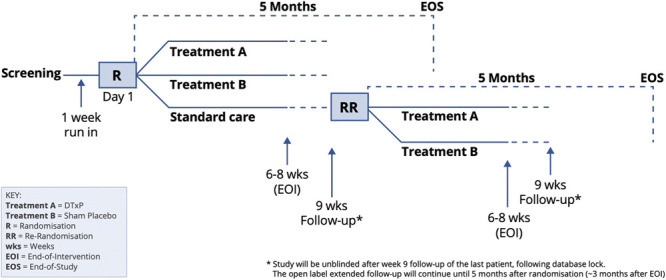
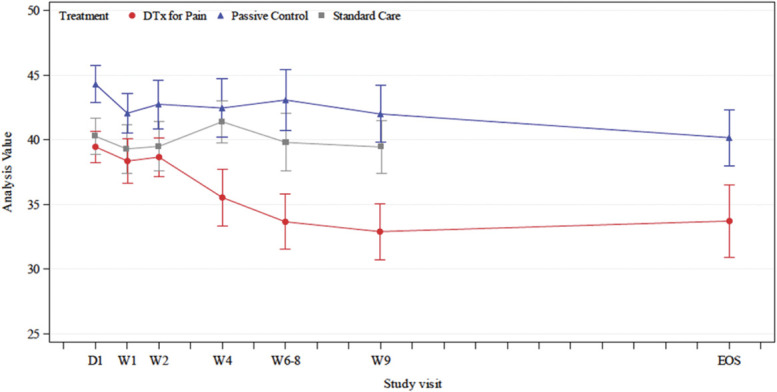
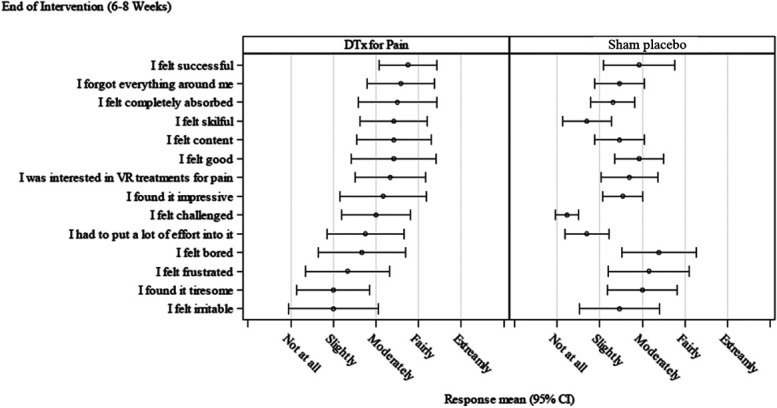
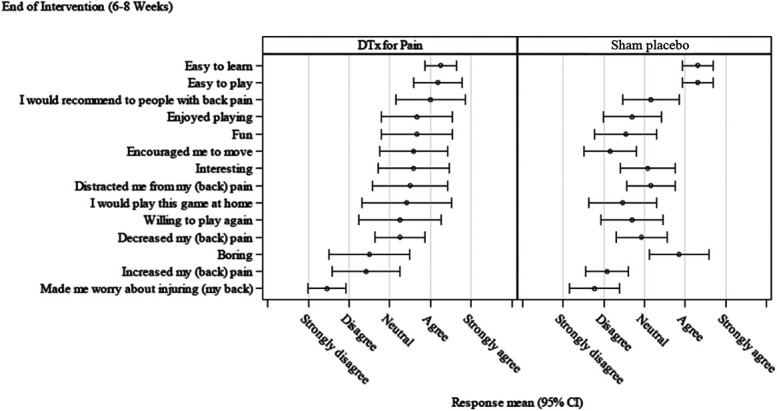
Adults with chronic low back pain, disability, moderate-to-severe pain, and high fear of movement and reinjury were recruited into a trial of a novel, automated, digital therapeutics, virtual reality, psychological intervention for pain (DTxP). We conducted a 3-arm, prospective, double-blind, pilot, randomized, controlled trial comparing DTxP with a sham placebo comparator and an open-label standard care. Participants were enrolled for 6 to 8 weeks, after which, the standard care control arm were rerandomized to receive either the DTxP or sham placebo. Forty-two participants completed assessments at baseline, immediately posttreatment (6-8 weeks), 9-week, and 5-month follow-up. We found that participants in the DTxP group reported greater reductions in fear of movement and better global impression of change when compared with sham placebo and standard care post treatment. No other group differences were noted at posttreatment or follow-up. When compared with baseline, participants in the DTxP group reported lower disability at 5-month follow-up, lower pain interference and fear of movement post treatment and follow-up, and lower pain intensity at posttreatment. The sham placebo group also reported lower disability and fear of movement at 5-month follow-up compared with baseline. Standard care did not report any significant changes. There were a number of adverse events, with one participant reporting a serious adverse event in the sham placebo, which was not related to treatment. No substantial changes in medications were noted, and participants in the DTxP group reported positive gaming experiences.
Overview
The claims and statistics of this paper haven’t been checked yet.
Free: it reads the open-access text and checks the first 5 claims that cite a source we can check. Create a free account to check every claim.
Integrity signals
Registry
Cites
Statistics
Figures
Verification
Claims the paper makes
The claims and statistics of this paper haven’t been checked yet.
Free: it reads the open-access text and checks the first 5 claims that cite a source we can check. Create a free account to check every claim.
Self-check
Percentages, sums and reported differences re-computed from the paper’s own numbers.
The self-check needs the paper’s full text.
Citations
Cites
Hao (2015) · doi:10.1002/14651858 · Cited by 11,321
Hoffmann, T. C., Glasziou, P. P., Boutron, I., Milne, R., Perera, R., Moher, D., Altman, D. G., Barbour, V., Macdonald, H., Johnston, M., et al. (2014) · BMJ · doi:10.1136/bmj.g1687 · Cited by 10,548
Development and preliminary testing of the new five-level version of EQ-5D (EQ-5D-5L)
Herdman, M., Gudex, C., Lloyd, A., Janssen, M., Kind, P., Parkin, D., Bonsel, G., & Badia, X. (2011) · Quality of Life Research · doi:10.1007/s11136-011-9903-x · Cited by 9,795
Fairbank, J. C. T., & Pynsent, P. B. (2000) · Spine · doi:10.1097/00007632-200011150-00017 · Cited by 5,851
Skivington, K., Matthews, L., Simpson, S. A., Craig, P., Baird, J., Blazeby, J. M., Boyd, K. A., Craig, N., French, D. P., McIntosh, E., et al. (2021) · BMJ · doi:10.1136/bmj.n2061 · Cited by 5,808 · cited 1×
“The inclusion criteria were (1) adults $18 years of age; (2) reported low back pain for at least 3 months, with average pain intensity of $4/10 over the past week on a 0 to 10 numeric rating scale, Oswestry Disability Index (ODI) of $26%, and medium (34-41) or high (42-68) TampaScale of Kinesiophobia (TSK) score; (3)…”
BackgroundPsychological therapies for the management of chronic pain (excluding headache) in adults
Williams, A. C. D. C., Eccleston, C., & Morley, S. (2012) · Cochrane Database of Systematic Reviews · doi:10.1002/14651858.cd007407.pub3 · Cited by 1,634 · cited 1×
“The inclusion criteria were (1) adults $18 years of age; (2) reported low back pain for at least 3 months, with average pain intensity of $4/10 over the past week on a 0 to 10 numeric rating scale, Oswestry Disability Index (ODI) of $26%, and medium (34-41) or high (42-68) TampaScale of Kinesiophobia (TSK) score; (3)…”
BackgroundSelf-citationJanssen, M. F., Pickard, A. S., Golicki, D., Gudex, C., Niewada, M., Scalone, L., Swinburn, P., & Busschbach, J. (2013) · Quality of Life Research · doi:10.1007/s11136-012-0322-4 · Cited by 1,582
Development of a PROMIS item bank to measure pain interference
Amtmann, D., Cook, K. F., Jensen, M. P., Chen, W.-H., Choi, S., Revicki, D., Cella, D., Rothrock, N., Keefe, F., Callahan, L., et al. (2010) · Pain · doi:10.1016/j.pain.2010.04.025 · Cited by 1,199 · cited 6×
“(1) Adverse events were defined as any untoward medical occurrence, unintended disease or injury, or any untoward clinical signs, whether or not related to the investigational medical device.”
BackgroundMethodInfluentialFear-Avoidance Model of Chronic Pain: The Next Generation
Crombez, G., Eccleston, C., Van Damme, S., Vlaeyen, J. W. S., & Karoly, P. (2012) · The Clinical Journal of Pain · doi:10.1097/ajp.0b013e3182385392 · Cited by 960
Self-citationPsychometric properties of the TSK-11: A shortened version of the Tampa Scale for Kinesiophobia
Woby, S. R., Roach, N. K., Urmston, M., & Watson, P. J. (2005) · Pain · doi:10.1016/j.pain.2005.05.029 · Cited by 923 · cited 1×
“The inclusion criteria were (1) adults $18 years of age; (2) reported low back pain for at least 3 months, with average pain intensity of $4/10 over the past week on a 0 to 10 numeric rating scale, Oswestry Disability Index (ODI) of $26%, and medium (34-41) or high (42-68) TampaScale of Kinesiophobia (TSK) score; (3)…”
BackgroundThe Tampa Scale: a Measure of Kinisophobia
Miller, R. P., Kori, S. H., & Todd, D. D. (1991) · The Clinical Journal of Pain · doi:10.1097/00002508-199103000-00053 · Cited by 659 · cited 1×
“The inclusion criteria were (1) adults $18 years of age; (2) reported low back pain for at least 3 months, with average pain intensity of $4/10 over the past week on a 0 to 10 numeric rating scale, Oswestry Disability Index (ODI) of $26%, and medium (34-41) or high (42-68) TampaScale of Kinesiophobia (TSK) score; (3)…”
BackgroundPsychological therapies for the management of chronic pain (excluding headache) in adults
Williams, A. C. D. C., Fisher, E., Hearn, L., & Eccleston, C. (2020) · Cochrane Database of Systematic Reviews · doi:10.1002/14651858.cd007407.pub4 · Cited by 605
Self-citationSmall study effects in meta-analyses of osteoarthritis trials: meta-epidemiological study
Nuesch, E., Trelle, S., Reichenbach, S., Rutjes, A. W. S., Tschannen, B., Altman, D. G., Egger, M., & Juni, P. (2010) · BMJ · doi:10.1136/bmj.c3515 · Cited by 559 · cited 1×
“The inclusion criteria were (1) adults $18 years of age; (2) reported low back pain for at least 3 months, with average pain intensity of $4/10 over the past week on a 0 to 10 numeric rating scale, Oswestry Disability Index (ODI) of $26%, and medium (34-41) or high (42-68) TampaScale of Kinesiophobia (TSK) score; (3)…”
BackgroundEccleston, C., Blyth, F. M., Dear, B. F., Fisher, E. A., Keefe, F. J., Lynch, M. E., Palermo, T. M., Reid, M. C., & Williams, A. C. D. C. (2020) · Pain · doi:10.1097/j.pain.0000000000001885 · Cited by 480
Self-citationVlaeyen, J. W. S., de Jong, J., Geilen, M., Heuts, P. H. T. G., & van Breukelen, G. (2001) · Behaviour Research and Therapy · doi:10.1016/s0005-7967(99)00174-6 · Cited by 469 · cited 1×
“The inclusion criteria were (1) adults $18 years of age; (2) reported low back pain for at least 3 months, with average pain intensity of $4/10 over the past week on a 0 to 10 numeric rating scale, Oswestry Disability Index (ODI) of $26%, and medium (34-41) or high (42-68) TampaScale of Kinesiophobia (TSK) score; (3)…”
BackgroundBirckhead, B., Khalil, C., Liu, X., Conovitz, S., Rizzo, A., Danovitch, I., Bullock, K., & Spiegel, B. (2019) · JMIR Mental Health · doi:10.2196/11973 · Cited by 372 · cited 2×
“Several exclusion criteria were applied, including (1) a history of epilepsy, migraine, vertigo, or psychosis; (2) a confirmed diagnosis of cancer; (3) susceptibility tomotion sickness requiring treatment; (4) pregnancy; (5) current physiotherapy that contraindicated the goals of the DTxP; (6) severe or acute structur…”
BackgroundMethodWhen pain gets stuck: the evolution of pain chronification and treatment resistance
Borsook, D., Youssef, A. M., Simons, L., Elman, I., & Eccleston, C. (2018) · Pain · doi:10.1097/j.pain.0000000000001401 · Cited by 281 · cited 2×
“Several exclusion criteria were applied, including (1) a history of epilepsy, migraine, vertigo, or psychosis; (2) a confirmed diagnosis of cancer; (3) susceptibility tomotion sickness requiring treatment; (4) pregnancy; (5) current physiotherapy that contraindicated the goals of the DTxP; (6) severe or acute structur…”
BackgroundMethodSelf-citationSpiegel, B., Fuller, G., Lopez, M., Dupuy, T., Noah, B., Howard, A., Albert, M., Tashjian, V., Lam, R., Ahn, J., et al. (2019) · PLOS ONE · doi:10.1371/journal.pone.0219115 · Cited by 233
Garcia, L. M., Birckhead, B. J., Krishnamurthy, P., Sackman, J., Mackey, I. G., Louis, R. G., Salmasi, V., Maddox, T., & Darnall, B. D. (2021) · Journal of Medical Internet Research · doi:10.2196/26292 · Cited by 218
Virtual reality for persistent pain: A new direction for behavioral pain management
Keefe, F. J., Huling, D. A., Coggins, M. J., Keefe, D. F., Rosenthal, Z. M., Herr, N. R., & Hoffman, H. G. (2012) · Pain · doi:10.1016/j.pain.2012.05.030 · Cited by 177 · cited 1×
“The inclusion criteria were (1) adults $18 years of age; (2) reported low back pain for at least 3 months, with average pain intensity of $4/10 over the past week on a 0 to 10 numeric rating scale, Oswestry Disability Index (ODI) of $26%, and medium (34-41) or high (42-68) TampaScale of Kinesiophobia (TSK) score; (3)…”
BackgroundVirtual reality approaches to pain: toward a state of the science
Trost, Z., France, C., Anam, M., & Shum, C. (2021) · Pain · doi:10.1097/j.pain.0000000000002060 · Cited by 173 · cited 1×
“The inclusion criteria were (1) adults $18 years of age; (2) reported low back pain for at least 3 months, with average pain intensity of $4/10 over the past week on a 0 to 10 numeric rating scale, Oswestry Disability Index (ODI) of $26%, and medium (34-41) or high (42-68) TampaScale of Kinesiophobia (TSK) score; (3)…”
BackgroundFisher, E., Law, E., Dudeney, J., Eccleston, C., & Palermo, T. M. (2019) · Cochrane Database of Systematic Reviews · doi:10.1002/14651858.cd011118.pub3 · Cited by 164
Self-citationDarnall, B. D., Krishnamurthy, P., Tsuei, J., & Minor, J. D. (2020) · JMIR Formative Research · doi:10.2196/17293 · Cited by 150
Characteristics and challenges of the clinical pipeline of digital therapeutics
Patel, N. A., & Butte, A. J. (2020) · npj Digital Medicine · doi:10.1038/s41746-020-00370-8 · Cited by 143 · cited 1×
“The inclusion criteria were (1) adults $18 years of age; (2) reported low back pain for at least 3 months, with average pain intensity of $4/10 over the past week on a 0 to 10 numeric rating scale, Oswestry Disability Index (ODI) of $26%, and medium (34-41) or high (42-68) TampaScale of Kinesiophobia (TSK) score; (3)…”
BackgroundNorming of the Tampa Scale for Kinesiophobia across pain diagnoses and various countries
Roelofs, J., van Breukelen, G., Sluiter, J., Frings-Dresen, M. H. W., Goossens, M., Thibault, P., Boersma, K., & Vlaeyen, J. W. S. (2011) · Pain · doi:10.1016/j.pain.2011.01.028 · Cited by 136 · cited 1×
“The inclusion criteria were (1) adults $18 years of age; (2) reported low back pain for at least 3 months, with average pain intensity of $4/10 over the past week on a 0 to 10 numeric rating scale, Oswestry Disability Index (ODI) of $26%, and medium (34-41) or high (42-68) TampaScale of Kinesiophobia (TSK) score; (3)…”
BackgroundTherapist and client emotional expression and psychotherapy outcomes: A meta-analysis.
Peluso, P. R., & Freund, R. R. (2018) · Psychotherapy · doi:10.1037/pst0000165 · Cited by 126 · cited 1×
“The inclusion criteria were (1) adults $18 years of age; (2) reported low back pain for at least 3 months, with average pain intensity of $4/10 over the past week on a 0 to 10 numeric rating scale, Oswestry Disability Index (ODI) of $26%, and medium (34-41) or high (42-68) TampaScale of Kinesiophobia (TSK) score; (3)…”
BackgroundTejera, D., Beltran-Alacreu, H., Cano-de-la-Cuerda, R., Leon Hernández, J. V., Martín-Pintado-Zugasti, A., Calvo-Lobo, C., Gil-Martínez, A., & Fernández-Carnero, J. (2020) · International Journal of Environmental Research and Public Health · doi:10.3390/ijerph17165950 · Cited by 121 · cited 1×
“The inclusion criteria were (1) adults $18 years of age; (2) reported low back pain for at least 3 months, with average pain intensity of $4/10 over the past week on a 0 to 10 numeric rating scale, Oswestry Disability Index (ODI) of $26%, and medium (34-41) or high (42-68) TampaScale of Kinesiophobia (TSK) score; (3)…”
BackgroundLeake, H. B., Moseley, G. L., Stanton, T. R., O’Hagan, E. T., & Heathcote, L. C. (2021) · Pain · doi:10.1097/j.pain.0000000000002244 · Cited by 116
van Hooff, M. L., Mannion, A. F., Staub, L. P., Ostelo, R. W. J. G., & Fairbank, J. C. T. (2016) · The Spine Journal · doi:10.1016/j.spinee.2016.06.010 · Cited by 112 · cited 1×
“The inclusion criteria were (1) adults $18 years of age; (2) reported low back pain for at least 3 months, with average pain intensity of $4/10 over the past week on a 0 to 10 numeric rating scale, Oswestry Disability Index (ODI) of $26%, and medium (34-41) or high (42-68) TampaScale of Kinesiophobia (TSK) score; (3)…”
BackgroundQuantifying the association between psychotherapy content and clinical outcomes using deep learning
Ewbank, M. P., Cummins, R., Tablan, V., Bateup, S., Catarino, A., Martin, A. J., & Blackwell, A. D. (2020) · JAMA Psychiatry · doi:10.1001/jamapsychiatry.2019.2664 · Cited by 108
Thomas, J. S., France, C. R., Applegate, M. E., Leitkam, S. T., & Walkowski, S. (2016) · The Journal of Pain · doi:10.1016/j.jpain.2016.08.011 · Cited by 107 · cited 1×
“The inclusion criteria were (1) adults $18 years of age; (2) reported low back pain for at least 3 months, with average pain intensity of $4/10 over the past week on a 0 to 10 numeric rating scale, Oswestry Disability Index (ODI) of $26%, and medium (34-41) or high (42-68) TampaScale of Kinesiophobia (TSK) score; (3)…”
BackgroundReliability and Validity Study of the Finnish Version 2.0 of the Oswestry Disability Index
Pekkanen, L. T., Kautiainen, H., YLINEN, J. J., Salo, P. K., & HÄKKINEN, A. H. (2010) · Spine · doi:10.1097/brs.0b013e3181cdd702 · Cited by 103
Fisher, E., Villanueva, G., Henschke, N., Nevitt, S. J., Zempsky, W., Probyn, K., Buckley, B., Cooper, T. E., Sethna, N., & Eccleston, C. (2022) · Pain · doi:10.1097/j.pain.0000000000002297 · Cited by 94
Self-citationEmbodiment in online psychotherapy: A qualitative study
García, E., Paolo, E. A. D., & Jaegher, H. D. (2021) · Psychology and Psychotherapy Theory Research and Practice · doi:10.1111/papt.12359 · Cited by 93
Ridout, B., Kelson, J. N., Campbell, A., & Steinbeck, K. S. (2021) · Journal of Medical Internet Research · doi:10.2196/24967 · Cited by 90 · cited 1×
“The inclusion criteria were (1) adults $18 years of age; (2) reported low back pain for at least 3 months, with average pain intensity of $4/10 over the past week on a 0 to 10 numeric rating scale, Oswestry Disability Index (ODI) of $26%, and medium (34-41) or high (42-68) TampaScale of Kinesiophobia (TSK) score; (3)…”
BackgroundGlombiewski, J. A., Holzapfel, S., Riecke, J., Vlaeyen, J. W. S., de Jong, J., Lemmer, G., & Rief, W. (2018) · Journal of Consulting and Clinical Psychology · doi:10.1037/ccp0000298 · Cited by 81
Virtual reality and chronic low back pain
Tack, C. (2021) · Disability and Rehabilitation: Assistive Technology · doi:10.1080/17483107.2019.1688399 · Cited by 80 · cited 1×
“The inclusion criteria were (1) adults $18 years of age; (2) reported low back pain for at least 3 months, with average pain intensity of $4/10 over the past week on a 0 to 10 numeric rating scale, Oswestry Disability Index (ODI) of $26%, and medium (34-41) or high (42-68) TampaScale of Kinesiophobia (TSK) score; (3)…”
BackgroundBank, P. J. M., Cidota, M. A., Ouwehand, P. W., & Lukosch, S. G. (2018) · Journal of Medical Systems · doi:10.1007/s10916-018-1100-9 · Cited by 75 · cited 6×
“Several exclusion criteria were applied, including (1) a history of epilepsy, migraine, vertigo, or psychosis; (2) a confirmed diagnosis of cancer; (3) susceptibility tomotion sickness requiring treatment; (4) pregnancy; (5) current physiotherapy that contraindicated the goals of the DTxP; (6) severe or acute structur…”
BackgroundMethodInfluentialCochrane, K. A., Loke, L., Leete, M., Campbell, A., & Ahmadpour, N. (2021) · International Conference on Tangible, Embedded, and Embodied Interaction (TEI) · doi:10.1145/3430524.3440637 · Cited by 70
The emerging world of digital therapeutics
Makin, S. J. (2019) · Nature · doi:10.1038/d41586-019-02873-1 · Cited by 67 · cited 1×
“The inclusion criteria were (1) adults $18 years of age; (2) reported low back pain for at least 3 months, with average pain intensity of $4/10 over the past week on a 0 to 10 numeric rating scale, Oswestry Disability Index (ODI) of $26%, and medium (34-41) or high (42-68) TampaScale of Kinesiophobia (TSK) score; (3)…”
BackgroundRobinson, N., Connolly, J., Hides, L. M., & Kavanagh, D. J. (2020) · Internet Interventions · doi:10.1016/j.invent.2020.100320 · Cited by 67
Hoffman, H. G. (2021) · Scientific Reports · doi:10.1038/s41598-021-89526-4 · Cited by 66
Embodied pain—negotiating the boundaries of possible action
Tabor, A., Keogh, E., & Eccleston, C. (2017) · Pain · doi:10.1097/j.pain.0000000000000875 · Cited by 65 · cited 1×
“The inclusion criteria were (1) adults $18 years of age; (2) reported low back pain for at least 3 months, with average pain intensity of $4/10 over the past week on a 0 to 10 numeric rating scale, Oswestry Disability Index (ODI) of $26%, and medium (34-41) or high (42-68) TampaScale of Kinesiophobia (TSK) score; (3)…”
BackgroundSelf-citationSteiner, B., Elgert, L., Saalfeld, B., & Wolf, K.-H. (2020) · JMIR Serious Games · doi:10.2196/19914 · Cited by 62 · cited 1×
“The inclusion criteria were (1) adults $18 years of age; (2) reported low back pain for at least 3 months, with average pain intensity of $4/10 over the past week on a 0 to 10 numeric rating scale, Oswestry Disability Index (ODI) of $26%, and medium (34-41) or high (42-68) TampaScale of Kinesiophobia (TSK) score; (3)…”
BackgroundVirtual Reality in Pain Rehabilitation for Youth With Chronic Pain: Pilot Feasibility Study
Griffin, A. T., Wilson, L., Feinstein, A. B., Bortz, A., Heirich, M. S., Gilkerson, R., Wagner, J. F., Menendez, M., Caruso, T. J., Rodríguez, S., et al. (2020) · JMIR Rehabilitation and Assistive Technologies · doi:10.2196/22620 · Cited by 62
Chronic pain as embodied defence: implications for current and future psychological treatments
Eccleston, C. (2018) · Pain · doi:10.1097/j.pain.0000000000001286 · Cited by 48
Self-citationRosser, B. A., Fisher, E., Janjua, S., Eccleston, C., Keogh, E., & Duggan, G. B. (2023) · Cochrane Database of Systematic Reviews · doi:10.1002/14651858.cd013863.pub2 · Cited by 45
Self-citationLogan, D. E., Simons, L. E., Caruso, T. J., Gold, J. I., Greenleaf, W., Griffin, A. T., King, C. D., Menendez, M., Olbrecht, V. A., Rodríguez, S., et al. (2021) · Journal of Medical Internet Research · doi:10.2196/25916 · Cited by 44 · cited 1×
“The inclusion criteria were (1) adults $18 years of age; (2) reported low back pain for at least 3 months, with average pain intensity of $4/10 over the past week on a 0 to 10 numeric rating scale, Oswestry Disability Index (ODI) of $26%, and medium (34-41) or high (42-68) TampaScale of Kinesiophobia (TSK) score; (3)…”
BackgroundMa, L., Mor, S., Anderson, P. L., Baños, R. M., Botella, C., Bouchard, S., Cárdenas-López, G., Donker, T., Fernández-Álvarez, J., Lindner, P., et al. (2021) · Cognitive Behaviour Therapy · doi:10.1080/16506073.2021.1939410 · Cited by 44 · cited 1×
“The inclusion criteria were (1) adults $18 years of age; (2) reported low back pain for at least 3 months, with average pain intensity of $4/10 over the past week on a 0 to 10 numeric rating scale, Oswestry Disability Index (ODI) of $26%, and medium (34-41) or high (42-68) TampaScale of Kinesiophobia (TSK) score; (3)…”
BackgroundTabbaa, L., Ang, C. S., Siriaraya, P., She, W. J., & Prigerson, H. G. (2020) · International Journal of Human-Computer Interaction · doi:10.1080/10447318.2020.1848161 · Cited by 42 · cited 1×
“The inclusion criteria were (1) adults $18 years of age; (2) reported low back pain for at least 3 months, with average pain intensity of $4/10 over the past week on a 0 to 10 numeric rating scale, Oswestry Disability Index (ODI) of $26%, and medium (34-41) or high (42-68) TampaScale of Kinesiophobia (TSK) score; (3)…”
BackgroundIntrapersonal and interpersonal vocal affect dynamics during psychotherapy.
Paz, A., Rafaeli, E., Bar‐Kalifa, E., Gilboa‐Schechtman, E., Gannot, S., Laufer-Goldshtein, B., Narayanan, S. S., Keshet, J., & Atzil–Slonim, D. (2021) · Journal of Consulting and Clinical Psychology · doi:10.1037/ccp0000623 · Cited by 39 · cited 1×
“The inclusion criteria were (1) adults $18 years of age; (2) reported low back pain for at least 3 months, with average pain intensity of $4/10 over the past week on a 0 to 10 numeric rating scale, Oswestry Disability Index (ODI) of $26%, and medium (34-41) or high (42-68) TampaScale of Kinesiophobia (TSK) score; (3)…”
BackgroundBirckhead, B., Eberlein, S., Alvarez, G., Gale, R., Dupuy, T., Makaroff, K., Fuller, G., Liu, X., Yu, K.-S., Black, J. T., et al. (2021) · BMJ Open · doi:10.1136/bmjopen-2021-050545 · Cited by 39 · cited 5×
“Several exclusion criteria were applied, including (1) a history of epilepsy, migraine, vertigo, or psychosis; (2) a confirmed diagnosis of cancer; (3) susceptibility tomotion sickness requiring treatment; (4) pregnancy; (5) current physiotherapy that contraindicated the goals of the DTxP; (6) severe or acute structur…”
BackgroundMethodInfluentialFowler, C. A., Ballistrea, L. M., Mazzone, K. E., Martin, A. M., Kaplan, H., Kip, K. E., Ralston, K., Murphy, J. L., & Winkler, S. L. (2019) · JMIR Formative Research · doi:10.2196/11266 · Cited by 36
Koho, P., Aho, S., Kautiainen, H., Pohjolainen, T., & Hurri, H. (2014) · Physiotherapy · doi:10.1016/j.physio.2013.11.007 · Cited by 35 · cited 1×
“The inclusion criteria were (1) adults $18 years of age; (2) reported low back pain for at least 3 months, with average pain intensity of $4/10 over the past week on a 0 to 10 numeric rating scale, Oswestry Disability Index (ODI) of $26%, and medium (34-41) or high (42-68) TampaScale of Kinesiophobia (TSK) score; (3)…”
BackgroundRoxburgh, T., Li, A. C., Guénancia, C., Pernollet, P., Bouleti, C., Alos, B., Gras, M., Kerforne, T., Frasca, D., Gal, F. L., et al. (2021) · Journal of Medical Internet Research · doi:10.2196/26349 · Cited by 35 · cited 1×
“The inclusion criteria were (1) adults $18 years of age; (2) reported low back pain for at least 3 months, with average pain intensity of $4/10 over the past week on a 0 to 10 numeric rating scale, Oswestry Disability Index (ODI) of $26%, and medium (34-41) or high (42-68) TampaScale of Kinesiophobia (TSK) score; (3)…”
BackgroundFrance, C. R., & Thomas, J. S. (2018) · Contemporary Clinical Trials · doi:10.1016/j.cct.2018.05.001 · Cited by 32
Rantonen, J., Vehtari, A., Karppinen, J., Luoto, S., Viikari-Juntura, E., Hupli, M., Malmivaara, A., & Taimela, S. (2014) · Scandinavian Journal of Work, Environment & Health · doi:10.5271/sjweh.3398 · Cited by 29 · cited 1×
“The inclusion criteria were (1) adults $18 years of age; (2) reported low back pain for at least 3 months, with average pain intensity of $4/10 over the past week on a 0 to 10 numeric rating scale, Oswestry Disability Index (ODI) of $26%, and medium (34-41) or high (42-68) TampaScale of Kinesiophobia (TSK) score; (3)…”
BackgroundFowler, C. A., Ballistrea, L. M., Mazzone, K. E., Martin, A. M., Kaplan, H. M., Kip, K. E., Murphy, J. L., & Winkler, S. (2019) · Pilot and Feasibility Studies · doi:10.1186/s40814-019-0501-y · Cited by 28
Garcia, L. M., Darnall, B. D., Krishnamurthy, P., Mackey, I. G., Sackman, J., Louis, R. G., Maddox, T., & Birckhead, B. J. (2021) · JMIR Research Protocols · doi:10.2196/25291 · Cited by 28
Williams, A. C. D. C., Fisher, E., Hearn, L., & Eccleston, C. (2021) · Pain · doi:10.1097/j.pain.0000000000002273 · Cited by 25
Self-citationGeneralizability of harm and pain expectations after exposure in chronic low back pain patients
Riecke, J., Rief, W., Vlaeyen, J. W. S., & Glombiewski, J. A. (2020) · European Journal of Pain · doi:10.1002/ejp.1604 · Cited by 21 · cited 1×
“The inclusion criteria were (1) adults $18 years of age; (2) reported low back pain for at least 3 months, with average pain intensity of $4/10 over the past week on a 0 to 10 numeric rating scale, Oswestry Disability Index (ODI) of $26%, and medium (34-41) or high (42-68) TampaScale of Kinesiophobia (TSK) score; (3)…”
BackgroundAssessing Upper Extremity Motor Dysfunction Using an Augmented Reality Game
Cidota, M. A., Bank, P. J. M., Ouwehand, P. W., & Lukosch, S. G. (2017) · Proceedings - International Symposium on Mixed and Augmented Reality, ISMAR · doi:10.1109/ismar.2017.31 · Cited by 17 · cited 1×
“Several exclusion criteria were applied, including (1) a history of epilepsy, migraine, vertigo, or psychosis; (2) a confirmed diagnosis of cancer; (3) susceptibility tomotion sickness requiring treatment; (4) pregnancy; (5) current physiotherapy that contraindicated the goals of the DTxP; (6) severe or acute structur…”
MethodRosser, B. A., Fisher, E., Eccleston, C., Duggan, G. B., & Keogh, E. (2021) · Cochrane Database of Systematic Reviews · doi:10.1002/14651858.cd013863 · Cited by 11 · cited 1×
“The inclusion criteria were (1) adults $18 years of age; (2) reported low back pain for at least 3 months, with average pain intensity of $4/10 over the past week on a 0 to 10 numeric rating scale, Oswestry Disability Index (ODI) of $26%, and medium (34-41) or high (42-68) TampaScale of Kinesiophobia (TSK) score; (3)…”
BackgroundSelf-citation
Research works printed but not linked: 4
- 2. Baker DP, Fairbank J. The oswestry disability index revisited. In: Roland M, Jenner J, eds. Back pain: New Approaches to Rehabilitation and Education. Manchester: Manchester University Press, 1989; 174–86.
- 7. Chen WH, Revicki DA, Amtmann D, Jensen MP, Keefe FJ, Cella D. Development and analysis of PROMIS pain intensity scale. Qual Life Res 2012;20:18. Proceedings of the 18th Annual Conference of the International Society for Quality of Life Research.
- 10. Cristea IA, Sucala M, David D. Can you tell the difference? Comparing face-toface versus computer-based interventions. The “Eliza” effect in psychotherapy. J Cogn Behav Psychotherapies 2013;13:291–9.
- 13. Eccleston C. Embodied: The Psychology of Physical Sensation. Oxford: Oxford University Press, 2016.
Cited by
An update on non-pharmacological interventions for pain relief
Wang, Y., Aaron, R. V., Attal, N., & Colloca, L. (2025) · Cell Reports Medicine · doi:10.1016/j.xcrm.2025.101940 · Cited by 132
“Evidence suggests that XR treatment modalities can decrease pain-related symptoms with small to medium effect size (SMD = 0.45 138 ).”
InfluentialVirtual Reality in Acute and Chronic Pain Medicine: An Updated Review
Moreau, S., Thérond, A., Cerda, I. H., Studer, K., Pan, A., Tharpe, J., Crowther, J. E., Abd-Elsayed, A. A., Gilligan, C. J., Tolba, R., et al. (2024) · Current Pain and Headache Reports · doi:10.1007/s11916-024-01246-2 · Cited by 56
“These limitations have largely impeded a robust evaluation of the long-term effectiveness of VR in treating chronic pain specifically [83].”
Li, R., Li, Y., Kong, Y., Li, H., Hu, D., Fu, C., & Wei, Q. (2024) · Journal of Medical Internet Research · doi:10.2196/45406 · Cited by 48
“All studies had an RCT design: 7 used a 3-arm parallel-group design [21,50-55], and 1 used a 4-arm parallel-group design [56].”
Influential(2022) · doi:10.2196/preprints.45406 · Cited by 48
Vase, L., Wager, T. D., & Eccleston, C. (2025) · The Lancet · doi:10.1016/s0140-6736(25)00404-0 · Cited by 48
Self-citation
Metadata
- Authors
- Eccleston, C., Fisher, E., Liikkanen, S., Sarapohja, T., Stenfors, C., Jääskeläinen, S. K., Rice, A. S. C., Mattila, L., Blom, T., & Bratty, J. R.
- Affiliations
- Ghent University (BE)
- University of Oxford (GB)
- Orion Corporation (Finland) (FI)
- University of Turku (FI)
- Imperial College London (GB)
- Corresponding author
- Eccleston, Christopher
- ORCID
- Venue
- Pain
- Published
- 2022-03-25
- Volume
- 163
- Issue
- 9
- Pages
- 1700-1715
- ISSN
- 0304-3959 (ISSN-L)
- 1872-6623
- PMC
- PMC9393796
- OpenAlex
- W4221063753
- Semantic Scholar
- dbb502a67d67e3cef75e0e0153fb2581358c082e
- Cited by
- 64
- References
- 64
- Citations by year
- 2026: 15 · 2025: 19 · 2024: 21 · 2023: 7 · 2022: 2
- FWCI
- 7.33
- Type
- journal article
- Language
- en
- Open access
- hybrid
- doi.org
- Licence
- Locations
- Pain (publishedVersion, cc-by-nc-nd)
- PubMed Central (publishedVersion, cc-by-nc-nd)
- PubMed (publishedVersion)
- UTUPub (University of Turku) (submittedVersion, cc-by-nc-nd)
- Pure (University of Bath) (submittedVersion, cc-by-nc)
- Funders
- Imperial College London
- Turun Yliopisto
- Business Finland
- Topics
- Health Sciences › Health Professions › Physical Therapy, Sports Therapy and Rehabilitation › Musculoskeletal pain and rehabilitation
- Physical Sciences › Computer Science › Human-Computer Interaction › Virtual Reality Applications and Impacts
- Health Sciences › Medicine › Anesthesiology and Pain Medicine › Pain Management and Treatment
- Keywords
- chronic low back pain, virtual reality, digital therapeutics, kinesiophobia, fear of reinjury, pain-related disability, pain interference, pain management
- MeSH terms
- Virtual Reality, Adult, Humans, Pain Measurement, Prospective Studies, Low Back Pain, Virtual Reality Exposure Therapy
About these checks
Registry, retraction, Cites and statistics results are computed, not judged, with one exception: a printed reference that no index lists is read once by a model before it counts as a citation error. Claims are extracted by a model and kept only when their quote appears verbatim in the text; each cited source is then checked, with a model’s help, for whether it says what the claim relies on. Those verdicts can be wrong — read the claim’s quote and the cited source before relying on one.
Statistics and arithmetic are recomputed, not judged.
Confidence bands are shown only for fields calibrated on our annotated test set. None is calibrated yet, so no band is shown.
What counts as a claim ›How we measure confidence ›How we check this ›
Are you an author, or do you see a problem with this page? Request a review
Data sources
Bibliographic data: Semantic Scholar, OpenAlex, Crossref.
Contains information from the Semantic Scholar Academic Graph Datasets, made available under the ODC Attribution License (ODC-BY 1.0).
Semantic Scholar’s data is described in: Kinney, R., et al. (2023). The Semantic Scholar Open Data Platform. arXiv:2301.10140.
