

Productivity outcomes from chronic pain management interventions in the working age population; a systematic review
Open accessThe DOI matches its Crossref record; 56 of the 62 references it cites were found in a registry or an index; 26 of the 33 sources its claims cite were checked for support.
Abstract
Productivity loss because of chronic pain in the working age population is a widespread concern internationally. Interventions for chronic pain in working age adults might be expected to achieve enhanced productivity in terms of reduced costs of workers' compensation insurance, reduced disability support, and improved rates of return to work for injured workers. This would require the use of measures of productivity in the evaluation of chronic pain management interventions. The aim of this review was to identify and interpret the productivity outcomes of randomised controlled trials reported by studies that conducted economic evaluations (eg, cost-effectiveness and cost-utility) of chronic pain management interventions in the working age population published from database inception to March 2023. Econlit, Embase, and Pubmed electronic databases were searched, yielding 12 studies that met the selection criteria. All 12 studies used absenteeism to measure productivity, translating return to work measures into indirect costs. Only one study included return to work as a primary outcome. Ten studies found no statistically significant improvements in productivity-related costs. Despite evidence for reduced pain-related disability after pain management interventions, this review suggests that the use of measures for assessing productivity gains is lacking. Including such measures would greatly assist administrators and payers when considering the broader societal benefits of such interventions. © 2024 Lippincott Williams and Wilkins. All rights reserved.
Overview
CoChat Summary
TL;DR
This systematic review of economic evaluations alongside RCTs found 12 eligible studies of chronic pain interventions in working-age adults, and all 12 measured productivity via absenteeism rather than return to work as a primary outcome. Most studies found no statistically significant productivity benefit, suggesting productivity gains are rarely captured in current evaluations.
Key findings
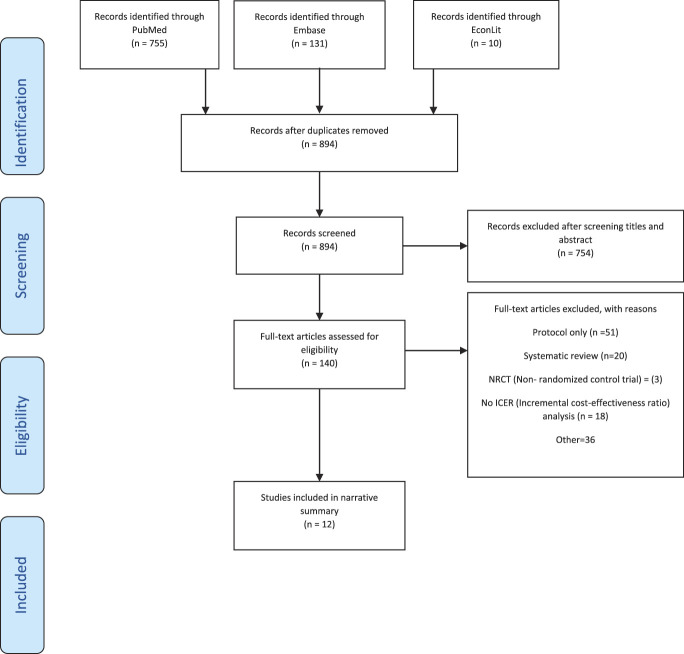
- The search identified 896 studies; after 2 duplicates were removed, 894 titles/abstracts were screened, 140 full texts were assessed, and 12 RCTs were included in the narrative synthesis.
- All 12 studies used absenteeism from paid work to measure productivity loss; only 1 study used return to work as a primary outcome.
- In the 7 studies comparing intervention vs usual care, 6 reported no statistically significant differences in productivity loss; 1 study (Lambeek et al.) reported significantly lower productivity loss with integrated care (P = 0.002).
- In the 5 studies comparing 2 or more interventions, only 1 study (Kemani et al.) found a marginally significant reduction in work cutback at 3 months (P = 0.046), but this was not maintained at 6 months; the others found no significant differences.
Methods
- Systematic review conducted according to PRISMA guidelines; protocol had been published previously.
- Searched Econlit, Embase, and PubMed from inception to March 2023 for English-language economic evaluations (cost-effectiveness/cost-utility) arising from RCTs in working-age adults (18–65 years) with musculoskeletal and/or neuropathic pain.
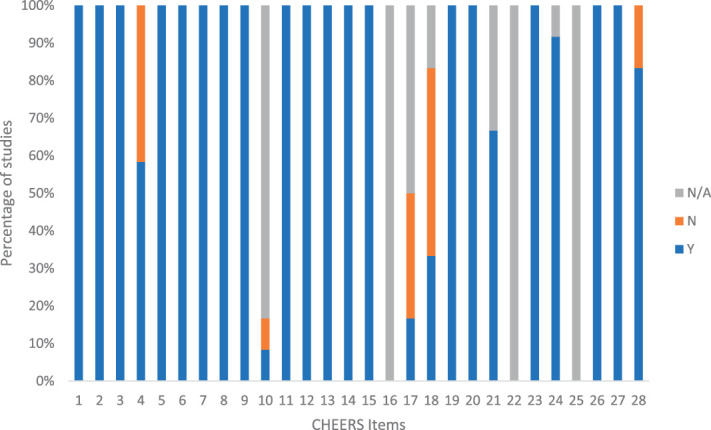
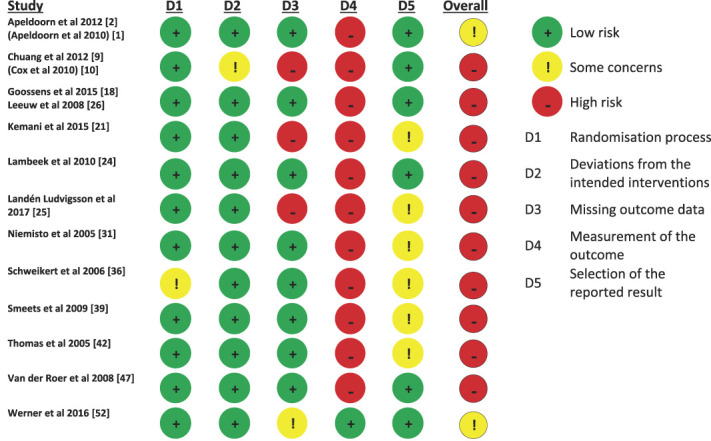
- Primary synthesis was narrative, with productivity outcomes grouped by intervention vs usual care and intervention vs other intervention; study quality was assessed with CHEERS 2022 and Cochrane risk of bias tools.
Limitations
- The paper states that methods of usual care and interventions varied widely, which limited generalisability of the outcomes.
- The authors note that most studies lacked power to detect productivity cost differences, so null findings may reflect sample-size limitations rather than absence of effect.
- Evident from the text: productivity was usually measured as absenteeism/indirect costs, with return to work rarely a primary outcome and presenteeism not incorporated, so the review likely undercaptures broader productivity effects.
Model-written summary. Check it against the paper before relying on it.
Integrity signals
Registry
Cites
Statistics
Figures
Verification
Claims the paper makes
5 Valid · 16 Not valid · 4 Not checked · 20 Own results and interpretations
The cited sources that could be checked couldn’t confirm or dispute this claim.
In the paper
“Cost-effectiveness of the intervention of interest was established in 6 studies.9,18,24,25,31,36”
§ Productivity outcomes from chronic pain management interventions in the working age population; a systematic review > 3. Results > 3.2. Characteristics of studies included
What the sources say
- Could not verifycites [9] Chuang LH Soares MO Tilbrook H Cox H Hewitt CE Aplin J Semlyen A Trewhela A Watt I Torgerson DJ. A pragmatic multicentered randomized controlled trial of yoga for chronic low back pain: economic evaluation. Spine 2012; 37: 1593– 601. 22433499 sourceExperimental — accuracy not yet measured
The Discussion (page not available in our copy) describes a survey of chronic-pain prevalence and states that no treatment information was available. Searches for the cost-effectiveness claim and for economic evaluations found no passage about an intervention being cost-effective in six studies. (LLM, conf=0.77)
- Not checked — no full text of the sourcecites [18] Goossens ME de Kinderen RJ Leeuw M de Jong JR Ruijgrok J Evers SM Vlaeyen JW. Is exposure in vivo cost-effective for chronic low back pain? A trial-based economic evaluation. BMC Health Serv Res 2015; 15: 549. 26651828 PMC4677446 source
- Could not verifycites [24] Lambeek LC Bosmans JE Van Royen BJ Van Tulder MW Van Mechelen W Anema JR. Effect of integrated care for sick listed patients with chronic low back pain: economic evaluation alongside a randomised controlled trial. BMJ 2010; 341: c6414. 21118874 PMC2995018 sourceExperimental — accuracy not yet measured
The Results and Table 7 report how many articles the PICO, PICOS, and SPIDER searches identified; the figure of six refers to articles found by a PICOS search in MEDLINE, not studies establishing cost-effectiveness. Searches for the quoted claim and for economic evaluation found no passage addressing the intervention’s cost-effectiveness. (LLM, conf=0.76)
- Asserted: passes — The authors put it forward as true.
- Checkable: passes — It can be checked against evidence.
- Load-bearing: unclear — It is unclear whether the paper’s conclusions depend on it.
- Based: unclear — It is unclear why the paper says it holds.
- Could not verify
The cited sources that could be checked couldn’t confirm or dispute this claim.
In the paper
“Only one study included return to work as a primary outcome.”
- Also stated in: § 3.2. Characteristics of studies included · plain
“The study of Lambeek et al.24 was the only one to capture productivity gain by including return to work as their primary outcome.”
- Also stated in: § 4. Discussion · plain
“No other included studies had assessed return to work as a primary outcome”
§ Productivity outcomes from chronic pain management interventions in the working age population; a systematic review > Abstract Productivity loss because of chronic pain in the working age population is a widespread concern internationally. Interventions for chronic pain in working age adults might be expected to achieve enhanced productivity in terms of reduced costs of workers' compensation insurance, reduced disability support, and improved rates of return to work for injured workers. This would require the use of measures of productivity in the evaluation of chronic pain management interventions. The aim of this review was to identify and interpret the productivity outcomes of randomised controlled trials reported by studies that conducted economic evaluations (eg, cost-effectiveness and cost-utility) of chronic pain management interventions in the working age population published from database inception to March 2023. Econlit, Embase, and Pubmed electronic databases were searched, yielding 12 studies that met the selection criteria. All 12 studies used absenteeism to measure productivity, translating return to work measures into indirect costs. Only one study included return to work as a primary outcome. Ten studies found no statistically significant improvements in productivity-related costs. Despite evidence for reduced pain-related disability after pain management interventions, this review suggests that the use of measures for assessing productivity gains is lacking. Including such measures would greatly assist administrators and payers when considering the broader societal benefits of such interventions.
What the sources say
- Could not verifycites [24] Lambeek LC Bosmans JE Van Royen BJ Van Tulder MW Van Mechelen W Anema JR. Effect of integrated care for sick listed patients with chronic low back pain: economic evaluation alongside a randomised controlled trial. BMJ 2010; 341: c6414. 21118874 PMC2995018 sourceExperimental — accuracy not yet measured
The Methods (Inclusion and exclusion criteria; page unavailable) describe a review of qualitative studies about healthcare experiences among people with multiple sclerosis, not studies of return-to-work outcomes. Searches of our copy for “return to work as a primary outcome” and “Lambeek return to work” found no passage addressing the claim. (LLM, conf=0.76)
plain- Asserted: passes — The authors put it forward as true.
- Checkable: passes — It can be checked against evidence.
- Load-bearing: passes — The paper’s conclusions depend on it.
- Based: passes — The paper gives a reason why it holds.
- Also stated in: § 3.2. Characteristics of studies included · plain
The cited sources that could be checked couldn’t confirm or dispute this claim.
In the paper
“Differences in productivity loss were not statistically significant in the other studies.18,25,31,39”
§ Productivity outcomes from chronic pain management interventions in the working age population; a systematic review > 3. Results > 3.7. Intervention vs other intervention
What the sources say
- Not checked — no full text of the sourcecites [18] Goossens ME de Kinderen RJ Leeuw M de Jong JR Ruijgrok J Evers SM Vlaeyen JW. Is exposure in vivo cost-effective for chronic low back pain? A trial-based economic evaluation. BMC Health Serv Res 2015; 15: 549. 26651828 PMC4677446 source
- Could not verifycites [25] Landén Ludvigsson M Peolsson A Peterson G Dedering Å Johansson G Bernfort L. Cost-effectiveness of neck-specific exercise with or without a behavioral approach versus physical activity prescription in the treatment of chronic whiplash-associated disorders: analyses of a randomized clinical trial. Medicine (Baltimore) 2017; 96: e7274. 28640136 PMC5484244 sourceExperimental — accuracy not yet measured
The Discussion addresses reporting standards and mentions cost-effectiveness reviews, but does not report productivity-loss results. Searches for productivity loss, work absence, and intervention comparisons found no passage about whether differences were statistically significant. The cited paper’s page number is unavailable in our copy. (LLM, conf=0.78)
- Could not verifycites [31] Niemistö L Rissanen P Sarna S Lahtinen-Suopanki T Lindgren KA Hurri H. Cost-effectiveness of combined manipulation, stabilizing exercises, and physician consultation compared to physician consultation alone for chronic low back pain: a prospective randomized trial with 2-year follow-up. Spine (Phila Pa 1976) 2005; 30: 1109– 15. 15897822 sourceExperimental — accuracy not yet measured
The Materials and methods and Results sections compare the wealth of people with different employment statuses, not productivity loss between interventions. Searches for intervention comparisons and productivity loss found no passage addressing the claimed nonsignificant differences; page numbers were unavailable in our copy. (LLM, conf=0.76)
plain- Asserted: passes — The authors put it forward as true.
- Checkable: passes — It can be checked against evidence.
- Load-bearing: unclear — It is unclear whether the paper’s conclusions depend on it.
- Based: passes — The paper gives a reason why it holds.
Every source the paper cites for this claim was checked and supports it.
In the paper
“All but 1 study2 used the HCA to calculate absenteeism from paid work”
§ Productivity outcomes from chronic pain management interventions in the working age population; a systematic review > 3. Results > 3.2. Characteristics of studies included
What the sources say
- Supportedcites [2] Apeldoorn AT Bosmans JE Ostelo RW de Vet HC van Tulder MW. Cost-effectiveness of a classification-based system for sub-acute and chronic low back pain. Eur Spine J 2012; 21: 1290– 300. 22258622 PMC3389120 source
The citation identifies this study as the exception. The Cost measures section says it used the friction cost method to estimate productivity losses from paid-work absenteeism; the Statistical analysis section says the human capital approach was used only in a sensitivity analysis. The paper does not establish what the other included studies used, but that is not the point attributed to this citation. (LLM, conf=0.91)
plain- Asserted: passes — The authors put it forward as true.
- Checkable: passes — It can be checked against evidence.
- Load-bearing: unclear — It is unclear whether the paper’s conclusions depend on it.
- Based: passes — The paper gives a reason why it holds.
- Supported
The cited sources that could be checked couldn’t confirm or dispute this claim.
In the paper
“Only the study by Lambeek et al. reported that productivity loss was significantly lower for the integrated care group compared with the UC group (P = 0.002).24”
§ Productivity outcomes from chronic pain management interventions in the working age population; a systematic review > 3. Results > 3.6. Intervention vs usual care
What the sources say
- Could not verifycites [24] Lambeek LC Bosmans JE Van Royen BJ Van Tulder MW Van Mechelen W Anema JR. Effect of integrated care for sick listed patients with chronic low back pain: economic evaluation alongside a randomised controlled trial. BMJ 2010; 341: c6414. 21118874 PMC2995018 sourceExperimental — accuracy not yet measured
The Methods (Search strategy) and Results (Proportion of relevant articles) passages concern search tools for qualitative studies of multiple sclerosis, not an integrated-care comparison. Searches for Lambeek, productivity loss, and the reported P value found no passage addressing the claim in our copy; page numbers were not available. (LLM, conf=0.77)
plainstates a cause- Asserted: passes — The authors put it forward as true.
- Checkable: passes — It can be checked against evidence.
- Load-bearing: unclear — It is unclear whether the paper’s conclusions depend on it.
- Based: passes — The paper gives a reason why it holds.
- Could not verify
14 more claims · 4 with their cited sources checked
Create a free account to see all 45 claims and every source verdict.
- Probably not a substantial claim. 16
- It may state two separate claims as one. 12
Citations
Cites
Preferred Reporting Items for Systematic Reviews and Meta-Analyses: the PRISMA statement
Moher, D., Liberati, A., Tetzlaff, J., Altman, D. G., & for the PRISMA Group (2009) · BMJ · doi:10.1136/bmj.b2535 · Cited by 83,823
Preferred Reporting Items for Systematic Reviews and Meta-Analyses: The PRISMA Statement
Moher, D., Liberati, A., Tetzlaff, J., Altman, D. G., & The PRISMA Group (2009) · PLoS Medicine · doi:10.1371/journal.pmed.1000097 · Cited by 64,042 · cited 1×
“28 The protocol for this study was published previously by these authors.”
Preferred reporting items for systematic reviews and meta-analyses: The PRISMA statement
Moher, D., Liberati, A., Tetzlaff, J., Altman, D. G., & the PRISMA Group* (2009) · Annals of Internal Medicine · doi:10.7326/0003-4819-151-4-200908180-00135 · Cited by 37,554
RoB 2: a revised tool for assessing risk of bias in randomised trials
Sterne, J. A. C., Savović, J., Page, M. J., Elbers, R. G., Blencowe, N. S., Boutron, I., Cates, C. J., Cheng, H.-Y., Corbett, M. S., Eldridge, S. M., et al. (2019) · BMJ · doi:10.1136/bmj.l4898 · Cited by 34,787
(1992) · PubMed · Cited by 33,716
The MOS 36-ltem Short-Form Health Survey (SF-36): I. Conceptual Framework and Item Selection
Ware, J. E., & Sherbourne, C. D. (1992) · Medical Care · doi:10.1097/00005650-199206000-00002 · Cited by 30,033
Wang, G., Ma, R., Qiao, G., Wada, K., Aizawa, Y., & Satoh, T. (2015) · Integrative Medicine International · doi:10.1159/000368408 · Cited by 18,657
WARE, J. E., KOSINSKI, M., & KELLER, S. D. (1996) · Medical Care · doi:10.1097/00005650-199603000-00003 · Cited by 17,392
James, S. L., Abate, D., Abate, K. H., Abay, S. M., Abbafati, C., Abbasi, N., Abbastabar, H., Abd-Allah, F., Abdela, J., Abdelalim, A., et al. (2018) · The Lancet · doi:10.1016/s0140-6736(18)32279-7 · Cited by 13,867
Fairbank, J. C. T., & Pynsent, P. B. (2000) · Spine · doi:10.1097/00007632-200011150-00017 · Cited by 5,851
Research works printed but not linked: 1
- Chowdhury AR Graham PL Schofield D Nicholas M. Productivity outcomes from chronic pain management interventions in the working age population; a systematic review protocol. 2021.Available at: https://www.crd.york.ac.uk/prospero/display_record.php?ID=CRD42021231028. Accessed February 24, 2022. PMC11090028 38323645
Cited by
Protein Adsorption and Cell Adhesion on Metallic Biomaterial Surfaces
Migita, S., & Sato, M. (2025) · Adhesives · doi:10.3390/adhesives1040015 · Cited by 19
“The chronic pain from these diseases can contribute to mental health problems, leading to reduced quality of life and work productivity [11].”
Deprescribing NSAIDs: The Potential Role of Community Pharmacists
Amedi, D., & Gazerani, P. (2024) · Pharmacy · doi:10.3390/pharmacy12040116 · Cited by 11
“It is more common in women and older individuals and poses significant challenges, including increased mortality risk, suicide, depression, anxiety, and decreased quality of life [18–23].”
BackgroundAssociation Between Temporomandibular Disorders and Irritable Bowel Syndrome: A Scoping Review
Saczuk, K., Roszuk, S., Wirkijowska, M., Fabisiak, A., Eyüboğlu, T. F., Özcan, M., & Łukomska−Szymańska, M. (2024) · Journal of Clinical Medicine · doi:10.3390/jcm13237326 · Cited by 6
Chronic Pain in Autism: A Systematic Review
Garriga‐Cazorla, H., Roman‐Juan, J., Martí, L., Solé, E., Martínez‐Leal, R., & Miró, J. (2025) · Clinical Journal of Pain · doi:10.1097/ajp.0000000000001296 · Cited by 7
Pedro, K. M., Alvi, M. A., Lozano, C. S., Karthikeyan, V., Wilson, J. R., Badhiwala, J. H., Anderson, D. F., Davies, B. M., Barbagallo, G., Harrop, J. S., et al. (2026) · Neurosurgery · doi:10.1227/neu.0000000000003999 · Cited by 2
THE POTENTIAL OF SUPERVISION IN RESTORING WORK CAPACITY IN INDIVIDUALS WITH CHRONIC BACK PAIN
Barone, L., Žilde, I., & Atstāja, D. (2025) · Environment Technology Resources Proceedings of the International Scientific and Practical Conference · doi:10.17770/etr2025vol1.8681
Chowdhury, A. R., SCHOFIELD, D. J., Shrestha, R. N., & Nicholas, M. K. (2025) · PAIN Reports · doi:10.1097/pr9.0000000000001306
Self-citationSomers, A., & Black, B. J. (2025) · Journal of Neural Engineering · doi:10.1088/1741-2552/ae0eef
Impact of third molars on quality of life in modern society
Альбертович, М. А. (2025) · Real-World Data & Evidence · doi:10.37489/2782-3784-myrwd-082
Nakaso, Y., Inoue, S., Makita, K., Arai, Y.-C. P., Shimo, K., Inoue, M., Wakabayashi, T., 宮川, 博., Iwamoto, K., Niwa, K., et al. (2025) · Pain Practice · doi:10.1111/papr.70102
Acute Pain Services: Clinical Impact, Cost Efficiency, and Hospital Value
DeLorenzo, J., Discepola, P. J., & Eloy, J. D. (2026) · Springer eBooks · doi:10.1007/978-3-032-18058-2_17
Pellow, K., Harrison, J., & Harper, B. (2026) · Scandinavian Journal of Pain · doi:10.1515/sjpain-2026-0018
“These estimates suggest total costs of pain ranging from $299 to $335 billion in the US [6, 7] and re fl ect more comprehensive models that capture the wider spectrum of costs associated with chronic pain.”
Rosenberg, S., Boyce, T. W., Walters, S. T., Barriga, L., Torres, J., Pankratz, V. S., Tawfik, B., Prabhakaran, S., Fine, S., Buro, A. W., et al. (2026) · International Journal of Environmental Research and Public Health · doi:10.3390/ijerph23081003
“Additionally, chronic pain can contribute to lost productivity, disability, and increased healthcare utilization [37].”
Metadata
- Authors
- Chowdhury, A. R., Graham, P. L., Schofield, D., Costa, D. S. J., & Nicholas, M.
- Affiliations
- The University of Sydney (AU)
- Macquarie University (AU)
- Corresponding author
- Chowdhury, Anonnya Rizwana
- ORCID
- Venue
- Pain
- Published
- 2024-02-06
- Volume
- 165
- Issue
- 6
- Pages
- 1233-1246
- ISSN
- 0304-3959 (ISSN-L)
- 1872-6623
- PMC
- PMC11090028
- OpenAlex
- W4391614712
- Semantic Scholar
- 4e11b546a74aea54b7f3ee9745173c75037a05da
- Cited by
- 15
- References
- 62
- Citations by year
- 2026: 5 · 2025: 7 · 2024: 3
- FWCI
- 0.94
- Type
- journal article
- Language
- en
- Open access
- hybrid
- doi.org
- Licence
- Locations
- Pain (publishedVersion, cc-by-nc-nd)
- PubMed Central (publishedVersion, cc-by-nc-nd)
- PubMed (publishedVersion)
- Topics
- Health Sciences › Health Professions › Physical Therapy, Sports Therapy and Rehabilitation › Musculoskeletal pain and rehabilitation
- Social Sciences › Economics, Econometrics and Finance › Economics and Econometrics › Health Systems, Economic Evaluations, Quality of Life
- Health Sciences › Health Professions › Physical Therapy, Sports Therapy and Rehabilitation › Medical Practices and Rehabilitation
- Keywords
- chronic pain, working-age adults, absenteeism, return to work, workers' compensation, disability services, cost-effectiveness, cost-utility analysis, interventional pain management, economic evaluation
- MeSH terms
- Absenteeism, Cost-Benefit Analysis, Efficiency, Humans, Chronic Pain, Pain Management, Return to Work
About these checks
Registry, retraction, Cites and statistics results are computed, not judged, with one exception: a printed reference that no index lists is read once by a model before it counts as a citation error. Claims are extracted by a model and kept only when their quote appears verbatim in the text; each cited source is then checked, with a model’s help, for whether it says what the claim relies on. Those verdicts can be wrong — read the claim’s quote and the cited source before relying on one.
The claim verdicts this report counts are experimental: their accuracy is not yet measured.
A language model drew the claims from the paper on 2026-10-11, under version 3 of the claim definition (model deepseek-v4.1-flash, prompt extract-v3).
A second model labelled each claim on 2026-10-11 (model jev-1.13-20260917, definition revision gold-guideline-v0.2).
Cited sources are checked with a language model’s help (gpt-6-sol).
Statistics and arithmetic are recomputed, not judged.
Confidence bands are shown only for fields calibrated on our annotated test set. None is calibrated yet, so no band is shown.
What counts as a claim ›How we measure confidence ›How we check this ›
Are you an author, or do you see a problem with this page? Request a review
Data sources
Bibliographic data: Semantic Scholar, OpenAlex, Crossref.
Contains information from the Semantic Scholar Academic Graph Datasets, made available under the ODC Attribution License (ODC-BY 1.0).
Semantic Scholar’s data is described in: Kinney, R., et al. (2023). The Semantic Scholar Open Data Platform. arXiv:2301.10140.
