

From Infancy to Adolescence: Fifteen Years of Continuous Treatment With Hydroxyurea in Sickle Cell Anemia
Open accessThe DOI matches its Crossref record, with a small difference in title or year; 20 of the 20 references it cites were found in a registry or an index.
Abstract
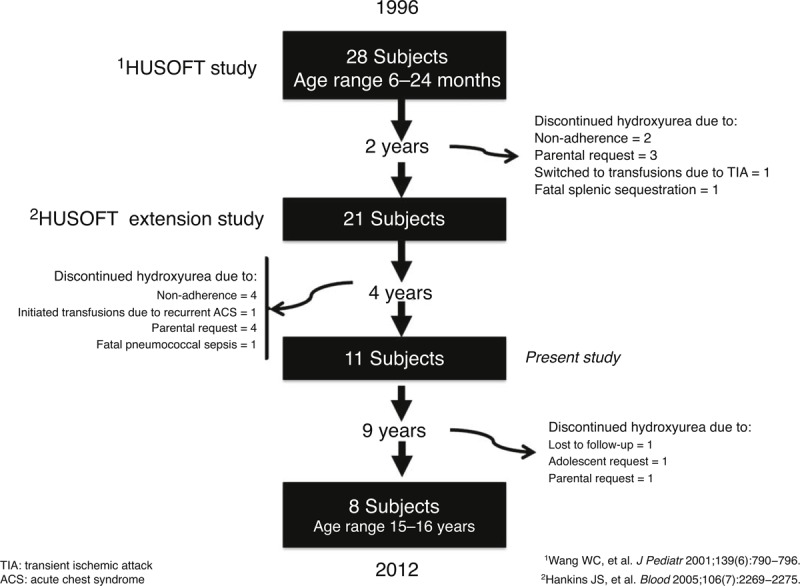
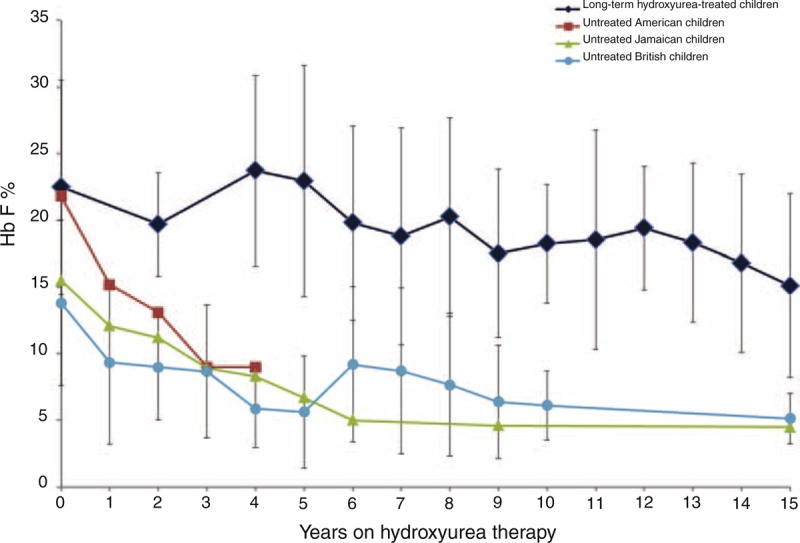
Despite documented laboratory and clinical benefits of hydroxyurea for children with sickle cell anemia (SCA), the drug's long-term safety and efficacy remains poorly defined. The HUSOFT trial and extension study examined feasibility, toxicity, and hematological efficacy of hydroxyurea in infants with SCA. This report describes HUSOFT participants who have continued hydroxyurea therapy for 15 years. With IRB approval, medical records were reviewed for clinical, laboratory, and growth parameters. Twenty-eight infants enrolled in the original 2-year HUSOFT study received open-label liquid hydroxyurea at 20 mg/kg/day; 17 completed the extension study with dose escalation to 30 mg/kg/day. Eight of these 17 (6 girls and 2 boys, all HbSS) have continued on daily hydroxyurea for at least 15 years (median age at last follow-up 17.6 years) without interruption. All hematologic indices (Hb concentration, mean corpuscular volume (MCV), fetal hemoglobin) showed sustained effect after 15 years. The median maximum tolerated dose of hydroxyurea has decreased from 30 to 26 mg/kg/day (range 19.5-31.2); neutropenia [absolute neutrophil count (ANC)<1.0×10⁹/L] prompting temporary drug discontinuation occurred a total of 10 times in 4 subjects and there was no severe neutropenia (ANC<0.5×10⁹/L). Growth rates over 15 years continued at the 50th percentile for both height and weight, and puberty occurred without delay (age range 10-14 years). There were 5.1 vaso-occlusive events (pain and acute chest syndrome)/100 patient years, 7.3 packed red blood cell transfusions/100 patient years. No malignancies, strokes, or deaths occurred. At last follow up, all subjects were at appropriate grade level (10-12 grade) with no history of repeated grades. A cohort of young teenagers with SCA who initiated treatment in infancy have had sustained and continued hematological benefits for a decade and a half. Growth and sexual development are normal and comparable to the general pediatric population. Continuous hydroxyurea therapy since infancy appears safe and efficacious in SCA.
Overview
The claims and statistics of this paper haven’t been checked yet.
Free: it reads the open-access text and checks the first 5 claims that cite a source we can check. Create a free account to check every claim.
Integrity signals
Registry
Cites
Statistics
Figures
Verification
Claims the paper makes
The claims and statistics of this paper haven’t been checked yet.
Free: it reads the open-access text and checks the first 5 claims that cite a source we can check. Create a free account to check every claim.
Claims other papers make about this one
Each is checked against this paper’s own text: does it say what the citing paper says it does?
The cited source doesn’t support the claim as written.
In the citing paper
“Therefore, even when started early in life, the HbF response to hydroxyurea might wane.88”
From Fetal hemoglobin in sickle cell anemia (2020) · cites this paper as [88]
Checked by a reasoning model — may be wrong.
Experimental — accuracy not yet measured
Self-check
Percentages, sums and reported differences re-computed from the paper’s own numbers.
The self-check needs the paper’s full text.
Citations
Cites
Effect of hydroxyurea on the frequency of painful crises in sickle cell anemia
Charache, S., Terrin, M. L., Moore, R. D., Dover, G. J., Barton, F. B., Eckert, S. V., McMahon, R. P., & Bonds, D. R. (1995) · New England Journal of Medicine · doi:10.1056/nejm199505183322001 · Cited by 2,340
Management of Sickle Cell Disease: Summary of the 2014 Evidence-Based Report by Expert Panel Members
Yawn, B. P., Buchanan, G. R., Afenyi-Annan, A. N., Ballas, S. K., Hassell, K. L., James, A. H., Jordan, L., Lanzkron, S. M., Lottenberg, R., Savage, W. J., et al. (2014) · JAMA · doi:10.1001/jama.2014.10517 · Cited by 1,599
Self-citationWang, W. C., Ware, R. E., Miller, S. T., Iyer, R. V., Casella, J. F., Minniti, C. P., Rana, S., Thornburg, C. D., Rogers, Z. R., Kalpatthi, R. V., et al. (2011) · The Lancet · doi:10.1016/s0140-6736(11)60355-3 · Cited by 803
Self-citationHydroxyurea enhances fetal hemoglobin production in sickle cell anemia.
Platt, O. S., Orkin, S. H., Dover, G., Beardsley, G. P., Miller, B., & Nathan, D. G. (1984) · Journal of Clinical Investigation · doi:10.1172/jci111464 · Cited by 535
The risks and benefits of long-term use of hydroxyurea in sickle cell anemia: a 17.5 year follow-up
Steinberg, M. H., McCarthy, W. F., Castro, O., Ballas, S. K., Armstrong, F. D., Smith, W., Ataga, K., Swerdlow, P., Kutlar, A., DeCastro, L., et al. (2010) · American Journal of Hematology · doi:10.1002/ajh.21699 · Cited by 486
Voskaridou, E., Christoulas, D., Bilalis, A., Plata, E., Varvagiannis, K., Stamatopoulos, G., Sinopoulou, K., Balassopoulou, A., Loukopoulos, D., & Terpos, E. (2010) · Blood · doi:10.1182/blood-2009-05-221333 · Cited by 430
How I use hydroxyurea to treat young patients with sickle cell anemia
Ware, R. E. (2010) · Blood · doi:10.1182/blood-2009-04-146852 · Cited by 396
Self-citationZimmerman, S. A., Schultz, W. H., Davis, J. S., Pickens, C. V., Mortier, N. A., Howard, T. A., & Ware, R. E. (2004) · Blood · doi:10.1182/blood-2003-07-2475 · Cited by 313
Self-citationLong-term hydroxyurea therapy for infants with sickle cell anemia: the HUSOFT extension study
Hankins, J. S., Ware, R. E., Rogers, Z. R., Wynn, L. W., Lane, P. A., Scott, J. P., & Wang, W. C. (2005) · Blood · doi:10.1182/blood-2004-12-4973 · Cited by 285
Self-citationInfluence of Sickle Hemoglobinopathies on Growth and Development
Platt, O. S., Rosenstock, W., & Espeland, M. A. (1984) · New England Journal of Medicine · doi:10.1056/nejm198407053110102 · Cited by 232
Cited by
Hydroxyurea therapy for sickle cell anemia
McGann, P. T., & Ware, R. E. (2015) · Expert Opinion on Drug Safety · doi:10.1517/14740338.2015.1088827 · Cited by 316
“There are now many adults and children who have been receiving hydroxyurea for 10 -- 20 years with sustained laboratory and clinical benefits [13,19,21-23,46].”
BackgroundSelf-citationHydroxyurea (hydroxycarbamide) for sickle cell disease
Nevitt, S. J., Jones, A. P., & Howard, J. (2017) · Cochrane Database of Systematic Reviews · doi:10.1002/14651858.cd002202.pub2 · Cited by 165
Fetal hemoglobin in sickle cell anemia
Steinberg, M. H. (2020) · Blood · doi:10.1182/blood.2020007645 · Cited by 136
McGann, P. T., Niss, O., Dong, M., Marahatta, A., Howard, T. A., Mizuno, T., Lane, A., Kalfa, T. A., Malik, P., Quinn, C. T., et al. (2019) · American Journal of Hematology · doi:10.1002/ajh.25510 · Cited by 105
“0 × 10(9)/L,(21,37) children treated with hydroxyurea reach MTD at ~25 mg/kg/d and can routinely achieve 25% HbF levels.(15,18,23,27,38) But relatively few patients treated at MTD will consistently maintain HbF ≥30%, a level that approximates deletional HbS/HPFH, is a benign form of SCA, in which MCGANN ET AL.”
BackgroundSelf-citationFetal haemoglobin in sickle-cell disease: from genetic epidemiology to new therapeutic strategies
Lettre, G., & Bauer, D. E. (2016) · The Lancet · doi:10.1016/s0140-6736(15)01341-0 · Cited by 104
Metadata
- Authors
- Hankins, J. S., Aygun, B., Nottage, K., Thornburg, C., Smeltzer, M. P., Ware, R. E., & Wang, W. C.
- Affiliations
- Cincinnati Children's Hospital Medical Center (US)
- Corresponding author
- Hankins, Jane S.
- Venue
- Medicine
- Published
- 2014-12
- Volume
- 93
- Issue
- 28
- Pages
- e215
- ISSN
- 0025-7974 (ISSN-L)
- PMC
- PMC4603125
- OpenAlex
- W2322018156
- Cited by
- 77
- References
- 20
- Citations by year
- 2026: 2 · 2025: 7 · 2024: 4 · 2023: 4 · 2022: 4 · 2021: 8 · 2020: 10 · 2019: 9 · 2018: 7 · 2017: 6 · 2016: 11 · 2015: 5
- FWCI
- 3.44
- Type
- journal article
- Language
- en
- Open access
- gold
- doi.org
- Licence
- cc-by-nc
- Locations
- Medicine (publishedVersion, cc-by-nc)
- PubMed Central (publishedVersion, cc-by-nc)
- PubMed (publishedVersion)
- eScholarship (California Digital Library) (submittedVersion)
- eScholarship (California Digital Library) (submittedVersion, cc-by-nc)
- Funders
- University of California, San Diego
- Topics
- Health Sciences › Medicine › Genetics (clinical) › Hemoglobinopathies and Related Disorders
- Health Sciences › Medicine › Pediatrics, Perinatology and Child Health › Neonatal Health and Biochemistry
- Health Sciences › Medicine › Hematology › Hemophilia Treatment and Research
- Keywords
- sickle cell disease, hydroxyurea, long-term treatment, infants, adolescents, fetal hemoglobin, vaso-occlusive crisis, acute chest syndrome, neutropenia, drug safety, HbSS
- MeSH terms
- Adolescent, Anemia, Sickle Cell, Antisickling Agents, Child, Child, Preschool, Dose-Response Relationship, Drug, Female, Follow-Up Studies, Forecasting, Hemoglobins, Humans, Hydroxyurea, Infant, Leukocyte Count, Male, Retrospective Studies, Treatment Outcome
About these checks
Registry, retraction, Cites and statistics results are computed, not judged, with one exception: a printed reference that no index lists is read once by a model before it counts as a citation error. Claims are extracted by a model and kept only when their quote appears verbatim in the text; each cited source is then checked, with a model’s help, for whether it says what the claim relies on. Those verdicts can be wrong — read the claim’s quote and the cited source before relying on one.
Statistics and arithmetic are recomputed, not judged.
Confidence bands are shown only for fields calibrated on our annotated test set. None is calibrated yet, so no band is shown.
What counts as a claim ›How we measure confidence ›How we check this ›
Are you an author, or do you see a problem with this page? Request a review
How to cite
Cite CoChat for the checks on this page, and the paper for its own findings.
- This page
- CoChat. (2026). Citation check: From Infancy to Adolescence: Fifteen Years of Continuous Treatment With Hydroxyurea in Sickle Cell Anemia. https://app.cochat.ai/papers/10.1097/md.0000000000000215
- The paper
- Hankins, J. S., Aygun, B., Nottage, K., Thornburg, C., Smeltzer, M. P., Ware, R. E., & Wang, W. C. (2014). From Infancy to Adolescence: Fifteen Years of Continuous Treatment With Hydroxyurea in Sickle Cell Anemia. Medicine. https://doi.org/10.1097/md.0000000000000215
Data sources
Bibliographic data: Semantic Scholar, OpenAlex, Crossref.
Contains information from the Semantic Scholar Academic Graph Datasets, made available under the ODC Attribution License (ODC-BY 1.0).
Semantic Scholar’s data is described in: Kinney, R., et al. (2023). The Semantic Scholar Open Data Platform. arXiv:2301.10140.
