

Antithrombotic Treatment for Recurrent Miscarriage: Bayesian Network Meta-Analysis and Systematic Review
Open accessThe DOI matches its Crossref record; 52 of the 52 references it cites were found in a registry or an index.
Abstract
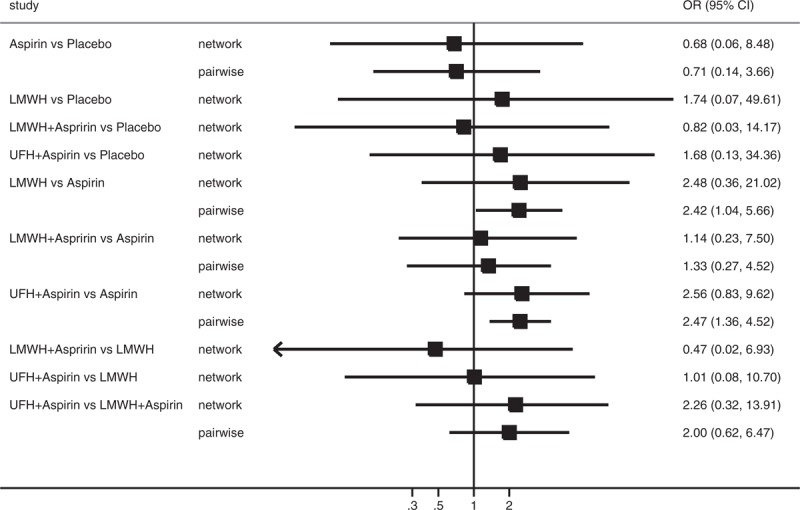
Combined use of heparin and aspirin is frequently prescribed for treatment of recurrent miscarriage (RM) in patients with antiphospholipid syndrome (APS), or in those without apparent cause of RM other than thrombophilia; however, this strategy is largely based on expert opinion and has not been well studied. The option for the use of different antithrombotic therapies to improve live birth remains unclear. In this network meta-analysis, we incorporated direct and indirect evidence to evaluate effects of different antithrombotic treatments on prevention of pregnancy losses.We searched PubMed and Embase for randomized clinical trials comparing effects of at least 2 antithrombotic treatments on live birth in RM patients published from 1965 through the early of May 2015. Potential risk bias of eligible trials was evaluated according to the Cochrane Collaboration guidelines. Bayesian network meta-analysis was used to estimate relative effects on live birth.A total of 19 trials involving 2391 RM patients with or without thrombophilia and 543 with APS were included. No beneficial effect of antithrombotic treatment was observed either in RM patients with or without thrombophilia or in patients with APS; however, for patients with or without thrombophilia, low molecular weight heparin therapy had the greatest probability (61.48%) of being the best option in terms of live birth; for patients with APS, unfractionated heparin plus aspirin was the superior treatment for RM with the highest possibility (75.15%) of being top 2 places for reducing pregnancy losses. Aspirin was inferior in both groups.Our results do not support the use of combined low molecular weight heparin and aspirin for RM treatment, and suggested aspirin may have negative effects for lowering the risk of pregnancy loss.
Overview
The claims and statistics of this paper haven’t been checked yet.
Free: it reads the open-access text and checks the first 5 claims that cite a source we can check. Create a free account to check every claim.
Integrity signals
Registry
Cites
Statistics
Figures




Verification
Claims the paper makes
The claims and statistics of this paper haven’t been checked yet.
Free: it reads the open-access text and checks the first 5 claims that cite a source we can check. Create a free account to check every claim.
Claims other papers make about this one
Each is checked against this paper’s own text: does it say what the citing paper says it does?
The cited source says what the claim attributes to it.
In the citing paper
“A 2015 Bayesian network meta-analysis also confirmed the above findings.165”
From Recurrent MiscarriageGreen‐top Guideline No. 17 (2023) · cites this paper as [165]
Self-check
Percentages, sums and reported differences re-computed from the paper’s own numbers.
The self-check needs the paper’s full text.
Citations
Cites
1 retracted
Badawy, A. M., Khiary, M., Sherif, L. S., Hassan, M., Ragab, A., & Abdelall, I. (2008) · Journal of Obstetrics and Gynaecology · doi:10.1080/01443610802042688 · Cited by 109
RetractedMeasuring inconsistency in meta-analyses
Higgins, J. P. T., Thompson, S. G., Deeks, J. J., & Altman, D. G. (2003) · BMJ · doi:10.1136/bmj.327.7414.557 · Cited by 63,139 · cited 1×
“eity.(23) The probability of publication bias was evaluated with the Egger regression test.”
MethodBias in meta-analysis detected by a simple, graphical test
Egger, M., Smith, G. D., Schneider, M., & Minder, C. (1997) · BMJ · doi:10.1136/bmj.315.7109.629 · Cited by 56,722 · cited 1×
“The probability of publication bias was evaluated with the Egger regression test.(24) If publication bias existed, the effect of publication bias was evaluated by the trim and fill method.”
MethodSalanti, G., Ades, A. E., & Ioannidis, J. P. A. (2011) · Journal of Clinical Epidemiology · doi:10.1016/j.jclinepi.2010.03.016 · Cited by 3,766 · cited 1×
“SUCRAwould be 1 if a treatment is certain to be the best and 0 if a treatment is certain to be the worst.(33) Analyses were conducted with WinBUGS1.”
MethodChecking consistency in mixed treatment comparison meta-analysis
Dias, S., Welton, N. J., Caldwell, D. M., & Ades, A. E. (2010) · Statistics in Medicine · doi:10.1002/sim.3767 · Cited by 2,521 · cited 1×
“Inconsistency of the model was evaluated using the node splitting method that separated evidence on a particular comparison into direct and indirect evidence.(27,28) The Bayesian P value was reported to measure the agreement between the direct and indirect evidence for each split node.”
MethodGraphical tools for network meta-analysis in STATA
Chaimani, A., Higgins, J. P. T., Mavridis, D., Spyridonos, P., & Salanti, G. (2013) · PLoS ONE · doi:10.1371/journal.pone.0076654 · Cited by 2,473
Combination of direct and indirect evidence in mixed treatment comparisons
Lu, G., & Ades, A. E. (2004) · Statistics in Medicine · doi:10.1002/sim.1875 · Cited by 2,166
Cipriani, A., Furukawa, T. A., Salanti, G., Geddes, J. R., Higgins, J. P., Churchill, R., Watanabe, N., Nakagawa, A., Omori, I. M., McGuire, H., et al. (2009) · The Lancet · doi:10.1016/s0140-6736(09)60046-5 · Cited by 1,654
Rai, R., & Regan, L. (2006) · The Lancet · doi:10.1016/s0140-6736(06)69204-0 · Cited by 1,227
Rai, R., Cohen, H., Dave, M., & Regan, L. (1997) · BMJ · doi:10.1136/bmj.314.7076.253 · Cited by 1,113
Cited by
Recurrent miscarriage: evidence to accelerate action
Coomarasamy, A., Dhillon-Smith, R. K., Papadopoulou, A., Al-Memar, M., Brewin, J., Abrahams, V. M., Maheshwari, A., Christiansen, O. B., Stephenson, M. D., Goddijn, M., et al. (2021) · The Lancet · doi:10.1016/s0140-6736(21)00681-4 · Cited by 180
Recurrent MiscarriageGreen‐top Guideline No. 17
Regan, L., Rai, R., Saravelos, S., Li, T., & the Royal College of Obstetricians and Gynaecologists (2023) · BJOG: An International Journal of Obstetrics & Gynaecology · doi:10.1111/1471-0528.17515 · Cited by 158
Safety and Efficacy of Enoxaparin in Pregnancy: A Systematic Review and Meta-Analysis
Jacobson, B. F., Rambiritch, V., Paek, D., Sayre, T., Naidoo, P., Shan, J., & Leisegang, R. F. (2019) · Advances in Therapy · doi:10.1007/s12325-019-01124-z · Cited by 63
Evaluation of T cell cytokines and their role in recurrent miscarriage
Ali, S., Majid, S., Ali, M. N., & Taing, S. (2020) · International Immunopharmacology · doi:10.1016/j.intimp.2020.106347 · Cited by 48
Lu, C. F., Liu, Y., & Jiang, H. (2017) · The Journal of Maternal-Fetal & Neonatal Medicine · doi:10.1080/14767058.2017.1404979 · Cited by 46
Metadata
- Authors
- Zhang, T., Ye, X., Zhu, T., XIAO, X., Liu, Y., Wei, X., Liu, Y., Wu, C., Guan, R., Li, X., Guo, X., Hu, H., & He, J.
- Affiliations
- Second Military Medical University (CN)
- Corresponding author
- He, Jia
- ORCID
- Venue
- Medicine
- Published
- 2015-11
- Volume
- 94
- Issue
- 45
- Pages
- e1732
- ISSN
- 0025-7974 (ISSN-L)
- PMC
- PMC4912243
- OpenAlex
- W2315047914
- Cited by
- 28
- References
- 52
- Citations by year
- 2025: 2 · 2024: 2 · 2023: 5 · 2022: 2 · 2021: 2 · 2020: 3 · 2019: 4 · 2018: 3 · 2017: 4 · 2016: 1
- FWCI
- 0.25
- Type
- journal article
- Language
- en
- Open access
- gold
- doi.org
- Licence
- cc-by-nc-nd
- Locations
- Medicine (publishedVersion, cc-by-nc-nd)
- PubMed Central (publishedVersion, cc-by-nc-nd)
- PubMed (publishedVersion)
- Funders
- Natural Science Foundation of Shanghai
- National Natural Science Foundation of China (2014QN09, 81373105)
- Second Military Medical University
- Topics
- Life Sciences › Immunology and Microbiology › Immunology › Reproductive System and Pregnancy
- Health Sciences › Medicine › Rheumatology › Systemic Lupus Erythematosus Research
- Health Sciences › Medicine › Hematology › Blood Coagulation and Thrombosis Mechanisms
- Keywords
- recurrent pregnancy loss, antithrombotic therapy, low molecular weight heparin, aspirin, unfractionated heparin, antiphospholipid syndrome, thrombophilia, live birth, pregnancy loss prevention, combination therapy
- MeSH terms
- Abortion, Habitual, Female, Fibrinolytic Agents, Humans, Pregnancy, Antiphospholipid Syndrome
About these checks
Registry, retraction, Cites and statistics results are computed, not judged, with one exception: a printed reference that no index lists is read once by a model before it counts as a citation error. Claims are extracted by a model and kept only when their quote appears verbatim in the text; each cited source is then checked, with a model’s help, for whether it says what the claim relies on. Those verdicts can be wrong — read the claim’s quote and the cited source before relying on one.
Statistics and arithmetic are recomputed, not judged.
Confidence bands are shown only for fields calibrated on our annotated test set. None is calibrated yet, so no band is shown.
What counts as a claim ›How we measure confidence ›How we check this ›
Are you an author, or do you see a problem with this page? Request a review
How to cite
Cite CoChat for the checks on this page, and the paper for its own findings.
- This page
- CoChat. (2026). Citation check: Antithrombotic Treatment for Recurrent Miscarriage: Bayesian Network Meta-Analysis and Systematic Review. https://app.cochat.ai/papers/10.1097/md.0000000000001732
- The paper
- Zhang, T., Ye, X., Zhu, T., XIAO, X., Liu, Y., Wei, X., Liu, Y., Wu, C., Guan, R., Li, X., Guo, X., Hu, H., & He, J. (2015). Antithrombotic Treatment for Recurrent Miscarriage: Bayesian Network Meta-Analysis and Systematic Review. Medicine. https://doi.org/10.1097/md.0000000000001732
Data sources
Bibliographic data: Semantic Scholar, OpenAlex, Crossref.
Contains information from the Semantic Scholar Academic Graph Datasets, made available under the ODC Attribution License (ODC-BY 1.0).
Semantic Scholar’s data is described in: Kinney, R., et al. (2023). The Semantic Scholar Open Data Platform. arXiv:2301.10140.
