

Low Triiodothyronine Syndrome in Patients With Radiation Enteritis: Risk Factors and Clinical Outcomes an Observational Study
Open accessThe DOI matches its Crossref record; 34 of the 34 references it cites were found in a registry or an index.
Abstract
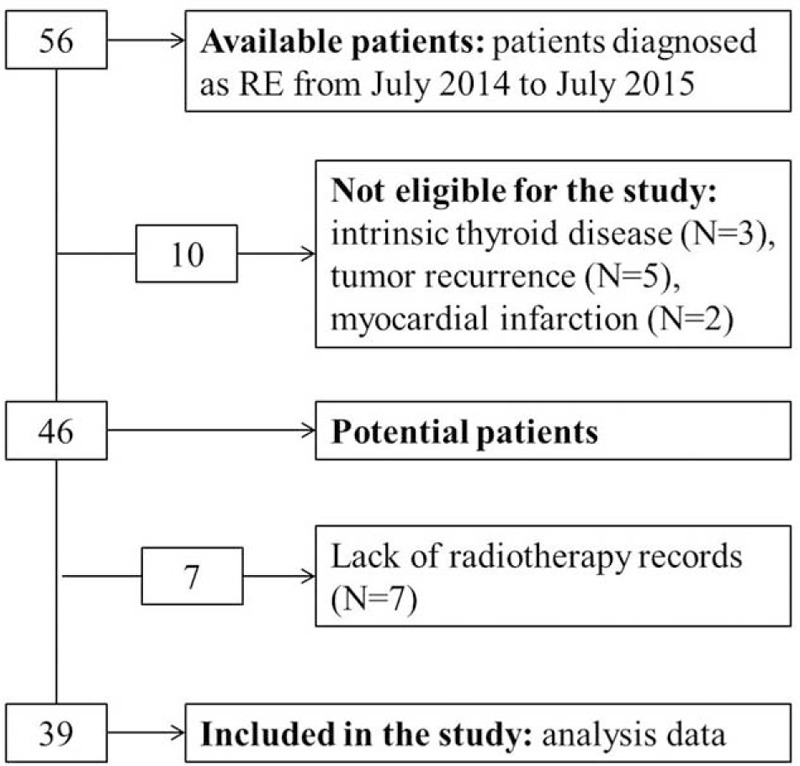
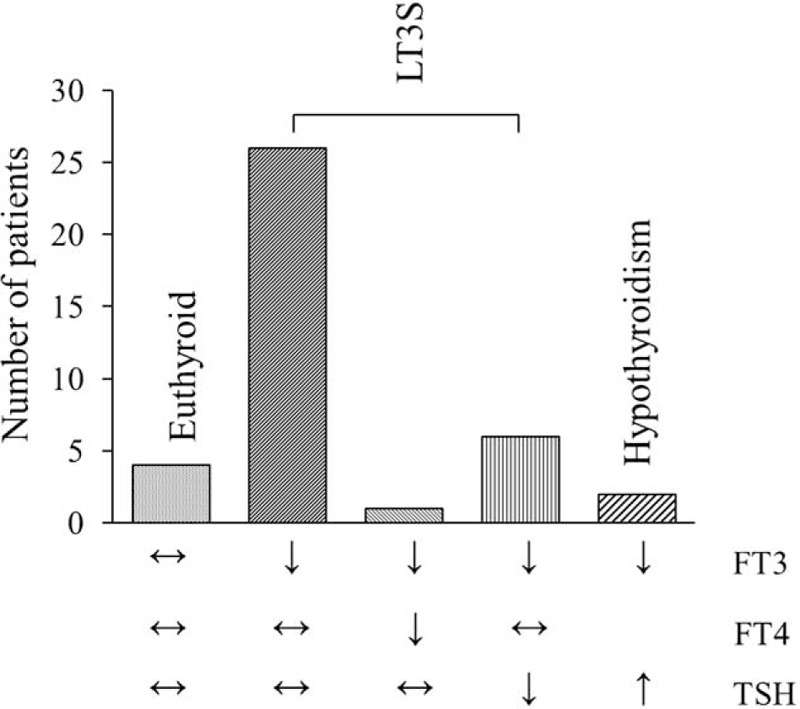
The implications of low triiodothyronine syndrome (LT3S) in patients with radiation enteritis (RE) have not been properly investigated. As such, we conducted this cohort study to investigate the association between LT3S and RE, to explore the etiology of LT3S in RE, to evaluate the clinical features and clinical outcomes of LT3S patients, and to inspect the correlation of clinical variables and LT3S in RE.This prospective study included 39 RE patients. Medical records and various laboratory parameters (including thyroidal, tumorous, nutritional, and radiotherapy variables) were collected in all participants.Our results showed that the incidence of LT3S was 84.6% in patients with RE. Total protein (71.7 ± 5.7 vs 63.2 ± 9.6 g/L, P = 0.04) and albumin (ALB, 46.0 ± 4.6 vs 38.7 ± 5.3 g/L, P = 0.01) were significantly lower in LT3S group compared with those in euthyroid group. Standard thyroid-stimulating hormone index (-0.89 ± 2.11 vs -2.39 ± 1.33, P = 0.03) and sum activity of deiodinases (19.74 ± 4.19 vs 12.55 ± 4.32 nmol/L, P = 0.01) were significantly lower in LT3S group. Patients with LT3S suffered longer duration of hospitalization (48.25 ± 23.29 days in LT3S vs 26.75 ± 10.56 days in euthyroid, P = 0.036). Low serum ALB (β = 0.694, 95% CI = 0.007-0.190, P = 0.037) was the only significant predictor of LT3S.LT3S was common in RE patients. A hypodeiodination condition and a potential pituitary-thyrotroph dysfunction might play a role in the pathophysiology of LT3S in RE. Worse nutritional status and clinical outcomes were confirmed in RE patients with LT3S. Furthermore, total protein and ALB were observed as protective and differentiating parameters of LT3S in RE. In summary, this was the 1st investigation to evaluate the clinical correlation between RE and LT3S, investigate the prevalence of LT3S in RE, and explore the pathogenesis of LT3S, despite the limitation of a relatively small sample size. These results will hopefully encourage future research to place greater emphasis on early identification of LT3S in RE patients.
Overview
The claims and statistics of this paper haven’t been checked yet.
Free: it reads the open-access text and checks the first 5 claims that cite a source we can check. Create a free account to check every claim.
Integrity signals
Registry
Cites
Statistics
Figures
Verification
Claims the paper makes
The claims and statistics of this paper haven’t been checked yet.
Free: it reads the open-access text and checks the first 5 claims that cite a source we can check. Create a free account to check every claim.
Claims other papers make about this one
Each is checked against this paper’s own text: does it say what the citing paper says it does?
The source backs part of the claim, not all of it — or backs it for a different population, condition or comparison.
In the citing paper
“Multiple trials demonstrated SPINA-GD to be reduced in NTIS (57, 69–71).”
From Calculated Parameters of Thyroid Homeostasis: Emerging Tools for Differential Diagnosis and Clinical Research (2016) · cites this paper as [69]
Experimental — accuracy not yet measuredThe source backs part of the claim, not all of it — or backs it for a different population, condition or comparison.
In the citing paper
“Recently, it was demonstrated that the TSHI is also reduced in patients with NTIS and thyrotropic adaptation (69).”
From Calculated Parameters of Thyroid Homeostasis: Emerging Tools for Differential Diagnosis and Clinical Research (2016) · cites this paper as [69]
Experimental — accuracy not yet measured
Self-check
Percentages, sums and reported differences re-computed from the paper’s own numbers.
The self-check needs the paper’s full text.
Citations
Cites
Bernstein, C. N., Wajda, A., & Blanchard, J. F. (2005) · Gastroenterology · doi:10.1053/j.gastro.2005.06.021 · Cited by 569
Dangerous dogmas in medicine: the nonthyroidal illness syndrome
De Groot, L. J. (1999) · The Journal of Clinical Endocrinology & Metabolism · doi:10.1210/jcem.84.1.5364 · Cited by 505
Low-T3 syndrome: a strong prognostic predictor of death in patients with heart disease
Iervasi, G., Pingitore, A., Landi, P., Raciti, M., Ripoli, A., Scarlattini, M., L’Abbate, A., & Donato, L. (2003) · Circulation · doi:10.1161/01.cir.0000048124.64204.3f · Cited by 472
Thyroid Hormone Treatment after Coronary-Artery Bypass Surgery
Klemperer, J. D., Klein, I., Gomez, M., Helm, R. E., Ojamaa, K., Thomas, S. J., Isom, O. W., & Krieger, K. (1995) · New England Journal of Medicine · doi:10.1056/nejm199512073332302 · Cited by 460
Mechanisms behind the non-thyroidal illness syndrome: an update
Warner, M. H., & Beckett, G. J. (2010) · Journal of Endocrinology · doi:10.1677/joe-09-0412 · Cited by 432
BERMUDEZ, F., SURKS, M. I., & OPPENHEIMER, J. H. (1975) · The Journal of Clinical Endocrinology & Metabolism · doi:10.1210/jcem-41-1-27 · Cited by 375
BRENT, G. A., & HERSHMAN, J. M. (1986) · The Journal of Clinical Endocrinology & Metabolism · doi:10.1210/jcem-63-1-1 · Cited by 365
Pingitore, A., Galli, E., Barison, A., Iervasi, A., Scarlattini, M., Nucci, D., L’Abbate, A., Mariotti, R., & Iervasi, G. (2008) · The Journal of Clinical Endocrinology & Metabolism · doi:10.1210/jc.2007-2210 · Cited by 279
Theis, V. S., Sripadam, R., Ramani, V., & Lal, S. (2010) · Clinical Oncology · doi:10.1016/j.clon.2009.10.003 · Cited by 268
Jostel, A., Ryder, W. D. J., & Shalet, S. M. (2009) · Clinical Endocrinology · doi:10.1111/j.1365-2265.2009.03534.x · Cited by 238
Hypermetabolic low triiodothyronine syndrome of burn injury
BECKER, R. A., VAUGHAN, G. M., ZIEGLER, M. G., SERAILE, L. G., GOLDFARB, I. W., MANSOUR, E. H., McMANUS, W. F., PRUITT, B. A., & MASON, A. D. (1982) · Critical Care Medicine · doi:10.1097/00003246-198212000-00014 · Cited by 205
De Groot, L. J. (2006) · Critical Care Clinics · doi:10.1016/j.ccc.2005.10.001 · Cited by 188
Kaptein, E. M., Robinson, W. J., Grieb, D. A., & Nicoloff, J. T. (1982) · Journal of Clinical Investigation · doi:10.1172/jci110478 · Cited by 183
Wajner, S. M., Goemann, I. M., Bueno, A. L., Larsen, P. R., & Maia, A. L. (2011) · Journal of Clinical Investigation · doi:10.1172/jci44678 · Cited by 168 · cited 10×
“Of note, we did not evaluate the efficacy of ALB supplementation for improving clinical variables and prognosis, and the effect of ALB supplementation on thyroid hormone metabolism in RE patients with LT3S.”
InfluentialPlikat, K., Langgartner, J., Buettner, R., Bollheimer, L. C., Woenckhaus, U., Schölmerich, J., & Wrede, C. E. (2007) · Metabolism · doi:10.1016/j.metabol.2006.09.020 · Cited by 156 · cited 1×
“In addition, these changes have been shown to be associated with disease severity and have been connected with poor short-term prognosis.(7,8) Radiation enteritis (RE) is by simple definition an inflammatory process occurring at the level of the intestines as a response to abdominal or pelvic radiation energy exposure.”
Bennett-Guerrero, E. (1996) · JAMA · doi:10.1001/jama.275.9.687 · Cited by 151
Bennett-Guerrero, E. (1996) · JAMA · doi:10.1001/jama.1996.03530330031025 · Cited by 139
Harb, A. H., Fadel, C. G. A., & Sharara, A. I. (2014) · Current Gastroenterology Reports · doi:10.1007/s11894-014-0383-3 · Cited by 123
Low triiodothyronine: a strong predictor of outcome in acute stroke patients
Alevizaki, M., Synetou, M., Xynos, K., Pappa, T., & Vemmos, K. N. (2007) · European Journal of Clinical Investigation · doi:10.1111/j.1365-2362.2007.01839.x · Cited by 116
Indaram, A., Visvalingam, V., Locke, M., & Bank, S. (2000) · The American Journal of Gastroenterology · doi:10.1111/j.1572-0241.2000.02013.x · Cited by 112
Prevention of chronic radiation enteritis
Waddell, B. E., Rodríguez-Bigas, M. A., Lee, R. J., Weber, T. K., & Petrelli, N. J. (1999) · Journal of the American College of Surgeons · doi:10.1016/s1072-7515(99)00199-4 · Cited by 85
Zimmerer, T., Böcker, U., Wenz, F. K., & Singer, M. V. (2008) · Zeitschrift für Gastroenterologie · doi:10.1055/s-2008-1027150 · Cited by 75
Low triiodothyronine syndrome: a prognostic marker for outcome in sepsis?
Meyer, S., Schüetz, P., Wieland, M., Nusbaumer, C., Müeller, B., & Christ‐Crain, M. (2011) · Endocrine · doi:10.1007/s12020-010-9431-4 · Cited by 73
Non-thyroidal illness syndrome and short-term survival in a hospitalised older population
Tognini, S., Marchini, F., Dardano, A., Polini, A., Ferdeghini, M., Castiglioni, M., & Monzani, F. (2010) · Age and Ageing · doi:10.1093/ageing/afp197 · Cited by 71
Correlates of non-thyroidal illness syndrome in chronic obstructive pulmonary disease
Karadag, F., Ozcan, H., Karul, A. B., Yilmaz, M., & Cildag, O. (2007) · Respiratory Medicine · doi:10.1016/j.rmed.2007.01.016 · Cited by 65
Cerillo, A. G., Storti, S., Kallushi, E., Haxhiademi, D., Miceli, A., Murzi, M., Berti, S. L., Glauber, M., Clerico, A., & Iervasi, G. (2014) · The Annals of Thoracic Surgery · doi:10.1016/j.athoracsur.2014.01.049 · Cited by 65
A low fT3 level as a prognostic marker in patients with acute myocardial infarctions
Zhang, B., Peng, W., Wang, C., Li, W., & Xu, Y. (2012) · Internal Medicine · doi:10.2169/internalmedicine.51.7902 · Cited by 59 · cited 2×
“Data have shown that about 35%–70% of acute and chronic critical conditions were associated with a significant abnormal thyroid hormone metabolism, of which LT3S was the most common type.(3) The underlying mechanism of this disorder was explained by multifactorial causes including modifications to the hypothalamicpitu…”
Reichlin, S., Bollinger, J., NEJAD, I., & Sullivan, P. (1973) · PubMed · Cited by 47
Dietrich, J. W., Stachon, A., Antic, B., Klein, H. H., & Hering, S. (2008) · BMC Endocrine Disorders · doi:10.1186/1472-6823-8-13 · Cited by 44
Thyroid hormone in cardiac surgery
Ranasinghe, A. M., & Bonser, R. S. (2009) · Vascular Pharmacology · doi:10.1016/j.vph.2009.11.004 · Cited by 38
Chang, T. I., Nam, J. Y., Shin, S. K., & Kang, E. W. (2015) · Clinical Journal of the American Society of Nephrology · doi:10.2215/cjn.03350414 · Cited by 28
Song, S., Chen, D., Ma, T., Luo, Y., Yang, Z., Wang, D., Fan, X., Qin, Q., Ni, B., Guo, X., et al. (2014) · Digestive Diseases and Sciences · doi:10.1007/s10620-014-3224-1 · Cited by 26
Self-citationCesarini, M., Angelucci, E., Rivera, M., Pica, R., Paoluzi, P., Vernia, P., & Corazziari, E. (2009) · Inflammatory Bowel Diseases · doi:10.1002/ibd.20964 · Cited by 20
Chronic Radiation Enteritis: A Ten-Year Follow-up
Jain, G., Scolapio, J. S., Wasserman, E., & Floch, M. H. (2002) · Journal of Clinical Gastroenterology · doi:10.1097/00004836-200209000-00003 · Cited by 18
Research works printed but not linked: 1
- Warner MH Beckett GJ Mechanisms behind the non-thyroidal illness syndrome: an update. J Endocrinol 2010; 205: 1– 13. 20016054 · DOI · Paper page
Cited by
Chatzitomaris, A., Hoermann, R., Midgley, J. E., Hering, S., Urban, A., Dietrich, B., Abood, A., Klein, H. H., & Dietrich, J. W. (2017) · Frontiers in Endocrinology · doi:10.3389/fendo.2017.00163 · Cited by 173
Dietrich, J. W., Landgrafe-Mende, G., Wiora, E., Chatzitomaris, A., Klein, H. H., Midgley, J. E. M., & Hoermann, R. (2016) · Frontiers in Endocrinology · doi:10.3389/fendo.2016.00057 · Cited by 164
Ruiz-Núñez, B., Tarasse, R., Vogelaar, E. F., Dijck-Brouwer, J., & Muskiet, F. A. J. (2018) · Frontiers in Endocrinology · doi:10.3389/fendo.2018.00097 · Cited by 64
Curative effects of montmorillonite powder combined with dexamethasone on acute radiation enteritis.
Chen, W., Ma, Q., Yang, L., Zhang, L., Zhu, J., & Lin, W. (2021) · PubMed Central · Cited by 11
Yu, H., Han, J., Wu, X., Qiu, Y., Yu, H., Xu, J., Hao, J., Peng, Y., Jin, R., & Zhou, F. (2023) · International Journal of Cancer · doi:10.1002/ijc.34535 · Cited by 4
Metadata
- Authors
- Fan, S., Ni, X., Wang, J., Zhang, Y., Tao, S., Chen, M., Li, Y., & Li, J.
- Affiliations
- Nanjing General Hospital of Nanjing Military Command (CN)
- Corresponding author
- Li, Yousheng
- Li, Jieshou
- Venue
- Medicine
- Published
- 2016-02
- Volume
- 95
- Issue
- 6
- Pages
- e2640
- ISSN
- 0025-7974 (ISSN-L)
- PMC
- PMC4753882
- OpenAlex
- W2294613341
- Cited by
- 7
- References
- 34
- Citations by year
- 2023: 1 · 2021: 1 · 2020: 1 · 2019: 1 · 2018: 1 · 2017: 1 · 2016: 1
- FWCI
- 1.34
- Type
- journal article
- Language
- en
- Open access
- gold
- doi.org
- Licence
- cc-by
- Locations
- Medicine (publishedVersion, cc-by)
- Europe PMC (PubMed Central) (publishedVersion, cc-by)
- PubMed Central (publishedVersion, cc-by)
- PubMed (publishedVersion)
- Funders
- National Natural Science Foundation of China (81270945)
- Topics
- Health Sciences › Medicine › Endocrinology, Diabetes and Metabolism › Thyroid Disorders and Treatments
- Health Sciences › Medicine › Radiology, Nuclear Medicine and Imaging › Effects of Radiation Exposure
- Health Sciences › Medicine › Surgery › Thyroid and Parathyroid Surgery
- Keywords
- low triiodothyronine syndrome, radiation enteritis, hypothyroidism, deiodinase activity, thyroid-stimulating hormone, serum albumin, total protein, nutritional status, radiotherapy complications, length of hospital stay, prognostic factors, thyroid function tests
- MeSH terms
- Adult, Aged, Enteritis, Female, Humans, Male, Middle Aged, Prospective Studies, Radiation Injuries, Risk Factors, Syndrome, Triiodothyronine, Cohort Studies
About these checks
Registry, retraction, Cites and statistics results are computed, not judged, with one exception: a printed reference that no index lists is read once by a model before it counts as a citation error. Claims are extracted by a model and kept only when their quote appears verbatim in the text; each cited source is then checked, with a model’s help, for whether it says what the claim relies on. Those verdicts can be wrong — read the claim’s quote and the cited source before relying on one.
Statistics and arithmetic are recomputed, not judged.
Confidence bands are shown only for fields calibrated on our annotated test set. None is calibrated yet, so no band is shown.
What counts as a claim ›How we measure confidence ›How we check this ›
Are you an author, or do you see a problem with this page? Request a review
Data sources
Bibliographic data: Semantic Scholar, OpenAlex, Crossref.
Contains information from the Semantic Scholar Academic Graph Datasets, made available under the ODC Attribution License (ODC-BY 1.0).
Semantic Scholar’s data is described in: Kinney, R., et al. (2023). The Semantic Scholar Open Data Platform. arXiv:2301.10140.
