

Mobile teledermatology for skin cancer screening: A diagnostic accuracy study
Open accessThe DOI matches its Crossref record; 24 of the 24 references it cites were found in a registry or an index.
Abstract
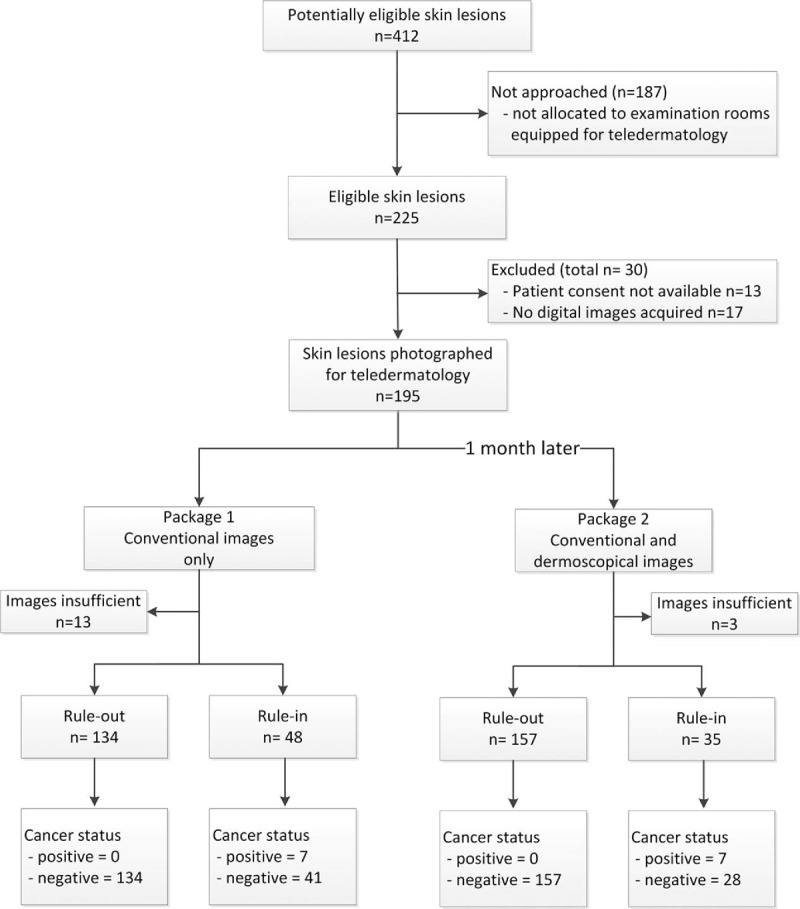
Skin cancer screening has undoubted potential to reduce cancer-specific morbidity and mortality. Total-body exams remain the prevailing concept of skin cancer screening even if effectiveness and value of this method are controversial. Meanwhile, store and forward teledermatology was shown to be a reliable instrument for several diagnostic purposes mostly in specialized dermatology settings. The objective of this study was to evaluate most convenient mobile teledermatology interventions as instruments for skin cancer screening in a representative population.Prospective diagnostic study with visitors of a skin cancer screening campaign in Switzerland. Histopathology was used as reference standard. Mobile teledermatology with or without dermoscopic images was assessed for performance as a screening test (i.e., rule-in or rule-out the need for further testing). Outcomes were sensitivity, specificity, and predictive values.Seven cases of skin cancer were present among 195 skin lesions. All skin cancers were ruled-in by teledermatology with or without dermoscopic images (sensitivity and negative predictive value 100%). The addition of dermoscopic images to conventional images resulted in higher specificity (85% vs. 77%), allowing reduction of unnecessary further testing in a larger proportion of skin lesions.Store and forward mobile teledermatology could serve as an instrument for population-based skin cancer screening because of favorable test performance.
Overview
The claims and statistics of this paper haven’t been checked yet.
Free: it reads the open-access text and checks the first 5 claims that cite a source we can check. Create a free account to check every claim.
Integrity signals
Registry
Cites
Statistics
Figures
Verification
Claims the paper makes
The claims and statistics of this paper haven’t been checked yet.
Free: it reads the open-access text and checks the first 5 claims that cite a source we can check. Create a free account to check every claim.
Claims other papers make about this one
Each is checked against this paper’s own text: does it say what the citing paper says it does?
The source backs part of the claim, not all of it — or backs it for a different population, condition or comparison.
In the citing paper
“The use of a dermoscope may improve the concordance (the kappa coefficient range was .29 to .87, median κ=.74).”
From Use of Smartphones for Early Detection of Melanoma: Systematic Review (2018) · cites this paper as [40]
Experimental — accuracy not yet measuredThe source backs part of the claim, not all of it — or backs it for a different population, condition or comparison.
In the citing paper
“However, the concordance between the conclusion of a teledermatologist and the conclusion of a dermatologist who conducts a face-to-face examination depended on the study (the kappa coefficient range was .20 to .84, median κ=.60).”
From Use of Smartphones for Early Detection of Melanoma: Systematic Review (2018) · cites this paper as [40]
Experimental — accuracy not yet measuredThe source backs part of the claim, not all of it — or backs it for a different population, condition or comparison.
In the citing paper
“In this literature review, up to 20% of the photographs transmitted were of insufficient quality.”
From Use of Smartphones for Early Detection of Melanoma: Systematic Review (2018) · cites this paper as [40]
Experimental — accuracy not yet measuredThe source backs part of the claim, not all of it — or backs it for a different population, condition or comparison.
In the citing paper
“This literature review suggests that teledermatology decreases the delays in the management of melanoma lesions [34-36,40,59], reduces the referrals to a dermatologist by avoiding unnecessary consultations [35,36,40] and limits the number of patients lost from follow-up [36,60].”
From Use of Smartphones for Early Detection of Melanoma: Systematic Review (2018) · cites this paper as [40]
Experimental — accuracy not yet measured
1 more claim about this paper
Create a free account to see every claim other papers make about this one.
Self-check
Percentages, sums and reported differences re-computed from the paper’s own numbers.
The self-check needs the paper’s full text.
Citations
Cites
Teledermatology for diagnosis and management of skin conditions: A systematic review
Warshaw, E. M., Hillman, Y. J., Greer, N. L., Hagel, E. M., MacDonald, R., Rutks, I. R., & Wilt, T. J. (2011) · Journal of the American Academy of Dermatology · doi:10.1016/j.jaad.2010.08.026 · Cited by 310 · cited 1×
“Keywords: m-health, screening, sensitivity, skin cancer, specificity, teledermatology”
Systematic skin cancer screening in Northern Germany
Breitbart, E. W., Waldmann, A., Nolte, S., Capellaro, M., Greinert, R., Volkmer, B., & Katalinic, A. (2012) · Journal of the American Academy of Dermatology · doi:10.1016/j.jaad.2010.11.016 · Cited by 302 · cited 1×
“The nationwide skin cancer screening program in Germany, for instance, relied on total-body exams but surprisingly failed to result in improvements of skin cancer mortality rates despite promising results from a pilot project.([7,8]) The role of total-body exams might be the one of a case-finding procedure in an at-ri…”
BackgroundGordon, L. G., & Rowell, D. (2015) · European Journal of Cancer Prevention · doi:10.1097/cej.0000000000000056 · Cited by 228 · cited 1×
“Owing to superficial growth and natural course running through preclinical stages, skin cancer is highly amenable for screening interventions with potential economical and healthbenefits.([4,5]) The selection of the population to screen, the kind of healthcare professionals to appoint, and the type of clinical assessm…”
BackgroundKroemer, S., Frühauf, J., Campbell, T. M., Massone, C., Schwantzer, G., Soyer, H. P., & Hofmann-Wellenhof, R. (2011) · British Journal of Dermatology · doi:10.1111/j.1365-2133.2011.10208.x · Cited by 202 · cited 2×
“Feasibility and reliability for cancer detection with such mobile teledermoscopy has already been shown in high prevalence settings.([16,17]) Given time-efficiency, reliability, and the widespread disseminationof powerful digital cameras integrated inmobile phones, the remaining technical limitations tomobile telederm…”
BackgroundResultScreening for Skin Cancer: U.S. Preventive Services Task Force Recommendation Statement
U.S. Preventive Services Task Force* (2009) · Annals of Internal Medicine · doi:10.7326/0003-4819-150-3-200902030-00008 · Cited by 181 · cited 1×
“Moreover, the effectiveness of skin cancer screening in general still remains to be determined.([6]) So far, the prevailing concept of skin cancer”
BackgroundAccuracy of teledermatology for pigmented neoplasms
Warshaw, E. M., Lederle, F. A., Grill, J. P., Gravely, A. A., Bangerter, A. K., Fortier, L. A., Bohjanen, K. A., Chen, K., Lee, P. K., Rabinovitz, H. S., et al. (2009) · Journal of the American Academy of Dermatology · doi:10.1016/j.jaad.2009.04.032 · Cited by 175 · cited 1×
“Keywords: m-health, screening, sensitivity, skin cancer, specificity, teledermatology”
A systematic review of the efficacy of telemedicine for making diagnostic and management decisions
Hersh, W., Helfand, M., Wallace, J., Kraemer, D., Patterson, P., Shapiro, S., & Greenlick, M. (2002) · Journal of Telemedicine and Telecare · doi:10.1258/135763302320272167 · Cited by 170
Application of mobile teledermatology for skin cancer screening
Lamel, S. A., Haldeman, K. M., Ely, H., Kovarik, C. L., Pak, H., & Armstrong, A. W. (2012) · Journal of the American Academy of Dermatology · doi:10.1016/j.jaad.2011.11.957 · Cited by 125 · cited 1×
“In a very similar setting as ours, a high management concordance between face-to-face consultations and conventional teledermatology has recently been found and cancer screening utilizing teledermatology was suggested.([20]) Here, we followed the diagnostic chain beyond agreement with clinical management recommendatio…”
Methodvan der Leest, R. J. T., de Vries, E., Bulliard, J., Paoli, J., Peris, K., Stratigos, A. J., Trakatelli, M. G., Maselis, T., Šitum, M., Pallouras, A. C., et al. (2011) · Journal of the European Academy of Dermatology and Venereology · doi:10.1111/j.1468-3083.2011.04228.x · Cited by 103 · cited 1×
“Campaigns to raise awareness and foster prevention and early detection of skin cancer are ongoing since over a decade.([2,3]) Owing to superficial growth and natural course running through preclinical stages, skin cancer is highly amenable for screening interventions with potential economical and healthbenefits.”
BackgroundAccuracy of teledermatology for nonpigmented neoplasms
Warshaw, E. M., Lederle, F. A., Grill, J. P., Gravely, A. A., Bangerter, A. K., Fortier, L. A., Bohjanen, K. A., Chen, K., Lee, P. K., Rabinovitz, H. S., et al. (2009) · Journal of the American Academy of Dermatology · doi:10.1016/j.jaad.2008.11.892 · Cited by 103 · cited 1×
“Keywords: m-health, screening, sensitivity, skin cancer, specificity, teledermatology”
Cited by
Hasan, N., Nadaf, A., Imran, M., Jiba, U., Sheikh, A., Almalki, W. H., Almujri, S. S., Mohammed, Y. H., Kesharwani, P., & Ahmad, F. J. (2023) · Molecular Cancer · doi:10.1186/s12943-023-01854-3 · Cited by 322
Freeman, K., Dinnes, J., Chuchu, N., Takwoingi, Y., Bayliss, S. E., Matin, R. N., Jain, A., Walter, F. M., Williams, H. C., & Deeks, J. J. (2020) · BMJ · doi:10.1136/bmj.m127 · Cited by 260
Use of Smartphones for Early Detection of Melanoma: Systematic Review
Rat, C., Hild, S., Rault Sérandour, J., Gaultier, A., Quereux, G., Dreno, B., & Nguyen, J.-M. (2018) · Journal of Medical Internet Research · doi:10.2196/jmir.9392 · Cited by 105
Teledermatology in the time of COVID‐19
Ibrahim, A. E., Magdy, M., Khalaf, E. M. M., Mostafa, A., & Arafa, A. (2021) · International Journal of Clinical Practice · doi:10.1111/ijcp.15000 · Cited by 73
Janda, M., Horsham, C., Vagenas, D., Loescher, L. J., Gillespie, N., Koh, U., Curiel-Lewandrowski, C., Hofmann-Wellenhof, R., Halpern, A., Whiteman, D. C., et al. (2020) · The Lancet Digital Health · doi:10.1016/s2589-7500(20)30001-7 · Cited by 62
Augustin, M., Wimmer, J., Biedermann, T., Blaga, R., Dierks, C., Djamei, V., Elmer, A., Elsner, P. U., Enk, A., Gass, S., et al. (2018) · JDDG Journal der Deutschen Dermatologischen Gesellschaft · doi:10.1111/ddg.13512 · Cited by 55
Recent trends in teledermatology and teledermoscopy.
Lee, K., Finnane, A. R., & Soyer, H. P. (2018) · Europe PMC (PubMed Central) · doi:10.5826/dpc.0803a13 · Cited by 42
The clinical utility of teledermoscopy in the era of telemedicine
Uppal, S. K., Beer, J., Hadeler, E., Gitlow, H., & Nouri, K. (2021) · Dermatologic Therapy · doi:10.1111/dth.14766 · Cited by 39
“Nonetheless, mobile teledermoscopy has very high cancer detection rates for patients presenting with specific skin lesions, especially in high-prevalence settings.(13) Store-andforward mobile teledermatology can be utilized for skin cancer screening for lesions of concern but precaution is advised when evaluating high…”
BackgroundImprove Image-based Skin Cancer Diagnosis with Generative Self-Supervised Learning
Ren, Z., Guo, Y., Yu, S. X., & Whitney, D. C. (2021) · IEEE/ACM Conference on Connected Health: Applications, Systems and Engineering Technologies · doi:10.1109/chase52844.2021.00011 · Cited by 41
“Teledermatology provides a promising technology for monitoring skin cancer [5]–[8].”
BackgroundUsefulness of Smartphones in Dermatology: A US-Based Review
Ouellette, S., & Rao, B. K. (2022) · International Journal of Environmental Research and Public Health · doi:10.3390/ijerph19063553 · Cited by 35
“In a more recent prospective diagnostic study, mobile teledermatology successfully detected all cases of skin cancer in a low prevalence population [32].”
BackgroundeSkin: Study on the Smartphone Application for Early Detection of Malignant Melanoma
Jaworek-Korjakowska, J., & Kłeczek, P. (2018) · Wireless Communications and Mobile Computing · doi:10.1155/2018/5767360 · Cited by 31
Perspectives on Telemedicine during the Era of COVID-19; What Can Saudi Arabia Do?
Al-Hazmi, A., Sheerah, H. A., & Arafa, A. (2021) · International Journal of Environmental Research and Public Health · doi:10.3390/ijerph182010617 · Cited by 38
“Yet, previous studies detected comparable accuracy between face-to-face diagnosis and telediagnosis in patients with skin cancers [46,47], diabetic retinopathy [48], burns [49,50], muscle tear [51], dementia [52], and uncontrolled hypertension [53].”
ResultPart I: Accuracy of Teledermatology in Inflammatory Dermatoses
Bianchi, M. G., de Sousa, R. M., & Cordioli, E. (2020) · Frontiers in Medicine · doi:10.3389/fmed.2020.585792 · Cited by 34
Applications of digital Medicine in oncology: Prospects and challenges
Ge, H., Li, L., Zhang, D., & Ma, F. (2022) · Cancer Innovation · doi:10.1002/cai2.37 · Cited by 27
“The study findings showed 100% sensitivity and 77% specificity without dermoscopy, which increased to 85% with dermoscopy, highlighting the good diagnostic performance of Internet medicine [29].”
BackgroundPart II: Accuracy of Teledermatology in Skin Neoplasms
Giavina-Bianchi, M., Azevedo, M. F. D., Sousa, R. M., & Cordioli, E. (2020) · Frontiers in Medicine · doi:10.3389/fmed.2020.598903 · Cited by 25
Choi, J., Cho, Y., & Woo, H. (2018) · JMIR mhealth and uhealth · doi:10.2196/mhealth.8554 · Cited by 29
Etiologies of Melanoma Development and Prevention Measures: A Review of the Current Evidence
Djavid, A. R., Stonesifer, C. J., Fullerton, B. T., Wang, S. W., Tartaro, M. A., Kwinta, B. D., Grimes, J. M., Geskin, L. J., & Saenger, Y. M. (2021) · Cancers · doi:10.3390/cancers13194914 · Cited by 31
Implementation of Teledermatology: Theory and Practice
Peracca, S. B., Jackson, G. L., Weinstock, M. A., & Oh, D. H. (2019) · Current Dermatology Reports · doi:10.1007/s13671-019-0252-2 · Cited by 26
Diagnostic accuracy of a telediagnosis service of oral mucosal diseases: A multicentric survey
Flores, A. P. C., Gonçalves, M. R., Batista, N. V. R., Gueiros, L. A., Linares, M. F., Santos‐Silva, A. R., Lopes, M. A., Flausino, C. S., Meurer, M. I., Grando, L. J., et al. (2022) · Oral Surgery Oral Medicine Oral Pathology and Oral Radiology · doi:10.1016/j.oooo.2022.02.005 · Cited by 21
The utility of teledermatology in the evaluation of skin lesions
Clarke, E. L., Reichenberg, J. S., Ahmed, A. M., Keeling, B. H., Custer, J., Rathouz, P. J., & Jambusaria‐Pahlajani, A. (2021) · Journal of Telemedicine and Telecare · doi:10.1177/1357633x20987423 · Cited by 21
Maul, L. V., Jahn, A. S., Pamplona, G. S. P., Streit, M., Gantenbein, L., Müller, S., Nielsen, M., Greis, C., Navarini, A. A., & Maul, J. (2023) · JMIR Dermatology · doi:10.2196/45384 · Cited by 17
S2k‐Guideline for Teledermatology
Augustin, M., Djamei, V., Elsner, P. U., Gass, S., Hofmann‐Wellenhof, R., Kaminski, K., Kirsten, N., Nast, A., Navarini, A. A., Otten, M., et al. (2021) · JDDG Journal der Deutschen Dermatologischen Gesellschaft · doi:10.1111/ddg.14615 · Cited by 15
COVID-19: Challenges and opportunities for dermatology response
Chawla, S. (2020) · Journal of Dermatological Treatment · doi:10.1080/09546634.2020.1751040 · Cited by 14
“Although teledermatology programs have been widely touted as the future of dermatology, with numerous studies demonstrating their efficacy, they have faced challenges in integration within NHS outpatient clinics (2,3).”
BackgroundDirect patient-to-physician teledermatology: Not a flash in the pan(demic)
Manuelyan, K., Shahid, M., Vassilev, V., Drenovska, K., & Vassileva, S. (2020) · Clinics in Dermatology · doi:10.1016/j.clindermatol.2020.12.011 · Cited by 16
Koop, C., Kruus, P., Hallik, R., Lehemets, H., Vettus, E., Niin, M., Ross, P., & Kingo, K. (2023) · JAAD International · doi:10.1016/j.jdin.2023.02.019 · Cited by 13
Teague, R., Wang, M. L., Wen, D., Sunderland, M., Rolfe, G., Oakley, A. M., Rademaker, M., & Martin, R. (2021) · Australasian Journal of Dermatology · doi:10.1111/ajd.13777 · Cited by 11
Tandon, A., Dhir, A., & Islam, N. (2023) · IEEE Transactions on Engineering Management · doi:10.1109/tem.2023.3243724 · Cited by 12
“The majority of the prior article has also directed attention to examining mHealth interventions in terms of diverse clinical objectives, including the management of pain [27] or symptoms [4], [65], adherence to medication [105], and screening rates [106], [107], [108].”
BackgroundMaita, K. C., Serrano, L. P., Ávila, F. R., Torres‐Guzman, R. A., Garcia, J. P., Eldaly, A. S., Haider, C. R., Felton, C. L., Paulson, M. R., Maniaci, M. J., et al. (2023) · Health and Technology · doi:10.1007/s12553-023-00745-3 · Cited by 13
“[16] evaluated the ability of mobile teledermoscopy to screen skin cancer by comparing it to histopathology as the gold standard.”
BackgroundEffectiveness and diagnostic accuracy of teledermatology for the assessment of skin conditions
Patel, N., Aboukhatwah, N., & Esdaile, B. A. (2024) · Australasian Journal of Dermatology · doi:10.1111/ajd.14239 · Cited by 8
Medical Selfies: Emotional Impacts and Practical Challenges
Diethei, D., Colley, A., Kalving, M., Salmela, T., Häkkilä, J., & Schöning, J. (2020) · International Conference on Human-Computer Interaction with Mobile Devices and Services (MobileHCI) · doi:10.1145/3379503.3403555 · Cited by 9
“his context has previously comprised expensive stereomicroscopes and digital dermoscopy systems, teledermatology has shown to be more cost effective [29, 30, 55] and at least as accurate in diagnosis [37, 58] compared to face-to-face consultations. Mobile teledermatology has good diagnostic accuracy for skin tumours […”
BackgroundEmerging Trends in Teledermatology Research: A Scientometric Analysis from 2002 to 2021
Luo, J., Yang, Z., Xie, Y., He, Y., Wu, M., Fang, X., & Liao, X. (2024) · Telemedicine Journal and e-Health · doi:10.1089/tmj.2023.0101 · Cited by 6
“38,39 It is worth noting that a representative and landmark systematic review from the Cochrane Library included studies on diagnosing skin cancer by TD before 2016 and found that previous studies were generally small scale and had poor reporting quality.”
Results of a 10-year web-based health promotion campaign against skin cancer in Switzerland
Meyer, S. R., Rudzki-Senet, A., Emde, N.-L., Imhof, L., Dummer, R., & Barysch, M. J. (2021) · European Journal of Dermatology · doi:10.1684/ejd.2021.4094 · Cited by 6
Jaber, N. F., Gulin, S. J., & Seifert, O. (2023) · Dermatology Practical & Conceptual · doi:10.5826/dpc.1303a212 · Cited by 5
“Compared to other TD studies that have shown comparable diagnostic accuracy between TD and FTF examinations [4,5,18], the diagnostic accuracy of FTF in our study was slightly lower (69%) than TD (80%), which may be due to the different study designs.”
ResultmHealth Interventions for Cancer Care and Support A Systematic Literature Review
Alshawwa, S. Z., & Assiri, R. (2020) · Systematic Reviews in Pharmacy · doi:10.31838/srp.2020.9.104 · Cited by 7
“…10.7) (60% Female) Text message intervention RCT (Longitudinal) Medication adherence and symptom severity Promote selfmanagement for patients prescribed OAs Markun et al. (2017) switzerland N 188 Mage 40.4 (60% Female) Teledermatolgist image Qualitative evaluation Detection of skin cancer…”
MethodInfluentialEvaluation of High‐Efficiency Image Coding algorithm for dermatology images in teledermatology
Bakhshali, M. A., Gholizadeh, M., Layegh, P., Nahidi, Y., Memarzadeh, Z., Meybodi, N. T., & Eslami, S. (2021) · Skin Research and Technology · doi:10.1111/srt.13081 · Cited by 5
“The literature review confirmed the ample teledermatology research conducted on skin neoplasms, especially skin cancer 4-8 and pigmented lesions 4,9– 11 and their result indicated rates of diagnostic accuracy using this system vary from study to study (in the range of 75%- 80%).”
BackgroundDiagnostic accuracy of teledermatology for skin diseases: a systematic review and meta-analysis
Martyin, K., Meznerics, F. A., Bokor, L. A., Szabó, B., Hegyi, P., Kiss, N., & Bánvölgyi, A. (2026) · Frontiers in Medicine · doi:10.3389/fmed.2026.1739592 · Cited by 4
Thiotaurine inhibits melanoma progression by enhancing Ca2+ overload-induced cellular apoptosis
Wang, D., Xie, A., Luo, J., Li, L., Zhang, Z., Deng, W., Yang, B., Chang, Y., & Liang, Y. (2025) · Journal of Dermatological Science · doi:10.1016/j.jdermsci.2025.03.001 · Cited by 2
van Sinderen, F., Langermans, A. P., Kushniruk, A. W., Borycki, E. M., Jaspers, M., & Peute, L. (2024) · JMIR Dermatology · doi:10.2196/60346 · Cited by 5
“%) studies [19,29,41,47,52,53,56,62] did not mention the type of lesions they included in their studies.”
BackgroundYudaputra, F. D., Triputra, F. A., Handayani, P. W., & Harahap, N. C. (2024) · Telematics and Informatics Reports · doi:10.1016/j.teler.2024.100180 · Cited by 11
Comparison of Costs in Teledermatology Using PC and Camera Versus Smartphone
Barrera-Valencia, C., & Perea-Flórez, E. X. (2024) · Telemedicine Journal and e-Health · doi:10.1089/tmj.2023.0369 · Cited by 3
“15 However, with the advent and exponential development of mobile devices such as Smartphones, a new way of providing tele-dermatology 16 has been developed that is economically viable, as demonstrated by this study.”
Early diagnosis of malignant skin tumors: new insights into solving the problem
Garanina, O. E., Lebedeva, O. E., Леонидовна, Ш. И., Александровна, К. И., Валерьевна, Д. Е., Dardyk, M. V., Subramaniyan, S., Babushkina, E. S., & Kagan, L. A. (2018) · Russian Journal of Clinical Dermatology and Venereology · doi:10.17116/klinderma201817051101 · Cited by 2
The waiting room of uncertainty: digital patient support for potentially bad news—a scoping review
Kellermann, M., Wetterauer, C., Kullak-Ublick, G. A., & Cheetham, M. (2025) · Frontiers in Digital Health · doi:10.3389/fdgth.2025.1706839 · Cited by 2
Sun, H., Fu, J., Li, J., Yuan, W., & Xin, J. (2026) · Medicine · doi:10.1097/md.0000000000049407 · Cited by 1
The Role of E-diagnosis Knowledge Based System on Omani Society: Skin Disease as Case
Elshaiekh, N. E. M., & Hijji, K. Z. A. (2020) · International Arab Conference on Information Technology (ACIT) · doi:10.1109/acit50332.2020.9300088 · Cited by 1
“[6][7] The knowledge base system will provide huge information need to health filed society, researchers, and decision makers.”
BackgroundMomoh, H., Ibrahim, H. A., Abdulmalik, M. O., & Bello, A. I. (2024) · Journal of applied science and environmental management · doi:10.4314/jasem.v28i4.8 · Cited by 3
Santa‐Vélez, C., Rueda, X., Pulido, L., Pozzobon, C., Sánchez, R., & Acosta, Á. (2018) · Revista de la Asociación Colombiana de Dermatología y Cirugía Dermatológica · doi:10.29176/2590843x.45 · Cited by 1
“La concordancia reportada en la literatura científica entre los diagnósticos por teledermatoscopia y aquellos hechos mediante examen clínico presencial, varía sustancialmente (6), con coeficientes kappa de 0,62 (13) a 0,2 (14), de 0,32 a 0,62 (15), y de 0,41 a 0,63 (16) para el diagnóstico de lesiones tumorales.”
BackgroundNovoa, M. P., Vela-Lopez, V., & Orduz-Robledo, M. (2024) · Biomedical engineering · doi:10.5772/intechopen.1005383 · Cited by 1
Oculoplastic and Orbital Surgery Telehealth
Downie, E. M., & van Landingham, S. W. (2022) · Elsevier eBooks · doi:10.1016/b978-0-323-83204-5.00003-2
Medical students views (Preprint)
(2017) · doi:10.2196/preprints.9393
Uppal, S. K. (2023) · Updates in clinical dermatology · doi:10.1007/978-3-031-27276-9_16
Teledermatology: Outcomes for Skin Lesions
Clarke, E., Mahama, A., Gracey, L. E., & Jambusaria‐Pahlajani, A. (2023) · Updates in clinical dermatology · doi:10.1007/978-3-031-27276-9_10
Teledermatology: International
Chen, J., Cai, E. D., & Choudhary, S. (2023) · Updates in clinical dermatology · doi:10.1007/978-3-031-27276-9_22
Time from Diagnostic Suspicion to In-Person Evaluation in Skin Cancer Using Teledermatology
Gatica, J. L., Aragón‐Caqueo, D., Fuenzalida, H., Loubies, R., Carrasco, M. F., Sabando, V., Cunill, C., Letelier, M. J., & Gúzman, E. P. (2025) · Telemedicine Journal and e-Health · doi:10.1089/tmj.2023.0660 · Cited by 1
“30 However, timely diagnosis and management of skin cancer require a combined effort of primary and secondary levels of attention.”
Uppal, S., Gupta, A., & Pellacani, G. (2024) · Springer eBooks · doi:10.1007/978-3-031-69091-4_17
The history of Teledermatology and its evolution, practical aspects, and prospects in Brazil
Kim, K. Y., Wen, C. L., & Neto, C. F. (2025) · Anais Brasileiros de Dermatologia · doi:10.1016/j.abd.2025.501208 · Cited by 1
História da Teledermatologia e sua evolução, aspectos práticos e perspectivas futuras no Brasil
Kim, K. Y., Wen, C. L., & Neto, C. F. (2025) · Anais Brasileiros de Dermatologia (Versão em Português) · doi:10.1016/j.abdp.2025.501208 · Cited by 1
Gupta, P., Pandhi, D., Grover, C., & Kumar, R. (2026) · Indian Dermatology Online Journal · doi:10.4103/idoj.idoj_222_25
“However, this is comparable to multiple studies by authors like Moreno‑Ramírez et al. [26] and Markun et al. , [27] who reported that dermoscopic images in a teleconsultation improve the reliability of telediagnosis, improving both sensitivity and specificity.”
Metadata
- Authors
- Markun, S., Scherz, N., Rosemann, T., Tandjung, R., & Braun, R. P.
- Affiliations
- University of Zurich (CH)
- University Hospital Zurich (CH)
- Corresponding author
- Markun, Stefan
- Venue
- Medicine
- Published
- 2017-03
- Volume
- 96
- Issue
- 10
- Pages
- e6278
- ISSN
- 0025-7974 (ISSN-L)
- PMC
- PMC5348191
- OpenAlex
- W2593633382
- Cited by
- 58
- References
- 24
- Citations by year
- 2026: 3 · 2025: 4 · 2024: 8 · 2023: 10 · 2022: 4 · 2021: 10 · 2020: 9 · 2019: 2 · 2018: 7 · 2017: 1
- FWCI
- 2.29
- Type
- journal article
- Language
- en
- Open access
- gold
- doi.org
- Licence
- cc-by
- Locations
- Medicine (publishedVersion, cc-by)
- PubMed Central (publishedVersion, cc-by)
- PubMed (publishedVersion)
- Zurich Open Repository and Archive (University of Zurich) (acceptedVersion, other-oa)
- Zurich Open Repository and Archive (University of Zurich) (submittedVersion, other-oa)
- Zurich Open Repository and Archive (University of Zurich)
- Topics
- Health Sciences › Medicine › Oncology › Cutaneous Melanoma Detection and Management
- Physical Sciences › Computer Science › Artificial Intelligence › AI in cancer detection
- Health Sciences › Medicine › Public Health, Environmental and Occupational Health › Telemedicine and Telehealth Implementation
- Keywords
- skin cancer screening, store-and-forward telemedicine, dermoscopy, total body skin examination, diagnostic accuracy, mass screening, skin lesions
- MeSH terms
- Adult, Dermatology, Female, Humans, Male, Mass Screening, Middle Aged, Prospective Studies, Telemedicine, Dermoscopy, Young Adult
About these checks
Registry, retraction, Cites and statistics results are computed, not judged, with one exception: a printed reference that no index lists is read once by a model before it counts as a citation error. Claims are extracted by a model and kept only when their quote appears verbatim in the text; each cited source is then checked, with a model’s help, for whether it says what the claim relies on. Those verdicts can be wrong — read the claim’s quote and the cited source before relying on one.
Statistics and arithmetic are recomputed, not judged.
Confidence bands are shown only for fields calibrated on our annotated test set. None is calibrated yet, so no band is shown.
What counts as a claim ›How we measure confidence ›How we check this ›
Are you an author, or do you see a problem with this page? Request a review
Data sources
Bibliographic data: Semantic Scholar, OpenAlex, Crossref.
Contains information from the Semantic Scholar Academic Graph Datasets, made available under the ODC Attribution License (ODC-BY 1.0).
Semantic Scholar’s data is described in: Kinney, R., et al. (2023). The Semantic Scholar Open Data Platform. arXiv:2301.10140.
