

The DOI matches its Crossref record; 29 of the 29 references it cites were found in a registry or an index.
Association of lymphocyte to monocyte ratio with severity of coronary artery disease
Abstract
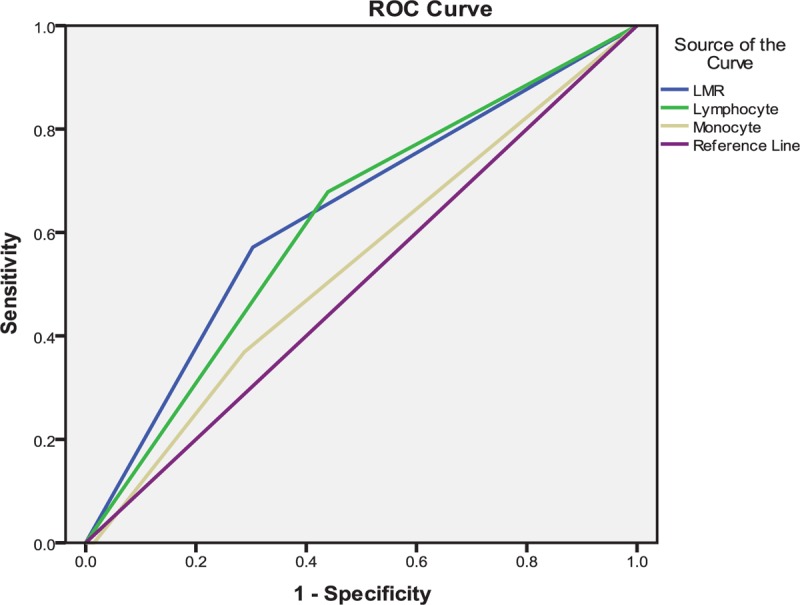
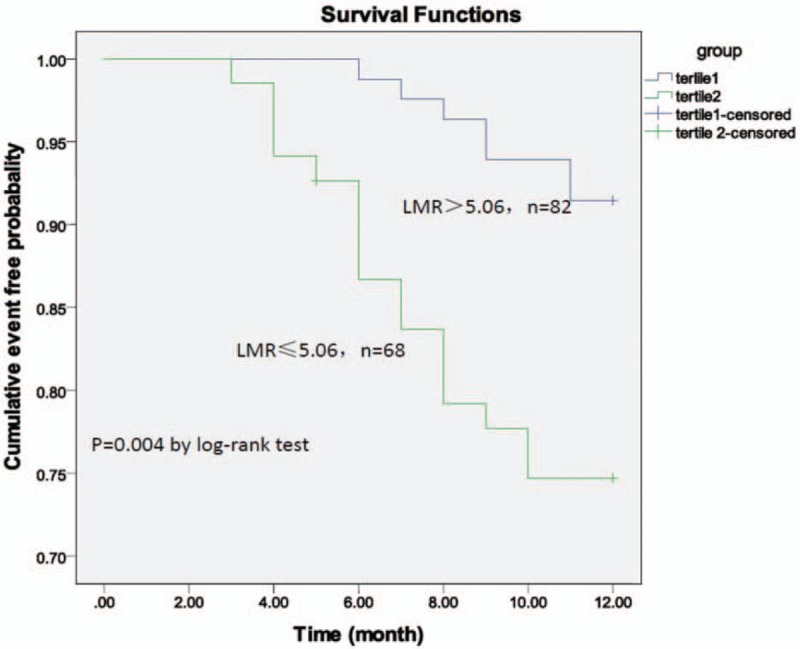
The aim of this study was to investigate the relationship between lymphocyte to monocyte ratio (LMR) and the severity of coronary artery disease (CAD) by using Gensini score. A total of 199 patients, who had undergone coronary angiography, were included in the study and retrospectively analyzed. Among them, 49 patients who had normal coronary arteries were selected as the control group. Patients with CAD were divided into 2 groups, those with low Gensini score (≤40) and those with high Gensini score (≥40). Our results showed that LMR in the severe atherosclerosis group was significantly lower than those of the mild atherosclerosis group and the control group. There was a closely significant correlation between the Gensini score and LMR (r = −0.362, P < .001). Furthermore, multivariate logistic regression analysis demonstrated that LMR (odds ratio, 0.715; 95% confidence interval [CI], 0.551–0.927; P = .012) was independent predictors of severe atherosclerosis. Using an optimal LMR cut-off value of 5.06, LMR predicted severe atherosclerosis with a sensitivity of 57.1% and specificity of 69.7% (area under curve = 0.634; 95% CI, 0.545–0.724; P = .005). Then patients with CAD group was divided into 2 groups according to the LMR value of 5.06. Patients with LMR ≤ 5.06 had worse prognosis, with a higher rate of cardiovascular events during up to 1 year follow-up. Our study demonstrated that LMR was independently and positively associated with the severity of coronary atherosclerosis, providing a new insight in the application of inflammation index evaluating the severity of CAD. And LMR may be a useful predictor of future cardiovascular events in patients with CAD.
Overview
The claims and statistics of this paper haven’t been checked yet.
Run the check — free, no account needed. It reads the open-access text and checks the sources it cites.
Integrity signals
Registry
Cites
Statistics
Figures
Verification
Claims the paper makes
The claims and statistics of this paper haven’t been checked yet.
Run the check — free, no account needed. It reads the open-access text and checks the sources it cites.
Claims other papers make about this one
Each is checked against this paper’s own text: does it say what the citing paper says it does?
The source backs part of the claim, not all of it — or backs it for a different population, condition or comparison.
In the citing paper
“Protection from cardiovascular disease has been associated with an LMR above 5 (Gong et al., 2018).”
From Reversal of epigenetic aging and immunosenescent trends in humans. (2019) · cites this paper as Gong et al., 2018
Experimental — accuracy not yet measuredThe cited source says what the claim attributes to it.
In the citing paper
“higher LMRs are associated with better prognoses for a variety of leading sources of human mortality, including at least 8 types of cancer (e.g., prostate cancer; Caglayan et al., 2019), atherosclerosis (Gong et al., 2018), cardiovascular disease (Ji et al., 2017), and stroke (Ren, Liu, Wang, & Gao, 2017)]”
From Reversal of epigenetic aging and immunosenescent trends in humans. (2019) · cites this paper as Gong et al., 2018
Self-check
Percentages, sums and reported differences re-computed from the paper’s own numbers.
The self-check needs the paper’s full text.
Citations
Cites
Inflammation, Atherosclerosis, and Coronary Artery Disease
Hansson, G. K. (2005) · New England Journal of Medicine · doi:10.1056/nejmra043430 · Cited by 8,773
A more meaningful scoring system for determining the severity of coronary heart disease
Gensini, G. G. (1983) · The American Journal of Cardiology · doi:10.1016/s0002-9149(83)80105-2 · Cited by 2,198
Pathophysiology of coronary artery disease
Libby, P., & Theroux, P. (2005) · Circulation · doi:10.1161/circulationaha.105.537878 · Cited by 1,965
Which White Blood Cell Subtypes Predict Increased Cardiovascular Risk?
Horne, B. D., Anderson, J. L., John, J. M., Weaver, A. N., Bair, T. L., Jensen, K. R., Renlund, D. G., & Muhlestein, J. B. (2005) · Journal of the American College of Cardiology · doi:10.1016/j.jacc.2005.02.054 · Cited by 984
Tamhane, U. U., Aneja, S., Montgomery, D., Rogers, E.-K., Eagle, K. A., & Gurm, H. S. (2008) · The American Journal of Cardiology · doi:10.1016/j.amjcard.2008.05.006 · Cited by 900
Monocytes in atherosclerosis: subsets and functions
Woollard, K. J., & Geissmann, F. (2010) · Nature Reviews Cardiology · doi:10.1038/nrcardio.2009.228 · Cited by 890
Inflammation in Atherosclerosis: Transition From Theory to Practice
Libby, P., Okamoto, Y., Rocha, V. Z., & Folco, E. (2010) · Circulation Journal · doi:10.1253/circj.cj-09-0706 · Cited by 799
The multifaceted contributions of leukocyte subsets to atherosclerosis: lessons from mouse models
Weber, C., Zernecke, A., & Libby, P. (2008) · Nature Reviews Immunology · doi:10.1038/nri2415 · Cited by 776
Neutrophil to lymphocyte ratio and cardiovascular diseases: a review
Bhat, T., Teli, S., Rijal, J., Bhat, H., Raza, M., Khoueiry, G., Meghani, M., Akhtar, M., & Costantino, T. (2013) · Expert Review of Cardiovascular Therapy · doi:10.1586/erc.12.159 · Cited by 600
Monocyte and Macrophage Dynamics During Atherogenesis
Ley, K., Miller, Y. I., & Hedrick, C. C. (2011) · Arteriosclerosis, Thrombosis, and Vascular Biology · doi:10.1161/atvbaha.110.221127 · Cited by 554
Cited by
Reversal of epigenetic aging and immunosenescent trends in humans.
Fahy, G. M., Brooke, R. T., Watson, J. P., Good, Z., Vasanawala, S. S., Maecker, H., Leipold, M. D., Lin, D. T. S., Kobor, M. S., & Horvath, S. (2019) · Aging Cell · doi:10.1111/acel.13028 · Cited by 477
Metadata
- Authors
- Gong, S., Gao, X., Xu, F., Shang, Z., Li, S., Chen, W., Yang, J., & Li, J.
- Affiliations
- The Key Laboratory of Cardiovascular Remodeling and Function Research, Chinese Ministry of Education and Chinese Ministry of Public Health
- International Medical Department, Qilu Hospital, Shandong University, Jinan
- Department of Cardiology, Heze Municipal Hospital, Heze, Shandong, China.
- Venue
- Medicine
- Published
- 2018-10
- Volume
- 97
- Issue
- 43
- Pages
- e12813
- ISSN
- 0025-7974
- 1536-5964
- PMC
- PMC6221743
- Cited by
- 80
- References
- 29
- Language
- en
About these checks
Registry, retraction, Cites and statistics results are computed, not judged, with one exception: a printed reference that no index lists is read once by a model before it counts as a citation error. Claims are extracted by a model and kept only when their quote appears verbatim in the text; each cited source is then checked, with a model’s help, for whether it says what the claim relies on. Those verdicts can be wrong — read the claim’s quote and the cited source before relying on one.
Statistics and arithmetic are recomputed, not judged.
Confidence bands are shown only for fields calibrated on our annotated test set. None is calibrated yet, so no band is shown.
What counts as a claim ›How we measure confidence ›How we check this ›
Are you an author, or do you see a problem with this page? Request a review
Data sources
Bibliographic data: Semantic Scholar, OpenAlex, Crossref.
Contains information from the Semantic Scholar Academic Graph Datasets, made available under the ODC Attribution License (ODC-BY 1.0).
Semantic Scholar’s data is described in: Kinney, R., et al. (2023). The Semantic Scholar Open Data Platform. arXiv:2301.10140.
