

The DOI matches its Crossref record; 31 of the 31 references it cites were found in a registry or an index.
Effectiveness, immunogenicity, and safety of influenza vaccines with MF59 adjuvant in healthy people of different age groups: A systematic review and meta-analysis
Open accessAbstract
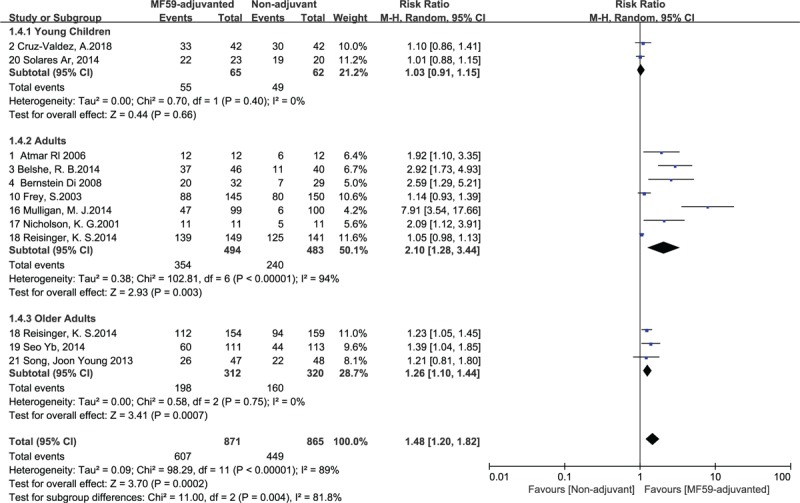
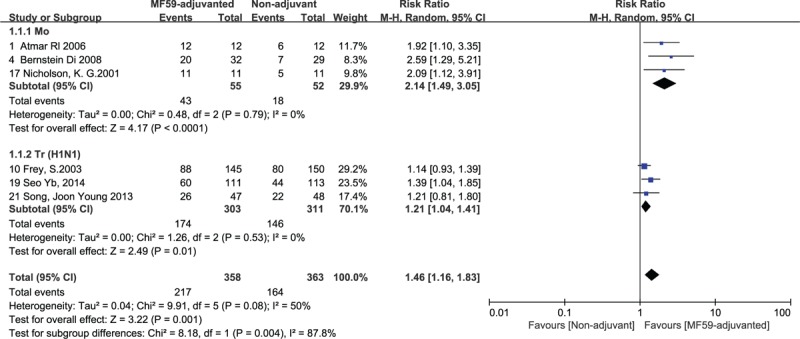
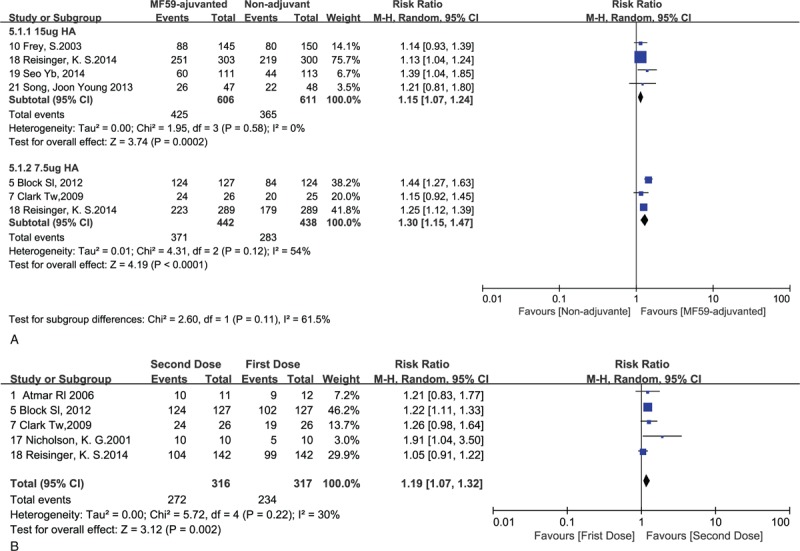
Background: Influenza is a severe disease burden among all age groups. This study aimed to review the efficacy of inactivated influenza vaccines with MF59 adjuvant and non-adjuvanted inactivated influenza vaccines among all age groups against specific influenza vaccine strains. Methods: Literature search of PubMed, Embase, Medline, OVID, and Cochrane Library Trials (CENTRAL) was implemented up to March 1, 2019. Homogeneity qualified studies were included for Data were extracted such as study country location, demographic characteristics, and measure outcomes, and were analyzed by a random effect model and sensitivity analyses to identify heterogeneity. Risk of bias was evaluated using the Cochrane Risk of Bias Tool. Results: We retrieved 1,021 publications and selected 31 studies for full review, including 17 trials for meta-analysis and 6 trials for qualitative synthesis. MF59-adjuvanted influenza vaccines demonstrated better immunogenicity against specific vaccine virus strains compared to non-adjuvanted influenza vaccine both in healthy adult group (RR = 2.10; 95% CI: 1.28–3.44) and the healthy aged (RR = 1.26; 95% CI: 1.10–1.44). Conclusion: The quality of evidence is moderate to high for seroconversion and seroprotection rates of influenza vaccine. MF59-adjuvanted influenza vaccines are superior to non-adjuvanted influenza vaccines to enhance immune responses of vaccination in healthy adults and older adults, and could be considered for routine use especially the monovalent prepandemic influenza vaccines.
Overview
The claims and statistics of this paper haven’t been checked yet.
Run the check — free, no account needed. It reads the open-access text and checks the sources it cites.
Integrity signals
Registry
Cites
Statistics
Figures
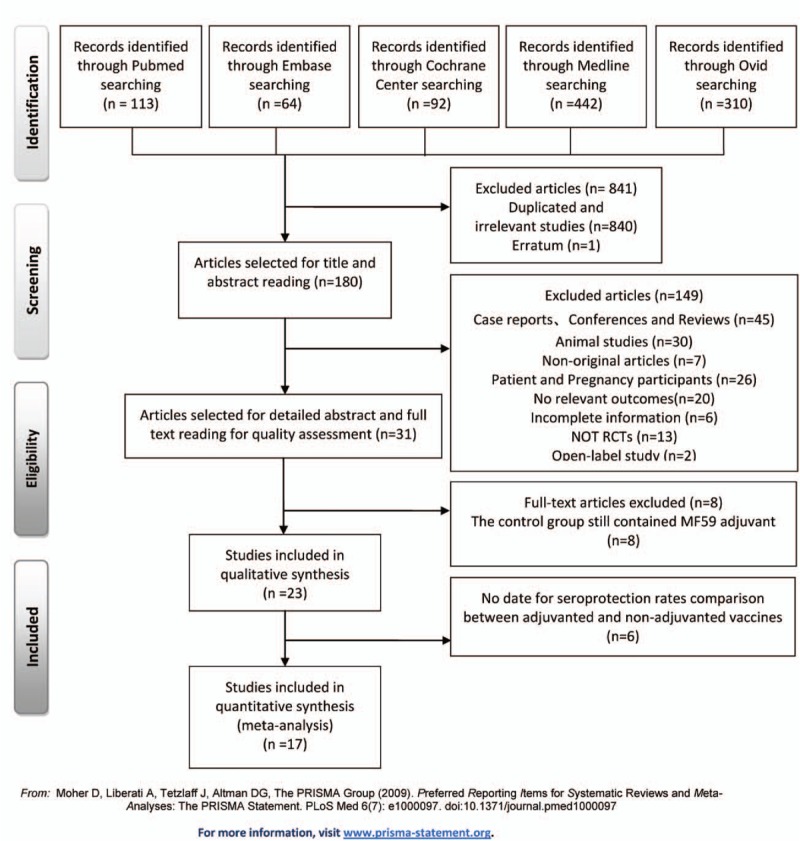
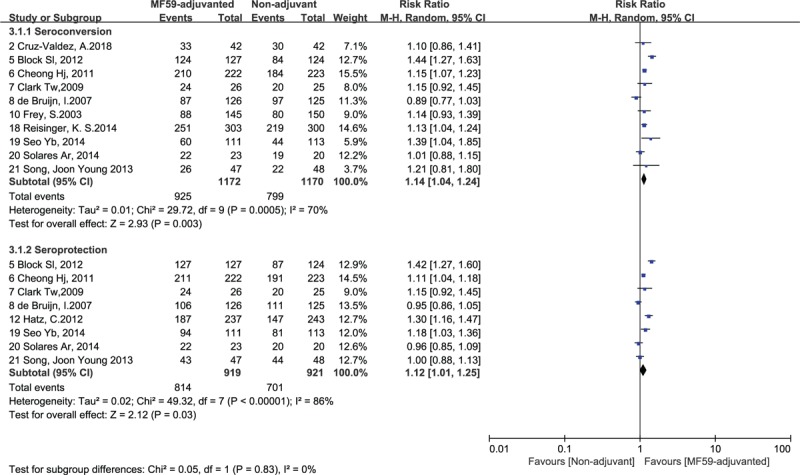
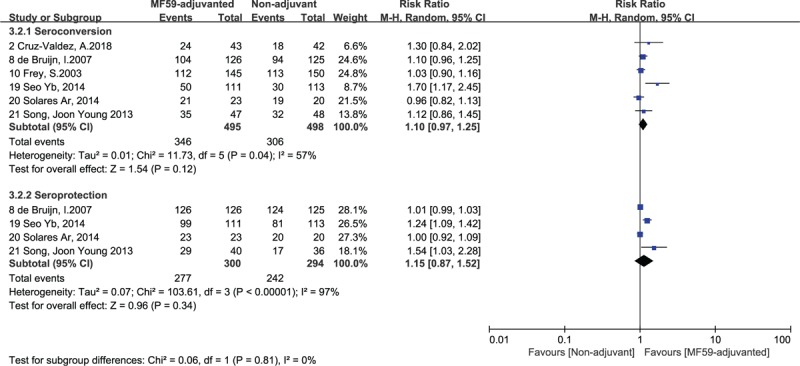
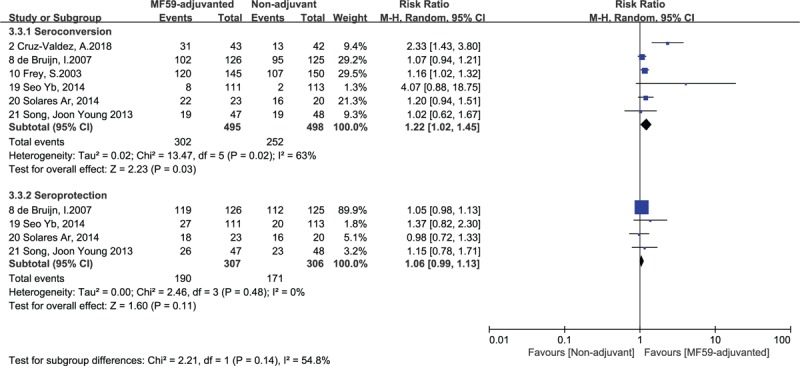
Verification
Claims the paper makes
The claims and statistics of this paper haven’t been checked yet.
Run the check — free, no account needed. It reads the open-access text and checks the sources it cites.
Claims other papers make about this one
Each is checked against this paper’s own text: does it say what the citing paper says it does?
In the citing paper
“In the elderly population, MF59-adjuvanted influenza vaccines enhance seroconversion and seroprotection rates compared with non-adjuvanted vaccines240 and induce broad serological protection against strains with antigenic drift241.”
From mRNA vaccines for infectious diseases: principles, delivery and clinical translation (2021) · cites this paper as [240]
Self-check
Percentages, sums and reported differences re-computed from the paper’s own numbers.
The self-check needs the paper’s full text.
Citations
Cites
Trial of 2009 Influenza A (H1N1) Monovalent MF59-Adjuvanted Vaccine
Clark, T. W., Pareek, M., Höschler, K., Dillon, H., Nicholson, K. G., Groth, N., & Stephenson, I. (2009) · New England Journal of Medicine · doi:10.1056/nejmoa0907650 · Cited by 445
Nicholson, K. G., Colegate, A., Podda, A., Stephenson, I., Wood, J., Ypma, E., & Zambon, M. C. F. A. (2001) · The Lancet · doi:10.1016/s0140-6736(00)05066-2 · Cited by 440
Khurana, S., Verma, N., Yewdell, J. W., Hilbert, A. K., Castellino, F., Lattanzi, M., Giudice, G. D., Rappuoli, R., & Golding, H. (2011) · Science Translational Medicine · doi:10.1126/scitranslmed.3002336 · Cited by 357
Vaccine technologies: From whole organisms to rationally designed protein assemblies
Karch, C. P., & Burkhard, P. (2016) · Biochemical Pharmacology · doi:10.1016/j.bcp.2016.05.001 · Cited by 252
Domnich, A., Arata, L., Amicizia, D., Puig-Barberà, J., Gasparini, R., & Panatto, D. (2017) · Vaccine · doi:10.1016/j.vaccine.2016.12.011 · Cited by 229
Kang, I., Hong, M. S., Nolasco, H., Park, S. H., Dan, J. M., Choi, J.-Y., & Craft, J. E. (2004) · The Journal of Immunology · doi:10.4049/jimmunol.173.1.673 · Cited by 197
Effects of Adjuvants on the Safety and Immunogenicity of an Avian Influenza H5N1 Vaccine in Adults
Bernstein, D. I., Edwards, K. M., Dekker, C. L., Belshe, R. B., Talbot, H. K., Graham, I. L., Noah, D. L., He, F., & Hill, H. (2008) · The Journal of Infectious Diseases · doi:10.1086/527489 · Cited by 195
Protection Against Influenza After Annually Repeated Vaccination
BEYER, W. E. P., de Bruijn, I. A., Palache, A. M., Westendorp, R. G. J., & Osterhaus, A. D. M. E. (1999) · Archives of Internal Medicine · doi:10.1001/archinte.159.2.182 · Cited by 185
Safety and Immunogenicity of Nonadjuvanted and MF59-Adjuvanted Influenza A/H9N2 Vaccine Preparations
Atmar, R. L., Keitel, W., Patel, S. M., Katz, J. M., She, D., Sahly, H. M. E., Pompey, J. M., Cate, T. R., & Couch, R. B. (2006) · Clinical Infectious Diseases · doi:10.1086/508174 · Cited by 148
Mulligan, M. J., Bernstein, D. I., Winokur, P. L., Rupp, R. E., Anderson, E. J., Rouphael, N., Dickey, M., Stapleton, J. T., Edupuganti, S., Spearman, P. W., et al. (2014) · JAMA · doi:10.1001/jama.2014.12854 · Cited by 133
Cited by
Sorted by citations
mRNA vaccines for infectious diseases: principles, delivery and clinical translation
Chaudhary, N., Weissman, D., & Whitehead, K. A. (2021) · Nature Reviews Drug Discovery · doi:10.1038/s41573-021-00283-5 · Cited by 1,555
A Comprehensive Review of mRNA Vaccines
Gote, V., Bolla, P. K., Kommineni, N., Butreddy, A., Nukala, P. K., Palakurthi, S. S., & Khan, W. (2023) · International Journal of Molecular Sciences · doi:10.3390/ijms24032700 · Cited by 457
Targeting Inflammation and Immunosenescence to Improve Vaccine Responses in the Elderly
Pereira, B. I., Xu, X., & Akbar, A. N. (2020) · Frontiers in Immunology · doi:10.3389/fimmu.2020.583019 · Cited by 190
Age-related changes in the immune system and challenges for the development of age-specific vaccines
Doherty, M. T., Weinberger, B., Didierlaurent, A. M., & Lambert, P. (2025) · Annals of Medicine · doi:10.1080/07853890.2025.2477300 · Cited by 69
Boikos, C., Fischer, L., O’Brien, D., Vasey, J., Sylvester, G. C., & Mansi, J. A. (2021) · Clinical Infectious Diseases · doi:10.1093/cid/ciab152 · Cited by 52
Metadata
- Authors
- Yang, J., Zhang, J., Han, T., Liu, C., Li, X., Yan, L., Yang, B., & Yang, X.
- Affiliations
- National Institute of Engineering Technology Research in Combination Vaccine
- Corresponding author
- Yang, Xiaoming
- Venue
- Medicine
- Published
- 2020-02
- Volume
- 99
- Issue
- 7
- Pages
- e19095
- ISSN
- 0025-7974 (ISSN-L)
- 1536-5964
- PMC
- PMC7035094
- OpenAlex
- W3006614329
- Cited by
- 37
- References
- 31
- Citations by year
- 2026: 1 · 2025: 6 · 2024: 1 · 2023: 13 · 2022: 3 · 2021: 9 · 2020: 4
- FWCI
- 1.06
- Type
- journal article
- Language
- en
- Open access
- gold
- doi.org
- Licence
- Locations
- Medicine (publishedVersion, cc-by-nc)
- PubMed Central (publishedVersion, cc-by-nc)
- PubMed (publishedVersion)
- Topics
- Health Sciences › Medicine › Epidemiology › Influenza Virus Research Studies
- Life Sciences › Immunology and Microbiology › Microbiology › Bacterial Infections and Vaccines
- Health Sciences › Medicine › Epidemiology › Respiratory viral infections research
- Keywords
- inactivated influenza vaccine, MF59 adjuvant, vaccine immunogenicity, vaccine efficacy, vaccine safety, seroconversion, seroprotection, older adults, adults, age groups
- MeSH terms
- Seroconversion, Immunogenicity, Vaccine, Adjuvants, Immunologic, Adolescent, Adult, Age Factors, Aged, Aged, 80 and over, Child, Female, Humans, Influenza, Human, Influenza Vaccines, Male, Middle Aged, Polysorbates, Squalene, Vaccines, Inactivated, Randomized Controlled Trials as Topic, Young Adult
About these checks
Registry, retraction, Cites and statistics results are computed, not judged, with one exception: a printed reference that no index lists is read once by a model before it counts as a citation error. Claims are extracted by a model and kept only when their quote appears verbatim in the text; each cited source is then checked, with a model’s help, for whether it says what the claim relies on. Those verdicts can be wrong — read the claim’s quote and the cited source before relying on one.
Statistics and arithmetic are recomputed, not judged.
Confidence bands are shown only for fields calibrated on our annotated test set. None is calibrated yet, so no band is shown.
What counts as a claim ›How we measure confidence ›How we check this ›
Are you an author, or do you see a problem with this page? Request a review
