

Reminiscence therapy-based care program for reducing anxiety and depression in glioma survivors: A randomized controlled trial
Open accessThe DOI matches its Crossref record; 26 of the 26 references it cites were found in a registry or an index.
Abstract
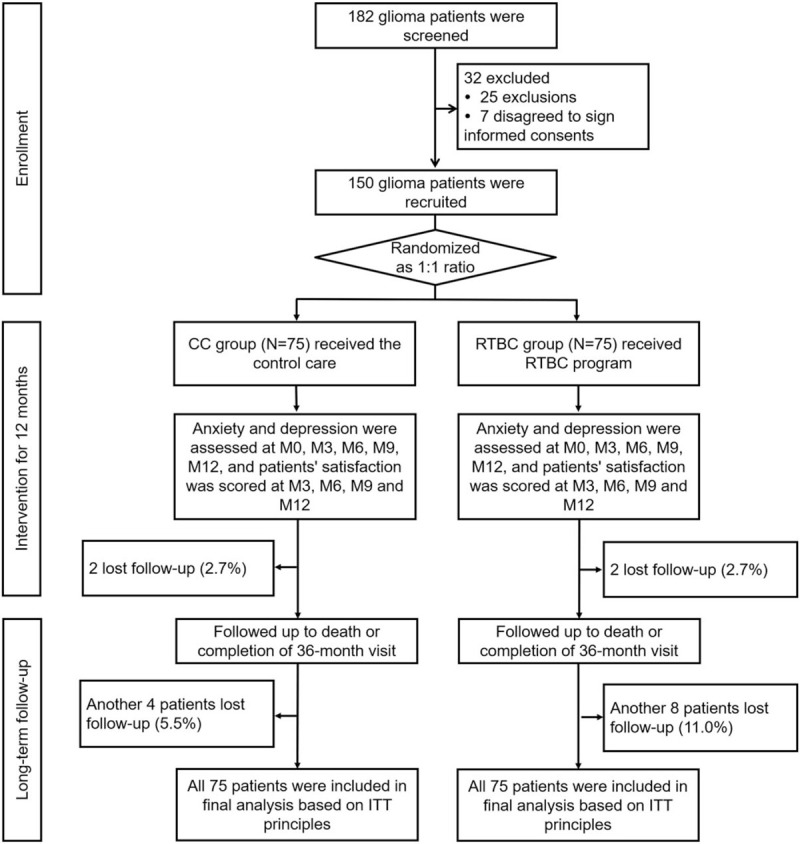
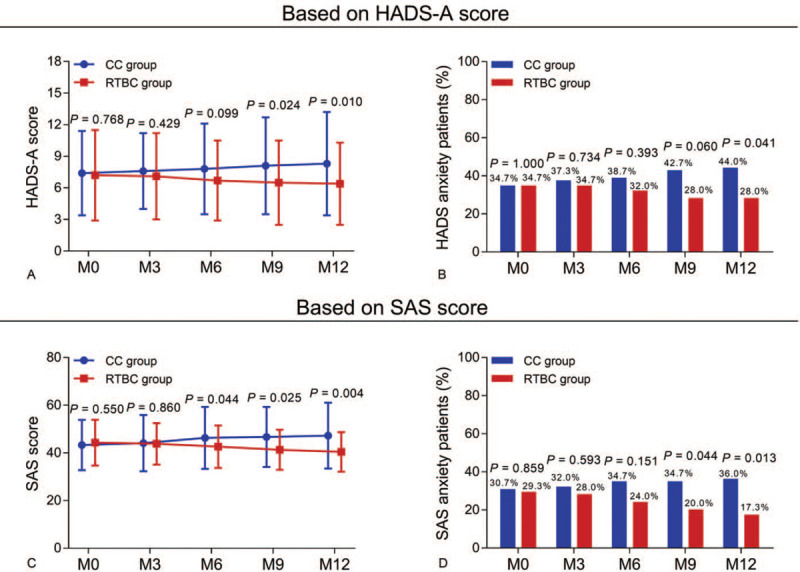
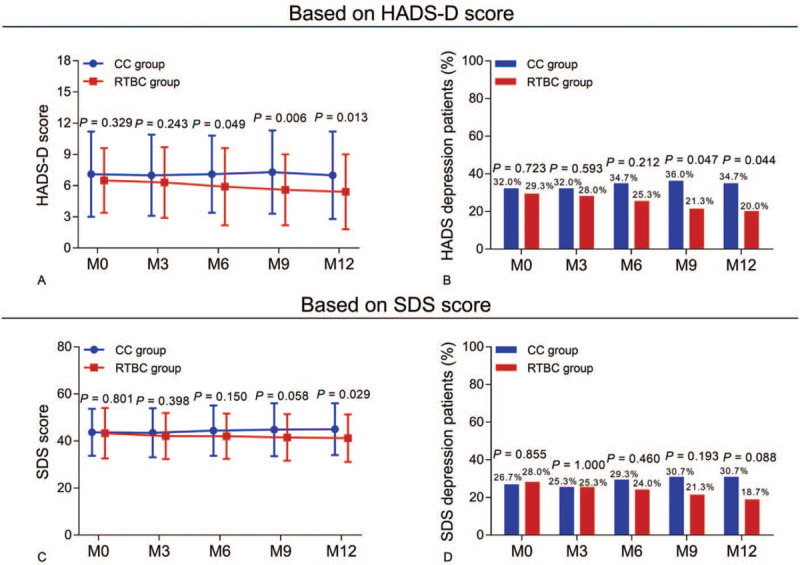
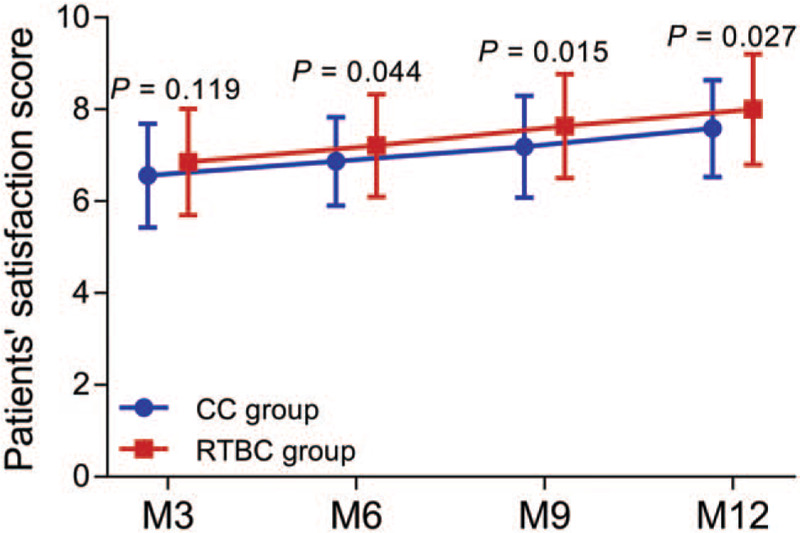
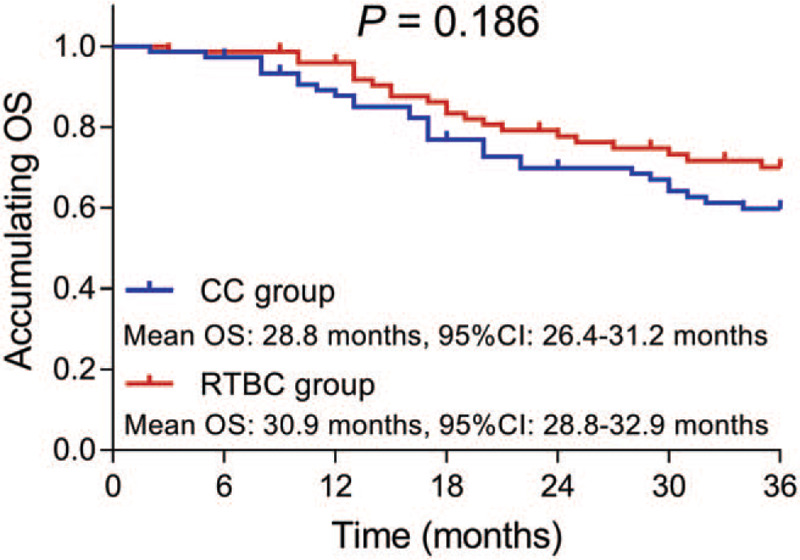
This study aimed to evaluate the effect of reminiscence therapy-based care (RTBC) program on anxiety, depression, patients satisfaction, and survival benefit in glioma patients after tumor resection. A total of 150 eligible glioma patients were randomized into the RTBC group (N = 75, receiving RTBC) and the control care (CC) group (N = 75, receiving CC). Interventions were performed twice a month for 12 months. Anxiety was evaluated by Hospital Anxiety and Depression Scale (HADS) for anxiety score and Zung self-rating anxiety scale (SAS) score; meanwhile, depression was evaluated by HADS for depression score and Zung self-rating depression scale (SDS) score; additionally, patients satisfaction was scored. A 36-month follow-up was performed, and accumulating overall survival (OS) were calculated. Both anxiety level and depression level were reduced in the RTBC group compared with the CC group at month 9 and month 12 (all P < .05); meanwhile, the proportion of anxious patients and depressed patients were decreased in the RTBC group compared with the CC group at month 12 (all P < .05). Moreover, patients satisfaction scores were increased in the RTBC group compared to the CC group at month 6, month 9, and month 12 (all P < .05). Additionally, accumulating OS showed an increasing tendency in the RTBC group compared to the CC group, but no statistical significance was observed (P = .186). RTBC program ameliorates anxiety, depression, and promotes patients satisfaction in glioma patients after tumor resection.
Overview
The claims and statistics of this paper haven’t been checked yet.
Free: it reads the open-access text and checks the first 5 claims that cite a source we can check. Create a free account to check every claim.
Integrity signals
Registry
Cites
Statistics
Figures
Verification
Claims the paper makes
The claims and statistics of this paper haven’t been checked yet.
Free: it reads the open-access text and checks the first 5 claims that cite a source we can check. Create a free account to check every claim.
Self-check
Percentages, sums and reported differences re-computed from the paper’s own numbers.
The self-check needs the paper’s full text.
Citations
Cites
The Hospital Anxiety and Depression Scale
Zigmond, A. S., & Snaith, R. P. (1983) · Acta Psychiatrica Scandinavica · doi:10.1111/j.1600-0447.1983.tb09716.x · Cited by 47,139 · cited 1×
“HADS-A and HADS-D score were ranging from0 to 21, and theHADS-A score≥8 orHADS-D score ≥8 was considered as anxiety or depression, correspondingly.([12]) SAS score and SDS score were ranging from 0 to 100, and the SAS score ≥50 or SDS score ≥50 was considered as anxiety or depression, accordingly.”
BackgroundKrebber, A. M. H., Buffart, L. M., Kleijn, G., Riepma, I. C., de Bree, R., Leemans, C. R., Becker, A., Brug, J., van Straten, A., Cuijpers, P., et al. (2014) · Psycho-Oncology · doi:10.1002/pon.3409 · Cited by 908 · cited 1×
“Anxiety and depression are well-recognized complications of glioma, and the frequency of glioma patients developing anxiety and depression ranges from 8% to 24%.([18]) Meanwhile, it is proposed that anxiety and depression are associated with the reduction of physical function, cognitive impairment, the decline of qual…”
BackgroundOstrom, Q. T., Gittleman, H., Stetson, L., Virk, S. M., & Barnholtz-Sloan, J. S. (2015) · Cancer Treatment and Research · doi:10.1007/978-3-319-12048-5_1 · Cited by 400 · cited 1×
“Glioma is a common type of primary brain tumor that affects around 4 to 7 in every 100,000 people annually worldwide.([1]) Patients with glioma suffer from the symptoms including headache, paresis, sensory loss, fatigue, cognitive deficits, anxiety, and depression, which greatly affect the quality of life of glioma pa…”
BackgroundDepression in Patients with High-grade Glioma: Results of the Glioma Outcomes Project
Glioma Outcomes Project Investigators, Litofsky, N. S., Farace, E., Anderson, F., Meyers, C. A., Huang, W., & Laws, E. R. (2004) · Neurosurgery · doi:10.1227/01.neu.0000103450.94724.a2 · Cited by 295 · cited 1×
“the RTBC program reduced depression (which was associated with worse prognosis according to a previous study ([25])) compared with control care in glioma patients, thus it might promote OS in glioma patients; 2.”
ResultDepression in Cerebral Glioma Patients: A Systematic Review of Observational Studies
Rooney, A. G., Carson, A., & Grant, R. (2011) · JNCI Journal of the National Cancer Institute · doi:10.1093/jnci/djq458 · Cited by 217 · cited 1×
“Meanwhile, it is proposed that anxiety and depression are associated with the reduction of physical function, cognitive impairment, the decline of quality of life, and most importantly, worse outcomes in glioma patients.([15]) Thus, ameliorating anxiety and depression might be beneficial for glioma patients.”
BackgroundEngel‐Yeger, B., Muzio, C., Rinosi, G., Solano, P., Geoffroy, P. A., Pompili, M., Amore, M., & Serafini, G. (2015) · Psychiatry Research · doi:10.1016/j.psychres.2015.12.022 · Cited by 175
Anxiety and depression in patients with an intracranial neoplasm before and after tumour surgery
PRINGLE, A.-M., TAYLOR, R., & WHITTLE, I. R. (1999) · British Journal of Neurosurgery · doi:10.1080/02688699944177 · Cited by 166
Syed Elias, S. M., Neville, C., & Scott, T. (2015) · Geriatric Nursing · doi:10.1016/j.gerinurse.2015.05.004 · Cited by 159 · cited 2×
“improve their communication skills and to establish new relationships,([21]) which could help decrease anxiety and depression in glioma patients; 3.”
BackgroundLök, N., Bademli, K., & Selçuk‐Tosun, A. (2019) · International Journal of Geriatric Psychiatry · doi:10.1002/gps.4980 · Cited by 156 · cited 2×
“patients with Alzheimer’s (which is characterized by cognitive deficits as glioma).([11]) Based on the above-mentioned information, we hypothesized that reminiscence therapy could reduce anxiety and depression in glioma patients.”
BackgroundAlexithymia and Suicide Risk in Psychiatric Disorders: A Mini-Review
De Berardis, D., Fornaro, M., Orsolini, L., Valchera, A., Carano, A., Vellante, F., Perna, G., Serafini, G., Gonda, X., Pompili, M., et al. (2017) · Frontiers in Psychiatry · doi:10.3389/fpsyt.2017.00148 · Cited by 149 · cited 1×
“Anxiety and depression are associated with the negative outcome of glioma patients.([5]) In order to further investigate whether the RTBC program could impact the outcomes of glioma patients, we performed a follow-up of 36-month and found that the RTBC program had a minor effect on accumulating OS in glioma patients c…”
Background
Cited by
Management of Anxiety and Depression in Adult Survivors of Cancer: ASCO Guideline Update
Andersen, B. L., Lacchetti, C., Ashing, K., Berek, J. S., Berman, B. S., Bolte, S., Dizon, D. S., Given, B., Nekhlyudov, L., Pirl, W., et al. (2023) · Journal of Clinical Oncology · doi:10.1200/jco.23.00293 · Cited by 318
“145 For any acutely suicidal patient, institutional management and referral policies should be followed.”
Palliative care and end-of-life care in adults with malignant brain tumors
Koekkoek, J. A. F., van der Meer, P. B., Pace, A., Hertler, C., Harrison, R. A., Leeper, H. E., Forst, D. A., Jalali, R., Oliver, K. R., Philip, J. A. M., et al. (2022) · Neuro-Oncology · doi:10.1093/neuonc/noac216 · Cited by 113
Depression and anxiety in glioma patients
van der Meer, P. B., Dirven, L., Hertler, C., Boele, F. W., Batalla, A., Walbert, T., Rooney, A. G., & Koekkoek, J. A. F. (2023) · Neuro-Oncology Practice · doi:10.1093/nop/npad019 · Cited by 64
“37,38 An online problem-solving therapy versus a waitlist control group ( n = 115 glioma patients) did not result in the reduction of depressive symptoms.”
BackgroundYoung, J. S., Al-Adli, N. N., Sibih, Y., Scotford, K. L., Casey, M., James, S., & Berger, M. S. (2022) · Journal of neurosurgery · doi:10.3171/2022.9.jns221139 · Cited by 39
Li, T., Li, B., Tan, L., & Lv, B. (2022) · Frontiers in Surgery · doi:10.3389/fsurg.2022.873843 · Cited by 23
Metadata
- Authors
- Zhao, X.
- Affiliations
- First Affiliated Hospital of Harbin Medical University (CN)
- Corresponding author
- Zhao, Xu
- ORCID
- Zhao, Xu
- Venue
- Medicine
- Published
- 2021-02-05
- Volume
- 100
- Issue
- 5
- Pages
- e23056
- ISSN
- 0025-7974 (ISSN-L)
- 1536-5964
- PMC
- PMC7870240
- OpenAlex
- W3133252327
- Semantic Scholar
- ed6bc13523bf62f8e8a779add9dd7988e61f36a8
- Cited by
- 23
- References
- 26
- Citations by year
- 2026: 3 · 2025: 6 · 2024: 2 · 2023: 5 · 2022: 6 · 2021: 1
- FWCI
- 1.27
- Type
- journal article
- Language
- en
- Open access
- gold
- doi.org
- Licence
- Locations
- Medicine (publishedVersion, cc-by-nc)
- PubMed Central (publishedVersion, cc-by-nc)
- PubMed (publishedVersion)
- Topics
- Health Sciences › Medicine › Oncology › Cancer survivorship and care
- Social Sciences › Psychology › Clinical Psychology › Art Therapy and Mental Health
- Social Sciences › Psychology › Social Psychology › Music Therapy and Health
- Keywords
- reminiscence therapy, glioma, anxiety, depression, postoperative psychological care, patient satisfaction, overall survival, tumor resection, psychological intervention
- MeSH terms
- Narrative Medicine, Adult, Age Factors, Aged, Anxiety, Brain Neoplasms, Depression, Female, Glioma, Humans, Male, Middle Aged, Sex Factors, Socioeconomic Factors, Comorbidity, Patient Satisfaction
About these checks
Registry, retraction, Cites and statistics results are computed, not judged, with one exception: a printed reference that no index lists is read once by a model before it counts as a citation error. Claims are extracted by a model and kept only when their quote appears verbatim in the text; each cited source is then checked, with a model’s help, for whether it says what the claim relies on. Those verdicts can be wrong — read the claim’s quote and the cited source before relying on one.
Statistics and arithmetic are recomputed, not judged.
Confidence bands are shown only for fields calibrated on our annotated test set. None is calibrated yet, so no band is shown.
What counts as a claim ›How we measure confidence ›How we check this ›
Are you an author, or do you see a problem with this page? Request a review
Data sources
Bibliographic data: Semantic Scholar, OpenAlex, Crossref.
Contains information from the Semantic Scholar Academic Graph Datasets, made available under the ODC Attribution License (ODC-BY 1.0).
Semantic Scholar’s data is described in: Kinney, R., et al. (2023). The Semantic Scholar Open Data Platform. arXiv:2301.10140.
