

Clinical effectiveness of liraglutide on weight loss in South Koreans: First real-world retrospective data on Saxenda in Asia
Open accessThe DOI matches its Crossref record; 27 of the 27 references it cites were found in a registry or an index.
Abstract
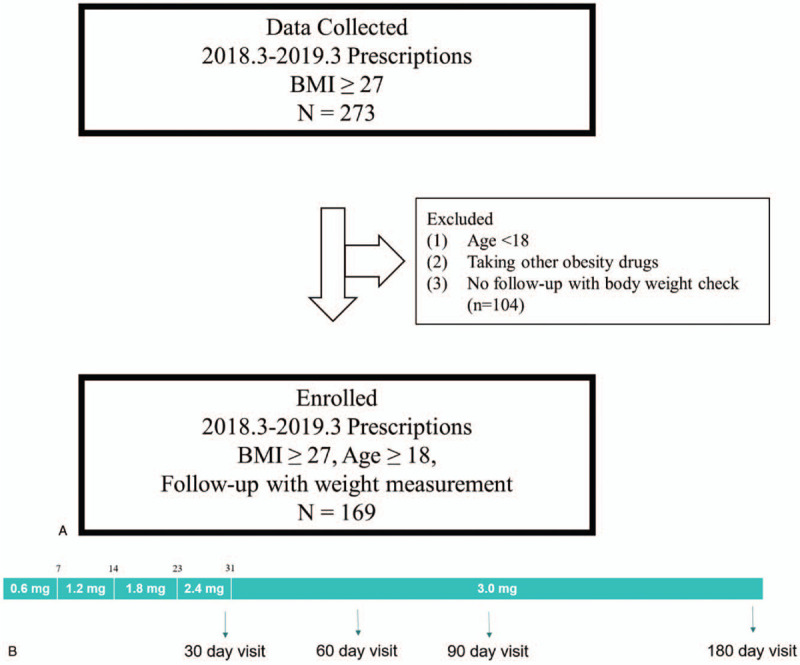
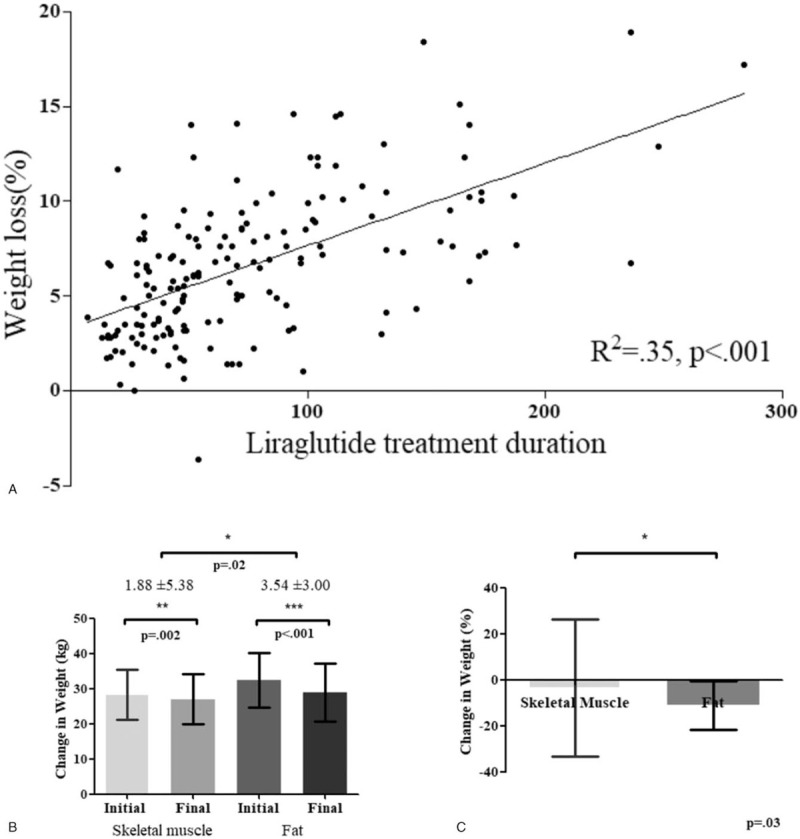
Among Asian countries, South Korea was the first to approve liraglutide as a treatment for obesity. Thus, the clinical effectiveness of liraglutide has not been studied in Asian populations. In this study, we retrospectively analyzed obese patients [body mass index (BMI) >27 kg/m 2] who were treated with liraglutide between March 2018 and March 2019 in a single clinic. Weight, BMI, HbA1c, and clinical data were collected before liraglutide treatment. Changes in body weight and composition and their relationships with clinical variables were examined at re-prescription dates within 30, 60, 90, and 180 days. A total of 169 subjects were studied. The average age was 41.5 years, and 42% of the subjects were male. The average weight was 85.2 kg, and the average BMI was 30.8 kg/m 2. Weight reduction was significant (–5.5 ± 3.4 kg, 30 days: –3.2 ± 1.8 kg, 60 days: –4.5 ± 2.3 kg, 90 days: –6.3 ± 2.6 kg, 180 days: –7.8 ± 3.5 kg) during the follow-up period and increased with longer treatment time (P < .001). The percentages of subjects that showed ≥ 5% and ≥ 10% body weight reduction were 62.1% and 17.2%, respectively. In the body composition analysis, skeletal muscle weight loss was –3.56 ± 29.7%, which was significantly smaller than fat weight loss of –11.06 ± 10.4% (P = .03). Weight loss was not significantly related to age, sex, baseline BMI, baseline HbA1c, smoking status, alcohol consumption, coffee intake. In conclusion, Liraglutide treatment led to meaningful weight loss in South Korean patients, and fat mass reduction was prominent during treatment. Furthermore, liraglutide showed greater clinical effectiveness with longer treatment time.
Overview
The claims and statistics of this paper haven’t been checked yet.
Free: it reads the open-access text and checks the first 5 claims that cite a source we can check. Create a free account to check every claim.
Integrity signals
Registry
Cites
Statistics
Figures
Verification
Claims the paper makes
The claims and statistics of this paper haven’t been checked yet.
Free: it reads the open-access text and checks the first 5 claims that cite a source we can check. Create a free account to check every claim.
Claims other papers make about this one
Each is checked against this paper’s own text: does it say what the citing paper says it does?
The source backs part of the claim, not all of it — or backs it for a different population, condition or comparison.
In the citing paper
“Similarly, patients with type 2 diabetes were also represented in many studies51,53,54,56,57,59,62,63,65,68–71.”
From Incretin-based therapies for the treatment of obesity-related diseases (2024) · cites this paper as [62]
Experimental — accuracy not yet measuredIn the citing paper
“As in RCT, participants were mostly adults (mean age 30.4–55.5 years) and females (60–95%) with class II obesity, except for studies conducted in China and South Korea, enrolling patients with a mean BMI ranging from 30.8 to 33 kg/m2 53,54,62,66.”
From Incretin-based therapies for the treatment of obesity-related diseases (2024) · cites this paper as [62]
In the citing paper
“Glucagon-like peptide-1 (GLP-1) receptor agonists (GLP-1RAs) are effective antiobesity drugs.”
From GLP-1 increases preingestive satiation via hypothalamic circuits in mice and humans (2024) · cites this paper as [7]
Self-check
Percentages, sums and reported differences re-computed from the paper’s own numbers.
The self-check needs the paper’s full text.
Citations
Cites
(2004) · The Lancet · doi:10.1016/s0140-6736(03)15268-3 · Cited by 12,717
Abarca-Gómez, L., Abdeen, Z. A., Hamid, Z. A., Abu-Rmeileh, N. M., Acosta-Cazares, B., Acuin, C., Adams, R. J., Aekplakorn, W., Afsana, K., Aguilar-Salinas, C. A., et al. (2017) · The Lancet · doi:10.1016/s0140-6736(17)32129-3 · Cited by 7,482
A Randomized, Controlled Trial of 3.0 mg of Liraglutide in Weight Management
Pi-Sunyer, X., Astrup, A., Fujioka, K., Greenway, F., Halpern, A., Krempf, M., Lau, D. C. W., le Roux, C. W., Violante Ortiz, R., Jensen, C. B., et al. (2015) · New England Journal of Medicine · doi:10.1056/nejmoa1411892 · Cited by 2,724
Diabetes in Asia: Epidemiology, Risk Factors, and Pathophysiology
Chan, J. C. N., Malik, V., Jia, W., Kadowaki, T., Yajnik, C. S., Yoon, K.-H., & Hu, F. B. (2009) · JAMA · doi:10.1001/jama.2009.726 · Cited by 1,997 · cited 3×
“Weight loss was evident regardless of baseline BMI.”
BackgroundInfluentialLong-term weight loss maintenance
Wing, R. R., & Phelan, S. (2005) · The American Journal of Clinical Nutrition · doi:10.1093/ajcn/82.1.222s · Cited by 1,941 · cited 1×
“However, the overall effects of behavioral therapies in weight loss maintenance can be meaningful yet small, and can result in a gradual regain of the weight.([4,5]) Pharmacological treatments can act as an adjunct to behavioral treatments, especially for cases in which lifestyle changes fail to produce the desired we…”
BackgroundMechanisms, Pathophysiology, and Management of Obesity
Heymsfield, S. B., & Wadden, T. A. (2017) · New England Journal of Medicine · doi:10.1056/nejmra1514009 · Cited by 1,867 · cited 1×
“Obesity is a globally prevalent chronically relapsing disease that requires continuous efforts toward prevention and treatment.([1]) Weight loss of over 5% is known to improve the risk of morbidity andmortality andmeaningfully improve health-related quality of life.”
BackgroundNew trends on obesity and NAFLD in Asia
Fan, J.-G., Kim, S.-U., & Wong, V. W.-S. (2017) · Journal of Hepatology · doi:10.1016/j.jhep.2017.06.003 · Cited by 1,083 · cited 1×
“In Asian populations, people with relatively lower BMI values can be obese; thus, the international classification of obesity defines BMI ≥ 25 as obese for Asian populations.([20]) We found that those with 27 BMI<30, 30 BMI<33, and 33 BMI achieved statistically similar weight loss (6.”
Backgroundon behalf of the NN8022-1923 Investigators, Wadden, T. A., Hollander, P., Klein, S., Niswender, K., Woo, V, Hale, P. M., & Aronne, L. (2013) · International Journal of Obesity · doi:10.1038/ijo.2013.120 · Cited by 842
Dombrowski, S. U., Knittle, K., Avenell, A., Araujo-Soares, V., & Sniehotta, F. F. (2014) · BMJ · doi:10.1136/bmj.g2646 · Cited by 816 · cited 1×
“However, the overall effects of behavioral therapies in weight loss maintenance can be meaningful yet small, and can result in a gradual regain of the weight.([4,5]) Pharmacological treatments can act as an adjunct to behavioral treatments, especially for cases in which lifestyle changes fail to produce the desired we…”
Backgroundvan Can, J., Sloth, B., Jensen, C. B., Flint, A., Blaak, E. E., & Saris, W. H. M. (2014) · International Journal of Obesity · doi:10.1038/ijo.2013.162 · Cited by 537 · cited 1×
“Liraglutide is an acylated glucagon-like peptide-1 (GLP-1) analog that has 97% similarity to human GLP-1 and is known to lower body weight by reducing appetite and calorie intake.([8,9]) Randomized controlled studies have proven that liraglutide prescribed up to 3.”
Background
Cited by
GLP-1 increases preingestive satiation via hypothalamic circuits in mice and humans
Kim, K. S., Park, J. S., Hwang, E., Park, M. J., Shin, H. Y., Lee, Y. H., Kim, K. M., Gautron, L., Godschall, E., Portillo, B., et al. (2024) · Science · doi:10.1126/science.adj2537 · Cited by 148
Self-citationEffectiveness and safety of drugs for obesity
Henderson Lewis, K., Sloan, C. E., Bessesen, D. H., & Arterburn, D. (2024) · BMJ · doi:10.1136/bmj-2022-072686 · Cited by 66
Park, J. S., Kim, K. S., & Choi, H. J. (2025) · Diabetes & Metabolism Journal · doi:10.4093/dmj.2025.0106 · Cited by 61
Self-citationIncretin-based therapies for the treatment of obesity-related diseases
Caruso, I., Cignarelli, A., Sorice, G. P., Perrini, S., & Giorgino, F. (2024) · npj Metabolic Health and Disease · doi:10.1038/s44324-024-00030-5 · Cited by 48
Anyiam, O., Ardavani, A., Rashid, R. S. A., Panesar, A., & IDRIS, I. R. (2025) · Obesity Reviews · doi:10.1111/obr.13916 · Cited by 49
Marked weight loss on liraglutide 3.0 mg: Real‐life experience of a Swiss cohort with obesity
Santini, S., Vionnet, N., Pasquier, J., Gonzalez‐Rodriguez, E., Fraga, M., Pitteloud, N., & Favre, L. (2023) · Obesity · doi:10.1002/oby.23596 · Cited by 39
“In contrast, the Korean real-life study did not show any differences in terms of weight loss according to sex [29].”
ResultThe Impact Once-Weekly Semaglutide 2.4 mg Will Have on Clinical Practice: A Focus on the STEP Trials
Alabduljabbar, K., Al-Najim, W., & le Roux, C. W. (2022) · Nutrients · doi:10.3390/nu14112217 · Cited by 26
Vilarrasa, E., Nicolau, J., de la Cueva, P., Goday, A., Gallardo, F., Martorell, A., & Carrascosa, J. M. (2023) · Actas Dermo-Sifiliográficas · doi:10.1016/j.ad.2023.06.017 · Cited by 28
Valladales‐Restrepo, L. F., Sánchez-Ramírez, N., Usma-Valencia, A. F., Gaviria‐Mendoza, A., Machado‐Duque, M. E., & Machado‐Alba, J. E. (2023) · Expert Opinion on Pharmacotherapy · doi:10.1080/14656566.2023.2178900 · Cited by 21
Pharmacotherapy as an Augmentation to Bariatric Surgery for Obesity
Horváth, L., Mráz, M., Jude, E. B., & Haluzík, M. (2024) · Drugs · doi:10.1007/s40265-024-02029-0 · Cited by 22
“[114].”
Choi, Y. J., Choi, C.-Y., Kim, C. U., & Shin, S. (2023) · Journal of Global Health · doi:10.7189/jogh.13.04095 · Cited by 17
Abutaima, R., Barakat, M. M., Sawan, H. M., Omari, S. M. A., & Mhaidat, N. M. (2024) · PLoS ONE · doi:10.1371/journal.pone.0314407 · Cited by 20
Impact of Incretin-Based Therapy on Skeletal Muscle Health
Koceva, A., Janež, A., & Jensterle, M. (2025) · Medicina · doi:10.3390/medicina61091691 · Cited by 16
“Trials across diverse populations, including prediabetes [47], obesity [48], T2D on metformin [49], T1D insulin pump users [50], consistently show that liraglutide-induced weight loss is predominantly achieved by fat mass reduction, with preserved or even improved lean mass percentage.”
Freitas, F. P. C., & Rodrigues, C. E. M. (2023) · Scientific Reports · doi:10.1038/s41598-023-40366-4 · Cited by 13
“Liraglutide at a daily dose of 3 mg was associated with weight loss and considerably improved clinical and laboratory findings in obese MetS pacients of both sexes, confirming the findings of previous trials 23,24 .”
ResultJia, I.-I.-T. T., Bloomfield, G. C., Chen, M. Y., Cunningham, M. H., Azagury, D. E., Alimi, Y., & Prindeze, N. J. (2025) · Surgical Endoscopy · doi:10.1007/s00464-025-12086-5 · Cited by 13
The role of glucagon-like peptides in osteosarcopenia
Tufail, E., Sanyal, S., Mithal, A., Sanyal, S., & Chattopadhyay, N. (2024) · Journal of Endocrinology · doi:10.1530/joe-24-0210 · Cited by 12
Oral, A., Küçük, C., & Köse, M. (2024) · Journal of Clinical Medicine · doi:10.3390/jcm13206121 · Cited by 8
“Furthermore, at 180 days, 34.5% of patients in the Swiss trial and 41.2% of those in the Korean study had achieved at least a 10% reduction in their body weight [24,26].”
BackgroundMethodInfluentialEffects of liraglutide on ANP secretion and cardiac dynamics
Luo, S., Zuo, Y., Cui, X., Zhang, M., Jin, H., & Hong, L. (2023) · Endocrine Connections · doi:10.1530/ec-23-0176 · Cited by 8
“GLP-1R agonists like as liraglutide are currently widely used in the clinic as second-line therapy for type II diabetes, and GLP-1R agonists have been used in the clinical treatment of obesity in countries such as Korea and the United States (3, 4, 5).”
A Study on Weight Loss Cause as per the Side Effect of Liraglutide
Yu, J. S., Lee, J., Lee, S., Cho, J., & Kim, H. (2022) · Cardiovascular Therapeutics · doi:10.1155/2022/5201684 · Cited by 9
“Furthermore, as in another retrospective study on the actual clinical effects of liraglutide in Korea with approximately 169 participants [30], there was no statistical limitation in achieving the purpose of the study.”
BackgroundZhou, F., Jiang, L., Guo, J., Fan, Y., Pan, Q., Li, T., Sun, X., & Li, P. (2023) · Therapeutic Advances in Chronic Disease · doi:10.1177/20406223231161516 · Cited by 7
Natural Appetite Control: Food-Derived Aromas as Appetite Decreasing Agents—A Proof-of-Concept Study
Godyla-Jabłoński, M., Pachura, N., Klemens, M., Wolska, J., & Łyczko, J. (2025) · Nutrients · doi:10.3390/nu17050819 · Cited by 6
“…whose efficiency is often doubtful, there are available pharmaceutical solutions, such as Saxenda ® (an analogue of the GLP-1 hormone) and Mysimba ® (a combination of naltrextone and bupropion) for overweight consumers and those with obesity who want to reduce their calorie intake [5,6].”
Vilarrasa, E., Nicolau, J., de la Cueva, P., Goday, A., Gallardo, F., Martorell, A., & Carrascosa, J. M. (2023) · Actas Dermo-Sifiliográficas · doi:10.1016/j.ad.2023.10.019 · Cited by 8
Kushner, R. F., Johansen, O. E., Araujo Torres, K., Phan, T.-M., & Marczewska, A. (2025) · Obesities · doi:10.3390/obesities5020029 · Cited by 5
Nugraha, G. I., Amalia, F. I., Imadudda’wah, F., Ariyanto, E. F., Ghozali, M., & Fatimah, S. N. (2024) · Medicine · doi:10.1097/md.0000000000039908 · Cited by 6
“[19] We also found an increase in skeletal muscle (2.4 ± 4.6) on day 84 after receiving diethylpropion (Table 2).”
BackgroundInfluentialThe effects and side effects of liraglutide as a treatment for obesity
Ha, J., Yu, J. S., Lee, J., & Kim, H. (2022) · Cardiovascular Prevention and Pharmacotherapy · doi:10.36011/cpp.2022.4.e18 · Cited by 4
Oborski, M., Oborski, K., Górski, S., Okupniarek, J., Ochwat, M., Bartosik, M., Jętasiewicz, I., Miarczyński, J., Piechocki, P., & Barczyńska, K. (2026) · Quality in Sport · doi:10.12775/qs.2026.49.67959 · Cited by 2
Exploring the off-label use of liraglutide in the treatment of obesity: a review
Braga, C. B. A., Segundo, J. P. V. A., & Filho, C. A. A. D. (2026) · Molecular and Cellular Biochemistry · doi:10.1007/s11010-026-05560-8 · Cited by 1
“Park et al. (2019) further supported this view by analyzing weight trends over different periods, reporting average losses of 3.2 kg in 30 days, 4.5 kg in 60 days, 6.3 kg in 90 days, and 7.8 kg in 180 days, reinforcing the continuous effectiveness of liraglutide over time [ 17].”
InfluentialRodrigues, C. E. M., & Freitas, F. P. C. (2023) · Research Square · doi:10.21203/rs.3.rs-2781457/v1
Moujaes, G., Azzam, W., Maalouf, M., Wakim, V., & Fares, J. E. (2023) · Research Square · doi:10.21203/rs.3.rs-3345740/v1 · Cited by 1
Anyiam, O. (2025) · Nottingham ePrints (University of Nottingham) · Cited by 1
Lischka, J., Torbahn, G., Vallis, M., Mörwald, K., Gomahr, J., Forslund, A., Stenlid, R., Manell, H., Bergsten, P., Geiersberger, S., et al. (2026) · Pediatric Obesity · doi:10.1111/ijpo.70122
Metadata
- Authors
- Park, J. S., Kwon, J., Choi, H. J., & Lee, C.
- Affiliations
- Seoul National University (KR)
- Seoul Happiness Clinic of Internal Medicine, Republic of Korea.
- Corresponding author
- Lee, Changhyun
- Venue
- Medicine
- Published
- 2021-01-15
- Volume
- 100
- Issue
- 2
- Pages
- e23780
- ISSN
- 0025-7974 (ISSN-L)
- 1536-5964
- PMC
- PMC7808520
- OpenAlex
- W3120644852
- Cited by
- 27
- References
- 27
- Citations by year
- 2026: 2 · 2025: 5 · 2024: 7 · 2023: 9 · 2022: 4
- FWCI
- 2.92
- Type
- journal article
- Language
- en
- Open access
- gold
- doi.org
- Licence
- Locations
- Medicine (publishedVersion, cc-by-nc)
- Europe PMC (PubMed Central) (publishedVersion, cc-by-nc)
- PubMed Central (publishedVersion, cc-by-nc)
- PubMed (publishedVersion)
- Seoul National University Open Repository (Seoul National University) (submittedVersion)
- Funders
- National Research Foundation of Korea (NRF) Grant funded by the Korean Government [MIST] (NRF-2018R1A5A2025964)
- Creative-Pioneering Researchers Program through Seoul National University (SNU) The Seoul National University Hospital Medical Research Collaborating Center (none)
- Topics
- Health Sciences › Medicine › Pharmacology (medical) › Pharmacology and Obesity Treatment
- Health Sciences › Medicine › Endocrinology, Diabetes and Metabolism › Diabetes Treatment and Management
- Life Sciences › Neuroscience › Endocrine and Autonomic Systems › Regulation of Appetite and Obesity
- Keywords
- liraglutide, obesity, weight loss, GLP-1 receptor agonists, body composition, fat mass reduction, skeletal muscle, South Korean patients, Asian populations, treatment duration
- MeSH terms
- Liraglutide, Adult, Blood Glucose, Body Weights and Measures, Dose-Response Relationship, Drug, Female, Glycated Hemoglobin, Humans, Life Style, Male, Middle Aged, Obesity, Retrospective Studies, Weight Loss, Body Mass Index, Glucagon-Like Peptide 1, Republic of Korea
About these checks
Registry, retraction, Cites and statistics results are computed, not judged, with one exception: a printed reference that no index lists is read once by a model before it counts as a citation error. Claims are extracted by a model and kept only when their quote appears verbatim in the text; each cited source is then checked, with a model’s help, for whether it says what the claim relies on. Those verdicts can be wrong — read the claim’s quote and the cited source before relying on one.
Statistics and arithmetic are recomputed, not judged.
Confidence bands are shown only for fields calibrated on our annotated test set. None is calibrated yet, so no band is shown.
What counts as a claim ›How we measure confidence ›How we check this ›
Are you an author, or do you see a problem with this page? Request a review
Data sources
Bibliographic data: Semantic Scholar, OpenAlex, Crossref.
Contains information from the Semantic Scholar Academic Graph Datasets, made available under the ODC Attribution License (ODC-BY 1.0).
Semantic Scholar’s data is described in: Kinney, R., et al. (2023). The Semantic Scholar Open Data Platform. arXiv:2301.10140.
