

Development of prognostic predictive model with neutrophil–lymphocyte ratio (NLR) in patients with gastric signet ring carcinoma
Open accessThe DOI matches its Crossref record; 30 of the 30 references it cites were found in a registry or an index.
Abstract
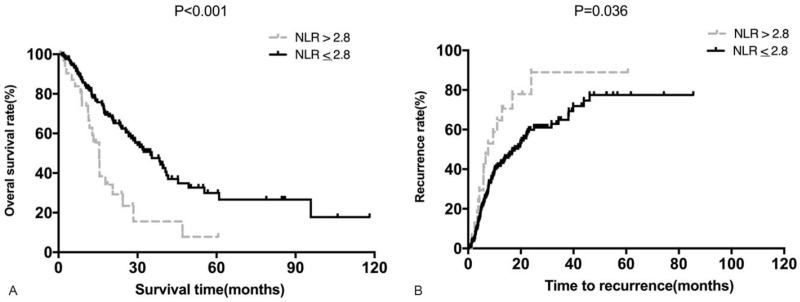
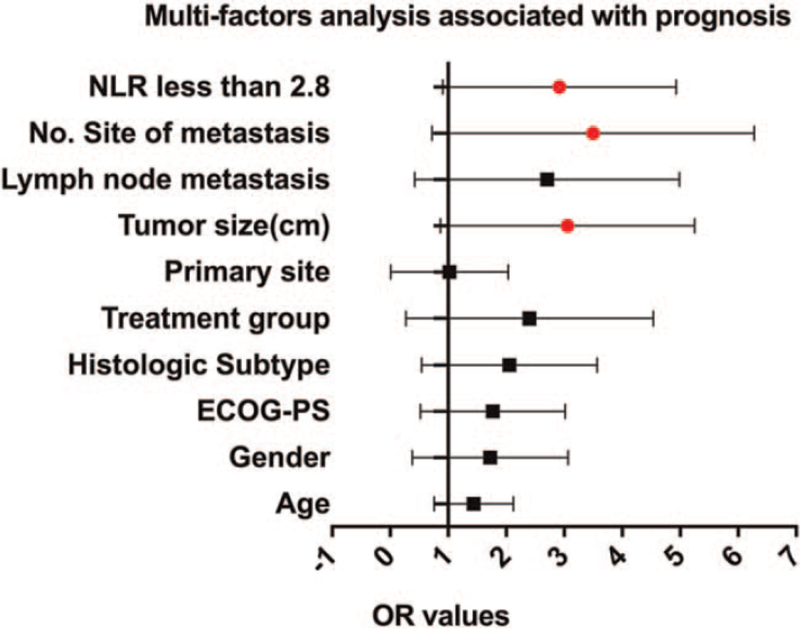
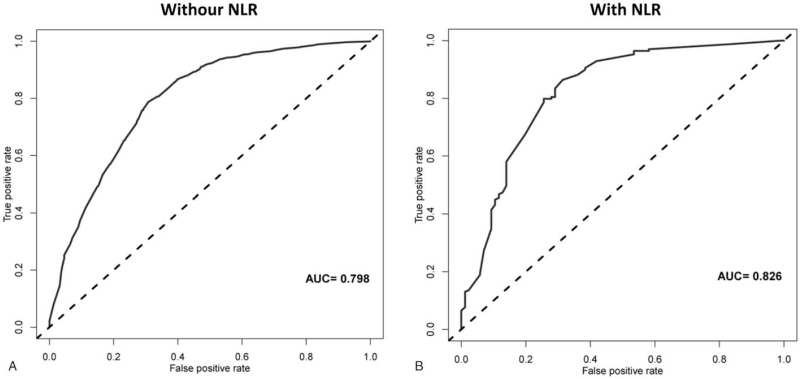
The risk factors have not been well-defined for prognosis in gastric signet ring cell carcinoma (GSRC) patients. This study is designed to prognosticate survival in GSRC patients by establishing and verifying a predictive model with neutrophil–lymphocyte ratio (NLR). A total of 147 GSRC patients from Department of Surgical Oncology, Neimenggu Baogang Hospital, Inner Mongolia Medical University were retrospectively reviewed. A predictive model was established using Cox proportional hazards. The performance of the model was evaluated by ROC curves. In present study, we found that overall survival (OS) (P < .001, Fig. 1A) and tumor recurrence rate (P = .036, Fig. 1B) in the NLR ≤ 2.8 group were significantly better than those in the NLR > 2.8 group. These results showed that NLR ≤ 2.8 was significant prognostic factor related with both OS and tumor recurrence in patients with GSRC. After adjusting for competing risk factors, NLR ≤ 2.8 (hazard ratio [HR]: 2.625, 95% confidence interval [CI]: 1.505–5.3166, P = .003), tumor size (HR: 3.024, 95% CI: 1.521–4.186, P = .005), and tumor metastasis (HR: 3.303, 95% CI: 1.25–4.525, P = .012) remained independent predictors of tumor recurrence rate and OS. Our results showed that comparing with the model without NLR (area under ROC curve: 0.798), the model with NLR (area under ROC curve: 0.826) had significant better predictive power than the model without NLR, which further confirmed the value of NLR in predicting prognosis of patients with GSRC. In conclusion, a high NLR value independently predicts poor survival in patients with GSRC after surgery. The NLR may help oncologists evaluate outcomes of patients received surgical resection and chemotherapy in order to choose alternative therapies for patients with high NLR value.
Overview
The claims and statistics of this paper haven’t been checked yet.
Free: it reads the open-access text and checks the first 5 claims that cite a source we can check. Create a free account to check every claim.
Integrity signals
Registry
Cites
Statistics
Figures
Verification
Claims the paper makes
The claims and statistics of this paper haven’t been checked yet.
Free: it reads the open-access text and checks the first 5 claims that cite a source we can check. Create a free account to check every claim.
Claims other papers make about this one
Each is checked against this paper’s own text: does it say what the citing paper says it does?
The source backs part of the claim, not all of it — or backs it for a different population, condition or comparison.
In the citing paper
“It's known that NLR has a predictive value in many non-psychiatric disorders treatment responses and prognoses [15,16].”
From Neutrophil-Lymphocyte Ratio, Monocyte-Lymphocyte Ratio and Platelet-Lymphocyte Ratio in Manic Episode Patients with Bipolar Disorder (2023) · cites this paper as [15]
Experimental — accuracy not yet measured
Self-check
Percentages, sums and reported differences re-computed from the paper’s own numbers.
The self-check needs the paper’s full text.
Citations
Cites
Regression Models and Life-Tables
Cox, D. R. (1972) · Journal of the Royal Statistical Society Series B: Statistical Methodology · doi:10.1111/j.2517-6161.1972.tb00899.x · Cited by 39,793
Nonparametric Estimation from Incomplete Observations
Kaplan, E. L., & Meier, P. (1958) · Journal of the American Statistical Association · doi:10.1080/01621459.1958.10501452 · Cited by 39,158
Toxicity and response criteria of the Eastern Cooperative Oncology Group
Oken, M. M., Creech, R. H., Tormey, D. C., Horton, J., Davis, T. E., McFadden, E. T., & Carbone, P. P. (1982) · AMERICAN JOURNAL OF CLINICAL ONCOLOGY · doi:10.1097/00000421-198212000-00014 · Cited by 11,647
Inflammation and cancer: back to Virchow?
Balkwill, F., & Mantovani, A. (2001) · The Lancet · doi:10.1016/s0140-6736(00)04046-0 · Cited by 7,746
Receiver operating characteristic (ROC) methodology: the state of the art.
Hanley, J. A. (1989) · PubMed · Cited by 807
Jaiswal, M., LaRusso, N. F., Burgart, L. J., & Gores, G. J. (2000) · PubMed · Cited by 738
Kusumanto, Y. H., Dam, W. A., Hospers, G. A. P., Meijer, C., & Mulder, N. H. (2003) · Angiogenesis · doi:10.1023/b:agen.0000029415.62384.ba · Cited by 530
FOXP3+ Regulatory T Cells Affect the Development and Progression of Hepatocarcinogenesis
Kobayashi, N., Hiraoka, N., Yamagami, W., Ojima, H., Kanai, Y., Kosuge, T., Nakajima, A., & Hirohashi, S. (2007) · Clinical Cancer Research · doi:10.1158/1078-0432.ccr-06-2363 · Cited by 431
Jung, M. R., Park, Y. K., Jeong, O., Seon, J. W., Ryu, S. Y., Kim, D. Y., & Kim, Y. J. (2011) · Journal of Surgical Oncology · doi:10.1002/jso.21986 · Cited by 251
Targeting the hallmarks of cancer: towards a rational approach to next-generation cancer therapy
Hainaut, P., & Plymoth, A. (2013) · Current Opinion in Oncology · doi:10.1097/cco.0b013e32835b651e · Cited by 241
Cited by
Clinical Impact of Nutrition and Inflammation Assessment Tools in Gastric Cancer Treatment
Aoyama, T., HARA, K., Kazama, K., & Maezawa, Y. (2022) · Anticancer Research · doi:10.21873/anticanres.16023 · Cited by 50
İmre, O., & Güldeste Yılmaz, İ. V. (2023) · European Journal of Therapeutics · doi:10.58600/eurjther.20232902-1574.y · Cited by 9
Pierce, K., Gaskins, J., & Martin, R. C. G. (2024) · Nutrition Reviews · doi:10.1093/nutrit/nuae138 · Cited by 8
Song, Q., Wang, X., Zhu, J., & Shi, H. (2024) · Abdominal Radiology · doi:10.1007/s00261-024-04286-9 · Cited by 2
Castaño, L. M. F. (2024) · Revista Ciencia y Salud Integrando conocimientos · doi:10.34192/cienciaysalud.v8i2.547 · Cited by 2
Metadata
- Authors
- Yang, S., & Li, S.
- Affiliations
- Inner Mongolia Medical University (CN)
- Corresponding author
- Li, Shangdong
- ORCID
- Li, Shangdong
- Venue
- Medicine
- Published
- 2022-01-07
- Volume
- 101
- Issue
- 1
- Pages
- e28043
- ISSN
- 0025-7974 (ISSN-L)
- 1536-5964
- PMC
- PMC8735796
- OpenAlex
- W4205697678
- Cited by
- 5
- References
- 30
- Citations by year
- 2024: 3 · 2023: 1 · 2022: 1
- FWCI
- 0.52
- Type
- journal article
- Language
- en
- Open access
- gold
- doi.org
- Licence
- Locations
- Medicine (publishedVersion, cc-by-nc)
- PubMed Central (publishedVersion, cc-by-nc)
- PubMed (publishedVersion)
- Topics
- Health Sciences › Medicine › Oncology › Inflammatory Biomarkers in Disease Prognosis
- Health Sciences › Medicine › Oncology › Gastric Cancer Management and Outcomes
- Life Sciences › Biochemistry, Genetics and Molecular Biology › Cancer Research › Cancer, Stress, Anesthesia, and Immune Response
- Keywords
- gastric signet ring cell carcinoma, neutrophil-to-lymphocyte ratio, prognostic model, overall survival, tumor recurrence, tumor size, metastasis, postoperative chemotherapy, surgical resection
- MeSH terms
- Female, Humans, Lymphocytes, Male, Middle Aged, Neoplasm Recurrence, Local, Neutrophils, Predictive Value of Tests, Prognosis, Retrospective Studies, ROC Curve, Stomach Neoplasms, Survival Analysis, Carcinoma, Signet Ring Cell, Lymphocyte Count
About these checks
Registry, retraction, Cites and statistics results are computed, not judged, with one exception: a printed reference that no index lists is read once by a model before it counts as a citation error. Claims are extracted by a model and kept only when their quote appears verbatim in the text; each cited source is then checked, with a model’s help, for whether it says what the claim relies on. Those verdicts can be wrong — read the claim’s quote and the cited source before relying on one.
Statistics and arithmetic are recomputed, not judged.
Confidence bands are shown only for fields calibrated on our annotated test set. None is calibrated yet, so no band is shown.
What counts as a claim ›How we measure confidence ›How we check this ›
Are you an author, or do you see a problem with this page? Request a review
How to cite
Cite CoChat for the checks on this page, and the paper for its own findings.
- This page
- CoChat. (2026). Citation check: Development of prognostic predictive model with neutrophil–lymphocyte ratio (NLR) in patients with gastric signet ring carcinoma. https://app.cochat.ai/papers/10.1097/md.0000000000028043
- The paper
- Yang, S., & Li, S. (2022). Development of prognostic predictive model with neutrophil–lymphocyte ratio (NLR) in patients with gastric signet ring carcinoma. Medicine. https://doi.org/10.1097/md.0000000000028043
Data sources
Bibliographic data: Semantic Scholar, OpenAlex, Crossref.
Contains information from the Semantic Scholar Academic Graph Datasets, made available under the ODC Attribution License (ODC-BY 1.0).
Semantic Scholar’s data is described in: Kinney, R., et al. (2023). The Semantic Scholar Open Data Platform. arXiv:2301.10140.
