

Long-term effects of integrated cognitive behavioral therapy for chronic pain: A qualitative and quantitative study
Open accessThe DOI matches its Crossref record; 22 of the 22 references it cites were found in a registry or an index; 14 of the 20 sources its claims cite were checked for support.
Abstract
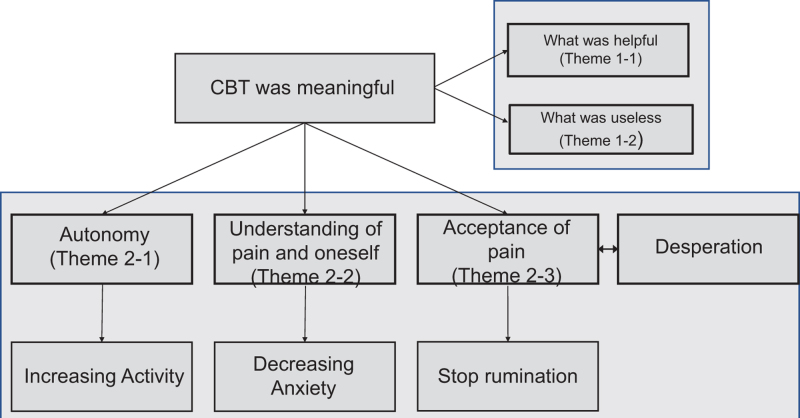
Cognitive behavioral therapy (CBT) is known to improve chronic pain management. However, past studies revealed only small to moderate benefits in short-term results, and long-term follow-up studies are lacking. This study aimed to follow an integrated CBT program's effectiveness 1.5 years after its completion. This observational study was the follow-up on the data collected from our CBT sessions conducted under 3 different studies in 2018 to 2019. Seven assessment items (Numerical Rating Scale, Pain Catastrophizing Scale [PCS], Pain Disability Assessment Scale [PDAS], Patient Health Questionnaire-9 items, Generalized Anxiety Disorder 7, European quality of life 5-dimensions 5-level, and Beck Depression Inventory [BDI]) were statistically analyzed. Thematic analysis was conducted in semi structured interviews. PCS (F=6.52, P=.003), PDAS (F=5.68, P=.01), European quality of life 5-dimensions 5-level (F=3.82, P=.03), and BDI (F=4.61, P=.01) exhibited significant changes (P<.05), confirmed by pairwise t test, revealing a moderate to large effect size. From post-treatment to follow-up, all scores showed no significant changes (P>.1). In the qualitative study, the analysis revealed 3 subthemes: "Autonomy,""Understanding of yourself and pain,"and "Acceptance of pain."Our study suggests that integrated CBT may reduce the scores of PCS, PDAS and BDI, and this effect lasts for at least 1 year. Identified themes support the relevance of mitigative factors in managing chronic pain. © 2023 the Author(s).
Overview
CoChat Summary
## TL;DR
This longitudinal mixed-methods follow-up found that integrated CBT for chronic pain had sustained benefits at 1-year follow-up for some patient-reported outcomes, especially PCS, PDAS, EQ-5D-5L, and BDI. Qualitative interviews suggested patients valued CBT for helping them gain autonomy, understand pain and themselves, and accept pain even when pain intensity did not fully improve.
## Key findings
- In the quantitative analysis, mean changes from pretreatment to follow-up were reported as –8.00 for PCS (F = 6.52, P = .003), –7.59 for PDAS (F = 5.68, P = .01), 0.06 for EQ-5D-5L (F = 3.82, P = .03), and –4.93 for BDI (F = 4.61, P = .01); these were described as significant and with moderate to large effect sizes.
- Other outcomes were not significant: NRS –0.82 (F = 1.20, P = .031), PHQ-9 –0.77 (F = 1.17, P = .32), and GAD-7 –0.73 (F = 2.52, P = .09).
- Post hoc tests showed a significant change between Pre-CBT and Post-CBT, but no significant changes between Post-CBT and follow-up, which the authors interpret as the effect being ongoing.
- The qualitative analysis identified 2 themes and 5 subthemes; the abstract summarizes 3 subthemes: “Autonomy,” “Understanding of yourself and pain,” and “Acceptance of pain.”
## Methods
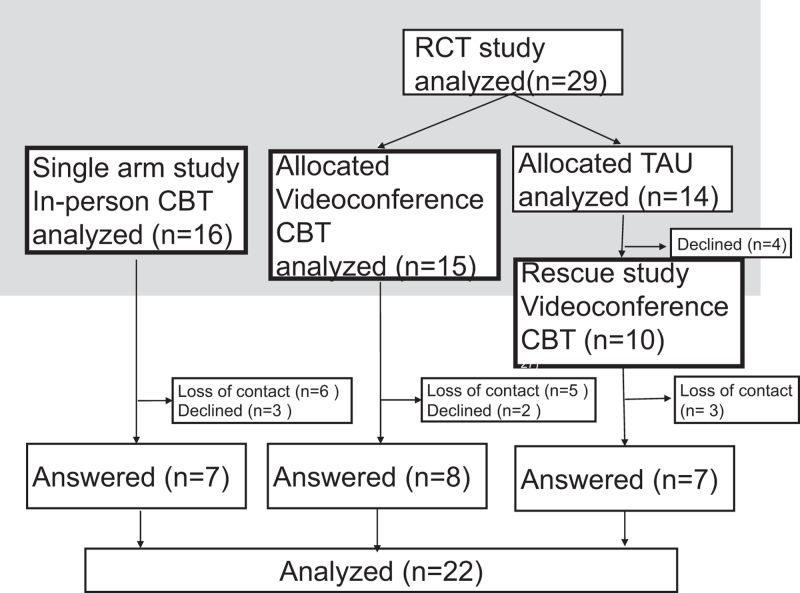
- Design: Longitudinal cohort observational follow-up combining quantitative and qualitative analyses of patients who had completed CBT in three earlier studies: a prospective open-labeled single-arm trial, an RCT, and a trial with rescue CBT for treatment-as-usual participants.
- Sample/data: 41 patients completed the original CBT sessions and were eligible; 22 patients responded, were interviewed, and had follow-up interview data analyzed. The sample was 6 men (27%) and 16 women (73%), with mean age 50.91 years and chronic pain duration 14.09 years.
- Analysis: Outcomes were assessed at week 1 (baseline), week 16 (post-session), and 1-year follow-up using ANCOVA, repeated-measures ANOVA, paired t tests, and Cohen’s d; interviews were recorded and analyzed by thematic analysis in MAXQDA.
## Limitations
- The authors state that most participants who agreed to participate already had a favorable opinion of CBT, and that people against CBT may have been less likely to respond, creating selection bias.
- The authors state that the sample size is relatively small, that CBT and videoconference-delivered CBT are mixed, and that the qualitative study had not reached saturation.
- Evident from the text: only 22 of 41 eligible patients contributed follow-up interview data, and some outcome data were missing (2 patients lacked NRS scores; patients 1 to 7 did not answer BDI), which may limit precision and generalizability.
Model-written summary. Check it against the paper before relying on it.
Integrity signals
Registry
Cites
Statistics
Figures
Verification
Claims the paper makes
4 Valid · 1 Not valid · 4 Not checked · 25 Own results and interpretations
At least one cited source doesn’t support this claim or points to a different paper, and none confirmed it — see the verdicts below.
In the paper
“In the single-arm trial and randomized control trial (RCT), patients who underwent our newly integrated CBT program for chronic pain exhibited statistically significant improvement with catastrophic cognition.”
§ Long-term effects of integrated cognitive behavioral therapy for chronic pain: A qualitative and quantitative study > 1. Introduction
What the sources say
- Disputedcites [11] Taguchi K Numata N Takanashi R. Integrated cognitive behavioral therapy for chronic pain. Medicine (Baltim). 2021; 100: e23859. PMC7886449 33578513 sourceExperimental — accuracy not yet measured
The Results (Secondary Outcomes; page not available) report that catastrophizing cognition decreased more in the CBT group than with usual treatment, but the difference was not statistically significant (P=.07). The Methods (Videoconference-Based Integrated CBT Program; page not available) mention improvement in catastrophic cognition from an earlier study, but this does not establish the claimed statistically significant result in the RCT. (LLM, conf=0.86)
Checked by a reasoning model — may be wrong.
- Disputedcites [12] Taguchi K Numata N Takanashi R. Clinical effectiveness and cost-effectiveness of videoconference-based integrated cognitive behavioral therapy for chronic pain: randomized controlled trial. J Med Internet Res. 2021; 23: e30690. 34813489 PMC8663446 sourceExperimental — accuracy not yet measured
The Results > Secondary Outcomes section of our copy states the opposite for the RCT: 'The adjusted mean reduction of the PCS score in vCBT was larger than that of TAU at 16 weeks, although the difference was not statistically significant (–6.25, 95% CI –12.89 to 0.38, df=25; P=.07)', and no significant difference at 8 weeks. The Abstract (Results) likewise lists significant improvements only for BPI total score, pain interference and PDAS disability, not catastrophizing. The only statement in our copy that the integrated program 'has been shown to improve catastrophic cognition, disability, and mood' appears in Methods > Videoconference-Based Integrated CBT Program and is credited to a separate earlier work (reference [30]), i.e. the face-to-face/web-based protocol study, not to this trial. Thus neither the 'single-arm trial' nor the 'RCT' portion of the claim, as attributed to this source, is supported; the RCT portion is directly contrary. (LLM, conf=0.85)
Checked by a reasoning model — may be wrong.
plainstates a cause- Asserted: passes — The authors put it forward as true.
- Checkable: passes — It can be checked against evidence.
- Load-bearing: passes — The paper’s conclusions depend on it.
- Based: passes — The paper gives a reason why it holds.
- Disputed
The cited sources support only part of this claim — read each source’s verdict below.
In the paper
“These studies revealed that the improvements caused by CBT were generally maintained well after 1 year.”
§ Long-term effects of integrated cognitive behavioral therapy for chronic pain: A qualitative and quantitative study > 1. Introduction
What the sources say
- Partly supportedcites [4] Rickardsson J Gentili C Holmström L. Internet-delivered acceptance and commitment therapy as microlearning for chronic pain: a randomized controlled trial with 1-year follow-up. Eur J Pain. 2021; 25: 1012– 30. 33460240 sourceExperimental — accuracy not yet measured
Split into 2 atoms — 0 confirmed, 2 partially supported, 0 disputed, 0 misattributed, 0 unverifiable. Expand the claim to see per-atom verdicts.
- Partly supportedcites [5] DasMahapatra P Chiauzzi E Pujol LM. Mediators and moderators of chronic pain outcomes in an online self-management program. Clin J Pain. 2015; 31: 404– 13. 24918473 PMC4262714 sourceExperimental — accuracy not yet measured
Split into 2 atoms — 0 confirmed, 2 partially supported, 0 disputed, 0 misattributed, 0 unverifiable. Expand the claim to see per-atom verdicts.
- Partly supportedcites [6] Changes in sleep problems and psychological flexibility following interdisciplinary acceptance and commitment therapy for chronic pain: an observational cohort study. [cited 2022 Jan 23]. Available at: https://www.ncbi.nlm.nih.gov/pmc/articles/PMC5006108 PMC5006108 27630601 sourceExperimental — accuracy not yet measured
Split into 2 atoms — 0 confirmed, 1 partially supported, 0 disputed, 0 misattributed, 1 unverifiable. Expand the claim to see per-atom verdicts.
- Partly supportedcites [7] van Hooff ML Vriezekolk JE Kroeze RJ. Targeting self-efficacy more important than dysfunctional behavioral cognitions in patients with longstanding chronic low back pain; a longitudinal study. BMC Musculoskelet Disord. 2021; 22: 824. 34563141 PMC8466398 sourceExperimental — accuracy not yet measured
Split into 2 atoms — 0 confirmed, 2 partially supported, 0 disputed, 0 misattributed, 0 unverifiable. Expand the claim to see per-atom verdicts.
- Not checked yetcites [8] Andreae SJ Andreae LJ Richman JS. Peer-delivered cognitive behavioral therapy-based intervention reduced depression and stress in community dwelling adults with diabetes and chronic pain: a cluster randomized trial. Ann Behav Med. 2021; 55: 970– 80. 33969866 source
- Partly supportedcites [9] van Hooff ML ter Avest W Horsting PP. A short, intensive cognitive behavioral pain management program reduces health-care use in patients with chronic low back pain. Eur Spine J. 2012; 21: 1257– 64. 22139049 PMC3389101 sourceExperimental — accuracy not yet measured
Split into 2 atoms — 1 confirmed, 1 partially supported, 0 disputed, 0 misattributed, 0 unverifiable. Expand the claim to see per-atom verdicts.
plainstates a cause- Asserted: passes — The authors put it forward as true.
- Checkable: passes — It can be checked against evidence.
- Load-bearing: passes — The paper’s conclusions depend on it.
- Based: passes — The paper gives a reason why it holds.
- Partly supported
The cited sources support only part of this claim — read each source’s verdict below.
In the paper
“Longer-term results are not well reported in the literature, and we observed only 6 related studies published after 2020.[4–9]”
§ Long-term effects of integrated cognitive behavioral therapy for chronic pain: A qualitative and quantitative study > 1. Introduction
What the sources say
- Supportedcites [4] Rickardsson J Gentili C Holmström L. Internet-delivered acceptance and commitment therapy as microlearning for chronic pain: a randomized controlled trial with 1-year follow-up. Eur J Pain. 2021; 25: 1012– 30. 33460240 source
The Introduction states that long-term effects of CBT for chronic pain are unclear. It also notes that follow-up assessments in earlier Internet-delivered ACT studies were limited, supporting the citing sentence’s broader point about longer-term results. The count of studies published after 2020 is the citing authors’ own observation, not a claim attributed to this source. (LLM, conf=0.87)
- Could not verifycites [5] DasMahapatra P Chiauzzi E Pujol LM. Mediators and moderators of chronic pain outcomes in an online self-management program. Clin J Pain. 2015; 31: 404– 13. 24918473 PMC4262714 sourceExperimental — accuracy not yet measured
The Introduction describes a CBT study with a one-year follow-up, and the Results report outcomes at six months. Neither passage says that longer-term CBT results for chronic pain are poorly reported in the literature. Searches for longer-term outcomes and follow-up found no passage making that broader claim. (LLM, conf=0.76)
- Could not verifycites [6] Changes in sleep problems and psychological flexibility following interdisciplinary acceptance and commitment therapy for chronic pain: an observational cohort study. [cited 2022 Jan 23]. Available at: https://www.ncbi.nlm.nih.gov/pmc/articles/PMC5006108 PMC5006108 27630601 sourceExperimental — accuracy not yet measured
The Introduction reports that outcomes of a CBT-based pain program remained stable at a minimum five-year follow-up, and the Results report one-year outcomes (page numbers unavailable). Neither section says that longer-term CBT results for chronic pain are poorly reported across the literature. Searches for limited long-term follow-up evidence found no passage establishing that broader claim. (LLM, conf=0.74)
- Partly supportedcites [7] van Hooff ML Vriezekolk JE Kroeze RJ. Targeting self-efficacy more important than dysfunctional behavioral cognitions in patients with longstanding chronic low back pain; a longitudinal study. BMC Musculoskelet Disord. 2021; 22: 824. 34563141 PMC8466398 sourceExperimental — accuracy not yet measured
Our copy of van Hooff et al. (2021) is itself a post-2020 longitudinal study of a CBT-based multidisciplinary program for longstanding chronic low back pain that reports maintenance of gains at 12 months (Discussion; Results, Table 2 section), so it fits as one of the 'related studies published after 2020' in the batch citation [4–9]. However, it does not state that longer-term results of CBT for chronic pain are poorly reported: the scarcity it describes concerns the working mechanisms of CBT-based programs ('still poorly understood', Discussion, opening paragraph) and the evidence that self-efficacy outperforms restructuring of dysfunctional behavioural cognitions ('the evidence is scarce', Abstract Background; 'evidence still lacks showing its contribution and role in the treatment of CLBP', Discussion). It even points to prior long-term data, noting improvements 'remained stable after a minimum of five-year follow-up' (Introduction). Thus the 'not well reported' assertion attributed here is not this paper's claim. (LLM, conf=0.70)
- Not checked yetcites [8] Andreae SJ Andreae LJ Richman JS. Peer-delivered cognitive behavioral therapy-based intervention reduced depression and stress in community dwelling adults with diabetes and chronic pain: a cluster randomized trial. Ann Behav Med. 2021; 55: 970– 80. 33969866 source
- Partly supportedcites [9] van Hooff ML ter Avest W Horsting PP. A short, intensive cognitive behavioral pain management program reduces health-care use in patients with chronic low back pain. Eur Spine J. 2012; 21: 1257– 64. 22139049 PMC3389101 sourceExperimental — accuracy not yet measured
Our copy clearly treats long-term outcomes of CBT-based management as unresolved, but only within chronic low back pain: the Abstract (Purpose) states 'most treatment effects are small and short-lived… the long-term results are not known', and the Introduction/Discussion state that 'many commonly used interventions lack evidence of clinically relevant long-term effects [4]' / 'lack evidence for the maintenance of clinically relevant long-term effects'. That supports the claim for CLBP specifically; the citing sentence's wider population ('chronic pain' generally) is not addressed anywhere in this paper, and the paper frames the gap as absence of evidence for maintained effects rather than as a bibliographic statement about reporting in the literature. The accompanying clause about 'only 6 related studies published after 2020' is the citing authors' own observation and cannot rest on this 2012 cohort study. (LLM, conf=0.68)
plain- Asserted: passes — The authors put it forward as true.
- Checkable: passes — It can be checked against evidence.
- Load-bearing: passes — The paper’s conclusions depend on it.
- Based: passes — The paper gives a reason why it holds.
- Supported
The cited sources support only part of this claim — read each source’s verdict below.
In the paper
“However, the most recent meta-analyses indicated only small to moderate benefits in short-term results after CBT sessions.[3]”
§ Long-term effects of integrated cognitive behavioral therapy for chronic pain: A qualitative and quantitative study > 1. Introduction
What the sources say
- Partly supportedcites [3] de C Williams AC Fisher E Hearn L. Psychological therapies for the management of chronic pain (excluding headache) in adults. Cochrane Database Syst Rev. 2020; 2020: CD007407. PMC7437545 32794606 sourceExperimental — accuracy not yet measured
The review reports short-term CBT benefits, but describes them as small versus treatment as usual and very small versus active controls (Background; CBT versus TAU, at end of treatment). Its policy-makers section likewise calls the overall effects small or very small, not moderate; “moderate” describes the quality of some evidence, not the size of the benefit. (LLM, conf=0.88)
hedgedstates a cause- Asserted: passes — The authors put it forward as true.
- Checkable: passes — It can be checked against evidence.
- Load-bearing: passes — The paper’s conclusions depend on it.
- Based: passes — The paper gives a reason why it holds.
- Partly supported
A result the paper reports from its own data — it cites no other source for it, so there is none to check. The quote shows it is in the paper.
In the paper
“Changes in total mean scores from pretreatment to follow-up assessment were –0.82 for NRS (F = 1.20, P = .031), –8.00 PCS (F = 6.52, P = .003), –7.59 for PDAS (F = 5.68, P = .01), –0.77 for PHQ-9 (F = 1.17, P = .32), −0.73 for GAD-7 (F = 2.52, P = .09), 0.06 for EQ-5D-5L (F = 3.82, P = .03), and −4.93 for BDI (F = 4.61, P = .01).”
§ Long-term effects of integrated cognitive behavioral therapy for chronic pain: A qualitative and quantitative study > 3. Results > 3.1. Quantitative study
plain- Asserted: passes — The authors put it forward as true.
- Checkable: passes — It can be checked against evidence.
- Load-bearing: passes — The paper’s conclusions depend on it.
- Based: passes — The paper gives a reason why it holds.
- Rests on an assumption not shown here.
15 more claims
Create a free account to see all 34 claims and to verify the 6 references still open.
- Probably not a substantial claim. 8
- It may state two separate claims as one. 9
Self-check
Percentages, sums and reported differences re-computed from the paper’s own numbers.
Each contradiction between two passages listed here was confirmed by an independent check.
Rated major: it would touch a result — a value a result rests on, reported and recomputed p-values on opposite sides of the significance level, two passages that conflict with no sign which is right, or a cited work retracted before this paper was published.
In the paper
§ Long-term effects of integrated cognitive behavioral therapy for chronic pain: A qualitative and quantitative study > Abstract
“This study aimed to follow an integrated CBT program’s effectiveness 1.5 years after its completion.”
§ Long-term effects of integrated cognitive behavioral therapy for chronic pain: A qualitative and quantitative study > 2. Methods > 2.5. Statistical analysis
“Patients were evaluated at week 1 (baseline, Pre-session), week 16 (Post-session), and a follow-up 1-year post-session (FU).”
Citations
Cites
Using thematic analysis in psychology
Braun, V., & Clarke, V. (2006) · Qualitative Research in Psychology · doi:10.1191/1478088706qp063oa · Cited by 194,414
Tong, A., Sainsbury, P., & Craig, J. (2007) · International Journal for Quality in Health Care · doi:10.1093/intqhc/mzm042 · Cited by 42,509
Dworkin, R. H., Turk, D. C., Wyrwich, K. W., Beaton, D., Cleeland, C. S., Farrar, J. T., Haythornthwaite, J. A., Jensen, M. P., Kerns, R. D., Ader, D. N., et al. (2008) · The Journal of Pain · doi:10.1016/j.jpain.2007.09.005 · Cited by 3,471 · cited 2×
“Seven assessment items (Numerical Rating Scale [NRS], Pain Catastrophizing Scale [PCS], Pain Disability Assessment Scale [PDAS], Patient Health Questionnaire-9 items [PHQ-9], Generalized Anxiety Disorder 7 [GAD-7], European quality of life 5-dimensions 5-level [EQ-5D-5L], and Beck Depression Inventory [BDI]) were set…”
MethodGuetterman, T. C., Fetters, M. D., & Creswell, J. W. (2015) · The Annals of Family Medicine · doi:10.1370/afm.1865 · Cited by 1,740 · cited 1×
“Mixed methods research is becoming a vital methodology for complex health-related topics, providing new insights,[16] though currently only a few studies have investigated CBT.”
BackgroundPsychological therapies for the management of chronic pain (excluding headache) in adults
Williams, A. C. D. C., Eccleston, C., & Morley, S. (2012) · Cochrane Database of Systematic Reviews · doi:10.1002/14651858.cd007407.pub3 · Cited by 1,634
Multidisciplinary treatment for chronic pain: a systematic review of interventions and outcomes
Scascighini, L., Toma, V., Dober-Spielmann, S., & Sprott, H. (2008) · Rheumatology · doi:10.1093/rheumatology/ken021 · Cited by 613 · cited 1×
“Cognitive behavioral therapy (CBT) is considered especially important in the treatment of chronic pain.[2] However, the most recent meta-analyses indicated only small to moderate benefits in short-term results after CBT sessions.”
BackgroundPsychological therapies for the management of chronic pain (excluding headache) in adults
Williams, A. C. D. C., Fisher, E., Hearn, L., & Eccleston, C. (2020) · Cochrane Database of Systematic Reviews · doi:10.1002/14651858.cd007407.pub4 · Cited by 605
Mansfield, K. E., Sim, J., Jordan, J. L., & Jordan, K. P. (2016) · Pain · doi:10.1097/j.pain.0000000000000314 · Cited by 402
Turner, J. A., Anderson, M. L., Balderson, B. H., Cook, A. J., Sherman, K. J., & Cherkin, D. C. (2016) · Pain · doi:10.1097/j.pain.0000000000000635 · Cited by 281 · cited 1×
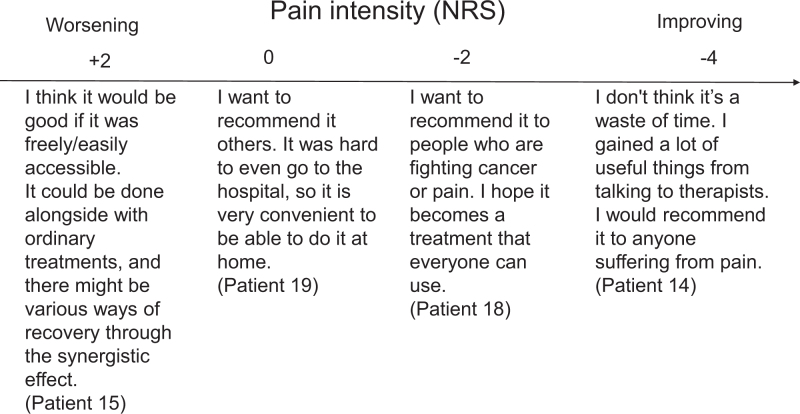
“The identified (sub)themes consist of 2 elements: acceptance by education and acquisition of self-efficacy, which both back up former research.[20] Integrated findings show that patients summarized their impressions of therapy as positive, regardless of whether their pain improved or worsened (Fig.”
Rickardsson, J., Gentili, C., Holmström, L., Zetterqvist, V., Andersson, E., Persson, J., Lekander, M., Ljótsson, B., & Wicksell, R. K. (2021) · European Journal of Pain · doi:10.1002/ejp.1723 · Cited by 64
Mediators and moderators of chronic pain outcomes in an online self-management program.
DasMahapatra, P., Chiauzzi, E., Pujol, L. M., Los, C., & Trudeau, K. J. (2015) · The Clinical Journal of Pain · doi:10.1097/ajp.0000000000000125 · Cited by 40
Taguchi, K., Numata, N., Takanashi, R., Takemura, R., Yoshida, T., Kutsuzawa, K., Yoshimura, K., & Shimizu, E. (2021) · Medicine · doi:10.1097/md.0000000000023859 · Cited by 34 · cited 2×
“In these sessions, attention-shift training, memory work based on the peak-end rule, sharpening behavioral image training, and video feedback were operated in addition to Conventional CBT programs for chronic pain (including psychoeducation for pain, case formulation for understanding cognitive behavioral models of ch…”
MethodResultSelf-citationTaguchi, K., Numata, N., Takanashi, R., Takemura, R., Yoshida, T., Kutsuzawa, K., Yoshimura, K., Nozaki-Taguchi, N., Ohtori, S., & Shimizu, E. (2021) · Journal of Medical Internet Research · doi:10.2196/30690 · Cited by 34 · cited 2×
“In these sessions, attention-shift training, memory work based on the peak-end rule, sharpening behavioral image training, and video feedback were operated in addition to Conventional CBT programs for chronic pain (including psychoeducation for pain, case formulation for understanding cognitive behavioral models of ch…”
MethodResultSelf-citationvan Hooff, M. L., ter Avest, W., Horsting, P. P., O’Dowd, J., de Kleuver, M., van Lankveld, W., & van Limbeek, J. (2012) · European Spine Journal · doi:10.1007/s00586-011-2091-0 · Cited by 34
Qualitative research and pain: Current controversies and future directions
Tutelman, P. R., & Webster, F. (2020) · Canadian Journal of Pain · doi:10.1080/24740527.2020.1809201 · Cited by 34
van Hooff, M. L., Vriezekolk, J. E., Kroeze, R. J., O’Dowd, J. K., van Limbeek, J., & Spruit, M. (2021) · BMC Musculoskeletal Disorders · doi:10.1186/s12891-021-04637-3 · Cited by 28
Andreae, S. J., Andreae, L. J., Richman, J. S., Cherrington, A. L., & Safford, M. M. (2021) · Annals of Behavioral Medicine · doi:10.1093/abm/kaab034 · Cited by 22
Psychological treatments for chronic pain in East and Southeast Asia: a systematic review.
Yang, S.-Y., McCracken, L. M., & Moss-Morris, R. (2016) · International Journal of Behavioral Medicine · doi:10.1007/s12529-015-9481-3 · Cited by 15 · cited 2×
“However, efforts to develop CBT programs for chronic pain and assess their feasibility are remarkably delayed in Asia.”
BackgroundRidings, L. E., Moreland, A. D., & Petty, K. H. (2019) · Psychological Services · doi:10.1037/ser0000278 · Cited by 12
Gellatly, J., Pelikan, G., Wilson, P., Woodward-Nutt, K., Spence, M., Jones, A., & Lovell, K. (2018) · BMC Family Practice · doi:10.1186/s12875-018-0838-y · Cited by 11 · cited 1×
“There is only 1 published paper upon searching the queries’ chronic pain’, “CBT,” “qualitative study,” and the ’long term’.[10] However, the study focused on the perspectives of professional stakeholders, who were offering a stepped-care approach for patients with chronic pain.”
Background(2020) · Canadian Journal of Pain · doi:10.1080/24740527.2020.1826282 · Cited by 10
Yang, J. P., Simoni, J. M., Cheryan, S., Shiu, C. A., Chen, W., Zhao, H., & Lu, H. (2017) · Cognitive and Behavioral Practice · doi:10.1016/j.cbpra.2017.08.002 · Cited by 9
Research works printed but not linked: 2
- Changes in sleep problems and psychological flexibility following interdisciplinary acceptance and commitment therapy for chronic pain: an observational cohort study. [cited 2022 Jan 23]. Available at: https://www.ncbi.nlm.nih.gov/pmc/articles/PMC5006108 PMC5006108 27630601
- Sleep disturbances in individuals with alcohol-related disorders: a review of Cognitive-Behavioral Therapy for Insomnia (CBT-I) and associated non-pharmacological therapies. [cited 2022 Mar 13]. Available at: https://www.ncbi.nlm.nih.gov/pmc/articles/PMC4179428 PMC4179428 25288884
Cited by
Exploring the Role of Community Pharmacists in Pain Management: Enablers and Challenges
Mujtaba, S. H., & Gazerani, P. (2024) · Pharmacy · doi:10.3390/pharmacy12040111 · Cited by 27
“Community pharmacists potentially play a crucial role in educating patients about CBT as an adjunctive therapy for chronic pain, highlighting its potential benefits alongside pharmacological interventions [36].”
BackgroundDorfman, C. S., Heapy, A. A., Williams, A. C. D. C., & Keefe, F. J. (2025) · Pain · doi:10.1097/j.pain.0000000000003552 · Cited by 9
Tan, W.-W., Liu, Z.-X., Liu, X.-Y., Zhang, W., Zheng, L., Zhang, Y.-L., & Dai, Y.-C. (2024) · Pain and Therapy · doi:10.1007/s40122-024-00672-9 · Cited by 14
Horton, D. M., Woods, D. K., Garland, E. L., Edwards, R. R., Barrett, B. P., & Zgierska, A. E. (2024) · Journal of Health Psychology · doi:10.1177/13591053241247710 · Cited by 4
García, M., Amayra, I., Pérez, M., Rodríguez, A. A., Salgueiro, M., & Infante, J. (2024) · Intractable & Rare Diseases Research · doi:10.5582/irdr.2024.01010 · Cited by 2
“In addition to surgical treatments, psychological therapy has shown some beneficial effects on chronic pain in different conditions ( 48,49 ).”
Metadata
- Authors
- Tsubaki, K., Taguchi, K., Yoshida, T., Takanashi, R., & Shimizu, E.
- Affiliations
- Chiba University (JP)
- Teikyo University (JP)
- Corresponding author
- Tsubaki, Kanako
- ORCID
- Tsubaki, Kanako
- Venue
- Medicine
- Published
- 2023-07-07
- Volume
- 102
- Issue
- 27
- Pages
- e34253
- ISSN
- 0025-7974 (ISSN-L)
- PMC
- PMC10328660
- OpenAlex
- W4383482735
- Semantic Scholar
- 63c5dfddc3812e9218cb3817ac3c4ed3cdb86750
- Cited by
- 11
- References
- 21
- Citations by year
- 2025: 5 · 2024: 6
- FWCI
- 1.98
- Type
- journal article
- Language
- en
- Open access
- gold
- doi.org
- Locations
- Medicine (publishedVersion, cc-by)
- PubMed (publishedVersion)
- Institutional Repositories DataBase (IRDB) (submittedVersion)
- PubMed Central (submittedVersion, cc-by)
- Topics
- Health Sciences › Health Professions › Physical Therapy, Sports Therapy and Rehabilitation › Musculoskeletal pain and rehabilitation
- Health Sciences › Medicine › Psychiatry and Mental health › Fibromyalgia and Chronic Fatigue Syndrome Research
- Life Sciences › Neuroscience › Cognitive Neuroscience › Pain Management and Placebo Effect
- Keywords
- cognitive behavioral therapy, chronic pain, long-term follow-up, pain catastrophizing, pain-related disability, depression, quality of life, pain acceptance
- MeSH terms
- Anxiety Disorders, Humans, Quality of Life, Cognitive Behavioral Therapy, Treatment Outcome, Qualitative Research, Chronic Pain
About these checks
Registry, retraction, Cites and statistics results are computed, not judged, with one exception: a printed reference that no index lists is read once by a model before it counts as a citation error. Claims are extracted by a model and kept only when their quote appears verbatim in the text; each cited source is then checked, with a model’s help, for whether it says what the claim relies on. Those verdicts can be wrong — read the claim’s quote and the cited source before relying on one.
The claim verdicts this report counts are experimental: their accuracy is not yet measured.
A language model drew the claims from the paper on 2026-10-11, under version 3 of the claim definition (model deepseek-v4.1-flash, prompt extract-v3).
A second model labelled each claim on 2026-10-11 (model jev-1.13-20260917, definition revision gold-guideline-v0.2).
Cited sources are checked with a language model’s help (gpt-6-sol and qwen3.8-omni-flash).
Statistics and arithmetic are recomputed, not judged.
Confidence bands are shown only for fields calibrated on our annotated test set. None is calibrated yet, so no band is shown.
What counts as a claim ›How we measure confidence ›How we check this ›
Are you an author, or do you see a problem with this page? Request a review
Data sources
Bibliographic data: Semantic Scholar, OpenAlex, Crossref.
Contains information from the Semantic Scholar Academic Graph Datasets, made available under the ODC Attribution License (ODC-BY 1.0).
Semantic Scholar’s data is described in: Kinney, R., et al. (2023). The Semantic Scholar Open Data Platform. arXiv:2301.10140.
