

Traditional Chinese Medicine for non-motor symptoms in Parkinson disease: A systematic review and meta-analysis of RCTs
Open accessThe DOI matches its Crossref record; 20 of the 20 references it cites were found in a registry or an index.
Abstract
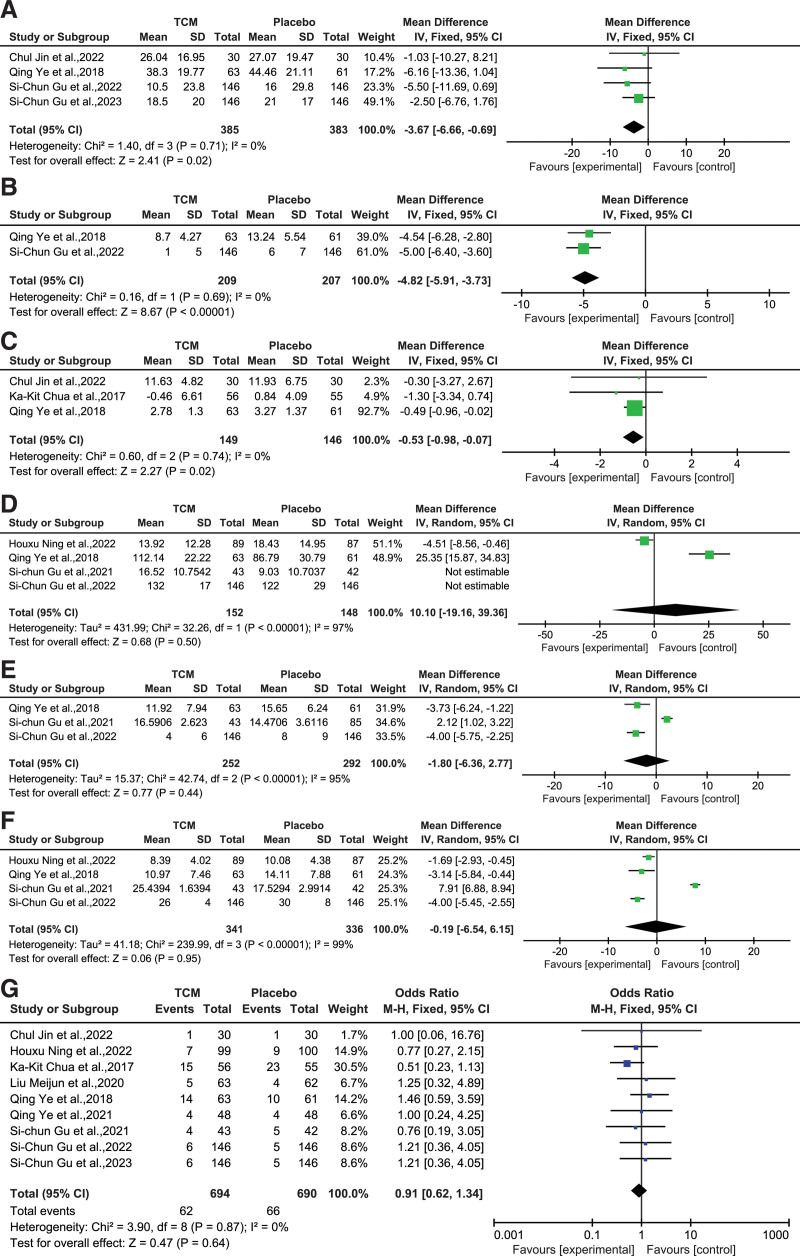
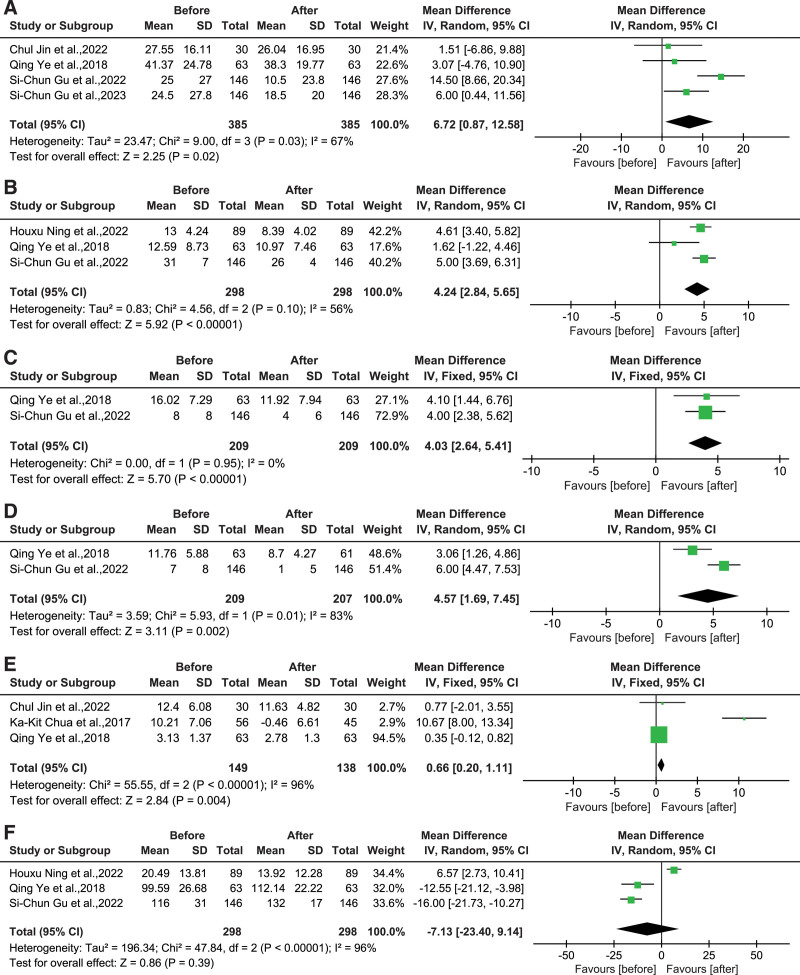
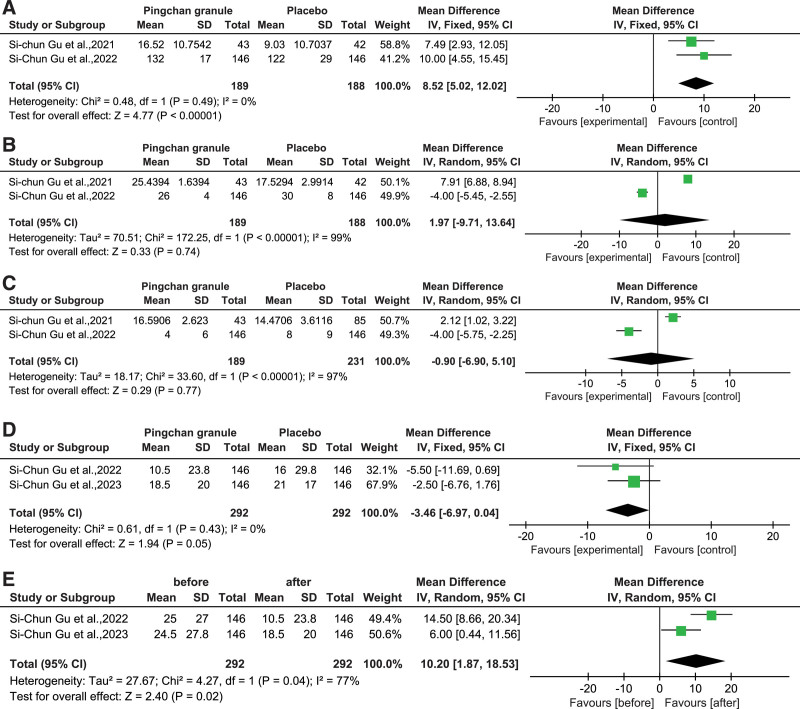
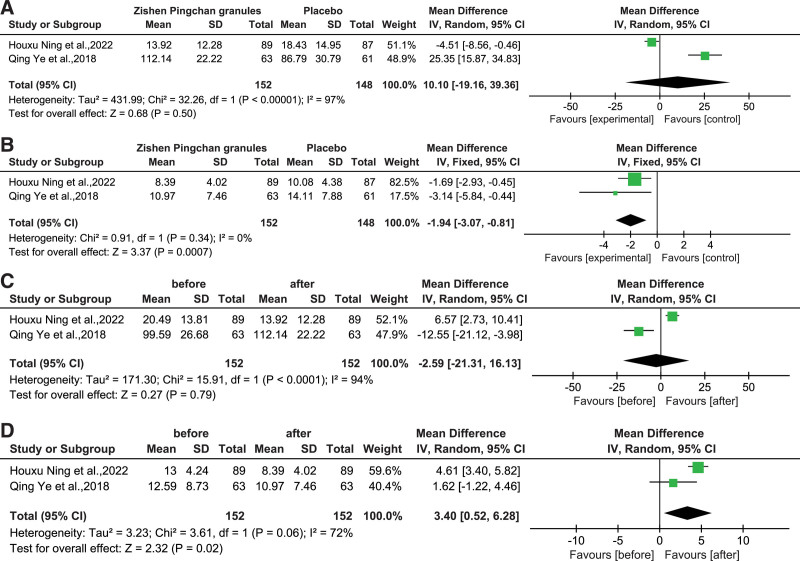
Background: Parkinson disease (PD) is the second most common neurodegenerative disease, which has impacts on the patient’s quality of life due to non-motor symptoms such as sleep disorders, anxiety, and depression. Traditional Chinese medicine (TCM) has gained increasing attention in the diagnosis and treatment of PD with the concept of “overall concepts and dialectical treatment.” Therefore, exploring the characteristics of TCM in the treatment of PD can improve the level of diagnosis and treatment of PD. Methods: A comprehensive literature search was conducted using the following electronic databases: PubMed, Web of Science, Embase, Scopus, Cochrane Library, and China National Knowledge Infrastructure. The inclusion criteria were randomized controlled trials (RCTs) that compared TCM intervention with conventional treatments or placebo for non-motor symptoms in PD. The quality of the included RCTs was assessed using the Cochrane risk of bias tool. Results: A total of 9 RCTs involving 1714 participants with PD were included in this systematic review and meta-analysis. The meta-analysis showed that TCM was effective in improving non-motor symptoms, including depression (Hamilton depression rating scale [HAMD], weighted mean difference [WMD] = 4.24, 95% CI = 2.84–5.65, P < .0001), anxiety (HAMA, WMD = 4.03, 95% CI = 2.64–5.41, P < .0001), autonomic dysfunction (Scales for Outcomes in Parkinson’s disease–Autonomic, WMD = 4.57, 95% CI = 1.69–7.45, P = .002), non-motor symptoms (Movement Disorder Society-Unified Parkinson’s Disease Rating Scale-part 1, WMD = 0.66, 95% CI = 0.20–1011, P = .004), and quality of life (PDQ-39, WMD = 6.72, 95% CI = 0.87–12.58, P < .05), compared with baseline. Zishen Pingchan granules was particularly effective for depression (HAMD, WMD = −1.94, 95% CI = −3.07 to −0.81, P < .001, compared to placebo; HAMD, WMD = 3.40, 95% CI = 0.52–6.28, P < .05, after treatment). Pingchan granules was particularly effective for quality of life after treatment (PDQ-39, WMD = 10.20, 95% CI = 1.87−18.53, P < .05). Conclusions: TCM is effective and safety for improvement of depression, anxiety, autonomic dysfunctions, and quality of life in PD. Zishen Pingchan granules was particularly effective for depression; and Pingchan granules was particularly effective for quality of life.
Overview
The claims and statistics of this paper haven’t been checked yet.
Free: it reads the open-access text and checks the first 5 claims that cite a source we can check. Create a free account to check every claim.
Integrity signals
Registry
Cites
Statistics
Figures
Verification
Claims the paper makes
The claims and statistics of this paper haven’t been checked yet.
Free: it reads the open-access text and checks the first 5 claims that cite a source we can check. Create a free account to check every claim.
Self-check
Percentages, sums and reported differences re-computed from the paper’s own numbers.
The self-check needs the paper’s full text.
Citations
Cites
PRISMA-P Group, Moher, D., Shamseer, L., Clarke, M., Ghersi, D., Liberati, A., Petticrew, M., Shekelle, P., & Stewart, L. A. (2015) · Systematic Reviews · doi:10.1186/2046-4053-4-1 · Cited by 26,223 · cited 1×
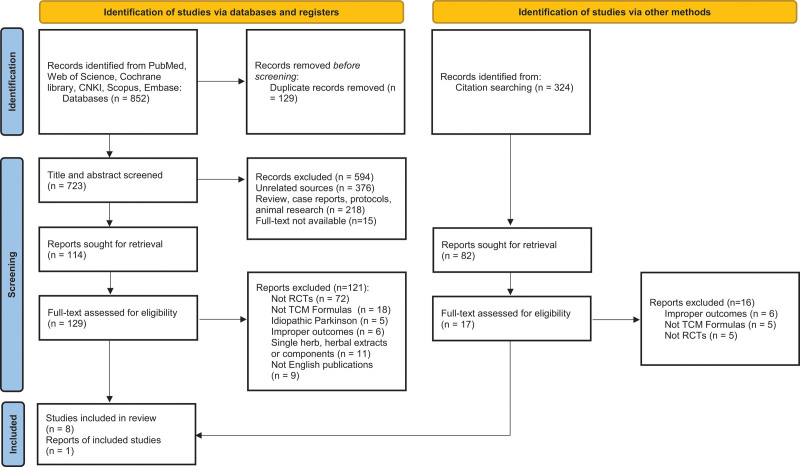
“Methods The systematic review and meta-analysis were conducted following the Cochrane Handbook and the Preferred Reporting Items for Systematic Review and Meta-Analysis (PRISMA) guidelines.[9] The study was registered at International Platform of Registered Systematic Review and Metaanalysis Protocols (INPLASY), the r…”
Bloem, B. R., Okun, M. S., & Klein, C. (2021) · The Lancet · doi:10.1016/s0140-6736(21)00218-x · Cited by 3,920 · cited 1×
“Introduction Parkinson disease (PD) is a progressive neurological disorder that can present with a wide range of clinical symptoms.[1] Symptoms can start off mild in the early stages of the disease, but progressively worsen as the disease advances.”
The diagnosis of Parkinson’s disease
Tolosa, E., Wenning, G., & Poewe, W. (2006) · The Lancet Neurology · doi:10.1016/s1474-4422(05)70285-4 · Cited by 902 · cited 1×
“The study inclusion criteria were as follows: patients had a confirmed diagnosis of PD based on the CNDS updated version in 2006 for PD[10]; interventions involved the use of herbal medicine or herbal formulas combined with conventional medicine treatments under PD treatment guidelines[10]; comparators were placebo or…”
Motor symptoms in Parkinson’s disease: A unified framework
Moustafa, A. A., Chakravarthy, S., Phillips, J. R., Gupta, A., Keri, S., Polner, B., Frank, M. J., & Jahanshahi, M. (2016) · Neuroscience & Biobehavioral Reviews · doi:10.1016/j.neubiorev.2016.07.010 · Cited by 481 · cited 1×
“Clinical signs of PD include tremor, bradykinesia, muscle stiffness, gait disturbance, impaired posture, and balance, speech and handwriting problems, and loss of automatic movements.[2] Non-motor symptoms of PD include cognitive dysfunction, depression, sleep disorders, gastrointestinal, and bladder dysfunction, fati…”
Spectrum of Non-Motor Symptoms in Parkinson's Disease
Kumaresan, M., & Khan, S. (2021) · Cureus · doi:10.7759/cureus.13275 · Cited by 108 · cited 1×
“dysfunction, mentation, behavior, mood, and quality of life problems.[3] Unfortunately, there is currently no optimal therapy to cure or prevent the progression of PD, and only a few interventions have been shown to be effective for certain clinical symptoms.”
Zhang, G., Xiong, N., Zhang, Z., Liu, L., Huang, J., Yang, J., Wu, J., Lin, Z., & Wang, T. (2015) · PLOS ONE · doi:10.1371/journal.pone.0118498 · Cited by 72 · cited 11×
“The inclusion criteria were randomized controlled trials (RCTs) that compared TCM intervention with conventional treatments or placebo for non-motor symptoms in PD.”
InfluentialSystematic Review of Traditional Chinese Medicine for Depression in Parkinson's Disease
Zhang, Y., Wang, Z., Sun, H., Li, P., Li, Y., & Chen, N. (2014) · The American Journal of Chinese Medicine · doi:10.1142/s0192415x14500657 · Cited by 60 · cited 1×
“The results showed that TCM was effective for the improvement of non-motor symptoms in PD such as depression, anxiety, quality of life, autonomic dysfunctions, which is consistent with previous studies.[7,20,21] However, our results suggest that TCM is not effective for sleep disturbance, this might be attributed to t…”
Herbal Medicines for Parkinson's Disease: A Systematic Review of Randomized Controlled Trials
Kim, T., Cho, K., Jung, W., & Lee, M. S. (2012) · PLoS ONE · doi:10.1371/journal.pone.0035695 · Cited by 50 · cited 1×
“The results showed that TCM was effective for the improvement of non-motor symptoms in PD such as depression, anxiety, quality of life, autonomic dysfunctions, which is consistent with previous studies.[7,20,21] However, our results suggest that TCM is not effective for sleep disturbance, this might be attributed to t…”
Shan, C.-S., Zhang, H., Xu, Q., Shi, Y., Wang, Y., Li, Y., Lin, Y., & Zheng, G. (2018) · Frontiers in Aging Neuroscience · doi:10.3389/fnagi.2018.00349 · Cited by 41
Self-citationYuan, C., Yang, X.-M., Ye, Q., Yuan, X.-L., & Zhang, H. (2018) · Neural Regeneration Research · doi:10.4103/1673-5374.235075 · Cited by 30
Research works printed but not linked: 1
- 11. Higgins J, Thompson SG, Deeks JJ, et al. Cochrane handbook for systematic reviews of interventions version 5.1.0. Cochrane Collaboration. 2008;5:S38.
Cited by
Jin, C., Ma, J.-X., Wang, H., Tang, L.-X., Ye, Y., Li, X., & Si, J. (2024) · Frontiers in Cellular and Infection Microbiology · doi:10.3389/fcimb.2023.1325418 · Cited by 5
Pereira, C. R., Machado, J., Criado, B., Santos, R., Reis, A. M., Ramos, B., Santos, M. J., & Greten, H. J. (2025) · Clinical Parkinsonism & Related Disorders · doi:10.1016/j.prdoa.2025.100324 · Cited by 1
“Several studies demonstrated a correlation between acupuncture and a reduction in motor symptoms in PD [12], as well as improvements in non-motor symptoms including mood, sleep, depression, anxiety, and autonomic dysfunctions [13,14].”
Neta, R. D. S. C., Batista, C. D. S., PALMERIM, É. M. M., Dias, H. M. C., Nóbrega, K. C. C., de Oliveira, C. A., & Visco, D. B. (2025) · Neuroscience · doi:10.1016/j.neuroscience.2025.08.014 · Cited by 2
Nie, W., & Li, L. (2025) · Journal of Visualized Experiments · doi:10.3791/69260 · Cited by 1
Zhang, X., Yao, M., Wang, T., Chen, H., Zeng, R., Hao, G., Wu, D., Li, H., Yang, S., Zhao, Y., et al. (2023) · Research Square · doi:10.21203/rs.3.rs-3808567/v1 · Cited by 1
Metadata
- Authors
- Huang, L., Hong, J., & Wang, Y.
- Affiliations
- Fujian University of Traditional Chinese Medicine (CN)
- Corresponding author
- Wang, Yang
- ORCID
- Wang, Yang
- Venue
- Medicine
- Published
- 2023-07-28
- Volume
- 102
- Issue
- 30
- Pages
- e34425
- ISSN
- 0025-7974 (ISSN-L)
- PMC
- PMC10378741
- OpenAlex
- W4385330858
- Cited by
- 9
- References
- 20
- Citations by year
- 2026: 3 · 2025: 4 · 2024: 1 · 2023: 1
- FWCI
- 0.37
- Type
- journal article
- Language
- en
- Open access
- gold
- doi.org
- Licence
- Locations
- Medicine (publishedVersion, cc-by-nc)
- PubMed Central (publishedVersion, cc-by-nc)
- PubMed (publishedVersion)
- Topics
- Health Sciences › Medicine › Clinical Neurology › Parkinson's Disease Mechanisms and Treatments
- Health Sciences › Medicine › Complementary and alternative medicine › Traditional Chinese Medicine Studies
- Health Sciences › Medicine › Complementary and alternative medicine › Traditional Chinese Medicine Clinical Research
- Keywords
- Parkinson's disease, traditional Chinese medicine, non-motor symptoms, depression, anxiety, autonomic dysfunction, sleep disorders, quality of life, herbal medicine, acupuncture combined with herbal medicine, risk of bias, quality of evidence, patient-reported outcomes, neurodegenerative disease treatment, PDQ-39
- MeSH terms
- China, Humans, Medicine, Chinese Traditional, Parkinson Disease
About these checks
Registry, retraction, Cites and statistics results are computed, not judged, with one exception: a printed reference that no index lists is read once by a model before it counts as a citation error. Claims are extracted by a model and kept only when their quote appears verbatim in the text; each cited source is then checked, with a model’s help, for whether it says what the claim relies on. Those verdicts can be wrong — read the claim’s quote and the cited source before relying on one.
Statistics and arithmetic are recomputed, not judged.
Confidence bands are shown only for fields calibrated on our annotated test set. None is calibrated yet, so no band is shown.
What counts as a claim ›How we measure confidence ›How we check this ›
Are you an author, or do you see a problem with this page? Request a review
How to cite
Cite CoChat for the checks on this page, and the paper for its own findings.
- This page
- CoChat. (2026). Citation check: Traditional Chinese Medicine for non-motor symptoms in Parkinson disease: A systematic review and meta-analysis of RCTs. https://app.cochat.ai/papers/10.1097/md.0000000000034425
- The paper
- Huang, L., Hong, J., & Wang, Y. (2023). Traditional Chinese Medicine for non-motor symptoms in Parkinson disease: A systematic review and meta-analysis of RCTs. Medicine. https://doi.org/10.1097/md.0000000000034425
Data sources
Bibliographic data: Semantic Scholar, OpenAlex, Crossref.
Contains information from the Semantic Scholar Academic Graph Datasets, made available under the ODC Attribution License (ODC-BY 1.0).
Semantic Scholar’s data is described in: Kinney, R., et al. (2023). The Semantic Scholar Open Data Platform. arXiv:2301.10140.
