

30 second screening test and education reduce chronic pain incidence after blood donation: Large prospective observational study from Japan
Open accessThe DOI matches its Crossref record; 19 of the 21 references it cites were found in a registry or an index; none of the 5 sources its claims cite is checked for support yet.
Abstract
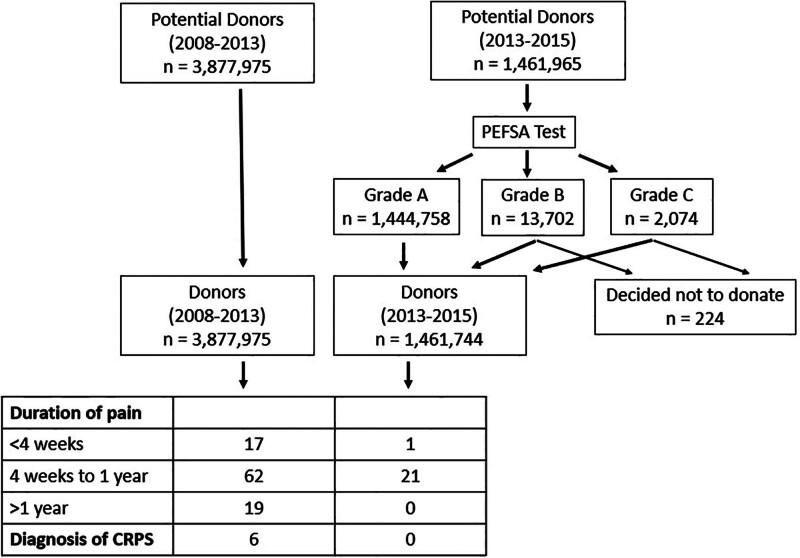
Venipuncture is a commonly performed procedure to obtain blood for testing or donation, but nerve injuries with persistent or chronic pain can occasionally occur. We implemented Phalen elbow flexion shoulder abduction (PEFSA) test to screen potential blood donors who may be at risk for persistent or chronic nerve pain after blood donation. Data were prospectively collected on all blood donors at Red Cross centers in Kansai area of Japan for 5 years prior to PEFSA test implementation, and then for 2 years after test implementation. Potential donors who had positive PEFSA test were given a handout informing them of potentially elevated risk for nerve complications. All donors who had persistent pain were followed and treated at Red Cross centers. There were 3,877,975 donors before and 1,461,965 potential donors after PEFSA test implementation. A total of 221 out of 15,776 potential donors with positive PEFSA test decided to stop donation. Prior to test implementation, 98 (0.00253%) donors developed persistent pain. Nineteen had symptoms lasting over 1 year. Six were diagnosed with complex regional pain syndrome (CRPS). After PEFSA test implementation, 22 (0.00151%) developed persistent pain. None had symptoms lasting >1 year or developed CRPS. Our data suggest that the PEFSA test alone do not identify high risk potential donors, but also educating the positive potential donors significantly decrease incidence of persistent pain and CRPS. To our knowledge, this study is the first to test an intervention that can help prevent persistent pain or CRPS from blood donation.
Overview
CoChat Summary
TL;DR
A 30-second PEFSA screening test plus education for positive donors was associated with a 40% reduction in persistent pain after blood donation (0.00253% to 0.00151%) and no CRPS after implementation. However, all 22 donors who developed persistent pain after implementation were PEFSA grade A, so the test alone did not identify high-risk donors.
Key findings
- Before PEFSA implementation, 98 of 3,877,975 donors (0.00253%) developed persistent pain; 19 had symptoms lasting over 1 year, and 6 were diagnosed with CRPS.
- After PEFSA implementation, 22 of 1,461,741 donors (0.00151%) developed persistent pain; none had symptoms lasting >1 year, and no donors developed CRPS. The difference was statistically significant (P = .0244), and the paper reports a 40% decrease in incidence.
- PEFSA grading after implementation: 1,444,758 (98.2%) were grade A, 13,702 (0.94%) grade B, and 2074 (0.14%) grade C. Of grade B donors, 196 of 13,702 (1.43%) decided not to donate; of grade C donors, 25 of 2074 (1.21%) decided not to donate.
- All 22 donors who developed persistent pain after implementation were grade A on PEFSA; the paper concludes the test alone did not identify high-risk donors, but education and opting out may have contributed to the decrease.
Methods
- Prospective observational study at Japanese Red Cross centers in the Kansai area, collecting data on all blood donors for 5 years before PEFSA implementation (September 1, 2008–August 31, 2013) and 2 years after implementation (September 1, 2013–August 31, 2015).
- PEFSA test: donors abducted shoulders 90 degrees, maximally flexed elbows, and maximally flexed wrists for 30 seconds; results were graded A (no discomfort), B (discomfort but able to maintain position), or C (unable to maintain position). Grade B or C donors received a handout about possible increased risk of nerve complications and could opt out of donation.
- Donors with persistent pain were followed and treated at Red Cross centers; Tinel sign was assessed, CRPS was diagnosed using Japanese Ministry of Health, Labour and Welfare CRPS Research Group criteria, and data were analyzed with Fisher exact test using R version 3.3.3 (P < .05 considered significant).
Limitations
- The paper states subjects were not randomized, though it argues the pre-implementation group was an appropriate control because data were collected prospectively and no other blood donation protocol aspects changed.
- The paper states the study does not explain the mechanism, and further studies are needed to understand the pathophysiology and prevention mechanism of persistent pain after blood donation.
- The text makes evident that the before-after design cannot separate the PEFSA test itself from the handout/education and opting-out opportunity; the paper notes all post-implementation persistent pain cases were PEFSA-negative, and it discusses possible explanations including the much larger number of PEFSA-negative donors and the possibility that the test reduced long-term but not short-term pain.
Model-written summary. Check it against the paper before relying on it.
Integrity signals
Registry
Cites
Statistics
Figures

Verification
Claims the paper makes
0 Valid · 0 Not valid · 5 Not checked · 20 Own results and interpretations
A result the paper reports from its own data — it cites no other source for it, so there is none to check. The quote shows it is in the paper.
In the paper
“Prior to test implementation, 98 (0.00253%) donors developed persistent pain.”
- Also stated in: § 3. Results · plain
“Prior to implementation of the PEFSA test, 98 out of 3,877,975 (0.00253%) donors developed persistent pain.”
§ 30 second screening test and education reduce chronic pain incidence after blood donation: Large prospective observational study from Japan > Abstract
plainn = 3,877,975- Asserted: passes — The authors put it forward as true.
- Checkable: passes — It can be checked against evidence.
- Load-bearing: passes — The paper’s conclusions depend on it.
- Based: passes — The paper gives a reason why it holds.
- Also stated in: § 3. Results · plain
A result the paper reports from its own data — it cites no other source for it, so there is none to check. The quote shows it is in the paper.
In the paper
“The incidence decreased by 40% from 0.00253% to 0.00151%.”
- Also stated in: § 5. Conclusion · plain
“reduce the incidence of persistent pain after blood donation by 40%.”
§ 30 second screening test and education reduce chronic pain incidence after blood donation: Large prospective observational study from Japan > 4. Discussion
plainstates a cause- Asserted: passes — The authors put it forward as true.
- Checkable: passes — It can be checked against evidence.
- Load-bearing: passes — The paper’s conclusions depend on it.
- Based: passes — The paper gives a reason why it holds.
- Also stated in: § 5. Conclusion · plain
A result the paper reports from its own data — it cites no other source for it, so there is none to check. The quote shows it is in the paper.
In the paper
“A total of 221 out of 15,776 potential donors with positive PEFSA test decided to stop donation.”
§ 30 second screening test and education reduce chronic pain incidence after blood donation: Large prospective observational study from Japan > Abstract
plainn = 15,776- Asserted: passes — The authors put it forward as true.
- Checkable: passes — It can be checked against evidence.
- Load-bearing: unclear — It is unclear whether the paper’s conclusions depend on it.
- Based: passes — The paper gives a reason why it holds.
A result the paper reports from its own data — it cites no other source for it, so there is none to check. The quote shows it is in the paper.
In the paper
“Six were diagnosed with complex regional pain syndrome (CRPS).”
- Also stated in: § 3. Results · plain
“Six patients were diagnosed with CRPS.”
§ 30 second screening test and education reduce chronic pain incidence after blood donation: Large prospective observational study from Japan > Abstract
plainn = 6- Asserted: passes — The authors put it forward as true.
- Checkable: passes — It can be checked against evidence.
- Load-bearing: unclear — It is unclear whether the paper’s conclusions depend on it.
- Based: passes — The paper gives a reason why it holds.
- Also stated in: § 3. Results · plain
A result the paper reports from its own data — it cites no other source for it, so there is none to check. The quote shows it is in the paper.
In the paper
“The rates of chronic pain PEFSA-negative vs PEFSA-positive donors were close (0.0016% vs 0%).”
§ 30 second screening test and education reduce chronic pain incidence after blood donation: Large prospective observational study from Japan > 4. Discussion
plain- Asserted: passes — The authors put it forward as true.
- Checkable: passes — It can be checked against evidence.
- Load-bearing: passes — The paper’s conclusions depend on it.
- Based: passes — The paper gives a reason why it holds.
13 more claims
Create a free account to see all 25 claims and to verify the 1 reference still open.
- Probably not a substantial claim. 4
- It may state two separate claims as one. 3
Self-check
Percentages, sums and reported differences re-computed from the paper’s own numbers.
Each contradiction between two passages listed here was confirmed by an independent check.
Rated minor: it would not touch a result — a value no result rests on, a p-value that stays on the same side of the significance level, or a conflict that is clerical, resolved elsewhere in the paper, or outside its own findings.
In the paper
§ 30 second screening test and education reduce chronic pain incidence after blood donation: Large prospective observational study from Japan > 4. Discussion
“there were many more PEFSA-negative donors than PEFSA-positive donors (1,461,744 vs 15,776).”
§ 30 second screening test and education reduce chronic pain incidence after blood donation: Large prospective observational study from Japan > 3. Results
“With PEFSA testing, 1,444,758 (98.2%) potential donors were grade A, 13,702 (0.94%) were grade B, and 2074 (0.14%) were grade C.”
Citations
Cites
The Pain Catastrophizing Scale: Development and validation.
Sullivan, M. J. L., Bishop, S. R., & Pivik, J. (1995) · Psychological Assessment · doi:10.1037//1040-3590.7.4.524 · Cited by 8,227
Fear-avoidance and its consequences in chronic musculoskeletal pain: a state of the art.
Vlaeyen, J. W. S., & Linton, S. J. (2000) · Pain · doi:10.1016/s0304-3959(99)00242-0 · Cited by 4,931
Pain catastrophizing: a critical review.
Quartana, P. J., Campbell, C. M., & Edwards, R. R. (2009) · Expert Review of Neurotherapeutics · doi:10.1586/ern.09.34 · Cited by 1,405
Outline of a fear-avoidance model of exaggerated pain perception--I.
Lethem, J., Slade, P. D., Troup, J. D. G., & Bentley, G. (1983) · Behaviour Research and Therapy · doi:10.1016/0005-7967(83)90009-8 · Cited by 1,327
CARPAL TUNNEL SYNDROME (DIAGNOSIS AND MANAGEMENT)
Annisa, D., Budhi Rianawati, S., Rahayu, M., Raisa, N., & Nandar Kurniawan, S. (2021) · JPHV (Journal of Pain, Vertigo and Headache) · doi:10.21776/ub.jphv.2021.002.01.2 · Cited by 217
The validity of upper-limb neurodynamic tests for detecting peripheral neuropathic pain.
Nee, R. J., Jull, G. A., Vicenzino, B., & Coppieters, M. W. (2012) · Journal of Orthopaedic & Sports Physical Therapy · doi:10.2519/jospt.2012.3988 · Cited by 171
(2016) · PubMed · Cited by 167
Upper limb tension tests as tools in the diagnosis of nerve and plexus lesions
Kleinrensink, G. J., Stoeckart, R., Mulder, P. G. H., Hoek, G. V. D., Broek, T., Vleeming, A., & Snijders, C. J. (2000) · Clinical Biomechanics · doi:10.1016/s0268-0033(99)00042-x · Cited by 149
Newman, B. H., & Waxman, D. A. (1996) · Transfusion · doi:10.1046/j.1537-2995.1996.36396182137.x · Cited by 105
Peripheral nerve injury and causalgia secondary to routine venipuncture.
Horowitz, S. H. (1994) · Neurology · doi:10.1212/wnl.44.5.962 · Cited by 101
Research works printed but not linked: 3
- McGraw M. Errant Needlestick Costs Surgery Center $1.25 Million. https://www.aorn.org/outpatient-surgery/articles/news-archive/2012/january/errant-needlestick-costs-surgery-center-1-25-million. Accessed August 14, 2022.
- Shima H Kida H Sugano W. Peripheral nerve problems following venipuncture – SFPD (the sum of factors concerning peripheral disorders) hypothesis and its prevention – Part 1. A case report of 10 cases that complained neurological symptoms and required treatment in hospitals after blood donation. J Jpn B Program. 2014; 37: 589– 92.
- Owaki Y Nishi A Sato C. The introduction of SAEFP test as a self-check. J Jpn B Program. 2014; 37: 589– 92.
Metadata
- Authors
- Hagiwara, Y., Nakamura, T., Shima, H., Tani, Y., Takahashi, Y., Sonoki, K., Moroi, K., & Yoshida, R.
- Affiliations
- Kamagaya General Hospital (JP)
- Kyoto University Hospital (JP)
- Japanese Red Cross Society, Japan (JP)
- Kyoto University (JP)
- Shizuoka Cancer Center (JP)
- Nara Medical University (JP)
- Cedars-Sinai Medical Center (US)
- Corresponding author
- Yoshida, Ryu
- Venue
- Medicine
- Published
- 2025-02-07
- Volume
- 104
- Issue
- 6
- Pages
- e41491
- ISSN
- 0025-7974 (ISSN-L)
- 1536-5964
- PMC
- PMC11813037
- OpenAlex
- W4407305405
- Semantic Scholar
- 39f317baa08ee018b35f7eb4a07bbee7214f7e71
- Cited by
- 0
- References
- 21
- FWCI
- 0.00
- Type
- journal article
- Language
- en
- Open access
- gold
- doi.org
- Locations
- Medicine (publishedVersion, cc-by)
- PubMed Central (publishedVersion, cc-by)
- PubMed (publishedVersion)
- Topics
- Health Sciences › Medicine › Hematology › Blood donation and transfusion practices
- Health Sciences › Medicine › Anesthesiology and Pain Medicine › Pain Management and Treatment
- Health Sciences › Medicine › Critical Care and Intensive Care Medicine › Central Venous Catheters and Hemodialysis
- Keywords
- blood donation, chronic pain, nerve injury, venipuncture complications, complex regional pain syndrome, donor screening, donor education
- MeSH terms
- Blood Donation, Adult, Blood Donors, Female, Humans, Japan, Male, Middle Aged, Prospective Studies, Incidence, Phlebotomy, Chronic Pain
About these checks
Registry, retraction, Cites and statistics results are computed, not judged, with one exception: a printed reference that no index lists is read once by a model before it counts as a citation error. Claims are extracted by a model and kept only when their quote appears verbatim in the text; each cited source is then checked, with a model’s help, for whether it says what the claim relies on. Those verdicts can be wrong — read the claim’s quote and the cited source before relying on one.
A language model drew the claims from the paper on 2026-09-29, under version 3 of the claim definition (model deepseek-v4.1-flash, prompt extract-v3).
A second model labelled each claim on 2026-09-29 (model jev-1.13-20260917, definition revision gold-guideline-v0.2).
Statistics and arithmetic are recomputed, not judged.
Confidence bands are shown only for fields calibrated on our annotated test set. None is calibrated yet, so no band is shown.
What counts as a claim ›How we measure confidence ›How we check this ›
Are you an author, or do you see a problem with this page? Request a review
Data sources
Bibliographic data: Semantic Scholar, OpenAlex, Crossref.
Contains information from the Semantic Scholar Academic Graph Datasets, made available under the ODC Attribution License (ODC-BY 1.0).
Semantic Scholar’s data is described in: Kinney, R., et al. (2023). The Semantic Scholar Open Data Platform. arXiv:2301.10140.
