

The DOI matches its Crossref record; 32 of the 32 references it cites were found in a registry or an index.
Applied Rapid Qualitative Analysis to Develop a Contextually Appropriate Intervention and Increase the Likelihood of Uptake
Open accessAbstract
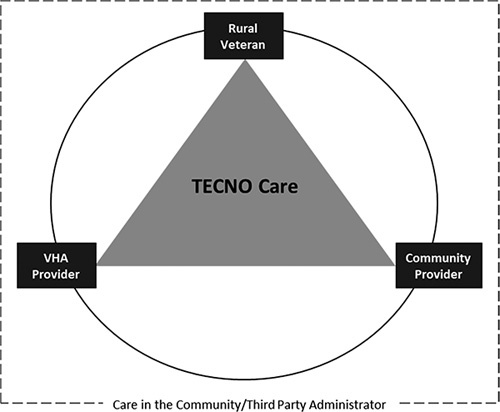
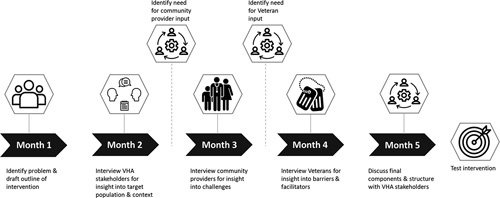
BACKGROUND: Rapid approaches to collecting and analyzing qualitative interview data can accelerate discovery timelines and intervention development while maintaining scientific rigor. We describe the application of these methods to a program designed to improve care coordination between the Veterans Health Administration (VHA) and community providers. METHODS: Care coordination between VHA and community providers can be challenging in rural areas. The Telehealth-based Coordination of Non-VHA Care (TECNO Care) intervention was designed to improve care coordination among VHA and community providers. To ensure contextually appropriate implementation of TECNO Care, we conducted preimplementation interviews with veterans, VHA administrators, and VHA and community providers involved in community care. Using both a rapid approach and qualitative analysis, an interviewer and 1-2 note-taker(s) conducted interviews. RESULTS: Over 5 months, 18 stakeholders were interviewed and we analyzed these data to identify how best to deliver TECNO Care. Responses relevant to improving care coordination include health system characteristics; target population; metrics and outcomes; challenges with the current system; and core components. Veterans who frequently visit VHA or community providers and are referred for additional services are at risk for poor outcomes and may benefit from additional care coordination. Using these data, we designed TECNO Care to include information on VHA services and processes, assist in the timely completion of referrals, and facilitate record sharing. CONCLUSION: Rapid qualitative analysis can inform near real-time intervention development and ensure relevant content creation while setting the stage for stakeholder buy-in. Rigorous and timely analyses support the delivery of contextually appropriate, efficient, high-value patient care.
Overview
The claims and statistics of this paper haven’t been checked yet.
Run the check — free, no account needed. It reads the open-access text and checks the sources it cites.
Integrity signals
Registry
Cites
Statistics
Figures
Verification
Claims the paper makes
The claims and statistics of this paper haven’t been checked yet.
Run the check — free, no account needed. It reads the open-access text and checks the sources it cites.
Claims other papers make about this one
Each is checked against this paper’s own text: does it say what the citing paper says it does?
The source backs part of the claim, not all of it — or backs it for a different population, condition or comparison.
In the citing paper
“Rapid qualitative analysis is useful to obtain targeted qualitative data and comparative results when data collection targets and processes are highly structured [65].”
From Synthetic Lies: Understanding AI-Generated Misinformation and Evaluating Algorithmic and Human Solutions (2023) · cites this paper as [65]
Experimental — accuracy not yet measured
Self-check
Percentages, sums and reported differences re-computed from the paper’s own numbers.
The self-check needs the paper’s full text.
Citations
Cites
Damschroder, L. J., Aron, D. C., Keith, R. E., Kirsh, S. R., Alexander, J. A., & Lowery, J. C. (2009) · Implementation Science · doi:10.1186/1748-5908-4-50 · Cited by 14,496
Sample Size in Qualitative Interview Studies: Guided by Information Power
Malterud, K., Siersma, V. D., & Guassora, A. D. (2016) · Qualitative Health Research · doi:10.1177/1049732315617444 · Cited by 12,703
Gale, N. K., Heath, G., Cameron, E., Rashid, S., & Redwood, S. (2013) · BMC Medical Research Methodology · doi:10.1186/1471-2288-13-117 · Cited by 10,865
Methods for the thematic synthesis of qualitative research in systematic reviews
Thomas, J., & Harden, A. (2008) · BMC Medical Research Methodology · doi:10.1186/1471-2288-8-45 · Cited by 9,312
Avoidable waste in the production and reporting of research evidence
Chalmers, I., & Glasziou, P. (2009) · The Lancet · doi:10.1016/s0140-6736(09)60329-9 · Cited by 2,208
Managing Clinical Knowledge for Health Care Improvement
Balas, E. A., & Boren, S. A. (2000) · Yearbook of Medical Informatics · doi:10.1055/s-0038-1637943 · Cited by 1,479 · cited 9×
“(2) Inner setting, contextual features of the VHA such as the administrative structure and processes that influence health care delivery and care coordination.”
BackgroundMethodInfluentialImplementation science: What is it and why should I care?
Bauer, M. S., & Kirchner, J. (2020) · Psychiatry Research · doi:10.1016/j.psychres.2019.04.025 · Cited by 1,167 · cited 3×
“(4) What are the central care coordination tasks TECNO Care should address? [Intervention characteristics]—We ensured that TECNO Care was neither duplicative nor burdensome to those who would be delivering TECNO Care.”
BackgroundMatrix Analysis as a Complementary Analytic Strategy in Qualitative Inquiry
Averill, J. B. (2002) · Qualitative Health Research · doi:10.1177/104973230201200611 · Cited by 866
Gale, R. C., Wu, J., Erhardt, T., Bounthavong, M., Reardon, C. M., Damschroder, L. J., & Midboe, A. M. (2019) · Implementation Science · doi:10.1186/s13012-019-0853-y · Cited by 846 · cited 3×
“VHA and community providers Community care experiences (1) What conditions or types of patients do you think require better care coordination between VHA and community providers? [Outer setting; patient needs and resources] (2) Who are the key players inside your organization that we should talk with about TECNO? [Pro…”
BackgroundTaylor, B., Henshall, C., Kenyon, S., Litchfield, I., & Greenfield, S. (2018) · BMJ Open · doi:10.1136/bmjopen-2017-019993 · Cited by 659 · cited 1×
“(6) What are the right metrics to assess TECNO Care’s effectiveness? [Process]—We identified which metrics should be followed to assess the program’s impact.”
Background
Cited by
Sorted by citations
Zhou, J., Zhang, Y., Luo, Q., Parker, A. G., & De Choudhury, M. (2023) · Proceedings of the 2023 CHI Conference on Human Factors in Computing Systems · doi:10.1145/3544548.3581318 · Cited by 288
“Rapid qualitative analysis is useful to obtain targeted qualitative data and comparative results when data collection targets and processes are highly structured [65].”
BackgroundKowalski, C. P., Nevedal, A., Finley, E. P., Young, J. P., Lewinski, A. A., Midboe, A. M., & Hamilton, A. B. (2024) · Implementation Science · doi:10.1186/s13012-024-01397-1 · Cited by 206
Self-citationChatGPT as a tool for medical education and clinical decision-making on the wards: Case study
Skryd, A., & Lawrence, K. (2024) · JMIR Formative Research · doi:10.2196/51346 · Cited by 63
“…short-hand attending notes from the clinical sessions and identify both emergent major, minor, and outlier themes and themes specifically related to the use of ChatGPT for real-time ward-based educational contexts; these themes were reviewed and revised between both authors (KL and AS) [10,11].”
BackgroundLee, H. S., Wright, C., Ferranto, J., Buttimer, J., Palmer, C. E., Welchman, A., Mazor, K. M., Fisher, K. A., Smelson, D., O’Connor, L., et al. (2025) · Frontiers in Psychiatry · doi:10.3389/fpsyt.2024.1505024 · Cited by 55
Burden, M. A., Astik, G. J., Auerbach, A. D., Bowling, G., Kangelaris, K. N., Keniston, A., Kochar, A., Leykum, L. K., Linker, A. S., Sakumoto, M., et al. (2024) · JAMA Internal Medicine · doi:10.1001/jamainternmed.2024.1890 · Cited by 52
Metadata
- Authors
- Lewinski, A. A., Crowley, M. J., Miller, C., Bosworth, H. B., Jackson, G. L., Steinhauser, K., White-Clark, C., McCant, F., & Zullig, L. L.
- Affiliations
- Duke University (US)
- Harvard University (US)
- Center of Innovation to Accelerate Discovery and Practice Transformation, Durham Veterans Affairs Health Care System
- Durham VA Health Care System (US)
- Corresponding author
- Lewinski, Allison A.
- Crowley, Matthew J.
- Bosworth, Hayden B.
- Jackson, George L.
- Steinhauser, Karen
- McCant, Felicia
- Zullig, Leah L.
- ORCID
- Venue
- Medical Care
- Published
- 2021-05-13
- Volume
- 59
- Issue
- Suppl 3
- Pages
- S242-S251
- ISSN
- 0025-7079 (ISSN-L)
- PMC
- PMC8132894
- OpenAlex
- W3163088900
- Cited by
- 296
- References
- 32
- Citations by year
- 2026: 83 · 2025: 70 · 2024: 79 · 2023: 43 · 2022: 20 · 2021: 1
- FWCI
- 40.17
- Type
- journal article
- Language
- en
- Open access
- hybrid
- doi.org
- Licence
- Locations
- Medical Care (publishedVersion, cc-by-nc-nd)
- PubMed Central (publishedVersion, cc-by-nc-nd)
- PubMed (publishedVersion)
- Funders
- U.S. Department of Veterans Affairs (CIN 13–410, IK6 HX003161)
- Topics
- Health Sciences › Health Professions › General Health Professions › Health Policy Implementation Science
- Social Sciences › Education › Qualitative Research Methods and Applications
- Health Sciences › Medicine › Public Health, Environmental and Occupational Health › Telemedicine and Telehealth Implementation
- Keywords
- rapid qualitative analysis, intervention development, care coordination, Veterans Health Administration, community service providers, telemedicine, rural veterans, stakeholder engagement, referral completion, health record sharing, implementation readiness
- MeSH terms
- Stakeholder Participation, Veterans Health Services, Community Health Services, Health Plan Implementation, Humans, Patient Acceptance of Health Care, Patient Care Management, United States, United States Department of Veterans Affairs, Veterans, Telemedicine, Rural Health Services, Qualitative Research
About these checks
Registry, retraction, Cites and statistics results are computed, not judged, with one exception: a printed reference that no index lists is read once by a model before it counts as a citation error. Claims are extracted by a model and kept only when their quote appears verbatim in the text; each cited source is then checked, with a model’s help, for whether it says what the claim relies on. Those verdicts can be wrong — read the claim’s quote and the cited source before relying on one.
Statistics and arithmetic are recomputed, not judged.
Confidence bands are shown only for fields calibrated on our annotated test set. None is calibrated yet, so no band is shown.
What counts as a claim ›How we measure confidence ›How we check this ›
Are you an author, or do you see a problem with this page? Request a review
