

The DOI matches its Crossref record; 34 of the 34 references it cites were found in a registry or an index; 16 of the 32 sources its claims cite were checked for support.
An Improved Definition and SAFE Rule for Predicting Difficult Intravascular Access (DIVA) in Hospitalized Adults
Open accessAbstract
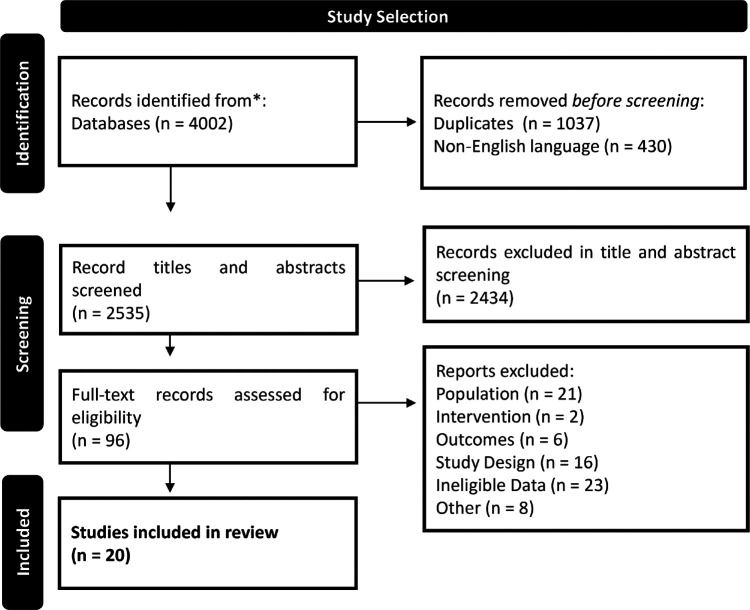
Patients with difficult intravascular access (DIVA) are common, yet the condition is often ignored or poorly managed, leading to patient dissatisfaction and misuse of health care resources. This study sought to assess all published risk factors associated with DIVA in order to promote prospective identification and improved management of patients with DIVA. A systematic literature review on risk factors associated with DIVA was conducted. Risk factors published in ≥4 eligible studies underwent a multivariate meta-analysis of multiple factors (MVMA-MF) using the Bayesian framework. Of 2535 unique publications identified, 20 studies were eligible for review. In total, 82 unique DIVA risk factors were identified, with the 10 factors found in ≥4 studies undergoing MVMA-MF. Significant predictors of DIVA included vein visibility, vein palpability, history of DIVA, obesity (body mass index [BMI] >30), and history of intravenous (IV) drug abuse, which were combined to create the mnemonic guideline, SAFE: See, Ask (about a history of DIVA or IV drug abuse), Feel, and Evaluate BMI. By recognizing patients with DIVA before the first insertion attempt and treating them from the outset with advanced vein visualization techniques, patients with DIVA could be subject to less frequent painful venipunctures, fewer delays in treatment, and a reduction in other DIVA-associated burdens.
Overview
CoChat Summary
TL;DR
This systematic review and meta-analysis synthesized DIVA risk factors from 20 studies and proposed the SAFE mnemonic (See, Ask, Feel, Evaluate BMI) plus a revised pre-insertion DIVA definition. The primary Bayesian meta-analysis found history of DIVA, obesity, non-palpable veins, non-visible veins, and IV drug abuse significantly associated with DIVA, though the SAFE rule is not yet clinically validated.
Key findings
- From 2535 unique search results, 20 studies (15,628 patients) were included; 170 risk factors were extracted and combined into 82 distinct factors, with 22 reported in ≥2 studies and 10 in ≥4 studies for primary analysis.
- The primary MVMA-MF found 5 significant predictors: history of DIVA, obesity, non-palpable veins, non-visible veins, and IV drug abuse. In a sensitivity analysis restricted to 13 studies defining DIVA as >1 attempt, history of DIVA, vein palpability, and vein visibility remained significant; obesity became nonsignificant and drug abuse was not included due to inadequate reporting.
- The authors created SAFE (See, Ask, Feel, Evaluate BMI) from vein palpability, vein visibility, history of DIVA, history of IV drug abuse, and obesity; it is not yet weighted or clinically validated.
- The proposed revised DIVA definition is: prior to any insertion attempt, no visible or palpable vasculature, stated/documented history of difficult vascular access, IV drug abuse, or BMI >30; these patients should be classified as DIVA and considered for escalation to advanced insertion techniques such as ultrasound.
Methods
- Systematic literature review and meta-analysis; searched multiple Ovid/EBM databases on March 9, 2022; 2535 unique results, 2530 screened, 96 full-text assessed, 20 included. Inclusion: hospitalized or emergency department patients aged ≥18 with indication for peripheral IV, with or without ultrasound, English-language, reporting DIVA risk factors.
- Data extracted in duplicate; risk of bias assessed descriptively. Bayesian random-effects multivariate meta-analysis of multiple factors (MVMA-MF) using the altmeta R package with vague priors, 3 chains, ≥10,000 burn-in, ≥100,000 iterations; univariate meta-analyses as sensitivity using metafor. Only factors reported in ≥4 studies were included in the primary analysis; results reported as ORs with credible intervals.
Limitations
- Stated: most included studies were noninterventional and cannot inform causation; risk of bias was assessed descriptively; three studies may be biased toward healthier patients by excluding critically ill patients, one excluded IV drug abuse patients, only one blinded participants and none blinded providers; lack of standardized terminology may impact interpretation.
- Stated: data were sparse—MVMA-MF on all 22 factors did not converge; only 10 factors appeared in ≥4 studies and only 1 study measured all 10; dialysis, insertion site availability, race, dark skin, smaller veins, and lack of cannulation sites were underreported; adjusted OR meta-analysis could not be conducted due to varied adjustment sets.
- Stated: the SAFE rule is not yet weighted or clinically validated; improved first-attempt success cannot be directly correlated with catheter functionality or survival, and further research is needed.
Model-written summary. Check it against the paper before relying on it.
Integrity signals
Registry
Cites
Statistics
Figures


Verification
Claims the paper makes
12 Valid · 1 Not valid · 11 Not checked · 61 Own results and interpretations
The cited sources support only part of this claim — read each source’s verdict below.
In the paper
“When many insertion attempts are needed, there may be up to a 7-fold increase in costs, including those from additional supplies used and increased procedure times.”
What the sources say
- Not checked — no full text of the sourcecites [6] source
- Partly supportedcites [8] sourceExperimental — accuracy not yet measured
The Introduction reports that one study found a sevenfold cost increase after multiple failed insertion attempts compared with a single attempt. It does not specify that the increased costs included additional supplies or longer procedure times. (LLM, conf=0.88)
- Not checked — no full text of the sourcecites [34] source
hedgedstates a possible cause- Asserted: passes — The authors put it forward as true.
- Checkable: passes — It can be checked against evidence.
- Load-bearing: unclear — It is unclear whether the paper’s conclusions depend on it.
- Based: passes — The paper gives a reason why it holds.
The cited sources support only part of this claim — read each source’s verdict below.
In the paper
“Moreover, the assessment instruments that have ORs available are similar to those found in the current analyses (Table 4 ).”
What the sources say
- Supportedcites [1] source
The Statistical Analysis section says the modified A-DIVA scale reports adjusted odds ratios for its independent predictors, and the Results section gives ORs for five factors in the final model (page numbers unavailable). This supports citing the paper as an example of an assessment instrument with ORs; the comparison with the citing authors’ own analyses is their assessment. (LLM, conf=0.87)
- Partly supportedcites [22] sourceExperimental — accuracy not yet measured
The Statistical Methods and Results sections report odds ratios for difficult-cannulation risk factors, including a previous history of difficulty. Our copy does not report odds ratios for assessment instruments or compare them with the citing paper’s analyses; that part of the claim is unsupported. (LLM, conf=0.76)
- Partly supportedcites [28] sourceExperimental — accuracy not yet measured
The Results (page not available in our copy) report odds ratios for five predictors in the A-DIVA scale. This supports the availability of ORs for this instrument, but the source cannot establish that they are similar to those in the citing paper’s current analyses. (LLM, conf=0.82)
plain- Asserted: passes — The authors put it forward as true.
- Checkable: passes — It can be checked against evidence.
- Load-bearing: unclear — It is unclear whether the paper’s conclusions depend on it.
- Based: passes — The paper gives a reason why it holds.
- Supported
A result the paper reports from its own data — it cites no other source for it, so there is none to check. The quote shows it is in the paper.
In the paper
“The MVMA-MF analyses on the set of 10 risk factors measured in at least 4 studies found 5 factors that were significantly associated with DIVA (history of DIVA, obesity, non-palpable veins, non-visible veins, and IV drug abuse; Table 2 ).”
- Also stated in: § Meta-Analysis · plain
“The primary analysis found 4 of the 6 clinician-identified set of a priori factors expected to be important in predicting DIVA to be significant (lack of vein palpability, obesity, lack of vein visibility, history of DIVA).”
- Also stated in: § Meta-Analysis · plain
“History of DIVA, vein palpability, and vein visibility remained as significant factors.”
plainstates an association- Asserted: passes — The authors put it forward as true.
- Checkable: passes — It can be checked against evidence.
- Load-bearing: passes — The paper’s conclusions depend on it.
- Based: passes — The paper gives a reason why it holds.
- Also stated in: § Meta-Analysis · plain
A result the paper states — it cites no source for it, so there is none to check. The quote shows it is in the paper.
In the paper
“Synonymous risk factors were combined where possible, and after consultation with subject matter experts, a total of 82 distinct risk factors were identified”
plain- Asserted: passes — The authors put it forward as true.
- Checkable: passes — It can be checked against evidence.
- Load-bearing: unclear — It is unclear whether the paper’s conclusions depend on it.
- Based: passes — The paper gives a reason why it holds.
A result the paper states — it cites no source for it, so there is none to check. The quote shows it is in the paper.
In the paper
“Due to the paucity of data, each DIVA risk factor may have only 2 to 3 studies contributing direct evidence.”
hedged- Asserted: passes — The authors put it forward as true.
- Checkable: passes — It can be checked against evidence.
- Load-bearing: passes — The paper’s conclusions depend on it.
- Based: passes — The paper gives a reason why it holds.
17 more claims
Create a free account to see all 85 claims and every source verdict.
- Probably not a substantial claim. 38
- It may state two separate claims as one. 40
- The quote only partly states this claim. 1
Claims other papers make about this one
Each is checked against this paper’s own text: does it say what the citing paper says it does?
The source backs part of the claim, not all of it — or backs it for a different population, condition or comparison.
In the citing paper
“the results show more than 16 tools for anticipating DIVA,22 23 25”
From Difficult intravenous access (DIVA) in the adult population: an umbrella review (2026) · cites this paper as [22]
Experimental — accuracy not yet measuredThe source backs part of the claim, not all of it — or backs it for a different population, condition or comparison.
In the citing paper
“underlining the A-DICAVE scale22 23 due to its content validity, inter-evaluator reliability and clinical applicability, in agreement with the study by Salleras-Duran et al.28”
From Difficult intravenous access (DIVA) in the adult population: an umbrella review (2026) · cites this paper as [22]
Experimental — accuracy not yet measuredThe source backs part of the claim, not all of it — or backs it for a different population, condition or comparison.
In the citing paper
“These divergences could explain the low adoption of DIVA assessment instruments in clinical practice,22 29”
From Difficult intravenous access (DIVA) in the adult population: an umbrella review (2026) · cites this paper as [22]
Experimental — accuracy not yet measuredThe check wasn’t confident either way, so it gives no verdict — never disputed.
In the citing paper
“the findings from this study22 24 and other recent evidence34 show that structured training significantly improves the technical skills needed for venous cannulation, although the impact of the competences of the clinician is still assessed in a heterogeneous and limited manner.19”
From Difficult intravenous access (DIVA) in the adult population: an umbrella review (2026) · cites this paper as [22]
Experimental — accuracy not yet measured
Citations
Cites
Conducting Meta-Analyses in R with the metafor Package
Viechtbauer, W. (2010) · Journal of Statistical Software · doi:10.18637/jss.v036.i03 · Cited by 20,464
Costantino, T. G., Parikh, A. K., Satz, W. A., & Fojtik, J. P. (2005) · Annals of Emergency Medicine · doi:10.1016/j.annemergmed.2004.12.026 · Cited by 435 · cited 3×
“6,8 The present SLR identified 170 DIVA indicators, which were synthesized into 82 risk factors, after combining syn-onymous terms.”
BackgroundMethodInfluentialJacobson, A. F., & Winslow, E. H. (2005) · Heart & Lung · doi:10.1016/j.hrtlng.2005.04.002 · Cited by 279
The epidemiology of peripheral vein infusion thrombophlebitis: a critical review
Tagalakis, V., Kahn, S. R., Libman, M., & Blostein, M. (2002) · The American Journal of Medicine · doi:10.1016/s0002-9343(02)01163-4 · Cited by 274
Risk factors associated with difficult venous access in adult ED patients
Fields, J. M., Piela, N. E., Au, A. K., & Ku, B. S. (2014) · The American Journal of Emergency Medicine · doi:10.1016/j.ajem.2014.07.008 · Cited by 192 · cited 2×
“18”
BackgroundSebbane, M., Claret, P.-G., Lefebvre, S., Mercier, G., Rubenovitch, J., Jreige, R., Eledjam, J.-J., & de La Coussaye, J.-E. (2013) · The Journal of Emergency Medicine · doi:10.1016/j.jemermed.2012.07.051 · Cited by 179 · cited 1×
“24 Only one of the studies blinded participants, and none blinded providers, so there is a risk of implicit bias, especially in studies based on provider reports.”
Backgroundvan Loon, F. H. J., van Hooff, L. W. E., de Boer, H. D., Koopman, S. S. H. A., Buise, M. P., Korsten, H. H. M., Dierick-van Daele, A. T. M., & Bouwman, A. R. A. (2019) · Journal of Clinical Medicine · doi:10.3390/jcm8020144 · Cited by 157 · cited 3×
“1,29,33 The present SLR and meta-analysis combined data from existing DIVA prediction tools and risk factor studies, along with clinician gestalt, to determine the best available indicators for predicting difficult venous access.”
MethodArmenteros‐Yeguas, V., Gárate‐Echenique, L., Tomás‐López, M. A., Cristóbal‐Domínguez, E., Moreno‐de Gusmão, B., Miranda‐Serrano, E., & Moraza‐Dulanto, M. I. (2017) · Journal of Clinical Nursing · doi:10.1111/jocn.13750 · Cited by 134
van Loon (2016) · doi:10.1097/md.0000000000003428 · Cited by 124 · cited 2×
“1,29,33 The present SLR and meta-analysis combined data from existing DIVA prediction tools and risk factor studies, along with clinician gestalt, to determine the best available indicators for predicting difficult venous access.”
MethodCarr, P. J., Rippey, J. C. R., Budgeon, C. A., Cooke, M. L., Higgins, N., & Rickard, C. M. (2016) · The Journal of Vascular Access · doi:10.5301/jva.5000487 · Cited by 122
Cited by
Weber, Y., Cohn‐Schwartz, D., Khamis, S., et al. (2025) · SAGE Open Medicine · doi:10.1177/20503121251337197 · Cited by 5
Callahan, A., Shamailov, M., Kalo, K., Bena, J., Morrison, S. L., Hartman, J., & Albert, N. M. (2024) · Journal of Clinical Nursing · doi:10.1111/jocn.17604 · Cited by 2
Petta, D., Longobucco, Y., Magi, C. E., Aoufy, K. E., Forciniti, C., Lucchini, A., Iovino, P., Amato, C., Iozzo, P., Rasero, L., et al. (2025) · The Journal of Vascular Access · doi:10.1177/11297298241312457 · Cited by 3
Impacto de los equipos hospitalarios multiprofesionales de acceso vascular guiado por ecografía
Dobrzynska, A., Aguilera-Cobos, L., Isabel‐Gómez, R., & Blasco‐Amaro, J. A. (2025) · doi:10.52766/fdhg5715 · Cited by 1
Alfaro, E., Ejercito, R., Canote, M., Cosgrove, T., Hawker, J.-J., Quinn, M. A., & Miaskowski, C. A. (2025) · Journal of Infusion Nursing · doi:10.1097/nan.0000000000000590
Metadata
- Authors
- Bahl, A., Alsbrooks, K., Zazyczny, K. A., Johnson, S., & Hoerauf, K.
- Affiliations
- University of Southern California (US)
- Corresponding author
- Alsbrooks, Kimberly
- Venue
- Journal of Infusion Nursing
- Published
- 2024-02-19
- Volume
- 47
- Issue
- 2
- Pages
- 96-107
- ISSN
- 1533-1458 (ISSN-L)
- PMC
- PMC10913859
- OpenAlex
- W4391985911
- Cited by
- 20
- References
- 34
- Citations by year
- 2026: 13 · 2025: 6 · 2024: 1
- FWCI
- 2.43
- Type
- journal article
- Language
- en
- Open access
- hybrid
- doi.org
- Licence
- Locations
- Journal of Infusion Nursing (publishedVersion, cc-by-nc-nd)
- PubMed Central (publishedVersion, cc-by-nc-nd)
- PubMed (publishedVersion)
- Funders
- Medline Industries
- Topics
- Health Sciences › Medicine › Critical Care and Intensive Care Medicine › Central Venous Catheters and Hemodialysis
- Physical Sciences › Engineering › Biomedical Engineering › Intravenous Infusion Technology and Safety
- Health Sciences › Medicine › Pulmonary and Respiratory Medicine › Vascular Procedures and Complications
- Keywords
- risk factors, hospitalized adults, vein visualization, intravenous drug use, obesity, body mass index, venipuncture
- MeSH terms
- Adult, Bayes Theorem, Humans, Pain, Prospective Studies, Risk Factors, Substance Abuse, Intravenous
About these checks
Registry, retraction, Cites and statistics results are computed, not judged, with one exception: a printed reference that no index lists is read once by a model before it counts as a citation error. Claims are extracted by a model and kept only when their quote appears verbatim in the text; each cited source is then checked, with a model’s help, for whether it says what the claim relies on. Those verdicts can be wrong — read the claim’s quote and the cited source before relying on one.
The claim verdicts this report counts are experimental: their accuracy is not yet measured.
A language model drew the claims from the paper on 2026-09-29, under version 3 of the claim definition (model deepseek-v4.1-flash, prompt extract-v3).
A second model labelled each claim on 2026-09-29 (model jev-1.13-20260917, definition revision gold-guideline-v0.2).
Cited sources are checked with a language model’s help (gpt-6-sol).
Statistics and arithmetic are recomputed, not judged.
Confidence bands are shown only for fields calibrated on our annotated test set. None is calibrated yet, so no band is shown.
What counts as a claim ›How we measure confidence ›How we check this ›
Are you an author, or do you see a problem with this page? Request a review
How to cite
Cite CoChat for the checks on this page, and the paper for its own findings.
- This page
- CoChat. (2026). Citation check: An Improved Definition and SAFE Rule for Predicting Difficult Intravascular Access (DIVA) in Hospitalized Adults. https://app.cochat.ai/papers/10.1097/nan.0000000000000535
- The paper
- Bahl, A., Alsbrooks, K., Zazyczny, K. A., Johnson, S., & Hoerauf, K. (2024). An Improved Definition and SAFE Rule for Predicting Difficult Intravascular Access (DIVA) in Hospitalized Adults. Journal of Infusion Nursing. https://doi.org/10.1097/nan.0000000000000535
Data sources
Bibliographic data: Semantic Scholar, OpenAlex, Crossref.
Contains information from the Semantic Scholar Academic Graph Datasets, made available under the ODC Attribution License (ODC-BY 1.0).
Semantic Scholar’s data is described in: Kinney, R., et al. (2023). The Semantic Scholar Open Data Platform. arXiv:2301.10140.
