

The DOI matches its Crossref record; 144 of the 159 references it cites were found in a registry or an index.
Updated Guideline on Treatment and Management of Craniosynostosis
Open accessAbstract
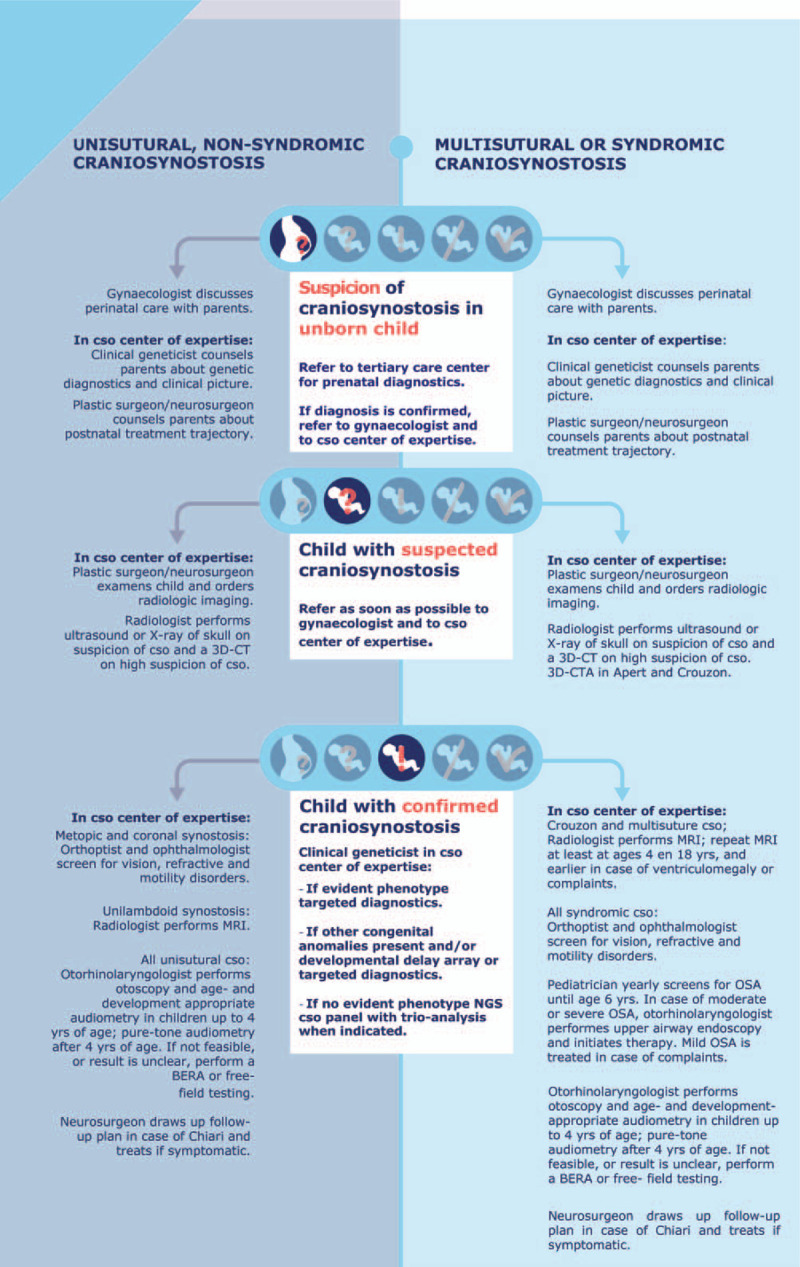
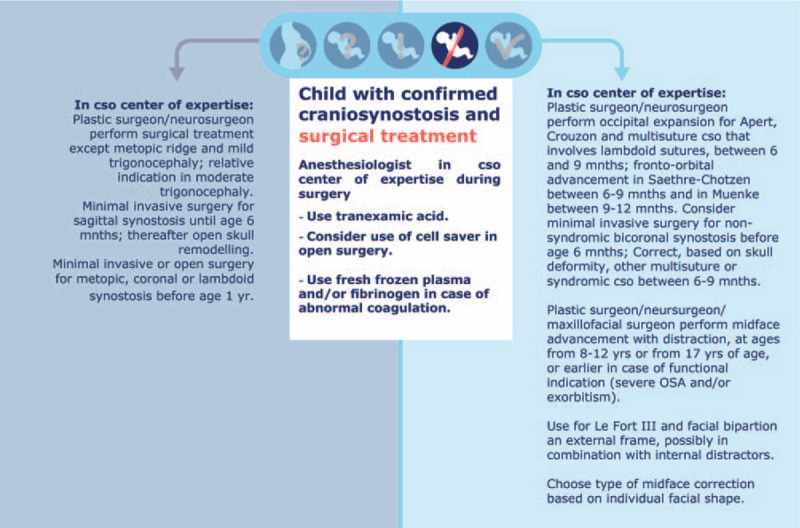
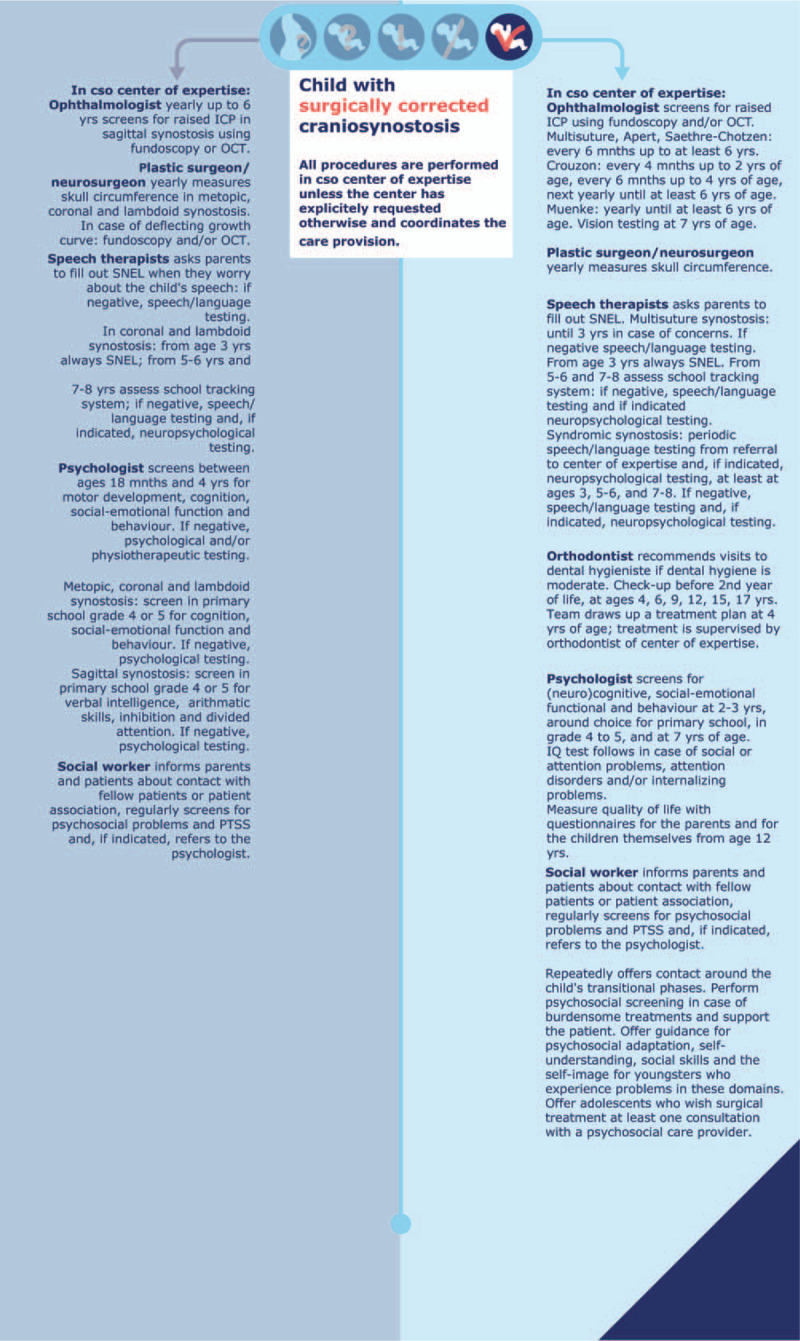
Contents CHAPTER 1. INTRODUCTION The first version of the Dutch guideline for care and treatment of patients with craniosynostosis was established in 2010 and published in 2015.1 The Dutch Society for Plastic and Reconstructive Surgery initiated the revision of this guideline, to update it according to the most recent scientific literature. This second version has been approved by all participating societies in 2020. All chapters from the previous version were revised and new topics on prenatal detection and speech and language development were introduced. REFERENCES 1. Mathijssen IMJ. Guideline for care of patients with the diagnoses of craniosynostosis: Working group on craniosynostosis. J Craniofac Surg 2015:26:1735-1807. CHAPTER 2. METHODOLOGY FOR GUIDELINE DEVELOPMENT Input of Patient Perspective The patient perspective was taken into account by asking the Patient Federation Netherlands for written input on bottlenecks and points for attention in the preparatory phase. They forwarded the request for the submission of bottlenecks to LAPOSA and Stichting Kind en Ziekenhuis (Child and Hospital Foundation). No bottlenecks were submitted. In addition, the chair of LAPOSA had a seat in the working group. During the comment phase, the draft guideline was also presented to the Patient Federation Netherlands, LAPOSA and Foundation Child and Hospital. For information: A focus group meeting had been organized during the development of the guideline in 2010 (see Appendix 1, https://links.lww.com/SCS/B832). This report is still valid. Method Employed by the Working Group Procedure in 2010 The content of this guideline is based on evidence from published scientific research. Relevant articles were identified using systematic searches in Medline, Embase, and the Cochrane Library. Existing guidelines were specifically searched for in online accessible (international and national guideline clearinghouses). Searches were limited to the Dutch, English and French languages. In addition, articles were extracted from reference lists of relevant literature. This resulted for several basic questions in additional articles. Care for children with craniosynostosis was introduced in the late 1960 s, and consequently the English literature from those years onwards was included. Searches were performed until 1 December 2009 and articles available as “Epub ahead of publication” at that date were included as well. Regarding all basic questions, patient categories were defined in a uniform way. The following search terms were used: craniofacial, craniosynostosis combined with: genetics, hydrocephalus, Chiari, cerebral pressure, otitis, hearing, vision, psychology, anesthesia, complications, infection, development, growth, maxilla, mandible, distraction, osteotomy, Fort, midface, RED, halo, monobloc, facial bipartition, median fasciotomy, hypertelorism. The complete search strategies are available on request. Relevant articles extracted from reference lists of retrieved literature and several relevant publications until 1 November 2009 were included as well. Ongoing research was left out of consideration. Under the headings Summary of the literature / Conclusions only published studies / guidelines are discussed. Case reports and letters were excluded, unless they reported a complication. The selected articles were assessed on methodological quality graded by level of evidence according to the standard classification: see Table 1. After selection, those articles remained that are listed to underpin the various conclusions. The articles are assessed under the heading ‘Summary of the literature’. Next, the scientific evidence was briefly summarized in a ‘Conclusion’. The main literature on which a conclusion is based was mentioned as well, including the level of evidence (see Table 2). Other aspects than scientific evidence may be relevant to making a recommendation as well, such as patient preferences (derived from the results of the focus group sessions or relevant literature on the patient perspective), costs, availability, or organizational aspects. These kinds of aspects, provided they have not been subject of research, were mentioned under the heading ‘Considerations’. The experience and the opinion of the working group members have been key to the other considerations. The ‘Recommendation’ results from the combination of the available evidence and the other considerations. Procedure in 2017/2018 AGREE This guideline has been revised in accordance with the requirements according to the report Medical Specialist Guidelines 2.0 of the Advisory Committee on Guidelines of the Council for Quality (www.kwaliteitskoepel.nl). This report is based on the AGREE II instrument (Appraisal of Guidelines for Research & Evaluation II) (www.agreecollaboration.org), which is an internationally widely accepted instrument, and on ’guidelines for guideline’ for assessing the quality of guidelines (www.cvz.nl). Bottleneck Analysis During the preparator
Overview
The claims and statistics of this paper haven’t been checked yet.
Run the check — free, no account needed. It reads the open-access text and checks the sources it cites.
Integrity signals
Registry
Cites
Statistics
Figures
Verification
Claims the paper makes
The claims and statistics of this paper haven’t been checked yet.
Run the check — free, no account needed. It reads the open-access text and checks the sources it cites.
Claims other papers make about this one
Each is checked against this paper’s own text: does it say what the citing paper says it does?
The source backs part of the claim, not all of it — or backs it for a different population, condition or comparison.
In the citing paper
“Surgical approaches have evolved from simple linear craniectomies to more complex cranial vault reconstructions (CVR) as well as minimal invasive approaches, highlighting continued efforts to refine treatment approaches for this complex condition [1, 6].”
From Developments in diagnostic and surgical techniques in children with sagittal suture craniosynostosis: a systematic review spanning the last 30 years (2025) · cites this paper as [6]
Experimental — accuracy not yet measuredThe cited source says what the claim attributes to it.
In the citing paper
“The effective use of these technologies still requires specialized expertise for accurate interpretation and further appropriate treatment recommendations based on the latest research findings [2, 6].”
From Developments in diagnostic and surgical techniques in children with sagittal suture craniosynostosis: a systematic review spanning the last 30 years (2025) · cites this paper as [6]
Self-check
Percentages, sums and reported differences re-computed from the paper’s own numbers.
The self-check needs the paper’s full text.
Citations
Cites
GRADE: an emerging consensus on rating quality of evidence and strength of recommendations
Guyatt, G. H., Oxman, A. D., Vist, G. E., Kunz, R., Falck-Ytter, Y., Alonso-Coello, P., & Schünemann, H. J. (2008) · BMJ · doi:10.1136/bmj.39489.470347.ad · Cited by 23,305
Statistical Power Analysis for the Behavioral Sciences
Wassertheil, S., & Cohen, J. (1970) · Biometrics · doi:10.2307/2529115 · Cited by 1,383
Obstructive sleep disordered breathing in 2- to 18-year-old children: diagnosis and management
Kaditis, A. G., Álvarez, M. L. A., Boudewyns, A. N., Alexopoulos, E. Ι., Ersu, R. H., Joosten, K., Larramona, H., Miano, S., Narang, I., Trang, H., et al. (2015) · European Respiratory Journal · doi:10.1183/13993003.00385-2015 · Cited by 944
Management of craniosynostoses
Renier, D., Lajeunie, E., Arnaud, E., & Marchac, D. (2000) · Child s Nervous System · doi:10.1007/s003810000320 · Cited by 384
Chiari malformation in craniosynostosis
Cinalli, G., Spennato, P., Sainte-Rose, C., Arnaud, É., Aliberti, F., Brunelle, F., Cianciulli, E., & Rénier, D. (2005) · Child's Nervous System · doi:10.1007/s00381-004-1115-z · Cited by 253
The evolving role of springs in craniofacial surgery: The first 100 clinical cases
Lauritzen, C. G. K., Davis, C., Ivarsson, A., Sanger, C., & Hewitt, T. D. (2008) · Plastic and Reconstructive Surgery · doi:10.1097/01.prs.0000297638.76602.de · Cited by 240
Endoscopic craniectomy for early correction of craniosynostosis.
Barone, C., & Jimenez, D. F. (1999) · Plastic and Reconstructive Surgery · doi:10.1097/00006534-199912000-00003 · Cited by 225
Cinalli, G., Rénier, D., Sebag, G., Sainte-Rose, C., Arnaud, É., & Pierre-Kahn, A. (1995) · Journal of Neurosurgery · doi:10.3171/jns.1995.83.4.0575 · Cited by 210
ERS statement on obstructive sleep disordered breathing in 1- to 23-month-old children
Kaditis, A. G., Álvarez, M. L. A., Boudewyns, A. N., Abel, F., Alexopoulos, E. Ι., Ersu, R. H., Joosten, K., Larramona, H., Miano, S., Narang, I., et al. (2017) · European Respiratory Journal · doi:10.1183/13993003.00985-2017 · Cited by 200
Intracranial Pressure in Single-Suture Craniosynostosis
Cohen, S. R., & Persing, J. (1998) · The Cleft Palate-Craniofacial Journal · doi:10.1597/1545-1569_1998_035_0194_ipissc_2.3.co_2 · Cited by 178
Cited by
Sorted by citations
Guideline on Treatment and Management of Craniosynostosis: Patient and Family Version
Faasse, M., Mathijssen, I. M. J., & ERN CRANIO Working Group on Craniosynostosis (2022) · Journal of Craniofacial Surgery · doi:10.1097/scs.0000000000009143 · Cited by 36
Self-citationSagittal Craniosynostosis: Comparing Surgical Techniques Using 3D Photogrammetry
Abdel‐Alim, T., Kurniawan, M. S. I. C., Mathijssen, I. M. J., Dremmen, M. H. G., Dirven, C. M. F., Niessen, W. J., Roshchupkin, G. V., & van Veelen, M. C. (2023) · Plastic & Reconstructive Surgery · doi:10.1097/prs.0000000000010441 · Cited by 27
Self-citationPreclinical Application of Augmented Reality in Pediatric Craniofacial Surgery: An Accuracy Study
Ruggiero, F., Cercenelli, L., Emiliani, N., Badiali, G., Bevini, M., Zucchelli, M., Marcelli, E., & Tarsitano, A. (2023) · Journal of Clinical Medicine · doi:10.3390/jcm12072693 · Cited by 26
Non-syndromic craniosynostosis
Alperovich, M., Tonello, C., Mayes, L. C., & Kahle, K. T. (2025) · Nature Reviews Disease Primers · doi:10.1038/s41572-025-00607-4 · Cited by 26
“The development of a fused metopic suture in the first year of life without any morphological cranial deformity is referred to as metopic ridging and is distinct from trigonocephaly 13,127 .”
Elkhill, C., Liu, J., Linguraru, M. G., LeBeau, S., Khechoyan, D. Y., French, B. M., & Porras, A. R. (2023) · Computer Methods and Programs in Biomedicine · doi:10.1016/j.cmpb.2023.107689 · Cited by 23
Metadata
- Authors
- Mathijssen, I. M. J.
- Affiliations
- Erasmus MC (NL)
- Corresponding author
- Mathijssen, Irene M.J.
- Venue
- Journal of Craniofacial Surgery
- Published
- 2020-11-04
- Volume
- 32
- Issue
- 1
- Pages
- 371-450
- ISSN
- 1049-2275 (ISSN-L)
- 1536-3732
- PMC
- PMC7769187
- OpenAlex
- W3096934129
- Cited by
- 140
- References
- 159
- Citations by year
- 2026: 29 · 2025: 31 · 2024: 29 · 2023: 29 · 2022: 14 · 2021: 7 · 2020: 1
- FWCI
- 7.48
- Type
- journal article
- Language
- en
- Open access
- hybrid
- doi.org
- Licence
- Locations
- Journal of Craniofacial Surgery (publishedVersion, cc-by-nc-nd)
- PubMed Central (publishedVersion, cc-by-nc-nd)
- PubMed (publishedVersion)
- EUR Research Repository (Erasmus University Rotterdam) (publishedVersion, other-oa)
- EUR Research Repository (Erasmus University Rotterdam) (submittedVersion, other-oa)
- RePub (Erasmus University Rotterdam) (submittedVersion, other-oa)
- Funders
- Stichting Kwaliteitsgelden Medisch Specialisten
- Topics
- Health Sciences › Medicine › Surgery › Craniofacial Disorders and Treatments
- Health Sciences › Medicine › Surgery › Pectus Deformity Diagnosis and Treatment
- Health Sciences › Medicine › Surgery › Reconstructive Facial Surgery Techniques
- Keywords
- prenatal diagnosis, speech and language development, pediatric neurosurgery, craniofacial surgery, patient perspectives, guideline development, multidisciplinary care
- MeSH terms
- Craniosynostoses, Humans
About these checks
Registry, retraction, Cites and statistics results are computed, not judged, with one exception: a printed reference that no index lists is read once by a model before it counts as a citation error. Claims are extracted by a model and kept only when their quote appears verbatim in the text; each cited source is then checked, with a model’s help, for whether it says what the claim relies on. Those verdicts can be wrong — read the claim’s quote and the cited source before relying on one.
Statistics and arithmetic are recomputed, not judged.
Confidence bands are shown only for fields calibrated on our annotated test set. None is calibrated yet, so no band is shown.
What counts as a claim ›How we measure confidence ›How we check this ›
Are you an author, or do you see a problem with this page? Request a review
