

A brief review of non-avian dinosaur biogeography: state-of-the-art and prospectus
Open accessThe DOI matches its Crossref record; 246 of the 246 references it cites were found in a registry or an index; none of the 328 sources its claims cite is checked for support yet.
Abstract
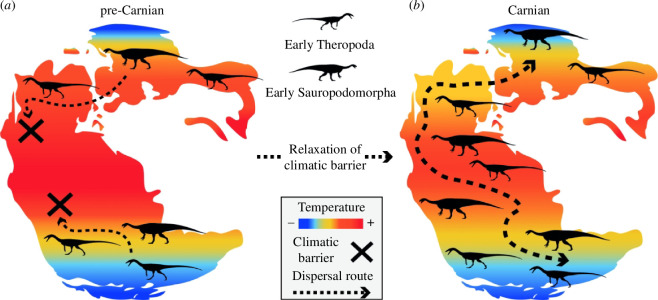
Dinosaurs potentially originated in the mid-palaeolatitudes of Gondwana 245–235 million years ago (Ma) and may have been restricted to cooler, humid areas by low-latitude arid zones until climatic amelioration made northern dispersals feasible ca 215 Ma. However, this scenario is challenged by new Carnian Laurasian fossils and evidence that even the earliest dinosaurs had adaptations for arid conditions. After becoming globally distributed in the Early–Middle Jurassic (200–160 Ma), dinosaurs experienced vicariance driven by Pangaean fragmentation. Regional extinctions and trans-oceanic dispersals also played a role, and the formation of ephemeral land connections meant that older vicariance patterns were repeatedly overprinted by younger ones, creating a reticulate biogeographic history. Palaeoclimates shaped dispersal barriers and corridors, including filters that had differential effects on different types of dinosaurs. Dinosaurian biogeographic research faces many challenges, not the least of which is the patchiness of the fossil record. However, new fossils, extensive databasing and improved analytical methods help distinguish signal from noise and generate fresh perspectives. In the future, developing techniques for quantifying and ameliorating sampling biases and modelling the dispersal capacities of dinosaurs are likely to be two of the key components in our modern research programme.
Overview
CoChat Summary
TL;DR
This review synthesizes non-avian dinosaur biogeography, supporting a possible southern Gondwanan origin in the Carnian followed by diachronous northward dispersals, Early Jurassic cosmopolitanism, and a reticulate Middle Jurassic–Cretaceous history of vicariance, geodispersal, and regional extinction. It argues that fossil-record sampling biases and uncertainty in phylogenies, palaeogeography, and palaeoclimate remain major challenges, while new databasing, network biogeography, and ecological niche/habitat suitability modelling offer key prospects.
Key findings
- The majority view remains a southern Gondwanan origin, with dinosaurs potentially originating 245–235 Ma and the modified southern Gondwana origin hypothesis restricting them to southern Gondwana for the first 10–15 million years before late Carnian–early Norian diversification/dispersal; Carnian body fossils are ca 233–230 Ma from Argentina, Brazil, southern Africa and India, but new Laurasian Carnian fossils challenge this.
- The diachronous rise of dinosaurs hypothesis posits mid-Norian northward breakouts: herrerasaurians and theropods reached the northern hemisphere earlier (mid-Norian ca 219 Ma or late Carnian), whereas sauropodomorphs did not reach Europe and Greenland until ca 215 Ma; pCO2 dips ca 215–212 Ma and 206–202 Ma are linked to climatic amelioration.
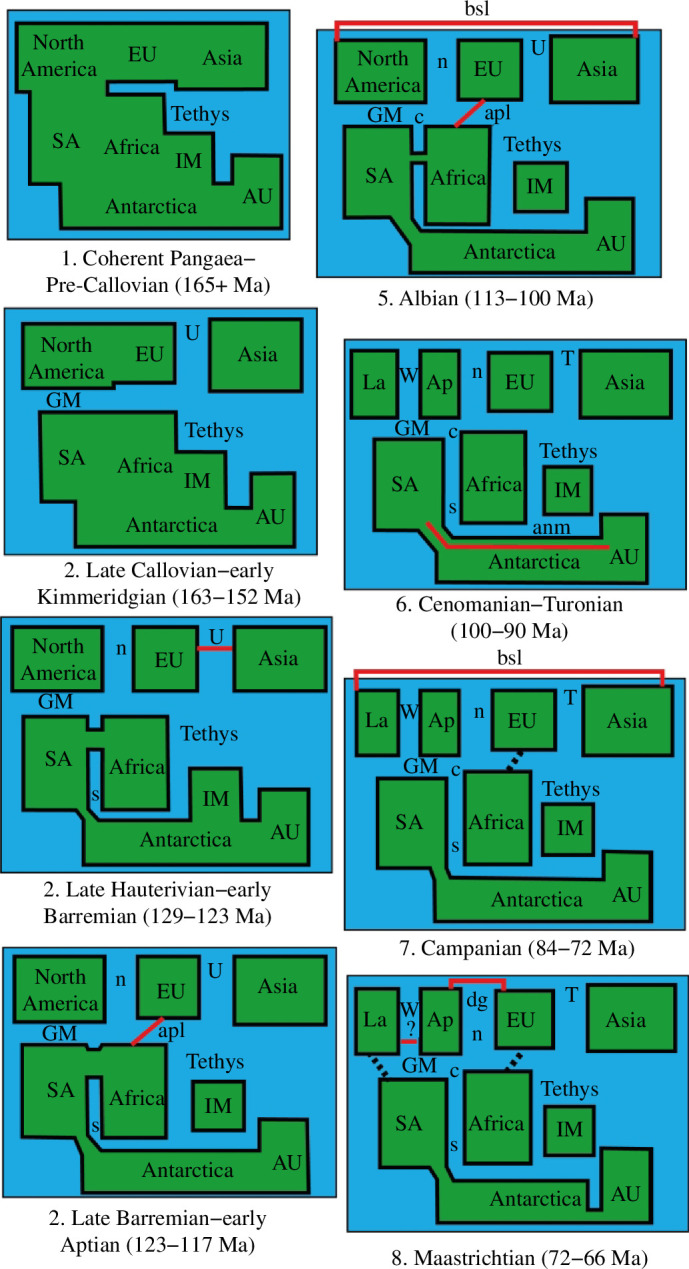
- After Early Jurassic cosmopolitanism (linked partly to end-Triassic mass extinction recovery), Middle Jurassic–latest Cretaceous history is reticulate: Pangaean fragmentation began ca 160 Ma, and table 1 lists landmass connection/disconnection events from 163–155 Ma through 69–66 Ma, with vicariance overprinted by geodispersal, regional extinction and possible trans-oceanic dispersal (e.g. hadrosaur *Ajnabia* crossing 500 km of Tethys).
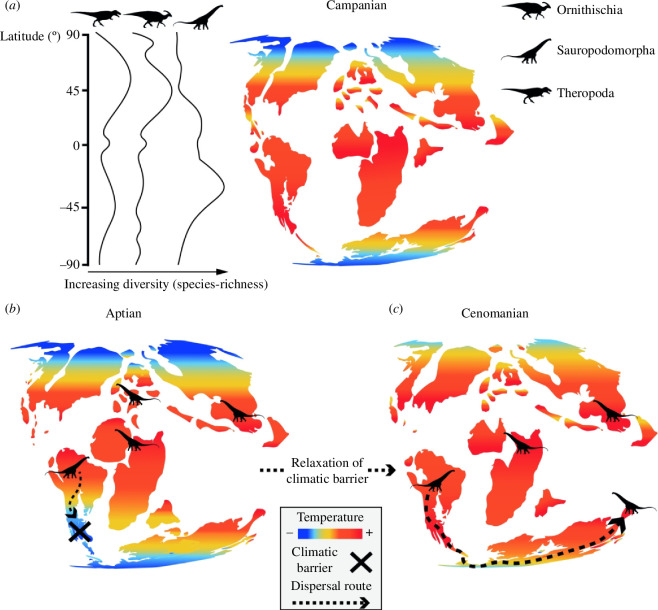
- Late Cretaceous latitudinal diversity did not match a modern tropical-peak gradient: peak diversity at 40–45° N for ornithischians, 45° N and 40° S for theropods, and 30° S for sauropods; no sauropod is known above 66° palaeolatitude, whereas some theropods and ornithischians lived at 70° or higher.
Methods
- Design: brief narrative review and prospectus; no new primary data or formal meta-analysis are presented.
- Data/sample: published fossil occurrences, dated phylogenies, palaeogeographic and palaeoclimatic reconstructions, and databases, spanning Carnian (ca 233–230 Ma) to latest Cretaceous (66 Ma).
- Main analysis: qualitative synthesis of literature and methods, including maximum likelihood/Bayesian ancestral-area estimation, network biogeography, and ecological niche/habitat suitability modelling (ENM/HSM).
Limitations
- Stated in paper: fossil-record sampling is patchy and extremely uneven temporally and spatially; palaeotropics are poorly sampled for Early–Middle Jurassic, and some regions (e.g. Early Cretaceous Indo-Madagascar) lack dinosaur-bearing formations.
- Stated in paper: disagreements or lack of resolution in taxonomy, phylogeny, fossil ages, and palaeogeographic/palaeoclimatic reconstructions can scramble or create spurious biogeographic signals; ephemeral landbridges are especially hard to resolve, and missing data can distort patterns.
- Evident from text: as a brief review, it does not apply a systematic search protocol or quantitative meta-analysis, so its conclusions depend on the cited literature and the authors’ synthesis.
Model-written summary. Check it against the paper before relying on it.
Integrity signals
Registry
Cites
Statistics
Figures
Verification
Claims the paper makes
0 Valid · 0 Not valid · 85 Not checked · 26 Own results and interpretations
None of the sources cited for this claim have been checked yet.
In the paper
“The earliest dinosaurs are known from Carnian age (early Late Triassic, ca 233−230 million years ago (Ma)) deposits in Argentina, Brazil, southern Africa and India [2–12].”
§ A brief review of non-avian dinosaur biogeography: state-of-the-art and prospectus > Biogeographic origin
What the sources say
- Not matchedcites [2] Upchurch P. In press. The biogeographic history of mesozoic dinosaurs. In The Dinosauria III (eds DB Weishample, PM Barrett, PJ Makovicky, MT Carrano). Cambridge, UK: Cambridge University Press.
Its entry has no title and year that we can search by.
- Not checked yetcites [3] Brusatte SL, Nesbitt SJ, Irmis RB, Butler RJ, Benton MJ, Norell MA. 2010 The origin and early radiation of dinosaurs. Earth Sci. Rev. 101, 68– 100. (10.1016/j.earscirev.2010.04.0012010.1746) source
- Not checked yetcites [4] Irmis RB. 2010 Evaluating hypotheses for the early diversification of dinosaurs. Earth Environ. Sci. Trans. R. Soc. Edinb. 101, 397– 426. (10.1017/S1755691011020068) source
- Not checked yetcites [5] Langer MC, Ezcurra MD, Bittencourt JS, Novas FE. 2010 The origin and early evolution of dinosaurs. Biol. Rev. Camb. Philos. Soc. 85, 55– 110. (10.1111/j.1469-185X.2009.00094.x) 19895605 source
- Not checked yetcites [6] Nesbitt SJ, Barrett PM, Werning S, Sidor CA, Charig AJ. 2013 The oldest dinosaur? A Middle Triassic dinosauriform from Tanzania. Biol. Lett. 9, 20120949. (10.1098/rsbl.2012.0949) 23221875 PMC3565515 source
- Not checked yetcites [7] Langer MC. 2014 The origins of Dinosauria: much ado about nothing. Palaeontology 57, 469– 478. (10.1111/pala.12108) source
- Not checked yetcites [8] Rakshit NN, Bhat MS, Ray S, Datta PM. 2018 First report of dinosaurian claws from the Late Triassic of India. Palaeoworld. 27, 179– 187. (10.1016/j.palwor.2018.01.001) source
- Not checked yetcites [9] Kent DV, Clemmensen LB. 2021 Northward dispersal of dinosaurs from Gondwana to Greenland at the mid-Norian (215–212 Ma, Late Triassic) dip in atmospheric pCO₂. Proc. Natl Acad. Sci. USA 118, e2020778118. (10.1073/pnas.2020778118) 33593914 PMC7923678 source
- Not checked yetcites [10] Novas FE, Agnolin FL, Ezcurra MD, Temp Müller R, Martinelli AG, Langer MC. 2021 Review of the fossil record of early dinosaurs from South America, and its phylogenetic implications. J. S. Am. Earth Sci. 110, 103341. (10.1016/j.jsames.2021.103341) source
- Not checked yetcites [11] Griffin CT, Wynd BM, Munyikwa D, Broderick TJ, Zondo M, Tolan S, Langer MC, Nesbitt SJ, Taruvinga HR. 2022 Africa’s oldest dinosaurs reveal early suppression of dinosaur distribution. Nature 609, 313– 319. (10.1038/s41586-022-05133-x) 36045297 source
plain- Asserted: passes — The authors put it forward as true.
- Checkable: passes — It can be checked against evidence.
- Load-bearing: passes — The paper’s conclusions depend on it.
- Based: passes — The paper gives a reason why it holds.
- Not matched
None of the sources cited for this claim have been checked yet.
In the paper
“Thus, we need to think of dinosaurian biogeographic history as a palimpsest of multiple (and often conflicting) signals laid down during different phases of Earth’s history [2,106,111].”
§ A brief review of non-avian dinosaur biogeography: state-of-the-art and prospectus > Tectonics and sea level, vicariance and dispersal > Middle Jurassic–latest Cretaceous: reticulate biogeographic history
What the sources say
- Not matchedcites [2] Upchurch P. In press. The biogeographic history of mesozoic dinosaurs. In The Dinosauria III (eds DB Weishample, PM Barrett, PJ Makovicky, MT Carrano). Cambridge, UK: Cambridge University Press.
Its entry has no title and year that we can search by.
- Not checked yetcites [106] Upchurch P, Hunn CA, Norman DB. 2002 An analysis of dinosaurian biogeography: evidence for the existence of vicariance and dispersal patterns caused by geological events. Proc. R. Soc. B 269, 613– 621. (10.1098/rspb.2001.1921) PMC1690931 11916478 source
- Not checked yetcites [111] Poropat SF et al. 2016 New Australian sauropods shed light on Cretaceous dinosaur palaeobiogeography. Sci. Rep. 6, 34467. (10.1038/srep34467) 27763598 PMC5072287 source
plain- Asserted: passes — The authors put it forward as true.
- Checkable: passes — It can be checked against evidence.
- Load-bearing: passes — The paper’s conclusions depend on it.
- Based: passes — The paper gives a reason why it holds.
- Not matched
None of the sources cited for this claim have been checked yet.
In the paper
“In particular, there are close phylogenetic relationships between South American (and when available, Antarctic) and Australian dinosaurs, such as titanosaurian sauropods [111,148], noasaurine and megaraptorid theropods [161,200–202] and parankylosaurs [203,204].”
§ A brief review of non-avian dinosaur biogeography: state-of-the-art and prospectus > Tectonics and sea level, vicariance and dispersal > Australia: a Cretaceous case study
What the sources say
- Not checked yetcites [111] Poropat SF et al. 2016 New Australian sauropods shed light on Cretaceous dinosaur palaeobiogeography. Sci. Rep. 6, 34467. (10.1038/srep34467) 27763598 PMC5072287 source
- Not checked yetcites [148] Poropat SF, Kundrát M, Mannion PD, Upchurch P, Tischler T, Elliott DA. 2021 Second specimen of the Late Cretaceous sauropod dinosaur Diamantinasaurus matildae provides new anatomical information on skull and neck evolution in early titanosaurs and the biogeographic origins of Australian dinosaur faunas. Zool. J. Linn. Soc. Lond. 192, 610– 674. (10.1093/zoolinnean/zlaa173) source
- Not checked yetcites [161] Novas FE, Agnolín FL, Ezcurra MD, Porfiri J, Canale JI. 2013 Evolution of the carnivorous dinosaurs during the Cretaceous: the evidence from Patagonia. Cretac. Res. 45, 174– 215. (10.1016/j.cretres.2013.04.001) source
- Not checked yetcites [200] Bell PR, Cau A, Fanti F, Smith ET. 2016 A large-clawed theropod (Dinosauria: Tetanurae) from the Lower Cretaceous of Australia and the Gondwanan origin of megaraptorid theropods. Gondwana Res. 36, 473– 487. (10.1016/j.gr.2015.08.004) source
- Not checked yetcites [201] Brougham T, Smith ET, Bell PR. 2020 Noasaurids are a component of the Australian ’mid’-Cretaceous theropod fauna. Sci. Rep. 10, 1428. (10.1038/s41598-020-57667-7) 31996712 PMC6989633 source
- Not checked yetcites [202] Lamanna MC, Casal GA, Martínez RDF, Ibiricu LM. 2020 Megaraptorid (Theropoda: Tetanurae) partial skeletons from the Upper Cretaceous Bajo Barreal Formation of Central Patagonia, Argentina: implications for the evolution of large body size in Gondwanan megaraptorans. Ann. Carneg. Mus. 86, 255– 294. (10.2992/007.086.0302) source
- Not checked yetcites [203] Frauenfelder TG, Bell PR, Brougham T, Bevitt JJ, Bicknell RDC, Kear BP, Wroe S, Campione NE. 2022 New ankylosaurian cranial remains from the Lower Cretaceous (upper Albian) Toolebuc Formation of Queensland, Australia. Front. Earth Sci. 10, 803505. (10.3389/feart.2022.803505) doi:10.3389/feart.2022.803505
- Not checked yetcites [204] Soto Acuña S, Vargas AO, Kaluza JE. 2024 A new look at the first dinosaur discovered in Antarctica: reappraisal of Antarctopelta oliveroi (Ankylosauria: Parankylosauria). Adv. Polar Sci. 35, 78– 107. (10.12429/j.advps.2023.0036)
plainstates an association- Asserted: passes — The authors put it forward as true.
- Checkable: passes — It can be checked against evidence.
- Load-bearing: passes — The paper’s conclusions depend on it.
- Based: passes — The paper gives a reason why it holds.
In the paper
“Pangaea persisted as a largely coherent landmass during the Early and Middle Jurassic [67], leading many older studies to suggest that early dinosaurian faunas were cosmopolitan (i.e. similar in taxonomic composition) [68–75].”
§ A brief review of non-avian dinosaur biogeography: state-of-the-art and prospectus > Tectonics and sea level, vicariance and dispersal > Early Jurassic cosmopolitanism
What the sources say
- Not checked yetcites [67] Scotese CR. 2021 An atlas of Phanerozoic paleogeographic maps: the seas come in and the seas go out. Annu. Rev. Earth Planet. Sci. 49, 679– 728. (10.1146/annurev-earth-081320-064052) source
plain- Asserted: passes — The authors put it forward as true.
- Checkable: passes — It can be checked against evidence.
- Load-bearing: passes — The paper’s conclusions depend on it.
- Based: passes — The paper gives a reason why it holds.
A conclusion the paper draws from its own results — it cites no other source for it, so there is none to check. The quote shows it is in the paper.
In the paper
“To some extent, these debates reflect uncertainties created by ‘noise’ factors such as sampling failures (§6a).”
§ A brief review of non-avian dinosaur biogeography: state-of-the-art and prospectus > Tectonics and sea level, vicariance and dispersal > Middle Jurassic–latest Cretaceous: reticulate biogeographic history
hedgedstates a possible cause- Asserted: passes — The authors put it forward as true.
- Checkable: passes — It can be checked against evidence.
- Load-bearing: unclear — It is unclear whether the paper’s conclusions depend on it.
- Based: passes — The paper gives a reason why it holds.
26 more claims
Create a free account to see all 111 claims and to verify the 303 references still open.
- It may state two separate claims as one. 68
- Probably not a substantial claim. 27
Self-check
Percentages, sums and reported differences re-computed from the paper’s own numbers.
Each contradiction between two passages listed here was confirmed by an independent check.
Rated minor: it would not touch a result — a value no result rests on, a p-value that stays on the same side of the significance level, or a conflict that is clerical, resolved elsewhere in the paper, or outside its own findings.
In the paper
§ A brief review of non-avian dinosaur biogeography: state-of-the-art and prospectus > Tectonics and sea level, vicariance and dispersal > Early Jurassic cosmopolitanism
“niches left vacant by various non-dinosaurian groups such as phytosaurs and ornithischians”
§ A brief review of non-avian dinosaur biogeography: state-of-the-art and prospectus > Conclusions and prospectus
“area of origin for dinosaurs is only likely to be resolved once the fundamental relationships between the major clades (theropods, sauropodomorphs and ornithischians)”
Citations
Cites
Items 201–246 of 246
Baron, M., & Williams, M. (2018) · Acta Palaeontologica Polonica · doi:10.4202/app.00372.2017 · Cited by 22
Sauropod teeth from the Middle Jurassic of Madagascar, and the oldest record of Titanosauriformes
Bindellini, G., & Sasso, C. D. (2019) · Papers in Palaeontology · doi:10.1002/spp2.1282 · Cited by 21
The problem of dinosaur origins: integrating three approaches to the rise of Dinosauria
Padian, K. (2012) · Earth and Environmental Science Transactions of the Royal Society of Edinburgh · doi:10.1017/s1755691013000431 · Cited by 20
Ezcurra, M. D., Müller, R. T., Novas, F. E., & Chatterjee, S. (2024) · The Anatomical Record · doi:10.1002/ar.25359 · Cited by 19
The biogeography and ecology of the Cretaceous non-avian dinosaurs of Appalachia
Brownstein, C. D. (2018) · Palaeontologia Electronica · doi:10.26879/801 · Cited by 18
Canudo, J. I., Barco, J. L., Castanera, D., & Fernández‐Baldor, F. T. (2010) · Paläontologische Zeitschrift · doi:10.1007/s12542-010-0057-x · Cited by 18
The oldest lambeosaurine dinosaur from Europe: Insights into the arrival of Tsintaosaurini
Conti, S., Vila, B., Sellés, A. G., Galobart, À., Benton, M. J., & Prieto‐Márquez, A. (2019) · Cretaceous Research · doi:10.1016/j.cretres.2019.104286 · Cited by 18
Longrich, N. R., Isasmendi, E., Suberbiola, X. P., & Jalil, N. (2023) · Cretaceous Research · doi:10.1016/j.cretres.2023.105677 · Cited by 17
The first juvenile dromaeosaurid (Dinosauria: Theropoda) from Arctic Alaska
Chiarenza, A. A., Fiorillo, A. R., Tykoski, R. S., McCarthy, P. J., Flaig, P. P., & Contreras, D. L. (2020) · PLOS ONE · doi:10.1371/journal.pone.0235078 · Cited by 16
Self-citationFirst report of dinosaurian claws from the Late Triassic of India
Rakshit, N., Bhat, M. S., Ray, S., & Datta, P. M. (2018) · Palaeoworld · doi:10.1016/j.palwor.2018.01.001 · Cited by 16
Berry, K. (2017) · Rocky Mountain geology · doi:10.24872/rmgjournal.52.1.1 · Cited by 16
Early cretaceous polar tetrapods from the great southern rift valley, souhteastern Australia
Vickers-Rich, P. (1996) · Biodiversity Heritage Library (Smithsonian Institution) · Cited by 16
New theropod remains from the Late Jurassic Cañadón Calcáreo formation of Chubut, Argentina
Rauhut, O. W. M., & Pol, D. (2021) · Journal of South American Earth Sciences · doi:10.1016/j.jsames.2021.103434 · Cited by 15
The northernmost sauropod record in the Northern Hemisphere
Averianov, A. O., Skutschas, P. P., Schellhorn, R., Lopatin, A. V., Kolosov, P. N., Kolchanov, V. V., Vitenko, D. D., Grigoriev, D. V., & Martin, T. (2020) · Lethaia · doi:10.1111/let.12362 · Cited by 14
Alaska Dinosaurs: An Ancient Arctic World
Fiorillo, A. R. (2018) · doi:10.1201/b22215 · Cited by 13
A Probable Neoceratopsian Manus Track from the Nanushuk Formation (Albian, Northern Alaska)
Fiorillo, A. R., Decker, P. L., LePain, D. L., Wartes, M., & McCarthy, P. J. (2010) · Journal of Iberian Geology · doi:10.5209/rev_jige.2010.v36.n2.4 · Cited by 13
Godefroit, P., Sinitsa, S. M., Cincotta, A., McNamara, M. E., Reshetova, S. A., & Dhouailly, D. (2020) · Fascinating Life Sciences · doi:10.1007/978-3-030-27223-4_4 · Cited by 12
Lovegrove, J., Upchurch, P., & Barrett, P. M. (2024) · Journal of Systematic Palaeontology · doi:10.1080/14772019.2024.2345333 · Cited by 12
Self-citationNew ornithischian dinosaur material from the Lower Jurassic Lufeng Formation of China
Irmis, R. B., & Knoll, F. (2008) · Neues Jahrbuch für Geologie und Paläontologie - Abhandlungen · doi:10.1127/0077-7749/2008/0247-0117 · Cited by 12
Biogeographical Network Analysis of Cretaceous Terrestrial Tetrapods: A Phylogeny-Based Approach
Kubo, T. (2019) · Systematic Biology · doi:10.1093/sysbio/syz024 · Cited by 11
Dinosaur evolution and extinction across the Jurassic / Creaceous boundary
Upchurch, P., & Mannion, P. D. (2012) · Dialnet (Universidad de la Rioja) · Cited by 11
Self-citationFilippi, L. S., Juárez Valieri, R. D., Gallina, P. A., Méndez, A. H., Gianechini, F. A., & Garrido, A. C. (2024) · Cretaceous Research · doi:10.1016/j.cretres.2023.105754 · Cited by 10
Fanti, F. (2012) · Earth and Life · doi:10.1007/978-90-481-3428-1_31 · Cited by 9
Biogeographical network analysis of Cretaceous Australian dinosaurs
Kubo, T. (2020) · Gondwana Research · doi:10.1016/j.gr.2019.12.012 · Cited by 9
Belfiore, A. M., Mondanaro, A., Castiglione, S., Melchionna, M., Girardi, G., Raia, P., & Di Febbraro, M. (2024) · Biological Conservation · doi:10.1016/j.biocon.2024.110495 · Cited by 8
Revisiting the Phanerozoic rock–diversity relationship
Na, L., Li, Q., Krause, C., Zhu, M., & Kiessling, W. (2023) · Geological Magazine · doi:10.1017/s0016756823000742 · Cited by 8
Late Cretaceous dinosaurian remains from the Kristianstad Basin of southern Sweden
Poropat, S. F., Einarsson, E., Lindgren, J., Bazzi, M., Lagerstam, C., & Kear, B. P. (2015) · Geological Society London Special Publications · doi:10.1144/sp434.8 · Cited by 8
Paleobiogeographical significance of the Late Jurassic continental fauna from western Gondwana
Souto, P. R. F., & Fernandes, M. A. (2017) · Palaeoworld · doi:10.1016/j.palwor.2017.01.004 · Cited by 8
Triassic-Jurassic dinosaurs from India, their ages and palaeobiogeographic significance
Khosla, A., & Lucas, S. G. (2024) · Historical Biology · doi:10.1080/08912963.2024.2336992 · Cited by 6
Vavrek, M. J., Hills, L. V., & Currie, P. J. (2014) · ARCTIC · doi:10.14430/arctic4362 · Cited by 6
Chapter 4 The biogeography of coelurosaurian theropods and its impact on their evolutionary history
Ding, A., Pittman, M., Upchurch, P., O'Connor, J. K., Field, D. J., & Xu, X. (2020) · Cited by 6
Self-citationThe Biogeography of Coelurosaurian Theropods and its Impact on their Evolutionary History
Ding, A., Pittman, M., Upchurch, P., O’Connor, J., Field, D. J., & Xu, X. (2019) · doi:10.1101/634170 · Cited by 5
Self-citationEuropean ornithomimosaurs (Dinosauria, Theropoda): an undetected record
(2014) · Geologica Acta · doi:10.1344/105.000002083 · Cited by 3
Hertler, C., Reschke, J. O., Hölzchen, E., Anwar, I. P., Puspaningrum, M. R., -, N. B., & Ngetich, E. K. (2022) · Zenodo (CERN European Organization for Nuclear Research) · doi:10.5281/zenodo.6833779 · Cited by 3
(2010) · doi:10.1371/journal.pone.0012553
(2018) · doi:10.1038/s41467-018-06319-6
(2019) · doi:10.1093/zoolinnean/zly068
Self-citation(2010) · doi:10.1098/rspb.2010.1867
(2004) · doi:10.1525/california/9780520242098.003.0004
Anatomy of a basal sauropodomorph dinosaur from the Early Jurassic Hanson Formation of Antarctica
Smith, N. D., & Pol, D. (2007) · Zenodo · doi:10.5281/zenodo.13741285
(2014) · doi:10.1111/pala.12107
(1999) · National Science Museum monographs
(2017) · doi:10.1098/rsos.170833
Remes (2009) · doi:10.1371/journal.pone.0006924
(2022) · doi:10.3389/feart.2022.803505
Hertler, C., Reschke, J. O., Hölzchen, E., Anwar, I. P., Puspaningrum, M. R., Büscher, N., & Ngetich, E. K. (2022) · Zenodo · doi:10.5281/zenodo.6833780
Research works printed but not linked: 12
- Brown JH, Lomolino MV. Biogeography. Sunderland, MA: Sinauer Associates.
- Upchurch P. In press. The biogeographic history of mesozoic dinosaurs. In The Dinosauria III (eds DB Weishample, PM Barrett, PJ Makovicky, MT Carrano). Cambridge, UK: Cambridge University Press.
- Cau A. 2018 The assembly of the avian body plan: a 160-million-year long process. Boll. Soc. Paleontol. Ital. 57, 1– 25. (10.4435/BSPI.2018.01) · doi:10.4435/bspi.2018.01
- Fitch AJ, Lovelace DM, Stocker MR. 2020 The oldest dinosaur from the northern hemisphere and the origins of Theropoda. In Program and Abstracts 80th Annual Meeting of the Society of Vertebrate Paleontology, pp. 140– 141. https://vertpaleo.org/wp-content/uploads/2021/03/SVP_2020_Program-Abstracts-Volume-FINAL-for-Publishing-1.27.2021.pdf.
- Volkheimer W. 1969 Palaeoclimatic evolution in Argentina and relations with other regions of Gondwana. In Gondwana stratigraphy, IUGS symp., UNESCO, Buenos Aires, pp. 1– 15. Paris, France: UNESCO.
- Upchurch P, Moore AJ, Mannion PD. In press. Non-neosauropod sauropods. In The Dinosauria III (eds DB Weishample, PM Barrett, PJ Makovicky, MT Carrano). Cambridge, UK: Cambridge University Press.
- Colbert EH. 1984 Mesozoic reptiles, India and Gondwanaland. Ind. J. Earth Sci. 11, 25– 37.
- Benton MJ. 2005 Vertebrate palaeontology, 3rd edition. Oxford, UK: Blackwell.
- Kirkland JI, Britt BB, Burge DI, Carpenter K, Cifelli RL, DeCourten F, Eaton JG, Hasiotis ST, Lawton TF. 1997 Lower to Middle Cretaceous dinosaur faunas of the central Colorado Plateau: a key to understanding 35 million years of tectonics, sedimentology, evolution and biogeography. Brigham Young Univ. Geol. Stud. 42, 69– 103.
- Calvo JO, Gandossi P, Porfiri JD. 2006 Dinosaur faunal replacement during Cenomanian times in Patagonia, Argentina (eds PM Barrett, SE Evans). In Ninth International Symp. on Mesozoic Terrestrial Ecosystems and Biota, pp. 17– 20. London, UK: The Natural History Museum.
- Scotese CR. 2004 Cenozoic and mesozoic paleogeography: changing terrestrial biogeographic pathways. In Frontiers of biogeography (eds MV Lomolino, LR Heaney), pp. 9– 26. Sunderland, MA: Sinauer Associates.
- Soto Acuña S, Vargas AO, Kaluza JE. 2024 A new look at the first dinosaur discovered in Antarctica: reappraisal of Antarctopelta oliveroi (Ankylosauria: Parankylosauria). Adv. Polar Sci. 35, 78– 107. (10.12429/j.advps.2023.0036) · doi:10.12429/j.advps.2023.0036
Cited by
Accounting for sampling heterogeneity suggests a low paleolatitude origin for dinosaurs
Heath, J. A., Cooper, N., Upchurch, P., & Mannion, P. D. (2025) · Current Biology · doi:10.1016/j.cub.2024.12.053 · Cited by 17
Self-citationThe macroecology of Mesozoic dinosaurs
Chiarenza, A. A. (2024) · Biology Letters · doi:10.1098/rsbl.2024.0392 · Cited by 14
Self-citationCariocecus bocagei , a new basal hadrosauroid from the Lower Cretaceous of Portugal
Bertozzo, F., Camilo, B., Araújo, R. M. N., Manucci, F., Kullberg, J. C., Cerio, D. G., Carvalho, V., Marrecas, P. C., Figueiredo, S., & Godefroit, P. (2025) · Journal of Systematic Palaeontology · doi:10.1080/14772019.2025.2536347 · Cited by 10
Mayer, E. L., da Silva, J. C. G., Kerber, L. R., Navarro, B. A., Bandeira, K. L. N., Cisneros, J. C., Sousa, E. P., Pereira, A. A., Medeiros, M. A., Lindoso, R. M., et al. (2026) · Journal of Systematic Palaeontology · doi:10.1080/14772019.2025.2601579 · Cited by 5
A ziphodont crocodylomorph from Villaggio del Pescatore Lagerstätte (Campanian, Italy)
Muscioni, M., Chiarenza, A. A., Nicholl, C. S. C., Perentin, T., Dreossi, D., & Fanti, F. (2025) · Zoological Journal of the Linnean Society · doi:10.1093/zoolinnean/zlaf171 · Cited by 4
Self-citation
Metadata
- Authors
- Upchurch, P., & Chiarenza, A. A.
- Affiliations
- University College London (GB)
- Corresponding author
- Upchurch, Paul
- Venue
- Biology Letters
- Publisher
- The Royal Society
- Published
- 2024-10
- Volume
- 20
- Issue
- 10
- Pages
- 20240429-20240429
- ISSN
- 1744-9561 (ISSN-L)
- 1744-957X
- PMC
- PMC11529633
- OpenAlex
- W4403856200
- Cited by
- 30
- References
- 246
- Citations by year
- 2026: 19 · 2025: 10 · 2024: 1
- FWCI
- 1.79
- Type
- journal article
- Language
- en
- Open access
- hybrid
- doi.org
- Licence
- cc-by
- creativecommons.org/licenses/by/4.0/ (vor)
- creativecommons.org/licenses/by/4.0/ (tdm)
- Locations
- Biology Letters (publishedVersion, cc-by)
- PubMed Central (publishedVersion, cc-by)
- PubMed (publishedVersion)
- UCL Discovery (University College London) (submittedVersion, cc-by)
- Funders
- Royal Society
- Topics
- Physical Sciences › Earth and Planetary Sciences › Paleontology › Paleontology and Evolutionary Biology
- Physical Sciences › Earth and Planetary Sciences › Paleontology › Evolution and Paleontology Studies
- Life Sciences › Agricultural and Biological Sciences › Ecology, Evolution, Behavior and Systematics › Plant Diversity and Evolution
- Keywords
- non-avian dinosaurs, dinosaur biogeography, Gondwana, vicariance, transoceanic dispersal, paleoclimate, sampling bias, fossil record, Carnian, Lower Jurassic, dinosaur origin
- MeSH terms
- Animals, Biological Evolution, Fossils, Dinosaurs, Phylogeography, Animal Distribution
About these checks
Registry, retraction, Cites and statistics results are computed, not judged, with one exception: a printed reference that no index lists is read once by a model before it counts as a citation error. Claims are extracted by a model and kept only when their quote appears verbatim in the text; each cited source is then checked, with a model’s help, for whether it says what the claim relies on. Those verdicts can be wrong — read the claim’s quote and the cited source before relying on one.
A language model drew the claims from the paper on 2026-11-23, under version 3 of the claim definition (model deepseek-v4.1-flash, prompt extract-v3).
A second model labelled each claim on 2026-11-23 (model jev-1.13-20260917, definition revision gold-guideline-v0.2).
Statistics and arithmetic are recomputed, not judged.
Confidence bands are shown only for fields calibrated on our annotated test set. None is calibrated yet, so no band is shown.
What counts as a claim ›How we measure confidence ›How we check this ›
Are you an author, or do you see a problem with this page? Request a review
Data sources
Bibliographic data: Semantic Scholar, OpenAlex, Crossref.
Contains information from the Semantic Scholar Academic Graph Datasets, made available under the ODC Attribution License (ODC-BY 1.0).
Semantic Scholar’s data is described in: Kinney, R., et al. (2023). The Semantic Scholar Open Data Platform. arXiv:2301.10140.
