

A brief review of non-avian dinosaur biogeography: state-of-the-art and prospectus
Open accessThe DOI matches its Crossref record; 246 of the 246 references it cites were found in a registry or an index; none of the 328 sources its claims cite is checked for support yet.
Abstract
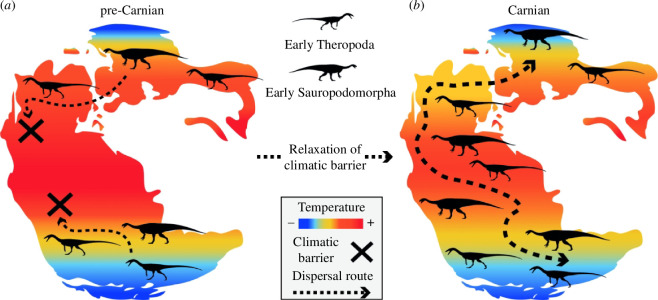
Dinosaurs potentially originated in the mid-palaeolatitudes of Gondwana 245–235 million years ago (Ma) and may have been restricted to cooler, humid areas by low-latitude arid zones until climatic amelioration made northern dispersals feasible ca 215 Ma. However, this scenario is challenged by new Carnian Laurasian fossils and evidence that even the earliest dinosaurs had adaptations for arid conditions. After becoming globally distributed in the Early–Middle Jurassic (200–160 Ma), dinosaurs experienced vicariance driven by Pangaean fragmentation. Regional extinctions and trans-oceanic dispersals also played a role, and the formation of ephemeral land connections meant that older vicariance patterns were repeatedly overprinted by younger ones, creating a reticulate biogeographic history. Palaeoclimates shaped dispersal barriers and corridors, including filters that had differential effects on different types of dinosaurs. Dinosaurian biogeographic research faces many challenges, not the least of which is the patchiness of the fossil record. However, new fossils, extensive databasing and improved analytical methods help distinguish signal from noise and generate fresh perspectives. In the future, developing techniques for quantifying and ameliorating sampling biases and modelling the dispersal capacities of dinosaurs are likely to be two of the key components in our modern research programme.
Overview
CoChat Summary
TL;DR
This review synthesizes non-avian dinosaur biogeography, supporting a possible southern Gondwanan origin in the Carnian followed by diachronous northward dispersals, Early Jurassic cosmopolitanism, and a reticulate Middle Jurassic–Cretaceous history of vicariance, geodispersal, and regional extinction. It argues that fossil-record sampling biases and uncertainty in phylogenies, palaeogeography, and palaeoclimate remain major challenges, while new databasing, network biogeography, and ecological niche/habitat suitability modelling offer key prospects.
Key findings
- The majority view remains a southern Gondwanan origin, with dinosaurs potentially originating 245–235 Ma and the modified southern Gondwana origin hypothesis restricting them to southern Gondwana for the first 10–15 million years before late Carnian–early Norian diversification/dispersal; Carnian body fossils are ca 233–230 Ma from Argentina, Brazil, southern Africa and India, but new Laurasian Carnian fossils challenge this.
- The diachronous rise of dinosaurs hypothesis posits mid-Norian northward breakouts: herrerasaurians and theropods reached the northern hemisphere earlier (mid-Norian ca 219 Ma or late Carnian), whereas sauropodomorphs did not reach Europe and Greenland until ca 215 Ma; pCO2 dips ca 215–212 Ma and 206–202 Ma are linked to climatic amelioration.
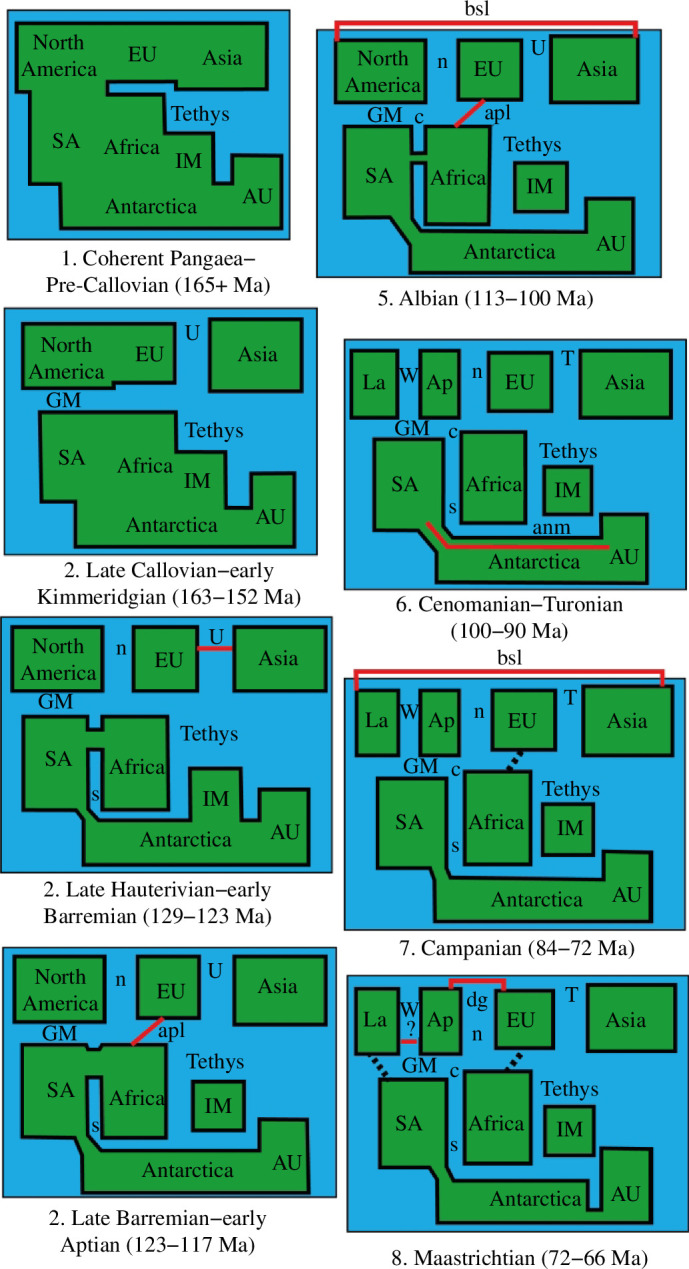
- After Early Jurassic cosmopolitanism (linked partly to end-Triassic mass extinction recovery), Middle Jurassic–latest Cretaceous history is reticulate: Pangaean fragmentation began ca 160 Ma, and table 1 lists landmass connection/disconnection events from 163–155 Ma through 69–66 Ma, with vicariance overprinted by geodispersal, regional extinction and possible trans-oceanic dispersal (e.g. hadrosaur *Ajnabia* crossing 500 km of Tethys).
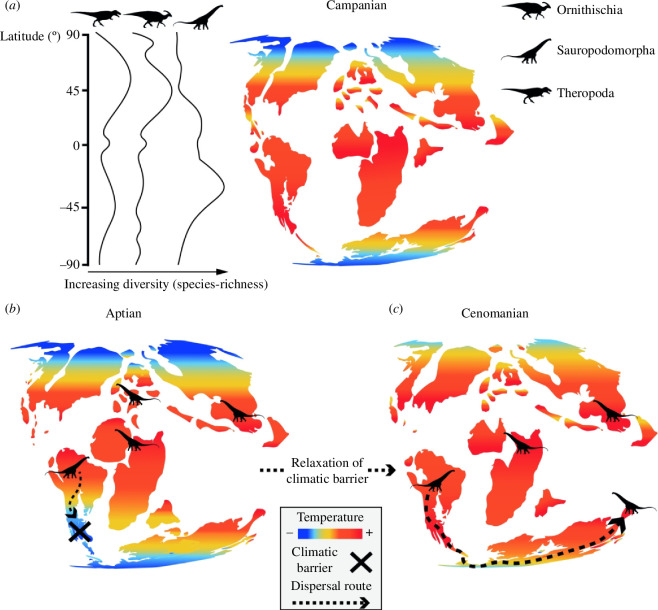
- Late Cretaceous latitudinal diversity did not match a modern tropical-peak gradient: peak diversity at 40–45° N for ornithischians, 45° N and 40° S for theropods, and 30° S for sauropods; no sauropod is known above 66° palaeolatitude, whereas some theropods and ornithischians lived at 70° or higher.
Methods
- Design: brief narrative review and prospectus; no new primary data or formal meta-analysis are presented.
- Data/sample: published fossil occurrences, dated phylogenies, palaeogeographic and palaeoclimatic reconstructions, and databases, spanning Carnian (ca 233–230 Ma) to latest Cretaceous (66 Ma).
- Main analysis: qualitative synthesis of literature and methods, including maximum likelihood/Bayesian ancestral-area estimation, network biogeography, and ecological niche/habitat suitability modelling (ENM/HSM).
Limitations
- Stated in paper: fossil-record sampling is patchy and extremely uneven temporally and spatially; palaeotropics are poorly sampled for Early–Middle Jurassic, and some regions (e.g. Early Cretaceous Indo-Madagascar) lack dinosaur-bearing formations.
- Stated in paper: disagreements or lack of resolution in taxonomy, phylogeny, fossil ages, and palaeogeographic/palaeoclimatic reconstructions can scramble or create spurious biogeographic signals; ephemeral landbridges are especially hard to resolve, and missing data can distort patterns.
- Evident from text: as a brief review, it does not apply a systematic search protocol or quantitative meta-analysis, so its conclusions depend on the cited literature and the authors’ synthesis.
Model-written summary. Check it against the paper before relying on it.
Integrity signals
Registry
Cites
Statistics
Figures
Verification
Claims the paper makes
0 Valid · 0 Not valid · 85 Not checked · 26 Own results and interpretations
None of the sources cited for this claim have been checked yet.
In the paper
“The earliest dinosaurs are known from Carnian age (early Late Triassic, ca 233−230 million years ago (Ma)) deposits in Argentina, Brazil, southern Africa and India [2–12].”
§ A brief review of non-avian dinosaur biogeography: state-of-the-art and prospectus > Biogeographic origin
What the sources say
- Not matchedcites [2] Upchurch P. In press. The biogeographic history of mesozoic dinosaurs. In The Dinosauria III (eds DB Weishample, PM Barrett, PJ Makovicky, MT Carrano). Cambridge, UK: Cambridge University Press.
Its entry has no title and year that we can search by.
- Not checked yetcites [3] Brusatte SL, Nesbitt SJ, Irmis RB, Butler RJ, Benton MJ, Norell MA. 2010 The origin and early radiation of dinosaurs. Earth Sci. Rev. 101, 68– 100. (10.1016/j.earscirev.2010.04.0012010.1746) source
- Not checked yetcites [4] Irmis RB. 2010 Evaluating hypotheses for the early diversification of dinosaurs. Earth Environ. Sci. Trans. R. Soc. Edinb. 101, 397– 426. (10.1017/S1755691011020068) source
- Not checked yetcites [5] Langer MC, Ezcurra MD, Bittencourt JS, Novas FE. 2010 The origin and early evolution of dinosaurs. Biol. Rev. Camb. Philos. Soc. 85, 55– 110. (10.1111/j.1469-185X.2009.00094.x) 19895605 source
- Not checked yetcites [6] Nesbitt SJ, Barrett PM, Werning S, Sidor CA, Charig AJ. 2013 The oldest dinosaur? A Middle Triassic dinosauriform from Tanzania. Biol. Lett. 9, 20120949. (10.1098/rsbl.2012.0949) 23221875 PMC3565515 source
- Not checked yetcites [7] Langer MC. 2014 The origins of Dinosauria: much ado about nothing. Palaeontology 57, 469– 478. (10.1111/pala.12108) source
- Not checked yetcites [8] Rakshit NN, Bhat MS, Ray S, Datta PM. 2018 First report of dinosaurian claws from the Late Triassic of India. Palaeoworld. 27, 179– 187. (10.1016/j.palwor.2018.01.001) source
- Not checked yetcites [9] Kent DV, Clemmensen LB. 2021 Northward dispersal of dinosaurs from Gondwana to Greenland at the mid-Norian (215–212 Ma, Late Triassic) dip in atmospheric pCO₂. Proc. Natl Acad. Sci. USA 118, e2020778118. (10.1073/pnas.2020778118) 33593914 PMC7923678 source
- Not checked yetcites [10] Novas FE, Agnolin FL, Ezcurra MD, Temp Müller R, Martinelli AG, Langer MC. 2021 Review of the fossil record of early dinosaurs from South America, and its phylogenetic implications. J. S. Am. Earth Sci. 110, 103341. (10.1016/j.jsames.2021.103341) source
- Not checked yetcites [11] Griffin CT, Wynd BM, Munyikwa D, Broderick TJ, Zondo M, Tolan S, Langer MC, Nesbitt SJ, Taruvinga HR. 2022 Africa’s oldest dinosaurs reveal early suppression of dinosaur distribution. Nature 609, 313– 319. (10.1038/s41586-022-05133-x) 36045297 source
plain- Asserted: passes — The authors put it forward as true.
- Checkable: passes — It can be checked against evidence.
- Load-bearing: passes — The paper’s conclusions depend on it.
- Based: passes — The paper gives a reason why it holds.
- Not matched
None of the sources cited for this claim have been checked yet.
In the paper
“Thus, we need to think of dinosaurian biogeographic history as a palimpsest of multiple (and often conflicting) signals laid down during different phases of Earth’s history [2,106,111].”
§ A brief review of non-avian dinosaur biogeography: state-of-the-art and prospectus > Tectonics and sea level, vicariance and dispersal > Middle Jurassic–latest Cretaceous: reticulate biogeographic history
What the sources say
- Not matchedcites [2] Upchurch P. In press. The biogeographic history of mesozoic dinosaurs. In The Dinosauria III (eds DB Weishample, PM Barrett, PJ Makovicky, MT Carrano). Cambridge, UK: Cambridge University Press.
Its entry has no title and year that we can search by.
- Not checked yetcites [106] Upchurch P, Hunn CA, Norman DB. 2002 An analysis of dinosaurian biogeography: evidence for the existence of vicariance and dispersal patterns caused by geological events. Proc. R. Soc. B 269, 613– 621. (10.1098/rspb.2001.1921) PMC1690931 11916478 source
- Not checked yetcites [111] Poropat SF et al. 2016 New Australian sauropods shed light on Cretaceous dinosaur palaeobiogeography. Sci. Rep. 6, 34467. (10.1038/srep34467) 27763598 PMC5072287 source
plain- Asserted: passes — The authors put it forward as true.
- Checkable: passes — It can be checked against evidence.
- Load-bearing: passes — The paper’s conclusions depend on it.
- Based: passes — The paper gives a reason why it holds.
- Not matched
None of the sources cited for this claim have been checked yet.
In the paper
“In particular, there are close phylogenetic relationships between South American (and when available, Antarctic) and Australian dinosaurs, such as titanosaurian sauropods [111,148], noasaurine and megaraptorid theropods [161,200–202] and parankylosaurs [203,204].”
§ A brief review of non-avian dinosaur biogeography: state-of-the-art and prospectus > Tectonics and sea level, vicariance and dispersal > Australia: a Cretaceous case study
What the sources say
- Not checked yetcites [111] Poropat SF et al. 2016 New Australian sauropods shed light on Cretaceous dinosaur palaeobiogeography. Sci. Rep. 6, 34467. (10.1038/srep34467) 27763598 PMC5072287 source
- Not checked yetcites [148] Poropat SF, Kundrát M, Mannion PD, Upchurch P, Tischler T, Elliott DA. 2021 Second specimen of the Late Cretaceous sauropod dinosaur Diamantinasaurus matildae provides new anatomical information on skull and neck evolution in early titanosaurs and the biogeographic origins of Australian dinosaur faunas. Zool. J. Linn. Soc. Lond. 192, 610– 674. (10.1093/zoolinnean/zlaa173) source
- Not checked yetcites [161] Novas FE, Agnolín FL, Ezcurra MD, Porfiri J, Canale JI. 2013 Evolution of the carnivorous dinosaurs during the Cretaceous: the evidence from Patagonia. Cretac. Res. 45, 174– 215. (10.1016/j.cretres.2013.04.001) source
- Not checked yetcites [200] Bell PR, Cau A, Fanti F, Smith ET. 2016 A large-clawed theropod (Dinosauria: Tetanurae) from the Lower Cretaceous of Australia and the Gondwanan origin of megaraptorid theropods. Gondwana Res. 36, 473– 487. (10.1016/j.gr.2015.08.004) source
- Not checked yetcites [201] Brougham T, Smith ET, Bell PR. 2020 Noasaurids are a component of the Australian ’mid’-Cretaceous theropod fauna. Sci. Rep. 10, 1428. (10.1038/s41598-020-57667-7) 31996712 PMC6989633 source
- Not checked yetcites [202] Lamanna MC, Casal GA, Martínez RDF, Ibiricu LM. 2020 Megaraptorid (Theropoda: Tetanurae) partial skeletons from the Upper Cretaceous Bajo Barreal Formation of Central Patagonia, Argentina: implications for the evolution of large body size in Gondwanan megaraptorans. Ann. Carneg. Mus. 86, 255– 294. (10.2992/007.086.0302) source
- Not checked yetcites [203] Frauenfelder TG, Bell PR, Brougham T, Bevitt JJ, Bicknell RDC, Kear BP, Wroe S, Campione NE. 2022 New ankylosaurian cranial remains from the Lower Cretaceous (upper Albian) Toolebuc Formation of Queensland, Australia. Front. Earth Sci. 10, 803505. (10.3389/feart.2022.803505) doi:10.3389/feart.2022.803505
- Not checked yetcites [204] Soto Acuña S, Vargas AO, Kaluza JE. 2024 A new look at the first dinosaur discovered in Antarctica: reappraisal of Antarctopelta oliveroi (Ankylosauria: Parankylosauria). Adv. Polar Sci. 35, 78– 107. (10.12429/j.advps.2023.0036)
plainstates an association- Asserted: passes — The authors put it forward as true.
- Checkable: passes — It can be checked against evidence.
- Load-bearing: passes — The paper’s conclusions depend on it.
- Based: passes — The paper gives a reason why it holds.
In the paper
“Pangaea persisted as a largely coherent landmass during the Early and Middle Jurassic [67], leading many older studies to suggest that early dinosaurian faunas were cosmopolitan (i.e. similar in taxonomic composition) [68–75].”
§ A brief review of non-avian dinosaur biogeography: state-of-the-art and prospectus > Tectonics and sea level, vicariance and dispersal > Early Jurassic cosmopolitanism
What the sources say
- Not checked yetcites [67] Scotese CR. 2021 An atlas of Phanerozoic paleogeographic maps: the seas come in and the seas go out. Annu. Rev. Earth Planet. Sci. 49, 679– 728. (10.1146/annurev-earth-081320-064052) source
plain- Asserted: passes — The authors put it forward as true.
- Checkable: passes — It can be checked against evidence.
- Load-bearing: passes — The paper’s conclusions depend on it.
- Based: passes — The paper gives a reason why it holds.
A conclusion the paper draws from its own results — it cites no other source for it, so there is none to check. The quote shows it is in the paper.
In the paper
“To some extent, these debates reflect uncertainties created by ‘noise’ factors such as sampling failures (§6a).”
§ A brief review of non-avian dinosaur biogeography: state-of-the-art and prospectus > Tectonics and sea level, vicariance and dispersal > Middle Jurassic–latest Cretaceous: reticulate biogeographic history
hedgedstates a possible cause- Asserted: passes — The authors put it forward as true.
- Checkable: passes — It can be checked against evidence.
- Load-bearing: unclear — It is unclear whether the paper’s conclusions depend on it.
- Based: passes — The paper gives a reason why it holds.
26 more claims
Create a free account to see all 111 claims and to verify the 303 references still open.
- It may state two separate claims as one. 68
- Probably not a substantial claim. 27
Self-check
Percentages, sums and reported differences re-computed from the paper’s own numbers.
Each contradiction between two passages listed here was confirmed by an independent check.
Rated minor: it would not touch a result — a value no result rests on, a p-value that stays on the same side of the significance level, or a conflict that is clerical, resolved elsewhere in the paper, or outside its own findings.
In the paper
§ A brief review of non-avian dinosaur biogeography: state-of-the-art and prospectus > Tectonics and sea level, vicariance and dispersal > Early Jurassic cosmopolitanism
“niches left vacant by various non-dinosaurian groups such as phytosaurs and ornithischians”
§ A brief review of non-avian dinosaur biogeography: state-of-the-art and prospectus > Conclusions and prospectus
“area of origin for dinosaurs is only likely to be resolved once the fundamental relationships between the major clades (theropods, sauropodomorphs and ornithischians)”
Citations
Cites
Ree, R. H., & Smith, S. A. (2008) · Systematic Biology · doi:10.1080/10635150701883881 · Cited by 2,317
Global continental and ocean basin reconstructions since 200Ma
Seton, M., Müller, R. D., Zahirovic, S., Gaina, C., Torsvik, T., Shephard, G., Talsma, A., Gurnis, M., Turner, M., Maus, S., et al. (2012) · Earth-Science Reviews · doi:10.1016/j.earscirev.2012.03.002 · Cited by 1,908
Systematics and Biogeography: Cladistics and Vicariance.
Brooks, D. R., Nelson, G., & Platnick, N. (1982) · Systematic Zoology · doi:10.2307/2413039 · Cited by 1,338
Matzke, N. J. (2014) · Systematic Biology · doi:10.1093/sysbio/syu056 · Cited by 1,336
Matzke, N. J. (2013) · Frontiers of Biogeography · doi:10.21425/f55419694 · Cited by 949
(1998) · Choice Reviews Online · doi:10.5860/choice.35-3642 · Cited by 734
An Atlas of Phanerozoic Paleogeographic Maps: The Seas Come In and the Seas Go Out
Scotese, C. R. (2021) · Annual Review of Earth and Planetary Sciences · doi:10.1146/annurev-earth-081320-064052 · Cited by 688
Climate of the Supercontinent Pangea
Parrish, J. T. (1993) · The Journal of Geology · doi:10.1086/648217 · Cited by 620
Matzke, N. J. (2013) · Frontiers of Biogeography · doi:10.21425/f5fbg19694 · Cited by 575
Kinematics of the South Atlantic rift
Heine, C., Zoethout, J., & Müller, R. D. (2013) · Solid Earth · doi:10.5194/se-4-215-2013 · Cited by 525
Systematics and Biogeography: Cladistics and Vicariance
Keener, C. S., Nelson, G. H., & Platnick, N. I. (1982) · The Bryologist · doi:10.2307/3243019 · Cited by 513
Superiority, Competition, and Opportunism in the Evolutionary Radiation of Dinosaurs
Brusatte, S. L., Benton, M. J., Ruta, M., & Lloyd, G. T. (2008) · Science · doi:10.1126/science.1161833 · Cited by 451
Biology of the sauropod dinosaurs: the evolution of gigantism
Sander, P. M., Christian, A., Clauss, M., Fechner, R., Gee, C. T., Griebeler, E.-M., Gunga, H.-C., Hummel, J., Mallison, H., Perry, S. F., et al. (2011) · Biological Reviews · doi:10.1111/j.1469-185x.2010.00137.x · Cited by 423
Gondwanan palaeogeography and pal˦oclimatology
Scotese, C. R., Boucot, A. J., & McKerrow, W. S. (1999) · Journal of African Earth Sciences · doi:10.1016/s0899-5362(98)00084-0 · Cited by 385
New thoughts about the Cretaceous climate and oceans
Hay, W. W., & Floegel, S. (2012) · Earth-Science Reviews · doi:10.1016/j.earscirev.2012.09.008 · Cited by 378
(2002) · doi:10.1126/science.1065522 · Cited by 367
The latitudinal biodiversity gradient through deep time
Mannion, P. D., Upchurch, P., Benson, R. B. J., & Goswami, A. (2014) · Trends in Ecology & Evolution · doi:10.1016/j.tree.2013.09.012 · Cited by 366
Self-citationDinosaurs and the Cretaceous Terrestrial Revolution
Lloyd, G. T., Davis, K. E., Pisani, D., Tarver, J. E., Ruta, M., Sakamoto, M., Hone, D. W. E., Jennings, R., & Benton, M. J. (2008) · Proceedings of the Royal Society B: Biological Sciences · doi:10.1098/rspb.2008.0715 · Cited by 350
(2010) · doi:10.1111/j.1469-185x.2009.00094.x · Cited by 339
The phylogeny of Tetanurae (Dinosauria: Theropoda)
Carrano, M. T., Benson, R. B. J., & Sampson, S. D. (2012) · Journal of Systematic Palaeontology · doi:10.1080/14772019.2011.630927 · Cited by 317
The origin and early radiation of dinosaurs
Brusatte, S. L., Nesbitt, S. J., Irmis, R. B., Butler, R. J., Benton, M. J., & Norell, M. A. (2010) · Earth-Science Reviews · doi:10.1016/j.earscirev.2010.04.001 · Cited by 305 · cited 3×
“Whatever their starting point, dinosaurs were certainly widespread by the mid-Norian ( ca 220−215 Ma), maintaining their presence in Gondwana and supposedly occurring for the first time in North America and Europe [1,3–5, 7, 15, 40– 42].”
A new hypothesis of dinosaur relationships and early dinosaur evolution
Baron, M. G., Norman, D. B., & Barrett, P. M. (2017) · Nature · doi:10.1038/nature21700 · Cited by 294
(2010) · doi:10.1038/nature08718 · Cited by 288
Mannion, P. D., Upchurch, P., Barnes, R. N., & Mateus, O. (2013) · Zoological Journal of the Linnean Society · doi:10.1111/zoj.12029 · Cited by 287
Self-citationPaleobiogeography of Africa: How distinct from Gondwana and Laurasia?
Gheerbrant, E., & Rage, J.-C. (2006) · Palaeogeography, Palaeoclimatology, Palaeoecology · doi:10.1016/j.palaeo.2006.03.016 · Cited by 282
Jurassic phytogeography and climates: new data and model comparisons
Rees, P. M., Ziegler, A. M., & Valdes, P. J. (1999) · Warm Climates in Earth History · doi:10.1017/cbo9780511564512.011 · Cited by 279
The early evolution of titanosauriform sauropod dinosaurs: TITANOSAURIFORM PHYLOGENY
D'EMIC, M. D. (2012) · Zoological Journal of the Linnean Society · doi:10.1111/j.1096-3642.2012.00853.x · Cited by 276
New Mid-Cretaceous (Latest Albian) Dinosaurs from Winton, Queensland, Australia
Hocknull, S. A., White, M. A., Tischler, T. R., Cook, A. G., Calleja, N. D., Sloan, T., & Elliott, D. A. (2009) · PLoS ONE · doi:10.1371/journal.pone.0006190 · Cited by 271
The Phylogeny of Ceratosauria (Dinosauria: Theropoda)
Carrano, M. T., & Sampson, S. D. (2008) · Journal of Systematic Palaeontology · doi:10.1017/s1477201907002246 · Cited by 263
Colonial history and global economics distort our understanding of deep-time biodiversity
Raja, N. B., Dunne, E. M., Matiwane, A., Khan, T. M., Nätscher, P. S., Ghilardi, A. M., & Chattopadhyay, D. (2021) · Nature Ecology & Evolution · doi:10.1038/s41559-021-01608-8 · Cited by 259
A Late Triassic Dinosauromorph Assemblage from New Mexico and the Rise of Dinosaurs
Irmis, R. B., Nesbitt, S. J., Padian, K., Smith, N. D., Turner, A. H., Woody, D., & Downs, A. (2007) · Science · doi:10.1126/science.1143325 · Cited by 255
SMITH, A. B., & McGOWAN, A. J. (2007) · Palaeontology · doi:10.1111/j.1475-4983.2007.00693.x · Cited by 247
Evolution of the carnivorous dinosaurs during the Cretaceous: The evidence from Patagonia
Novas, F. E., Agnolín, F. L., Ezcurra, M. D., Porfiri, J., & Canale, J. I. (2013) · Cretaceous Research · doi:10.1016/j.cretres.2013.04.001 · Cited by 245
Csiki-Sava, Z., Buffetaut, E., Ősi, A., Pereda-Suberbiola, X., & Brusatte, S. L. (2015) · ZooKeys · doi:10.3897/zookeys.469.8439 · Cited by 244
Vertebrate paleontology in Utah
(1999) · Utah Geological Survey eBooks · doi:10.34191/mp-99-1 · Cited by 243
A Complete Skeleton of a Late Triassic Saurischian and the Early Evolution of Dinosaurs
Nesbitt, S. J., Smith, N. D., Irmis, R. B., Turner, A. H., Downs, A., & Norell, M. A. (2009) · Science · doi:10.1126/science.1180350 · Cited by 241
New dinosaurs link southern landmasses in the Mid–Cretaceous
Sereno, P. C., Wilson, J. A., & Conrad, J. L. (2004) · Proceedings of the Royal Society of London. Series B: Biological Sciences · doi:10.1098/rspb.2004.2692 · Cited by 241
A Unique Late Triassic Dinosauromorph Assemblage Reveals Dinosaur Ancestral Anatomy and Diet
Cabreira, S. F., Kellner, A. W. A., Dias-da-Silva, S., Roberto da Silva, L., Bronzati, M., Marsola, J. C. D. A., Müller, R. T., Bittencourt, J. D. S., Batista, B. J., Raugust, T., et al. (2016) · Current Biology · doi:10.1016/j.cub.2016.09.040 · Cited by 226
Dinosaur diversity and the rock record
Barrett, P. M., McGowan, A. J., & Page, V. (2009) · Proceedings of the Royal Society B: Biological Sciences · doi:10.1098/rspb.2009.0352 · Cited by 224
Upchurch, P., Hunn, C. A., & Norman, D. B. (2002) · Proceedings of the Royal Society of London. Series B: Biological Sciences · doi:10.1098/rspb.2001.1921 · Cited by 210 · cited 4×
“Theropods and ornithischians probably possessed meso-or endothermic metabolisms [106,132] (see also [138–142]) early Aptian (119 Ma) separation of Indo-Madagascar from northern margin of Antarctica isolates former region during the rest of the Cretaceous [2,116,143] Albian or Cenomanian ( ca 100…”
InfluentialSelf-citationA new giant titanosaur sheds light on body mass evolution among sauropod dinosaurs
Carballido, J. L., Pol, D., Otero, A., Cerda, I. A., Salgado, L., Garrido, A. C., Ramezani, J., Cúneo, N. R., & Krause, J. M. (2017) · Proceedings of the Royal Society B: Biological Sciences · doi:10.1098/rspb.2017.1219 · Cited by 208
The Cretaceous opening of the South Atlantic Ocean
Granot, R., & Dyment, J. (2015) · Earth and Planetary Science Letters · doi:10.1016/j.epsl.2015.01.015 · Cited by 203
Cope's rule and the adaptive landscape of dinosaur body size evolution
Benson, R. B. J., Hunt, G., Carrano, M. T., & Campione, N. (2018) · Palaeontology · doi:10.1111/pala.12329 · Cited by 202
Using species distribution models in paleobiogeography: A matter of data, predictors and concepts
Varela, S., Lobo, J. M., & Hortal, J. (2011) · Palaeogeography, Palaeoclimatology, Palaeoecology · doi:10.1016/j.palaeo.2011.07.021 · Cited by 199
A New Global Palaeobiogeographical Model for the Late Mesozoic and Early Tertiary
Ezcurra, M. D., & Agnolín, F. L. (2012) · Systematic Biology · doi:10.1093/sysbio/syr115 · Cited by 199
Gondwanan break-up: legacies of a lost world?
Upchurch, P. (2008) · Trends in Ecology & Evolution · doi:10.1016/j.tree.2007.11.006 · Cited by 199
Self-citationThe role of Central Asia in dinosaurian biogeography
Russell, D. A. (1993) · Canadian Journal of Earth Sciences · doi:10.1139/e93-176 · Cited by 198
Sereno, P. C., & Brusatte, S. L. (2008) · Acta Palaeontologica Polonica · doi:10.4202/app.2008.0102 · Cited by 193
SMITH, N. D., MAKOVICKY, P. J., HAMMER, W. R., & CURRIE, P. J. (2007) · Zoological Journal of the Linnean Society · doi:10.1111/j.1096-3642.2007.00325.x · Cited by 184
The De Geer, Thulean and Beringia routes: key concepts for understanding early Cenozoic biogeography
Brikiatis, L. (2014) · Journal of Biogeography · doi:10.1111/jbi.12310 · Cited by 184
New Australian sauropods shed light on Cretaceous dinosaur palaeobiogeography
Poropat, S. F., Mannion, P. D., Upchurch, P., Hocknull, S. A., Kear, B. P., Kundrát, M., Tischler, T. R., Sloan, T., Sinapius, G. H. K., Elliott, J. A., et al. (2016) · Scientific Reports · doi:10.1038/srep34467 · Cited by 178
Self-citationTyrant Dinosaur Evolution Tracks the Rise and Fall of Late Cretaceous Oceans
Loewen, M. A., Irmis, R. B., Sertich, J. J. W., Currie, P. J., & Sampson, S. D. (2013) · PLoS ONE · doi:10.1371/journal.pone.0079420 · Cited by 170
A Middle Jurassic abelisaurid from Patagonia and the early diversification of theropod dinosaurs
Pol, D., & Rauhut, O. W. M. (2012) · Proceedings of the Royal Society B: Biological Sciences · doi:10.1098/rspb.2012.0660 · Cited by 169
Australian cretaceous terrestrial faunas and floras: biostratigraphic and biogeographic implications
Dettmann, M. E., Molnar, R. E., Douglas, J. G., Burger, D., Fielding, C., Clifford, H. T., Francis, J., Jell, P., Rich, T., Wade, M., et al. (1992) · Cretaceous Research · doi:10.1016/0195-6671(92)90001-7 · Cited by 165
A Jurassic ornithischian dinosaur from Siberia with both feathers and scales
Godefroit, P., Sinitsa, S. M., Dhouailly, D., Bolotsky, Y. L., Sizov, A. V., McNamara, M. E., Benton, M. J., & Spagna, P. (2014) · Science · doi:10.1126/science.1253351 · Cited by 164
Dinosaur diversification linked with the Carnian Pluvial Episode
Bernardi, M., Gianolla, P., Petti, F. M., Mietto, P., & Benton, M. J. (2018) · Nature Communications · doi:10.1038/s41467-018-03996-1 · Cited by 164
Sellwood, B. W., & Valdes, P. J. (2008) · Proceedings of the Geologists' Association · doi:10.1016/s0016-7878(59)80068-7 · Cited by 162
The systematic relationships and biogeographic history of ornithischian dinosaurs
Boyd, C. A. (2015) · PeerJ · doi:10.7717/peerj.1523 · Cited by 162
Splendid and Seldom Isolated: The Paleobiogeography of Patagonia
Wilf, P., Cúneo, N. R., Escapa, I. H., Pol, D., & Woodburne, M. O. (2013) · Annual Review of Earth and Planetary Sciences · doi:10.1146/annurev-earth-050212-124217 · Cited by 161
The Vegetation of Antarctica through Geological Time
Cantrill, D. J., & Poole, I. (2012) · Cambridge University Press eBooks · doi:10.1017/cbo9781139024990 · Cited by 159
The vertebrates of the Jurassic Daohugou Biota of northeastern China
Sullivan, C., Wang, Y., Hone, D. W. E., Wang, Y., Xu, X., & Zhang, F. (2014) · Journal of Vertebrate Paleontology · doi:10.1080/02724634.2013.787316 · Cited by 151
Models for the Rise of the Dinosaurs
Benton, M. J., Forth, J., & Langer, M. C. (2014) · Current Biology · doi:10.1016/j.cub.2013.11.063 · Cited by 150
The Paleobiology Database application programming interface
Peters, S. E., & McClennen, M. (2016) · Paleobiology · doi:10.1017/pab.2015.39 · Cited by 149
The first 50 Myr of dinosaur evolution: macroevolutionary pattern and morphological disparity
Brusatte, S. L., Benton, M. J., Ruta, M., & Lloyd, G. T. (2008) · Biology Letters · doi:10.1098/rsbl.2008.0441 · Cited by 133
Irmis, R. B., Mundil, R., Martz, J. W., & Parker, W. G. (2011) · Earth and Planetary Science Letters · doi:10.1016/j.epsl.2011.07.015 · Cited by 133
Butler, R. J., Smith, R. M. H., & Norman, D. B. (2007) · Proceedings of the Royal Society B: Biological Sciences · doi:10.1098/rspb.2007.0367 · Cited by 131
(2013) · doi:10.1098/rsbl.2012.0949 · Cited by 125 · cited 1×
“This has given rise to the hypothesis that Dinosauria, and probably also its major subdivisions, originated and diversified in southern Gondwana during or before the Carnian and subsequently dispersed across the rest of Pangaea in the Norian (227 Ma onward) [3,6,7,11–24].”
Upchurch, P., Mannion, P. D., Benson, R. B. J., Butler, R. J., & Carrano, M. T. (2011) · Geological Society, London, Special Publications · doi:10.1144/sp358.14 · Cited by 125
Self-citationLœuff, J. L. (1991) · Cretaceous Research · doi:10.1016/s0195-6671(05)80019-9 · Cited by 125
Faunal provinces in space and time
Cowen, R. (1972) · Palaeogeography Palaeoclimatology Palaeoecology · doi:10.1016/0031-0182(72)90050-8 · Cited by 125
Tennant, J. P., Mannion, P. D., Upchurch, P., Sutton, M. D., & Price, G. D. (2017) · Biological Reviews · doi:10.1111/brv.12255 · Cited by 125
Self-citationAli, J. R., & Krause, D. W. (2011) · Journal of Biogeography · doi:10.1111/j.1365-2699.2011.02546.x · Cited by 123
RAUHUT, O. W. M., MILNER, A. C., & MOORE-FAY, S. (2010) · Zoological Journal of the Linnean Society · doi:10.1111/j.1096-3642.2009.00591.x · Cited by 120
Continental Drift and Vertebrate Distribution
Cracraft, J. L. (1974) · Annual Review of Ecology and Systematics · doi:10.1146/annurev.es.05.110174.001243 · Cited by 118
Untangling the dinosaur family tree
Langer, M. C., Ezcurra, M. D., Rauhut, O. W. M., Benton, M. J., Knoll, F., McPhee, B. W., Novas, F. E., Pol, D., & Brusatte, S. L. (2017) · Nature · doi:10.1038/nature24011 · Cited by 117
Chiarenza, A. A., Mannion, P. D., Lunt, D. J., Farnsworth, A., Jones, L. A., Kelland, S.-J., & Allison, P. A. (2019) · Nature Communications · doi:10.1038/s41467-019-08997-2 · Cited by 114
Self-citationCarballido, J. L., Salgado, L., Pol, D., Canudo, J. I., & Garrido, A. C. (2012) · Historical Biology · doi:10.1080/08912963.2012.672416 · Cited by 114
Lieberman, B. S. (2000) · Topics in geobiology · doi:10.1007/978-1-4615-4161-5 · Cited by 113
Evaluating hypotheses for the early diversification of dinosaurs
Irmis, R. B. (2010) · Earth and Environmental Science Transactions of the Royal Society of Edinburgh · doi:10.1017/s1755691011020068 · Cited by 112
Footprints pull origin and diversification of dinosaur stem lineage deep into Early Triassic
Brusatte, S. L., Niedźwiedzki, G., & Butler, R. J. (2011) · Proceedings of the Royal Society B: Biological Sciences · doi:10.1098/rspb.2010.1746 · Cited by 109
Benson, R. B. J., Rich, T. H., Vickers-Rich, P., & Hall, M. (2012) · PLoS ONE · doi:10.1371/journal.pone.0037122 · Cited by 106
Mannion, P. D., & Upchurch, P. (2010) · Paleobiology · doi:10.1666/09008.1 · Cited by 105
Self-citationWarm climates in earth history
(2000) · Choice Reviews Online · doi:10.5860/choice.38-0308 · Cited by 104
Kent, D. V., Santi Malnis, P., Colombi, C. E., Alcober, O. A., & Martínez, R. N. (2014) · Proceedings of the National Academy of Sciences · doi:10.1073/pnas.1402369111 · Cited by 104
Biogeographical affinities of Late Cretaceous continental tetrapods of Europe: a review
Suberbiola, X. P. (2009) · Bulletin de la Société Géologique de France · doi:10.2113/gssgfbull.180.1.57 · Cited by 102
WATSON, D. M. S. (1946) · Nature · doi:10.1038/157281a0 · Cited by 102
Tykoski, R. S., & Rowe, T. (2004) · The Dinosauria · doi:10.1525/california/9780520242098.003.0005 · Cited by 101
Paleobiology of herbivorous dinosaurs
Barrett, P. M. (2014) · Annual Review of Earth and Planetary Sciences · doi:10.1146/annurev-earth-042711-105515 · Cited by 99
Neovenatorid theropods are apex predators in the Late Cretaceous of North America
Zanno, L. E., & Makovicky, P. J. (2013) · Nature Communications · doi:10.1038/ncomms3827 · Cited by 99
The first definitive Asian spinosaurid (Dinosauria: Theropoda) from the early cretaceous of Laos
Allain, R., Xaisanavong, T., Richir, P., & Khentavong, B. (2012) · Die Naturwissenschaften · doi:10.1007/s00114-012-0911-7 · Cited by 99
Extreme ecosystem instability suppressed tropical dinosaur dominance for 30 million years
Whiteside, J. H., Lindström, S., Irmis, R. B., Glasspool, I. J., Schaller, M. F., Dunlavey, M., Nesbitt, S. J., Smith, N. D., & Turner, A. H. (2015) · Proceedings of the National Academy of Sciences · doi:10.1073/pnas.1505252112 · Cited by 98
Chapter 9 The Western Interior Basin
Miall, A. D., Catuneanu, O., Vakarelov, B. K., & Post, R. (2008) · Sedimentary basins of the world · doi:10.1016/s1874-5997(08)00009-9 · Cited by 98
Systematics, phylogeny and palaeobiogeography of the ankylosaurid dinosaurs
Arbour, V. M., & Currie, P. J. (2016) · Journal of Systematic Palaeontology · doi:10.1080/14772019.2015.1059985 · Cited by 98
Close, R. A., Benson, R. B. J., Upchurch, P., & Butler, R. J. (2017) · Nature Communications · doi:10.1038/ncomms15381 · Cited by 96
Self-citationSlattery, J. S., Cobban, W. A., Mckinney, K. C., Harries, P. J., & Sandness, A. L. (2013) · doi:10.13140/rg.2.1.4439.8801 · Cited by 95
Pennaraptoran Theropod Dinosaurs Past Progress and New Frontiers
Pittman, M., & Xu, X. (2020) · Bulletin of the American Museum of Natural History · doi:10.1206/0003-0090.440.1.1 · Cited by 94
Gorscak, E., & O‘Connor, P. M. (2016) · Biology Letters · doi:10.1098/rsbl.2015.1047 · Cited by 94
Review of the fossil record of early dinosaurs from South America, and its phylogenetic implications
Novas, F. E., Agnolin, F. L., Ezcurra, M. D., Temp Müller, R., Martinelli, A. G., & Langer, M. C. (2021) · Journal of South American Earth Sciences · doi:10.1016/j.jsames.2021.103341 · Cited by 94
Pacheco, C., Müller, R. T., Langer, M., Pretto, F. A., Kerber, L., & Dias da Silva, S. (2019) · PeerJ · doi:10.7717/peerj.7963 · Cited by 94
The first record of a sauropod dinosaur from Antarctica
Cerda, I. A., Paulina‐Carabajal, A., Salgado, L., Coria, R. A., Reguero, M. A., Tambussi, C. P., & Moly, J. J. (2011) · Die Naturwissenschaften · doi:10.1007/s00114-011-0869-x · Cited by 92
Xu, X., Upchurch, P., Mannion, P. D., Barrett, P. M., Regalado-Fernandez, O. R., Mo, J., Ma, J., & Liu, H. (2018) · Nature Communications · doi:10.1038/s41467-018-05128-1 · Cited by 91
Self-citationGlobal historical biogeography of hadrosaurid dinosaurs: BIOGEOGRAPHY OF HADROSAURIDAE
PRIETO-MÁRQUEZ, A. (2010) · Zoological Journal of the Linnean Society · doi:10.1111/j.1096-3642.2010.00642.x · Cited by 90
Escaso, F., Ortega, F., Dantas, P., Malafaia, E., Pimentel, N. L. A., Suberbiola, X. P., Sanz, J. L., Kullberg, J. C., Kullberg, M. C., & Barriga, F. (2006) · Die Naturwissenschaften · doi:10.1007/s00114-006-0209-8 · Cited by 90
Masters, J. C., Génin, F., Zhang, Y., Pellen, R., Huck, T., Mazza, P., Rabineau, M., Doucouré, M., & Aslanian, D. (2020) · Journal of Biogeography · doi:10.1111/jbi.14032 · Cited by 89
A gigantic new dinosaur from Argentina and the evolution of the sauropod hind foot
González Riga, B. J., Lamanna, M. C., Ortiz David, L. D., Calvo, J. O., & Coria, J. P. (2016) · Scientific Reports · doi:10.1038/srep19165 · Cited by 89
Han, F., Barrett, P. M., Butler, R. J., & Xu, X. (2012) · Journal of Vertebrate Paleontology · doi:10.1080/02724634.2012.694385 · Cited by 89
Farke, A. A., Maxwell, W. D., Cifelli, R. L., & Wedel, M. J. (2014) · PLoS ONE · doi:10.1371/journal.pone.0112055 · Cited by 85
Cretaceous palaeogeography of the North-Eastern Peri-Tethys
Baraboshkin, E. Y., Alekseev, A. S., & Копаевич, Л. Ф. (2003) · Palaeogeography Palaeoclimatology Palaeoecology · doi:10.1016/s0031-0182(03)00318-3 · Cited by 84
Mass extinctions drove increased global faunal cosmopolitanism on the supercontinent Pangaea
Button, D. J., Lloyd, G. T., Ezcurra, M. D., & Butler, R. J. (2017) · Nature Communications · doi:10.1038/s41467-017-00827-7 · Cited by 83
Müller, R. T., & Garcia, M. S. (2020) · Biology Letters · doi:10.1098/rsbl.2020.0417 · Cited by 83
Brusatte, S. L., Vremir, M., Csiki-Sava, Z., Turner, A. H., Watanabe, A., Erickson, G. M., & Norell, M. A. (2013) · Bulletin of the American Museum of Natural History · doi:10.1206/798.1 · Cited by 82
New Egyptian sauropod reveals Late Cretaceous dinosaur dispersal between Europe and Africa
Sallam, H. M., Gorscak, E., O’Connor, P. M., El-Dawoudi, I. A., El-Sayed, S., Saber, S., Kora, M. A., Sertich, J. J. W., Seiffert, E. R., & Lamanna, M. C. (2018) · Nature Ecology & Evolution · doi:10.1038/s41559-017-0455-5 · Cited by 81
Climatic shifts drove major contractions in avian latitudinal distributions throughout the Cenozoic
Saupe, E. E., Farnsworth, A., Lunt, D. J., Sagoo, N., Pham, K. V., & Field, D. J. (2019) · Proceedings of the National Academy of Sciences · doi:10.1073/pnas.1903866116 · Cited by 80
Dinosaurs in decline tens of millions of years before their final extinction
Sakamoto, M., Benton, M. J., & Venditti, C. (2016) · Proceedings of the National Academy of Sciences · doi:10.1073/pnas.1521478113 · Cited by 80
Cruzado‐Caballero, P., Suberbiola, X. P., & Ruiz-Omeñaca, J. I. (2010) · Canadian Journal of Earth Sciences · doi:10.1139/e10-081 · Cited by 80
Geodynamic reconstructions of the South America–Antarctica plate system
Vérard, C., Flores, K. E., & Stampfli, G. M. (2011) · Journal of Geodynamics · doi:10.1016/j.jog.2011.07.007 · Cited by 79
Mannion, P. D., Benson, R. B. J., Upchurch, P., Butler, R. J., Carrano, M. T., & Barrett, P. M. (2012) · Global Ecology and Biogeography · doi:10.1111/j.1466-8238.2011.00735.x · Cited by 78
Self-citationA new phylogeny of cerapodan dinosaurs
Dieudonné, P. E., Cruzado-Caballero, P., Godefroit, P., & Tortosa, T. (2021) · Historical Biology · doi:10.1080/08912963.2020.1793979 · Cited by 78
Late Jurassic Climates, Vegetation, and Dinosaur Distributions
Rees, P. M., Noto, C. R., Parrish, J. M., & Parrish, J. T. (2004) · The Journal of Geology · doi:10.1086/424577 · Cited by 77
Olsen, P. E., Kent, D. V., & Whiteside, J. H. (2010) · Earth and Environmental Science Transactions of the Royal Society of Edinburgh · doi:10.1017/s1755691011020032 · Cited by 75
Africa’s oldest dinosaurs reveal early suppression of dinosaur distribution
Griffin, C. T., Wynd, B. M., Munyikwa, D., Broderick, T. J., Zondo, M., Tolan, S., Langer, M. C., Nesbitt, S. J., & Taruvinga, H. R. (2022) · Nature · doi:10.1038/s41586-022-05133-x · Cited by 73
A New Sauropod Dinosaur from Chubut Province, Argentina
Rich, T. H., Vickers-Rich, P., Giménez, O., Cúneo, R., Puerta, P., & Vacca, R. (1999) · National Science Museum monographs · Cited by 73
A Middle Jurassic heterodontosaurid dinosaur from Patagonia and the evolution of heterodontosaurids
Pol, D., Rauhut, O. W. M., & Becerra, M. G. (2011) · Die Naturwissenschaften · doi:10.1007/s00114-011-0780-5 · Cited by 71
Sea level regulated tetrapod diversity dynamics through the Jurassic/Cretaceous interval
Tennant, J. P., Mannion, P. D., & Upchurch, P. (2016) · Nature Communications · doi:10.1038/ncomms12737 · Cited by 70
Self-citationRoyo‐Torres, R., Upchurch, P., Kirkland, J. I., DeBlieux, D. D., Foster, J. R., Cobos, A., & Alcalá, L. (2017) · Scientific Reports · doi:10.1038/s41598-017-14677-2 · Cited by 70
Self-citationNovas, F. E., Ezcurra, M. D., Chatterjee, S., & Kutty, T. S. (2010) · Earth and Environmental Science Transactions of the Royal Society of Edinburgh · doi:10.1017/s1755691011020093 · Cited by 68
Silvestro, D., Zizka, A., Bacon, C. D., Cascales-Miñana, B., Salamin, N., & Antonelli, A. (2016) · Philosophical Transactions of the Royal Society B: Biological Sciences · doi:10.1098/rstb.2015.0225 · Cited by 67
Hunn, C. A., & Upchurch, P. (2001) · Systematic Biology · doi:10.1093/sysbio/50.3.391 · Cited by 66
Self-citationEarly development of the facial region in a non-avian theropod dinosaur
Rauhut, O. W. M., & Fechner, R. (2005) · Proceedings of the Royal Society B: Biological Sciences · doi:10.1098/rspb.2005.3071 · Cited by 66
Late Mesozoic North Atlantic land bridges
Brikiatis, L. (2016) · Earth-Science Reviews · doi:10.1016/j.earscirev.2016.05.002 · Cited by 66
Climatic constraints on the biogeographic history of Mesozoic dinosaurs
Chiarenza, A. A., Mannion, P. D., Farnsworth, A., Carrano, M. T., & Varela, S. (2022) · Current Biology · doi:10.1016/j.cub.2021.11.061 · Cited by 65
Self-citationBarrett, P. M., & Wang, X. (2007) · Palaeoworld · doi:10.1016/j.palwor.2007.07.001 · Cited by 65
Choiniere, J. N., Clark, J. M., Forster, C. A., & Xu, X. (2010) · Journal of Vertebrate Paleontology · doi:10.1080/02724634.2010.520779 · Cited by 64
Climatic drivers of latitudinal variation in Late Triassic tetrapod diversity
Dunne, E. M., Farnsworth, A., Greene, S. E., Lunt, D. J., & Butler, R. J. (2021) · Palaeontology · doi:10.1111/pala.12514 · Cited by 64
Xing, L., Miyashita, T., Zhang, J., Li, D., Ye, Y., Sekiya, T., Wang, F., & Currie, P. J. (2015) · Journal of Vertebrate Paleontology · doi:10.1080/02724634.2014.889701 · Cited by 63
Marshall, C. R., Finnegan, S., Clites, E. C., Holroyd, P. A., Bonuso, N., Cortez, C., Davis, E., Dietl, G. P., Druckenmiller, P. S., Eng, R. C., et al. (2018) · Biology Letters · doi:10.1098/rsbl.2018.0431 · Cited by 61
First spinosaurid dinosaur from Australia and the cosmopolitanism of Cretaceous dinosaur faunas
Barrett, P. M., Benson, R. B. J., Rich, T. H., & Vickers-Rich, P. (2011) · Biology Letters · doi:10.1098/rsbl.2011.0466 · Cited by 59
Norman, D. B., Baron, M. G., Garcia, M. S., & Müller, R. T. (2022) · Zoological Journal of the Linnean Society · doi:10.1093/zoolinnean/zlac062 · Cited by 59
Herne, M. C., Nair, J. P., Evans, A. R., & Tait, A. M. (2019) · Journal of Paleontology · doi:10.1017/jpa.2018.95 · Cited by 58
Fanti, F., Cau, A., Cantelli, L., Hassine, M., & Auditore, M. (2015) · PLOS ONE · doi:10.1371/journal.pone.0123475 · Cited by 56
Rauhut, O. W. M., & López-Arbarello, A. (2009) · Palaeogeography, Palaeoclimatology, Palaeoecology · doi:10.1016/j.palaeo.2008.10.019 · Cited by 56
Prieto-Marquez, A., & Salinas, G. C. (2010) · Journal of Vertebrate Paleontology · doi:10.1080/02724631003763508 · Cited by 56
Longrich, N. R., Suberbiola, X. P., Pyron, R. A., & Jalil, N.-E. (2021) · Cretaceous Research · doi:10.1016/j.cretres.2020.104678 · Cited by 55
Arctic ice and the ecological rise of the dinosaurs
Olsen, P., Sha, J., Fang, Y., Chang, C., Whiteside, J. H., Kinney, S., Sues, H.-D., Kent, D., Schaller, M., & Vajda, V. (2022) · Science Advances · doi:10.1126/sciadv.abo6342 · Cited by 54
Arbour, V. M., Zanno, L. E., & Gates, T. (2016) · Palaeogeography, Palaeoclimatology, Palaeoecology · doi:10.1016/j.palaeo.2016.02.033 · Cited by 54
Bell, P. R., Cau, A., Fanti, F., & Smith, E. T. (2016) · Gondwana Research · doi:10.1016/j.gr.2015.08.004 · Cited by 53
Poropat, S. F., Kundrát, M., Mannion, P. D., Upchurch, P., Tischler, T. R., & Elliott, D. A. (2021) · Zoological Journal of the Linnean Society · doi:10.1093/zoolinnean/zlaa173 · Cited by 53
Self-citationZanno, L. E., & Makovicky, P. J. (2011) · Historical Biology · doi:10.1080/08912963.2010.543952 · Cited by 53
North Africa's first stegosaur: Implications for Gondwanan thyreophoran dinosaur diversity
Maidment, S. C. R., Raven, T. J., Ouarhache, D., & Barrett, P. M. (2020) · Gondwana Research · doi:10.1016/j.gr.2019.07.007 · Cited by 53
Krause, D. W., Sertich, J. J. W., O'Connor, P. M., Curry Rogers, K., & Rogers, R. R. (2019) · Annual Review of Earth and Planetary Sciences · doi:10.1146/annurev-earth-053018-060051 · Cited by 52
Reguero, M. A., & Goin, F. J. (2021) · Journal of South American Earth Sciences · doi:10.1016/j.jsames.2021.103358 · Cited by 51
The first well-preserved coelophysoid theropod dinosaur from Asia
You, H., Azuma, Y., Wang, T., WANG, Y.-M., & Dong, Z.-M. (2014) · Zootaxa · doi:10.11646/zootaxa.3873.3.3 · Cited by 51
Díaz, V. D., Garcia, G., Suberbiola, X. P., Jentgen, B., Stein, K. H. W., Godefroit, P., & Valentin, X. (2018) · Cretaceous Research · doi:10.1016/j.cretres.2018.06.015 · Cited by 51
Chronostratigraphic synthesis of the latest Cretaceous dinosaur turnover in south-western Europe
Fondevilla, V., Riera, V., Vila, B., Sellés, A. G., Dinarès‐Turell, J., Vicens, E., Gaete, R., Oms, O., & Galobart, À. (2019) · Earth-Science Reviews · doi:10.1016/j.earscirev.2019.01.007 · Cited by 50
ARCHOSAUR EVOLUTION DURING THE JURASSIC: A SOUTHERN PERSPECTIVE
Rauhut, O. W. M., & López‐Arbarello, A. (2008) · Revista de la Asociación Geológica Argentina · Cited by 49
Dinosaur biogeographical structure and Mesozoic continental fragmentation: a network‐based approach
Dunhill, A. M., Bestwick, J., Narey, H., & Sciberras, J. (2016) · Journal of Biogeography · doi:10.1111/jbi.12766 · Cited by 47 · cited 1×
“To Although controversial, several studies have suggested that dinosaurs were capable of dispersing across marine ‘barriers’ via rafting or swimming, potentially modifying faunal compositions and partially overwriting vicariance patterns [155,194,195].”
The build-up of the present-day tropical diversity of tetrapods
Quintero, I., Landis, M. J., Jetz, W., & Morlon, H. (2023) · Proceedings of the National Academy of Sciences · doi:10.1073/pnas.2220672120 · Cited by 47
Extinction of herbivorous dinosaurs linked to Early Jurassic global warming event
Pol, D., Ramezani, J., Gomez, K., Carballido, J. L., Carabajal, A. P., Rauhut, O. W. M., Escapa, I. H., & Cúneo, N. R. (2020) · Proceedings of the Royal Society B: Biological Sciences · doi:10.1098/rspb.2020.2310 · Cited by 47
Nanglu, K., & Cullen, T. M. (2023) · Earth-Science Reviews · doi:10.1016/j.earscirev.2023.104537 · Cited by 46
Origin and Relationships of Dinosauria
Benton, M. J. (2004) · The Dinosauria · doi:10.1525/california/9780520242098.003.0002 · Cited by 46
A titanosaurian sauropod with Gondwanan affinities in the latest Cretaceous of Europe
Vila, B., Sellés, A. G., Moreno‐Azanza, M., Razzolini, N. L., Gil-Delgado, A., Canudo, J. I., & Galobart, À. (2022) · Nature Ecology & Evolution · doi:10.1038/s41559-021-01651-5 · Cited by 46
Boyd, D. W., & Lillegraven, J. A. (2011) · Rocky Mountain geology · doi:10.2113/gsrocky.46.1.43 · Cited by 45
Poropat, S. F., Mannion, P. D., Rigby, S. L., Duncan, R. J., Pentland, A. H., Bevitt, J. J., Sloan, T., & Elliott, D. A. (2023) · Royal Society Open Science · doi:10.1098/rsos.221618 · Cited by 44
Dinosaur origins: evidence from the footprint record
Marsicano, C. A., Domnanovich, N. S., & Mancuso, A. C. (2007) · Historical Biology · doi:10.1080/08912960600866920 · Cited by 44
Pre-Archaeopteryx coelurosaurian dinosaurs and their implications for understanding avian origins
Xu, X., Ma, Q., & Hu, D. (2010) · Chinese Science Bulletin · doi:10.1007/s11434-010-4150-z · Cited by 43
Benson, R. B. J., Barrett, P. M., Rich, T. H., & Vickers-Rich, P. (2010) · Science · doi:10.1126/science.1187456 · Cited by 42
Holwerda, F. M., Díaz, V. D., Blanco, A., Montie, R., & Reumer, J. W. F. (2018) · PeerJ · doi:10.7717/peerj.5925 · Cited by 41
Nesting at extreme polar latitudes by non-avian dinosaurs
Druckenmiller, P. S., Erickson, G. M., Brinkman, D., Brown, C. M., & Eberle, J. J. (2021) · Current Biology · doi:10.1016/j.cub.2021.05.041 · Cited by 40
Wiersma, J. P., & Irmis, R. B. (2018) · PeerJ · doi:10.7717/peerj.5016 · Cited by 40
Climatic controls on the ecological ascendancy of dinosaurs
Dunne, E. M., Farnsworth, A., Benson, R. B. J., Godoy, P. L., Greene, S. E., Valdes, P. J., Lunt, D. J., & Butler, R. J. (2023) · Current Biology · doi:10.1016/j.cub.2022.11.064 · Cited by 39
Dinosaurs reveal the geographical signature of an evolutionary radiation
O’Donovan, C., Meade, A., & Venditti, C. (2018) · Nature Ecology & Evolution · doi:10.1038/s41559-017-0454-6 · Cited by 38
Norman, D. B., Witmer, L. M., & Weishampel, D. B. (2004) · The Dinosauria · doi:10.1525/california/9780520242098.003.0018 · Cited by 38
Kent, D. V., & Clemmensen, L. B. (2021) · Proceedings of the National Academy of Sciences · doi:10.1073/pnas.2020778118 · Cited by 37
Dal Sasso, C., Pierangelini, G., Famiani, F., Cau, A., & Nicosia, U. (2016) · Cretaceous Research · doi:10.1016/j.cretres.2016.03.008 · Cited by 36
Mesozoic Biogeography of Dinosauria
Holtz, T. R., Chapman, R. E., & Lamanna, M. C. (2004) · University of California Press eBooks · doi:10.1525/california/9780520242098.003.0030 · Cited by 35
Pisanosaurus mertii and the Triassic ornithischian crisis: could phylogeny offer a solution?
Baron, M. G. (2019) · Historical Biology · doi:10.1080/08912963.2017.1410705 · Cited by 34
Chiarenza, A. A., Waterson, A. M., Schmidt, D. N., Valdes, P. J., Yesson, C., Holroyd, P. A., Collinson, M. E., Farnsworth, A., Nicholson, D. B., Varela, S., et al. (2023) · Current Biology · doi:10.1016/j.cub.2022.11.056 · Cited by 34
Self-citationLamanna, M. C., Casal, G. A., Martínez, R. D. F., & Ibiricu, L. M. (2020) · Annals of Carnegie Museum · doi:10.2992/007.086.0302 · Cited by 33
Modelling the climatic niche of turtles: a deep-time perspective
Waterson, A. M., Schmidt, D. N., Valdes, P. J., Holroyd, P. A., Nicholson, D. B., Farnsworth, A., & Barrett, P. M. (2016) · Proceedings of the Royal Society B: Biological Sciences · doi:10.1098/rspb.2016.1408 · Cited by 33
Ten more years of discovery: revisiting the quality of the sauropodomorph dinosaur fossil record
Cashmore, D. D., Mannion, P. D., Upchurch, P., & Butler, R. J. (2020) · Palaeontology · doi:10.1111/pala.12496 · Cited by 33
Self-citationThe origins of Dinosauria: much ado about nothing
Langer, M. C. (2014) · Palaeontology · doi:10.1111/pala.12108 · Cited by 33
Bell, P. R., Brougham, T., Herne, M. C., Frauenfelder, T., & Smith, E. T. (2019) · Journal of Vertebrate Paleontology · doi:10.1080/02724634.2019.1564757 · Cited by 33
Gauging the effects of sampling failure in biogeographical analysis
Turner, A. H., Smith, N. D., & Callery, J. A. (2009) · Journal of Biogeography · doi:10.1111/j.1365-2699.2008.02020.x · Cited by 31
Protoceratopsian? ulnae from Australia
Rich, T. H., & Vickers-Rich, P. (2003) · Biodiversity Heritage Library (Smithsonian Institution) · doi:10.5281/zenodo.16207463 · Cited by 30
“Time”: the neglected dimension in cladistic biogeography?
Upchurch, P., & Hunn, C. A. (2002) · Geobios · doi:10.1016/s0016-6995(02)00065-7 · Cited by 29
Self-citationIncreases in sampling support the southern Gondwanan hypothesis for the origin of dinosaurs
Marsola, J. C. A., Ferreira, G. S., Langer, M. C., Button, D. J., & Butler, R. J. (2018) · Palaeontology · doi:10.1111/pala.12411 · Cited by 29
First report of Megapnosaurus (Theropoda: Coelophysoidea) from China
Irmis, R. B. (2004) · Cited by 29
Gorscak, E., Lamanna, M. C., Schwarz, D., Díaz, V. D., Salem, B. S., Sallam, H. M., & Wiechmann, M. F. (2022) · Journal of Vertebrate Paleontology · doi:10.1080/02724634.2023.2199810 · Cited by 28
Xu, X., Tan, Q., Gao, Y., Bao, Z., Yin, Z., Guo, B., Wang, J., Tan, L., Zhang, Y., & Xing, H. (2018) · Science Bulletin · doi:10.1016/j.scib.2018.03.016 · Cited by 28
First ceratosaurian dinosaur from Australia
Fitzgerald, E. M. G., Carrano, M. T., Holland, T., Wagstaff, B. E., Pickering, D., Rich, T. H., & Vickers-Rich, P. (2012) · Naturwissenschaften · doi:10.1007/s00114-012-0915-3 · Cited by 26
A fast-growing basal troodontid (Dinosauria: Theropoda) from the latest Cretaceous of Europe
Sellés, A. G., Vila, B., Brusatte, S. L., Currie, P. J., & Galobart, À. (2021) · Scientific Reports · doi:10.1038/s41598-021-83745-5 · Cited by 26
Dynamic biogeographic models and dinosaur origins
Lee, M. S. Y., Baron, M. G., NORMAN, D. B., & Barrett, P. M. (2018) · Earth and Environmental Science Transactions of the Royal Society of Edinburgh · doi:10.1017/s1755691018000920 · Cited by 26
Longrich, N. R., Pereda-Suberbiola, X., Bardet, N., & Jalil, N.-E. (2024) · Scientific Reports · doi:10.1038/s41598-024-53447-9 · Cited by 26
52,000 years of woolly rhinoceros population dynamics reveal extinction mechanisms
Fordham, D. A., Brown, S. C., Canteri, E., Austin, J. J., Lomolino, M. V., Haythorne, S., Armstrong, E., Bocherens, H., Manica, A., Rey-Iglesia, A., et al. (2024) · Proceedings of the National Academy of Sciences · doi:10.1073/pnas.2316419121 · Cited by 25
Noasaurids are a component of the Australian ‘mid’-Cretaceous theropod fauna
Birch, S. A., Smith, E. T., & Bell, P. R. (2020) · Scientific Reports · doi:10.1038/s41598-020-57667-7 · Cited by 25
Farke, A. A., & Phillips, G. E. (2017) · PeerJ · doi:10.7717/peerj.3342 · Cited by 25
Climates of the Late Triassic: Perspectives, Proxies and Problems
Tanner, L. H. (2018) · Topics in Geobiology · doi:10.1007/978-3-319-68009-5_3 · Cited by 24
Early Jurassic origin of avian endothermy and thermophysiological diversity in dinosaurs
Chiarenza, A. A., Cantalapiedra, J. L., Jones, L. A., Gamboa, S., Galván, S., Farnsworth, A. J., Valdes, P. J., Sotelo, G., & Varela, S. (2024) · Current Biology · doi:10.1016/j.cub.2024.04.051 · Cited by 23
Self-citation
Research works printed but not linked: 12
- Brown JH, Lomolino MV. Biogeography. Sunderland, MA: Sinauer Associates.
- Upchurch P. In press. The biogeographic history of mesozoic dinosaurs. In The Dinosauria III (eds DB Weishample, PM Barrett, PJ Makovicky, MT Carrano). Cambridge, UK: Cambridge University Press.
- Cau A. 2018 The assembly of the avian body plan: a 160-million-year long process. Boll. Soc. Paleontol. Ital. 57, 1– 25. (10.4435/BSPI.2018.01) · doi:10.4435/bspi.2018.01
- Fitch AJ, Lovelace DM, Stocker MR. 2020 The oldest dinosaur from the northern hemisphere and the origins of Theropoda. In Program and Abstracts 80th Annual Meeting of the Society of Vertebrate Paleontology, pp. 140– 141. https://vertpaleo.org/wp-content/uploads/2021/03/SVP_2020_Program-Abstracts-Volume-FINAL-for-Publishing-1.27.2021.pdf.
- Volkheimer W. 1969 Palaeoclimatic evolution in Argentina and relations with other regions of Gondwana. In Gondwana stratigraphy, IUGS symp., UNESCO, Buenos Aires, pp. 1– 15. Paris, France: UNESCO.
- Upchurch P, Moore AJ, Mannion PD. In press. Non-neosauropod sauropods. In The Dinosauria III (eds DB Weishample, PM Barrett, PJ Makovicky, MT Carrano). Cambridge, UK: Cambridge University Press.
- Colbert EH. 1984 Mesozoic reptiles, India and Gondwanaland. Ind. J. Earth Sci. 11, 25– 37.
- Benton MJ. 2005 Vertebrate palaeontology, 3rd edition. Oxford, UK: Blackwell.
- Kirkland JI, Britt BB, Burge DI, Carpenter K, Cifelli RL, DeCourten F, Eaton JG, Hasiotis ST, Lawton TF. 1997 Lower to Middle Cretaceous dinosaur faunas of the central Colorado Plateau: a key to understanding 35 million years of tectonics, sedimentology, evolution and biogeography. Brigham Young Univ. Geol. Stud. 42, 69– 103.
- Calvo JO, Gandossi P, Porfiri JD. 2006 Dinosaur faunal replacement during Cenomanian times in Patagonia, Argentina (eds PM Barrett, SE Evans). In Ninth International Symp. on Mesozoic Terrestrial Ecosystems and Biota, pp. 17– 20. London, UK: The Natural History Museum.
- Scotese CR. 2004 Cenozoic and mesozoic paleogeography: changing terrestrial biogeographic pathways. In Frontiers of biogeography (eds MV Lomolino, LR Heaney), pp. 9– 26. Sunderland, MA: Sinauer Associates.
- Soto Acuña S, Vargas AO, Kaluza JE. 2024 A new look at the first dinosaur discovered in Antarctica: reappraisal of Antarctopelta oliveroi (Ankylosauria: Parankylosauria). Adv. Polar Sci. 35, 78– 107. (10.12429/j.advps.2023.0036) · doi:10.12429/j.advps.2023.0036
Cited by
Accounting for sampling heterogeneity suggests a low paleolatitude origin for dinosaurs
Heath, J. A., Cooper, N., Upchurch, P., & Mannion, P. D. (2025) · Current Biology · doi:10.1016/j.cub.2024.12.053 · Cited by 17
Self-citationThe macroecology of Mesozoic dinosaurs
Chiarenza, A. A. (2024) · Biology Letters · doi:10.1098/rsbl.2024.0392 · Cited by 14
Self-citationCariocecus bocagei , a new basal hadrosauroid from the Lower Cretaceous of Portugal
Bertozzo, F., Camilo, B., Araújo, R. M. N., Manucci, F., Kullberg, J. C., Cerio, D. G., Carvalho, V., Marrecas, P. C., Figueiredo, S., & Godefroit, P. (2025) · Journal of Systematic Palaeontology · doi:10.1080/14772019.2025.2536347 · Cited by 10
Mayer, E. L., da Silva, J. C. G., Kerber, L. R., Navarro, B. A., Bandeira, K. L. N., Cisneros, J. C., Sousa, E. P., Pereira, A. A., Medeiros, M. A., Lindoso, R. M., et al. (2026) · Journal of Systematic Palaeontology · doi:10.1080/14772019.2025.2601579 · Cited by 5
A ziphodont crocodylomorph from Villaggio del Pescatore Lagerstätte (Campanian, Italy)
Muscioni, M., Chiarenza, A. A., Nicholl, C. S. C., Perentin, T., Dreossi, D., & Fanti, F. (2025) · Zoological Journal of the Linnean Society · doi:10.1093/zoolinnean/zlaf171 · Cited by 4
Self-citation
Metadata
- Authors
- Upchurch, P., & Chiarenza, A. A.
- Affiliations
- University College London (GB)
- Corresponding author
- Upchurch, Paul
- Venue
- Biology Letters
- Publisher
- The Royal Society
- Published
- 2024-10
- Volume
- 20
- Issue
- 10
- Pages
- 20240429-20240429
- ISSN
- 1744-9561 (ISSN-L)
- 1744-957X
- PMC
- PMC11529633
- OpenAlex
- W4403856200
- Cited by
- 30
- References
- 246
- Citations by year
- 2026: 19 · 2025: 10 · 2024: 1
- FWCI
- 1.79
- Type
- journal article
- Language
- en
- Open access
- hybrid
- doi.org
- Licence
- cc-by
- creativecommons.org/licenses/by/4.0/ (vor)
- creativecommons.org/licenses/by/4.0/ (tdm)
- Locations
- Biology Letters (publishedVersion, cc-by)
- PubMed Central (publishedVersion, cc-by)
- PubMed (publishedVersion)
- UCL Discovery (University College London) (submittedVersion, cc-by)
- Funders
- Royal Society
- Topics
- Physical Sciences › Earth and Planetary Sciences › Paleontology › Paleontology and Evolutionary Biology
- Physical Sciences › Earth and Planetary Sciences › Paleontology › Evolution and Paleontology Studies
- Life Sciences › Agricultural and Biological Sciences › Ecology, Evolution, Behavior and Systematics › Plant Diversity and Evolution
- Keywords
- non-avian dinosaurs, dinosaur biogeography, Gondwana, vicariance, transoceanic dispersal, paleoclimate, sampling bias, fossil record, Carnian, Lower Jurassic, dinosaur origin
- MeSH terms
- Animals, Biological Evolution, Fossils, Dinosaurs, Phylogeography, Animal Distribution
About these checks
Registry, retraction, Cites and statistics results are computed, not judged, with one exception: a printed reference that no index lists is read once by a model before it counts as a citation error. Claims are extracted by a model and kept only when their quote appears verbatim in the text; each cited source is then checked, with a model’s help, for whether it says what the claim relies on. Those verdicts can be wrong — read the claim’s quote and the cited source before relying on one.
A language model drew the claims from the paper on 2026-11-23, under version 3 of the claim definition (model deepseek-v4.1-flash, prompt extract-v3).
A second model labelled each claim on 2026-11-23 (model jev-1.13-20260917, definition revision gold-guideline-v0.2).
Statistics and arithmetic are recomputed, not judged.
Confidence bands are shown only for fields calibrated on our annotated test set. None is calibrated yet, so no band is shown.
What counts as a claim ›How we measure confidence ›How we check this ›
Are you an author, or do you see a problem with this page? Request a review
Data sources
Bibliographic data: Semantic Scholar, OpenAlex, Crossref.
Contains information from the Semantic Scholar Academic Graph Datasets, made available under the ODC Attribution License (ODC-BY 1.0).
Semantic Scholar’s data is described in: Kinney, R., et al. (2023). The Semantic Scholar Open Data Platform. arXiv:2301.10140.
