

A Bayesian phylogenetic study of the Dravidian language family
Open accessThe DOI matches its Crossref record; 63 of the 63 references it cites were found in a registry or an index; none of the 55 sources its claims cite is checked for support yet.
Abstract
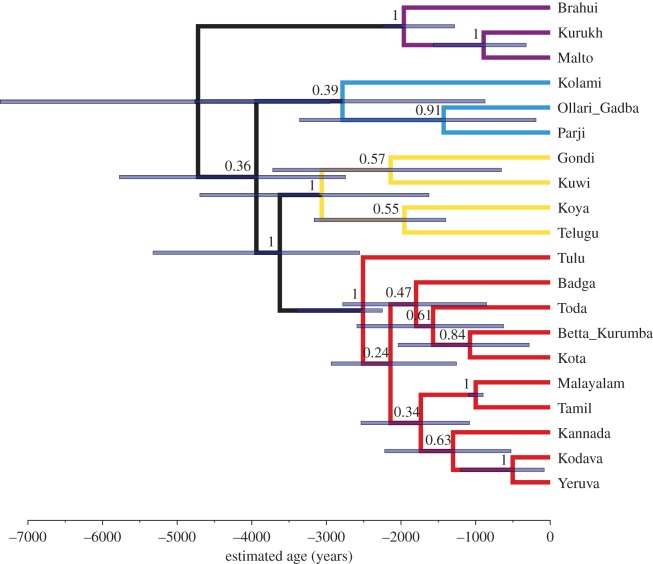
The Dravidian language family consists of about 80 varieties (Hammarström H. 2016 Glottolog 2.7) spoken by 220 million people across southern and central India and surrounding countries (Steever SB. 1998 In The Dravidian languages(ed. SB Steever), pp. 1–39: 1). Neither the geographical origin of the Dravidian language homeland nor its exact dispersal through time are known. The history of these languages is crucial for understanding prehistory in Eurasia, because despite their current restricted range, these languages played a significant role in influencing other language groups including Indo-Aryan (Indo-European) and Munda (Austroasiatic) speakers. Here, we report the results of a Bayesian phylogenetic analysis of cognate-coded lexical data, elicited first hand from native speakers, to investigate the subgrouping of the Dravidian language family, and provide dates for the major points of diversification. Our results indicate that the Dravidian language family is approximately 4500 years old, a finding that corresponds well with earlier linguistic and archaeological studies. The main branches of the Dravidian language family (North, Central, South I, South II) are recovered, although the placement of languages within these main branches diverges from previous classifications. We find considerable uncertainty with regard to the relationships between the main branches.
Overview
CoChat Summary
TL;DR
A Bayesian phylogenetic analysis of first-hand Swadesh-list lexical data from 20 Dravidian languages estimates the family’s root at about 4500 years ago and recovers North, Central, South I and South II branches, though higher-order relationships remain uncertain. The best-fitting model was a relaxed covarion model with word-specific mutation rates, and several lower-level placements diverge from traditional classifications.
Key findings
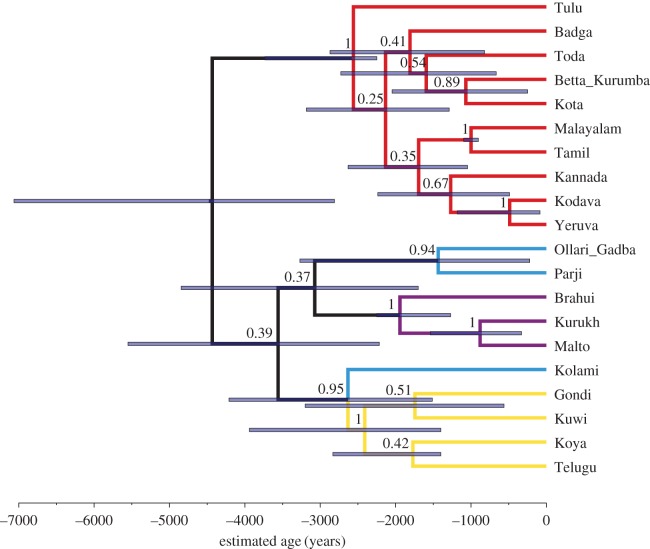
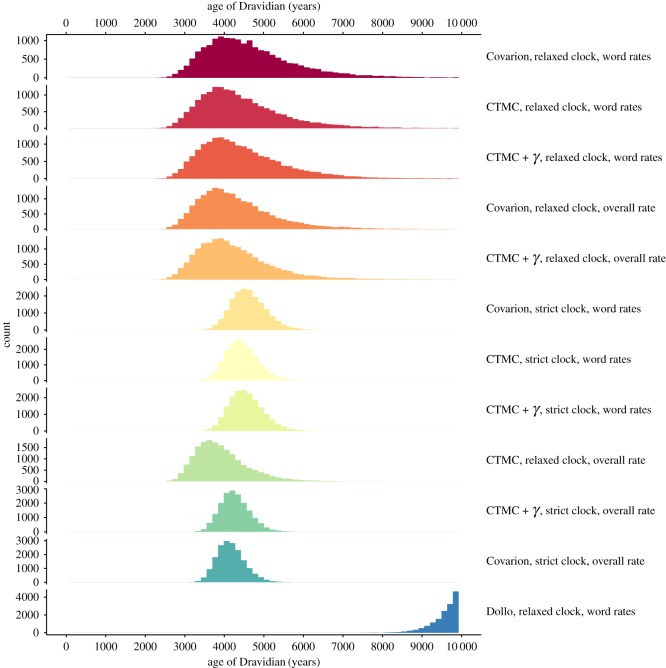
- The best-supported relaxed covarion model dates the Dravidian root to a mean of 4650 years ago (median 4433), with a 95% HPD of approximately 3000–6500 years ago; the authors therefore cannot exclude a root as old as 6000–6500 years. This contrasts with Pagel et al.’s estimate of around 13,000 years ago.
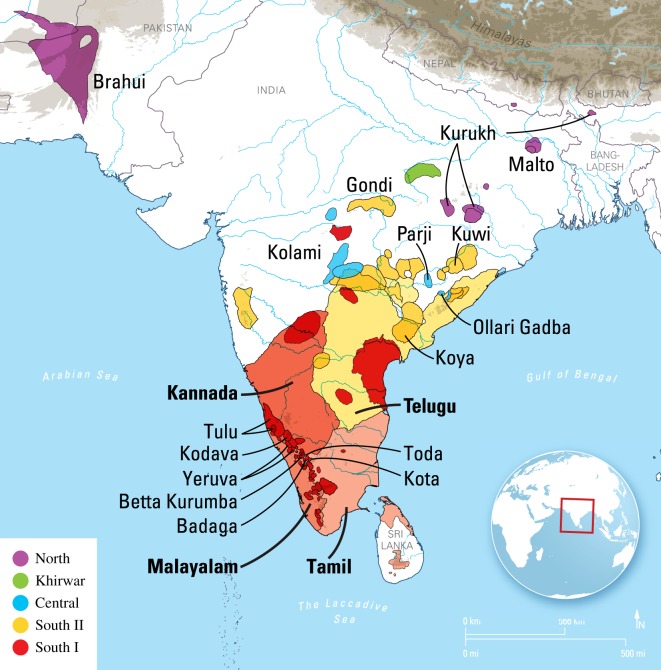
- Four main groups are recovered: South I (Badga, Betta Kurumba, Kota, Toda, Kannada, Kodava, Yeruva, Malayalam, Tamil, Tulu), South II (Gondi, Kuwi, Telugu, Koya, with Central Kolami as outgroup), Central (Ollari Gadba, Parji) and North (Brahui, Kurukh, Malto). The best-supported tree splits South I from South II–Central–North, but support is low: South I and South II are found together in only 42 of 18,000 trees (proportion 0.0023).
- The best model is the covarion model with relaxed clock and estimated word rates (marginal log-likelihood = −4128), with positive support over the next best model, CTMC with relaxed clock and word rates (−4131; Bayes factor 6); the stochastic Dollo model performs much worse (−4540).
- Automatic cognate detection with LingPy’s LexStat-Infomap at threshold 0.55 gives precision 0.90, F-score 0.84 and 90% agreement with the authors’ cognate coding.
Methods
- The authors elicited 100 Swadesh basic-vocabulary items first-hand from native speakers of 20 Dravidian languages chosen to represent all previously reported subgroups; cognate coding used the Dravidian Etymological Dictionary, revised 2nd edition, yielding 778 binary-coded sites of which 91% are complete.
- Phylogenetic analyses used BEAST 2 v. 2.4.3, testing CTMC, binary covarion and stochastic Dollo models of cognate gain and loss; strict versus relaxed lognormal clocks; and overall versus word-specific mutation rates, with ascertainment correction, Yule tree priors, subgroup priors and historical calibration points. Runs were 100 million generations, sampling every 5000 generations, with 10% burn-in and 18,000 posterior trees; marginal likelihoods used stepping-stone analysis.
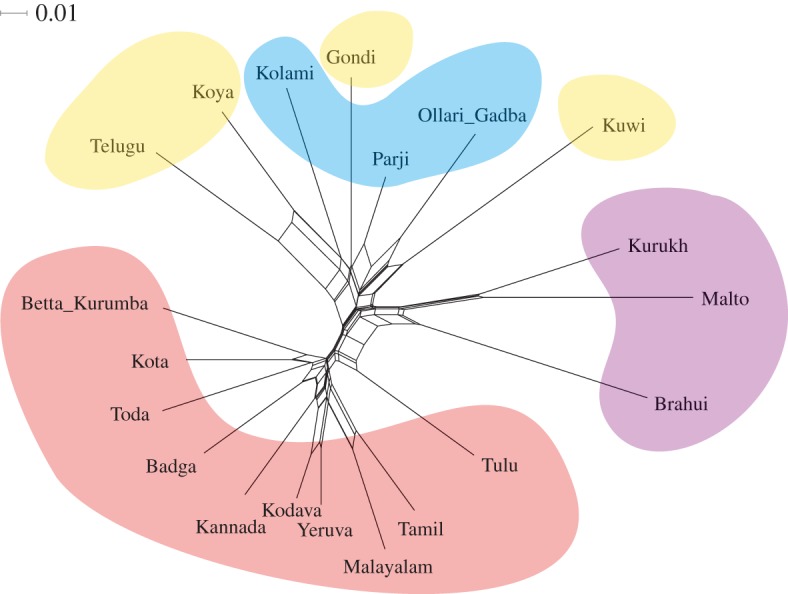
- Additional checks included NeighborNet networks in SplitsTree, δ scores and Q-residuals, LingPy automatic cognate detection, orthography profiles, Concepticon linking, and two extra calibration regimes: one with no monophyletic constraints and one adding a South I + South II monophyletic constraint.
Limitations
- The paper states that uncertainty on the root age is large, especially for the best-fitting relaxed-clock analyses, and that a root age of 6000 or 6500 years cannot be excluded; it also states that the dataset has low resolution for higher-order subgrouping despite recovering the four subgroups with reasonable confidence.
- The paper states that Kuwi, Ollari Gadba and Parji have 36–44 missing comparative concepts, over one-third of the dataset, limiting placement within the Central–South II subgroup; it also notes possible unidentified loanwords, though it argues the methods are robust to moderate borrowing, and that the stochastic Dollo model makes the unrealistic assumption of no semantic change.
- Evident from the text: the sample covers only 20 of about 80 Dravidian varieties, Malto and Betta Kurumba lacked native-speaker informants, and multilingual contact may produce reticulate signal or placements reflecting geographical proximity rather than genealogical descent; the authors also note that constrained analyses can recover a different higher-order topology.
Model-written summary. Check it against the paper before relying on it.
Integrity signals
Registry
Cites
Statistics
Figures
Verification
Claims the paper makes
0 Valid · 1 Not valid · 36 Not checked · 71 Own results and interpretations
A result the paper reports from its own data — it cites no other source for it, so there is none to check. The quote shows it is in the paper.
In the paper
“Our results indicate that the Dravidian language family is approximately 4500 years old, a finding that corresponds well with earlier linguistic and archaeological studies.”
§ A Bayesian phylogenetic study of the Dravidian language family > Abstract
hedged- Asserted: passes — The authors put it forward as true.
- Checkable: passes — It can be checked against evidence.
- Load-bearing: passes — The paper’s conclusions depend on it.
- Based: passes — The paper gives a reason why it holds.
A result the paper reports from its own data — it cites no other source for it, so there is none to check. The quote shows it is in the paper.
In the paper
“The main branches of the Dravidian language family (North, Central, South I, South II) are recovered, although the placement of languages within these main branches diverges from previous classifications.”
§ A Bayesian phylogenetic study of the Dravidian language family > Abstract
plain- Asserted: passes — The authors put it forward as true.
- Checkable: passes — It can be checked against evidence.
- Load-bearing: passes — The paper’s conclusions depend on it.
- Based: passes — The paper gives a reason why it holds.
A result the paper reports from its own data — it cites no other source for it, so there is none to check. The quote shows it is in the paper.
In the paper
“The main branches of the Dravidian language family (North, Central, South I, South II) are recovered, although the placement of languages within these main branches diverges from previous classifications.”
- Also stated in: § Subgrouping · plain
“we find four main groups, all of which, except Central, were constrained in the priors: South I (Badga, Betta Kurumba, Kota, Toda, Kannada, Kodava, Yeruva, Malayalam, Tamil, Tulu), South II (Gondi, Kuwi, Telugu, Koya, with the Central language Kolami as outgroup), Central (Ollari Gadba, Parji) and North (Brahui, Kurukh, Malto).”
§ A Bayesian phylogenetic study of the Dravidian language family > Abstract
plain- Asserted: passes — The authors put it forward as true.
- Checkable: passes — It can be checked against evidence.
- Load-bearing: passes — The paper’s conclusions depend on it.
- Based: passes — The paper gives a reason why it holds.
- Also stated in: § Subgrouping · plain
A result the paper reports from its own data — it cites no other source for it, so there is none to check. The quote shows it is in the paper.
In the paper
“We find considerable uncertainty with regard to the relationships between the main branches.”
§ A Bayesian phylogenetic study of the Dravidian language family > Abstract
plain- Asserted: passes — The authors put it forward as true.
- Checkable: passes — It can be checked against evidence.
- Load-bearing: passes — The paper’s conclusions depend on it.
- Based: passes — The paper gives a reason why it holds.
A result the paper reports from its own data — it cites no other source for it, so there is none to check. The quote shows it is in the paper.
In the paper
“Kolami is included in the South II group in this less constrained analysis.”
§ A Bayesian phylogenetic study of the Dravidian language family > Results > Subgrouping
plain- Asserted: passes — The authors put it forward as true.
- Checkable: passes — It can be checked against evidence.
- Load-bearing: unclear — It is unclear whether the paper’s conclusions depend on it.
- Based: passes — The paper gives a reason why it holds.
62 more claims
Create a free account to see all 108 claims and to verify the 53 references still open.
- It may state two separate claims as one. 31
- Probably not a substantial claim. 13
Claims other papers make about this one
Each is checked against this paper’s own text: does it say what the citing paper says it does?
In the citing paper
“However, the noCT scenario is not representative of other phylogenetic studies, which often remove loanwords from the data (Gray et al., 2009;Kolipakam et al., 2018).”
From Detecting contact in language trees: a Bayesian phylogenetic model with horizontal transfer (2022) · cites this paper as Kolipakam et al., 2018
Self-check
Percentages, sums and reported differences re-computed from the paper’s own numbers.
Each contradiction between two passages listed here was confirmed by an independent check.
Rated minor: it would not touch a result — a value no result rests on, a p-value that stays on the same side of the significance level, or a conflict that is clerical, resolved elsewhere in the paper, or outside its own findings.
In the paper
§ A Bayesian phylogenetic study of the Dravidian language family > Abstract
“Munda (Austroasiatic) speakers”
§ A Bayesian phylogenetic study of the Dravidian language family > Introduction
“Munda (Afroasiatic)”
Rated minor: it would not touch a result — a value no result rests on, a p-value that stays on the same side of the significance level, or a conflict that is clerical, resolved elsewhere in the paper, or outside its own findings.
In the paper
§ A Bayesian phylogenetic study of the Dravidian language family > Results > Subgrouping
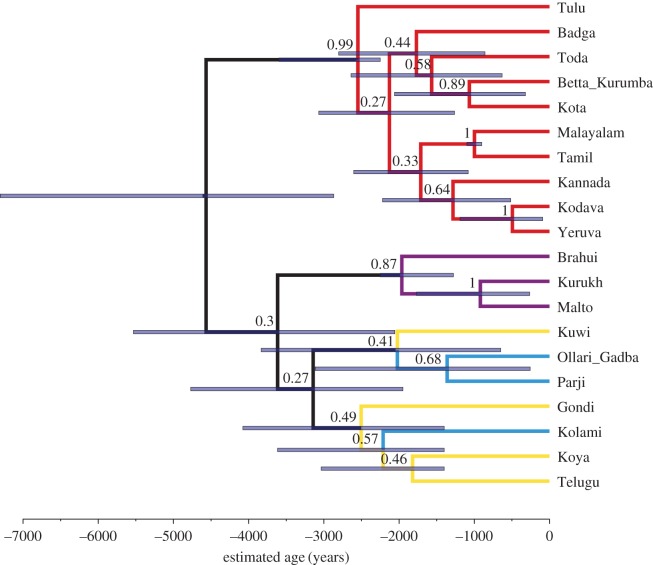
“Under these assumptions, we recover the main split between South I and the other three groups that is found in the more constrained analyses (figures 3 and 5).”
§ A Bayesian phylogenetic study of the Dravidian language family > Results > Subgrouping
“Under regime (2), with monophyletic priors kept in and a ninth calibration constraining South I and South II as monophyletic added (figure 5), we instead recover the more ‘traditional’ topology as hypothesized in Krishnamurti [7, p. 493] and Fuller [61, p. 200] (as based on [62, p. 267]). The North group splits off first, and South I + South II diverges last.”
Citations
Cites
Kass, R. E., & Raftery, A. E. (1995) · Journal of the American Statistical Association · doi:10.1080/01621459.1995.10476572 · Cited by 12,558
Bayesian Phylogenetics with BEAUti and the BEAST 1.7
Drummond, A. J., Suchard, M. A., Xie, D., & Rambaut, A. (2012) · Molecular Biology and Evolution · doi:10.1093/molbev/mss075 · Cited by 10,063
Application of Phylogenetic Networks in Evolutionary Studies
Huson, D. H., & Bryant, D. (2006) · Molecular Biology and Evolution · doi:10.1093/molbev/msj030 · Cited by 8,830
BEAST 2: a software platform for Bayesian evolutionary analysis
Bouckaert, R., Heled, J., Kühnert, D., Vaughan, T., Wu, C.-H., Xie, D., Suchard, M. A., Rambaut, A., & Drummond, A. J. (2014) · PLoS Computational Biology · doi:10.1371/journal.pcbi.1003537 · Cited by 6,527 · cited 1×
“3, [41]) for all phylogenetic analyses.”
Self-citationRelaxed Phylogenetics and Dating with Confidence
Drummond, A. J., Ho, S. Y. W., Phillips, M. J., & Rambaut, A. (2006) · PLoS Biology · doi:10.1371/journal.pbio.0040088 · Cited by 6,463 · cited 1×
“The second clock model was a relaxed clock [47] where branch rates were sampled from a lognormal distribution with parameters estimated from the data.”
Method(1986) · Cited by 2,570
Ethnologue. Languages of the World
(2014) · African Studies Companion Online · doi:10.1163/_afco_asc_441 · Cited by 2,162
Pipkins, H. R., Bradshaw, J. L., Keller, L. E., Swiatlo, E., & McDaniel, L. S. (2017) · PLOS ONE · doi:10.1371/journal.pone.0179159 · Cited by 1,338
Ethnologue: Languages of the World
(2015) · Choice Reviews Online · doi:10.5860/choice.192005 · Cited by 1,176
Baele, G., Lemey, P., Bedford, T., Rambaut, A., Suchard, M. A., & Alekseyenko, A. V. (2012) · Molecular Biology and Evolution · doi:10.1093/molbev/mss084 · Cited by 1,125
Research works printed but not linked: 17
- Hammarström H, Forkel R, Haspelmath M, Bank S 2016 Glottolog 2.7. Jena, Germany: Max Planck Institute for the Science of Human History.
- Steever SB 1998 Gonḍi. In The Dravidian languages (ed. Steever SB), pp. 270– 297. London, UK: Routledge.
- Steever SB 1998 Malto. In The Dravidian languages (ed. Steever SB), pp. 359– 387. London, UK: Routledge.
- Kulkarnu-Joshi S 2012 Language contact and the pidgin origin of Marathi: another look at arguments and evidence. Bull. Deccan College Res. Inst. 72/73, 353– 366.
- Bhaskararao P 1998 Gadaba. In The Dravidian languages (ed. Steever SB), pp. 328– 355. London, UK: Routledge.
- Tyler SB 1969 Koya: an outline grammar. Berkeley, CA: University of California Press.
- Bhat DNS 1998 Tulu. In The Dravidian languages (ed. Steever SB), pp. 158– 177. London, UK: Routledge.
- Burrow T, Emeneau MB 1984 A Dravidian etymological dictionary [DEDR], 2nd edn Oxford, UK: Clarendon Press.
- Beine DK 1994 A sociolinguistic survey of the Gondi-speaking communities of Central India. MA thesis, San Diego State University, San Diego, CA.
- Kolichala S 2017 Dravidian languages. In The languages and linguistics of south Asia (eds Hock HH, Bashir E), pp. 73– 107. Berlin, Germany: De Gruyter Mouton.
- Rao BR 1982 Inter-relation of Tulu with other Dravidian languages. Int. J. Dravidian Linguist. 11, 244– 252.
- Subrahmanyam PS 1968 The position of Tuḷu in Dravidian. Indian Linguist. 29, 47– 66.
- Zvelebil KV 1981 Problems of identification and classification of some Nilagiri Tribes: Iṛulas-Ūrāḷis, Kāṭṭu Nāyakas/Jēnu Kuṛumbas, Šōlegas. Anthropos 76, 467– 528.
- Emeneau MB 1944 Kota texts. Part One. Berkeley, CA: University of California Press.
- Balakrishnan R 1999 Badaga: A Dravidian language. Annamalainagar, Chidambaram, India: Annamalai University.
- Emeneau MB 1955 Kolami, a Dravidian language. Berkeley, CA: University of California Press.
- Southworth FC 2006 Proto-Dravidian argiculture. In Proc. Pre-symp. Rihn and 7th ESCA Harvard-Kyoto roundtable (ed. Osada T), pp. 121– 150. Kyoto, Japan: Research Institute for Humanity and Nature.
Cited by
Phylogenetic evidence for Sino-Tibetan origin in northern China in the Late Neolithic
Zhang, M., Yan, S., Pan, W., & Jin, L. (2019) · Nature · doi:10.1038/s41586-019-1153-z · Cited by 266
Cross-Linguistic Data Formats, advancing data sharing and re-use in comparative linguistics
Forkel, R., List, J., Greenhill, S. J., Rzymski, C., Bank, S., Cysouw, M., Hammarström, H., Haspelmath, M., Kaiping, G. A., & Gray, R. D. (2018) · Scientific Data · doi:10.1038/sdata.2018.205 · Cited by 233
Self-citationHeggarty, P., Anderson, C., Scarborough, M., King, B., Bouckaert, R., Jocz, L., Kümmel, M. J., Jügel, T., Irslinger, B., Pooth, R., et al. (2023) · Science · doi:10.1126/science.abg0818 · Cited by 213
Self-citationPhylogenetic signal in phonotactics
Macklin-Cordes, J. L., Bowern, C., & Round, E. R. (2021) · Diachronica · doi:10.1075/dia.20004.mac · Cited by 160
The ecological drivers of variation in global language diversity
Hua, X., Greenhill, S. J., Cardillo, M., Schneemann, H., & Bromham, L. D. (2019) · Nature Communications · doi:10.1038/s41467-019-09842-2 · Cited by 148
Self-citation
Metadata
- Authors
- Kolipakam, V., Jordan, F. M., Dunn, M., Greenhill, S. J., Bouckaert, R., Gray, R. D., & Verkerk, A.
- Affiliations
- Wildlife Institute of India (IN)
- University of Bristol (GB)
- Uppsala University (SE)
- Australian National University (AU)
- University of Auckland (NZ)
- Max Planck Institute of Geoanthropology (DE)
- Max Planck Institute for Psycholinguistics (NL)
- Corresponding author
- Verkerk, Annemarie
- ORCID
- Venue
- Royal Society Open Science
- Publisher
- The Royal Society
- Published
- 2018-03
- Volume
- 5
- Issue
- 3
- Pages
- 171504
- ISSN
- 2054-5703 (ISSN-L)
- PMC
- PMC5882685
- OpenAlex
- W2791610449
- Cited by
- 171
- References
- 63
- Citations by year
- 2026: 11 · 2025: 57 · 2024: 17 · 2023: 21 · 2022: 18 · 2021: 17 · 2020: 12 · 2019: 12 · 2018: 6
- FWCI
- 41.16
- Type
- journal article
- Language
- en
- Open access
- gold
- doi.org
- Licence
- cc-by
- royalsociety.org/journals/ethics-policies/data-sharing-mining/ (tdm)
- Locations
- Royal Society Open Science (publishedVersion, cc-by)
- Europe PMC (PubMed Central) (publishedVersion, cc-by)
- PubMed Central (publishedVersion, cc-by)
- PubMed (publishedVersion)
- Bristol Research (University of Bristol) (publishedVersion, cc-by)
- Explore Bristol Research (publishedVersion, cc-by)
- Uppsala University Publications (Uppsala University) (submittedVersion, other-oa)
- DOAJ (DOAJ: Directory of Open Access Journals) (submittedVersion)
- Max Planck Digital Library (submittedVersion, other-oa)
- ANU Open Research (Australian National University) (submittedVersion, cc-by)
- MPG.PuRe (Max Planck Society) (submittedVersion, other-oa)
- MPG.PuRe (Max Planck Society) (submittedVersion, cc-by)
- ResearchSpace (University of Auckland) (submittedVersion, cc-by)
- Funders
- University of Bristol
- Ministry of Environment
- Uppsala Universitet
- Max-Planck-Institut für Menschheitsgeschichte
- Max Planck Instituut voor Psycholinguïstiek
- Topics
- Social Sciences › Arts and Humanities › Language and Linguistics › Linguistics and language evolution
- Social Sciences › Cultural Studies › Language and cultural evolution
- Social Sciences › Arts and Humanities › Language and Linguistics › Historical Linguistics and Language Studies
- Keywords
- Dravidian languages, language family phylogeny, Bayesian phylogenetic analysis, lexical data, language divergence time, language dispersal, language contact, Indo-Aryan languages, Munda languages, language classification
About these checks
Registry, retraction, Cites and statistics results are computed, not judged, with one exception: a printed reference that no index lists is read once by a model before it counts as a citation error. Claims are extracted by a model and kept only when their quote appears verbatim in the text; each cited source is then checked, with a model’s help, for whether it says what the claim relies on. Those verdicts can be wrong — read the claim’s quote and the cited source before relying on one.
A language model drew the claims from the paper on 2026-11-24, under version 3 of the claim definition (model deepseek-v4.1-flash, prompt extract-v3).
A second model labelled each claim on 2026-11-24 (model jev-1.13-20260917, definition revision gold-guideline-v0.2).
Statistics and arithmetic are recomputed, not judged.
Confidence bands are shown only for fields calibrated on our annotated test set. None is calibrated yet, so no band is shown.
What counts as a claim ›How we measure confidence ›How we check this ›
Are you an author, or do you see a problem with this page? Request a review
How to cite
Cite CoChat for the checks on this page, and the paper for its own findings.
- This page
- CoChat. (2026). Citation check: A Bayesian phylogenetic study of the Dravidian language family. https://app.cochat.ai/papers/10.1098/rsos.171504
- The paper
- Kolipakam, V., Jordan, F. M., Dunn, M., Greenhill, S. J., Bouckaert, R., Gray, R. D., & Verkerk, A. (2018). A Bayesian phylogenetic study of the Dravidian language family. Royal Society Open Science. https://doi.org/10.1098/rsos.171504
Data sources
Bibliographic data: Semantic Scholar, OpenAlex, Crossref.
Contains information from the Semantic Scholar Academic Graph Datasets, made available under the ODC Attribution License (ODC-BY 1.0).
Semantic Scholar’s data is described in: Kinney, R., et al. (2023). The Semantic Scholar Open Data Platform. arXiv:2301.10140.
