

Ice-core cosmogenic radionuclides support the occurrence of an extreme solar particle storm 5259 BCE (7208 years BP)
Open accessThe DOI matches its Crossref record; 48 of the 48 references it cites were found in a registry or an index; none of the 59 sources its claims cite is checked for support yet.
Abstract
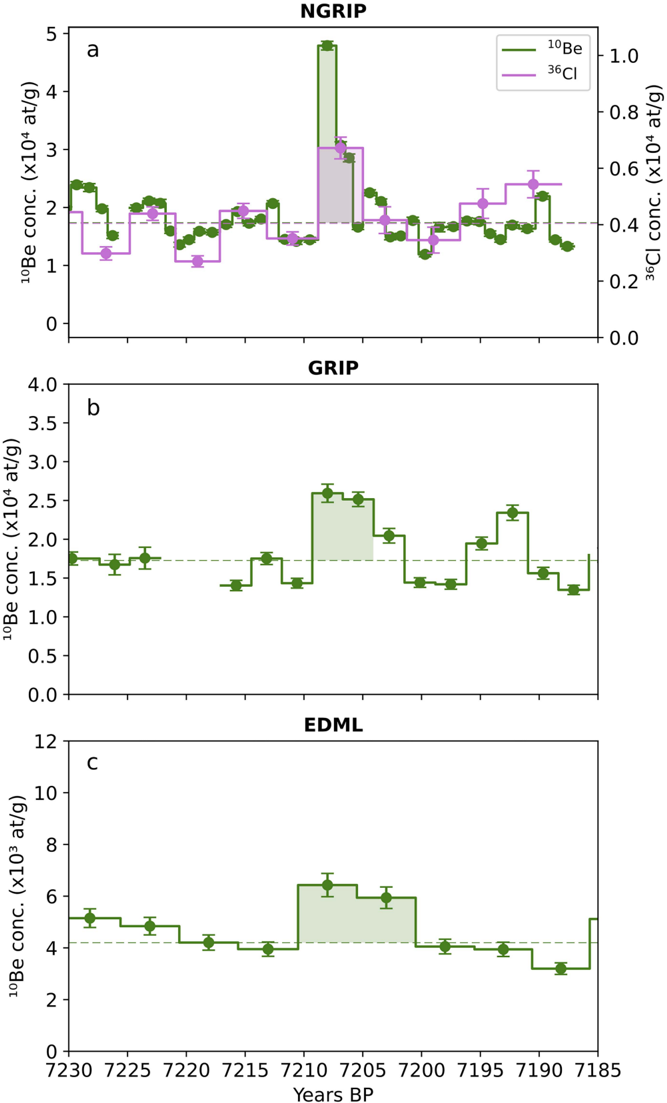
A prominent rapid increase in radiocarbon from tree rings has been detected in 5259 BCE (7208 years BP). In this study, we present 10Be and 36Cl data from the NGRIP and the GRIP ice cores from Greenland, and the EDML ice core from Antarctica around the 14C excursion. The ice-core radionuclide data show an increase consistent with the occurrence of an extreme solar energetic particle (SEP) event. The 10Be data show the event was of a similar magnitude as the extreme SEP event of 7176 BCE (9125 years BP), in agreement with previously published 14C data. Using all ice-core radionuclide data, we show that the event was characterized by a fluence above 200 MeV comparable with that of other extreme SEP events detected in radionuclide records. In addition, the detection of the SEP event in both tree-ring and ice-core records provides an important time-marker to synchronize the ice-core and tree-ring chronologies. This article is part of the Theo Murphy meeting issue ‘Radiocarbon and cosmic radiation events’.
Overview
CoChat Summary
TL;DR
New 10Be and 36Cl measurements from Greenland (NGRIP, GRIP) and Antarctic (EDML) ice cores show a radionuclide peak around 5259 BCE (7208 years BP) consistent with an extreme solar energetic particle event. The event’s 10Be enhancement is similar to the 7176 BCE event, and fluence estimates above ~200 MeV are comparable to previously confirmed extreme SEP events.
Key findings
- All ice-core radionuclide records show a consistent peak around 5259 BCE; enhancement factors are 3.7 ± 0.7 (NGRIP 10Be), 2.7 ± 0.8 (GRIP 10Be), 4.7 ± 1.5 (EDML 10Be), and 2.5 ± 1.0 (NGRIP 36Cl), with an average 10Be enhancement factor of 3.7 ± 0.6.
- The event was of similar magnitude to the 7176 BCE (9125 years BP) extreme SEP event, in agreement with previously published 14C data.
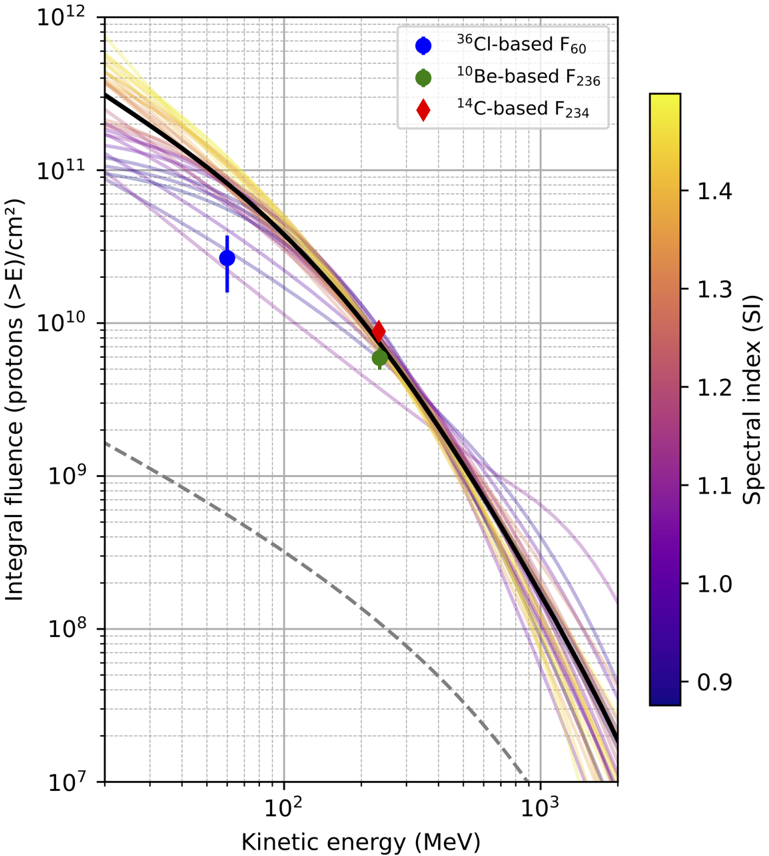
- Fluence estimates include F236 = 5.9 ± 1.0 × 10^9 protons cm^-2 from 10Be, F234 = 8.8 ± 0.4 × 10^9 from 14C, F60 = 2.7 ± 1.1 × 10^10 from 36Cl, F200 = 7.7 ± 1.3 × 10^9 from 10Be and 1.1 ± 0.1 × 10^10 from 14C, and F30 = 9.5 ± 3.9 × 10^10 from 36Cl.
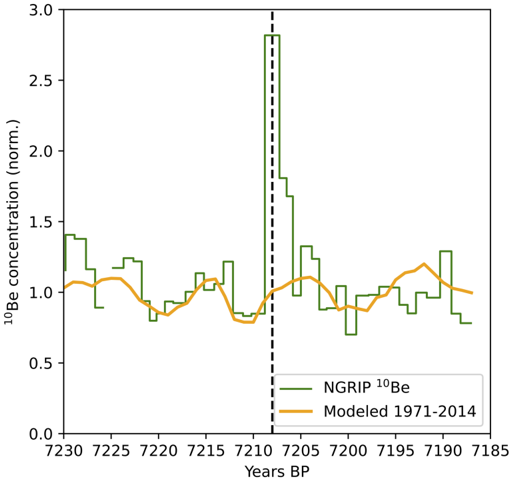
- The event probably occurred close to solar maximum (best correlation r = 0.47, p < 0.01 for 1971–2014), unlike the 7176 BCE and 774/5 CE events; an ice-core chronology adjustment of 23–21 years toward the present around 5259 BCE agrees within uncertainty with a suggested 25 ± 6 years.
Methods
- Ice cores used were NGRIP, GRIP, and EDML. NGRIP 10Be has ~1-year resolution and 36Cl ~4-year resolution; GRIP 10Be ~3-year; EDML 10Be ~5-year. NGRIP was sampled at 11 cm resolution; 10Be was extracted by ion exchange with 0.15 mg 9Be carrier, and four 10Be samples were combined per 36Cl sample with 4 mg Cl carrier. Measurements used the ETH Zurich MILEA facility for 10Be and a 6 MV Tandem AMS facility for 36Cl, with blank correction and normalization to standards.
- Enhancement factors were calculated as the time-integrated radionuclide concentration above a baseline (7185–7230 years BP excluding peak values) divided by the baseline. Fluence was inferred by scaling modern hard-spectrum GLE 10Be enhancements (S_GLE = 3.7/X_GLE) and by regression using effective energies (10Be E_eff = 236 MeV, 14C E_eff = 234 MeV, 36Cl E_eff = 60 MeV).
- Timing within the 11-year solar cycle was assessed by cross-correlating normalized NGRIP 10Be data (excluding the peak, binned to whole years) with normalized global 10Be production rates from the last approximately 70 years.
Limitations
- Stated: no modern GLE analogue reproduces the observed larger relative increase in 10Be than in 36Cl at NGRIP, so the fluence spectrum cannot be robustly reconstructed using the empirical 36Cl/10Be relationship alone.
- Stated: the 36Cl regression has larger scatter, and the 36Cl enhancement may be insufficiently constrained due to lower resolution, lack of measurements from multiple ice cores, and possible post-depositional effects, leading to an unreliable lower fluence estimate; additional 36Cl measurements are required. The F30 extrapolation remains more uncertain (R² = 0.69).
- Evident from the text: 10Be alone provides limited constraint at lower energies, as scaled spectra diverge below ~200–300 MeV; the solar-cycle timing inference rests on a single higher-resolution NGRIP 10Be record and a correlation with modern production rates.
Model-written summary. Check it against the paper before relying on it.
Integrity signals
Registry
Cites
Statistics
Figures
Verification
Claims the paper makes
0 Valid · 0 Not valid · 34 Not checked · 35 Own results and interpretations
A result the paper reports from its own data — it cites no other source for it, so there is none to check. The quote shows it is in the paper.
In the paper
“F 60 (2.7 ± 1.1 × 10 10 protons cm -2 )”
- Also stated in: § 5. Relationship with solar activity levels · plain
“| 60 | 2.7 ± 1.1 × 10 10 | 36 Cl | 0.83 |”
§ Ice-core cosmogenic radionuclides support the occurrence of an extreme solar particle storm 5259 BCE (7208 years BP) > 5. Relationship with solar activity levels
plain- Asserted: passes — The authors put it forward as true.
- Checkable: passes — It can be checked against evidence.
- Load-bearing: passes — The paper’s conclusions depend on it.
- Based: passes — The paper gives a reason why it holds.
- Rests on an assumption not shown here.
- Also stated in: § 5. Relationship with solar activity levels · plain
A result the paper reports from its own data — it cites no other source for it, so there is none to check. The quote shows it is in the paper.
In the paper
“A strong linear relationship is observed between F ( > E eff ) and cosmogenic isotope enhancement factors (supplementary material, figure S1), particularly for 10 Be and 14 C, where approximately 99% of the variance is explained by F ( > E eff ).”
§ Ice-core cosmogenic radionuclides support the occurrence of an extreme solar particle storm 5259 BCE (7208 years BP) > (c) Fluence spectrum
boostedstates an association- Asserted: passes — The authors put it forward as true.
- Checkable: passes — It can be checked against evidence.
- Load-bearing: passes — The paper’s conclusions depend on it.
- Based: passes — The paper gives a reason why it holds.
A result the paper reports from its own data — it cites no other source for it, so there is none to check. The quote shows it is in the paper.
In the paper
“| | 7.7 ± 1.3 × 10 9 | 10 Be | 0.98 |”
§ Ice-core cosmogenic radionuclides support the occurrence of an extreme solar particle storm 5259 BCE (7208 years BP) > 5. Relationship with solar activity levels
plain- Asserted: passes — The authors put it forward as true.
- Checkable: passes — It can be checked against evidence.
- Load-bearing: passes — The paper’s conclusions depend on it.
- Based: passes — The paper gives a reason why it holds.
- Rests on an assumption not shown here.
A result the paper reports from its own data — it cites no other source for it, so there is none to check. The quote shows it is in the paper.
In the paper
“| 200 | 1.1 ± 0.1 × 10 10 | 14 C | 0.97 |”
§ Ice-core cosmogenic radionuclides support the occurrence of an extreme solar particle storm 5259 BCE (7208 years BP) > 5. Relationship with solar activity levels
plain- Asserted: passes — The authors put it forward as true.
- Checkable: passes — It can be checked against evidence.
- Load-bearing: passes — The paper’s conclusions depend on it.
- Based: passes — The paper gives a reason why it holds.
- Rests on an assumption not shown here.
A result the paper reports from its own data — it cites no other source for it, so there is none to check. The quote shows it is in the paper.
In the paper
“F 236 (5.9 ± 1.0 × 10 9 protons cm -2 )”
- Also stated in: § 5. Relationship with solar activity levels · plain
“| 236 | 5.9 ± 1.0 × 10 9 | 10 Be | 0.99 |”
- Also stated in: § Additional information · hedged
“with an estimated F 236 of 5.9 ± 1.0 × 10 9 protons cm -2 .”
§ Ice-core cosmogenic radionuclides support the occurrence of an extreme solar particle storm 5259 BCE (7208 years BP) > 5. Relationship with solar activity levels
plain- Asserted: passes — The authors put it forward as true.
- Checkable: passes — It can be checked against evidence.
- Load-bearing: passes — The paper’s conclusions depend on it.
- Based: passes — The paper gives a reason why it holds.
- Rests on an assumption not shown here.
- Also stated in: § 5. Relationship with solar activity levels · plain
33 more claims
Create a free account to see all 69 claims and to verify the 59 references still open.
- It may state two separate claims as one. 21
- The quote only partly states this claim. 1
- Probably not a substantial claim. 13
Citations
Cites
Veres, D., Bazin, L., Landais, A., Toyé Mahamadou Kele, H., Lemieux-Dudon, B., Parrenin, F., Martinerie, P., Blayo, E., Blunier, T., Capron, E., et al. (2013) · Climate of the Past · doi:10.5194/cp-9-1733-2013 · Cited by 556
A signature of cosmic-ray increase in AD 774–775 from tree rings in Japan
Miyake, F., Nagaya, K., Masuda, K., & Nakamura, T. (2012) · Nature · doi:10.1038/nature11123 · Cited by 539
Use of 10Be in polar ice to trace the 11-year cycle of solar activity
Beer, J., Blinov, A., Bonani, G., Finkel, R. C., Hofmann, H. J., Lehmann, B., Oeschger, H., Sigg, A., Schwander, J., Staffelbach, T., et al. (1990) · Nature · doi:10.1038/347164a0 · Cited by 389
Self-citationSolar activity during the last 1000 yr inferred from radionuclide records
Muscheler, R., Joos, F., Beer, J., Müller, S. A., Vonmoos, M., & Snowball, I. (2007) · Quaternary Science Reviews · doi:10.1016/j.quascirev.2006.07.012 · Cited by 373
Self-citationThe ETH Zurich AMS facilities: Performance parameters and reference materials
Christl, M., Vockenhuber, C., Kubik, P. W., Wacker, L., Lachner, J., Alfimov, V., & Synal, H.-A. (2013) · Nuclear Instruments and Methods in Physics Research Section B: Beam Interactions with Materials and Atoms · doi:10.1016/j.nimb.2012.03.004 · Cited by 342
Self-citationMuscheler, R., Beer, J., Kubik, P. W., & Synal, H.-A. (2005) · Quaternary Science Reviews · doi:10.1016/j.quascirev.2005.01.012 · Cited by 330
Self-citationVonmoos, M., Beer, J., & Muscheler, R. (2006) · Journal of Geophysical Research: Space Physics · doi:10.1029/2005ja011500 · Cited by 307
Self-citationMultiradionuclide evidence for the solar origin of the cosmic-ray events of ad 774/5 and 993/4
Mekhaldi, F., Muscheler, R., Adolphi, F., Aldahan, A., Beer, J., McConnell, J. R., Possnert, G., Sigl, M., Svensson, A., Synal, H.-A., et al. (2015) · Nature Communications · doi:10.1038/ncomms9611 · Cited by 265
Self-citationAnother rapid event in the carbon-14 content of tree rings
Miyake, F., Masuda, K., & Nakamura, T. (2013) · Nature Communications · doi:10.1038/ncomms2783 · Cited by 254
A first chronology for the North Greenland Eemian Ice Drilling (NEEM) ice core
Rasmussen, S. O., Abbott, P. M., Blunier, T., Bourne, A. J., Brook, E., Buchardt, S. L., Buizert, C., Chappellaz, J., Clausen, H. B., Cook, E., et al. (2013) · Climate of the Past · doi:10.5194/cp-9-2713-2013 · Cited by 249
Self-citation
Research works printed but not linked: 1
- Tellus B: Chem. Phys. Meteorol. 56 , 492-498. ( doi:10.3402/tellusb.v56i5.16454 ) · doi:10.3402/tellusb.v56i5.16454 · Paper page
Cited by
High-resolution 10 Be measurements prove the extreme solar proton event at 14 300 years BP
Auriol, E., Bard, E., USOSKIN, I. G., Sukhodolov, T., Golubenko, K., Jörimann, A., Lamothe, A., Severi, M., Masko, L., Aster Team, et al. (2026) · Astronomy and Astrophysics · doi:10.1051/0004-6361/202662474
Metadata
- Authors
- Paleari, C. I., Mekhaldi, F., Christl, M., Gautschi, P., Vockenhuber, C., Anderberg, E., Beer, J., Raisbeck, G., Yiou, F., Brehm, N., Wacker, L., Wilhelms, F., & Muscheler, R.
- Affiliations
- Stockholm University (SE)
- ETH Zurich (CH)
- Lund University (SE)
- Swiss Federal Institute of Aquatic Science and Technology (CH)
- Centre National de la Recherche Scientifique (FR)
- Université Paris-Saclay, CNRS/IN2P3, IJCLab 5 , Orsay 91405, France
- Alfred-Wegener-Institut Helmholtz-Zentrum für Polar- und Meeresforschung (DE)
- Corresponding author
- Paleari, Chiara I.
- ORCID
- Venue
- Philosophical Transactions of the Royal Society A: Mathematical, Physical and Engineering Sciences
- Publisher
- The Royal Society
- Published
- 2026-09-10
- Volume
- 384
- Issue
- 2329
- Pages
- 20250347
- ISSN
- 1364-503X (ISSN-L)
- 1471-2962
- OpenAlex
- W7212147072
- Cited by
- 1
- References
- 48
- Citations by year
- 2026: 1
- FWCI
- 1.35
- Type
- journal article
- Language
- en
- Open access
- hybrid
- doi.org
- Licence
- Locations
- Philosophical Transactions of the Royal Society A Mathematical Physical and Engineering Sciences (publishedVersion, cc-by)
- DORA Eawag (Swiss Federal Institute of Aquatic Science and Technology (Eawag)) (publishedVersion, cc-by)
- PubMed (publishedVersion)
- Repository for Publications and Research Data (ETH Zurich) (publishedVersion, cc-by)
- HAL (submittedVersion)
- ETH Zürich Research Collection (cc-by)
- Funders
- Royal Physiographic Society of Lund
- European Union (101142677)
- European Union or the European Research Council
- Swedish Research Council (2023-05514, 2025-05471)
- Ice and Climate Research Group at the Niels Bohr Institute, University of Copenhagen
- Denmark
- Belgium
- France
- Germany
- Iceland
- Japan
- Sweden
- Switzerland
- United States of America
- Topics
- Physical Sciences › Earth and Planetary Sciences › Atmospheric Science › Geology and Paleoclimatology Research
- Physical Sciences › Physics and Astronomy › Astronomy and Astrophysics › Solar and Space Plasma Dynamics
- Physical Sciences › Earth and Planetary Sciences › Atmospheric Science › Tree-ring climate responses
- Keywords
- tree-ring radiocarbon, cosmogenic nuclides, beryllium-10, chlorine-36, ice core chronology, chronology synchronization, NGRIP, grip, EDML
About these checks
Registry, retraction, Cites and statistics results are computed, not judged, with one exception: a printed reference that no index lists is read once by a model before it counts as a citation error. Claims are extracted by a model and kept only when their quote appears verbatim in the text; each cited source is then checked, with a model’s help, for whether it says what the claim relies on. Those verdicts can be wrong — read the claim’s quote and the cited source before relying on one.
A language model drew the claims from the paper on 2026-11-23, under version 3 of the claim definition (model deepseek-v4.1-flash, prompt extract-v3).
A second model labelled each claim on 2026-11-23 (model jev-1.13-20260917, definition revision gold-guideline-v0.2).
Statistics and arithmetic are recomputed, not judged.
Confidence bands are shown only for fields calibrated on our annotated test set. None is calibrated yet, so no band is shown.
What counts as a claim ›How we measure confidence ›How we check this ›
Are you an author, or do you see a problem with this page? Request a review
Data sources
Bibliographic data: Semantic Scholar, OpenAlex, Crossref.
Contains information from the Semantic Scholar Academic Graph Datasets, made available under the ODC Attribution License (ODC-BY 1.0).
Semantic Scholar’s data is described in: Kinney, R., et al. (2023). The Semantic Scholar Open Data Platform. arXiv:2301.10140.
