

The DOI matches its Crossref record; 1 of the 1 references it cites were found in a registry or an index.
Mining folded proteomes in the era of accurate structure prediction
Open accessPreprint — published as 10.1371/journal.pcbi.1009930 · Paper page
Abstract
Protein structure fundamentally underpins the function and processes of numerous biological systems. Fold recognition algorithms offer a sensitive and robust tool to detect structural, and thereby functional, similarities between distantly related homologs. In the era of accurate structure prediction owing to advances in machine learning techniques, previously curated sequence databases have become a rich source of biological information. Here, we use bioinformatic fold recognition algorithms to scan the entire AlphaFold structure database to identify novel protein family members, infer function and group predicted protein structures. As an example of the utility of this approach, we identify novel, previously unknown members of various pore-forming protein families, including MACPFs, GSDMs and aerolysin-like proteins. Further, we explore the use of structure-based mining for functional inference.
Overview
The claims and statistics of this paper haven’t been checked yet.
Run the check — free, no account needed. It reads the open-access text and checks the sources it cites.
Integrity signals
Registry
Cites
Statistics
Figures
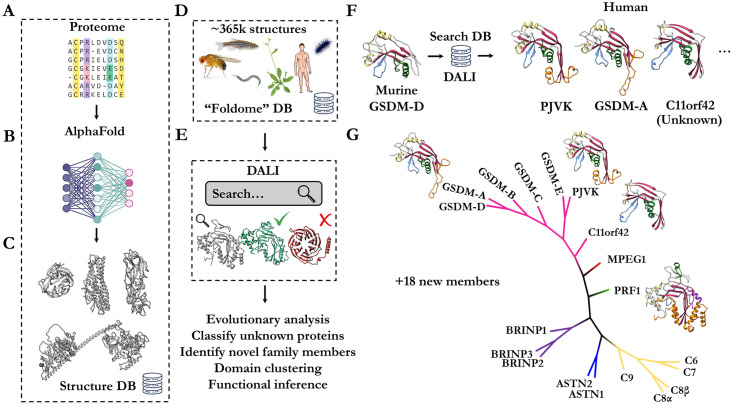
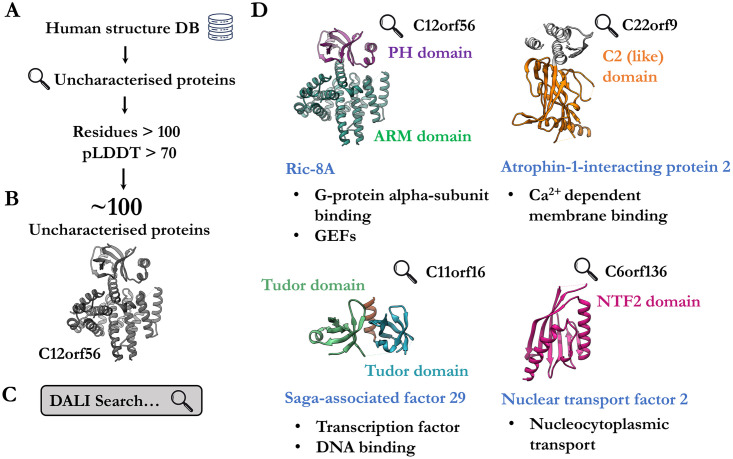
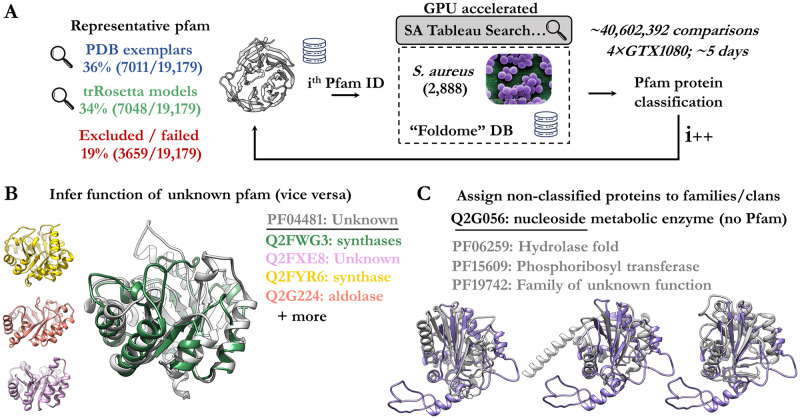
Verification
Claims the paper makes
The claims and statistics of this paper haven’t been checked yet.
Run the check — free, no account needed. It reads the open-access text and checks the sources it cites.
Self-check
Percentages, sums and reported differences re-computed from the paper’s own numbers.
The self-check needs the paper’s full text.
Citations
Cites
Highly accurate protein structure prediction with AlphaFold
Jumper, J., Evans, R., Pritzel, A., Green, T., Figurnov, M., Ronneberger, O., Tunyasuvunakool, K., Bates, R., Žídek, A., Potapenko, A., et al. (2021) · Nature · doi:10.1038/s41586-021-03819-2 · Cited by 43,764
Research works printed but not linked: 29
- 2010, Structural classification of proteins and structural genomics: New insights into protein folding and evolution, Acta Crystallogr. Sect. F Struct. Biol. Cryst. Commun, 66, 1190, 10.1107/S1744309110007177 · DOI
- 2020, The SCOP database in 2020: Expanded classification of representative family and superfamily domains of known protein structures, Nucleic Acids Res, 48, D376, 10.1093/nar/gkz1064 · DOI
- 2010, Dali server:conservation mapping in 3D, Nucleic Acids Res, 38, 545, 10.1093/nar/gkq366 · DOI · Paper page
- 10.1126/science.1144706 · DOI
- 10.1126/science.abj8754 · DOI · Paper page
- 10.1038/s41586-021-03828-1 · DOI · Paper page
- Artificial intelligence in structural biology is here to stay, 2021, Nature, 595, 625, 10.1038/d41586-021-02037-0 · DOI
- 10.1101/2021.08.03.454980 · DOI
- 10.1126/science.1260419 · DOI · Paper page
- 10.1038/s41586-019-1103-9 · DOI · Paper page
- 10.1016/j.cell.2017.09.027 · DOI · Paper page
- 10.1038/nbt.3567 · DOI
- 2021, The BioGRID database: A comprehensive biomedical resource of curated protein, genetic, and chemical interactions, Protein Sci, 30, 187, 10.1002/pro.3978 · DOI · Paper page
- 10.1038/s41586-018-0058-6 · DOI
- 10.1038/nature18590 · DOI · Paper page
- Ni, T. , Harlos, K. & Gilbert, R. Structure of astrotactin-2: A conserved vertebrate-specific and perforin-like membrane protein involved in neuronal development. Open Biol. 6, (2016). · DOI
- 2020, A dual-constriction biological nanopore resolves homonucleotide sequences with high fidelity, Nat. Biotechnol, 38, 1415, 10.1038/s41587-020-0570-8 · DOI
- 10.1038/nature13768 · DOI
- Brinkerhoff, H. , Kang, A. S. W. , Liu, J. , Aksimentiev, A. & Dekker, C. Infinite re-reading of single proteins at single-amino-acid resolution using nanopore sequencing. bioRxiv (2021). · DOI
- 10.1038/s41587-019-0401-y · DOI
- 10.1021/nn5049987 · DOI
- 10.1038/s41587-019-0345-2 · DOI
- McClelland, L. J. et al. Structure of the G protein chaperone and guanine nucleotide exchange factor Ric-8A bound to Gαi1. Nat. Commun. 11, (2020). · DOI
- 10.1186/1471-2105-11-446 · DOI
- 10.1093/nar/gky1134 · DOI
- Cheng, H. et al. ECOD: An Evolutionary Classification of Protein Domains. PLoS Comput. Biol. 10, (2014). · DOI · Paper page
- 10.1101/2021.08.02.454840 · DOI · Paper page
- 10.1101/2021.08.15.456425 · DOI · Paper page
- 2020, ProtCID: a data resource for structural information on protein interactions, Nat. Commun, 11, 711, 10.1038/s41467-020-14301-4 · DOI
Metadata
- Authors
- Bayly-Jones, C., & Whisstock, J.
- Affiliations
- Monash University (AU)
- Corresponding author
- Whisstock, James
- Venue
- PLoS Computational Biology
- Publisher
- openRxiv
- Published
- 2021-08-25
- Volume
- 18
- Issue
- 3
- Pages
- e1009930-e1009930
- ISSN
- 1553-734X (ISSN-L)
- PMC
- PMC8986115
- OpenAlex
- W4221071868
- Cited by
- 16
- References
- 1
- Citations by year
- 2026: 2 · 2024: 4 · 2023: 4 · 2022: 6
- FWCI
- 1.14
- Type
- journal article
- Language
- en
- Open access
- gold
- doi.org
- Licence
- cc-by
- Locations
- PLoS Computational Biology (publishedVersion, cc-by)
- bioRxiv (Cold Spring Harbor Laboratory) (acceptedVersion, cc-by)
- PubMed Central (publishedVersion, cc-by)
- PubMed (publishedVersion)
- DOAJ (DOAJ: Directory of Open Access Journals) (submittedVersion, cc-by-sa)
- Funders
- Australian Research Data Commons
- Medical Research Council
- Australian Research Council
- National Health and Medical Research Council
- Topics
- Life Sciences › Biochemistry, Genetics and Molecular Biology › Molecular Biology › Protein Structure and Dynamics
- Life Sciences › Biochemistry, Genetics and Molecular Biology › Structural Biology › Enzyme Structure and Function
- Life Sciences › Biochemistry, Genetics and Molecular Biology › Molecular Biology › Machine Learning in Bioinformatics
- Keywords
- protein fold recognition, AlphaFold, protein structure prediction, pore-forming proteins, protein function prediction, structural similarity
- MeSH terms
- Machine Learning, Algorithms, Computational Biology, Proteome, Databases, Protein
About these checks
Registry, retraction, Cites and statistics results are computed, not judged, with one exception: a printed reference that no index lists is read once by a model before it counts as a citation error. Claims are extracted by a model and kept only when their quote appears verbatim in the text; each cited source is then checked, with a model’s help, for whether it says what the claim relies on. Those verdicts can be wrong — read the claim’s quote and the cited source before relying on one.
Statistics and arithmetic are recomputed, not judged.
Confidence bands are shown only for fields calibrated on our annotated test set. None is calibrated yet, so no band is shown.
What counts as a claim ›How we measure confidence ›How we check this ›
Are you an author, or do you see a problem with this page? Request a review
