

The DOI matches its Crossref record; 1 of the 1 references it cites were found in a registry or an index.
The Vibrio cholerae Seventh Pandemic islands act in tandem to defend against a circulating phage
Open accessPreprint — published as 10.1371/journal.pgen.1010250 · Paper page
Abstract
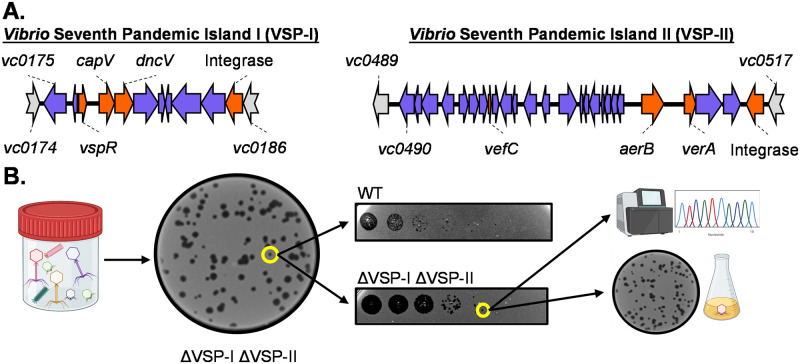
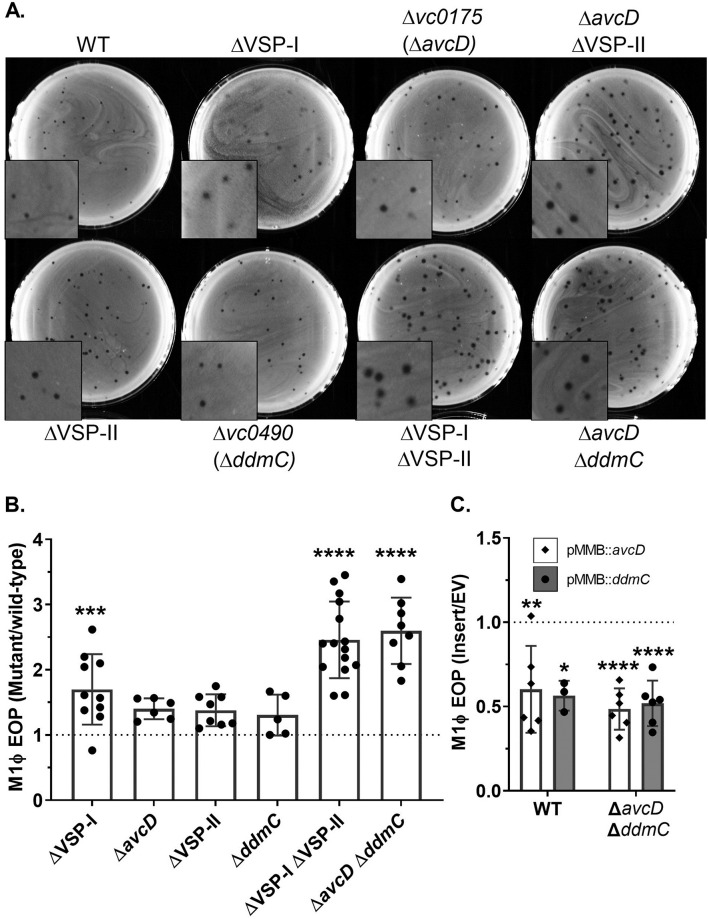
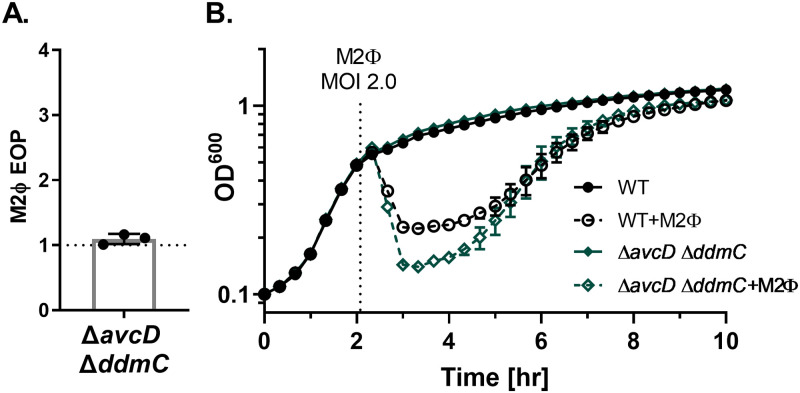
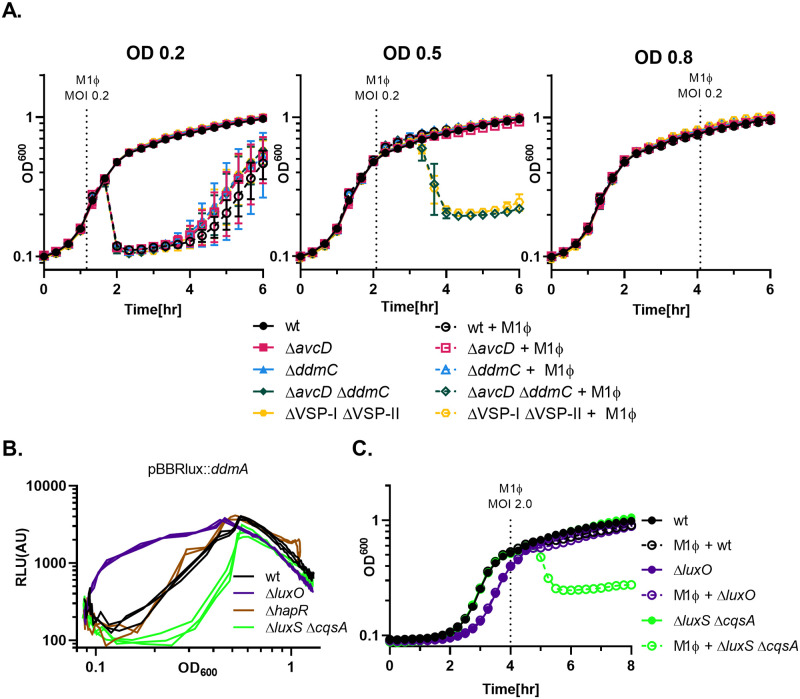
The current circulating pandemic El Tor biotype of Vibrio cholerae has persisted for over sixty years and is characterized by its acquisition of two unique genomic islands called the Vibrio Seventh Pandemic Islands 1 and 2 (VSP-I and VSP-II). However, the functions of most of the genes on VSP-I and VSP-II are unknown and the advantages realized by El Tor through these two islands are not clear. Recent studies have broadly implicated these two mobile genetic elements with phage defense. Still, protection against phage infection through these islands has not been observed directly in any V. cholerae El Tor biotype. Here we report the isolation of a circulating phage from a cholera patient stool sample and demonstrate that propagation of this phage in its native host is inhibited by elements in both VSP-I and VSP-II, providing direct evidence for the role of these genomic islands in phage defense. Moreover, we show that these defense systems are regulated by quorum sensing and active only at certain cell density. Finally, we have isolated a naturally occurring phage variant that is resistant to the defense conferred by the VSP islands, illustrating the countermeasures used by phages to evade these defense mechanisms. Together, this work demonstrates a functional role for the VSPs in V. cholerae and highlights the key regulatory and mechanistic insights that can be gained by studying anti-phage systems in their native contexts. SIGNIFICANCE (AUTHOR SUMMARY): The current pandemic strain of Vibrio cholerae carries two unique genomic islands. How these two islands confer evolutionary advantage to the pathogen is unknown. We show here the identification of a circulating phage that is sensitive to the defense systems present on these two islands and demonstrate how phage variants can evade these defenses. Our studies provide the first direct evidence showing the importance of these genomic islands in defending against phage in their native environments; and in doing so provide novel insight into the mechanisms of these highly conserved defense elements.
Overview
The claims and statistics of this paper haven’t been checked yet.
Run the check — free, no account needed. It reads the open-access text and checks the sources it cites.
Integrity signals
Registry
Cites
Statistics
Figures
Verification
Claims the paper makes
The claims and statistics of this paper haven’t been checked yet.
Run the check — free, no account needed. It reads the open-access text and checks the sources it cites.
Self-check
Percentages, sums and reported differences re-computed from the paper’s own numbers.
The self-check needs the paper’s full text.
Citations
Cites
Highly accurate protein structure prediction with AlphaFold
Jumper, J., Evans, R., Pritzel, A., Green, T., Figurnov, M., Ronneberger, O., Tunyasuvunakool, K., Bates, R., Žídek, A., Potapenko, A., et al. (2021) · Nature · doi:10.1038/s41586-021-03819-2 · Cited by 43,764
Research works printed but not linked: 63
- 10.1073/pnas.1608732113 · DOI
- 10.1073/pnas.042667999 · DOI
- 10.1038/nrmicro2204 · DOI
- 10.1073/pnas.0502069102 · DOI
- 10.1128/mBio.00334-10 · DOI
- 10.1073/pnas.1810138116 · DOI
- 10.1038/s41467-016-0009-6 · DOI · Paper page
- 10.1371/journal.ppat.1004691 · DOI
- 10.1371/journal.pbio.3001514 · DOI
- 10.1371/journal.pgen.1010065 · DOI
- 10.1371/journal.pgen.1006563 · DOI
- 10.1126/science.abg2166 · DOI
- Colwell RR , Fidelma E . Crispr-Cas and Contact-Dependent Secretion Systems Present on Excisable Pathogenicity Islands with Conserved Recombination Modules. 2017;199: 1–20. doi:https://doi.org/10.1128/JB.00842-16. · DOI
- 10.1007/s11103-011-9767-z · DOI
- 10.1073/pnas.1801233115 · DOI
- 10.1038/s41586-019-1605-5 · DOI
- 10.1038/s41586-019-0953-5 · DOI
- Huiting E , Athukoralage J , Guan J , Silas S , Carion H , Bondy-Denomy J . Bacteriophages antagonize cGAS-like immunity in bacteria. bioRxiv. 2022;1: 2022.03.30.486325. doi:https://doi.org/10.1101/2022.03.30.486325 · DOI
- Severin GB , Hsueh BY , Elg CA , Dover JA , Rhoades CR , Wessel AJ , et al. A Broadly Conserved Deoxycytidine Deaminase Protects Bacteria from Phage Infection. BioRxiv. 2021. doi:https://doi.org/10.1101/2021.03.31.437871 · DOI
- Tal N , Millman A , Stokar-Avihail A , Fedorenko T , Leavitt A , Melamed S , et al. Antiviral defense via nucleotide depletion in bacteria. bioRxiv. 2021; 2021.04.26.441389. doi:https://doi.org/10.1101/2021.04.26.441389 · DOI
- 10.1111/j.1574-6968.2010.02008.x · DOI
- 10.1128/JB.00704-15 · DOI
- Murphy SG , Johnson BA , Ledoux CM , Dörr T . Vibrio cholerae’s mysterious Seventh Pandemic island (VSP-II) encodes novel Zur-regulated zinc starvation genes involved in chemotaxis and autoaggregation. PLoS Genet. 2021. doi:https://doi.org/10.1371/journal.pgen.1009624 June · DOI
- 10.1038/s41586-022-04546-y · DOI
- 10.1126/science.aba0372 · DOI
- 10.1128/JCM.42.10.4657-4671.2004 · DOI
- 10.1371/journal.pntd.0008275 · DOI
- 10.1126/science.272.5270.1910 · DOI
- 10.1111/j.1365-2958.1995.mmi_18040685.x · DOI
- 10.1016/j.cell.2012.01.053 · DOI
- 10.1007/978-1-60327-164-6_17 · DOI
- 10.1186/1471-2180-11-181 · DOI
- 10.1073/pnas.1718787115 · DOI
- 10.7554/eLife.42057 · DOI
- 10.1371/journal.ppat.1004837 · DOI
- 10.1016/S0092-8674(02)00829-2 · DOI
- 10.1016/j.cell.2004.06.009 · DOI
- 10.1073/pnas.0703860104 · DOI
- 10.3391/mbi.2016.7.1.01 · DOI
- 10.1038/s41598-018-23276-8 · DOI
- 10.1093/nar/gkaa726 · DOI
- 10.1016/j.chom.2022.03.001 · DOI
- 10.1128/mBio.00939-20 · DOI
- 10.1146/annurev-virology-011620-040628 · DOI
- 10.1038/s41598-016-0001-8 · DOI · Paper page
- 10.1073/pnas.1315647110 · DOI
- 10.1038/s41467-020-19415-3 · DOI
- 10.1126/science.aar4120 · DOI
- 10.1073/pnas.69.11.3365 · DOI
- 10.1126/science.1225829 · DOI · Paper page
- 10.1111/j.1462-2920.2012.02886.x · DOI
- 10.3389/fgene.2019.00735 · DOI
- 10.1093/infdis/145.3.296 · DOI
- 10.1371/journal.ppat.1002917 · DOI
- 10.1128/mBio.01028-13 · DOI
- 10.1073/pnas.1406478111 · DOI
- 10.1128/AEM.00066-06 · DOI
- 10.1007/978-1-60327-164-6_18 · DOI
- 10.1128/jb.92.3.787-788.1966 · DOI
- 10.1128/IAI.64.7.2853-2856.1996 · DOI · Paper page
- 10.1128/JB.01307-08 · DOI
- 10.1016/0378-1119(86)90358-6 · DOI
- 10.1128/AEM.72.1.802-810.2006 · DOI
Metadata
- Authors
- O’Hara, B. J., Alam, M., & Ng, W.-L.
- Affiliations
- Tufts University (US)
- International Centre for Diarrhoeal Disease Research (BD)
- Corresponding author
- Ng, Wai-Leung
- Venue
- PLoS Genetics
- Publisher
- openRxiv
- Published
- 2022-05-16
- Volume
- 18
- Issue
- 8
- Pages
- e1010250-e1010250
- ISSN
- 1553-7390 (ISSN-L)
- PMC
- PMC9455884
- OpenAlex
- W4293155768
- Cited by
- 45
- References
- 1
- Citations by year
- 2026: 7 · 2025: 14 · 2024: 11 · 2023: 10 · 2022: 3
- FWCI
- 5.06
- Type
- journal article
- Language
- en
- Open access
- gold
- doi.org
- Licence
- cc-by
- Locations
- PLoS Genetics (publishedVersion, cc-by)
- bioRxiv (Cold Spring Harbor Laboratory) (acceptedVersion, cc-by)
- PubMed Central (publishedVersion, cc-by)
- PubMed (publishedVersion)
- DOAJ (DOAJ: Directory of Open Access Journals) (submittedVersion, cc-by-sa)
- Greater South Information System
- Funders
- International Centre for Diarrhoeal Disease Research, Bangladesh
- National Institutes of Health
- National Institute of General Medical Sciences (T32GM007310)
- National Institute of Allergy and Infectious Diseases (R01AI121337)
- Topics
- Life Sciences › Immunology and Microbiology › Virology › Bacteriophages and microbial interactions
- Life Sciences › Immunology and Microbiology › Microbiology › Vibrio bacteria research studies
- Life Sciences › Biochemistry, Genetics and Molecular Biology › Genetics › Bacterial Genetics and Biotechnology
- Keywords
- Vibrio cholerae, phage defense, bacteriophages, El Tor biotype, quorum sensing, cell density regulation, phage resistance, mobile genetic elements, genomic islands
- MeSH terms
- Bacteriophages, Cholera, Humans, Vibrio cholerae O1, Genomic Islands, Pandemics
About these checks
Registry, retraction, Cites and statistics results are computed, not judged, with one exception: a printed reference that no index lists is read once by a model before it counts as a citation error. Claims are extracted by a model and kept only when their quote appears verbatim in the text; each cited source is then checked, with a model’s help, for whether it says what the claim relies on. Those verdicts can be wrong — read the claim’s quote and the cited source before relying on one.
Statistics and arithmetic are recomputed, not judged.
Confidence bands are shown only for fields calibrated on our annotated test set. None is calibrated yet, so no band is shown.
What counts as a claim ›How we measure confidence ›How we check this ›
Are you an author, or do you see a problem with this page? Request a review
