

Computational model of the full-length TSH receptor
Open accessPreprint — published as 10.7554/elife.81415
The DOI matches its Crossref record; 39 of the 39 references it cites were found in a registry or an index.
Abstract
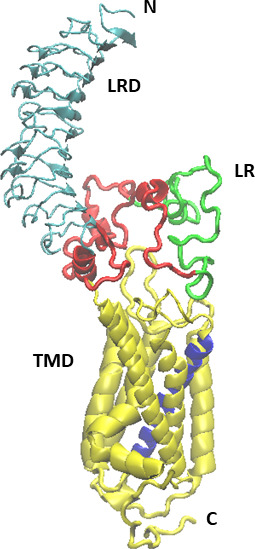
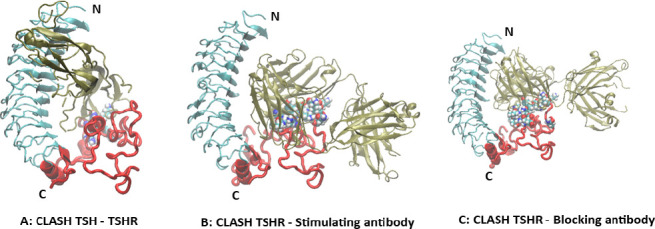
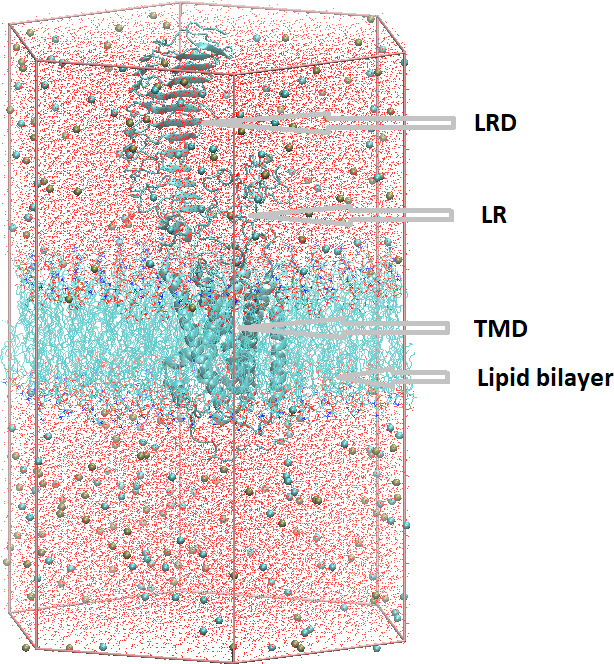
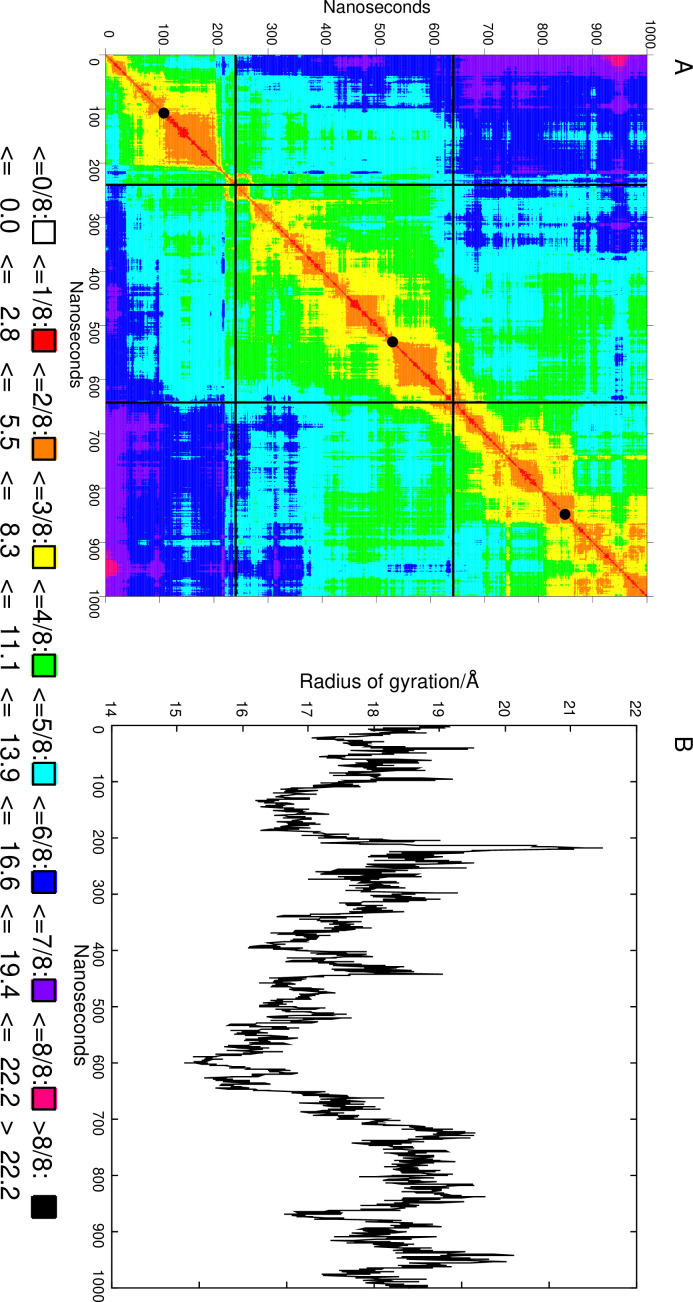
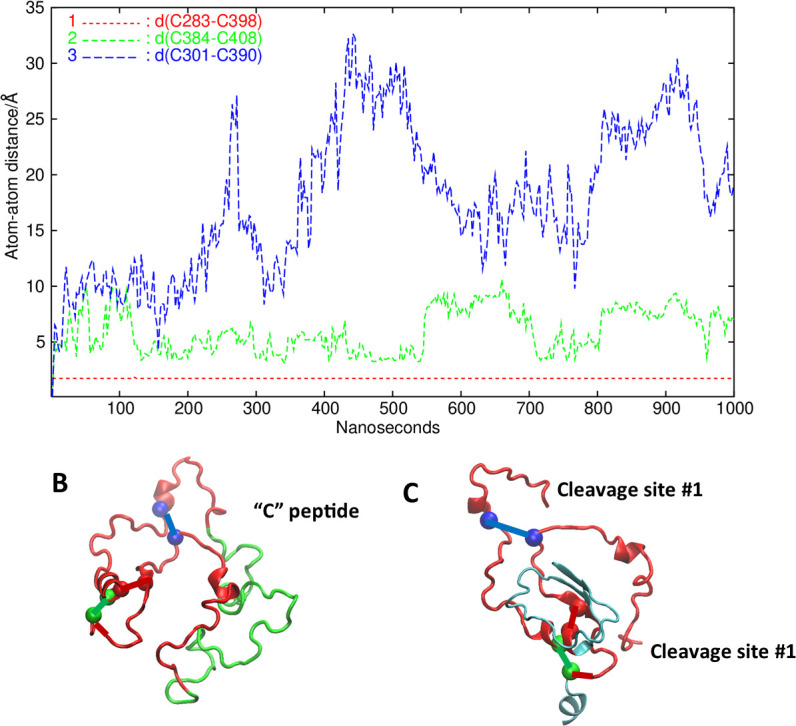
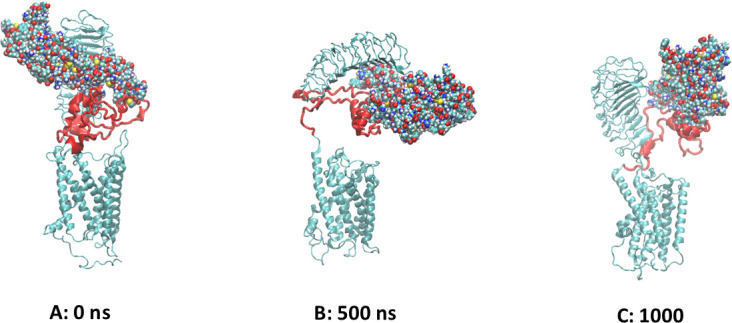
The receptor for thyroid stimulating hormone (TSHR), a GPCR, is of particular interest as the primary antigen in autoimmune hyperthyroidism (Graves’ disease) caused by stimulating TSHR antibodies. To date, only one domain of the extracellular region of the TSHR has been crystallized. We have now generated a model of the entire TSHR by merging the extracellular region of the receptor, obtained using artificial intelligence, with our recent homology model of the transmembrane domain, embedded it in a lipid membrane solvated it with water and counterions, and performed 1000ns Molecular Dynamic simulations on it. The simulations showed that the structure of the transmembrane and leucine-rich domains were remarkably constant while the linking region (LR), known more commonly as the “hinge region”, showed significant flexibility, forming several transient secondary structural elements. Furthermore, the relative orientation of the leucine-rich domain with the rest of the receptor was also seen to be variable. These data suggest that this linker region is an intrinsically disordered protein (IDP). Furthermore, preliminary data simulating the full TSHR model complexed with its ligand (TSH) showed that (a) there is a strong affinity between the linker region and TSH ligand and (b) the association of the linker region and the TSH ligand reduces the structural fluctuations in the linker region. This full-length model illustrates the importance of the linker region in responding to ligand binding and lays the foundation for studies of pathologic TSHR autoantibodies complexed with the TSHR to give further insight into their interaction with the flexible linker region.
Overview
The claims and statistics of this paper haven’t been checked yet.
Free: it reads the open-access text and checks the first 5 claims that cite a source we can check. Create a free account to check every claim.
Integrity signals
Registry
Cites
Statistics
Figures
Verification
Claims the paper makes
The claims and statistics of this paper haven’t been checked yet.
Free: it reads the open-access text and checks the first 5 claims that cite a source we can check. Create a free account to check every claim.
Self-check
Percentages, sums and reported differences re-computed from the paper’s own numbers.
The self-check needs the paper’s full text.
Citations
Cites
VMD: visual molecular dynamics
Humphrey, W., Dalke, A., & Schulten, K. (1996) · Journal of Molecular Graphics · doi:10.1016/0263-7855(96)00018-5 · Cited by 66,952
Highly accurate protein structure prediction with AlphaFold
Jumper, J., Evans, R., Pritzel, A., Green, T., Figurnov, M., Ronneberger, O., Tunyasuvunakool, K., Bates, R., Žídek, A., Potapenko, A., et al. (2021) · Nature · doi:10.1038/s41586-021-03819-2 · Cited by 43,764
Comparison of simple potential functions for simulating liquid water
Jorgensen, W. L., Chandrasekhar, J., Madura, J. D., Impey, R. W., & Klein, M. L. (1983) · The Journal of Chemical Physics · doi:10.1063/1.445869 · Cited by 41,298
Scalable molecular dynamics with NAMD
Phillips, J. C., Braun, R., Wang, W., Gumbart, J., Tajkhorshid, E., Villa, E., Chipot, C., Skeel, R. D., Kalé, L., & Schulten, K. (2005) · Journal of Computational Chemistry · doi:10.1002/jcc.20289 · Cited by 16,914
Kabsch, W., & Sander, C. (1983) · Biopolymers · doi:10.1002/bip.360221211 · Cited by 15,320
CHARMM‐GUI: A web‐based graphical user interface for CHARMM
Jo, S., Kim, T., Iyer, V. G., & Im, W. (2008) · Journal of Computational Chemistry · doi:10.1002/jcc.20945 · Cited by 9,284
CHARMM36m: an improved force field for folded and intrinsically disordered proteins
Huang, J., Rauscher, S., Nawrocki, G., Ran, T., Feig, M., de Groot, B. L., Grubmüller, H., & MacKerell, A. D. (2017) · Nature Methods · doi:10.1038/nmeth.4067 · Cited by 7,285
The SWISS-PROT protein sequence database and its supplement TrEMBL in 2000
Bairoch, A. (2000) · Nucleic Acids Research · doi:10.1093/nar/28.1.45 · Cited by 3,093
Davies, T. F., Andersen, S., Latif, R., Nagayama, Y., Barbesino, G., Brito, M., Eckstein, A. K., Stagnaro-Green, A., & Kahaly, G. J. (2020) · Nature Reviews Disease Primers · doi:10.1038/s41572-020-0184-y · Cited by 398
Self-citationLaugwitz, K. L., Allgeier, A., Offermanns, S., Spicher, K., Van Sande, J., Dumont, J. E., & Schultz, G. (1996) · Proceedings of the National Academy of Sciences · doi:10.1073/pnas.93.1.116 · Cited by 317
Research works printed but not linked: 6
- 10.1210/er.19.6.673 · DOI
- 2018, Antigenic “Hot-Spots” on the TSH Receptor Hinge Region, Front Endocrinol (Lausanne), 9, 765
- Mardia KV , Jupp PE. Directional Statistics. Chichester: John Wiley & Sons, Ltd.
- 1984, Generic solvation sites in a crystal, J Comp Chem, 6, 523
- 2014, Comparative Protein Structure Modeling Using MODELLER, Curr Protoc Bioinformatics, 47, 561
- Ali MR , Latif R , Davies TF , Mezei M. Monte Carlo loop refinement and virtual screening of the thyroid-stimulating hormone receptor transmembrane domain. Journal of Biomolecular Structure and Dynamics. 2014:1–13. · DOI
Metadata
- Authors
- Mezei, M., Latif, R., & Davies, T. F.
- Affiliations
- Icahn School of Medicine at Mount Sinai (US)
- James J. Peters VA Medical Center (US)
- Corresponding author
- Mezei, Mihaly
- Venue
- eLife
- Publisher
- openRxiv
- Published
- 2022-07-15
- Volume
- 11
- ISSN
- 2050-084X (ISSN-L)
- PMC
- PMC9640187
- OpenAlex
- W4307462464
- Cited by
- 15
- References
- 39
- Citations by year
- 2026: 1 · 2025: 4 · 2024: 8 · 2023: 2
- FWCI
- 1.14
- Type
- journal article
- Language
- en
- Open access
- gold
- doi.org
- Licence
- cc-by
- Locations
- eLife (publishedVersion, cc-by)
- bioRxiv (Cold Spring Harbor Laboratory) (acceptedVersion, cc-by)
- PubMed Central (publishedVersion, cc-by)
- PubMed (publishedVersion)
- DOAJ (DOAJ: Directory of Open Access Journals) (submittedVersion, cc-by-sa)
- Funders
- U.S. Department of Veterans Affairs (I01 BX000800)
- Icahn School of Medicine at Mount Sinai
- Segal Family Foundation (00000000)
- National Institutes of Health
- NIH Office of the Director (DK069713)
- National Institute of Diabetes and Digestive and Kidney Diseases (R01DK069713)
- Topics
- Life Sciences › Biochemistry, Genetics and Molecular Biology › Molecular Biology › Receptor Mechanisms and Signaling
- Life Sciences › Biochemistry, Genetics and Molecular Biology › Molecular Biology › Protein Structure and Dynamics
- Health Sciences › Medicine › Endocrinology, Diabetes and Metabolism › Thyroid Disorders and Treatments
- Keywords
- TSH receptor, G protein-coupled receptors, leucine-rich domain, hinge region, intrinsically disordered proteins, receptor flexibility, Graves' disease, transmembrane domain, extracellular domain, homology model
- MeSH terms
- Artificial Intelligence, Autoantibodies, Leucine, Ligands, Receptors, Thyrotropin, Thyrotropin, Receptors, G-Protein-Coupled
About these checks
Registry, retraction, Cites and statistics results are computed, not judged, with one exception: a printed reference that no index lists is read once by a model before it counts as a citation error. Claims are extracted by a model and kept only when their quote appears verbatim in the text; each cited source is then checked, with a model’s help, for whether it says what the claim relies on. Those verdicts can be wrong — read the claim’s quote and the cited source before relying on one.
Statistics and arithmetic are recomputed, not judged.
Confidence bands are shown only for fields calibrated on our annotated test set. None is calibrated yet, so no band is shown.
What counts as a claim ›How we measure confidence ›How we check this ›
Are you an author, or do you see a problem with this page? Request a review
How to cite
Cite CoChat for the checks on this page, and the paper for its own findings.
- This page
- CoChat. (2026). Citation check: Computational model of the full-length TSH receptor. https://app.cochat.ai/papers/10.1101/2022.07.13.499955
- The paper
- Mezei, M., Latif, R., & Davies, T. F. (2022). Computational model of the full-length TSH receptor. eLife. https://doi.org/10.1101/2022.07.13.499955
Data sources
Bibliographic data: Semantic Scholar, OpenAlex, Crossref.
Contains information from the Semantic Scholar Academic Graph Datasets, made available under the ODC Attribution License (ODC-BY 1.0).
Semantic Scholar’s data is described in: Kinney, R., et al. (2023). The Semantic Scholar Open Data Platform. arXiv:2301.10140.
