

The DOI matches its Crossref record; 2 of the 2 references it cites were found in a registry or an index.
Insights into the conservation and diversification of the molecular functions of YTHDF proteins
Open accessPreprint — published as 10.1371/journal.pgen.1010980
Abstract
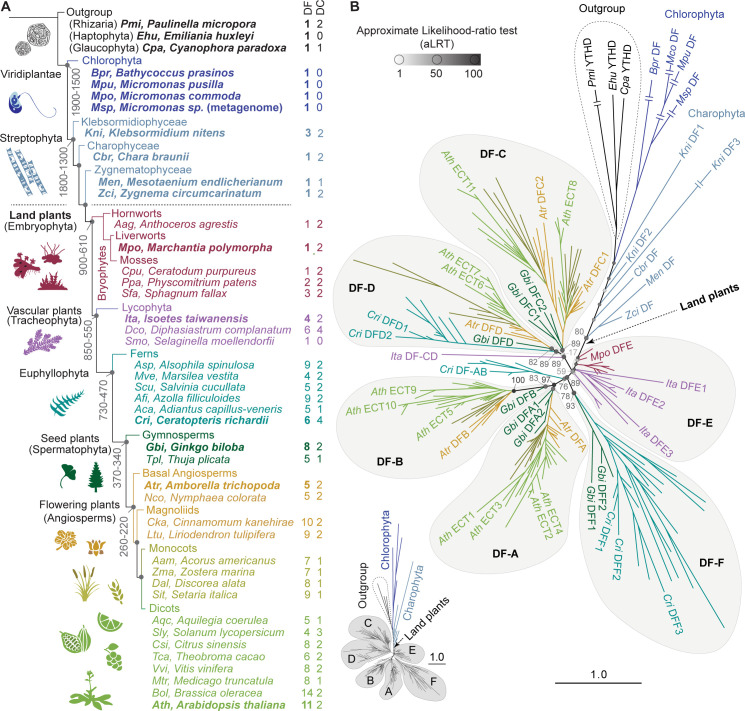
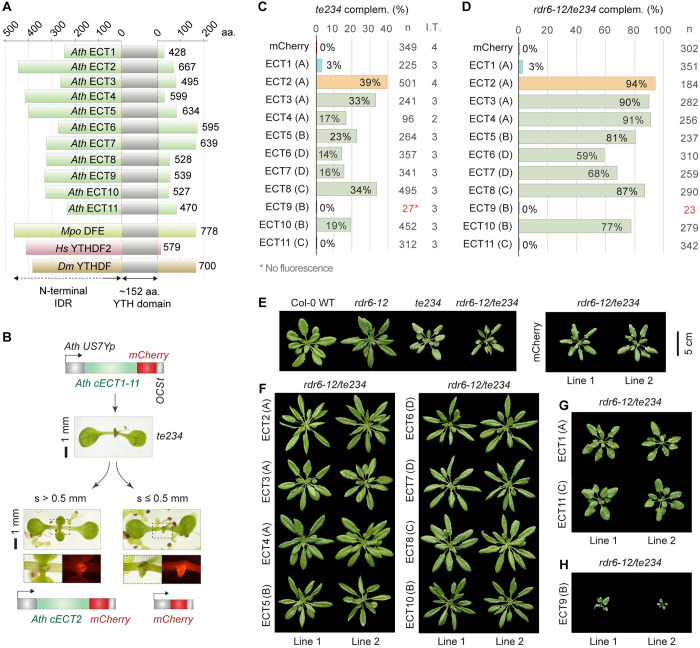
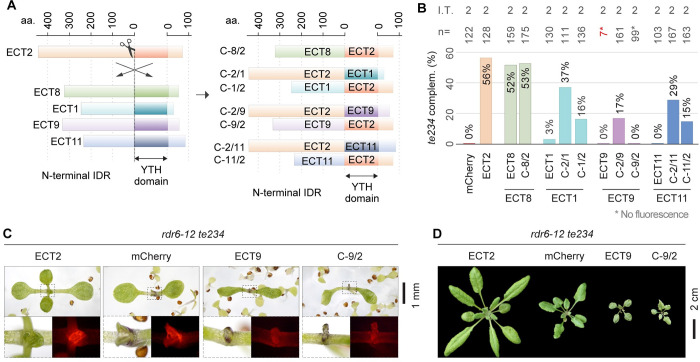
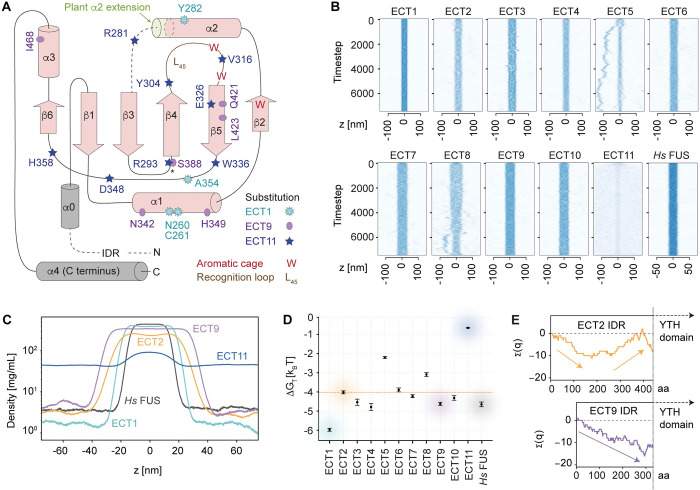
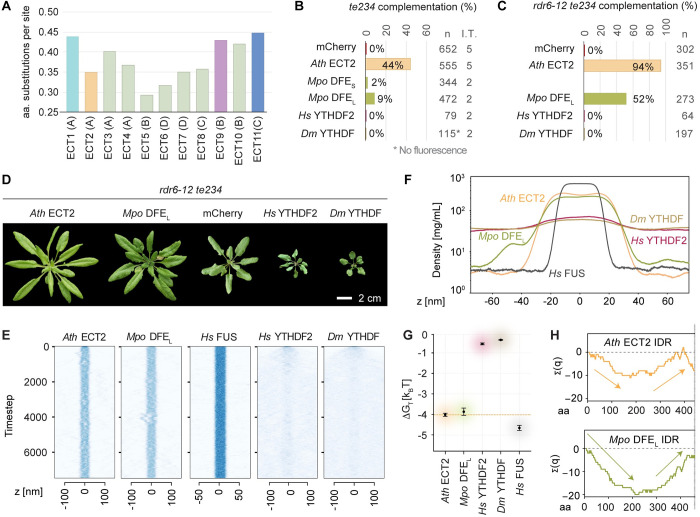
YT521-B homology (YTH) domain proteins act as readers of N6 -methyladenosine (m 6 A) in mRNA. Members of the YTHDF clade determine properties of m 6 A-containing mRNAs in the cytoplasm. Vertebrates encode three YTHDF proteins whose possible functional specialization is debated. In land plants, the YTHDF clade has expanded from one member in basal lineages to eleven so-called EVOLUTIONARILY CONSERVED C-TERMINAL REGION1-11 (ECT1-11) proteins in Arabidopsis thaliana , named after the conserved YTH domain placed behind a long N-terminal intrinsically disordered region (IDR). ECT2 , ECT3 and ECT4 show genetic redundancy in stimulation of primed stem cell division, but the origin and implications of YTHDF expansion in higher plants are unknown, as it is unclear whether it involves acquisition of fundamentally different molecular properties, in particular of their divergent IDRs. Here, we use functional complementation of ect2 / ect3 / ect4 mutants to test whether different YTHDF proteins can perform the same function when similarly expressed in leaf primordia. We show that stimulation of primordial cell division relies on an ancestral molecular function of the m 6 A-YTHDF axis in land plants that is present in bryophytes and is conserved over YTHDF diversification, as it appears in all major clades of YTHDF proteins in flowering plants. Importantly, although our results indicate that the YTH domains of all arabidopsis ECT proteins have m 6 A-binding capacity, lineage-specific neo-functionalization of ECT1, ECT9 and ECT11 happened after late duplication events, and involves altered properties of both the YTH domains, and, especially, of the IDRs. We also identify two biophysical properties recurrent in IDRs of YTHDF proteins able to complement ect2 ect3 ect4 mutants, a clear phase separation propensity and a charge distribution that creates electric dipoles. Human and fly YTHDFs do not have IDRs with this combination of properties and cannot replace ECT2/3/4 function in arabidopsis, perhaps suggesting different molecular activities of YTHDF proteins between major taxa. Author Summary: Regulation of gene expression is essential to life. It ensures correct balancing of cellular activities and the controlled proliferation and differentiation necessary for the development of multicellular organisms. Methylation of adenosines in mRNA (m 6 A) contributes to genetic control, and absence of m 6 A impairs embryo development in plants and vertebrates. m 6 A-dependent regulation can be exerted by a group of cytoplasmic proteins called YTHDFs. Higher plants have many more YTHDFs than animals, but it is unknown whether these many YTHDF proteins carry out fundamentally different or roughly the same molecular functions, as only a small fraction of them have been studied thus far. This work addresses the origin and reasons behind YTHDF expansion during land plant evolution and reveals that most YTHDFs in flowering plants have the same molecular functions that facilitate rapid division of differentiating stem cells. Remarkably, this molecular activity is present in the most basal lineage of land plants and functions similarly across 450 million years of land plant evolution. We also identified a few plant YTHDF proteins with divergent molecular function despite their ability to bind to m 6 A. Our work provides a firm basis for further advances on understanding molecular properties and biological contexts underlying YTHDF diversification.
Overview
The claims and statistics of this paper haven’t been checked yet.
Run the check — free, no account needed. It reads the open-access text and checks the sources it cites.
Integrity signals
Registry
Cites
Statistics
Figures
Verification
Claims the paper makes
The claims and statistics of this paper haven’t been checked yet.
Run the check — free, no account needed. It reads the open-access text and checks the sources it cites.
Self-check
Percentages, sums and reported differences re-computed from the paper’s own numbers.
The self-check needs the paper’s full text.
Citations
Cites
Highly accurate protein structure prediction with AlphaFold
Jumper, J., Evans, R., Pritzel, A., Green, T., Figurnov, M., Ronneberger, O., Tunyasuvunakool, K., Bates, R., Žídek, A., Potapenko, A., et al. (2021) · Nature · doi:10.1038/s41586-021-03819-2 · Cited by 43,764
A structural biology community assessment of AlphaFold2 applications
Akdel, M., Pires, D. E. V., Pardo, E. P., Jänes, J., Zalevsky, A. O., Mészáros, B., Bryant, P., Good, L. L., Laskowski, R. A., Pozzati, G., et al. (2022) · Nature Structural & Molecular Biology · doi:10.1038/s41594-022-00849-w · Cited by 675
Self-citation
Research works printed but not linked: 133
- 10.1105/tpc.108.058883 · DOI
- 10.1126/science.1261417 · DOI
- 10.1038/nature14234 · DOI · Paper page
- 10.1021/ja513080v · DOI
- 10.1038/nature14263 · DOI
- 10.1016/j.tcb.2017.10.001 · DOI
- 10.1038/nature11112 · DOI · Paper page
- 10.1016/S0968-0004(02)02189-8 · DOI
- 10.1038/nature12730 · DOI · Paper page
- 10.1038/cr.2014.153 · DOI
- 10.1073/pnas.1412742111 · DOI
- 10.1093/nar/gku1116 · DOI
- 10.1038/nchembio.1654 · DOI
- 10.1038/cr.2014.152 · DOI
- 10.1074/jbc.M110.104711 · DOI
- 10.1105/tpc.17.00833 · DOI
- 10.1242/dev.189134 · DOI
- 10.1101/gad.340695.120 · DOI · Paper page
- 10.1016/j.molcel.2017.08.003 · DOI
- 10.1186/s13059-018-1436-y · DOI
- 10.1038/s41586-018-0666-1 · DOI · Paper page
- 10.1016/j.celrep.2020.108598 · DOI
- 10.7554/eLife.72377 · DOI
- 10.1038/nature20568 · DOI
- 10.1038/nature20577 · DOI
- 10.1105/tpc.17.00854 · DOI
- 10.1007/s11105-014-0724-2 · DOI
- 10.1038/ncomms12626 · DOI
- 10.1016/j.molcel.2019.02.034 · DOI
- 10.1016/j.celrep.2022.110861 · DOI
- 10.7554/eLife.72375 · DOI
- 10.1016/j.molcel.2020.05.032 · DOI
- 10.1007/s13238-019-00660-2 · DOI
- 10.1038/s41422-019-0210-3 · DOI
- 10.1038/s41586-019-1374-1 · DOI
- 10.1038/s41589-020-0524-y · DOI
- 10.1093/nar/gkac640 · DOI
- 10.7554/eLife.84034 · DOI
- 10.1016/j.cell.2020.05.012 · DOI
- 10.1104/pp.105.065649 · DOI
- 10.1016/j.cell.2016.05.026 · DOI
- 10.1016/j.sbi.2020.09.004 · DOI
- 10.1016/j.molcel.2022.05.029 · DOI
- 10.1016/j.cell.2015.05.014 · DOI · Paper page
- 10.1038/cr.2017.15 · DOI · Paper page
- 10.1038/cr.2017.10 · DOI
- 10.1021/acs.jcim.0c01029 · DOI
- 10.1186/s13059-023-02862-8 · DOI
- 10.1016/j.pbi.2015.05.015 · DOI
- 10.3389/fpls.2012.00048 · DOI
- 10.1016/j.devcel.2016.06.008 · DOI
- 10.1111/nph.14586 · DOI
- 10.1098/rstb.2011.0252 · DOI
- 10.1038/s41586-019-1693-2 · DOI · Paper page
- 10.1111/nph.14975 · DOI
- 10.1016/j.cub.2020.03.048 · DOI
- 10.1038/s41477-020-0618-2 · DOI
- 10.1016/j.cub.2018.01.063 · DOI
- 10.1093/molbev/msab106 · DOI
- 10.1038/s41477-019-0588-4 · DOI
- 10.1074/jbc.M115.680389 · DOI
- 10.1038/s41477-022-01283-y · DOI
- 10.3732/ajb.1200416 · DOI
- 10.1111/tpj.15667 · DOI
- 10.1093/plcell/koac333 · DOI
- 10.1242/dev.128.21.4289 · DOI
- 10.1146/annurev.arplant.51.1.167 · DOI
- 10.1021/acs.biochem.8b01166 · DOI
- 10.1093/nar/gkv1382 · DOI
- 10.1016/S0092-8674(00)80864-8 · DOI
- 10.1016/S0092-8674(00)80863-6 · DOI
- 10.1101/gad.1231804 · DOI
- 10.1016/j.molp.2020.08.001 · DOI
- 10.1093/nar/gkab1061 · DOI · Paper page
- 10.1093/nar/gku340 · DOI
- 10.1093/nar/gkac1065 · DOI
- 10.1073/pnas.2111696118 · DOI
- 10.1073/pnas.2114412118 · DOI
- 10.1016/j.cell.2012.04.017 · DOI · Paper page
- 10.1016/j.cell.2015.07.047 · DOI
- 10.1016/j.celrep.2013.11.017 · DOI
- 10.3390/biom12040561 · DOI
- 10.1073/pnas.1516277113 · DOI
- 10.1016/j.cell.2017.09.030 · DOI
- 10.1007/s11103-006-0041-8 · DOI
- 10.1038/46528 · DOI
- 10.1038/46536 · DOI
- 10.1016/0022-2836(78)90183-3 · DOI
- 10.1038/ncb2902 · DOI
- 10.1101/gad.301036.117 · DOI
- 10.1038/nmeth.4435 · DOI · Paper page
- 10.1016/j.celrep.2018.10.020 · DOI
- 10.1105/tpc.17.00934 · DOI
- 10.7554/eLife.49658 · DOI
- 10.1186/s13059-023-02947-4 · DOI
- 10.1104/pp.19.01156 · DOI
- 10.1101/2023.07.03.547513 · DOI
- 10.1126/sciadv.ade4973 · DOI
- 10.1016/j.tree.2019.08.008 · DOI · Paper page
- 10.1002/ajb2.16175 · DOI
- 10.1073/pnas.97.9.4535 · DOI
- 10.1093/dnares/dsz009 · DOI
- 10.1111/jpy.13321 · DOI
- 10.1126/sageke.2003.38.re7 · DOI
- 10.1104/pp.15.01995 · DOI
- 10.1093/nar/gkr944 · DOI
- 10.1093/database/baac046 · DOI
- 10.1038/s41477-018-0188-8 · DOI
- 10.1093/nar/gkr947 · DOI
- 10.1093/nar/gkt1069 · DOI
- 10.1093/nar/gkh340 · DOI · Paper page
- 10.1186/1471-2105-5-113 · DOI
- 10.1093/bioinformatics/btp033 · DOI
- 10.1093/molbev/msu300 · DOI · Paper page
- 10.1093/molbev/msaa015 · DOI · Paper page
- 10.1093/sysbio/syab010 · DOI
- 10.1098/rspb.2018.1012 · DOI
- 10.1038/nmeth.4285 · DOI · Paper page
- 10.1093/oxfordjournals.molbev.a026201 · DOI · Paper page
- 10.1093/oxfordjournals.molbev.a040317 · DOI
- 10.1093/molbev/msab120 · DOI
- 10.1002/0471142727.mb0321s86 · DOI
- 10.1093/nar/gkl635 · DOI
- 10.1371/journal.pone.0083043 · DOI
- 10.12688/openreseurope.14967.2 · DOI
- 10.1371/journal.pcbi.1005941 · DOI
- 10.1021/acs.jctc.0c01064 · DOI
- 10.1093/nar/gkr1047 · DOI
- 10.1093/nar/gku316 · DOI · Paper page
- 10.1002/pro.3280 · DOI
- 10.1093/nar/gkac993 · DOI
- 10.1016/j.jmb.2004.03.016 · DOI
- 10.1093/molbev/msz312 · DOI
Metadata
- Authors
- Flores-Téllez, D., Tankmar, M. D., von Bülow, S., Chen, J., Lindorff-Larsen, K., Brodersen, P., & Arribas-Hernández, L.
- Affiliations
- University of Copenhagen (DK)
- Corresponding author
- Brodersen, Peter
- ORCID
- Venue
- PLoS Genetics
- Publisher
- openRxiv
- Published
- 2022-10-19
- Volume
- 19
- Issue
- 10
- Pages
- e1010980-e1010980
- ISSN
- 1553-7390 (ISSN-L)
- PMC
- PMC10617740
- OpenAlex
- W4387493067
- Cited by
- 29
- References
- 2
- Citations by year
- 2026: 7 · 2025: 13 · 2024: 7 · 2023: 2
- FWCI
- 4.56
- Type
- journal article
- Language
- en
- Open access
- gold
- doi.org
- Licence
- cc-by
- Locations
- PLoS Genetics (publishedVersion, cc-by)
- bioRxiv (Cold Spring Harbor Laboratory) (acceptedVersion, cc-by-nc-nd)
- PubMed Central (publishedVersion, cc-by)
- PubMed (publishedVersion)
- Research at the University of Copenhagen (University of Copenhagen) (publishedVersion, cc-by)
- DIGITAL.CSIC (Spanish National Research Council (CSIC)) (submittedVersion, cc-by)
- Deposito Digital UFV (Francisco de Vitoria University) (submittedVersion, cc-by-nc-nd)
- DOAJ (DOAJ: Directory of Open Access Journals) (submittedVersion, cc-by-sa)
- Funders
- European Molecular Biology Organization (ALTF 810‐2022)
- Novo Nordisk
- Novo Nordisk Fonden (NNF19OC0054973, NNF18OC0033950)
- Danmarks Frie Forskningsfond (9040-00409B)
- H2020 European Research Council (726417)
- Topics
- Life Sciences › Agricultural and Biological Sciences › Plant Science › Plant Molecular Biology Research
- Life Sciences › Biochemistry, Genetics and Molecular Biology › Molecular Biology › RNA modifications and cancer
- Life Sciences › Biochemistry, Genetics and Molecular Biology › Molecular Biology › RNA Research and Splicing
- Keywords
- N6-methyladenosine, m6A RNA methylation, intrinsically disordered regions, functional diversification, neofunctionalization, gene duplication, functional complementation, leaf primordia, stem cell division, phase separation, electric dipole, Arabidopsis thaliana, bryophytes, YTH domain
- MeSH terms
- Animals, Multigene Family, Humans, RNA, Messenger, Arabidopsis, Arabidopsis Proteins, Intracellular Signaling Peptides and Proteins
About these checks
Registry, retraction, Cites and statistics results are computed, not judged, with one exception: a printed reference that no index lists is read once by a model before it counts as a citation error. Claims are extracted by a model and kept only when their quote appears verbatim in the text; each cited source is then checked, with a model’s help, for whether it says what the claim relies on. Those verdicts can be wrong — read the claim’s quote and the cited source before relying on one.
Statistics and arithmetic are recomputed, not judged.
Confidence bands are shown only for fields calibrated on our annotated test set. None is calibrated yet, so no band is shown.
What counts as a claim ›How we measure confidence ›How we check this ›
Are you an author, or do you see a problem with this page? Request a review
