

Increased levels of eIF2A inhibit translation by sequestering 40S ribosomal subunits
Open accessPreprint — published as 10.1093/nar/gkad683
The DOI matches its Crossref record; 85 of the 85 references it cites were found in a registry or an index.
Abstract
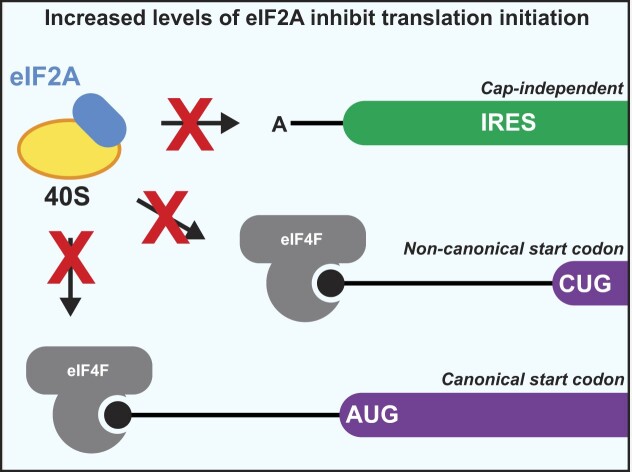
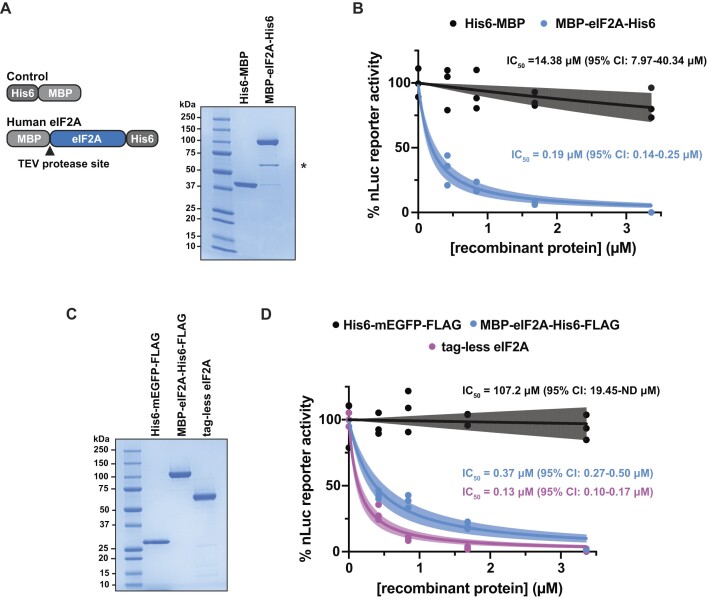
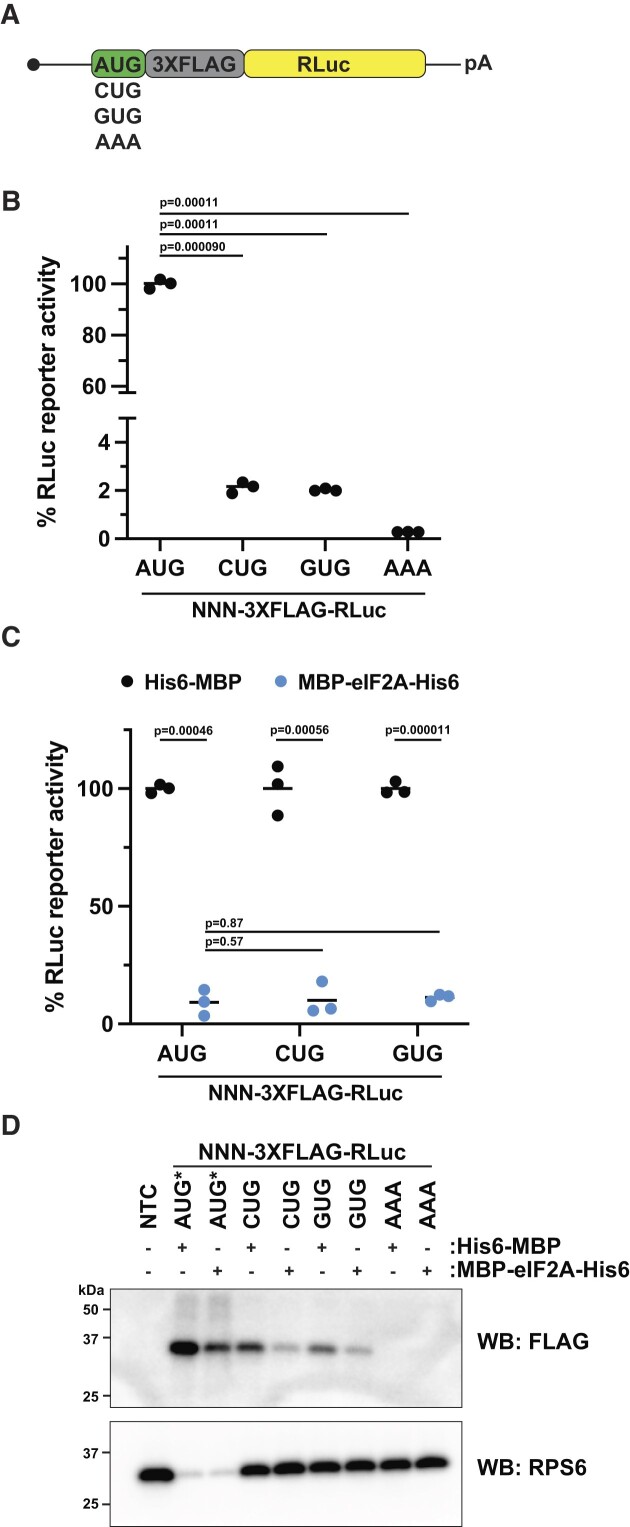
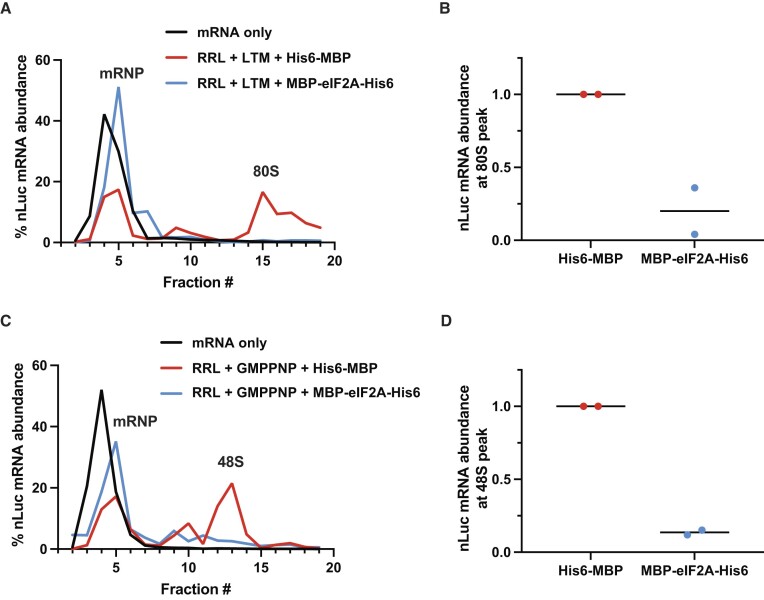
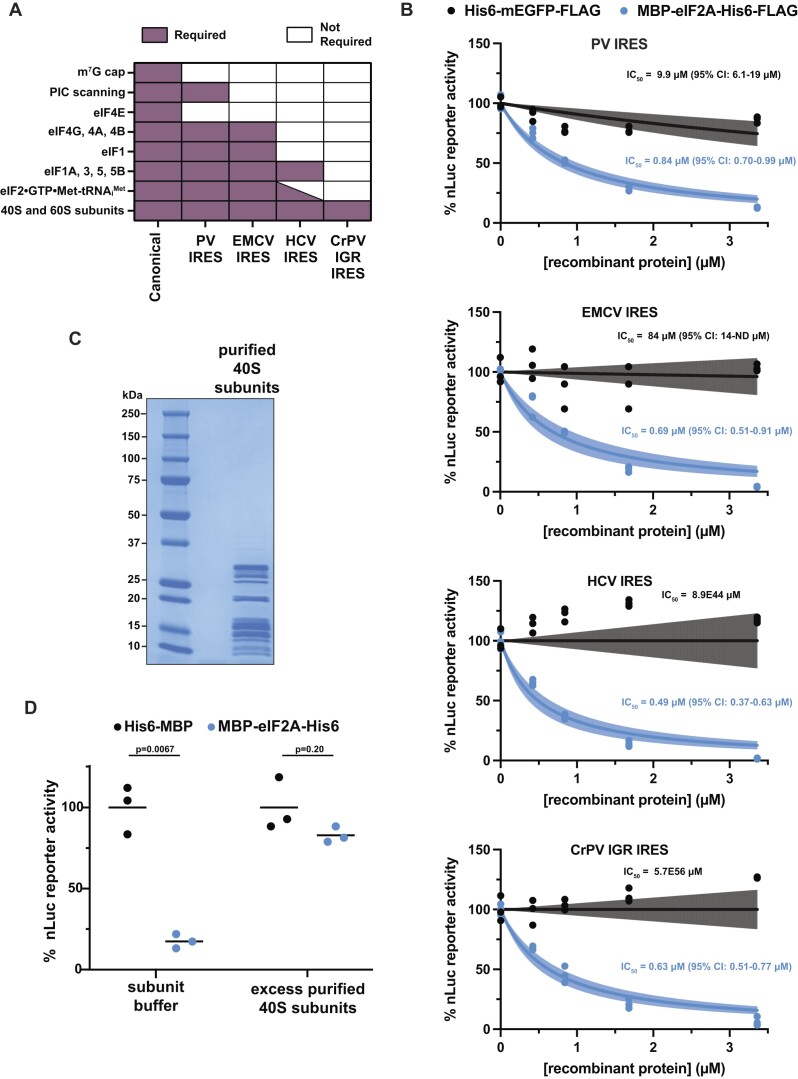
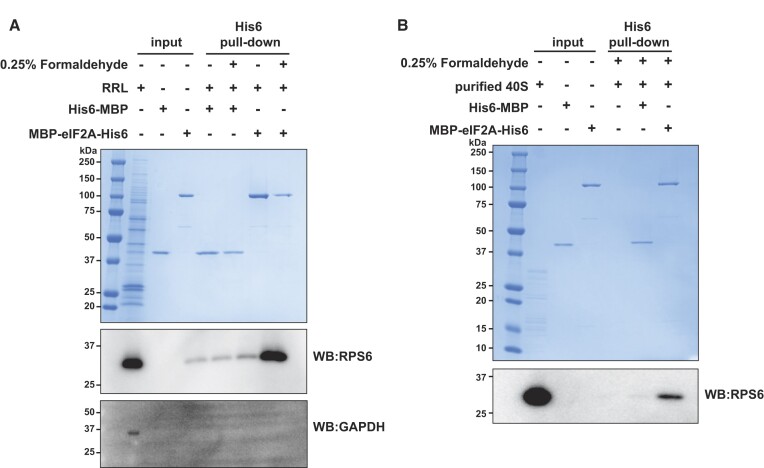
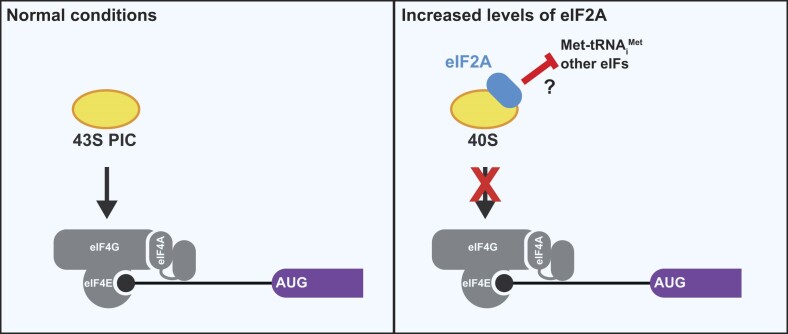
eIF2A was the first eukaryotic initiator tRNA carrier discovered but its exact function has remained enigmatic. Uncharacteristic of translation initiation factors, eIF2A is reported to be non-cytosolic in multiple human cancer cell lines. Attempts to study eIF2A mechanistically have been limited by the inability to achieve high yield of soluble recombinant protein. Here, we developed a purification paradigm that yields ∼360-fold and ∼6,000-fold more recombinant human eIF2A from E. coli and insect cells, respectively, than previous reports. Using a mammalian in vitro translation system, we found that increased levels of recombinant human eIF2A inhibit translation of multiple reporter mRNAs, including those that are translated by cognate and near-cognate start codons, and does so prior to start codon recognition. eIF2A also inhibited translation directed by all four types of cap-independent viral IRESs, including the CrPV IGR IRES that does not require initiation factors or initiator tRNA, suggesting excess eIF2A sequesters 40S subunits. Supplementation with additional 40S subunits prevented eIF2A-mediated inhibition and pull-down assays demonstrated direct binding between recombinant eIF2A and purified 40S subunits. These data support a model that eIF2A must be kept away from the translation machinery to avoid sequestering 40S ribosomal subunits.
Overview
The claims and statistics of this paper haven’t been checked yet.
Free: it reads the open-access text and checks the first 5 claims that cite a source we can check. Create a free account to check every claim.
Integrity signals
Registry
Cites
Statistics
Figures
Verification
Claims the paper makes
The claims and statistics of this paper haven’t been checked yet.
Free: it reads the open-access text and checks the first 5 claims that cite a source we can check. Create a free account to check every claim.
Self-check
Percentages, sums and reported differences re-computed from the paper’s own numbers.
The self-check needs the paper’s full text.
Citations
Cites
Highly accurate protein structure prediction with AlphaFold
Jumper, J., Evans, R., Pritzel, A., Green, T., Figurnov, M., Ronneberger, O., Tunyasuvunakool, K., Bates, R., Žídek, A., Potapenko, A., et al. (2021) · Nature · doi:10.1038/s41586-021-03819-2 · Cited by 43,764
Varadi, M., Anyango, S., Deshpande, M., Nair, S., Natassia, C., Yordanova, G., Yuan, D., Stroe, O., Wood, G., Laydon, A., et al. (2022) · Nucleic Acids Research · doi:10.1093/nar/gkab1061 · Cited by 7,850
A subcellular map of the human proteome
Thul, P. J., Åkesson, L., Wiking, M., Mahdessian, D., Geladaki, A., Ait Blal, H., Alm, T., Asplund, A., Björk, L., Breckels, L. M., et al. (2017) · Science · doi:10.1126/science.aal3321 · Cited by 2,813
The mechanism of eukaryotic translation initiation and principles of its regulation
Jackson, R. J., Hellen, C. U. T., & Pestova, T. V. (2010) · Nature Reviews Molecular Cell Biology · doi:10.1038/nrm2838 · Cited by 2,759
Towards a knowledge-based Human Protein Atlas
Uhlen, M., Oksvold, P., Fagerberg, L., Lundberg, E., Jonasson, K., Forsberg, M., Zwahlen, M., Kampf, C., Wester, K., Hober, S., et al. (2010) · Nature Biotechnology · doi:10.1038/nbt1210-1248 · Cited by 2,440
Translational Control Is Required for the Unfolded Protein Response and In Vivo Glucose Homeostasis
Scheuner, D., Song, B., McEwen, E., Liu, C., Laybutt, R., Gillespie, P., Saunders, T., Bonner-Weir, S., & Kaufman, R. J. (2001) · Molecular Cell · doi:10.1016/s1097-2765(01)00265-9 · Cited by 1,355
Inhibition of eukaryotic translation elongation by cycloheximide and lactimidomycin
Schneider-Poetsch, T., Ju, J., Eyler, D. E., Dang, Y., Bhat, S., Merrick, W. C., Green, R., Shen, B., & Liu, J. O. (2010) · Nature Chemical Biology · doi:10.1038/nchembio.304 · Cited by 1,014
A new system for naming ribosomal proteins
Ban, N., Beckmann, R., Cate, J. H., Dinman, J. D., Dragon, F., Ellis, S. R., Lafontaine, D. L., Lindahl, L., Liljas, A., Lipton, J. M., et al. (2014) · Current Opinion in Structural Biology · doi:10.1016/j.sbi.2014.01.002 · Cited by 568
Role of eIF2α Kinases in Translational Control and Adaptation to Cellular Stress
Wek, R. C. (2018) · Cold Spring Harbor Perspectives in Biology · doi:10.1101/cshperspect.a032870 · Cited by 543
Wang, M., Herrmann, C. J., Simonovic, M., Szklarczyk, D., & von Mering, C. (2015) · PROTEOMICS · doi:10.1002/pmic.201400441 · Cited by 537
Research works printed but not linked: 2
- 1971, Anomalous stimulation of protein synthesis: evidence for translational control in primary cells, Cell Tissue Kinet, 4, 75
- 10.1042/bj3540025 · doi:10.1042/bj3540025
Metadata
- Authors
- Grove, D. J., Levine, D. J., & Kearse, M. G.
- Affiliations
- The Ohio State University (US)
- Corresponding author
- Kearse, Michael G.
- ORCID
- Kearse, Michael G.
- Venue
- Nucleic Acids Research
- Publisher
- openRxiv
- Published
- 2022-11-18
- Volume
- 51
- Issue
- 18
- Pages
- 9983-10000
- ISSN
- 0305-1048 (ISSN-L)
- PMC
- PMC10570035
- OpenAlex
- W4386019841
- Cited by
- 17
- References
- 85
- Citations by year
- 2026: 1 · 2025: 9 · 2024: 4 · 2023: 3
- FWCI
- 1.51
- Type
- journal article
- Language
- en
- Open access
- gold
- doi.org
- Licence
- cc-by
- Locations
- Nucleic Acids Research (publishedVersion, cc-by)
- bioRxiv (Cold Spring Harbor Laboratory) (acceptedVersion)
- PubMed Central (publishedVersion, cc-by)
- PubMed (publishedVersion)
- Funders
- Ohio State University (P30CA016058)
- National Institutes of Health
- National Cancer Institute (P30CA016058)
- National Institute of General Medical Sciences (R00GM126064, R35GM146924)
- Topics
- Life Sciences › Biochemistry, Genetics and Molecular Biology › Molecular Biology › RNA and protein synthesis mechanisms
- Life Sciences › Biochemistry, Genetics and Molecular Biology › Molecular Biology › PI3K/AKT/mTOR signaling in cancer
- Life Sciences › Biochemistry, Genetics and Molecular Biology › Molecular Biology › RNA modifications and cancer
- Keywords
- eIF2A, translation initiation, recombinant protein purification, in vitro translation, internal ribosome entry site, start codon recognition, protein synthesis inhibition
- MeSH terms
- Internal Ribosome Entry Sites, Animals, Humans, Mammals, Peptide Initiation Factors, RNA, Messenger, RNA, Transfer, Met, Protein Biosynthesis, Eukaryotic Initiation Factor-2, Codon, Initiator, Ribosome Subunits, Small, Eukaryotic
About these checks
Registry, retraction, Cites and statistics results are computed, not judged, with one exception: a printed reference that no index lists is read once by a model before it counts as a citation error. Claims are extracted by a model and kept only when their quote appears verbatim in the text; each cited source is then checked, with a model’s help, for whether it says what the claim relies on. Those verdicts can be wrong — read the claim’s quote and the cited source before relying on one.
Statistics and arithmetic are recomputed, not judged.
Confidence bands are shown only for fields calibrated on our annotated test set. None is calibrated yet, so no band is shown.
What counts as a claim ›How we measure confidence ›How we check this ›
Are you an author, or do you see a problem with this page? Request a review
How to cite
Cite CoChat for the checks on this page, and the paper for its own findings.
- This page
- CoChat. (2026). Citation check: Increased levels of eIF2A inhibit translation by sequestering 40S ribosomal subunits. https://app.cochat.ai/papers/10.1101/2022.11.18.517125
- The paper
- Grove, D. J., Levine, D. J., & Kearse, M. G. (2022). Increased levels of eIF2A inhibit translation by sequestering 40S ribosomal subunits. Nucleic Acids Research. https://doi.org/10.1101/2022.11.18.517125
Data sources
Bibliographic data: Semantic Scholar, OpenAlex, Crossref.
Contains information from the Semantic Scholar Academic Graph Datasets, made available under the ODC Attribution License (ODC-BY 1.0).
Semantic Scholar’s data is described in: Kinney, R., et al. (2023). The Semantic Scholar Open Data Platform. arXiv:2301.10140.
