

Evaluating GPT-4-based ChatGPT’s Clinical Potential on the NEJM Quiz
Open accessPreprint — published as 10.1186/s44247-023-00058-5 · Paper page
The DOI matches its Crossref record; 19 of the 19 references it cites were found in a registry or an index.
Abstract
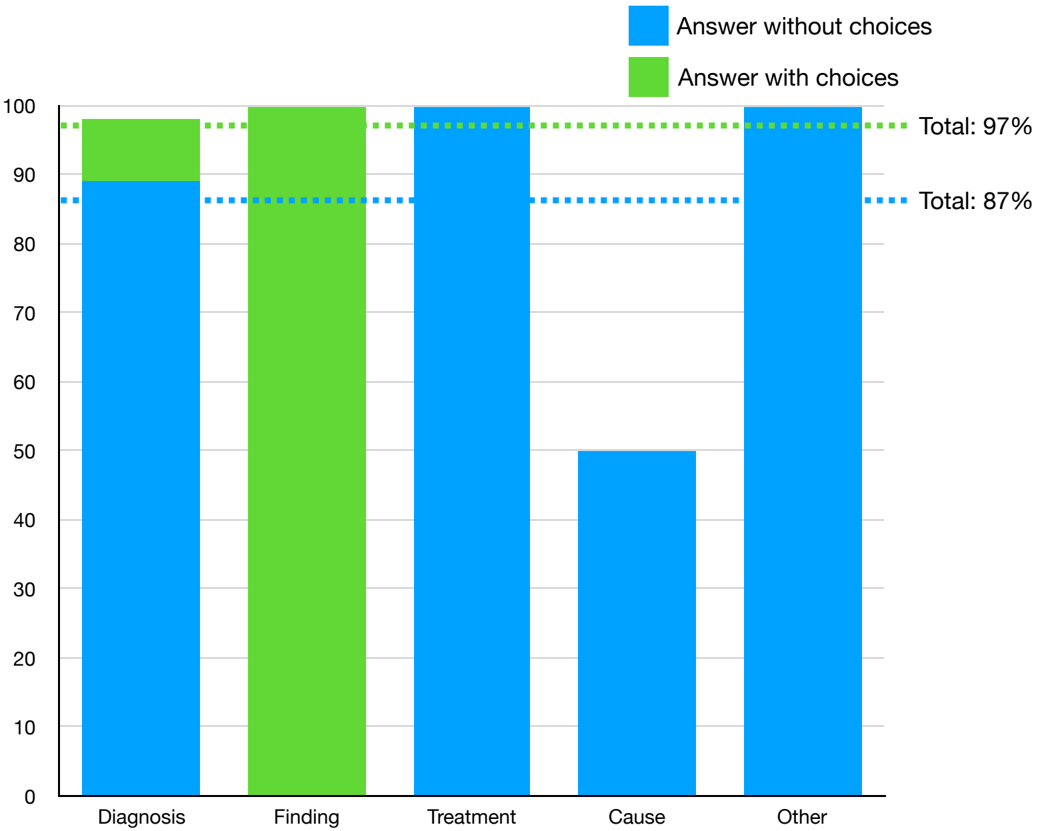
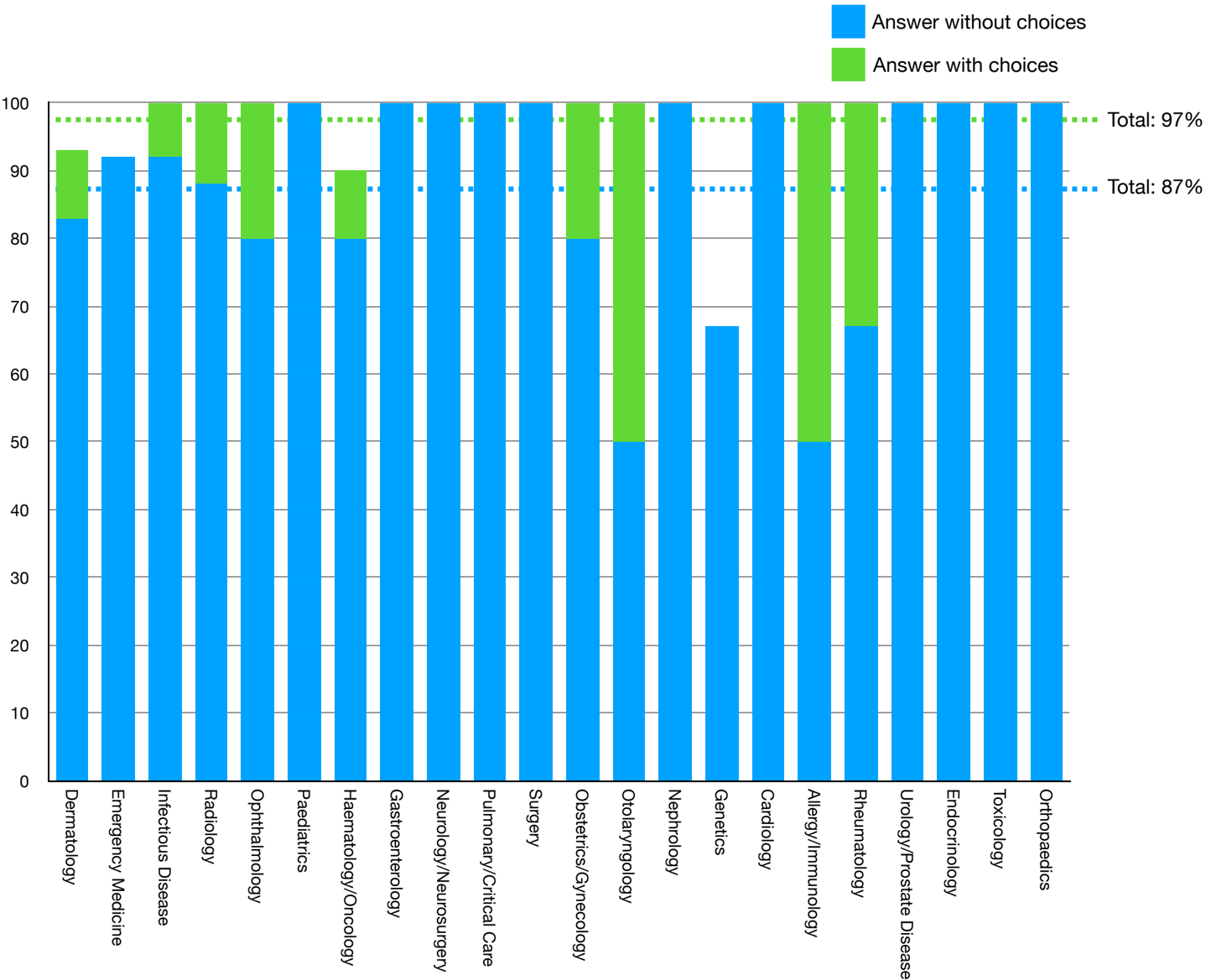
Background: GPT-4-based ChatGPT demonstrates significant potential in various industries; however, its potential clinical applications remain largely unexplored. Methods: We employed the New England Journal of Medicine (NEJM) quiz “Image Challenge” from October 2021 to March 2023 to assess ChatGPT’s clinical capabilities. The quiz, designed for healthcare professionals, tests the ability to analyze clinical scenarios and make appropriate decisions. We evaluated ChatGPT’s performance on the NEJM quiz, analyzing its accuracy rate by questioning type and specialty after excluding quizzes which were impossible to answer without images. The NEJM quiz has five multiple-choice options, but ChatGPT was first asked to answer without choices, and then given the choices to answer afterwards, in order to evaluate the accuracy in both scenarios. Results: ChatGPT achieved an 87% accuracy without choices and a 97% accuracy with choices, after excluding 16 image-based quizzes. Upon analyzing performance by quiz type, ChatGPT excelled in the Diagnosis category, attaining 89% accuracy without choices and 98% with choices. Although other categories featured fewer cases, ChatGPT’s performance remained consistent. It demonstrated strong performance across the majority of medical specialties; however, Genetics had the lowest accuracy at 67%. Conclusion: ChatGPT demonstrates potential for clinical application, suggesting its usefulness in supporting healthcare professionals and enhancing AI-driven healthcare.
Overview
The claims and statistics of this paper haven’t been checked yet.
Free: it reads the open-access text and checks the first 5 claims that cite a source we can check. Create a free account to check every claim.
Integrity signals
Registry
Cites
Statistics
Figures
Verification
Claims the paper makes
The claims and statistics of this paper haven’t been checked yet.
Free: it reads the open-access text and checks the first 5 claims that cite a source we can check. Create a free account to check every claim.
Claims other papers make about this one
Each is checked against this paper’s own text: does it say what the citing paper says it does?
In the citing paper
“The emergence of tools like Chat Generative Pre-trained Transformer (ChatGPT) is expected to greatly change white-collar jobs, and physicians are no exception [120–122].”
From Fairness of artificial intelligence in healthcare: review and recommendations (2024) · cites this paper as [122]
Self-check
Percentages, sums and reported differences re-computed from the paper’s own numbers.
The self-check needs the paper’s full text.
Citations
Cites
Kung, T. H., Cheatham, M., Medenilla, A., Sillos, C., De Leon, L., Elepaño, C., Madriaga, M., Aggabao, R., Diaz-Candido, G., Maningo, J., et al. (2023) · PLOS Digital Health · doi:10.1371/journal.pdig.0000198 · Cited by 4,115
GPTs are GPTs: An Early Look at the Labor Market Impact Potential of Large Language Models
Eloundou, T., Manning, S., Mishkin, P., & Rock, D. (2023) · arXiv · doi:10.48550/arxiv.2303.10130 · Cited by 2,330
Advances in natural language processing
Hirschberg, J., & Manning, C. D. (2015) · Science · doi:10.1126/science.aaa8685 · Cited by 1,712
Sparks of Artificial General Intelligence: Early experiments with GPT-4
Bubeck, S., Chandrasekaran, V., Eldan, R., Gehrke, J., Horvitz, E., Kamar, E., Lee, P., Lee, Y. T., Li, Y., Lundberg, S., et al. (2023) · arXiv · doi:10.48550/arxiv.2303.12712 · Cited by 1,526
STARD 2015: An Updated List of Essential Items for Reporting Diagnostic Accuracy Studies
Bossuyt, P. M., Reitsma, J. B., Bruns, D. E., Gatsonis, C. A., Glasziou, P. P., Irwig, L., Lijmer, J. G., Moher, D., Rennie, D., de Vet, H. C. W., et al. (2015) · Radiology · doi:10.1148/radiol.2015151516 · Cited by 1,337
Eysenbach, G. (2023) · JMIR Medical Education · doi:10.2196/46885 · Cited by 840
Fairness of artificial intelligence in healthcare: review and recommendations
Ueda, D., Kakinuma, T., Fujita, S., Kamagata, K., Fushimi, Y., Ito, R., Matsui, Y., Nozaki, T., Nakaura, T., Fujima, N., et al. (2024) · Japanese Journal of Radiology · doi:10.1007/s11604-023-01474-3 · Cited by 607
Self-citationLecler, A., Duron, L., & Soyer, P. (2023) · Diagnostic and Interventional Imaging · doi:10.1016/j.diii.2023.02.003 · Cited by 385
Hirosawa, T., Harada, Y., Yokose, M., Sakamoto, T., Kawamura, R., & Shimizu, T. (2023) · International Journal of Environmental Research and Public Health · doi:10.3390/ijerph20043378 · Cited by 343
Health intelligence: how artificial intelligence transforms population and personalized health
Shaban-Nejad, A., Michalowski, M., & Buckeridge, D. L. (2018) · npj Digital Medicine · doi:10.1038/s41746-018-0058-9 · Cited by 252
Research works printed but not linked: 2
- Brown TB, Mann B, Ryder N, et al. Language Models are Few-Shot Learners [Internet]. arXiv [cs.CL]. 2020 [cited 2023 Apr 8];1877-901. Available from: https://proceedings.neurips.cc/paper/2020/hash/1457c0d6bfcb4967418bfb8ac142f64a-Abstract.html
- Glover WJ, Li Z, Pachamanova D. The AI-enhanced future of health care administrative task management. NEJM Catal Innov Care Deliv [Internet] Available from: https://catalyst.nejm.org/doi/abs/10.1056/CAT.21.0355 · doi:10.1056/cat.21.0355
Cited by
Fairness of artificial intelligence in healthcare: review and recommendations
Ueda, D., Kakinuma, T., Fujita, S., Kamagata, K., Fushimi, Y., Ito, R., Matsui, Y., Nozaki, T., Nakaura, T., Fujima, N., et al. (2024) · Japanese Journal of Radiology · doi:10.1007/s11604-023-01474-3 · Cited by 607
Self-citationThe application of large language models in medicine: A scoping review
Meng, X., Yan, X., Zhang, K., Liu, D., Cui, X., Yang, Y., Zhang, M., Cao, C., Wang, J., Wang, X., et al. (2024) · iScience · doi:10.1016/j.isci.2024.109713 · Cited by 414
A systematic review of large language model (LLM) evaluations in clinical medicine
Shool, S., Adimi, S., Saboori Amleshi, R., Bitaraf, E., Golpira, R., & Tara, M. (2025) · BMC Medical Informatics and Decision Making · doi:10.1186/s12911-025-02954-4 · Cited by 346
Large language models in medical and healthcare fields: applications, advances, and challenges
Wang, D., & Zhang, S. (2024) · Artificial Intelligence Review · doi:10.1007/s10462-024-10921-0 · Cited by 246
Takita, H., Kabata, D., Walston, S. L., Tatekawa, H., Saito, K., Tsujimoto, Y., Miki, Y., & Ueda, D. (2025) · npj Digital Medicine · doi:10.1038/s41746-025-01543-z · Cited by 203
Self-citationAn evaluation framework for clinical use of large language models in patient interaction tasks
Johri, S., Jeong, J., Tran, B. A., Schlessinger, D. I., Wongvibulsin, S., Barnes, L. A., Zhou, H.-Y., Cai, Z. R., Van Allen, E. M., Kim, D., et al. (2025) · Nature Medicine · doi:10.1038/s41591-024-03328-5 · Cited by 201
Gaber, F., Shaik, M., Allega, F., Bilecz, A. J., Busch, F., Goon, K., Franke, V., & Akalin, A. (2025) · npj Digital Medicine · doi:10.1038/s41746-025-01684-1 · Cited by 165
Luo, X., Tham, Y. C., Giuffrè, M., Ranisch, R., Daher, M., Lam, K., Eriksen, A. V., Hsu, C.-W., Ozaki, A., Moraes, F. Y. D., et al. (2025) · BMJ Evidence-Based Medicine · doi:10.1136/bmjebm-2025-113825 · Cited by 97
Development of Prompt Templates for Large Language Model–Driven Screening in Systematic Reviews
Cao, C., Sang, J., Arora, R., Chen, D., Kloosterman, R., Cecere, M., Gorla, J., Saleh, R., Drennan, I., Teja, B., et al. (2025) · Annals of Internal Medicine · doi:10.7326/annals-24-02189 · Cited by 91
Mitsuyama, Y., Tatekawa, H., Takita, H., Sasaki, F., Tashiro, A., Oue, S., Walston, S. L., Nonomiya, Y., Shintani, A., Miki, Y., et al. (2024) · European Radiology · doi:10.1007/s00330-024-11032-8 · Cited by 62
Self-citationLi, Y., Li, J., He, J., & Tao, C. (2024) · PLoS ONE · doi:10.1371/journal.pone.0300919 · Cited by 73
Horiuchi, D., Tatekawa, H., Oura, T., Oue, S., Walston, S. L., Takita, H., Matsushita, S., Mitsuyama, Y., Shimono, T., Miki, Y., et al. (2024) · Clinical Neuroradiology · doi:10.1007/s00062-024-01426-y · Cited by 81
Self-citationOura, T., Tatekawa, H., Horiuchi, D., Matsushita, S., Takita, H., Atsukawa, N., Mitsuyama, Y., Yoshida, A., Murai, K., Tanaka, R., et al. (2024) · Japanese Journal of Radiology · doi:10.1007/s11604-024-01633-0 · Cited by 48
Self-citationBias Sensitivity in Diagnostic Decision-Making: Comparing ChatGPT with Residents
Schmidt, H. G., Rotgans, J. I., & Mamede, S. (2024) · Journal of General Internal Medicine · doi:10.1007/s11606-024-09177-9 · Cited by 27
Shikino, K., Shimizu, T., Otsuka, Y., Tago, M., Takahashi, H., Watari, T., Sasaki, Y., Iizuka, G., Tamura, H., Nakashima, K., et al. (2024) · JMIR Medical Education · doi:10.2196/58758 · Cited by 29
Self-citationBenchmarking vision-language models for diagnostics in emergency and critical care settings
Kurz, C., Merzhevich, T., Eskofier, B. M., Kather, J. N., & Gmeiner, B. (2025) · npj Digital Medicine · doi:10.1038/s41746-025-01837-2 · Cited by 27
Park, H., Huh, J.-Y., Chae, G., & Choi, M. G. (2024) · PLoS ONE · doi:10.1371/journal.pone.0314136 · Cited by 17
RasPatient Pi: A Low-Cost Customizable LLM-Based Virtual Standardized Patient Simulator
Grévisse, C. (2024) · Communications in computer and information science · doi:10.1007/978-3-031-75147-9_9 · Cited by 12
Ueda, D., Walston, S. L., Takita, H., Mitsuyama, Y., & Miki, Y. (2024) · Japanese Journal of Radiology · doi:10.1007/s11604-024-01716-y · Cited by 9
Self-citationHoriuchi, D., Tatekawa, H., Oura, T., Oue, S., Walston, S. L., Takita, H., Matsushita, S., Mitsuyama, Y., Shimono, T., Miki, Y., et al. (2023) · medRxiv · doi:10.1101/2023.08.28.23294607 · Cited by 9
Self-citationAssessing the research landscape and clinical utility of large language models: A scoping reviewPreprint
Park, Y., Pillai, A., Deng, J., Guo, E., Gupta, M., Paget, M., & Naugler, C. T. (2023) · Research Square · doi:10.21203/rs.3.rs-3472000/v1 · Cited by 8
A systematic review on the generative AI applications in human medical genetics
Changalidis, A. I., Barbitoff, Y. A., Nasykhova, Y. A., & Glotov, A. S. (2026) · Frontiers in Genetics · doi:10.3389/fgene.2025.1694070 · Cited by 9
Christopher, C. M., Pathak, N., Babar, Z., & Shrestha, S. (2025) · Aging Medicine · doi:10.1002/agm2.70051 · Cited by 6
Naeem, A., Khan, O. A., Baqir, S. M., Jana, K. R., Shankar, P., Kaur, A., Zaaya, M., Sajid, F., Mohsin, F., Boadla, M. R., et al. (2025) · Journal of Clinical Medicine · doi:10.3390/jcm14041131 · Cited by 6
Wang, T.-H., Jheng, J.-C., Tseng, Y.-T., Chen, L., & Chen, Y. (2025) · Journal of the Chinese Medical Association · doi:10.1097/jcma.0000000000001273 · Cited by 6
Zhou, Y., Wang, W., Wang, P., & Hu, K. (2026) · Frontiers in Medicine · doi:10.3389/fmed.2025.1709413 · Cited by 4
IA en santé : guide pour l’interniste averti
Barba, T., Robert, M., & Hot, A. (2025) · La Revue de Médecine Interne · doi:10.1016/j.revmed.2025.02.002 · Cited by 6
Les Printemps de la Médecine Interne : l’intelligence artificielle face aux experts internistes
Albaladejo, A., Lorleac’h, A., & Allain, J. (2024) · La Revue de Médecine Interne · doi:10.1016/j.revmed.2024.01.012 · Cited by 6
Zhou, Y., Si, M., & Doll, J. (2024) · Communications in computer and information science · doi:10.1007/978-3-031-78561-0_17 · Cited by 2
Yin, C., Sun, X., Dai, A., Ye, X., Lu, Y., Wang, W., Chen, Y., Jiang, H., Yu, J., Chong, S., et al. (2026) · APL Bioengineering · doi:10.1063/5.0299327 · Cited by 2
Leveraging Large Language Models in Healthcare: From Speech Documentation to Conversational Agents
Winkler, C. (2026) · Springer eBooks · doi:10.1007/978-3-032-16837-5_16 · Cited by 2
Agrawal, A., Praveen, Aakash, A., Wajid, M. A., & Bhattacharya, P. (2025) · Studies in computational intelligence · doi:10.1007/978-981-95-2129-6_6 · Cited by 1
Revolutionizing sentiment analysis with generative AI: techniques, trends, and challenges
Mamun, R., Sadman, S., Nabil, H. R., Mridha, M. F., & Kabir, M. (2026) · Multimedia tools and applications · doi:10.1007/s11042-026-21390-8
da Silva, A. R. S., Schwingel, D., de Aquino, S. R., de Brito, R. J. V. C., Silva, M. D. O., Fernandes, F. E. C. V., da Silva, A. A. M., Shiosaki, R. K., de Carvalho, P. G. S., Gonçalves, R. F., et al. (2026) · Healthcare · doi:10.3390/healthcare14101385 · Cited by 1
Ram, P., Hong, N., Xu, H., & Jiang, X. (2024) · IEEE International Conference on Healthcare Informatics (ICHI) · doi:10.1109/ichi61247.2024.00048 · Cited by 1
Ishaque, A. H., Boutet, A., Hiremath, S. B., Mullarkey, M. P., Peris‐Celda, M., & Zadeh, G. M. (2025) · medRxiv · doi:10.1101/2025.04.22.25326204 · Cited by 1
Kim, S., Kim, D., Shin, H., Kim, J., & Yoon, D. (2024) · doi:10.2196/preprints.58331
Aldwean, A., & Tenney, D. (2024) · doi:10.18260/1-2--45771 · Cited by 1
Gürsel, B. E., Öngen, G., & Sağlam, D. (2025) · Journal of Contemporary Medicine · doi:10.16899/jcm.1626433
Scholz, S., Wüchner-Fuchs, M., & Höller, K. (2026) · Springer eBooks · doi:10.1007/978-3-032-16837-5 · Cited by 1
Insights in Human and Medical Genomics 2024
Freidin, M. B., & Roach, J. C. (2026) · Frontiers research topics · doi:10.3389/978-2-8325-7660-1
Xu, L., Zhao, W., Qin, Y., & Wang, J. (2026) · Journal of Medical Systems · doi:10.1007/s10916-026-02372-7
DBEE: Dual-Path Biomedical Event Extraction with Large Language Model
Zeng, J., Wang, J., Zhang, W., Wang, Y., Zhou, Y., Wu, Y., Zhu, L., Ruan, T., & Liu, J. (2026) · Lecture notes in computer science · doi:10.1007/978-981-92-0378-9_10
da Silva, A. R. S., Schwingel, D., de Aquino, S. R., Santos, A. D. C., Francisco, H. B., Ferreira, L. A., Dantas, J. A. R., Silva, M. D. O., de Carvalho, P. G. S., Gonçalves, R. F., et al. (2026) · Artificial Intelligence in Health · doi:10.36922/aih026190041
Akinwumi, P. O., Qian, M., Babatope, O. A., Ogunleye, R. O., & Olorunsogbon, T. A. (2026) · Research Square · doi:10.21203/rs.3.rs-9885996/v1
The Role of Laboratory and Radiology Specialists in Diagnostic Accuracy: A Comprehensive Review
al., S. M. T. E. M. E. (2024) · Letters in High Energy Physics
Alalman, O., Scheyerer, M. J., Syed, W., Ghandour, M. A., Hermasch, M. A., Beyersdorf, C., Mahmoud, M. A., Neuerburg, C., Kabir, K., & Mert, Ü. (2026) · Journal of Clinical Medicine · doi:10.3390/jcm15207944
Metadata
- Authors
- Ueda, D., Walston, S. L., Matsumoto, T., Deguchi, R., Tatekawa, H., & Miki, Y.
- Affiliations
- Center for Health Science Innovation, Osaka Metropolitan University (JP)
- Osaka Metropolitan University (JP)
- Corresponding author
- Ueda, Daiju
- Venue
- BMC Digital Health
- Publisher
- openRxiv
- Published
- 2023-05-05
- Volume
- 2
- Issue
- 1
- ISSN
- 2731-684X (ISSN-L)
- OpenAlex
- W4390719175
- Cited by
- 45
- References
- 17
- Citations by year
- 2026: 10 · 2025: 14 · 2024: 16 · 2023: 5
- FWCI
- 3.74
- Type
- journal article
- Language
- en
- Open access
- gold
- doi.org
- Licence
- cc-by
- Locations
- BMC Digital Health (publishedVersion, cc-by)
- medRxiv (acceptedVersion, cc-by)
- DOAJ (DOAJ: Directory of Open Access Journals) (submittedVersion, cc-by-sa)
- Topics
- Health Sciences › Medicine › Health Informatics › Artificial Intelligence in Healthcare and Education
- Health Sciences › Health Professions › Health Information Management › Artificial Intelligence in Healthcare
- Physical Sciences › Computer Science › Artificial Intelligence › Machine Learning in Healthcare
- Keywords
- ChatGPT, GPT-4, large language models, clinical decision support, diagnosis, differential diagnosis, AI accuracy evaluation, medical specialties, multiple-choice questions
About these checks
Registry, retraction, Cites and statistics results are computed, not judged, with one exception: a printed reference that no index lists is read once by a model before it counts as a citation error. Claims are extracted by a model and kept only when their quote appears verbatim in the text; each cited source is then checked, with a model’s help, for whether it says what the claim relies on. Those verdicts can be wrong — read the claim’s quote and the cited source before relying on one.
Statistics and arithmetic are recomputed, not judged.
Confidence bands are shown only for fields calibrated on our annotated test set. None is calibrated yet, so no band is shown.
What counts as a claim ›How we measure confidence ›How we check this ›
Are you an author, or do you see a problem with this page? Request a review
Data sources
Bibliographic data: Semantic Scholar, OpenAlex, Crossref.
Contains information from the Semantic Scholar Academic Graph Datasets, made available under the ODC Attribution License (ODC-BY 1.0).
Semantic Scholar’s data is described in: Kinney, R., et al. (2023). The Semantic Scholar Open Data Platform. arXiv:2301.10140.
