PreprintCited by 43interferon and immune responsesInvertebrate Immune Response MechanismsImmune Response and Inflammation

The DOI matches its Crossref record; 1 of the 1 references it cites were found in a registry or an index.

Eukaryotic antiviral immune proteins arose via convergence, horizontal transfer, and ancient inheritance

Open access

Preprint — published as 10.1371/journal.pbio.3002436 · Paper page

Abstract

Animals use a variety of cell-autonomous innate immune proteins to detect viral infections and prevent replication. Recent studies have discovered that a subset of mammalian antiviral proteins have homology to anti-phage defense proteins in bacteria, implying that there are aspects of innate immunity that are shared across the Tree of Life. While the majority of these studies have focused on characterizing the diversity and biochemical functions of the bacterial proteins, the evolutionary relationships between animal and bacterial proteins are less clear. This ambiguity is partly due to the long evolutionary distances separating animal and bacterial proteins, which obscures their relationships. Here, we tackle this problem for three innate immune families (CD-NTases [including cGAS], STINGs, and Viperins) by deeply sampling protein diversity across eukaryotes. We find that Viperins and OAS family CD-NTases are truly ancient immune proteins, likely inherited since the last eukaryotic common ancestor and possibly longer. In contrast, we find other immune proteins that arose via at least four independent events of horizontal gene transfer (HGT) from bacteria. Two of these events allowed algae to acquire new bacterial viperins, while two more HGT events gave rise to distinct superfamilies of eukaryotic CD-NTases: the Mab21 superfamily (containing cGAS) which has diversified via a series of animal-specific duplications, and a previously undefined eSMODS superfamily, which more closely resembles bacterial CD-NTases. Finally, we found that cGAS and STING proteins have substantially different histories, with STINGs arising via convergent domain shuffling in bacteria and eukaryotes. Overall, our findings paint a picture of eukaryotic innate immunity as highly dynamic, where eukaryotes build upon their ancient antiviral repertoires through the reuse of protein domains and by repeatedly sampling a rich reservoir of bacterial anti-phage genes.

Overview

The claims and statistics of this paper haven’t been checked yet.

Run the check — free, no account needed. It reads the open-access text and checks the sources it cites.

A few free checks a day · papers already verified open instantly · results are public

Integrity signals

Registry

Crossref · 10.1101/2023.06.27.546753

Cites

1 of 1 references verified0 citation errors · 0 not checkable

Statistics

Figures

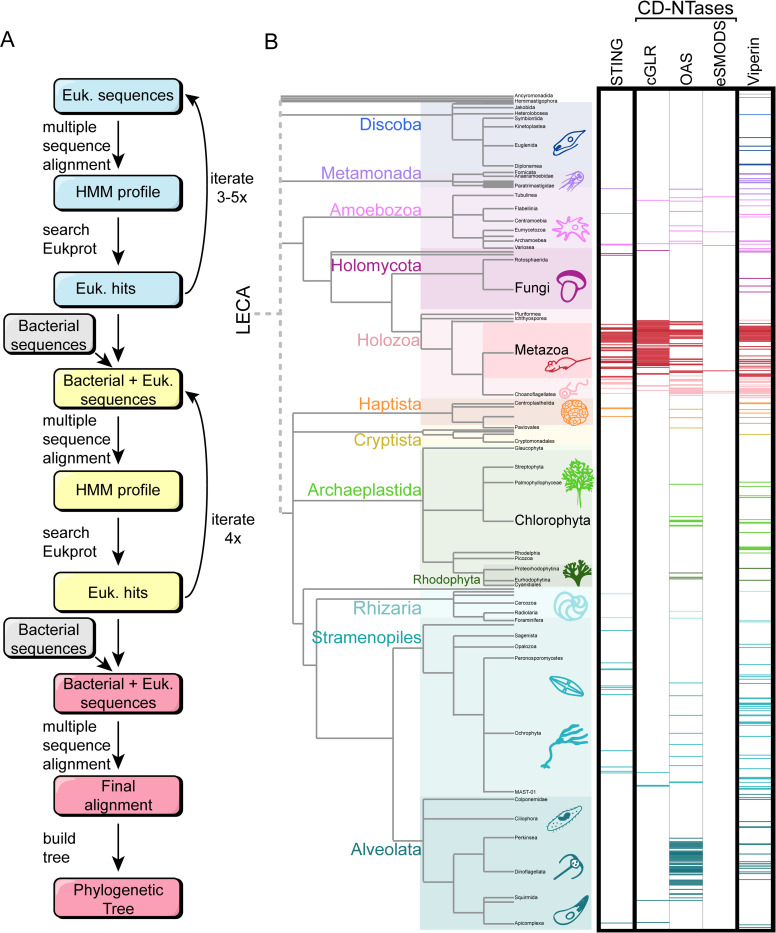
Fig 1 HMM searches to find homologs across the eukaryotic Tree of Life. (A) A schematic of the HMM search process. Starting from initial, animal-dominated HMM profiles for each protein family, we used iterative HMM searches of the EukProt database to generate pan-eukaryotic HMMs. These were combined with bacterial sequences to enable discovery of bacteria-like homologs in eukaryotes. Each set of searches was repeated until few or no additional eukaryotic sequences were recovered which was between 3 and 5 times in all cases. (B) Phylogenetic tree of eukaryotes, with major supergroups color coded. The height of the colored rectangles for each group is proportional to its species representation in EukProt. Horizontal, colored bars mark each eukaryotic species in which we found homologs of STINGs, CD-NTases, or viperins. White space indicates species where we searched but did not recover any homologs. The CD-NTase hits are divided into the 3 eukaryotic superfamilies, defined in Fig 2. Individual data are available in S1 File. CD-NTase, cGAS-DncV-like nucleotidyltransferase; HMM, hidden Markov model; STING, Stimulator of Interferon Genes.
Fig 1 HMM searches to find homologs across the eukaryotic Tree of Life. (A) A schematic of the HMM search process. Starting from initial, animal-dominated HMM profiles for each protein family, we used iterative HMM searches of the EukProt database to generate pan-eukaryotic HMMs. These were combined with bacterial sequences to enable discovery of bacteria-like homologs in eukaryotes. Each set of searches was repeated until few or no additional eukaryotic sequences were recovered which was between 3 and 5 times in all cases. (B) Phylogenetic tree of eukaryotes, with major supergroups color coded. The height of the colored rectangles for each group is proportional to its species representation in EukProt. Horizontal, colored bars mark each eukaryotic species in which we found homologs of STINGs, CD-NTases, or viperins. White space indicates species where we searched but did not recover any homologs. The CD-NTase hits are divided into the 3 eukaryotic superfamilies, defined in Fig 2. Individual data are available in S1 File. CD-NTase, cGAS-DncV-like nucleotidyltransferase; HMM, hidden Markov model; STING, Stimulator of Interferon Genes.CC BY · PubMed Central
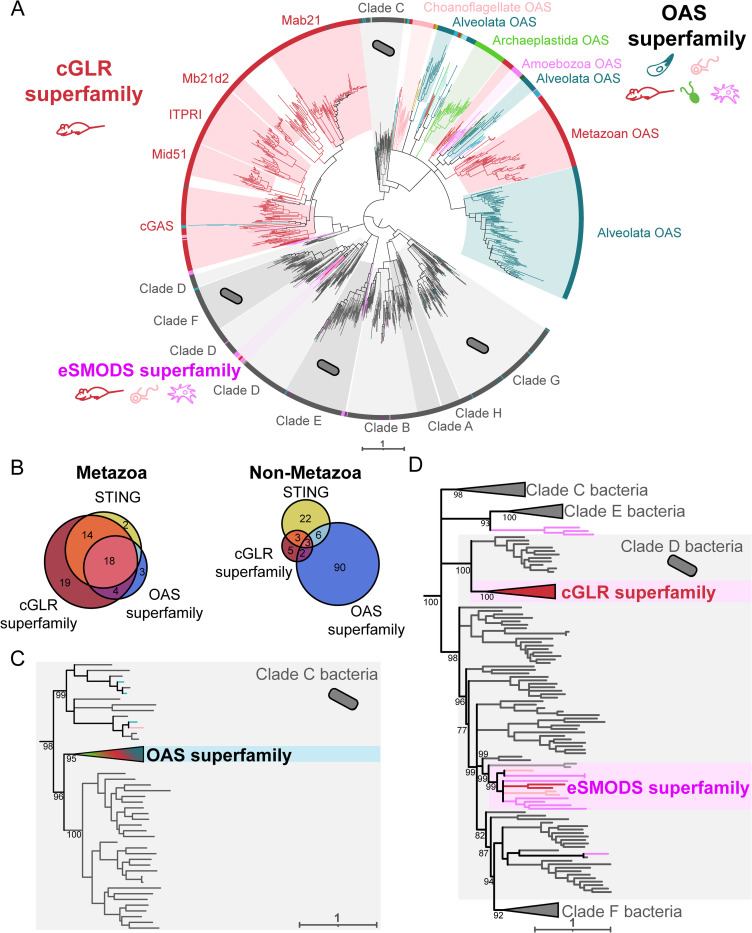
Fig 2 Independent HGT events gave rise to multiple CD-NTase superfamilies. (A) Maximum likelihood phylogenetic tree generated by IQtree of CD-NTases spanning eukaryotic and bacterial diversity. The cGLR superfamily (red, top left) is largely an animal-specific innovation, with many paralogs including cGAS. In contrast, most other eukaryotic lineages encode CD-NTases from the OAS superfamily (multicolor, top right). The relatively small eSMODS superfamily (pink, bottom left) likely arose from a recent HGT between clade D bacteria and eukaryotes. Bacterial CD-NTase sequences shown in gray. Eukaryotic sequences are colored according to eukaryotic supergroup as in Fig 1B. Tree is arbitrarily rooted on a branch separating bacterial clades A, B, G, and H from the rest of the bacterial CD-NTases. (B) Venn diagrams showing the number of species where we detected at least 1 STING, cGLR, and/or OAS homolog, either within Metazoa (left) or in non-metazoan eukaryotes (right). (C) Magnification of the CD-NTase phylogenetic tree in (A), showing the region where the OAS superfamily branches within clade C bacterial CD-NTases (gray branches). (D) Magnification showing clade D CD-NTases (gray branches), which have been horizontally transferred into eukaryotes multiple times, giving rise to both the cGLR and the eSMODS superfamilies. Ultrafast bootstraps determined by IQtree shown at key nodes. See S4 Fig for full CD-NTase phylogenetic tree. Underlying Newick file is included in S2 File. Additional information on which species encode CD-NTases of a given homolog (Fig 2B) can be found in S1 File. CD-NTase, cGAS-DncV-like nucleotidyltransferase; cGAS, cyclic GMP-AMP synthase; HGT, horizontal gene transfer; STING, Stimulator of Interferon Genes.
Fig 2 Independent HGT events gave rise to multiple CD-NTase superfamilies. (A) Maximum likelihood phylogenetic tree generated by IQtree of CD-NTases spanning eukaryotic and bacterial diversity. The cGLR superfamily (red, top left) is largely an animal-specific innovation, with many paralogs including cGAS. In contrast, most other eukaryotic lineages encode CD-NTases from the OAS superfamily (multicolor, top right). The relatively small eSMODS superfamily (pink, bottom left) likely arose from a recent HGT between clade D bacteria and eukaryotes. Bacterial CD-NTase sequences shown in gray. Eukaryotic sequences are colored according to eukaryotic supergroup as in Fig 1B. Tree is arbitrarily rooted on a branch separating bacterial clades A, B, G, and H from the rest of the bacterial CD-NTases. (B) Venn diagrams showing the number of species where we detected at least 1 STING, cGLR, and/or OAS homolog, either within Metazoa (left) or in non-metazoan eukaryotes (right). (C) Magnification of the CD-NTase phylogenetic tree in (A), showing the region where the OAS superfamily branches within clade C bacterial CD-NTases (gray branches). (D) Magnification showing clade D CD-NTases (gray branches), which have been horizontally transferred into eukaryotes multiple times, giving rise to both the cGLR and the eSMODS superfamilies. Ultrafast bootstraps determined by IQtree shown at key nodes. See S4 Fig for full CD-NTase phylogenetic tree. Underlying Newick file is included in S2 File. Additional information on which species encode CD-NTases of a given homolog (Fig 2B) can be found in S1 File. CD-NTase, cGAS-DncV-like nucleotidyltransferase; cGAS, cyclic GMP-AMP synthase; HGT, horizontal gene transfer; STING, Stimulator of Interferon Genes.CC BY · PubMed Central
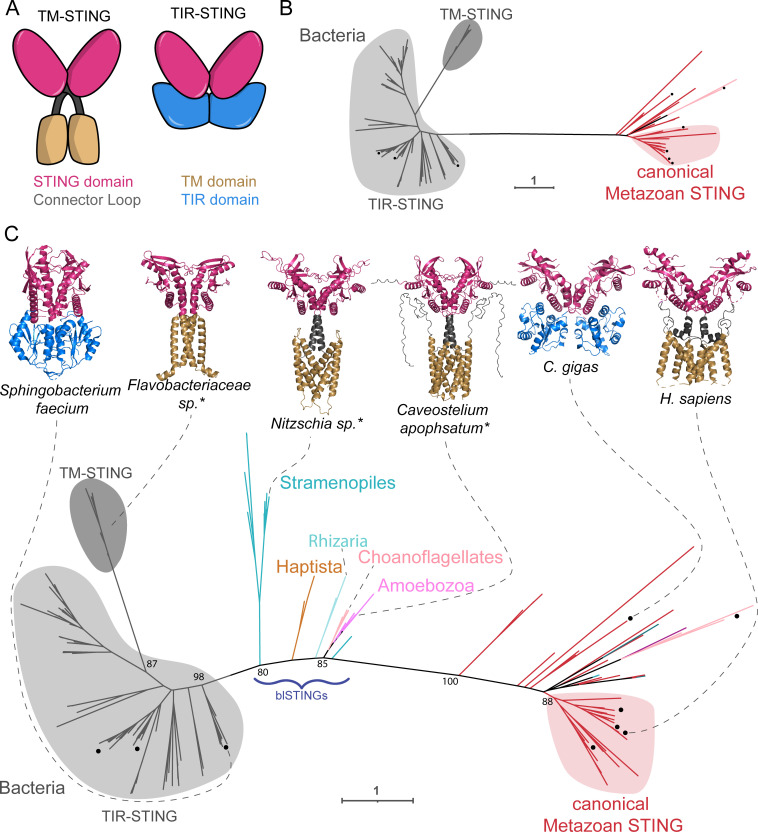
Fig 3 Diverse eukaryotic STING proteins bridge the gap between metazoans and bacteria. (A) Graphical depiction of common domain architectures of STING proteins. (B) Maximum likelihood unrooted phylogenetic tree of STING domains from Metazoa and bacteria, which are separated by 1 long branch. Black dot (•) indicates proteins that have been previously experimentally characterized. Bacterial sequences are in gray and animal sequences are in red. (C) Maximum likelihood unrooted phylogenetic tree of hits from iterative HMM searches for diverse eukaryotic STING domains. The STING domains from blSTINGs from diverse eukaryotes break up the long branch between bacterial and animal STINGs. Structures of the indicated STING proteins are shown above, with those predicted by AlphaFold indicated by an asterisk. Homologs with X-ray crystal structures are from [3,87]. Two domain architectures exist in bacteria and eukaryotes (STING linked to a TIR domain and STING linked to a transmembrane domain), each of which have evolved convergently through domain shuffling. Ultrafast bootstraps determined by IQtree shown at key nodes. Eukaryotic sequences are colored according to the eukaryotic group as in Fig 1B. See S5 Fig for full STING phylogenetic tree. Underlying Newick files are included in Supporting information (S3 File and S4 File). AlphaFold predicted structures are also included in the Supporting information (S6 File, S7 File, and S8 File). blSTING, bacteria-like STING; HMM, hidden Markov model; STING, Stimulator of Interferon Genes.
Fig 3 Diverse eukaryotic STING proteins bridge the gap between metazoans and bacteria. (A) Graphical depiction of common domain architectures of STING proteins. (B) Maximum likelihood unrooted phylogenetic tree of STING domains from Metazoa and bacteria, which are separated by 1 long branch. Black dot (•) indicates proteins that have been previously experimentally characterized. Bacterial sequences are in gray and animal sequences are in red. (C) Maximum likelihood unrooted phylogenetic tree of hits from iterative HMM searches for diverse eukaryotic STING domains. The STING domains from blSTINGs from diverse eukaryotes break up the long branch between bacterial and animal STINGs. Structures of the indicated STING proteins are shown above, with those predicted by AlphaFold indicated by an asterisk. Homologs with X-ray crystal structures are from [3,87]. Two domain architectures exist in bacteria and eukaryotes (STING linked to a TIR domain and STING linked to a transmembrane domain), each of which have evolved convergently through domain shuffling. Ultrafast bootstraps determined by IQtree shown at key nodes. Eukaryotic sequences are colored according to the eukaryotic group as in Fig 1B. See S5 Fig for full STING phylogenetic tree. Underlying Newick files are included in Supporting information (S3 File and S4 File). AlphaFold predicted structures are also included in the Supporting information (S6 File, S7 File, and S8 File). blSTING, bacteria-like STING; HMM, hidden Markov model; STING, Stimulator of Interferon Genes.CC BY · PubMed Central
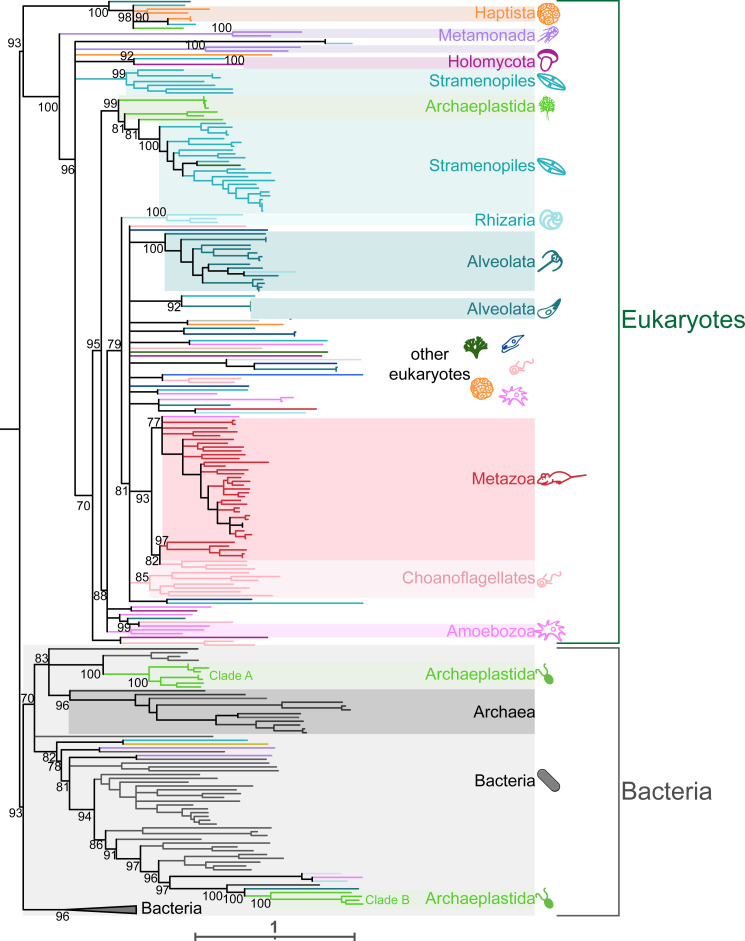
Fig 4 Viperin is a deeply conserved innate immune module. Maximum likelihood phylogenetic tree generated by IQtree of viperins from eukaryotes, bacteria, and archaea. All major eukaryotic supergroups have at least 2 species that encode a viperin homolog (colored supergroups). Eukaryotic sequences are colored according to eukaryotic group as in Fig 1B. Bacterial viperin sequences shown in gray and archaeal sequences in dark gray. There are 2 clades of Chloroplastida (a group within Archaeplastida) sequences that branch robustly (>80 ultrafast bootstrap value) within the bacteria clade. Ultrafast bootstraps determined by IQtree shown at key nodes. Tree is arbitrarily rooted between the major eukaryotic and bacterial clades. See S6 Fig for fully annotated viperin phylogenetic tree. Underlying Newick file is included in S8 File under Supporting information.
Fig 4 Viperin is a deeply conserved innate immune module. Maximum likelihood phylogenetic tree generated by IQtree of viperins from eukaryotes, bacteria, and archaea. All major eukaryotic supergroups have at least 2 species that encode a viperin homolog (colored supergroups). Eukaryotic sequences are colored according to eukaryotic group as in Fig 1B. Bacterial viperin sequences shown in gray and archaeal sequences in dark gray. There are 2 clades of Chloroplastida (a group within Archaeplastida) sequences that branch robustly (>80 ultrafast bootstrap value) within the bacteria clade. Ultrafast bootstraps determined by IQtree shown at key nodes. Tree is arbitrarily rooted between the major eukaryotic and bacterial clades. See S6 Fig for fully annotated viperin phylogenetic tree. Underlying Newick file is included in S8 File under Supporting information.CC BY · PubMed Central
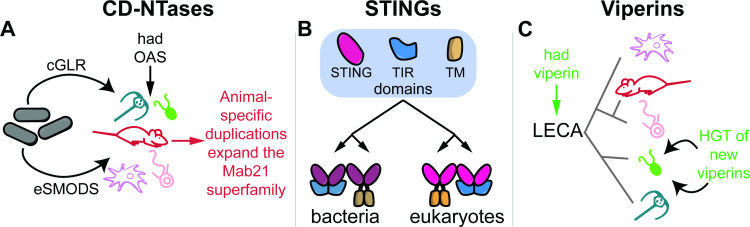
Fig 5 Proposed model of evolutionary history of CD-NTases, STING, and viperin. Summary of the proposed evolutionary history of each innate immune gene family. (A) We define 2 distinct superfamilies of CD-NTases that likely arose from bacteria–eukaryote HGT: eSMODS and cGLRs. Within the cGLR superfamily (which contains cGAS), a number of animal-specific duplications gave rise to numerous paralogs. The OAS superfamily of CD-NTases are abundant across diverse eukaryotic taxa and were likely present in the LECA. (B) Drawing on a shared ancient repertoire of protein domains that includes STING, TIR, and transmembrane (TM) domains, bacteria and eukaryotes have convergently evolved similar STING proteins through domain shuffling. (C) Viperins are widespread across the eukaryotic tree and likely were present in the LECA. In addition, 2 sets of recent HGT events from bacteria have equipped algal species with new viperins. CD-NTase, cGAS-DncV-like nucleotidyltransferase; HGT, horizontal gene transfer; LECA, last eukaryotic common ancestor; STING, Stimulator of Interferon Genes.
Fig 5 Proposed model of evolutionary history of CD-NTases, STING, and viperin. Summary of the proposed evolutionary history of each innate immune gene family. (A) We define 2 distinct superfamilies of CD-NTases that likely arose from bacteria–eukaryote HGT: eSMODS and cGLRs. Within the cGLR superfamily (which contains cGAS), a number of animal-specific duplications gave rise to numerous paralogs. The OAS superfamily of CD-NTases are abundant across diverse eukaryotic taxa and were likely present in the LECA. (B) Drawing on a shared ancient repertoire of protein domains that includes STING, TIR, and transmembrane (TM) domains, bacteria and eukaryotes have convergently evolved similar STING proteins through domain shuffling. (C) Viperins are widespread across the eukaryotic tree and likely were present in the LECA. In addition, 2 sets of recent HGT events from bacteria have equipped algal species with new viperins. CD-NTase, cGAS-DncV-like nucleotidyltransferase; HGT, horizontal gene transfer; LECA, last eukaryotic common ancestor; STING, Stimulator of Interferon Genes.CC BY · PubMed Central

Verification

Claims the paper makes

The claims and statistics of this paper haven’t been checked yet.

Run the check — free, no account needed. It reads the open-access text and checks the sources it cites.

A few free checks a day · papers already verified open instantly · results are public

Self-check

Percentages, sums and reported differences re-computed from the paper’s own numbers.

The self-check needs the paper’s full text.

Citations

Cites

Research works printed but not linked: 81

  1. 10.1038/nri1712 · DOI
  2. 10.1101/2021.06.07.447441 · DOI
  3. 2020, STING cyclic dinucleotide sensing originated in bacteria, Nature, 586, 429, 10.1038/s41586-020-2719-5 · DOI
  4. 2021, Prokaryotic viperins produce diverse antiviral molecules, Nature, 589, 120, 10.1038/s41586-020-2762-2 · DOI
  5. 10.1038/s41577-022-00705-4 · DOI
  6. 10.1016/j.cell.2023.04.015 · DOI
  7. 10.1038/nsmb.2879 · DOI
  8. 2019, Cyclic GMP–AMP signalling protects bacteria against viral infection, Nature, 574, 691, 10.1038/s41586-019-1605-5 · DOI
  9. 10.1038/s41586-021-04098-7 · DOI
  10. 2022, Bacteria deplete deoxynucleotides to defend against bacteriophage infection, Nat Microbiol, 7, 1200, 10.1038/s41564-022-01158-0 · DOI
  11. 10.1038/s41586-019–0953-5 · DOI
  12. 10.7554/eLife.52696 · DOI
  13. 10.1101/2023.05.28.542683 · DOI
  14. 10.1128/JB.00365-20 · DOI
  15. 10.1101/2020.06.30.180687 · DOI
  16. 10.1016/j.tree.2014.03.006 · DOI
  17. 10.1371/journal.pbio.2004086 · DOI
  18. 10.1093/nar/gkt1223 · DOI · Paper page
  19. 10.1371/journal.pcbi.1002195 · DOI · Paper page
  20. 10.1093/bioinformatics/14.9.755 · DOI · Paper page
  21. 10.1371/journal.pone.0000085 · DOI
  22. 10.1038/nrg.2016.39 · DOI · Paper page
  23. 10.1371/journal.pbio.0040052 · DOI · Paper page
  24. 10.3109/10409238.2013.821444 · DOI
  25. 10.1111/brv.12988 · DOI
  26. 2022, Gene loss and compensatory evolution promotes the emergence of morphological novelties in budding yeast, Nat Ecol Evol, 6, 763, 10.1038/s41559-022-01730-1 · DOI
  27. 10.1016/j.sbi.2019.08.003 · DOI
  28. 10.1016/j.cell.2023.05.038 · DOI
  29. 10.1038/srep27498 · DOI
  30. 1995, The mab-21 gene of Caenorhabditis elegans encodes a novel protein required for choice of alternate cell fates, Development, 121, 3615, 10.1242/dev.121.11.3615 · DOI
  31. 10.1242/dev.00399 · DOI
  32. 10.1016/j.it.2011.08.004 · DOI
  33. 10.1038/nri2690 · DOI
  34. 10.1038/nature12306 · DOI · Paper page
  35. 10.1016/j.cell.2013.04.046 · DOI · Paper page
  36. 10.1126/science.1232458 · DOI · Paper page
  37. 10.1038/nature10429 · DOI · Paper page
  38. 10.1038/s41586-019-1006-9 · DOI · Paper page
  39. 10.1074/jbc.272.35.22236 · DOI
  40. 10.1128/JVI.01471-07 · DOI
  41. 10.1089/jir.2010.0107 · DOI
  42. 10.1073/pnas.1801233115 · DOI
  43. 2020, Diversity and classification of cyclic-oligonucleotide-based anti-phage signalling systems, Nat Microbiol, 5, 1608, 10.1038/s41564-020-0777-y · DOI
  44. 10.1016/j.ygeno.2009.05.009 · DOI
  45. 10.1093/nar/gku569 · DOI
  46. 10.7554/eLife.70436 · DOI
  47. 10.1016/j.molcel.2019.12.009 · DOI
  48. 2021, Molecular basis of CD-NTase nucleotide selection in CBASS anti-phage defense, Cell Rep, 35, 109206, 10.1016/j.celrep.2021.109206 · DOI
  49. 2023, Author Correction: Cyclic nucleotide-induced helical structure activates a TIR immune effector, Nature, 614, E15, 10.1038/s41586-023-05701-9 · DOI
  50. 2023, Function and regulation of cGAS-STING signaling in infectious diseases, Front Immunol, 14, 1130423, 10.3389/fimmu.2023.1130423 · DOI
  51. 10.1038/nature07317 · DOI · Paper page
  52. Nishimura MT . TIR Domains of Plant Immune Receptors are NAD plus Consuming Enzymes that Promote Cell Death. Molecular Plant-Microbe Interactions. Amer Phytopathological Soc 3340 Pilot Knob Road, ST Paul, MN 55121 USA; 2019. pp. 217–218.
  53. 10.1126/science.aax1911 · DOI
  54. 10.1016/j.it.2017.03.004 · DOI
  55. 10.1038/nature11413 · DOI
  56. 10.1038/s41586-018-0238-4 · DOI
  57. 10.1073/pnas.1705402114 · DOI
  58. 2020, Viperin Reveals Its True Function, Annu Rev Virol, 7, 421, 10.1146/annurev-virology-011720-095930 · DOI
  59. 10.7554/eLife.70968 · DOI
  60. 2021, Structural Insight into the Substrate Scope of Viperin and Viperin-like Enzymes from Three Domains of Life, Biochemistry, 60, 2116, 10.1021/acs.biochem.0c00958 · DOI
  61. 10.1016/j.cub.2017.02.003 · DOI
  62. 10.1073/pnas.1105100108 · DOI
  63. 10.1111/nyas.14471 · DOI
  64. 10.1002/bies.201700242 · DOI
  65. 2020, The pan-immune system of bacteria: antiviral defence as a community resource, Nat Rev Microbiol, 18, 113, 10.1038/s41579-019-0278-2 · DOI
  66. 10.1146/annurev-micro-090816-093830 · DOI
  67. 10.1128/MMBR.00011-16 · DOI
  68. 2023, The defense island repertoire of the Escherichia coli pan-genome, PLoS Genet, 19, e1010694, 10.1371/journal.pgen.1010694 · DOI
  69. 10.1126/science.abg2166 · DOI
  70. 10.1038/nrg2386 · DOI · Paper page
  71. 10.1093/molbev/mst010 · DOI · Paper page
  72. 10.1093/bioinformatics/btp348 · DOI
  73. 10.1371/journal.pone.0009490 · DOI · Paper page
  74. 10.1111/2041-210x.12299 · DOI
  75. 10.1101/2021.06.20.449169 · DOI
  76. 10.1093/molbev/msaa015 · DOI · Paper page
  77. 10.1093/BIOINFORMATICS/BTZ305 · DOI
  78. 10.1093/NAR/GKAB301 · DOI
  79. Hulsen T. DeepVenn -- a web application for the creation of area-proportional Venn diagrams using the deep learning framework Tensorflow.js. arXiv [cs.HC]. 2022. Available: http://arxiv.org/abs/2210.04597 · arXiv
  80. 10.1093/NAR/GKAB1061 · DOI · Paper page
  81. 10.1038/s41586-019-0998-5 · DOI

Metadata

Authors
Culbertson, E. M., & Levin, T. C.
Affiliations
University of Pittsburgh (US)
Corresponding author
Levin, Tera C.
Venue
PLoS Biology
Publisher
openRxiv
Published
2023-06-27
Volume
21
Issue
12
Pages
e3002436-e3002436
ISSN
1544-9173 (ISSN-L)
OpenAlex
W4389475020
Cited by
43
References
1
Citations by year
2026: 11 · 2025: 12 · 2024: 19 · 2023: 1
FWCI
4.71
Type
journal article
Language
en
Open access
Licence
cc-by
Locations
  • PLoS Biology (publishedVersion, cc-by)
  • bioRxiv (Cold Spring Harbor Laboratory) (acceptedVersion, cc-by-nc)
  • PubMed Central (publishedVersion, cc-by)
  • PubMed (publishedVersion)
  • PubMed Central (submittedVersion, cc-by-nc)
  • RePEc: Research Papers in Economics (submittedVersion)
  • DOAJ (DOAJ: Directory of Open Access Journals) (submittedVersion, cc-by-sa)
Funders
  • National Science Foundation (S10OD028483, 2208971)
  • Division of Intramural Research, National Institute of Allergy and Infectious Diseases (R00AI139344)
  • University of Pittsburgh (SCR 022735, S10OD028483)
  • National Institutes of Health (1s10od028483-01a1)
  • Center for Research Computing, University of Pittsburgh (RRID:SCR_022735, SCR_022735, S10OD028483)
  • National Institute of General Medical Sciences (R35GM150681)
  • National Institute of Allergy and Infectious Diseases (R00AI139344)
  • Office of Research Infrastructure Programs, National Institutes of Health (S10OD028483)
Topics
  • Life Sciences › Immunology and Microbiology › Immunology › interferon and immune responses
  • Life Sciences › Immunology and Microbiology › Immunology › Invertebrate Immune Response Mechanisms
  • Life Sciences › Immunology and Microbiology › Immunology › Immune Response and Inflammation
Keywords
STING, viperin, cGAS, OAS, innate immunity, antiviral proteins, horizontal gene transfer, domain shuffling, protein evolution, algae, convergent evolution

About these checks

Registry, retraction, Cites and statistics results are computed, not judged, with one exception: a printed reference that no index lists is read once by a model before it counts as a citation error. Claims are extracted by a model and kept only when their quote appears verbatim in the text; each cited source is then checked, with a model’s help, for whether it says what the claim relies on. Those verdicts can be wrong — read the claim’s quote and the cited source before relying on one.

Statistics and arithmetic are recomputed, not judged.

Confidence bands are shown only for fields calibrated on our annotated test set. None is calibrated yet, so no band is shown.

What counts as a claim ›How we measure confidence ›How we check this ›

Are you an author, or do you see a problem with this page? Request a review