PreprintCited by 15Chromosomal and Genetic VariationsEvolution and Genetic DynamicsGenomics and Phylogenetic Studies

The DOI matches its Crossref record; 1 of the 1 references it cites were found in a registry or an index.

Deep-mining of vertebrate genomes reveals an unexpected diversity of endogenous viral elements

Open access
Barreat, Jose Gabriel Nino, Katzourakis, Aris·2023·Nature Microbiology

Preprint — published as 10.1038/s41564-024-01825-4

Abstract

Endogenous viral elements (EVEs) are key to our understanding of the diversity, host range and evolutionary history of viruses. Given the increasing amounts of virus and host sequence data, a systematic search for EVEs is becoming computationally challenging. We used ElasticBLAST on the Google Cloud Platform to perform a comprehensive search for EVEs (kingdoms Shotokuvirae and Orthornavirae ) across vertebrates. We provide evidence for the first EVEs belonging to the families Chuviridae , Paramyxoviridae , Nairoviridae and Benyviridae in vertebrate genomes. We also find an EVE from the Hepacivirus genus of flaviviruses with orthology across murine rodents. Phylogenetic analysis of hits closely related to reptarenavirus and filovirus ectodomains suggest three independent captures from a retroviral source. Our findings increase the family-level diversity of non-retroviral EVEs in vertebrates by 44%. In particular, our results shed light on key aspects of the natural history and evolution of viruses in the phyla Negarnaviricota and Kitrinoviricota .

Overview

The claims and statistics of this paper haven’t been checked yet.

Run the check — free, no account needed. It reads the open-access text and checks the sources it cites.

A few free checks a day · papers already verified open instantly · results are public

Integrity signals

Registry

Crossref · 10.1101/2023.10.26.564176

Cites

1 of 1 references verified0 citation errors · 0 not checkable

Statistics

Figures

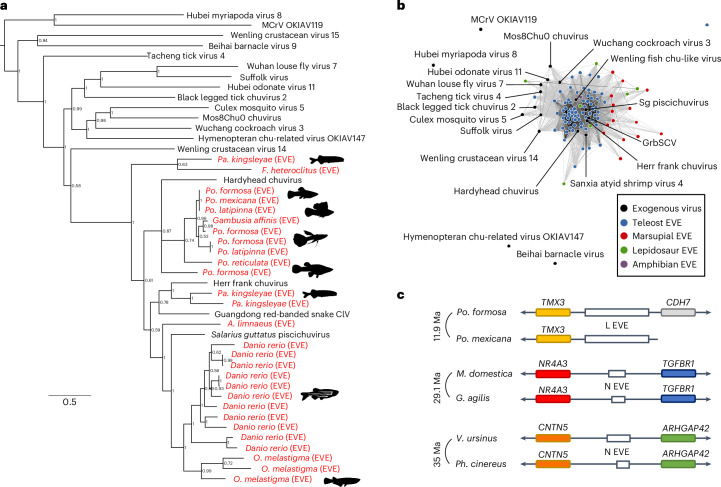
Fig. 1 Chuvirus EVEs in vertebrate genomes. a, Bayesian phylogenetic tree of the RdRps of exogenous chuviruses and the EVEs found in teleost fish (in red). Some species have multiple integrations suggesting a close interaction with these viruses and recurrent integrations, or possibly a single integration event followed by intragenomic amplification. Note how the vertebrate-associated viruses form a monophyletic group, while the arthropod-associated ones are paraphyletic. The tree was rooted with Hubei myriapoda virus 8 (Myriaviridae) and Megalopteran chu-related virus 119 (MCrV, Crepuscoviridae) as outgroups. Tree inferred in MrBayes3 using the LG + F + I + G4 model and 4.74 M generations (relative burn-in = 25%). EVEs are shown in red. Pa., Paramormyrops; F., Fundulus; Po., Poecilia; A., Austrofundulus; O., Oryzias; ClV, chuvirus-like virus. b, CLANS network of the nucleoprotein of exogenous chuviruses, vertebrate chuvirus EVEs and the two outgroups mentioned above. Edges are drawn between nodes with a significance of P < 1 × 10⁻¹⁵. The vertebrate EVEs are well connected to the central network that includes vertebrate-associated chuviruses and a number of chuviruses from arthropods. Sg, Salarius guttatus; GrbSCV, Guangdong red-banded snake chuvirus-like virus. c, Syntenic arrangement of the most-proximal genes was used to establish orthology of three integrations. The minimum date of integrations in each species pair is based on the divergence of the host species in TimeTree. M., Monodelphis; G., Gracilinanus; V., Vombatus; Ph., Phascolarctos. Source data
Fig. 1 Chuvirus EVEs in vertebrate genomes. a, Bayesian phylogenetic tree of the RdRps of exogenous chuviruses and the EVEs found in teleost fish (in red). Some species have multiple integrations suggesting a close interaction with these viruses and recurrent integrations, or possibly a single integration event followed by intragenomic amplification. Note how the vertebrate-associated viruses form a monophyletic group, while the arthropod-associated ones are paraphyletic. The tree was rooted with Hubei myriapoda virus 8 (Myriaviridae) and Megalopteran chu-related virus 119 (MCrV, Crepuscoviridae) as outgroups. Tree inferred in MrBayes3 using the LG + F + I + G4 model and 4.74 M generations (relative burn-in = 25%). EVEs are shown in red. Pa., Paramormyrops; F., Fundulus; Po., Poecilia; A., Austrofundulus; O., Oryzias; ClV, chuvirus-like virus. b, CLANS network of the nucleoprotein of exogenous chuviruses, vertebrate chuvirus EVEs and the two outgroups mentioned above. Edges are drawn between nodes with a significance of P < 1 × 10⁻¹⁵. The vertebrate EVEs are well connected to the central network that includes vertebrate-associated chuviruses and a number of chuviruses from arthropods. Sg, Salarius guttatus; GrbSCV, Guangdong red-banded snake chuvirus-like virus. c, Syntenic arrangement of the most-proximal genes was used to establish orthology of three integrations. The minimum date of integrations in each species pair is based on the divergence of the host species in TimeTree. M., Monodelphis; G., Gracilinanus; V., Vombatus; Ph., Phascolarctos. Source dataCC BY · PubMed Central
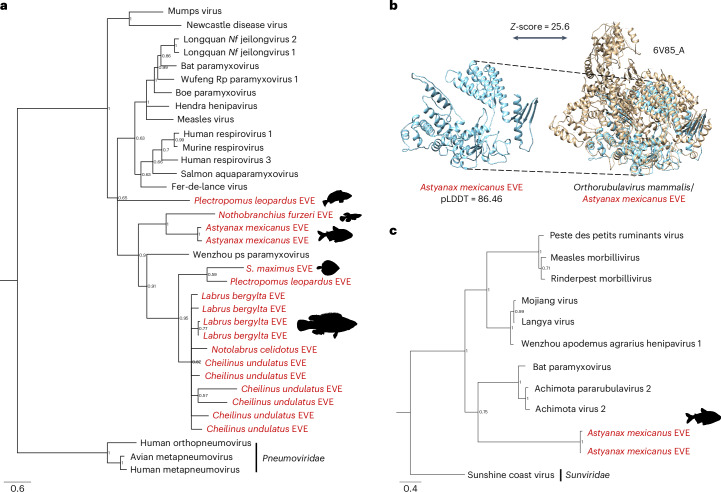
Fig. 2 Paramyxovirus EVEs in the genomes of teleost fish. a, Bayesian tree of the RdRp of exogenous paramyxoviruses and the EVEs found in teleost fish (in red). Most EVEs form a clade together with Wenzhou Pacific spadenose shark paramyxovirus. The tree was outgroup rooted with RdRp sequences from pneumoviruses. Tree inferred in MrBayes3 using the LG + F + I + G4 model and 9.06 M generations (relative burn-in = 25%). EVEs are shown in red. b, Predicted structure of an RdRp fragment present in the genome of the Mexican tetra and comparison to the RdRp structure of parainfluenza virus 5 (Orthorubulavirus mammalis). pLDDT, predicted local distance difference test metric. c, Bayesian tree of the nucleoprotein of paramyxoviruses and the EVEs found in the Mexican tetra. The EVEs are nested within the Paramyxoviridae with high support (posterior probability = 1) and are closest to a group of bat paramyxoviruses with a posterior probability = 0.75. Tree inferred in MrBayes3 using the LG + I + G4 model and 1 M generations (relative burn-in = 25%). EVEs are shown in red. Nf, Niviventer fulvescens; ps, Pacific shark; S., Scophthalmus. Source data
Fig. 2 Paramyxovirus EVEs in the genomes of teleost fish. a, Bayesian tree of the RdRp of exogenous paramyxoviruses and the EVEs found in teleost fish (in red). Most EVEs form a clade together with Wenzhou Pacific spadenose shark paramyxovirus. The tree was outgroup rooted with RdRp sequences from pneumoviruses. Tree inferred in MrBayes3 using the LG + F + I + G4 model and 9.06 M generations (relative burn-in = 25%). EVEs are shown in red. b, Predicted structure of an RdRp fragment present in the genome of the Mexican tetra and comparison to the RdRp structure of parainfluenza virus 5 (Orthorubulavirus mammalis). pLDDT, predicted local distance difference test metric. c, Bayesian tree of the nucleoprotein of paramyxoviruses and the EVEs found in the Mexican tetra. The EVEs are nested within the Paramyxoviridae with high support (posterior probability = 1) and are closest to a group of bat paramyxoviruses with a posterior probability = 0.75. Tree inferred in MrBayes3 using the LG + I + G4 model and 1 M generations (relative burn-in = 25%). EVEs are shown in red. Nf, Niviventer fulvescens; ps, Pacific shark; S., Scophthalmus. Source dataCC BY · PubMed Central
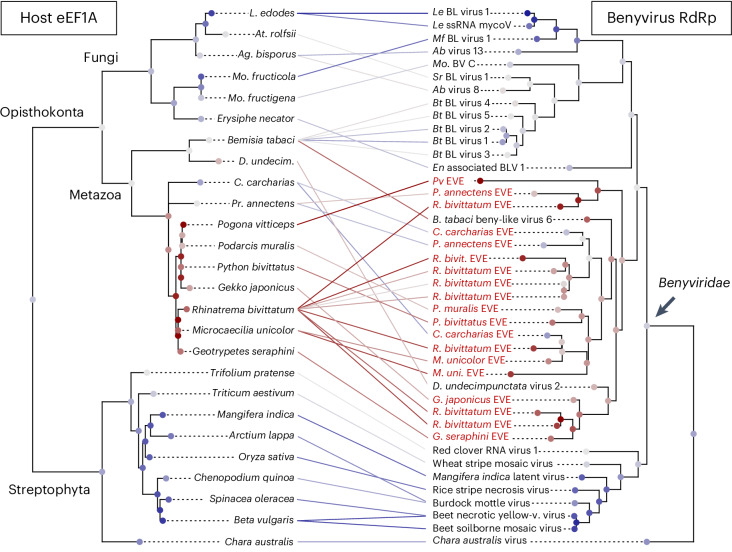
Fig. 3 Tanglegram of the phylogenies of benyviruses (including vertebrate EVEs) and their eukaryotic hosts. The benyvirus RdRp and host eEF1A (eukaryotic translation elongation factor 1-alpha) phylogenies point at deep codivergences and more recent cross-species transmissions in the three main groups (plant, fungi, animal benyviruses). The position of Chara australis virus in the RdRp phylogeny (see Supplementary Fig. 3) could be interpreted as an ancient virus jump between photosynthetic organisms and the ancestors of animals and fungi (Opisthokonta). The maximum-likelihood trees were inferred in RAxML-NG (eEF1A: LG + I + G4, RdRp: LG + F + I + G4) and the tanglegram inferred using the maximum incongruence algorithm (MIC) in Rtapas. EVEs are shown in red. L., Lentinula; At., Athelia; Ag., Agaricus; Mo., Monilinia; D., Diabrotica; C., Carcharodon; P./Pr., Protopterus; M., Microcaecilia; Le, Lentinula edodes; Mf, Monilinia fructicola; Ab, Agaricus bisporus; Sr, S. rolfsii; B., Bemisia; Bt, Bemisia tabaci; En, Erysiphe necator; BL, beny-like. Source data
Fig. 3 Tanglegram of the phylogenies of benyviruses (including vertebrate EVEs) and their eukaryotic hosts. The benyvirus RdRp and host eEF1A (eukaryotic translation elongation factor 1-alpha) phylogenies point at deep codivergences and more recent cross-species transmissions in the three main groups (plant, fungi, animal benyviruses). The position of Chara australis virus in the RdRp phylogeny (see Supplementary Fig. 3) could be interpreted as an ancient virus jump between photosynthetic organisms and the ancestors of animals and fungi (Opisthokonta). The maximum-likelihood trees were inferred in RAxML-NG (eEF1A: LG + I + G4, RdRp: LG + F + I + G4) and the tanglegram inferred using the maximum incongruence algorithm (MIC) in Rtapas. EVEs are shown in red. L., Lentinula; At., Athelia; Ag., Agaricus; Mo., Monilinia; D., Diabrotica; C., Carcharodon; P./Pr., Protopterus; M., Microcaecilia; Le, Lentinula edodes; Mf, Monilinia fructicola; Ab, Agaricus bisporus; Sr, S. rolfsii; B., Bemisia; Bt, Bemisia tabaci; En, Erysiphe necator; BL, beny-like. Source dataCC BY · PubMed Central
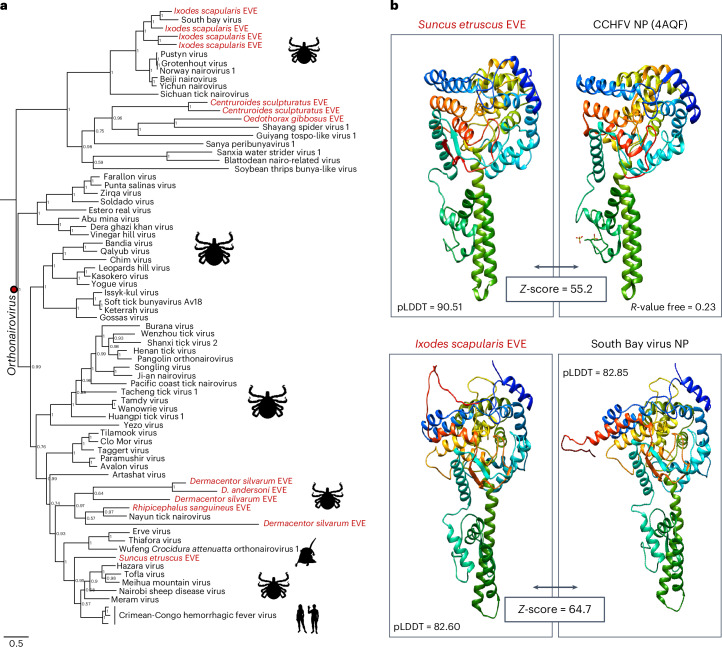
Fig. 4 Nairovirus EVEs in the genome of the Etruscan shrew and ticks. a, Bayesian phylogeny of the nairovirus nucleoprotein gene including EVEs from the Etruscan shrew, ticks and other chelicerates, together with exogenous nairoviruses. The element found in the Etruscan shrew genome forms a clade with the Crimean–Congo hemorrhagic fever viruses/Hazara virus, sister to the Erve/Thiafora and Wufeng Crocidura attenuatta orthonairovirus 1 clade, known to infect soricid shrews of the subfamily Crocidurinae. The node in red shows the clade of viruses that contains recognized members of the Orthonairovirus genus. Tree inferred in MrBayes3 with a codon-partitioned model (1st and 3rd positions: GTR + G4, 2nd position: GTR + I + G4) and 5 M generations (relative burn-in = 25%). EVEs are shown in red. b, Structural comparison of nucleoproteins from EVEs in the Etruscan shrew and black-legged tick genomes with exogenous nairoviruses. Structures were modelled in Alphafold2 to a good backbone accuracy (pLDDT > 80) or downloaded from the Protein Data Bank. The Etruscan shrew element adopts a structure highly similar to the structure of Crimean–Congo hemorrhagic fever virus determined by X-ray crystallography. The black-legged tick predicted structure is more similar to the South Bay virus structure as predicted from phylogenetic analysis. Source data
Fig. 4 Nairovirus EVEs in the genome of the Etruscan shrew and ticks. a, Bayesian phylogeny of the nairovirus nucleoprotein gene including EVEs from the Etruscan shrew, ticks and other chelicerates, together with exogenous nairoviruses. The element found in the Etruscan shrew genome forms a clade with the Crimean–Congo hemorrhagic fever viruses/Hazara virus, sister to the Erve/Thiafora and Wufeng Crocidura attenuatta orthonairovirus 1 clade, known to infect soricid shrews of the subfamily Crocidurinae. The node in red shows the clade of viruses that contains recognized members of the Orthonairovirus genus. Tree inferred in MrBayes3 with a codon-partitioned model (1st and 3rd positions: GTR + G4, 2nd position: GTR + I + G4) and 5 M generations (relative burn-in = 25%). EVEs are shown in red. b, Structural comparison of nucleoproteins from EVEs in the Etruscan shrew and black-legged tick genomes with exogenous nairoviruses. Structures were modelled in Alphafold2 to a good backbone accuracy (pLDDT > 80) or downloaded from the Protein Data Bank. The Etruscan shrew element adopts a structure highly similar to the structure of Crimean–Congo hemorrhagic fever virus determined by X-ray crystallography. The black-legged tick predicted structure is more similar to the South Bay virus structure as predicted from phylogenetic analysis. Source dataCC BY · PubMed Central
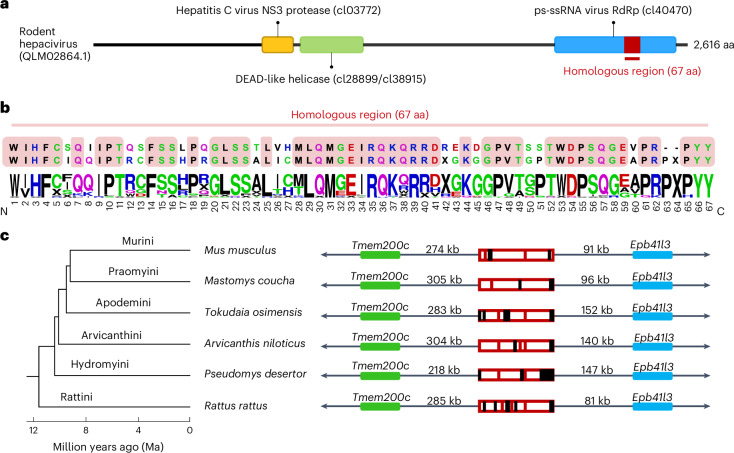
Fig. 5 Hepacivirus EVE in the genomes of rodents from the subfamily Murinae. a, Conserved domain annotation of the rodent hepacivirus ETH674/ETH/2012 (QLM02864.1) polyprotein. The region of homology to the EVEs is embedded within the ps-ssRNA domain. b, Comparison of the region of homology between rodent hepacivirus ETH674/ETH/2012 (top sequence) and the consensus sequence obtained from 21 murine genomes (middle sequence). Identical amino acids at a given position are highlighted in a red box (the two sequences are 75% pairwise identical at the amino acid level). The sequence logo at the bottom shows variation at the given position proportional to frequency (0–100%). c, Orthology across 6 representative species in 6 tribes (Murini, Praomyini, Apodemini, Arvicanthini, Hydromyini, Rattini) of the subfamily Murinae, together with a phylogeny of the group. Flanking genes were identified in the mouse (Mus musculus) assembly and used to annotate the region in the other assemblies. Red bars, internal stop codons; black rectangles, indel mutations. Source data
Fig. 5 Hepacivirus EVE in the genomes of rodents from the subfamily Murinae. a, Conserved domain annotation of the rodent hepacivirus ETH674/ETH/2012 (QLM02864.1) polyprotein. The region of homology to the EVEs is embedded within the ps-ssRNA domain. b, Comparison of the region of homology between rodent hepacivirus ETH674/ETH/2012 (top sequence) and the consensus sequence obtained from 21 murine genomes (middle sequence). Identical amino acids at a given position are highlighted in a red box (the two sequences are 75% pairwise identical at the amino acid level). The sequence logo at the bottom shows variation at the given position proportional to frequency (0–100%). c, Orthology across 6 representative species in 6 tribes (Murini, Praomyini, Apodemini, Arvicanthini, Hydromyini, Rattini) of the subfamily Murinae, together with a phylogeny of the group. Flanking genes were identified in the mouse (Mus musculus) assembly and used to annotate the region in the other assemblies. Red bars, internal stop codons; black rectangles, indel mutations. Source dataCC BY · PubMed Central
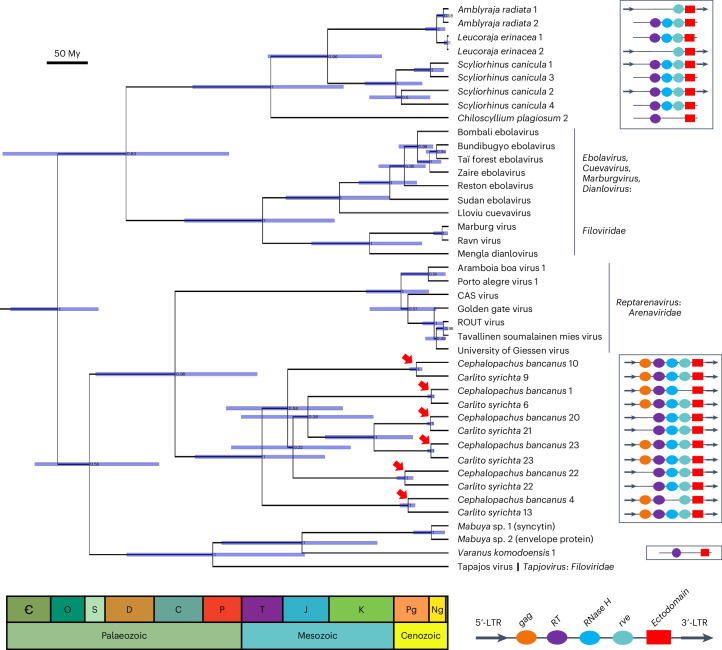
Fig. 6 Bayesian timetree of the ectodomain homologues found in retroviruses, filoviruses and reptarenaviruses. The ectodomains of reptarenaviruses form a highly supported clade (posterior probability = 0.98) with the endogenous ectodomains found in tarsiers (Carlito syrichta, Cephalopachus bancanus). The ectodomains of ebolaviruses, cuevaviruses, marburgviruses and dianloviruses form a clade which is the sister group to the endogenous ectodomains found in cartilaginous fish. However, the ectodomain of Tapajos virus forms a distinct clade (posterior probability = 1) with endogenous ectodomains found in lizards (Mabuya, Varanus), suggesting that the Tapajos virus ectodomain was captured independently from the ectodomains of other filoviruses. The tree was inferred in BEAST2 with the JTT + G4 site model using the optimized relaxed clock (ORC) and 20 M generations (relative burn-in = 25%). The red arrows indicate pairs of tarsier orthologues. A diagram with the genomic context of the endogenous ectodomains is shown to the right and suggests that the endogenous ectodomains form part of endogenous retroviral elements. C, Cambrian; O, Ordovician; S, Silurian; D, Devonian; C, Carboniferous; P, Permian; T, Triassic; J, Jurassic; K, Cretaceous; Pg, Paleogene; Ng, Neogene. Source data
Fig. 6 Bayesian timetree of the ectodomain homologues found in retroviruses, filoviruses and reptarenaviruses. The ectodomains of reptarenaviruses form a highly supported clade (posterior probability = 0.98) with the endogenous ectodomains found in tarsiers (Carlito syrichta, Cephalopachus bancanus). The ectodomains of ebolaviruses, cuevaviruses, marburgviruses and dianloviruses form a clade which is the sister group to the endogenous ectodomains found in cartilaginous fish. However, the ectodomain of Tapajos virus forms a distinct clade (posterior probability = 1) with endogenous ectodomains found in lizards (Mabuya, Varanus), suggesting that the Tapajos virus ectodomain was captured independently from the ectodomains of other filoviruses. The tree was inferred in BEAST2 with the JTT + G4 site model using the optimized relaxed clock (ORC) and 20 M generations (relative burn-in = 25%). The red arrows indicate pairs of tarsier orthologues. A diagram with the genomic context of the endogenous ectodomains is shown to the right and suggests that the endogenous ectodomains form part of endogenous retroviral elements. C, Cambrian; O, Ordovician; S, Silurian; D, Devonian; C, Carboniferous; P, Permian; T, Triassic; J, Jurassic; K, Cretaceous; Pg, Paleogene; Ng, Neogene. Source dataCC BY · PubMed Central

Verification

Claims the paper makes

The claims and statistics of this paper haven’t been checked yet.

Run the check — free, no account needed. It reads the open-access text and checks the sources it cites.

A few free checks a day · papers already verified open instantly · results are public

Self-check

Percentages, sums and reported differences re-computed from the paper’s own numbers.

The self-check needs the paper’s full text.

Citations

Cites

Research works printed but not linked: 82

  1. 10.1371/journal.pgen.1001191 · DOI
  2. 10.1016/j.coviro.2011.06.007 · DOI
  3. 10.1038/nrg3199 · DOI
  4. 2021, Ancient evolution of hepadnaviral paleoviruses and their impact on host genomes, Virus Evol, 7, veab012, 10.1093/ve/veab012 · DOI
  5. 2017, A novel viral lineage distantly related to herpesviruses discovered within fish genome sequence data, Virus Evol, 3, vex016
  6. 2023, Teratorn and Its Related Elements – a Novel Group of Herpesviruses Widespread in Teleost Genomes, Zoolog Sci, 40, 83
  7. 10.1093/molbev/msaa291 · DOI
  8. 10.1128/JVI.01732-10 · DOI
  9. 2019, The evolution, distribution and diversity of endogenous circoviral elements in vertebrate genomes, Virus Res, 262, 15, 10.1016/j.virusres.2018.03.014 · DOI
  10. 10.1098/rstb.2012.0499 · DOI · Paper page
  11. 10.1186/1471-2148-10-193 · DOI
  12. 2022, Endogenous Viral Elements in Shrew Genomes Provide Insights into Pestivirus Ancient History, Mol Biol Evol, 39, msac190, 10.1093/molbev/msac190 · DOI
  13. 2020, Current understanding of human herpesvirus 6 (HHV-6) chromosomal integration, Antiviral Res, 176, 104720, 10.1016/j.antiviral.2020.104720 · DOI
  14. 10.1073/pnas.2011872117 · DOI
  15. 10.1093/ve/vey026 · DOI
  16. 10.1128/JVI.01164-12 · DOI
  17. 10.1038/s41467-019-11433-0 · DOI
  18. 10.1093/nar/gkx932 · DOI
  19. 2014, Towards inferring the global movement of beak and feather disease virus, Virology, 450–451, 24
  20. 10.1016/j.vetmic.2011.09.007 · DOI
  21. 2011, Ebola haemorrhagic fever, The Lancet, 377, 849, 10.1016/S0140-6736(10)60667-8 · DOI
  22. 2017, New World Arenavirus Biology, Annu Rev Virol, 4, 141, 10.1146/annurev-virology-101416-042001 · DOI
  23. 10.1016/S1473-3099(06)70435-2 · DOI
  24. 2008, Mumps, The Lancet, 371, 932, 10.1016/S0140-6736(08)60419-5 · DOI
  25. 10.1111/j.1574-6976.2012.00330.x · DOI
  26. 10.1016/j.coviro.2012.02.001 · DOI
  27. 2020, The continued threat of emerging flaviviruses, Nat Microbiol, 5, 796, 10.1038/s41564-020-0714-0 · DOI
  28. 2022, Jingchuvirales: a New Taxonomical Framework for a Rapidly Expanding Order of Unusual Monjiviricete Viruses Broadly Distributed among Arthropod Subphyla, Appl Environ Microbiol, 88, e01954
  29. 10.7554/eLife.05378 · DOI
  30. Dezordi FZ , Vasconcelos CR dos S , Rezende AM , Wallau GL . In and Outs of Chuviridae Endogenous Viral Elements: Origin of a Potentially New Retrovirus and Signature of Ancient and Ongoing Arms Race in Mosquito Genomes. Front Genet [Internet]. 2020;11. Available from: https://www.frontiersin.org/articles/10.3389/fgene.2020.542437 · DOI
  31. 10.1093/molbev/msac174 · DOI
  32. 10.1099/jgv.0.001328 · DOI
  33. 2017, ICTV Virus Taxonomy Profile: Benyviridae, J Gen Virol, 98, 1571, 10.1099/jgv.0.000864 · DOI
  34. 2022, Uncovering Plant Virus Species Forming Novel Provisional Taxonomic Units Related to the Family Benyviridae, Viruses, 14, 2680, 10.3390/v14122680 · DOI
  35. 2020, ICTV Virus Taxonomy Profile: Nairoviridae, J Gen Virol, 101, 798, 10.1099/jgv.0.001485 · DOI
  36. 2023, Crimean–Congo haemorrhagic fever virus, Nat Rev Microbiol, 21, 463, 10.1038/s41579-023-00871-9 · DOI
  37. 10.1099/jgv.0.000672 · DOI
  38. 10.7150/ijms.3.47 · DOI
  39. 10.1128/JVI.75.23.11709-11719.2001 · DOI
  40. 10.1128/mbio.00180-12 · DOI
  41. 2018, Neutral Evolution, Introd Evol Genomics, 17, 109, 10.1007/978-3-319-92642-1_5 · DOI
  42. 10.1128/JVI.00593-16 · DOI
  43. 2021, Identification of a novel filovirus in a common lancehead (Bothrops atrox (Linnaeus, 1758)), J Vet Med Sci, 83, 1485, 10.1292/jvms.21-0285 · DOI
  44. Laovechprasit W , Young KT , Stacy BA , Tillis SB , Ossiboff RJ , Vann JA , et al. Piscichuviral encephalitis in marine and freshwater chelonians: first evidence of jingchuviral disease [Internet]. bioRxiv; 2023 [cited 2023 Jul 26]. p. 2023.02.24.528524. Available from: https://www.biorxiv.org/content/10.1101/2023.02.24.528524v1 · DOI
  45. 10.1128/mra.00380-20 · DOI
  46. 2021, Diversity and infectivity of the RNA virome among different cryptic species of an agriculturally important insect vector: whitefly Bemisia tabaci, Npj Biofilms Microbiomes, 7, 1
  47. 10.1038/s41586-018-0012-7 · DOI
  48. Meyers TR , Batts WN . Chapter 17 – Paramyxoviruses of Fish. In: Kibenge FSB , Godoy MG , editors. Aquaculture Virology [Internet]. San Diego: Academic Press; 2016 [cited 2023 Jul 27]. p. 259–65. Available from: https://www.sciencedirect.com/science/article/pii/B9780128015735000176 · DOI
  49. 2018, Fossils know it best: Using a new set of fossil calibrations to improve the temporal phylogenetic framework of murid rodents (Rodentia: Muridae), Mol Phylogenet Evol, 128, 98, 10.1016/j.ympev.2018.07.017 · DOI
  50. 2021, Molecular detection and genomic characterization of diverse hepaciviruses in African rodents, Virus Evol, 7, veab036, 10.1093/ve/veab036 · DOI
  51. Li YQ , Ghafari M , Holbrook AJ , Boonen I , Amor N , Catalano S , et al. The evolutionary history of hepaciviruses [Internet]. bioRxiv; 2023 [cited 2023 Jul 27]. p. 2023.06.30.547218. Available from: https://www.biorxiv.org/content/10.1101/2023.06.30.547218v1 · DOI
  52. 10.1007/s11262-012-0796-8 · DOI
  53. 1989, Erve virus, a probable member of Bunyaviridae family isolated from shrews (Crocidura russula) in France, Acta Virol, 33, 270
  54. 10.1007/BF01310935 · DOI
  55. 2022, Identification of novel orthonairoviruses from rodents and shrews in Gabon, Central Africa, J Gen Virol, 103, 001796
  56. 2023, Cencurut virus: A novel Orthonairovirus from Asian house shrews (Suncus murinus) in Singapore, One Health, 16, 100529, 10.1016/j.onehlt.2023.100529 · DOI
  57. 10.1371/journal.pone.0121609 · DOI
  58. 10.1073/pnas.1407046111 · DOI
  59. 2023, Antiviral Activity of an Endogenous Parvoviral Element, Viruses, 15, 1420, 10.3390/v15071420 · DOI
  60. 10.1016/j.cub.2019.05.041 · DOI
  61. National Library of Medicine (US), National Center for Biotechnology Information. NCBI Virus [Internet]. 2022. Available from: https://www.ncbi.nlm.nih.gov/labs/virus/vssi/#/
  62. 10.1038/nbt.3988 · DOI · Paper page
  63. 2023, ElasticBLAST: accelerating sequence search via cloud computing, BMC Bioinformatics, 24, 117, 10.1186/s12859-023-05245-9 · DOI
  64. 10.1093/bioinformatics/btq033 · DOI · Paper page
  65. Kans J. Entrez Direct: E-utilities on the Unix Command Line. In: Entrez Programming Utilities Help [Internet] [Internet]. National Center for Biotechnology Information (US); 2023 [cited 2023 Jun 26]. Available from: https://www.ncbi.nlm.nih.gov/books/NBK179288/
  66. 10.1038/s41592-021-01101-x · DOI · Paper page
  67. 10.1006/jmbi.1990.9999 · DOI · Paper page
  68. 10.1093/nar/gkt282 · DOI · Paper page
  69. 10.1093/nar/gkab1112 · DOI · Paper page
  70. 10.1093/nar/gkz268 · DOI · Paper page
  71. 10.1101/gr.1865504 · DOI · Paper page
  72. 2020, Protein Sequence Analysis Using the MPI Bioinformatics Toolkit, Curr Protoc Bioinforma, 72, e108, 10.1002/cpbi.108 · DOI · Paper page
  73. 10.1093/nar/gki408 · DOI
  74. 10.1093/molbev/mst010 · DOI · Paper page
  75. 10.1093/molbev/msy159 · DOI · Paper page
  76. 10.1093/MOLBEV/MSZ189 · DOI
  77. 10.1093/BIOINFORMATICS/BTZ305 · DOI
  78. 10.1093/sysbio/sys029 · DOI
  79. 10.1371/journal.pcbi.1006650 · DOI · Paper page
  80. Llaberia-Robledillo M , Lucas-Lledó JI , Pérez-Escobar OA , Krasnov BR , Balbuena JA . Rtapas: An R Package to Assess Cophylogenetic Signal between Two Evolutionary Histories. Syst Biol. 2023 Mar 25;syad016. · DOI
  81. 10.1038/S41592-022-01488-1 · DOI · Paper page
  82. 10.1093/bioinformatics/bth444 · DOI

Metadata

Authors
Barreat, J. G. N., & Katzourakis, A.
Affiliations
University of Oxford (GB)
Corresponding author
Katzourakis, Aris
Venue
Nature Microbiology
Publisher
openRxiv
Published
2023-10-27
Volume
9
Issue
11
Pages
3013-3024
ISSN
2058-5276 (ISSN-L)
OpenAlex
W4403619477
Cited by
15
References
1
Citations by year
2026: 6 · 2025: 6 · 2024: 3
FWCI
3.66
Type
journal article
Language
en
Open access
Licence
cc-by
Locations
  • Nature Microbiology (publishedVersion, cc-by)
  • bioRxiv (Cold Spring Harbor Laboratory) (acceptedVersion, cc-by)
  • PubMed Central (publishedVersion, cc-by)
  • PubMed (publishedVersion)
Funders
  • University of Oxford
  • H2020 European Research Council (101001623)
Topics
  • Life Sciences › Biochemistry, Genetics and Molecular Biology › Genetics › Chromosomal and Genetic Variations
  • Life Sciences › Biochemistry, Genetics and Molecular Biology › Genetics › Evolution and Genetic Dynamics
  • Life Sciences › Biochemistry, Genetics and Molecular Biology › Molecular Biology › Genomics and Phylogenetic Studies
Keywords
endogenous viral elements, vertebrate genomes, Paramyxoviridae, Nairoviridae, Hepacivirus, filoviruses, retroviral elements, viral evolution, cloud computing
MeSH terms
Animals, Humans, Phylogeny, Genetic Variation, Vertebrates, Genome, Evolution, Molecular, Endogenous Retroviruses, Host Specificity

About these checks

Registry, retraction, Cites and statistics results are computed, not judged, with one exception: a printed reference that no index lists is read once by a model before it counts as a citation error. Claims are extracted by a model and kept only when their quote appears verbatim in the text; each cited source is then checked, with a model’s help, for whether it says what the claim relies on. Those verdicts can be wrong — read the claim’s quote and the cited source before relying on one.

Statistics and arithmetic are recomputed, not judged.

Confidence bands are shown only for fields calibrated on our annotated test set. None is calibrated yet, so no band is shown.

What counts as a claim ›How we measure confidence ›How we check this ›

Are you an author, or do you see a problem with this page? Request a review