

The DOI matches its Crossref record; 2 of the 2 references it cites were found in a registry or an index.
Molecular dynamics simulation analysis of structural dynamic cross correlation induced by odorant hydrogen-bonding in mouse eugenol olfactory receptor *
Open accessPreprint — published as 10.2142/biophysico.bppb-v21.0007 · Paper page
Abstract
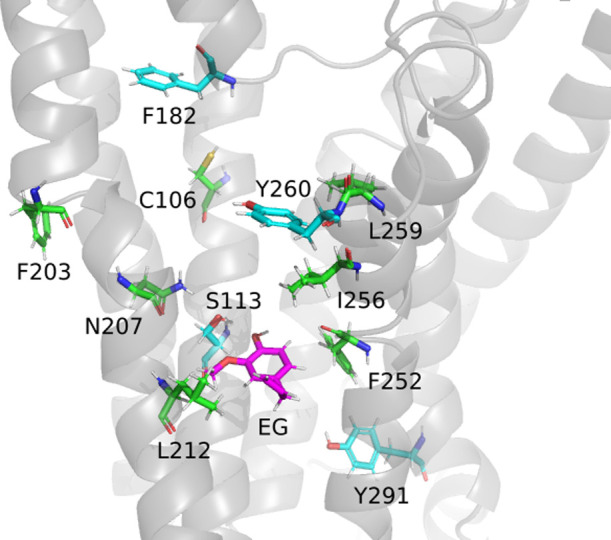
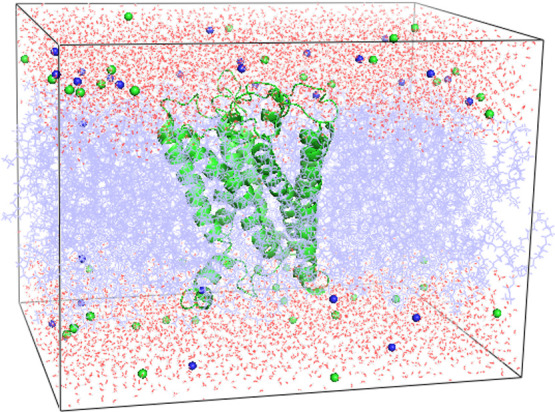
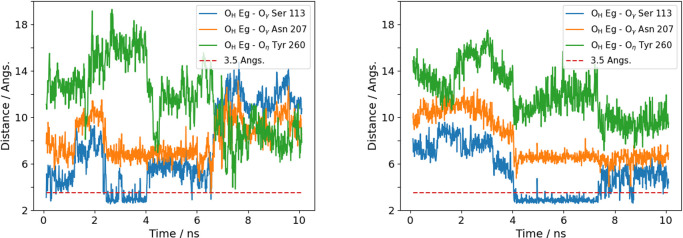
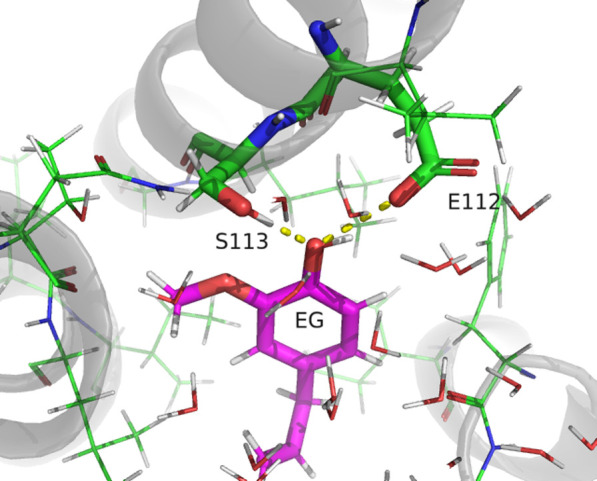
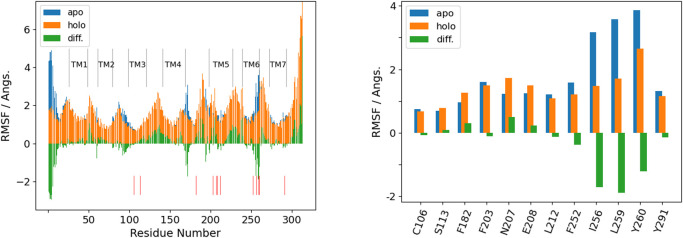
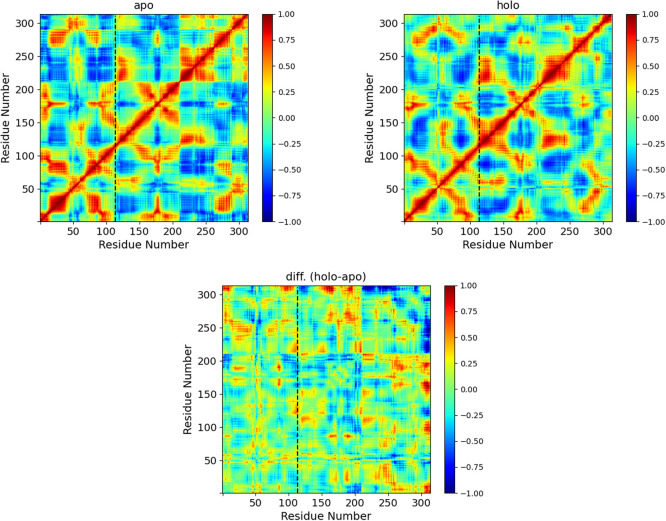
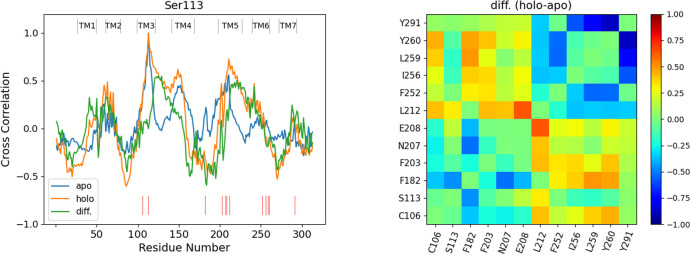
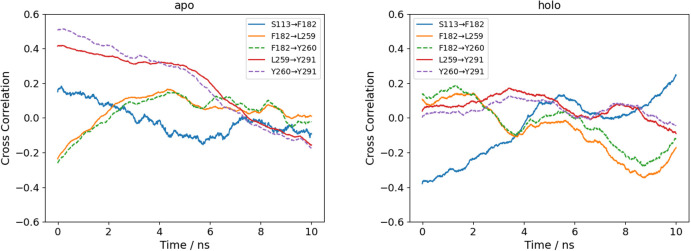
Structural fluctuations and dynamic cross-correlations in the mouse eugenol olfactory receptor (Olfr73) were studied by molecular dynamics (MD) simulation to characterize the dynamic response of the protein upon ligand binding. The initial structure was generated by the artificial intelligence tool AlfaFold2 due to the current lack of experimental data. We focused on the hydrogen (H) bond of the odorant eugenol to Ser113, Asn207, and Tyr260 of the receptor protein, the importance of which has been suggested by previous experimental studies. The H-bond was not observed in docking simulations, but in subsequent MD simulations the H-bond to Ser113 was formed in 2–4 ns. The lifetime of the H-bond was in the range of 1–20 ns. On the trajectory with the most stable (20 ns) H-bond, the structural fluctuation of the α -carbon atoms of the receptor main chain was studied by calculating the root mean square fluctuations, the dynamic cross-correlation map, and the time-dependent dynamic cross-correlation. The analysis suggested a correlation transfer pathway Ser113 → Phe182 → (Leu259 or Tyr260) → Tyr291 induced by the ligand binding with a time scale of 4–6 ns.
Overview
The claims and statistics of this paper haven’t been checked yet.
Run the check — free, no account needed. It reads the open-access text and checks the sources it cites.
Integrity signals
Registry
Cites
Statistics
Figures
Verification
Claims the paper makes
The claims and statistics of this paper haven’t been checked yet.
Run the check — free, no account needed. It reads the open-access text and checks the sources it cites.
Self-check
Percentages, sums and reported differences re-computed from the paper’s own numbers.
The self-check needs the paper’s full text.
Citations
Cites
Highly accurate protein structure prediction with AlphaFold
Jumper, J., Evans, R., Pritzel, A., Green, T., Figurnov, M., Ronneberger, O., Tunyasuvunakool, K., Bates, R., Žídek, A., Potapenko, A., et al. (2021) · Nature · doi:10.1038/s41586-021-03819-2 · Cited by 43,764
A structural biology community assessment of AlphaFold2 applications
Akdel, M., Pires, D. E. V., Pardo, E. P., Jänes, J., Zalevsky, A. O., Mészáros, B., Bryant, P., Good, L. L., Laskowski, R. A., Pozzati, G., et al. (2022) · Nature Structural & Molecular Biology · doi:10.1038/s41594-022-00849-w · Cited by 675
Research works printed but not linked: 42
- 10.1016/0092-8674(91)90418-X · DOI · Paper page
- 10.1002/1521-3773(20000901)39:17<2980::AID-ANIE2980>3.0.CO;2-# · DOI
- 10.1038/35093026 · DOI
- 2001, Genome Biol, 2, research0018., 10.1186/gb-2001-2-7-reports0018 · DOI
- 10.1038/nn800 · DOI
- 10.1126/science.1089122 · DOI
- 10.1073/pnas.0307882100 · DOI
- 10.1016/S0092-8674(04)00047-9 · DOI
- C. S. Sell , Chemistry and the Sense of Smell (Wiley, New Jersey, 2014). · DOI
- 2021, Signal Transduct, Target. Ther, 6, 7
- 2014, Isr. J. Chem, 54, 1205, 10.1002/ijch.201400027 · DOI
- 10.1002/anie.200605002 · DOI
- 2011, Angew. Chem. Int. Ed. Engl, 51, 1274
- 10.1073/pnas.97.20.10712 · DOI
- 10.1093/chemse/bjh030 · DOI
- 10.1523/JNEUROSCI.4723-04.2005 · DOI
- 2010, Biochemistry, 50, 843
- 2015, Sci. Rep, 5, 14948, 10.1038/srep14948 · DOI
- 2019, Commun. Biol, 2, 141, 10.1038/s42003-019-0384-8 · DOI
- 2023, Signal Transduct. Target. Ther, 8, 115, 10.1038/s41392-023-01381-z · DOI
- 1984, Rep. Prog. Phys, 47, 1, 10.1088/0034-4885/47/1/001 · DOI
- 2020, Gonçalves Vianez Junior, Sci. Rep, 10, 9625
- 2020, Phytother. Res, 34, 3420, 10.1002/ptr.6868 · DOI
- 2022, Oxid. Med. Cell. Longev, 2022, 3720026
- 2022, Sci. Rep, 12, 9378, 10.1038/s41598-022-13120-5 · DOI
- 1995, Methods Neurosci, 25, 366428
- 2022, Nucleic Acids Research, 51, D395D402
- 10.1038/S41592-022-01488-1 · DOI · Paper page
- 10.1021/jp035478e · DOI
- 10.1063/1.448118 · DOI
- 1983, Phys. Rev. A, 28, 1016, 10.1103/PhysRevA.28.1016 · DOI
- 10.1143/PTPS.103.1 · DOI
- 10.1016/0021-9991(77)90098-5 · DOI
- 2016, Biophys. Physicobiol, 13, 209, 10.2142/biophysico.13.0_209 · DOI
- 10.1063/1.3582791 · DOI
- 10.1021/ct400342e · DOI
- 10.1002/1096-987X(200009)21:12<1049::AID-JCC3>3.0.CO;2-F · DOI
- 10.1016/j.jmgm.2005.04.004 · DOI
- 10.1002/jcc.540141112 · DOI
- 2022, Nat. Commun, 13, 6335, 10.1038/s41467-022-33795-8 · DOI
- 2022, J. Chem. Phys, 156, 075101, 10.1063/5.0079797 · DOI
- 2021, Acc. Chem. Res, 54, 2238, 10.1021/acs.accounts.1c00113 · DOI
Metadata
- Authors
- Okamoto, C., & Ando, K.
- Affiliations
- Tokyo Woman's Christian University (JP)
- Corresponding author
- Ando, Koji
- ORCID
- Ando, Koji
- Venue
- Biophysics and Physicobiology
- Publisher
- openRxiv
- Published
- 2023-11-05
- Volume
- 21
- Issue
- 1
- Pages
- n/a-n/a
- ISSN
- 2189-4779 (ISSN-L)
- PMC
- PMC11128758
- OpenAlex
- W4390939122
- Cited by
- 19
- References
- 2
- Citations by year
- 2026: 7 · 2025: 11 · 2024: 1
- FWCI
- 2.58
- Type
- journal article
- Language
- en
- Open access
- gold
- doi.org
- Locations
- Biophysics and Physicobiology (publishedVersion)
- bioRxiv (Cold Spring Harbor Laboratory) (acceptedVersion, cc-by-nc-nd)
- PubMed Central (publishedVersion, cc-by-nc-sa)
- PubMed (publishedVersion)
- arXiv (Cornell University) (submittedVersion, cc-by-nc-nd)
- DOAJ (DOAJ: Directory of Open Access Journals) (submittedVersion)
- arXiv (Cornell University)
- Funders
- Japan Society for the Promotion of Science (19K22173)
- Topics
- Life Sciences › Biochemistry, Genetics and Molecular Biology › Molecular Biology › Protein Structure and Dynamics
- Life Sciences › Biochemistry, Genetics and Molecular Biology › Molecular Biology › Receptor Mechanisms and Signaling
- Life Sciences › Neuroscience › Sensory Systems › Olfactory and Sensory Function Studies
- Keywords
- eugenol, odorant binding, hydrogen bonding, structural fluctuations, ligand binding, RMSF
About these checks
Registry, retraction, Cites and statistics results are computed, not judged, with one exception: a printed reference that no index lists is read once by a model before it counts as a citation error. Claims are extracted by a model and kept only when their quote appears verbatim in the text; each cited source is then checked, with a model’s help, for whether it says what the claim relies on. Those verdicts can be wrong — read the claim’s quote and the cited source before relying on one.
Statistics and arithmetic are recomputed, not judged.
Confidence bands are shown only for fields calibrated on our annotated test set. None is calibrated yet, so no band is shown.
What counts as a claim ›How we measure confidence ›How we check this ›
Are you an author, or do you see a problem with this page? Request a review
How to cite
Cite CoChat for the checks on this page, and the paper for its own findings.
- This page
- CoChat. (2026). Citation check: Molecular dynamics simulation analysis of structural dynamic cross correlation induced by odorant hydrogen-bonding in mouse eugenol olfactory receptor *. https://app.cochat.ai/papers/10.1101/2023.11.05.565671
- The paper
- Okamoto, C., & Ando, K. (2023). Molecular dynamics simulation analysis of structural dynamic cross correlation induced by odorant hydrogen-bonding in mouse eugenol olfactory receptor *. Biophysics and Physicobiology. https://doi.org/10.1101/2023.11.05.565671
