

PTFSpot: Deep co-learning on transcription factors and their binding regions attains impeccable universality in plants
Open accessPreprint — published as 10.1093/bib/bbae324
The DOI matches its Crossref record; 52 of the 52 references it cites were found in a registry or an index.
Abstract
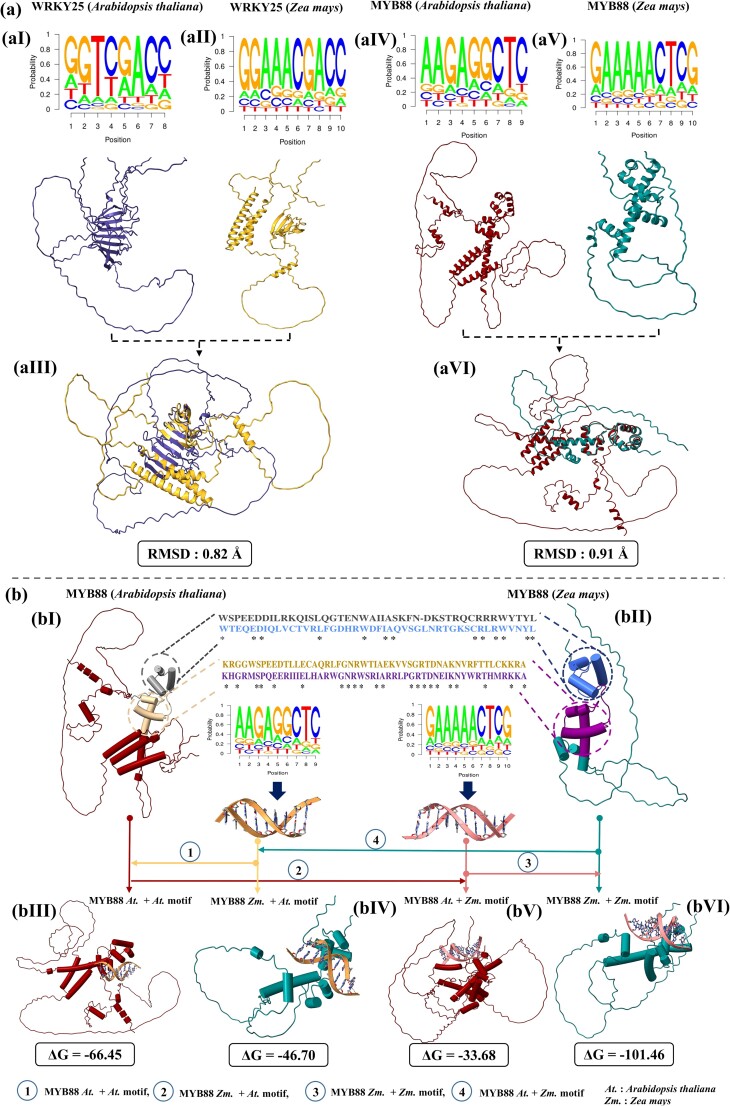
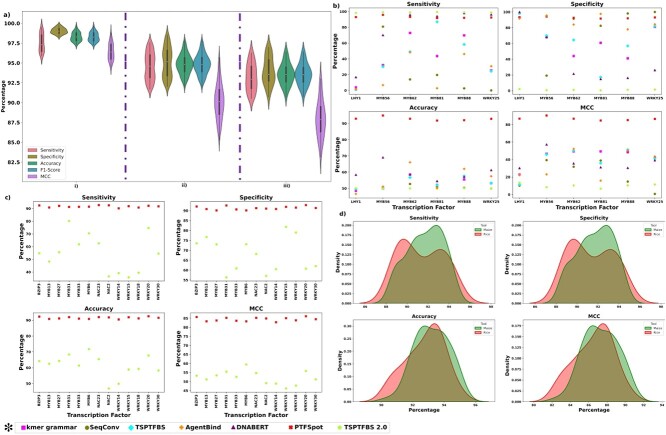
Unlike animals, variability in transcription factors (TF) and their binding regions (TFBR) across the plants species is a major problem which most of the existing TFBR finding software fail to tackle, rendering them hardly of any use. This limitation has resulted into underdevelopment of plant regulatory research and rampant use of Arabidopsis like model species, generating misleading results. Here we report a revolutionary transformers based deep-learning approach, PTFSpot, which learns from TF structures and their binding regions co-variability to bring a universal TF-DNA interaction model to detect TFBR with complete freedom from TF and species specific models’ limitations. During a series of extensive benchmarking studies over multiple experimentally validated data, it not only outperformed the existing software by >30% lead, but also delivered consistently >90% accuracy even for those species and TF families which were never encountered during model building process. PTFSpot makes it possible now to accurately annotate TFBRs across any plant genome even in the total lack of any TF information, completely free from the bottlenecks of species and TF specific models.
Overview
The claims and statistics of this paper haven’t been checked yet.
Free: it reads the open-access text and checks the first 5 claims that cite a source we can check. Create a free account to check every claim.
Integrity signals
Registry
Cites
Statistics
Figures
Verification
Claims the paper makes
The claims and statistics of this paper haven’t been checked yet.
Free: it reads the open-access text and checks the first 5 claims that cite a source we can check. Create a free account to check every claim.
Self-check
Percentages, sums and reported differences re-computed from the paper’s own numbers.
The self-check needs the paper’s full text.
Citations
Cites
Densely Connected Convolutional Networks
Huang, G., Liu, Z., Van Der Maaten, L., & Weinberger, K. Q. (2017) · 2017 IEEE Conference on Computer Vision and Pattern Recognition (CVPR) · doi:10.1109/cvpr.2017.243 · Cited by 48,566
Highly accurate protein structure prediction with AlphaFold
Jumper, J., Evans, R., Pritzel, A., Green, T., Figurnov, M., Ronneberger, O., Tunyasuvunakool, K., Bates, R., Žídek, A., Potapenko, A., et al. (2021) · Nature · doi:10.1038/s41586-021-03819-2 · Cited by 43,764
Chicco, D., & Jurman, G. (2020) · BMC Genomics · doi:10.1186/s12864-019-6413-7 · Cited by 6,143
Genome-Wide Mapping of in Vivo Protein-DNA Interactions
Johnson, D. S., Mortazavi, A., Myers, R. M., & Wold, B. (2007) · Science · doi:10.1126/science.1141319 · Cited by 2,927
Predicting the sequence specificities of DNA- and RNA-binding proteins by deep learning
Alipanahi, B., Delong, A., Weirauch, M. T., & Frey, B. J. (2015) · Nature Biotechnology · doi:10.1038/nbt.3300 · Cited by 2,873
PlantTFDB 4.0: toward a central hub for transcription factors and regulatory interactions in plants
Jin, J., Tian, F., Yang, D.-C., Meng, Y.-Q., Kong, L., Luo, J., & Gao, G. (2017) · Nucleic Acids Research · doi:10.1093/nar/gkw982 · Cited by 2,361
Cistrome and Epicistrome Features Shape the Regulatory DNA Landscape
O’Malley, R. C., Huang, S.-S. C., Song, L., Lewsey, M. G., Bartlett, A., Nery, J. R., Galli, M., Gallavotti, A., & Ecker, J. R. (2016) · Cell · doi:10.1016/j.cell.2016.04.038 · Cited by 1,608
Ji, Y., Zhou, Z., Liu, H., & Davuluri, R. V. (2021) · Bioinformatics · doi:10.1093/bioinformatics/btab083 · Cited by 1,303
Comprehensive Genome-wide Protein-DNA Interactions Detected at Single-Nucleotide Resolution
Rhee, H. S., & Pugh, B. F. (2011) · Cell · doi:10.1016/j.cell.2011.11.013 · Cited by 757
Mapping genome-wide transcription-factor binding sites using DAP-seq
Bartlett, A., O'Malley, R. C., Huang, S.-S. C., Galli, M., Nery, J. R., Gallavotti, A., & Ecker, J. R. (2017) · Nature Protocols · doi:10.1038/nprot.2017.055 · Cited by 729
Research works printed but not linked: 2
- 2006, Protein Binding Microarrays (PBMs) for the Rapid, High-Throughput Characterization of the Sequence Specificities of DNA Binding Proteins, Methods Mol Biol, 338, 245
- Vaswani A , Shazeer N , Parmar N , et al. Attention is All you Need. Advances in Neural Information Processing Systems 2017; 30:
Metadata
- Authors
- Gupta, S., Kesarwani, V., Bhati, U., Jyoti, & Shankar, R.
- Affiliations
- Institute of Himalayan Bioresource Technology (IN)
- Corresponding author
- Shankar, Ravi
- Venue
- Briefings in Bioinformatics
- Publisher
- openRxiv
- Published
- 2023-11-20
- Volume
- 25
- Issue
- 4
- ISSN
- 1467-5463 (ISSN-L)
- PMC
- PMC11250369
- OpenAlex
- W4400678889
- Cited by
- 19
- References
- 52
- Citations by year
- 2026: 7 · 2025: 9 · 2024: 3
- FWCI
- 2.58
- Type
- journal article
- Language
- en
- Open access
- gold
- doi.org
- Licence
- cc-by-nc
- Locations
- Briefings in Bioinformatics (publishedVersion, cc-by-nc)
- bioRxiv (Cold Spring Harbor Laboratory) (acceptedVersion, cc-by)
- PubMed Central (publishedVersion, cc-by-nc)
- PubMed (publishedVersion)
- Funders
- Department of Biotechnology, Ministry of Science and Technology, India
- Topics
- Life Sciences › Biochemistry, Genetics and Molecular Biology › Molecular Biology › Genomics and Chromatin Dynamics
- Life Sciences › Agricultural and Biological Sciences › Plant Science › Plant Molecular Biology Research
- Life Sciences › Biochemistry, Genetics and Molecular Biology › Molecular Biology › Genomics and Phylogenetic Studies
- Keywords
- transformer models, plant genome, interspecies transmission, plant gene regulation
- MeSH terms
- Deep Learning, Binding Sites, Plants, Software, Transcription Factors, Arabidopsis, Genome, Plant, Computational Biology
About these checks
Registry, retraction, Cites and statistics results are computed, not judged, with one exception: a printed reference that no index lists is read once by a model before it counts as a citation error. Claims are extracted by a model and kept only when their quote appears verbatim in the text; each cited source is then checked, with a model’s help, for whether it says what the claim relies on. Those verdicts can be wrong — read the claim’s quote and the cited source before relying on one.
Statistics and arithmetic are recomputed, not judged.
Confidence bands are shown only for fields calibrated on our annotated test set. None is calibrated yet, so no band is shown.
What counts as a claim ›How we measure confidence ›How we check this ›
Are you an author, or do you see a problem with this page? Request a review
How to cite
Cite CoChat for the checks on this page, and the paper for its own findings.
- This page
- CoChat. (2026). Citation check: PTFSpot: Deep co-learning on transcription factors and their binding regions attains impeccable universality in plants. https://app.cochat.ai/papers/10.1101/2023.11.16.567355
- The paper
- Gupta, S., Kesarwani, V., Bhati, U., Jyoti, & Shankar, R. (2023). PTFSpot: Deep co-learning on transcription factors and their binding regions attains impeccable universality in plants. Briefings in Bioinformatics. https://doi.org/10.1101/2023.11.16.567355
Data sources
Bibliographic data: Semantic Scholar, OpenAlex, Crossref.
Contains information from the Semantic Scholar Academic Graph Datasets, made available under the ODC Attribution License (ODC-BY 1.0).
Semantic Scholar’s data is described in: Kinney, R., et al. (2023). The Semantic Scholar Open Data Platform. arXiv:2301.10140.
