Student or educator? Sign up with your school email and get 6 months of Pro free.
PreprintCited by 7Bacterial Genetics and BiotechnologyEscherichia coli research studiesBiochemical and Structural Characterization

The DOI matches its Crossref record; 1 of the 1 references it cites were found in a registry or an index.

Chimeric systems composed of swapped Tra subunits between distantly-related F plasmids reveal striking plasticity among type IV secretion machines

Open access
Kishida, Kouhei, Li, Yang Grace, Ogawa-Kishida, Natsumi, Khara, Pratick, Al Mamun, Abu Amar M, Bosserman, Rachel E., Christie, Peter J.·2023·PLoS Genetics

Preprint — published as 10.1371/journal.pgen.1011088

Abstract

Bacterial type IV secretion systems (T4SSs) are a versatile family of macromolecular translocators, collectively able to recruit diverse DNA and protein substrates and deliver them to a wide range of cell types. Presently, there is little understanding of how T4SSs recognize substrate repertoires and form productive contacts with specific target cells. Although T4SSs are composed of a number of conserved subunits and adopt certain conserved structural features, they also display considerable compositional and structural diversity. Here, we explored the structural bases underlying the functional versatility of T4SSs through systematic deletion and subunit swapping between two conjugation systems encoded by the distantly-related IncF plasmids, pED208 and F. We identified several regions of intrinsic flexibility among the encoded T4SSs, as evidenced by partial or complete functionality of chimeric machines. Swapping of VirD4-like TraD type IV coupling proteins (T4CPs) yielded functional chimeras, indicative of relaxed specificity at the substrate - TraD and TraD - T4SS interfaces. Through mutational analyses, we further delineated domains of the TraD T4CPs contributing to recruitment of cognate vs heterologous DNA substrates. Remarkably, swaps of components comprising the outer membrane core complexes, a few F-specific subunits, or the TraA pilins supported DNA transfer in the absence of detectable pilus production. Among sequenced enterobacterial species in the NCBI database, we identified many strains that harbor two or more F-like plasmids and many F plasmids lacking one or more T4SS components required for self-transfer. We confirmed that host cells carrying co-resident, non-selftransmissible variants of pED208 and F elaborate chimeric T4SSs, as evidenced by transmission of both plasmids. We propose that T4SS plasticity enables the facile assembly of functional chimeras, and this intrinsic flexibility at the structural level can account for functional diversification of this superfamily over evolutionary time and, on a more immediate time-scale, to proliferation of transfer-defective MGEs in nature. AUTHOR SUMMARY: Mobile genetic elements (MGEs) comprise a diverse group of extrachromosomal plasmids or integrated DNA fragments that are widely distributed among many bacterial species. MGEs typically encode conjugation systems dedicated to their transmission to other bacteria, and also code for resistance to antibiotics or virulence or other fitness traits. The conjugation systems, along with an equally medically important group of translocators devoted to the interkingdom delivery of protein effectors by pathogenic species, comprise the superfamily of type IV secretion systems (T4SSs). Recent studies have defined many mechanistic and structural features of the T4SSs, yet there remains little understanding of how T4SSs recruit specific DNA or protein substrates, elaborate functional channels, and in some cases build attachment organelles termed conjugative pili. We explored the mechanics of T4SS machine function by systematically exchanging individual components between two distinct conjugation systems functioning in enterobacterial species. Through construction of chimeric machines, and further mutational analyses, we identified subunits or protein domains of conjugation machines specifying recruitment of distinct DNA substrates or selectively contributing to assembly of translocation channels or conjugative pili. Such features of T4SSs are prime targets for development of inhibitory strategies aimed at blocking T4SS functions for therapeutic intervention.

Overview

The claims and statistics of this paper haven’t been checked yet.

Run the check — free, no account needed. It reads the open-access text and checks the sources it cites.

A few free checks a day · papers already verified open instantly · results are public

Integrity signals

Registry

Crossref · 10.1101/2023.12.05.570194

Cites

1 of 1 references verified0 citation errors · 0 not checkable

Statistics

Figures

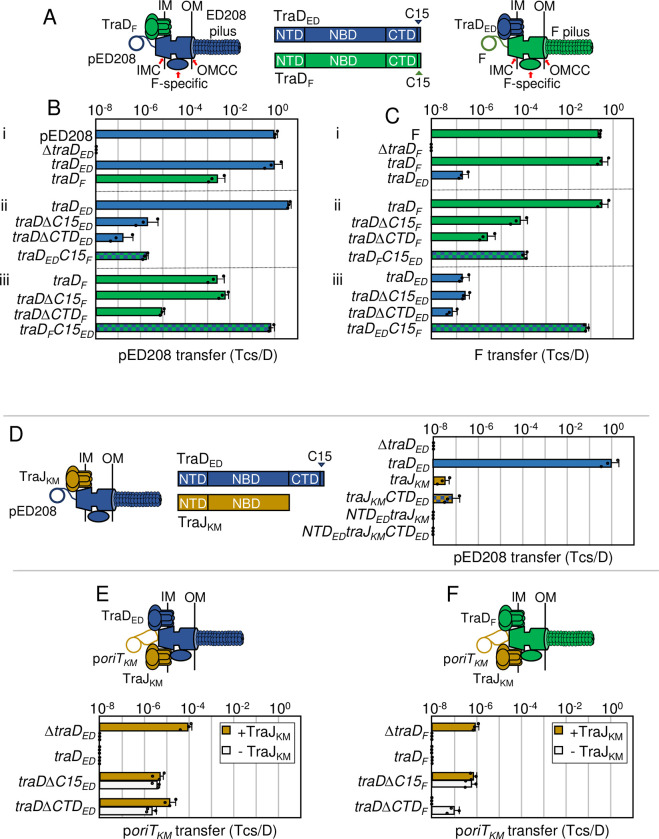
Fig 1 Chimeric F-like T4SSs with substituted T4CPs retain function. A) Schematics depicting chimeric T4SSs with substituted TraD subunits. Left: Chimera of pED208-encoded T4SS (components in blue) with F-encoded TraD (green). Right: F-encoded T4SS (green) with pED208-encoded TraD (blue). IM, inner membrane; OM, outer membrane. IMC, inner membrane complex; F-specific, F-specific complex(es); OMCC, outer membrane core complex. Center: Schematic of TraD T4CPS with domains shown as N-terminal transmembrane domain (NTD), nucleotide binding domain (NBD), C-terminal domain (CTD), C-terminal discrimination motif (C15). B & C) pED208 and F transfer frequencies presented as transconjugants per donor (Tcs/D). i) Donors carrying pED208 or F and the corresponding ΔtraD mutant plasmids without or with plasmids expressing traDED or traDF. ii) Donors carrying the pED208 or F ΔtraD mutant plasmids additionally expressing cognate traD genes, truncations shown, or traD chimeras with swapped C15 discrimination motifs. iii) Donors carrying the ΔtraD mutant plasmids additionally expressing the noncognate traD genes, truncations shown, or traD chimeras with swapped C15 discrimination motifs. For this and other figures/panels in this manuscript, blue and green bars respectively denote the pED208 and F plasmids or plasmid sources of the genes or truncations, and blue/green checkered bars denote a chimeric gene. D) Left: Schematic of chimeric T4SSED (blue) with substituted TraJ T4CP from pKM101 (yellow). Middle: Schematic of TraDED and TraJKM with domains shown. Right: Transfer frequencies by donors carrying pED208ΔtraD donors and plasmids expressing traDED (blue bars) traJKM (yellow bars), or traJKM chimeric proteins with fused TraDED domains (blue/yellow checkered bars) shown. E & F) Upper: Schematics of T4SSs with TraD or substituted TraJKM translocating the poriTKM substrate. Lower: poriTKM transfer frequencies by donors carrying the pED208 and F ΔtraD variants shown and plasmids expressing the intact or truncated forms of traD shown. In these experiments, color coding represents poriT transfer in the presence (yellow bars) or absence (white bars) of TraJKM. All matings were repeated at least three times in triplicate; a representative experiment is shown with replicate data points and the average transfer frequencies as horizontal bars along with standard deviations as error bars.
Fig 1 Chimeric F-like T4SSs with substituted T4CPs retain function. A) Schematics depicting chimeric T4SSs with substituted TraD subunits. Left: Chimera of pED208-encoded T4SS (components in blue) with F-encoded TraD (green). Right: F-encoded T4SS (green) with pED208-encoded TraD (blue). IM, inner membrane; OM, outer membrane. IMC, inner membrane complex; F-specific, F-specific complex(es); OMCC, outer membrane core complex. Center: Schematic of TraD T4CPS with domains shown as N-terminal transmembrane domain (NTD), nucleotide binding domain (NBD), C-terminal domain (CTD), C-terminal discrimination motif (C15). B & C) pED208 and F transfer frequencies presented as transconjugants per donor (Tcs/D). i) Donors carrying pED208 or F and the corresponding ΔtraD mutant plasmids without or with plasmids expressing traDED or traDF. ii) Donors carrying the pED208 or F ΔtraD mutant plasmids additionally expressing cognate traD genes, truncations shown, or traD chimeras with swapped C15 discrimination motifs. iii) Donors carrying the ΔtraD mutant plasmids additionally expressing the noncognate traD genes, truncations shown, or traD chimeras with swapped C15 discrimination motifs. For this and other figures/panels in this manuscript, blue and green bars respectively denote the pED208 and F plasmids or plasmid sources of the genes or truncations, and blue/green checkered bars denote a chimeric gene. D) Left: Schematic of chimeric T4SSED (blue) with substituted TraJ T4CP from pKM101 (yellow). Middle: Schematic of TraDED and TraJKM with domains shown. Right: Transfer frequencies by donors carrying pED208ΔtraD donors and plasmids expressing traDED (blue bars) traJKM (yellow bars), or traJKM chimeric proteins with fused TraDED domains (blue/yellow checkered bars) shown. E & F) Upper: Schematics of T4SSs with TraD or substituted TraJKM translocating the poriTKM substrate. Lower: poriTKM transfer frequencies by donors carrying the pED208 and F ΔtraD variants shown and plasmids expressing the intact or truncated forms of traD shown. In these experiments, color coding represents poriT transfer in the presence (yellow bars) or absence (white bars) of TraJKM. All matings were repeated at least three times in triplicate; a representative experiment is shown with replicate data points and the average transfer frequencies as horizontal bars along with standard deviations as error bars.CC BY · PubMed Central
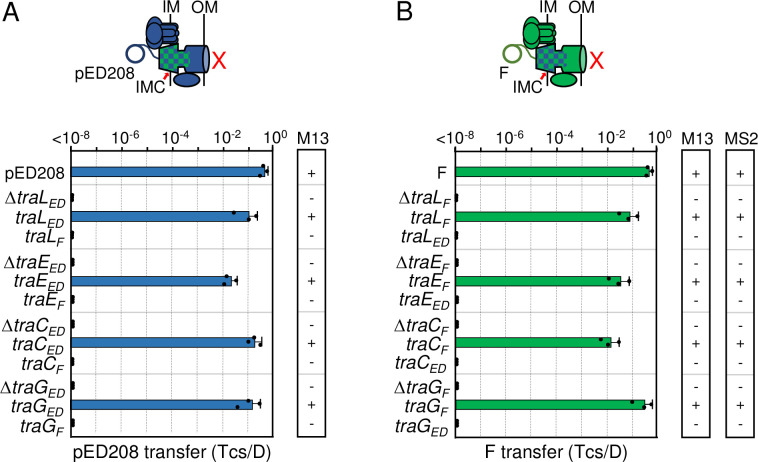
Fig 2 F-like T4SSs with substituted IMC components are nonfunctional. A & B) Upper: Schematics depicting chimeric T4SSs with substituted IMC subunits (blue/green checkered); these systems do not translocate substrates or elaborate pili (red X). Lower: pED208 or F transfer frequencies by donors bearing deletions of IMC genes or isogenic strains expressing the complementing cognate or noncognate genes. All matings were repeated at least three times in triplicate; a representative experiment is shown with replicate data points and the average transfer frequencies as horizontal bars along with standard deviations as error bars. M13 or MS2 columns: Susceptibility of donor cells to M13KO7 or MS2 phages: +, sensitive; -, resistant. M13KO7 quantitative data are presented in S3 FigB and source data in S5 Table.
Fig 2 F-like T4SSs with substituted IMC components are nonfunctional. A & B) Upper: Schematics depicting chimeric T4SSs with substituted IMC subunits (blue/green checkered); these systems do not translocate substrates or elaborate pili (red X). Lower: pED208 or F transfer frequencies by donors bearing deletions of IMC genes or isogenic strains expressing the complementing cognate or noncognate genes. All matings were repeated at least three times in triplicate; a representative experiment is shown with replicate data points and the average transfer frequencies as horizontal bars along with standard deviations as error bars. M13 or MS2 columns: Susceptibility of donor cells to M13KO7 or MS2 phages: +, sensitive; -, resistant. M13KO7 quantitative data are presented in S3 FigB and source data in S5 Table.CC BY · PubMed Central
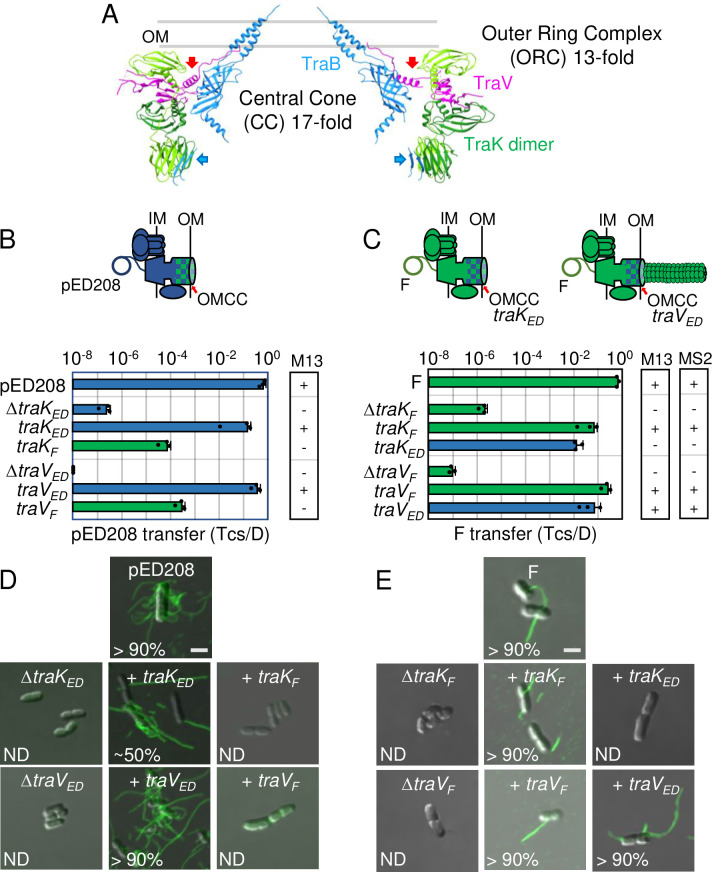
Fig 3 Chimeric F-like T4SSs with substituted OMCC components can exhibit a Tra+, Pil- “uncoupling” phenotype. A) A central slice of the atomic model of the pED208-encoded OMCC, generated using PDB files 7SPB and 7SPC and UCSF Chimera [49]. The central cone (CC) with 17-fold symmetry is composed mainly of the TraB β-barrel domains (blue); the TraB AP α-helical projections comprising the outer membrane (OM)-spanning channel are also shown. The outer ring complex (ORC) with 13-fold symmetry is composed of 13 TraK dimers (light and dark green shades) and 26 copies of TraV lipoprotein (pink). The CC and ORC are connected only by TraV (red arrows) and TraB (blue arrows) linker domains. B & C) Upper: Schematics depicting chimeric T4SSs with substituted OMCC subunits (blue/green checkered); these systems translocate substrates and may or may not elaborate pili. Lower: pED208 or F transfer frequencies by donors bearing deletions of OMCC genes or isogenic strains expressing the complementing cognate or noncognate genes. Plasmid transfer frequencies and phage susceptibilities are presented as described in Fig 2 legend. D & E) Visualization of Cys-derivatized ED208 pili by labeling with AF488-mal or F pili by labeling with MS2-GFP. Representative static images are shown for cells carrying pED208 or F, plasmid variants deleted of OMCC genes, or deletion plasmids along with plasmids expressing the complementing cognate or noncognate genes shown. Numbers correspond to percentages of cells with detectable pili in the cell population; ND, none detected. Scale bars, 2 μm.
Fig 3 Chimeric F-like T4SSs with substituted OMCC components can exhibit a Tra+, Pil- “uncoupling” phenotype. A) A central slice of the atomic model of the pED208-encoded OMCC, generated using PDB files 7SPB and 7SPC and UCSF Chimera [49]. The central cone (CC) with 17-fold symmetry is composed mainly of the TraB β-barrel domains (blue); the TraB AP α-helical projections comprising the outer membrane (OM)-spanning channel are also shown. The outer ring complex (ORC) with 13-fold symmetry is composed of 13 TraK dimers (light and dark green shades) and 26 copies of TraV lipoprotein (pink). The CC and ORC are connected only by TraV (red arrows) and TraB (blue arrows) linker domains. B & C) Upper: Schematics depicting chimeric T4SSs with substituted OMCC subunits (blue/green checkered); these systems translocate substrates and may or may not elaborate pili. Lower: pED208 or F transfer frequencies by donors bearing deletions of OMCC genes or isogenic strains expressing the complementing cognate or noncognate genes. Plasmid transfer frequencies and phage susceptibilities are presented as described in Fig 2 legend. D & E) Visualization of Cys-derivatized ED208 pili by labeling with AF488-mal or F pili by labeling with MS2-GFP. Representative static images are shown for cells carrying pED208 or F, plasmid variants deleted of OMCC genes, or deletion plasmids along with plasmids expressing the complementing cognate or noncognate genes shown. Numbers correspond to percentages of cells with detectable pili in the cell population; ND, none detected. Scale bars, 2 μm.CC BY · PubMed Central
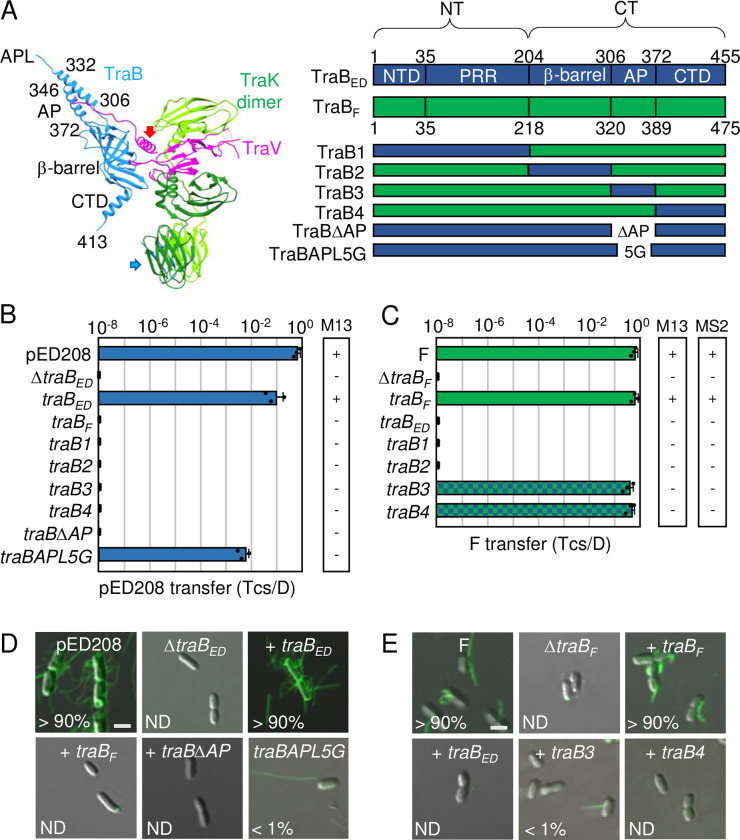
Fig 4 F-like T4SSs with substituted TraB chimeras establish the functional importance of AP and C-terminal domains. A) An asymmetric unit of the pED208-encoded OMCC generated as described in Fig 3 legend. Thirteen TraK dimers (green shades) and C-terminal domains of TraV (pink) comprise the C13 ORC, and 17 TraB β-barrel (blue) and N-terminal domains of TraV (pink) assemble as the C17 CC. Flexible linkers of TraV and TraB bridge the ORC and CC substructures (red, blue arrows). Residues shown denote boundaries of the β-barrel, AP, and AP loop (APL) of TraB; the C-terminal domain (CTD) of TraB extending from residues 372–455 lines the surface of the β-barrel and extends into the lumen of the OMCC (unstructured). Right: Schematic of TraB homologs with domains shown as N-terminal transmembrane domain (NTD), proline-rich-region (PRR), β-barrel, antennae projection (AP), and C-terminal domain (CTD); numbers correspond to residues demarcating the domain boundaries. Schematics of TraB chimeras and mutants are depicted. B & C) pED208 or F transfer frequencies by donors bearing traB deletions or isogenic strains expressing the complementing genes shown. Plasmid transfer frequencies and phage susceptibilities are presented as described in Fig 2 legend. D & E) Visualization of Cys-derivatized ED208 pili by labeling with AF488-mal or F pili by labeling with MS2-GFP. Representative static images are shown for cells carrying pED208 or F, or the corresponding ΔtraB variants without or with the complementing genes shown. Numbers correspond to percentages of cells with detectable pili in the cell population; ND, none detected. Scale bars, 2 μm.
Fig 4 F-like T4SSs with substituted TraB chimeras establish the functional importance of AP and C-terminal domains. A) An asymmetric unit of the pED208-encoded OMCC generated as described in Fig 3 legend. Thirteen TraK dimers (green shades) and C-terminal domains of TraV (pink) comprise the C13 ORC, and 17 TraB β-barrel (blue) and N-terminal domains of TraV (pink) assemble as the C17 CC. Flexible linkers of TraV and TraB bridge the ORC and CC substructures (red, blue arrows). Residues shown denote boundaries of the β-barrel, AP, and AP loop (APL) of TraB; the C-terminal domain (CTD) of TraB extending from residues 372–455 lines the surface of the β-barrel and extends into the lumen of the OMCC (unstructured). Right: Schematic of TraB homologs with domains shown as N-terminal transmembrane domain (NTD), proline-rich-region (PRR), β-barrel, antennae projection (AP), and C-terminal domain (CTD); numbers correspond to residues demarcating the domain boundaries. Schematics of TraB chimeras and mutants are depicted. B & C) pED208 or F transfer frequencies by donors bearing traB deletions or isogenic strains expressing the complementing genes shown. Plasmid transfer frequencies and phage susceptibilities are presented as described in Fig 2 legend. D & E) Visualization of Cys-derivatized ED208 pili by labeling with AF488-mal or F pili by labeling with MS2-GFP. Representative static images are shown for cells carrying pED208 or F, or the corresponding ΔtraB variants without or with the complementing genes shown. Numbers correspond to percentages of cells with detectable pili in the cell population; ND, none detected. Scale bars, 2 μm.CC BY · PubMed Central
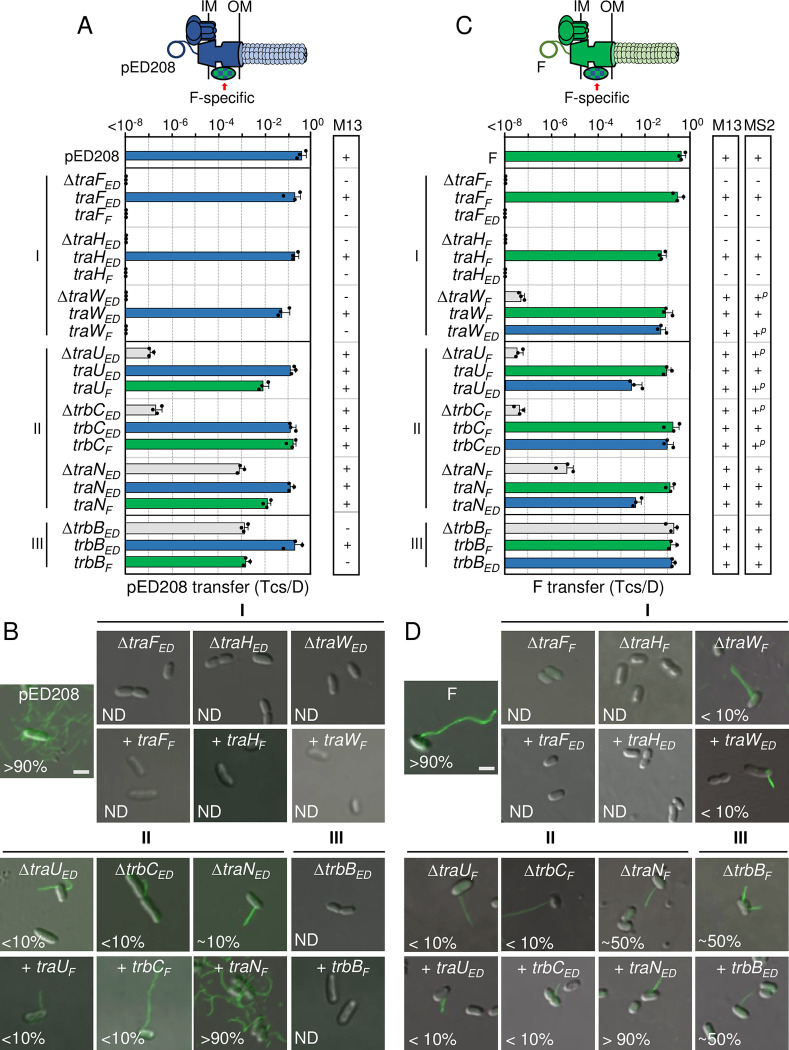
Fig 5 Chimeric F-like T4SSs with substituted F-specific subunits confer distinct phenotypes. A & C) Upper: Schematics depicting chimeric T4SSs with substituted F-specific subunits (blue/green checkered); these systems may or may not translocate substrates or elaborate pili (denoted as lighter coloration). Lower: pED208 or F transfer frequencies by donors bearing deletions of F-specific genes or isogenic strains expressing the complementing cognate or noncognate genes. F-specific subunits are grouped according to phenotypes of corresponding deletion mutations (Classes I, II, III, see [25]). Plasmid transfer frequencies are presented as described in Fig 2 legend. M13 or MS2 columns: Susceptibility of donor cells to M13 (M13KO7) or MS2 phages: +, sensitive; +p, partially sensitive; -, resistant. M13KO7 quantitative data are presented in S3D Fig and source data in S5 Table. B & D) Visualization of Cys-derivatized ED208 pili by labeling with AF488-mal or F pili by labeling with MS2-GFP. Representative static images are shown for cells carrying pED208 or F, variants deleted of F-specific genes, or isogenic strains expressing the complementing cognate or noncognate genes. Numbers correspond to percentages of cells with detectable pili in the cell population; ND, none detected. Scale bars, 2 μm.
Fig 5 Chimeric F-like T4SSs with substituted F-specific subunits confer distinct phenotypes. A & C) Upper: Schematics depicting chimeric T4SSs with substituted F-specific subunits (blue/green checkered); these systems may or may not translocate substrates or elaborate pili (denoted as lighter coloration). Lower: pED208 or F transfer frequencies by donors bearing deletions of F-specific genes or isogenic strains expressing the complementing cognate or noncognate genes. F-specific subunits are grouped according to phenotypes of corresponding deletion mutations (Classes I, II, III, see [25]). Plasmid transfer frequencies are presented as described in Fig 2 legend. M13 or MS2 columns: Susceptibility of donor cells to M13 (M13KO7) or MS2 phages: +, sensitive; +p, partially sensitive; -, resistant. M13KO7 quantitative data are presented in S3D Fig and source data in S5 Table. B & D) Visualization of Cys-derivatized ED208 pili by labeling with AF488-mal or F pili by labeling with MS2-GFP. Representative static images are shown for cells carrying pED208 or F, variants deleted of F-specific genes, or isogenic strains expressing the complementing cognate or noncognate genes. Numbers correspond to percentages of cells with detectable pili in the cell population; ND, none detected. Scale bars, 2 μm.CC BY · PubMed Central
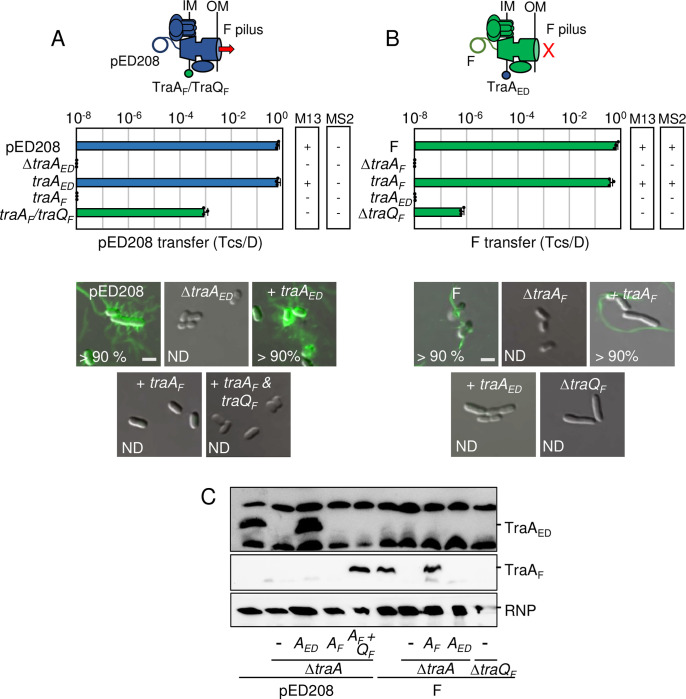
Fig 6 A T4SSEDTraAF chimeric machine translocates pED208 in the absence of F pilus production. A & B) Upper: Schematics depicting T4SSs with substituted TraA pilin subunits (blue or green); the TraQ chaperone promotes integration of TraAF into the T4SSED machine to support DNA transfer (red arrow) but not F pilus production. Middle: pED208 or F transfer frequencies by donors bearing ΔtraA or traQF mutations, or isogenic strains expressing the complementing cognate or noncognate genes, without or with expression of the traQF chaperone. Plasmid transfer frequencies and phage susceptibilities are presented as described in Fig 2 legend. Lower: Visualization of Cys-derivatized ED208 pili by labeling with AF488-mal or F pili by labeling with MS2-GFP. Representative static images of cells carrying pED208 or F, ΔtraA variants, or isogenic strains expressing the gene shown. Numbers correspond to percentages of cells with detectable pili in the cell population; ND, none detected. Scale bars, 2 μm. C) Immunoblotting of cellular fractions for detection of TraAED or TraF pilin subunits. Blots were developed with α-TraA antibodies specific for the pED208-encoded or F-encoded TraA pilins, and with antibodies against E. coli RNA polymerase β-subunit (RNP) as a loading control. The upper and lower bands in the TraAED blot are nonspecific proteins reactive to the polyclonal α-TraAED antibodies. Strains carried pED208 or F, or the corresponding ΔtraA variants without or with plasmids expressing the traA pilin or traQ chaperone genes shown.
Fig 6 A T4SSEDTraAF chimeric machine translocates pED208 in the absence of F pilus production. A & B) Upper: Schematics depicting T4SSs with substituted TraA pilin subunits (blue or green); the TraQ chaperone promotes integration of TraAF into the T4SSED machine to support DNA transfer (red arrow) but not F pilus production. Middle: pED208 or F transfer frequencies by donors bearing ΔtraA or traQF mutations, or isogenic strains expressing the complementing cognate or noncognate genes, without or with expression of the traQF chaperone. Plasmid transfer frequencies and phage susceptibilities are presented as described in Fig 2 legend. Lower: Visualization of Cys-derivatized ED208 pili by labeling with AF488-mal or F pili by labeling with MS2-GFP. Representative static images of cells carrying pED208 or F, ΔtraA variants, or isogenic strains expressing the gene shown. Numbers correspond to percentages of cells with detectable pili in the cell population; ND, none detected. Scale bars, 2 μm. C) Immunoblotting of cellular fractions for detection of TraAED or TraF pilin subunits. Blots were developed with α-TraA antibodies specific for the pED208-encoded or F-encoded TraA pilins, and with antibodies against E. coli RNA polymerase β-subunit (RNP) as a loading control. The upper and lower bands in the TraAED blot are nonspecific proteins reactive to the polyclonal α-TraAED antibodies. Strains carried pED208 or F, or the corresponding ΔtraA variants without or with plasmids expressing the traA pilin or traQ chaperone genes shown.CC BY · PubMed Central
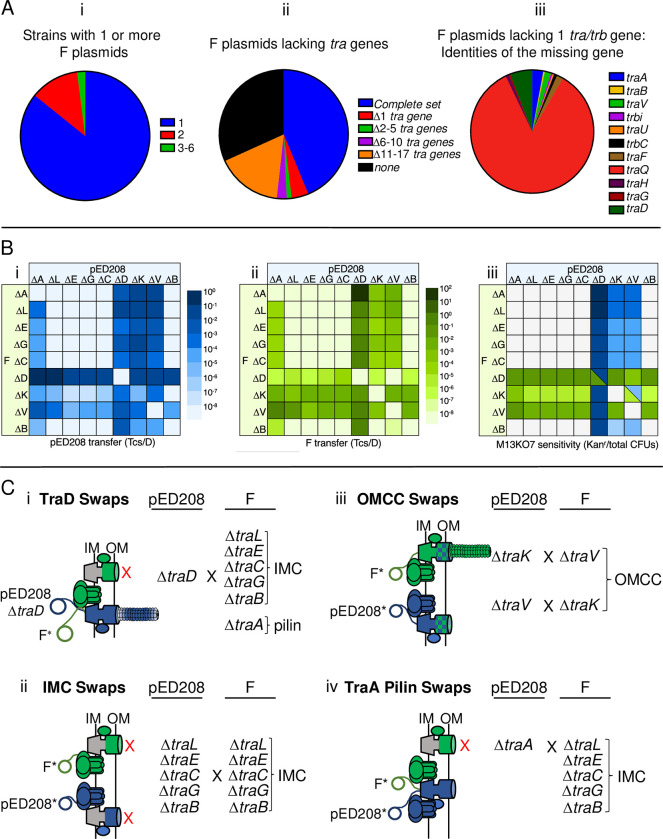
Fig 7 Strains with coresident, transfer-defective pED208 and F plasmids assemble functional T4SS chimeric machines. A) Pie charts showing prevalence of F plasmids and of tra/trb genes that are missing among F plasmids sourced from the COMPASS database [76] and PLSDB (v. 2021_06_23_v2) [79]. i) The number of F plasmids per strain among all strains shown to carry at least one F plasmid. Colors represent the number of F plasmids per strain. A total of 908 strains carrying at least one F plasmid were identified and analyzed. ii) The prevalence of F plasmids with completely intact or missing tra/trb genes. Colors represent the fraction of F plasmids with the depicted number of missing tra/trb genes. A total of 5,664 F plasmid sequences were analyzed from PLSDB (v. 2021_06_23_v2). The tblastn searches were performed against these F plasmid sequences using Tra and Trb proteins encoded by the following F plasmids as queries: pOX38 (MF370216.1), pED208 (AF411480.1), pKpQIL-UK (KY798507.1), pOZ172 (CP016763.1) (see Materials and methods). iii) The fractions of specific tra/trb genes that were missing among F plasmids shown to lack one tra/trb gene. Source data for panels Ai, Aii, and Aiii appear in S3 Table. B) Heat maps showing transfer frequencies of Bi) pED208 (blue) and Bii) F (green) variants deleted of the tra genes shown by donor strains carrying the pairwise combinations of mutant plasmids depicted. Transfer frequencies (Tcs/D) are color-graded as depicted. Biii) M13KO7 susceptibility of host strains carrying the mutant plasmids depicted. M13KO7 susceptibilities (Kanr colonies/total CFUs) are color-graded as depicted. Quantitative data for panels Bi, Bii, and Biii are presented in S4 Table and source data in S5 Table. The color shades reflect our predictions of what pili are produced enabling M13 infection; blue, ED208 pili; green, F pili; blue/green triangles, both pili are produced. C) Schematics and summaries of transfer and piliation among donors co-harboring pED208 and F plasmids with the mutations indicated. Strains with co-resident mutant plasmids are grouped to highlight: Ci) exchangeability of TraD T4CPs, Cii) lack of functional exchanges of IMC subunits, Ciii) exchangeability of OMCC subunits TraV and TraK, Civ) functional incorporation of traAF into the pED208 system, resulting in the Tra+, Pil- “uncoupling” phenotype.
Fig 7 Strains with coresident, transfer-defective pED208 and F plasmids assemble functional T4SS chimeric machines. A) Pie charts showing prevalence of F plasmids and of tra/trb genes that are missing among F plasmids sourced from the COMPASS database [76] and PLSDB (v. 2021_06_23_v2) [79]. i) The number of F plasmids per strain among all strains shown to carry at least one F plasmid. Colors represent the number of F plasmids per strain. A total of 908 strains carrying at least one F plasmid were identified and analyzed. ii) The prevalence of F plasmids with completely intact or missing tra/trb genes. Colors represent the fraction of F plasmids with the depicted number of missing tra/trb genes. A total of 5,664 F plasmid sequences were analyzed from PLSDB (v. 2021_06_23_v2). The tblastn searches were performed against these F plasmid sequences using Tra and Trb proteins encoded by the following F plasmids as queries: pOX38 (MF370216.1), pED208 (AF411480.1), pKpQIL-UK (KY798507.1), pOZ172 (CP016763.1) (see Materials and methods). iii) The fractions of specific tra/trb genes that were missing among F plasmids shown to lack one tra/trb gene. Source data for panels Ai, Aii, and Aiii appear in S3 Table. B) Heat maps showing transfer frequencies of Bi) pED208 (blue) and Bii) F (green) variants deleted of the tra genes shown by donor strains carrying the pairwise combinations of mutant plasmids depicted. Transfer frequencies (Tcs/D) are color-graded as depicted. Biii) M13KO7 susceptibility of host strains carrying the mutant plasmids depicted. M13KO7 susceptibilities (Kanr colonies/total CFUs) are color-graded as depicted. Quantitative data for panels Bi, Bii, and Biii are presented in S4 Table and source data in S5 Table. The color shades reflect our predictions of what pili are produced enabling M13 infection; blue, ED208 pili; green, F pili; blue/green triangles, both pili are produced. C) Schematics and summaries of transfer and piliation among donors co-harboring pED208 and F plasmids with the mutations indicated. Strains with co-resident mutant plasmids are grouped to highlight: Ci) exchangeability of TraD T4CPs, Cii) lack of functional exchanges of IMC subunits, Ciii) exchangeability of OMCC subunits TraV and TraK, Civ) functional incorporation of traAF into the pED208 system, resulting in the Tra+, Pil- “uncoupling” phenotype.CC BY · PubMed Central

Verification

Claims the paper makes

The claims and statistics of this paper haven’t been checked yet.

Run the check — free, no account needed. It reads the open-access text and checks the sources it cites.

A few free checks a day · papers already verified open instantly · results are public

Self-check

Percentages, sums and reported differences re-computed from the paper’s own numbers.

The self-check needs the paper’s full text.

Citations

Cites

Research works printed but not linked: 78

  1. 10.3390/toxins13100713 · DOI
  2. 10.1038/s41579-023-00974-3 · DOI
  3. 10.1371/journal.ppat.1010720 · DOI
  4. 10.1007/978-3-319-75241-9_6 · DOI
  5. 10.1038/s41586-022-04859-y · DOI
  6. 10.1007/978-3-030-18768-2_12 · DOI
  7. 10.1128/microbiolspec.PSIB-0012-2018 · DOI
  8. 10.1038/35054586 · DOI · Paper page
  9. 10.1093/emboj/cdg223 · DOI
  10. 10.1126/science.1166101 · DOI
  11. Sgro GG , Costa TR , Cenens W , Souza DP , Cassago A , Oliverira LD , et al. CryoEM structure of the core complex of a bacterial killing type IV secretion system. Nat Microbiol. 2018;In press.
  12. 10.7554/eLife.59495 · DOI
  13. 10.7554/eLife.70427 · DOI
  14. 10.1038/s41467-021-27178-8 · DOI
  15. 10.1038/s41467-022-28058-5 · DOI
  16. 10.1016/j.cell.2016.08.025 · DOI
  17. 10.1016/j.str.2020.08.010 · DOI
  18. 10.1016/j.str.2022.11.007 · DOI
  19. 10.1016/j.str.2023.02.005 · DOI
  20. 10.3389/fmicb.2021.750200 · DOI
  21. 10.1128/mBio.03328-19 · DOI
  22. 10.1038/nature13081 · DOI
  23. 10.1016/j.plasmid.2013.03.010 · DOI
  24. 10.1016/j.plasmid.2022.102652 · DOI
  25. 10.1111/mmi.14908 · DOI
  26. 10.3389/fmolb.2016.00071 · DOI
  27. 10.1099/00221287-108-1-141 · DOI
  28. 10.1128/jb.167.2.660-665.1986 · DOI
  29. 10.1111/j.1574-6976.2009.00195.x · DOI
  30. 10.1111/mmi.12275 · DOI
  31. 10.1128/JB.00367-13 · DOI
  32. 10.1111/j.1365-2958.2012.08131.x · DOI
  33. 10.1128/JB.00513-07 · DOI
  34. 10.1111/j.1365-2958.2008.06391.x · DOI
  35. 10.1093/nar/gkr296 · DOI
  36. 10.1111/mmi.14507 · DOI
  37. 10.1074/jbc.M310422200 · DOI
  38. 10.1016/j.febslet.2006.04.059 · DOI
  39. 10.1016/j.bbamem.2013.05.022 · DOI
  40. 10.1073/pnas.0406241102 · DOI
  41. 10.1074/jbc.M703464200 · DOI
  42. 10.1016/S0378-1097(03)00430-0 · DOI
  43. 10.1128/ecosalplus.ESP-0003-2018 · DOI
  44. 10.1073/pnas.1904428116 · DOI
  45. 10.1073/pnas.2011901117 · DOI
  46. 2011, Filamentous bacteriophage: biology, phage display and nanotechnology applications, Curr Issues Mol Biol, 13, 51
  47. 10.1073/pnas.0806786105 · DOI
  48. 10.1111/j.1365-2958.2008.06565.x · DOI
  49. 10.1073/pnas.0405843101 · DOI
  50. 10.1111/j.1365-2958.2004.04345.x · DOI
  51. 10.1099/mic.0.28410-0 · DOI
  52. 10.1128/JB.00351-11 · DOI
  53. 10.1128/JB.186.16.5480-5485.2004 · DOI
  54. 10.1128/JB.00726-09 · DOI
  55. 10.1111/mmi.14582 · DOI
  56. 10.1016/j.bbrc.2018.06.166 · DOI
  57. 10.3390/biomedicines8090362 · DOI
  58. 10.1128/JB.180.16.4036-4043.1998 · DOI
  59. 10.1099/mic.0.28025-0 · DOI
  60. 10.1038/s41564-022-01146-4 · DOI
  61. 10.1128/jb.00061-23 · DOI
  62. 10.1093/nar/gkad678 · DOI
  63. 10.1128/mbio.02143-23 · DOI
  64. 10.1016/j.plasmid.2013.05.004 · DOI
  65. 10.1128/jb.178.13.3742-3747.1996 · DOI
  66. 10.1046/j.1365-2958.2002.02731.x · DOI
  67. 10.1128/jb.175.5.1384-1391.1993 · DOI
  68. 10.1046/j.1365-2958.1999.01640.x · DOI
  69. 10.3389/fmicb.2020.00483 · DOI
  70. 10.1128/AAC.01275-15 · DOI
  71. 10.1128/spectrum.04235-22 · DOI
  72. 10.1002/0471142727.mb0116s106 · DOI · Paper page
  73. 10.1038/nsb1203-980 · DOI · Paper page
  74. 10.1093/nar/gkab1061 · DOI · Paper page
  75. 10.1038/s41592-022-01488-1 · DOI · Paper page
  76. 10.1002/pro.4792 · DOI · Paper page
  77. 10.1093/nar/gkab1111 · DOI
  78. 10.1093/nar/16.22.10881 · DOI

Metadata

Authors
Kishida, K., Li, Y. G., Ogawa-Kishida, N., Khara, P., Al Mamun, A. A. M., Bosserman, R. E., & Christie, P. J.
Affiliations
The University of Texas Health Science Center at Houston (US)
Corresponding author
Christie, Peter J.
Venue
PLoS Genetics
Publisher
openRxiv
Published
2023-12-06
Volume
20
Issue
3
Pages
e1011088-e1011088
ISSN
1553-7390 (ISSN-L)
OpenAlex
W4392367512
Cited by
7
References
1
Citations by year
2026: 2 · 2025: 3 · 2024: 2
FWCI
1.85
Type
journal article
Language
en
Open access
Licence
cc-by
Locations
  • PLoS Genetics (publishedVersion, cc-by)
  • bioRxiv (Cold Spring Harbor Laboratory) (acceptedVersion, cc-by)
  • PubMed Central (publishedVersion, cc-by)
  • PubMed (publishedVersion)
  • PubMed Central (submittedVersion, cc-by)
  • Digital Commons-TMC (Texas Medical Center) (submittedVersion)
Funders
  • National Institutes of Health
  • National Institute of General Medical Sciences (R01GM048746, R35GM131892)
  • National Institute of Allergy and Infectious Diseases (R21AI159970)
  • Division of Microbiology and Infectious Diseases, National Institute of Allergy and Infectious Diseases (R21AI159970)
Topics
  • Life Sciences › Biochemistry, Genetics and Molecular Biology › Genetics › Bacterial Genetics and Biotechnology
  • Life Sciences › Immunology and Microbiology › Microbiology › Escherichia coli research studies
  • Life Sciences › Biochemistry, Genetics and Molecular Biology › Molecular Biology › Biochemical and Structural Characterization
Keywords
type IV secretion system, F plasmid, IncF plasmids, DNA conjugation, plasmid maintenance, mobile genetic elements, structural flexibility, Enterobacteriaceae

About these checks

Registry, retraction, Cites and statistics results are computed, not judged, with one exception: a printed reference that no index lists is read once by a model before it counts as a citation error. Claims are extracted by a model and kept only when their quote appears verbatim in the text; each cited source is then checked, with a model’s help, for whether it says what the claim relies on. Those verdicts can be wrong — read the claim’s quote and the cited source before relying on one.

Statistics and arithmetic are recomputed, not judged.

Confidence bands are shown only for fields calibrated on our annotated test set. None is calibrated yet, so no band is shown.

What counts as a claim ›How we measure confidence ›How we check this ›

Are you an author, or do you see a problem with this page? Request a review

Data sources

Bibliographic data: Semantic Scholar, OpenAlex, Crossref.

Contains information from the Semantic Scholar Academic Graph Datasets, made available under the ODC Attribution License (ODC-BY 1.0).

Semantic Scholar’s data is described in: Kinney, R., et al. (2023). The Semantic Scholar Open Data Platform. arXiv:2301.10140.